

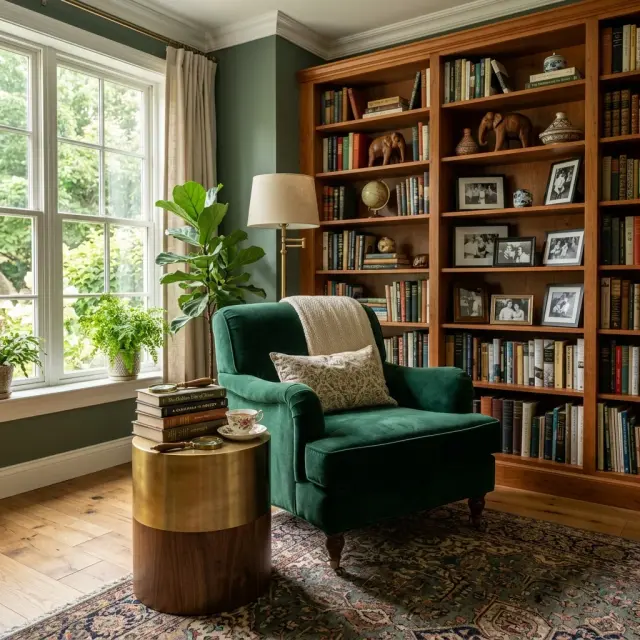
I'm Theo Caldwell, and I've spent the last seven years walking other people's houses in the Hudson Valley — Beacon kitchens with smoke-stained ceilings, Rhinebeck libraries with shelves three generations deep, Brooklyn brownstones where the rear parlor has been four different rooms in twenty years. After enough site visits you start to notice that the homes that feel honest aren't the ones that photograph best. They're the ones where the owner's habits, history, and quiet contradictions have been allowed to settle into the room over time. This piece is for The Renovation Mind file — a slower, less prescriptive read on what a home actually says about the person living inside it.
How I Read a Room
When I walk a house for a renovation consult, I try not to look at the finishes for the first ten minutes. I look at what's on the kitchen counter, which chair has the throw blanket folded over it, where the reading light is actually positioned, what's leaning against the wall waiting to be hung. Those small accumulations are the parts of the house the owner doesn't perform for guests. They're also the parts that most reliably tell me what the renovation should preserve, what it should quietly support, and what it should never try to "fix."
My working assumption is that every home is a slow-built record of decisions a person has already made about themselves — sometimes consciously, more often not. The renovation question, then, isn't "what's trending." It's "what would the plan tell you about this person's interior life, if you read it carefully?" If you want a companion piece on the same theme, my essay on the silent storyteller approaches the same territory from a different angle.
1. The Home as a Mirror, Not a Stage
Environmental psychologists have written for decades about the reciprocal relationship between people and the spaces they inhabit — Clare Cooper Marcus called the house a "mirror of self," and Winifred Gallagher's work on how settings shape mood treats the same idea from a slightly different angle. What both authors point to, and what I see almost every week on site, is that we tend to project our inner state onto our surroundings before we ever consciously choose a paint color or pull a faucet from a catalog. A drafty sparseness in a Brooklyn loft might read as minimalist on Instagram, but it usually says something quieter about its inhabitant's need for control and visual quiet in a chaotic life. A layered, heavily curated Rhinebeck library — books spilling onto the floor, a globe in the corner, a half-finished puzzle on the side table — is rarely accidental.
The distinction worth making is between a home that functions as a mirror and one that performs as a stage. A stage is designed to be witnessed. A mirror is designed to be lived inside. There is no aesthetic verdict here — plenty of stages are beautiful, and plenty of mirrors are messy. But when I ask a client what they want a renovation to do for them and they keep referencing what their guests will think, I gently push back. The home that nourishes you is the one that holds up under your own gaze first.
2. The Bookshelf as Intellectual Footprint
In a renovation walkthrough, the bookshelf is one of the first places I let my eyes settle, because it's the room's most legible autobiography. In an era where most reading happens on a screen, the physical books a person keeps on display are a deliberate edit. The college-era Tolstoy that nobody actually re-reads, the unopened David Allen productivity book, the dog-eared cookbook with the splatter stains, the bottom-shelf novels the owner wouldn't admit to in mixed company — all of it together is a kind of map. It's a record of past interests, current curiosities, and aspirational selves the owner hasn't yet talked themselves out of.
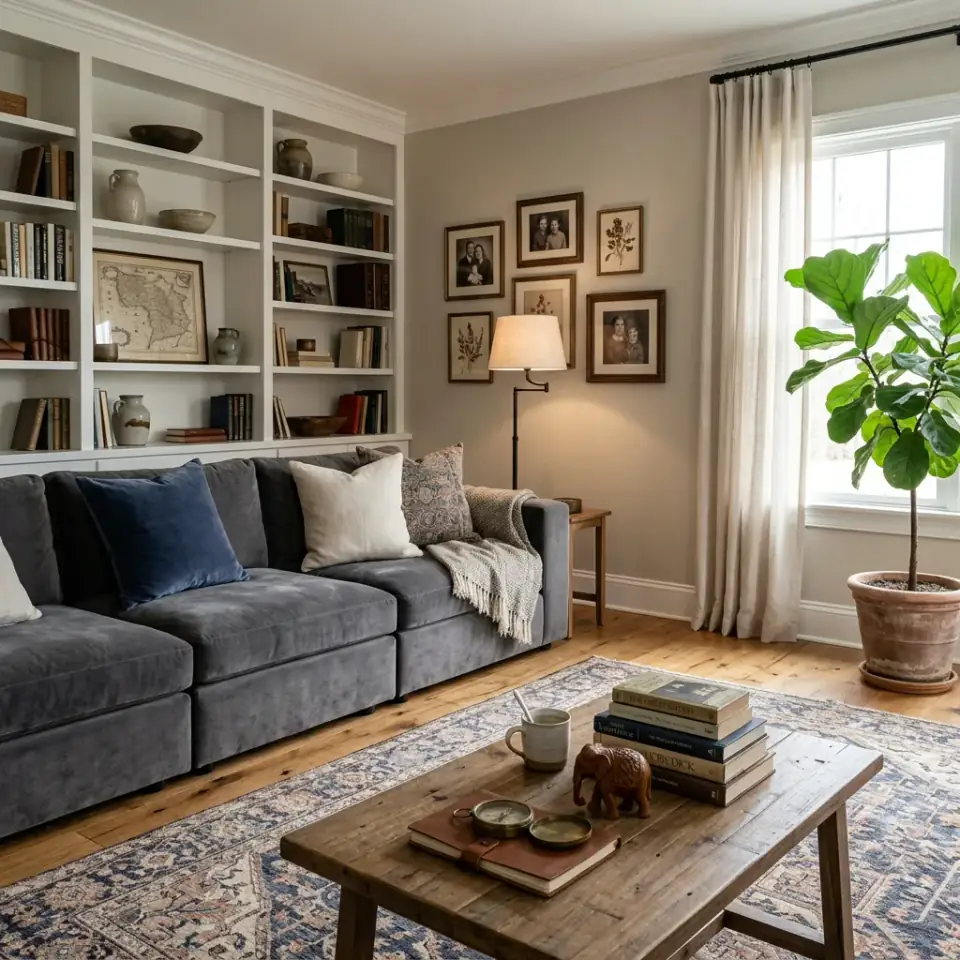
The arrangement carries information too. Color-coded shelves usually signal an inhabitant who values visible order and is comfortable letting the cover do the talking. Loose subject grouping with vertical and horizontal stacks tells me the owner reads — actually reads — and isn't precious about how the books look between sessions. Built-ins with closed cabinetry below and open shelving above suggest a person who edits in public but stores in private. None of these readings are right or wrong; they're just what's there. A renovation that lifts books out of a bookshelf to "stage" the shelves with vases and pampas grass is one I argue against almost every time, because it strips the room of the single element that was already doing the most work.
3. Anchoring Artifacts and the Weight of Memory
Renovation culture often pushes toward the clean slate — strip the wallpaper, donate the Victorian credenza, repaint everything in Benjamin Moore Simply White OC-117 and start fresh. There's a place for that move, especially when an inherited interior is genuinely oppressive. But more often, the things a client is told to purge are the things that were holding the house together emotionally. The brass magnifying glass that belonged to a grandfather. The Beni Ourain rug bought in a market in Marrakech on a trip that mattered. The framed photograph of a family kitchen the owner can't reproduce but doesn't want to forget. I think of these as anchoring artifacts, and I treat them as load-bearing elements of the room even when they aren't load-bearing in any structural sense.
The discipline isn't accumulation — it's curation. A house overstuffed with sentimental objects becomes its own kind of stage, performing nostalgia rather than living inside it. A house entirely stripped of them becomes a hotel room. The middle path is the one most renovations should aim for: choose the three or five or eight objects that tell the truth about where you came from, give each one a deliberate place to land, and let the rest go. My essay on the inheritance of space goes deeper into how to draw that line.
4. Comfort as a Quiet Form of Self-Respect
There is a real gap between a chair that photographs well and a chair you actually want to sit in for three hours on a Sunday afternoon. The first chair is an object; the second is a relationship. When I walk a Hudson Valley living room and the owner gestures toward a beautiful but stiffly upholstered sectional that "everyone admires," I usually ask where they actually read. The answer is almost always a different piece of furniture — a worn velvet armchair in the corner, an inherited rocker, a sagging chaise pushed up against the window. The body knows where it wants to be. The eye sometimes overrules the body in service of an idea about what the room should look like.
A renovation that prioritizes the body over the photograph is a quiet act of self-respect. It means specifying down pillows that flatten under your shoulders rather than firm foam that resists them. It means picking a sofa depth that matches your actual torso height rather than the depth the catalog photograph suggests. It means choosing a rug your bare feet will tolerate at 6 a.m. in January when the radiators are slow to come on. I work in 2026 Hudson Valley pricing realities, and the surprise I run into most often is that the comfortable specification is almost always cheaper than the photogenic one — because comfort tends to come from materials and proportions, while photogeneity tends to come from sculptural shapes and brand-name furniture lines.
5. Color as an Emotional Regulator
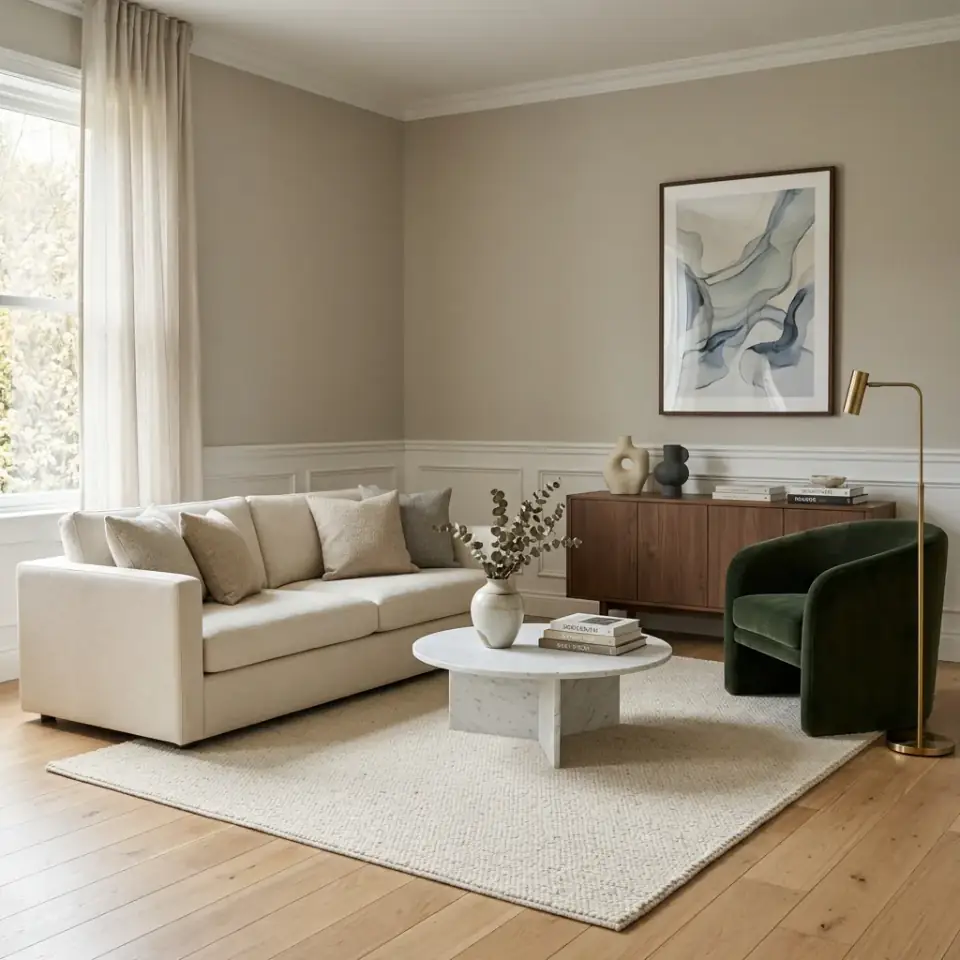
The single fastest read on a person's interior life is the dominant color of the room they spend the most time in. Color isn't a finish-stage decision in the way the construction schedule treats it — it's the background score of the inhabitant's daily emotional life. Deep restorative greens (Farrow & Ball Studio Green No. 93, Benjamin Moore Hunter Green 2041-10) read most often as a desire for cocoon, recovery, and slow return to ground after a high-stimulus day. Cool whites and pale greys (Benjamin Moore White Dove OC-17, Cornforth White 228) usually signal an inhabitant trying to impose clarity on a noisy external life. Warm earth-toned palettes (Benjamin Moore Pashmina AF-100, Sherwin-Williams Accessible Beige SW 7036) point to a desire for grounding, continuity, and reassurance.
None of these readings are deterministic — a designer-led project will sometimes override the owner's instinct, and seasonal mood shifts will sometimes carry a palette in a direction the owner didn't anticipate. But when I ask a client what colors they keep returning to year after year, regardless of trend cycles, the answer is more useful than any mood board. It tells me what emotional register they're trying to live inside. The job of a renovation is to honor that register rather than override it with the current Pantone forecast.
6. A Short History of the Private Interior
It's worth remembering that the private home as a vehicle for individual self-expression is a young idea — really only a few centuries old in the West, and meaningfully widespread for less than a hundred years. For most of human history, the home was a working unit: shelter, kitchen, workshop, sometimes a stable. The notion that a room could exist purely for one person's intellectual leisure — a library nook with a deep chair, a single reading lamp, a stack of unread novels — would have struck a 17th-century European farmer or a 19th-century American tenement family as an unimaginable extravagance.
I bring this up not to moralize but to give the design choices a little weight. When a client in Cold Spring or Hudson asks me to carve a reading nook out of an underused dining alcove, we are exercising a historically novel right. Acknowledging that doesn't make the renovation more virtuous, but it does change the tone of the conversation. We treat the space with more intention. We're slower to add a television where a window seat could go. We protect the rooms that exist purely to be inhabited, not consumed.
7. Designing for the Person You Are Becoming
The strongest argument against a fully "finished" house is that the person living inside it isn't finished either. A house that's been styled to a single fixed point in time — every wall art-hung, every shelf carefully composed, every corner committed to one specific aesthetic — leaves the inhabitant with nowhere to grow. I've walked plenty of beautiful renovations where the owner confided that they no longer feel allowed to change anything, because the room is already photographed, already "done." That's a sign the house has become a museum of an earlier self rather than a partner to the current one.
The renovation question I'd ask in this category is simple: what blank pages are you keeping? An empty shelf for a hobby you haven't fully taken on yet. A corner left under-furnished so a future practice — meditation, painting, slow morning coffee — has somewhere to land. A wall left bare so next year's art find has a home. A guest room that doubles as a flexible workspace until you're ready to commit to one or the other. The home that supports your future self has slightly less furniture than a magazine would suggest. My piece on the silent confessions picks up the daily-ritual side of this argument.
Reading Prompts for Your Own Rooms
- Walk your house as a guest would. Start at the front door, move through each room in the order a visitor would, and notice what story the rooms tell in sequence. The narrative might surprise you.
- Look at what you actually use, not what looks good unused. Identify the three objects in each room that get touched daily. If those objects aren't the ones the room is built around, the room is staged rather than lived.
- Audit your bookshelf without rearranging it. Read the titles in the order they currently sit. Notice the clusters, the surprises, the books you keep meaning to read. That's your honest intellectual profile.
- Locate your real reading chair. The piece of furniture you actually relax in tells you more about your relationship with yourself than any aspirational item in the same room.
- Name the dominant color of the room you spend the most time in. Then ask: is that color regulating you, or fighting you? Trust the body's response, not the trend report.
- Identify one blank page. Look for the corner, wall, or shelf in your house that is intentionally unfinished. If there isn't one, consider creating one.
Reader Questions on Reading Your Own Home
How do I tell the difference between a home that's "stage" and one that's "mirror"?
The fastest test is to ask yourself what changes when guests come over. If you instinctively re-stage the living room, hide the laundry basket, pull a different throw blanket, and put away the half-read book on the side table, the everyday version of the room is the mirror and the guest version is the stage. There's nothing wrong with making a house presentable for visitors, but if the everyday version feels less true to you than the guest version, the renovation conversation is worth having. The goal is to close the gap between what your house looks like at 7 a.m. and what it looks like when you're expecting company.
Is it OK to keep sentimental objects that aren't aesthetically "on brand"?
Yes — and I'd argue those are often the objects that make a house feel like a real home rather than a curated showroom. The discipline isn't avoiding sentimental objects; it's choosing which ones earn a place in your daily sightline. A grandparent's brass lamp on a writing desk you sit at every morning is doing more work than a styled brass object pulled from a catalog. The rule I use with clients is: if the object would hurt to lose in a fire, it earns a place. If it wouldn't, it can be donated, photographed for memory, or moved to a less prominent shelf.
How much weight should I give to design trends?
Treat trends the way you'd treat fashion magazines — useful for vocabulary, dangerous as instruction. A trend can teach you a new word for something you've been quietly drawn to for years (the language of "quiet luxury," for example, gave a lot of Hudson Valley clients permission to commit to palettes they'd already been gravitating toward). But a trend that asks you to override an existing instinct, especially one you've held for a decade, is almost always wrong for you. Renovations executed on borrowed taste age poorly. Renovations executed on honest taste — even unfashionable taste — tend to age well.
My home doesn't feel like "me" anymore. Where do I start?
Start in the room you spend the most actual time in — not the room that's been most recently renovated, and not the room that gets the most compliments from guests. Walk in, sit where you naturally sit, and notice what your eye lands on. If what your eye lands on doesn't feel like you, that's the first thing to change. The renovation question to ask is small: what one element here, swapped or removed or repositioned, would bring this room one degree closer to the person I actually am right now? Iterate slowly. Identity-aligned renovations almost never need to be done in one push.
How do I design for who I'm becoming if I don't know yet?
You don't need to know. You only need to leave room. A blank shelf, an under-furnished corner, a wall left bare, a flexible-use second bedroom — these are spatial bets on a future self you haven't fully met yet. The mistake most homeowners make is filling every square inch in the renovation push, which leaves no architectural room for the person they grow into. Build slightly less than the room can hold. Future-you will find a way to use the gap.
Is this approach compatible with selling the house later?
More than people think. A house that's been built around its inhabitant's authentic life almost always shows better to buyers than a house that's been styled to a market trend, because authenticity reads as care — and care reads as quality of construction and quality of maintenance. The exception is the very specific renovation, like a heavily themed period restoration or a personalized art-installation interior, where the next owner would need to undo your choices to live there. For everything in between, build for yourself. The market follows quality.
Where to Read Next
The Renovation Mind file is built as a conversation across several pieces. For the language a home uses on the outside, my essay on the silent autobiographer picks up the public-versus-private question, and the soul's blueprint goes deeper into the architectural-language side of the same idea. If you want the full archive, the Renovation Mind category collects everything in one place.
Sources & Further Reading
- Clare Cooper Marcus, House as a Mirror of Self: Exploring the Deeper Meaning of Home — the foundational text on environmental autobiography.
- Winifred Gallagher, House Thinking: A Room-by-Room Look at How We Live — environmental psychology applied at the room scale.
- Witold Rybczynski, Home: A Short History of an Idea — historical context for the private interior as a Western development.
- Christopher Alexander et al., A Pattern Language — the architectural-pattern reference for designing rooms around how people actually live.
- Sally Augustin, Place Advantage: Applied Psychology for Interior Architecture — applied environmental psychology for the design-build conversation.
- Edward T. Hall, The Hidden Dimension — foundational work on personal space and proxemics that informs how rooms feel.
- The Joint Center for Housing Studies of Harvard University, Improving America's Housing report series — current data on how American homeowners renovate, prioritize, and live.
- Architectural Digest, Clever editorial archive — ongoing reference for the lived-in, identity-driven side of residential design.
- Remodelista, Inspirations editorial archive — reference for interiors that prioritize honesty over performance.

Nora Whitfield
Renovation Designer & Interiors Editor · Beacon, New YorkNine years of design-build renovation work across the Hudson Valley and the Northeast. Nora runs the Renovations, Room Guides and Renovation Mind desks — before-and-after studies, room-by-room design guides, and the long essays on why what we renovate matters.
More from Nora →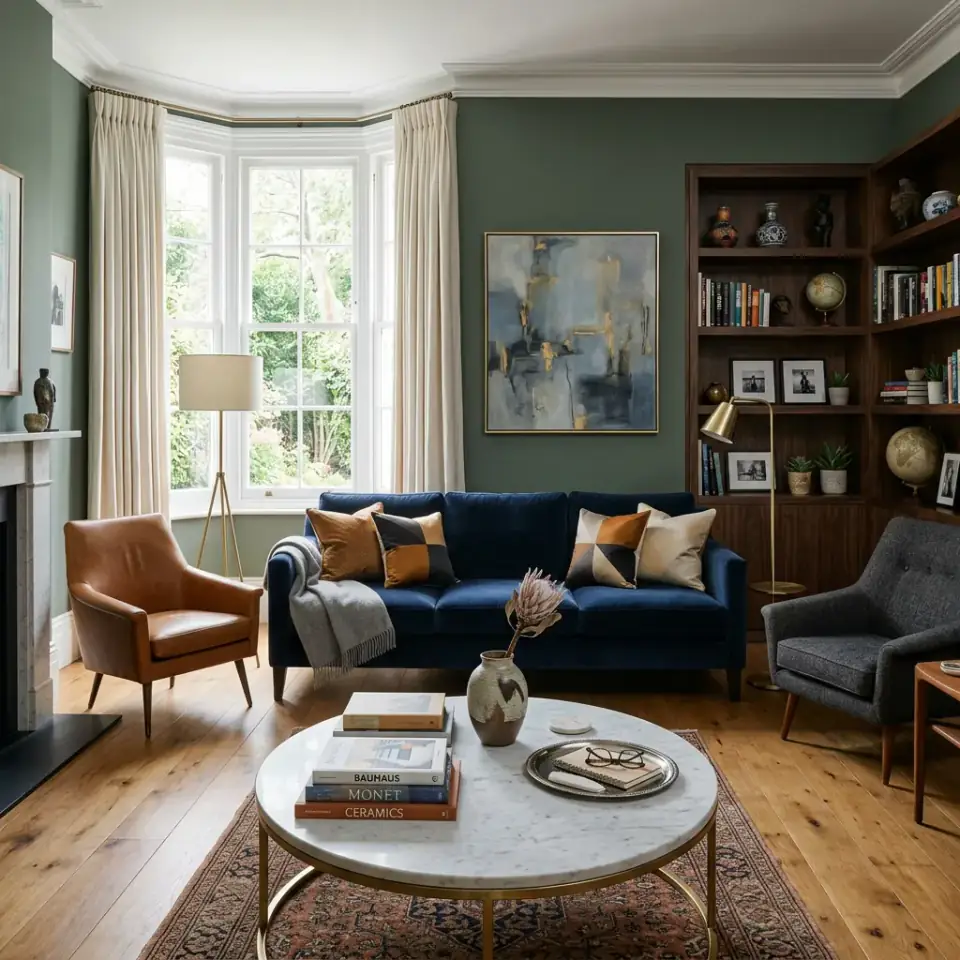
Reader notes