

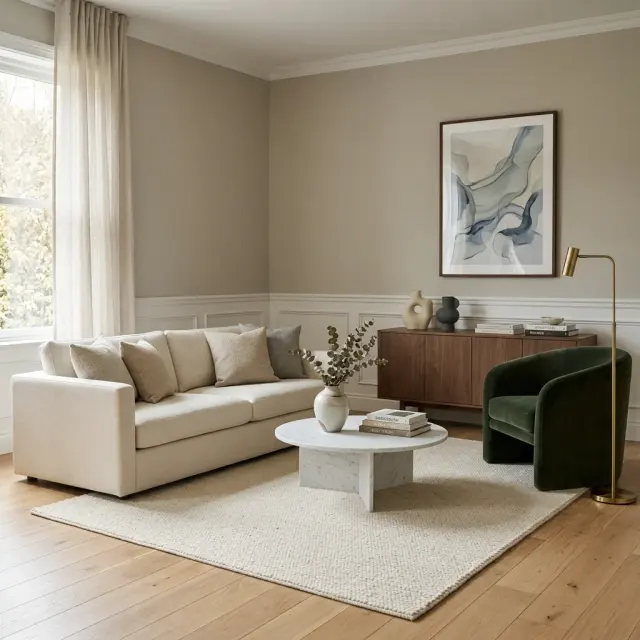
I've walked through enough Hudson Valley living rooms by now to know that the elevation drawing in my hand is only half of what the room is telling me. The other half is harder to draft. It lives in the chair the owner sits in when no one else is home, the books left open on the side table, the wall that should have art and instead has nothing, the lamp that's been broken for two years that no one has replaced. This is the essay I write between the literal renovation drawings — the one about what a room is doing when its owners aren't trying to show it to anyone. Call it the blueprint of being. It's the part of the home that no client thinks they're commissioning, and it's the part of the home that ends up mattering most.
Why a Renovation Designer Reads Rooms Like Drawings
My usual reading method is technical. I open the elevation, study the framing plan, walk the site, and translate between the two. But the longer I do this work, the more I've noticed that the most honest information about a renovation lives outside the construction drawings. A homeowner tells me they want a quiet living room and then asks for an open shelf wall facing the front door. The drawing says one thing; the request says another. The room they actually live in says a third. Reconciling those three is most of the project, and the reconciliation almost always happens at the level of the inner life — not the structural plan.
This essay is the second drawing. The first one is what I sign and stamp. The second one is what the client is unconsciously trying to build. The seven observations below are patterns I've watched repeat across nearly every Hudson Valley living room I've stood in over the last seven years. They aren't psychology in any clinical sense. They're field notes — what design-build practice teaches you about people when you spend enough time inside their rooms. For more in this register, two essays in The Renovation Mind sit close to this one — The Soul's Blueprint and The Silent Confessions.
1. The Psychology of Space: Your Home as a Mirror
Environmental psychology has a working assumption I keep returning to: the room you spend time in eventually becomes congruent with the person spending time in it. Not in a literal mirror sense — your beige sofa is not metaphor for your beige interiority. But over years, the home settles into a shape that fits the inhabitant the way a well-worn jacket fits a shoulder. The corners go soft. The wall the natural light hits at 4 p.m. is the wall where the reading chair lands. The artwork that was a mistake gets quietly retired. What's left is a room that the owner stops noticing, and that's the moment the room has become a mirror — it reflects so accurately that it disappears from conscious attention.
The most interesting renovations I draw are not the ones where a homeowner wants to fix the room. They're the ones where the homeowner has changed faster than the room has, and the mirror has gone out of sync. The room still reflects who they used to be, and standing inside it now feels mildly disorienting in a way they can't name. My job in those moments is less about cladding and built-ins and more about reading what's already true and helping the room catch up. The structural drawing comes second.
2. The Language of Color: Decoding Your Emotional Palette
I've never met a client who chose paint dispassionately. Even the people who insist they don't care will reject three of the four samples I tape to the wall, with no language for why. That's the language of color doing its work. Earthy muted hues — the Hudson Valley palette of softened greens, weathered creams, charcoal grays — are usually chosen by people who want their nervous system regulated by their walls. They're rarely picked by people who already feel regulated. The choice is corrective.
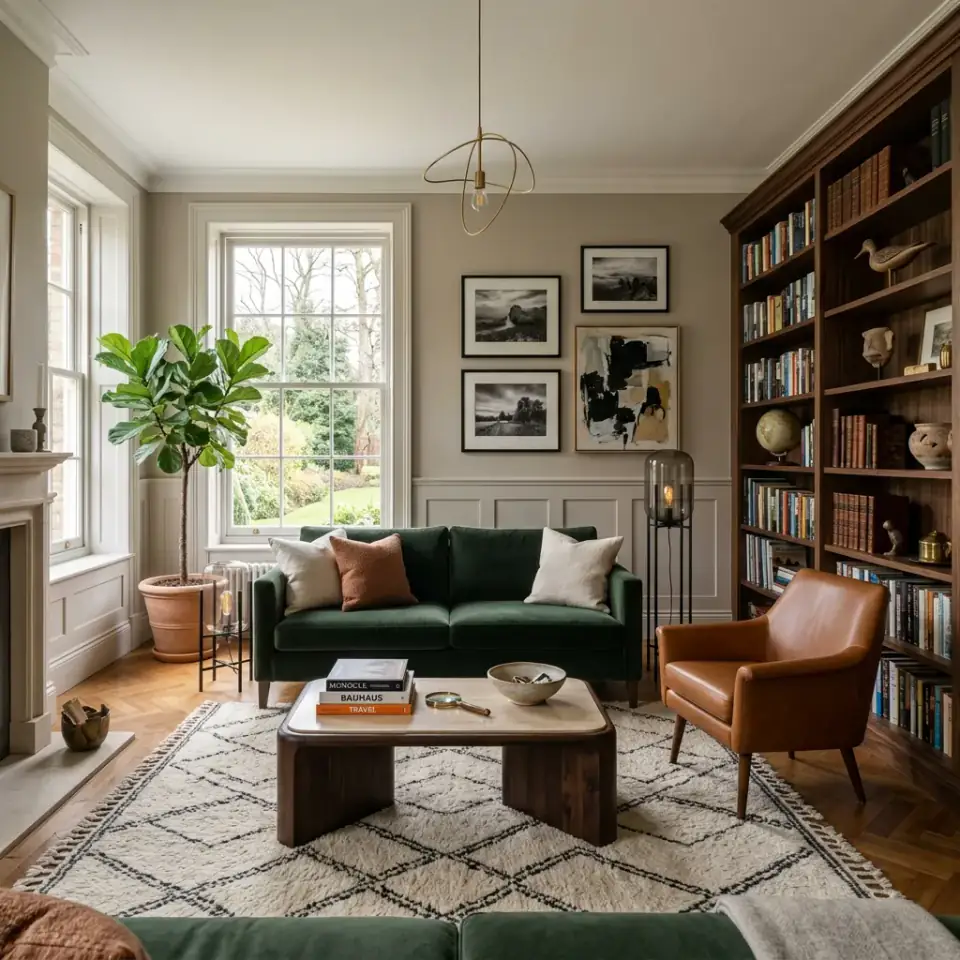
Bold saturated walls — a deep navy, a real terracotta, a true forest green — are almost always chosen by people who want their walls to do something other than calm them. They want the room to push back. Both choices are legitimate; both reveal something. I keep this observation private during paint consultations because it's not my place to interpret a client's emotional weather from a Sherwin-Williams card. But I notice. A wall painted Benjamin Moore Hale Navy in a Beacon farmhouse is rarely just a decorating decision. It's a homeowner deciding that her quiet life needs one room that doesn't whisper.
3. Texture and Touch: The Tactile Foundation of Comfort
Touch is the sense that interior design most often shortchanges. We obsess over how a room looks, photograph it from the corner that flatters most, and forget that the people who actually live in the room are touching it constantly — the door handle, the chair arm, the throw on the back of the sofa, the cool stone of the coffee table. Tactile diversity isn't decoration. It's how a body settles into a space and decides whether to stay relaxed or stay on alert.
The most-recovered-in rooms I've designed share one trait: they layer at least three textures within hand's reach of every seat. A wool throw, a smooth ceramic, a wood arm. A linen pillow, a polished stone tray, a soft leather. The diversity does something to the nervous system that I don't fully understand — psychophysiologists like Esther Sternberg have written about this in formal terms — but I've watched people exhale when they sit down in a tactile-rich room and stay alert when they sit down in a hard-surface-only one. If your living room reads beautiful in photos but no one wants to spend the evening in it, the question is almost always texture.
4. Curated vs. Cluttered: Order and the Mental State
There's a useful distinction I make on first walk-throughs between a curated room and a controlled room. Curation is restraint with affection — every object on the shelf has been chosen, and the empty spaces between objects have also been chosen. Control is restraint with anxiety — every object has been forced into compliance, and the empty spaces feel evacuated rather than considered. Both can look photogenic. Only one of them is restful to live in.
Clutter is the third condition, and it's not the opposite of curation; it's its absence. A cluttered room is a room where decisions haven't been made yet. The mail on the entry console, the keys on the kitchen counter, the books on every flat surface — these aren't moral failings. They're paused decisions. The therapeutic effect that decluttering books talk about isn't really about the objects. It's about the deciding. Every object you sort through, you make a small choice; cumulatively, that hour of choosing rebuilds a sense of agency that the cluttered room had quietly drained.
5. Personal Artifacts: The Storytellers of Your Life
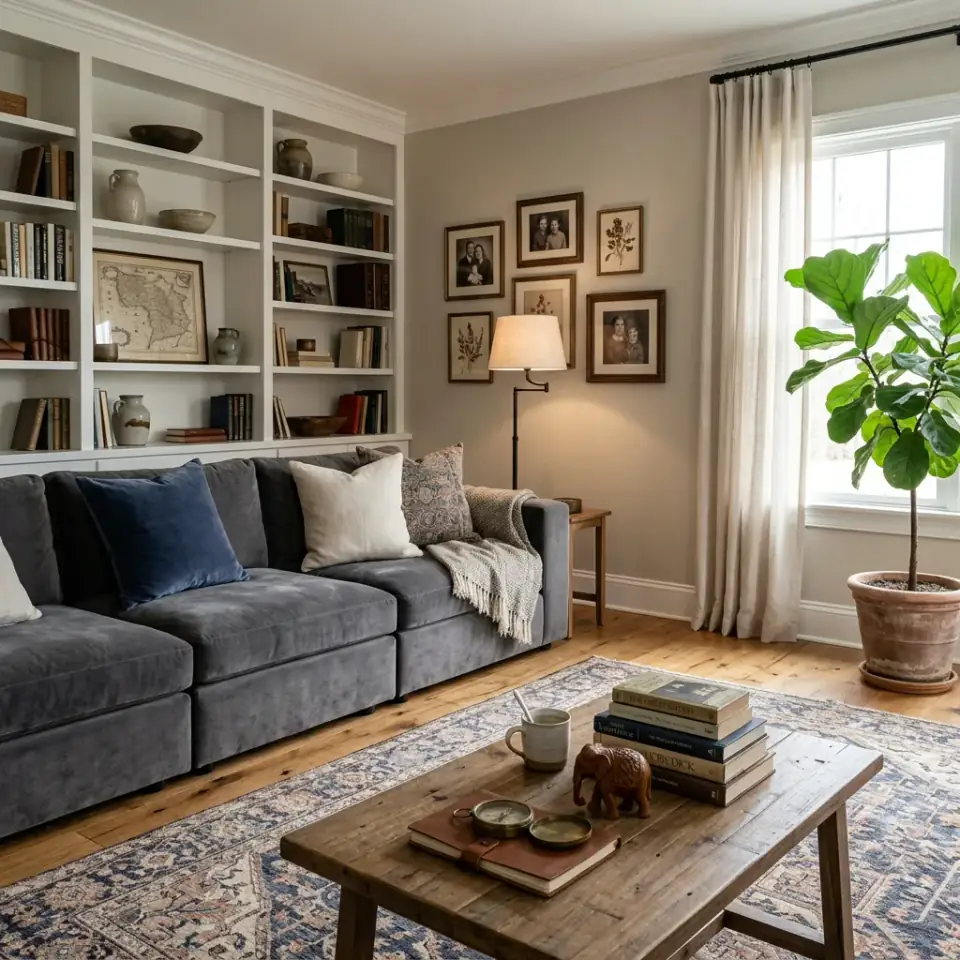
The objects on a homeowner's shelves are the most honest tour of the renovation I'll ever get. Not because they're decorative — because they're stubborn. People will repaint a wall a season after we install it. They won't move the small ceramic bowl their grandmother gave them in 1992. The artifacts that survive every redesign are the load-bearing biographical elements of the room, and any renovation that treats them as decoration to be styled around is going to feel hollow once the contractor leaves.
I've learned to ask early: which three objects in this room would you grab in a fire. Not the financially valuable ones — the ones you'd grieve. The answer reshapes the whole project. If the answer is a stack of letters from a parent who died last year, I'm not designing a coffee table; I'm designing a piece of furniture that can hold those letters with respect. If the answer is a child's first ceramic mug, I'm designing a kitchen that doesn't push that mug into a closet just because it doesn't match the new palette. Artifacts are not styling. They're the part of the room that already knows what the home is for.
6. The Sanctuary Principle: Designing for Recharge
The home as a social-display platform was the dominant model of the 1990s and early 2000s. The home as personal sanctuary is the dominant model now, and it's been accelerating since 2020. Almost every Hudson Valley renovation I take on now includes some version of the same brief: build me a room I can disappear into. A reading corner that doesn't double as anything else. A bathroom that holds a real soaking tub. A study with a door that closes. The clients aren't social-distancing anymore; they're recovering from a decade of overstimulation, and they want their house to participate in the recovery rather than amplify it.
The sanctuary principle changes the renovation drawing in subtle ways. Sightlines from the front door no longer have to terminate at the most-photographed view; they can land on a single comfortable chair next to a real lamp. Material palettes contract — fewer surfaces, more repetition of the same warm wood or the same soft stone. Lighting layers proliferate, because a sanctuary needs to be dimmable at every hour. None of this looks dramatic on the plan. All of it is felt the minute the homeowner steps inside.
7. Biophilia and Balance: The Vital Connection to Nature
The biophilia argument — that humans need contact with living things to function well — is the easiest one to take seriously in our region because nature here is right outside the window. A Hudson Valley living room that doesn't acknowledge the woodline, the river, or the seasonal turn of the light is a room that's fighting its own location. The simplest renovations I've drawn in the last few years have been the ones where the client and I agreed to do less to the room and more to the relationship between the room and what's outside it. A larger window. A reframed sightline. A reading chair angled toward the trees instead of the television.
Indoor plants are the small version of the same impulse, and they work. A vase of eucalyptus on a coffee table, a Monstera in the corner that picks up the morning light, a clipping from the garden in a small glass — these aren't styling moves. They're the homeowner reminding themselves daily that they belong to a larger living system. The eucalyptus dies and gets replaced. The Monstera doubles in size in two seasons. The room metabolizes time the way a person does, and that metabolism is what makes it feel alive instead of staged.
Habits I've Watched Stick
- The annual artifact pass. Once a year, walk through the house and ask which objects no longer belong. The answer is rarely sentimental — it's usually obvious, and the freed shelf space is worth more than the object was.
- One real chair per person. Each adult in the household needs one place in the house that's their place — a chair, a corner, a window seat. The renovation that doesn't account for this fails quietly within six months.
- Lighting on three circuits. Overhead, mid-level (lamps), and low (sconces or strip). Every room of any significance needs all three on independent dimmers. The mood of a room is set by which circuits are on, not by the paint color.
- A book within reach of every seat. Not as decoration. As a working signal that the room is for thinking, not just for sitting. The room that has nothing to read in it tends to be the room nobody lingers in.
- One slow-aging material per room. Wood, leather, real stone, lime plaster. Something that earns marks over time and gets better for it. Rooms that are entirely composed of finish materials that look worse with age feel anxious. Rooms with one slow-aging element age in a way that feels lived-in instead of worn out.
Reader Questions on the Inner Life of a Home
Do I have to know my "inner world" before I renovate?
No, and most of my clients don't. The renovation itself is one of the better ways to learn what your inner world is asking for, because the process forces decisions that everyday life lets you avoid. Choosing a paint color forces you to confront whether you want the room to calm you or push you. Choosing where the reading chair goes forces you to admit whether you read or whether you'd like to. Treat the renovation as a structured conversation with yourself, not a final answer.
My partner and I have very different aesthetic instincts. Whose "inner world" wins?
Neither, ideally. The most successful long-married households I've designed for figured out that the public rooms — kitchen, living room, entry — are negotiations, and the private rooms — each person's study, the bedside table, the closet — are not. Give every adult in the house one room or one corner that's unambiguously theirs, designed without compromise. The shared rooms get easier when the private ones are properly honored. Most couples-design conflict is a private-space deficit dressed up as a paint argument.
How do I tell the difference between curated and controlled?
Sit in the room for thirty minutes without your phone and notice whether your shoulders drop. A curated room has rules you can feel but not name, and once you stop noticing them you relax. A controlled room has rules you can feel and you keep noticing them, because the room is enforcing them on you. The tell is your nervous system, not your eyes. Both rooms photograph well; only one of them is restful.
Is minimalism the answer to a cluttered home?
Not on its own. Minimalism by subtraction is a temporary state — empty rooms slowly refill — and minimalism by ideology can be just as anxious as the clutter it replaced. The lasting fix is making peace with what you actually want to keep around. The right number of objects in a room is the number that lets you breathe; it's almost never zero, and it's almost never the number Pinterest is showing you. Find your own number by living with the room.
Can renovating a room actually change how you feel day to day?
Yes, but not the way the design magazines promise. A renovation won't fix a hard year or a difficult relationship. What it does, when it's done thoughtfully, is remove small daily friction — the chair that hurts your back, the lighting that's wrong every evening, the entry that feels chaotic the moment you walk in. Cumulatively, that removed friction is real. Most homeowners I've worked with describe the post-renovation difference as "less effort to be at home," not "more happiness." The first is more honest, and arguably more valuable.
What's one change that gives the most psychological return?
A real reading chair in good light, with a working side table and a working lamp, in a corner that doesn't double as anything else. Total cost can be under $1,500 if you're patient and shop secondhand. The reason it returns so much is that it gives the household one undisputed location for slowing down. Other rooms can do other work; this one chair only has to do one job. Most homeowners I've made that suggestion to have written back six months later about how often they use it.
Where to Read Next
If this register lands, my architecture of identity essay sits in the same drawer of The Renovation Mind, and the soul's blueprint goes deeper into the design-as-self-portrait argument. For the field-note version of how this shows up in specific rituals, the silent confessions is a useful companion.
Sources & Further Reading
- Esther M. Sternberg, MD, Healing Spaces: The Science of Place and Well-Being (Harvard University Press, 2009) — the foundational text on how built environment affects physiological recovery.
- Roger S. Ulrich, "View Through a Window May Influence Recovery from Surgery", Science, 1984 — the original biophilia hospital study.
- Edward O. Wilson, Biophilia (Harvard University Press, 1984) — the book that named the human affinity for living systems.
- Sally Augustin, PhD, Place Advisors — Research Library on Environmental Psychology and Design — accessible peer-reviewed work on how design choices affect mood and behavior.
- Stephen Kaplan, "The Restorative Benefits of Nature: Toward an Integrative Framework", Journal of Environmental Psychology, 1995 — Attention Restoration Theory.
- Christopher Alexander et al., A Pattern Language (Oxford University Press, 1977) — patterns 142 (Sequence of Sitting Spaces), 179 (Alcoves), 180 (Window Place), 252 (Pools of Light).
- Junichirō Tanizaki, In Praise of Shadows (1933, Vintage edition) — meditation on dim light, restraint, and how rooms hold a person.
- Donald A. Norman, The Design of Everyday Things (MIT Press, 2013) — on the friction between objects, people, and the small daily decisions that erode or restore.
- Sarah Susanka, The Not So Big House (Taunton, 1998) — on right-sizing rooms for the inner life that actually fills them.
- Architectural Digest, Editorial Survey of Biophilic Design Principles — accessible overview of design framing.

Nora Whitfield
Renovation Designer & Interiors Editor · Beacon, New YorkNine years of design-build renovation work across the Hudson Valley and the Northeast. Nora runs the Renovations, Room Guides and Renovation Mind desks — before-and-after studies, room-by-room design guides, and the long essays on why what we renovate matters.
More from Nora →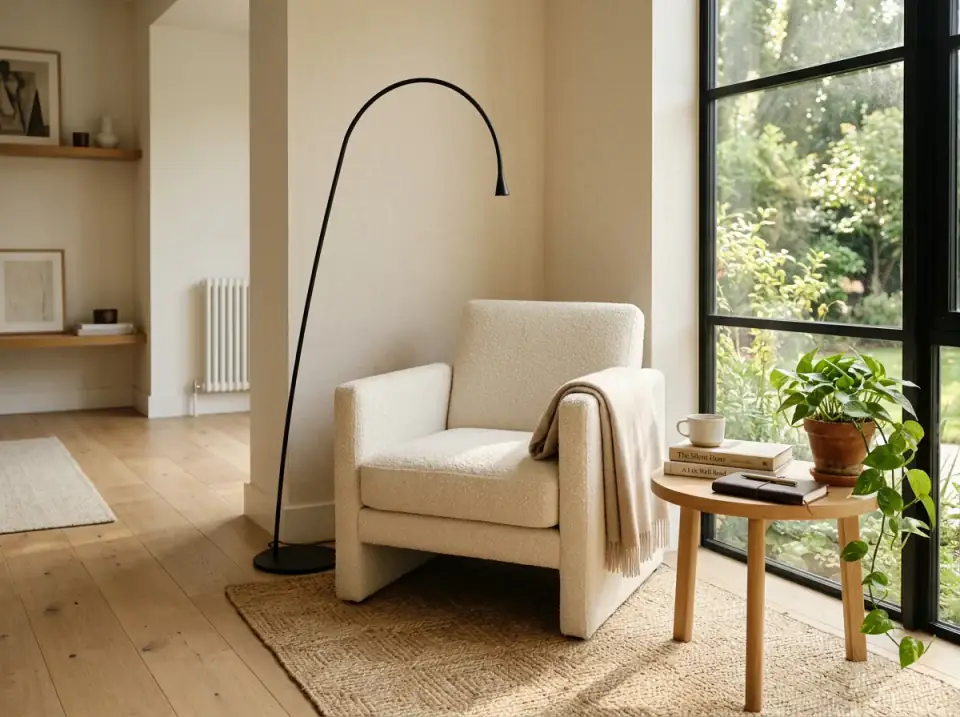
Reader notes