
The dark, cluttered basement game room with tangled wires and mismatched furniture is over. The contemporary version is a flex room — sometimes a basement, sometimes a converted bonus space, sometimes a dedicated wing — that earns its square footage by behaving like an architectural room with one specific job.
A dedicated PC battlestation, a 12-person home theatre, a retro arcade with a beverage station — these are three different rooms with three different acoustic, lighting, and electrical demands. The honest version commits to one primary job and lets a secondary use sit on top of it without disturbing the primary.
Is the room a basement (managing humidity, low ceilings, limited daylight), a converted bonus room above a garage (sound transmission into bedrooms below, HVAC zoning), or a dedicated above-grade flex space (the easiest case but the most expensive square footage)? Each envelope changes the material spec and the cost.
The nine directions below run from least to most expensive. The cost ranges are 2026 Northeast and Brooklyn rates for the FF&E (furniture, fixtures, and equipment) only — they do not include the room shell, drywall, electrical rough-in, or HVAC. Add roughly $45–$95 per square foot for a basement-grade build-out shell, and $95–$185 per square foot for a finished above-grade flex room shell.
Moody Minimalist Media Lounge
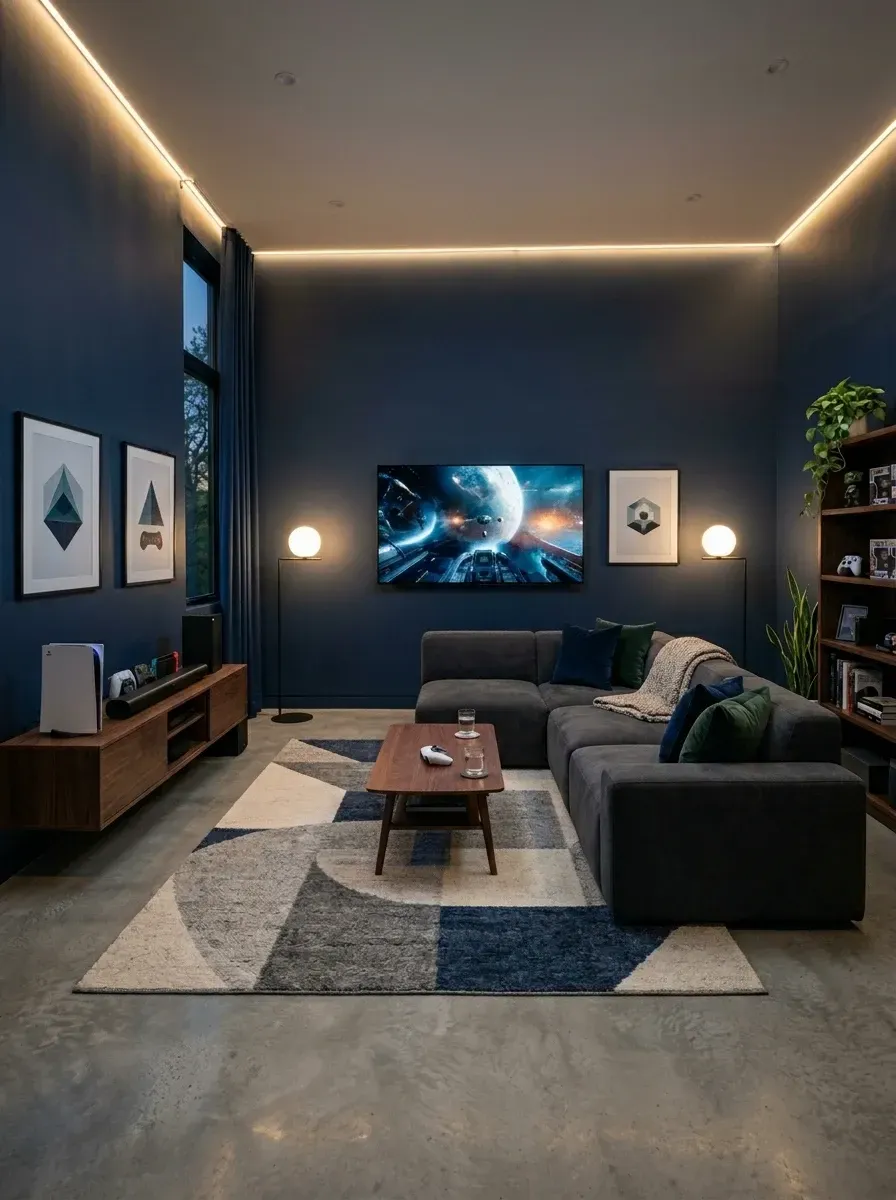
Deep navy walls in Benjamin Moore Hale Navy HC-154 read as architectural rather than dorm-room because the LRV (Light Reflectance Value) is low enough to absorb projector spill without going claustrophobic. The polished concrete floor is the basement-specific move — sealed with AmeriPolish dye in a graphite tone, it handles humidity better than any wood or LVT and reads as intentional rather than utilitarian.
The walnut media console (Floyd or West Elm Mid-Century, both solid wood) and matching coffee table introduce the warm tone that prevents the dark palette from going cold. The WAC Lighting 2700K cove strip behind the ceiling perimeter is the detail that improves this from "dark room" to "media room" — diffused indirect light at 100–150 lumens per foot, dimmable, never visible to seated viewers.
Visible details in Moody Minimalist Media Lounge
The Moody Minimalist Media Lounge direction brings together deep navy accent walls (BM Hale Navy HC-154), polished concrete floor with graphite dye, integrated 2700K WAC LED cove lighting, article Sven or Joybird Eliot sectional, patterned wool area rug from Loloi or Lulu and Georgia, and solid walnut media console and coffee table.
Budget notes for Moody Minimalist Media Lounge
Large Dark Grey Sectional Sofa (Article Sven or equivalent): $2,500 – $5,000. Walnut Media Console (Long, solid wood): $800 – $2,000. Walnut Coffee Table: $300 – $800. Large Geometric Area Rug (8x10 wool): $400 – $1,200.
Globe Floor Lamp (x2): $300 – $700. Framed Geometric Wall Art (x3): $150 – $450. Integrated 2700K LED Cove Lighting (materials + installation): $500 – $1,500. Wall Paint (Deep Navy) and Labor: $400 – $800. Total Estimated Cost: $5,350 – $12,450.
Hale Navy on all four walls and the ceiling reads more architectural than navy on three walls plus a white ceiling. Commit to the dark envelope; the room is for evening viewing, and the perceived ceiling height collapses naturally into the dark palette rather than fighting it.
Bright Multi-Purpose Gaming & Lounge Area
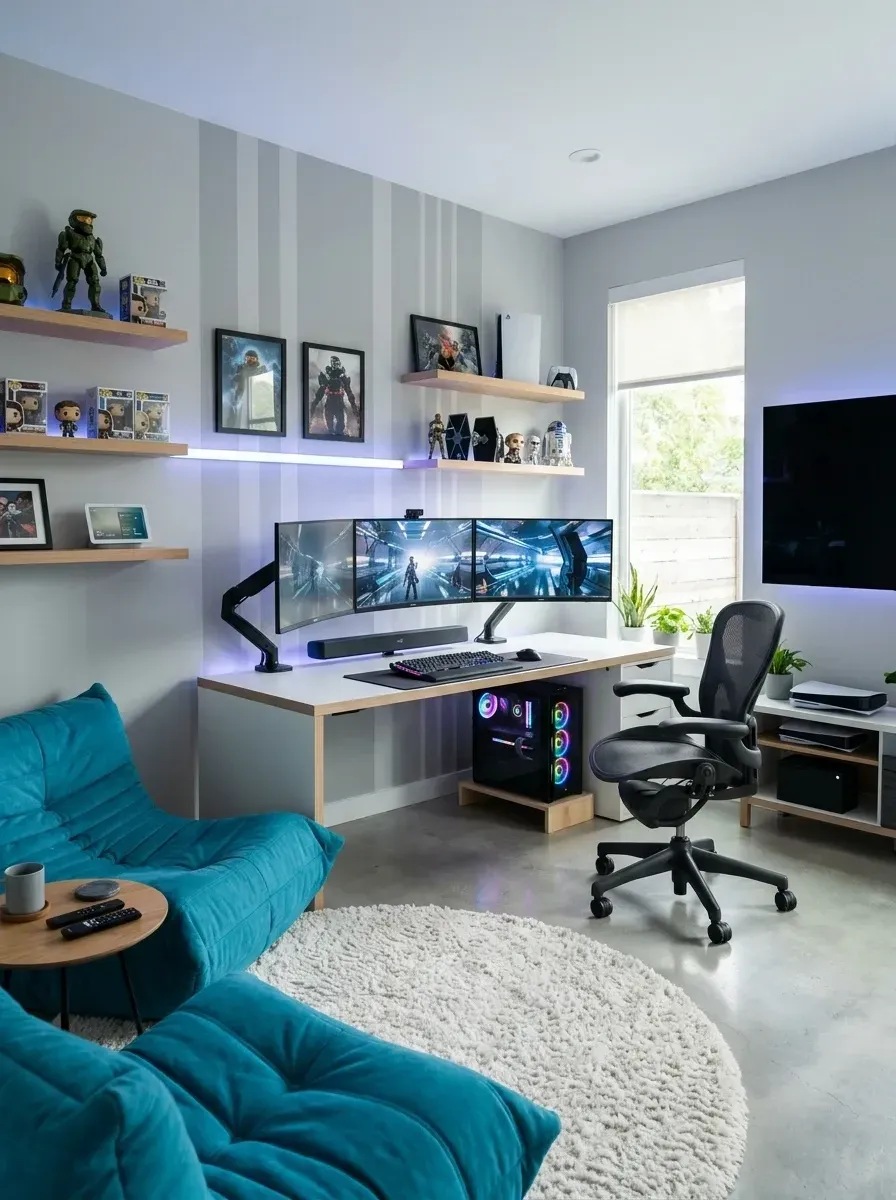
When the client is a serious daytime PC gamer who also uses the room as a lounge between sessions, the spatial trick is two distinct zones treated as one room. Light grey vertical-stripe walls (BM Stonington Gray HC-170 base with a half-tone stripe roller treatment) keep the room bright enough for daylight work while still reading as a designed space. The long white desk anchors the productivity zone — A practical recommendation is a custom solid white-oak top from a local the Northeast maker on Herman Miller Renew Sit-to-Stand legs, or for budget the IKEA Karlby beech top on Alex drawer units.
The teal Togo-style sofa is the personality. The original Ligne Roset Togo is the heritage version at $4,000+; Burrow Nomad in Pacific Blue and Article Adams Velvet in Ivy are credible replicas at one-third the price. Floyd or Open Spaces floating wood shelves display the collectibles vertically and keep the desk surface clean. The ergonomic chair is non-negotiable for a serious gaming room — Herman Miller Aeron or Embody, Steelcase Leap V2, or for budget the Branch Ergonomic Chair.
Visible details in Bright Multi-Purpose Gaming & Lounge Area
The Bright Multi-Purpose Gaming & Lounge Area direction brings together triple-monitor PC setup on a Karlby or custom oak desk, herman Miller Aeron or Embody ergonomic chair, teal Togo-style sectional (Burrow Nomad or Article Adams), floyd or Open Spaces floating shelves, striped paint treatment in BM Stonington Gray HC-170, and sealed concrete floor with round shag rug.
Budget notes for Bright Multi-Purpose Gaming & Lounge Area
Long White Desk with Light Wood Legs (IKEA Karlby or custom): $400 – $1,000. Ergonomic Office Chair (Herman Miller Aeron or Embody): $600 – $1,500. Teal Togo-style Sofa (Burrow Nomad or Article Adams): $800 – $2,500. Teal Togo-style Ottoman/Chair: $400 – $1,000.
Small Round Wood Side Table: $100 – $300. Floating Wood Shelf (Floyd or Open Spaces, x3): $150 – $450. Round White Shag Rug: $100 – $300. Triple Monitor Mount (Ergotron LX or VIVO): $100 – $300.
Striped Wall Treatment (paint or wallpaper) and Labor: $300 – $800. Total Estimated Cost: $2,950 – $8,150.
The Herman Miller Aeron at $1,500 is the line item that separates a real gaming room from a styled photo shoot. For long-session gaming and remote work both, no other chair in the price band competes on lumbar support and 12-year warranty.
Retro Arcade & Collectibles Corner
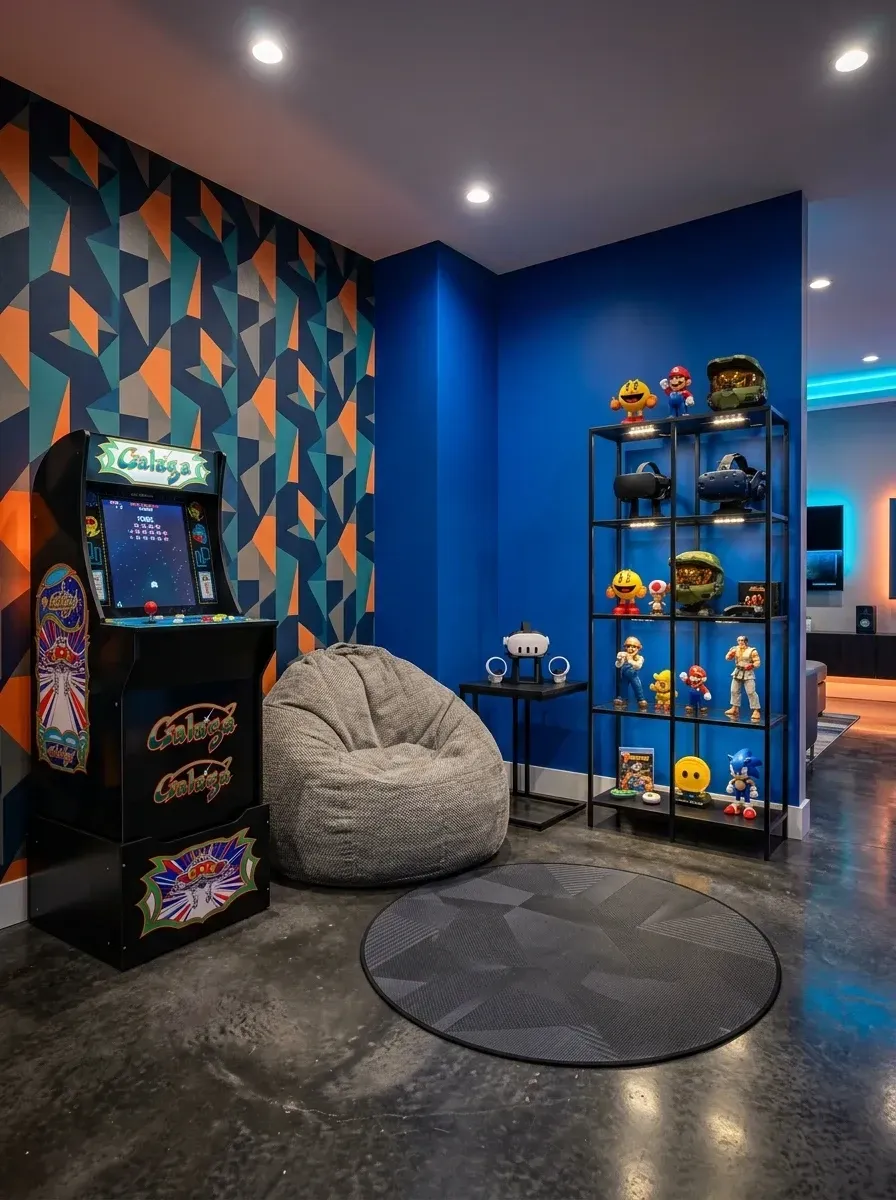
The solid cobalt accent wall (BM Symphony Blue 2060-10 or SW Indigo Batik SW 7602) flanks the wallpaper and gives the eye a place to rest.
The centrepiece is an Arcade1Up cabinet — Pac-Man, Street Fighter II, Marvel vs Capcom 2 are the most-rebought titles. For a true authentic vintage piece, a restored 1980s original from the Northeast collector runs $1,800–$3,500 but adds 30 years of patina no replica can fake. The Lovesac or PBteen oversized bean bag is the comfortable secondary seat. The black IKEA Vittsjö or Wayfair Mainstays open shelf displays collectibles, and a $50–$150 Govee or Philips Hue Lightstrip Plus run along the back edge gives every figurine a halo light.
Visible details in Retro Arcade & Collectibles Corner
The Retro Arcade & Collectibles Corner direction brings together geometric Hygge and West or Milton and King wallpaper, solid cobalt accent wall (BM Symphony Blue 2060-10), arcade1Up cabinet (or restored vintage original), lovesac or PBteen oversized bean bag, black IKEA Vittsjö display shelf with Govee LED strip, and sealed concrete floor with round geometric mat.
Budget notes for Retro Arcade & Collectibles Corner
Classic Arcade Cabinet (Arcade1Up): $400 – $700. Large Grey Bean Bag (Lovesac or PBteen): $150 – $400. Black Metal Display Shelf (IKEA Vittsjö or similar): $100 – $300. LED Strip Lighting for Shelves (Govee or Philips Hue): $50 – $150.
Small Side Table: $50 – $150. Round Geometric Floor Mat: $50 – $150. Geometric Wallpaper (material + installation): $300 – $800. Wall Paint (Electric Blue accent) and Labor: $200 – $400. Total Estimated Cost: $1,300 – $3,050.
Restored vintage arcade cabinets from craigslist or the Northeast collectors give you 30 years of patina and CRT screen weight you cannot replicate with an Arcade1Up. If authenticity matters and the budget allows ($1,800–$3,500), the vintage route is the right one.
Elegant Wood Slat Media Wall
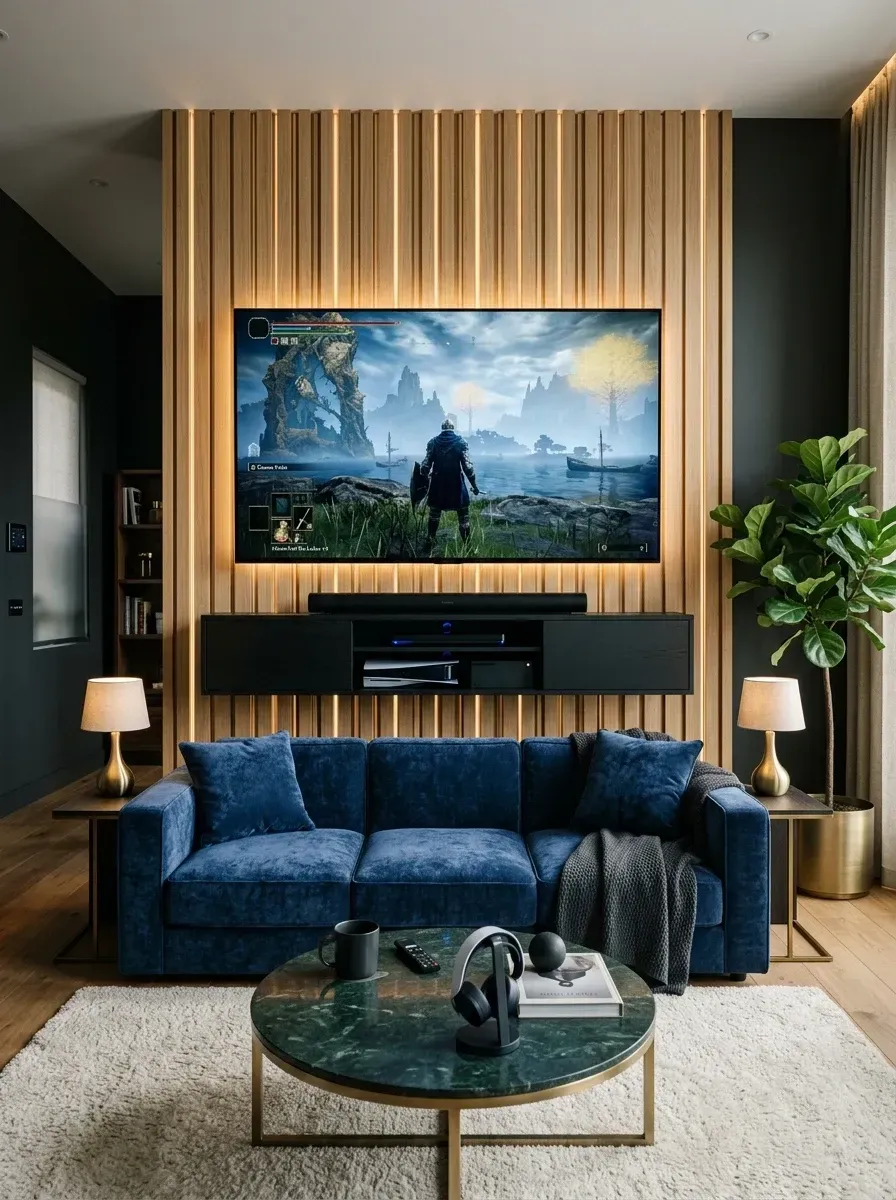
The backlit white oak slat wall is the structural move — typically 1x2 vertical white oak slats at 1.5-inch on-centre spacing, mounted on 3/4-inch black painted plywood with WAC InvisiLED 2700K strips run vertically behind every other slat. A custom the Northeast millworker will execute the wall for $2,000–$5,000 depending on length and finish complexity.
The sapphire blue velvet sofa is the personality — West Elm Andes Velvet in Performance Distressed Velvet, or Burrow Nomad in Royal for the budget tier. The green marble coffee table from Anthropologie or CB2 is the moment of luxury that ties the room to the wood-slat wall through warm tone repetition. The floating BDI or West Elm Logan media console keeps the floor line clean and reveals the floor finish, which makes the room read larger. The fiddle leaf fig (real, not faux) is the biophilic move that prevents the dark palette from going cold.
Visible details in Elegant Wood Slat Media Wall
The Elegant Wood Slat Media Wall direction brings together backlit white oak slat feature wall with WAC InvisiLED 2700K, BDI or West Elm Logan floating black media console, west Elm Andes velvet sofa in sapphire blue, anthropologie or CB2 green marble coffee table, brass the Northeast Lighting or Schoolhouse table lamps, and large fiddle leaf fig in brass planter.
Budget notes for Elegant Wood Slat Media Wall
Custom Oak Slat Wall with LED Backlighting (material + installation): $2,000 – $5,000. Sapphire Blue Velvet Sofa (West Elm Andes or Burrow Nomad): $1,200 – $3,500. Green Marble Top Coffee Table with Brass Base: $500 – $1,500. Floating Black Media Console (BDI or West Elm Logan): $400 – $1,200.
Brass Table Lamp (the Northeast Lighting or Schoolhouse, x2): $200 – $600. Side Table with Brass Frame (x2): $200 – $500. Large Fiddle Leaf Fig in Brass Planter: $150 – $400. Large Light-Coloured Area Rug (9x12 wool): $300 – $1,000. Total Estimated Cost: $4,950 – $13,700.
Specify the LED strip with a continuous diffuser channel like the WAC InvisiLED Aluminium Channel — without the channel, you see individual LED dots through the slat gaps and the wall reads as DIY rather than custom.
Dedicated Dual-Gamer Setup
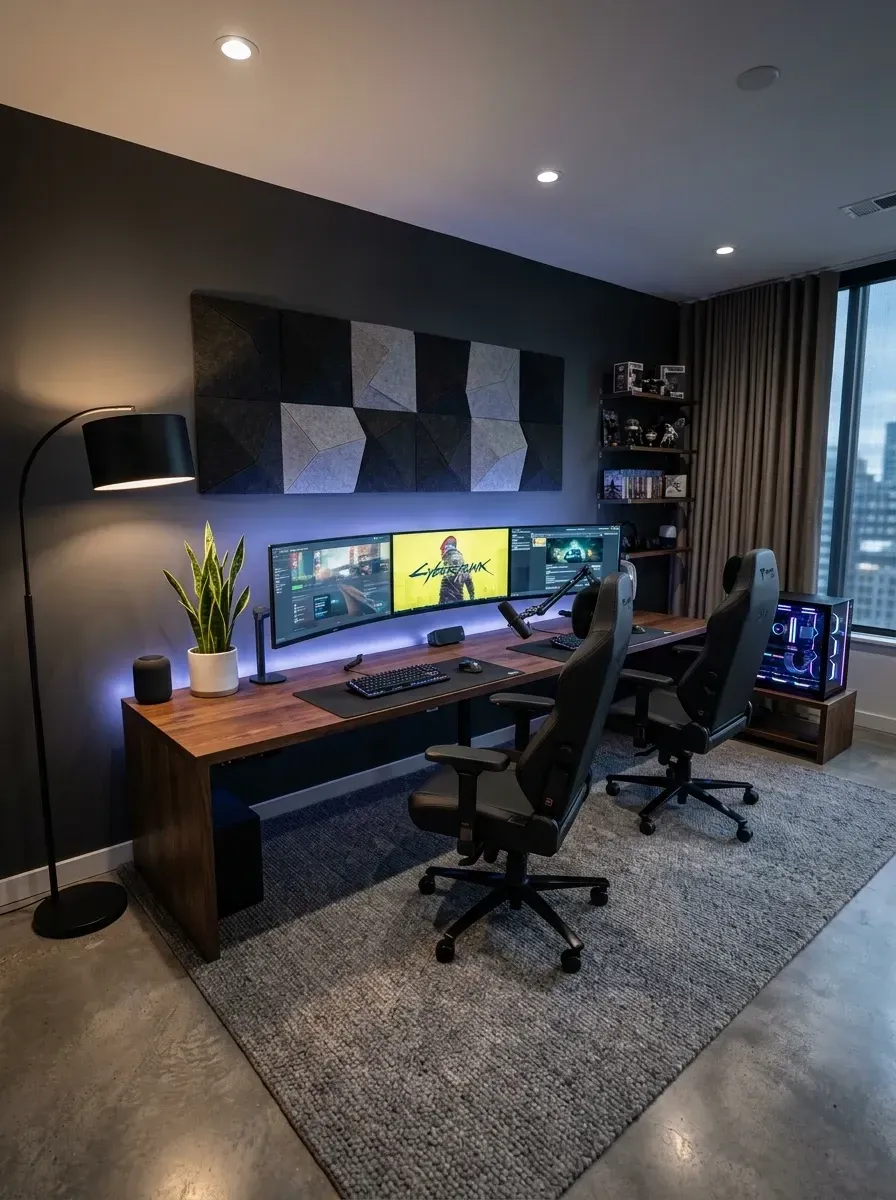
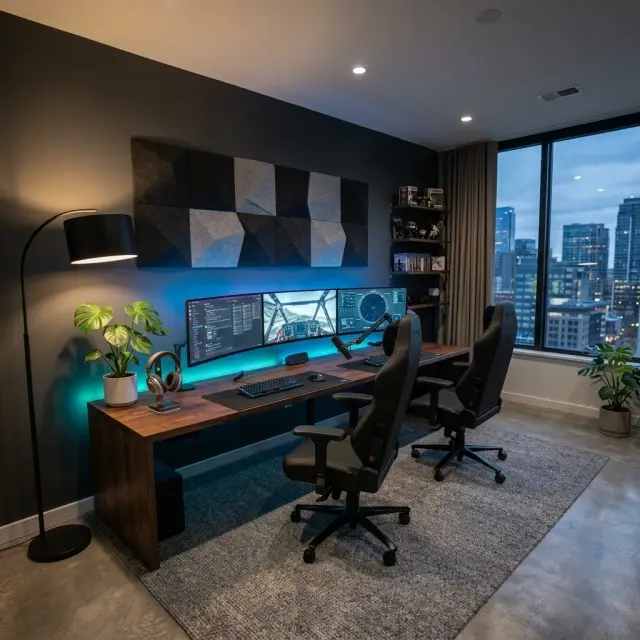
The single extra-long walnut desk (custom solid walnut top on Uplift V2 standing legs, or a 96-inch Karlby beech for the budget version) reads as one designed surface, not two desks pushed together.
Dark charcoal walls (Benjamin Moore Wrought Iron 2124-10 or BM Cheating Heart 1617) create the moody immersive backdrop serious gamers want. The geometric acoustic panels are doing two jobs — they cut down the keyboard-clack and mouse-click that bother the second user, and they read as a designed wall feature. Acoustimac Eco, GIK Acoustics 242 panels, or ATS Acoustics Geo cover both functions well. Two Herman Miller Embody chairs are the gold standard; Steelcase Leap V2 is the credible alternative. The snake plant (Sansevieria trifasciata) is the one plant that genuinely thrives in low-light gaming rooms.
Visible details in Dedicated Dual-Gamer Setup
The Dedicated Dual-Gamer Setup direction brings together custom 96-inch walnut Uplift V2 standing desk for two, dual PC gaming setups with cable management trays, geometric Acoustimac or GIK Acoustics wall panels, two Herman Miller Embody or Steelcase Leap V2 chairs, sealed concrete floor with large textured area rug, and snake plant in matte black planter.
Budget notes for Dedicated Dual-Gamer Setup
Extra-Long Walnut Desk (Uplift V2 standing or custom): $1,000 – $2,500. Ergonomic Gaming Chair (Herman Miller Embody, x2): $800 – $2,000. Set of Geometric Acoustic Panels (Acoustimac or GIK): $200 – $600. Large Textured Grey Area Rug (8x10): $300 – $800.
Large Arc Floor Lamp: $150 – $400. Snake Plant in Matte Black Pot: $50 – $150. Wall Paint (BM Wrought Iron) and Labor: $300 – $600. Total Estimated Cost: $2,800 – $7,050.
Run the cable management down through grommets in the desk surface to a Hue Stick-On Cable Channel along the rear wall. This is the difference between a clean shared desk and a tangled mess after week three. Spend the $150 on cable trays up front.
High-Tech Home Theater with Integrated LED
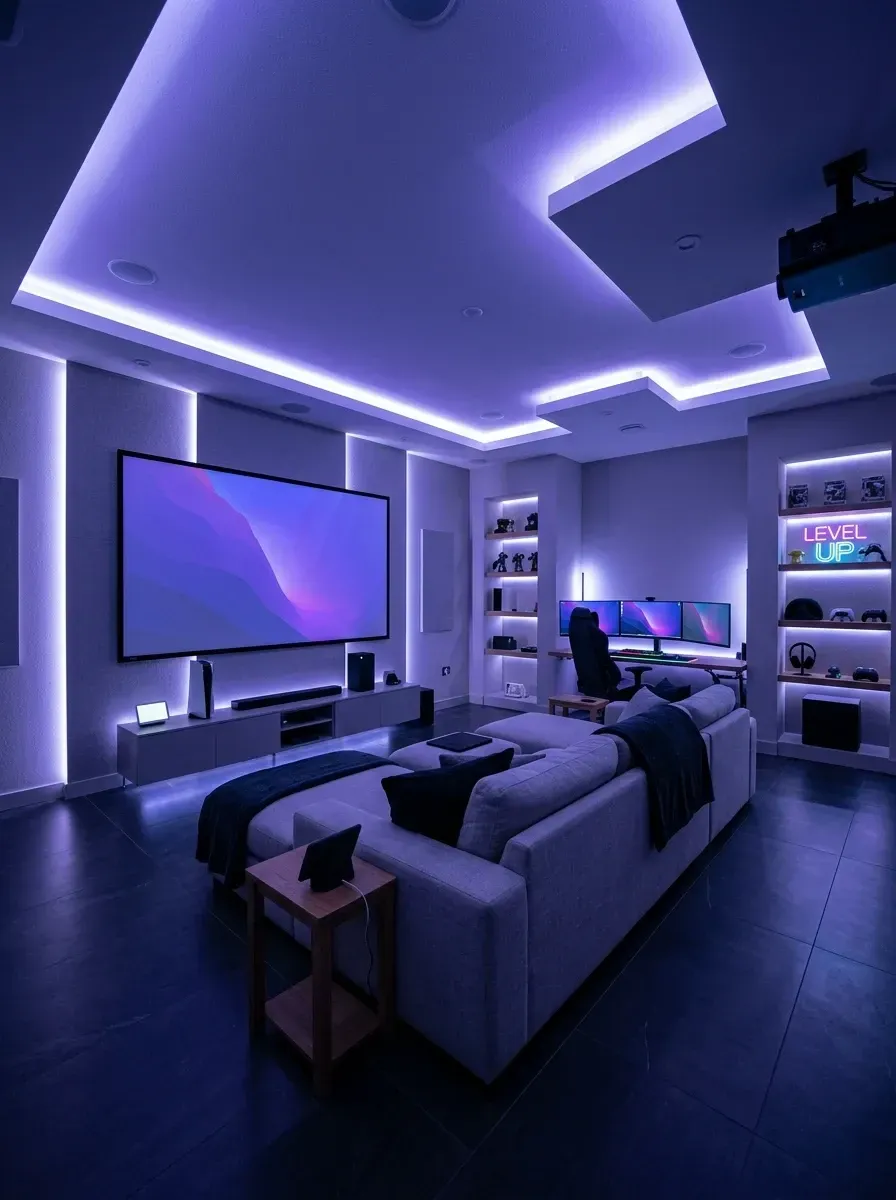
This is the room with a planning ranges — a basement or above-grade flex space committed entirely to immersive viewing. The integrated LED system is the architectural commitment. Specify Philips Hue Lightstrip Plus Outdoor (used indoors for the longer continuous runs) or WAC InvisiLED Color-Changing with Lutron control, run through cove millwork at the ceiling perimeter and vertically every six feet on the side walls. Programming is via Lutron RadioRA 3 or Crestron — both let you preset "movie", "gaming", "intermission" scenes that change colour temperature and brightness with one tap.
The 4K projector and screen is the biggest line item — A practical recommendation is Epson LS800 Ultra Short Throw or Sony VPL-XW5000ES for the upgrade tier, paired with a Stewart Filmscreen StudioTek 130 fixed-frame screen. Custom built-in shelves in white oak on either side of the screen display collectibles and house the AV equipment behind a perforated grille that does not block IR signals. The dark large-format porcelain tile (Daltile Modern Outdoor Living or Bedrosians Cloe in 24x48 inches) reflects the coloured LED light and amplifies the immersion. Sectional in light grey Sunbrella performance fabric — durable, projector-spill-friendly, and easy to clean.
Visible details in High-Tech Home Theater with Integrated LED
The High-Tech Home Theater with Integrated LED direction brings together philips Hue or WAC integrated LED cove and wall lighting, epson LS800 or Sony VPL-XW5000ES 4K projector, stewart Filmscreen StudioTek 130 fixed-frame screen, custom white oak built-in display shelving with hidden AV, large light grey Sunbrella sectional, and daltile or Bedrosians dark large-format porcelain floor.
Budget notes for High-Tech Home Theater with Integrated LED
Custom Built-in Shelving & Media Unit with LED (material + installation): $4,000 – $10,000. Integrated Philips Hue or WAC LED System with Lutron Control: $2,500 – $6,000. Large Light Grey Sectional Sofa (performance fabric): $2,500 – $6,000. Epson LS800 / Sony VPL-XW5000ES Projector and Stewart Screen: $3,000 – $8,000.
Dark Large-Format Porcelain Floor Tile (material + installation): $2,000 – $5,000. Small Side Table: $100 – $300. Total Estimated Cost: $14,100 – $35,300.
Wire it before drywall. Integrated cove LED and projector cabling have to be run during the electrical rough-in, not after. Adding this system to a finished room means cutting drywall and increases the bill by 40–60%. Decide on the lighting plan during framing, before the rock goes up.
Multi-Zone Entertainment Hub
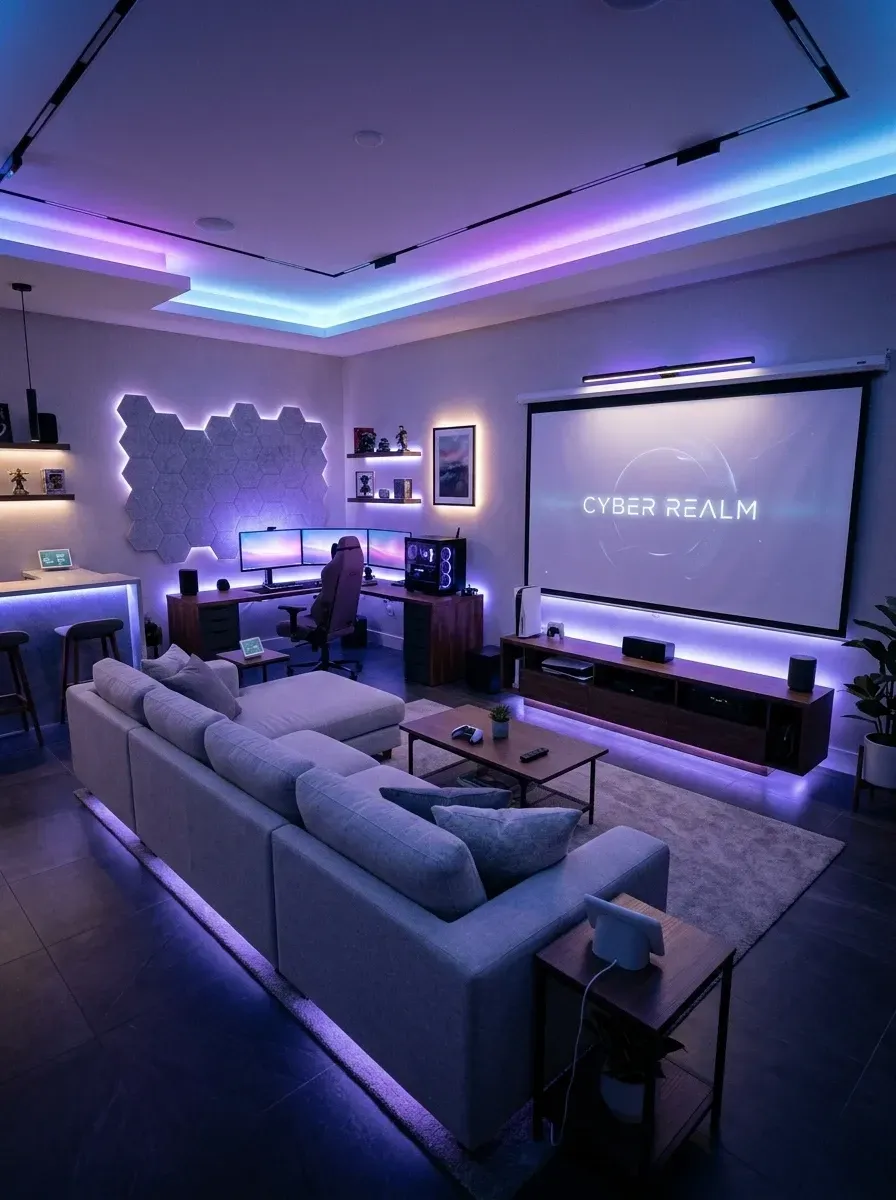
This is the biggest brief on the page — a large basement or above-grade flex room split into three distinct zones (theatre, beverage station, PC gaming corner) treated as one unified room through colour, lighting, and flooring discipline. The unifying tactic is critical: light greige walls (BM Edgecomb Gray HC-173 or SW Accessible Beige SW 7036) on every wall, dark walnut on every surface that touches the eye line, and a consistent dark porcelain tile on the floor throughout. Without that visual unity, the three zones read as three different rooms cobbled into one space.
The Nanoleaf hexagon LED panels are the lighting move that ties the zones together — programmed to a single colour scene across all three areas, they create a visual through-line that says "one room" rather than "three rooms." The home theatre zone uses the same Epson LS800 and light grey Sunbrella sectional from section six. The beverage station gets quartz counter, dark cabinetry, and counter stools from CB2 or West Elm. The PC corner gets the Embody chair and walnut Uplift desk. Each zone is fully functional standalone; together they read as one designed entertainment hub.
Visible details in Multi-Zone Entertainment Hub
The Multi-Zone Entertainment Hub direction brings together home theatre zone with Epson projector and large sectional, beverage station with quartz counter and CB2 counter stools, dedicated PC gaming corner with Uplift desk and Embody chair, nanoleaf hexagon LED wall panels unifying all three zones, philips Hue cove ceiling lighting on Lutron control, and dark large-format porcelain floor tile throughout.
Budget notes for Multi-Zone Entertainment Hub
Large Light Grey Sectional Sofa (Sunbrella performance): $2,500 – $5,000. Epson LS800 / Stewart Filmscreen Projector and Screen Setup: $2,500 – $7,000. Dark Walnut Media Console (Long, solid wood): $800 – $2,000. Gaming Desk Setup (Uplift V2 + Embody chair): $800 – $2,000.
Bar Counter and CB2 Counter Stools (x2): $1,000 – $3,000. Nanoleaf Hexagon LED Light Panels (Set of 9): $200 – $500. Coffee Table: $200 – $600. Large Area Rug (9x12): $300 – $800.
Integrated Ceiling Cove Lighting (material + installation): $1,500 – $4,000. Total Estimated Cost: $9,800 – $24,900.
Define each zone with a separate area rug, but specify them in the same colour family. Three matching-tone rugs read as a unified room with three uses; three different colour rugs read as three different rooms forced into one space.
Sleek & Functional Beverage Station
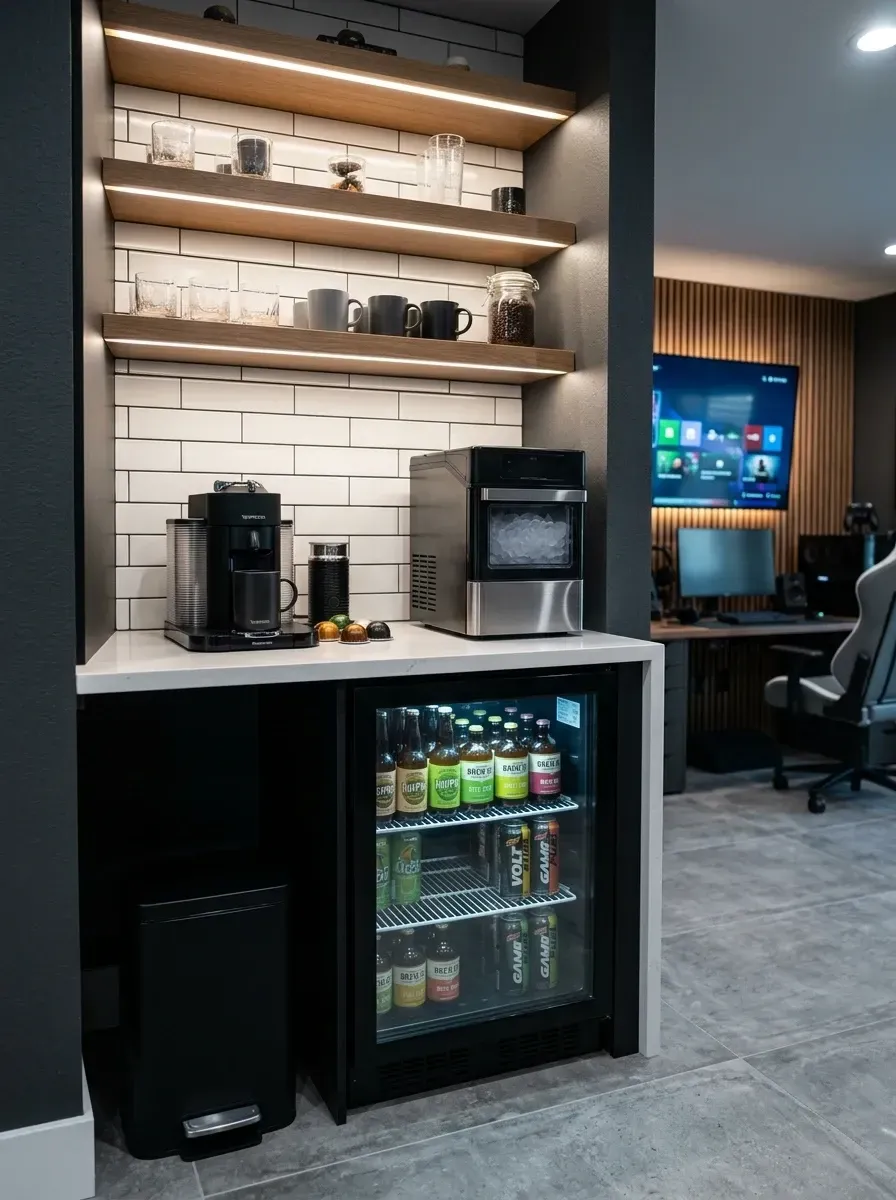
A beverage station is the upgrade that turns a game room from a place where people watch screens into a place where people stay. The matte black Semihandmade cabinetry (over IKEA Sektion boxes for the budget tier, or full custom from the Northeast millworker for the upgrade) gives the station a built-in look without the built-in price. White Cambria Brittanicca or Caesarstone Calacatta Nuvo quartz on the counter holds up to spilled red wine and hot espresso cups equally well — natural marble would stain within six months in this use.
The appliance trio is the functional commitment: a Summit Appliance or U-Line undercounter beverage fridge (glass door for visual display), a GE Profile Opal 2.0 nugget ice maker (the appliance no one regrets buying — Opal pellet ice is the cocktail-bar standard), and a Breville Barista Express or Jura E8 coffee machine. Floyd or Open Spaces white oak floating shelves with WAC LED Tape Light underneath display glassware and create the bar-back lighting that makes the station read as designed rather than functional. The white subway tile backsplash with dark grout is the timeless choice that ages 20 years without dating.
Visible details in Sleek & Functional Beverage Station
The Sleek & Functional Beverage Station direction brings together summit Appliance or U-Line undercounter beverage fridge, GE Profile Opal 2.0 nugget ice maker, breville Barista Express or Jura E8 coffee machine, floyd or Open Spaces white oak floating shelves with WAC LED, white subway tile backsplash with dark grout, and cambria Brittanicca or Caesarstone Calacatta Nuvo quartz counter.
Budget notes for Sleek & Functional Beverage Station
Custom Base Cabinetry (Semihandmade over IKEA Sektion): $1,000 – $2,500. Cambria or Caesarstone Quartz Countertop & Installation: $500 – $1,500. Floyd or Open Spaces Floating White Oak Shelves with WAC LED (x3): $600 – $1,500. White Subway Tile Backsplash & Installation: $300 – $800.
Summit or U-Line Undercounter Beverage Fridge: $500 – $1,500. GE Profile Opal 2.0 Nugget Ice Maker: $400 – $700. Breville Barista Express or Jura E8 Espresso Machine: $200 – $600. Total Estimated Cost: $3,500 – $9,100.
Run a 20-amp dedicated circuit to the beverage station during electrical rough-in. The combination of beverage fridge + nugget ice maker + espresso machine running simultaneously will trip a shared 15-amp circuit, and rewiring after drywall is the most expensive mistake on this section's list.
Industrial Loft Game Room with a View
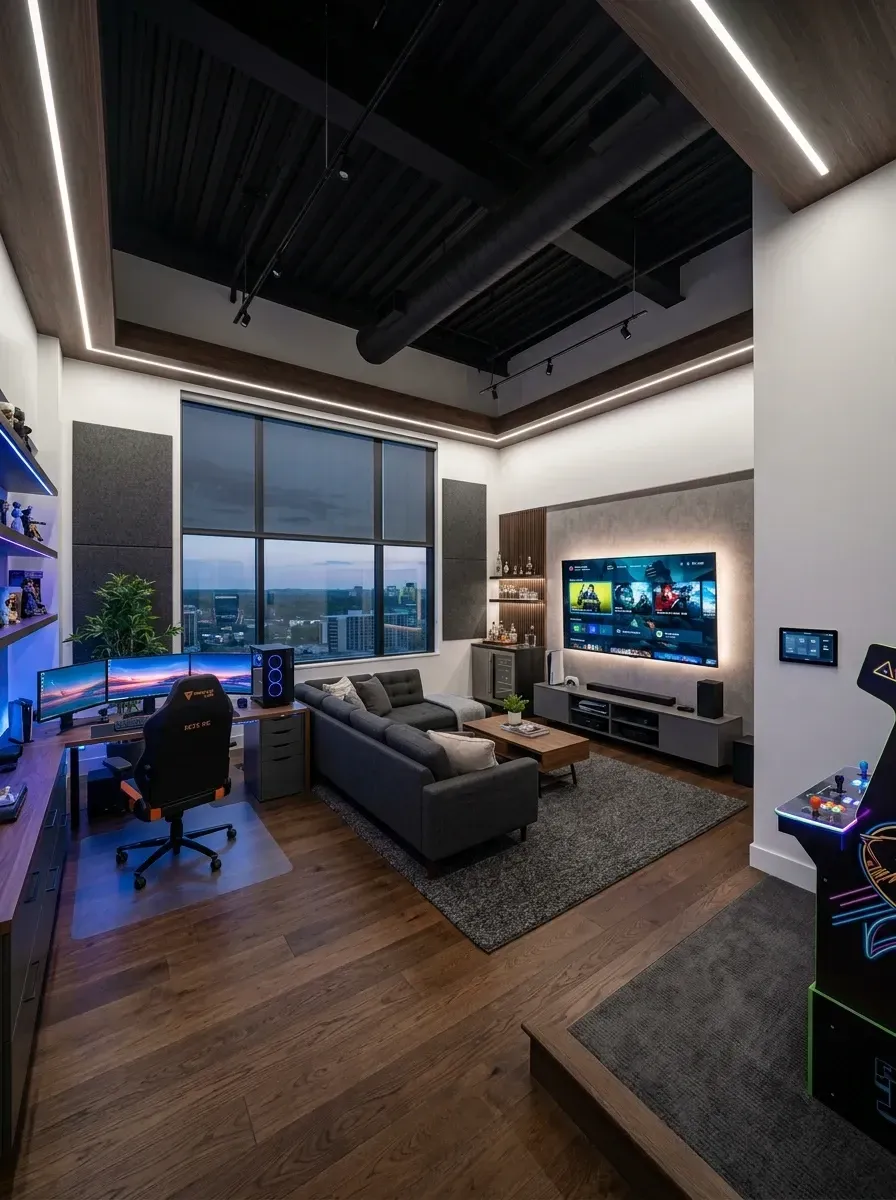
The architectural envelope is doing most of the design work — exposed structural ceiling painted in BM Wrought Iron 2124-10, dark-stained wide-plank white oak flooring (Stuga, Hallmark Floors, or local the Northeast mill), and floor-to-ceiling Marvin Modern direct-glaze windows that take the city or river view and make it the dominant visual element in the room.
The interior layout works with the envelope rather than against it. A large dark grey Article Sven or BDI sectional defines the lounge zone. A separate PC gaming setup with the Herman Miller Embody chair and the Uplift V2 desk sits on a defined area rug. A restored vintage arcade cabinet (or Arcade1Up for budget) anchors the back wall as the personality move. Acoustimac panels mounted as a feature wall control the reverb that exposed structure and hard floors create. Juno Trac-Master or USAI Lighting BeveLED track lighting hangs from the exposed beams in 2700K — the warmest temperature the architectural envelope can carry without going dim.
Visible details in Industrial Loft Game Room with a View
The Industrial Loft Game Room with a View direction brings together exposed structural ceiling in BM Wrought Iron with Juno track lighting, marvin Modern floor-to-ceiling direct-glaze windows, dark-stained Stuga or Hallmark wide-plank white oak floors, large dark grey Article Sven sectional, PC gaming setup (Uplift V2 desk + Embody chair) and restored arcade cabinet, and acoustimac feature wall for reverb control.
Budget notes for Industrial Loft Game Room with a View
Large Dark Grey Sectional Sofa (Article Sven or BDI): $2,000 – $4,500. PC Gaming Setup (Uplift V2 desk, Embody chair, PC, monitors): $2,000 – $5,000. Arcade Cabinet (Arcade1Up or restored vintage): $400 – $1,000. Media Console (BDI or West Elm): $500 – $1,500.
Coffee Table: $200 – $600. Large Area Rugs (x2): $600 – $1,600. Acoustimac or GIK Acoustics Wall Panels (Set): $200 – $500. Juno Trac-Master or USAI Track Lighting (material + installation): $500 – $1,500. Total Estimated Cost: $6,400 – $16,200.
Exposed structural ceilings and wide-plank wood floors create real reverb. Without Acoustimac panels or equivalent treatment, voice and game audio bounce around the room and degrade everything — both conversation and immersive viewing. Budget $400–$800 for proper acoustic treatment from day one.
Planning checks for Industrial Loft Game Room with a View
Plan the lighting before drywall. Cove LED, projector cabling, and dedicated circuits have to be roughed in during framing. Adding any of these to a finished room cuts drywall and increases the bill by 40–60%.
Invest in seating that supports 8-hour use. Whether a Herman Miller Embody chair or an Article Sven sectional, the furniture you sit in for hours decides whether the room earns its square footage. Skimp anywhere else first.
Manage cables structurally, not cosmetically. In-wall HDMI kits, raceways behind the media wall, and grommeted desk runs are the difference between a designed room and a working room. Add this to the contractor scope, not the homeowner punch-list.
Personalise with restraint. One framed game-art print at 24x36 inches beats six smaller prints at 8x10. The eye reads scale as intentional and clutter as accidental.
Run a 20-amp dedicated circuit anywhere appliances cluster. Beverage stations, gaming PCs, and projector systems pull serious load. A tripped 15-amp shared circuit mid-movie is the single most preventable game-room failure.
Specify the colour temperature, not just the lumens. 2700K for media lounges, 3000K for productivity zones, 4000K only for utility areas like the beverage station prep counter. Mixing temperatures in one room destroys the mood.
Budget priorities for Smart Game Room Design
DIY the paint, peel-and-stick wallpaper, and basic shelving. Painting walls, applying Tempaper or Spoonflower removable wallpaper, and installing IKEA Vittsjö or Wayfair shelving are owner-skill tasks. Saving labour here can offset 40–60% of those line items.
Buy the big-ticket furniture secondhand. Article Sven sectionals, BDI media consoles, and Herman Miller chairs appear regularly on Facebook Marketplace and Chairish in the Northeast and Brooklyn at 40–60% of new retail. Inspect cushion firmness and chair pneumatics in person before buying.
Use Govee or Philips Hue Lightstrip in place of fully-integrated cove systems. A $50–$150 stick-on smart LED strip behind the media console, monitor, or floating shelf delivers 80% of the visual effect of a $2,500+ integrated installation. Upgrade to integrated only when committing to a full home-theatre build.
Substitute Semihandmade fronts on IKEA Sektion boxes for the beverage station. The cabinetry on section 8 runs $1,000–$2,500 in this configuration; full custom from a local millworker is $4,000–$8,000. Semihandmade fronts read identical from across the room and save half the budget.
The Core Idea. A smart game room is a flex room that commits to one primary use, layers the right lighting and acoustic treatment from the framing stage, and lets the architectural envelope drive material decisions. Nine directions, same underlying discipline: pick the brief that fits your room's bones, spend the seating and lighting budget honestly, and let restraint do more visual work than novelty.
Questions about Smart Game Room Design
For a 200-square-foot basement conversion, expect $25,000–$55,000 all-in (shell build-out + FF&E) in the Northeast or Brooklyn. For a 400-square-foot dedicated flex room with integrated lighting, projector, and a beverage station, plan $55,000–$110,000 all-in. The biggest single variable is the integrated lighting and AV cabling — adding these to a finished room versus a new framed room can swing the project by $8,000–$18,000. Budget at framing stage, not after move-in, to avoid that swing.
What is the single most important decision in game-room design?
Lighting. Specifically, the colour temperature and dimming control. A media lounge with 2700K dimmable cove LED on a Lutron switch is fundamentally different from a media lounge with hard-wired 4000K can lights that go on and off. The first is a room you can stay in for three hours; the second is a room you leave after thirty minutes. If you are budget-constrained, cut the marble coffee table before you cut the dimmable colour-tuned lighting plan.
Is a basement always the right place for a game room?
Often, but not always. Basements give you natural sound isolation, projector-friendly low ambient light, and forgiving floor finishes. They cost you natural daylight, ceiling height in older homes, and humidity management overhead. For evening media use, basements are ideal. For daytime PC gaming or remote work, an above-grade flex room with proper window treatments and zoned HVAC almost always serves better. Match the room location to the dominant time-of-day use, not to the default assumption that game rooms live underground.
Does a homeowner need acoustic panels, or is that an overkill detail?
For any room with hard floors, exposed structure, large glass, or a projector, yes — acoustic panels are functional infrastructure, not styling. Acoustimac, GIK Acoustics, or ATS Acoustics panels start around $200 for a full-room kit and prevent the reverb that makes voice unintelligible and game audio mushy. A $300 panel package improves the room more than a $3,000 furniture upgrade ever will. Skip the panels only if the room is fully carpeted, has dropped acoustic-tile ceilings, and has small windows — at which point the room is already absorbing most of the reverb.
What is the best projector for a 2026 home theatre on a planning ranges?
For most rooms under 300 square feet, the Epson LS800 Ultra Short Throw ($3,500–$4,000) is the best value 4K projector in 2026 — true 4K resolution, laser light source with 20,000-hour life, and ultra-short-throw geometry that lets you mount the projector inches from the wall. For larger rooms or premium budgets, the Sony VPL-XW5000ES ($6,000–$8,000) is the upgrade. Pair either with a Stewart Filmscreen StudioTek 130 fixed-frame screen for the cinema-grade image, or with a Silver Ticket Products budget-tier fixed screen for one-third the cost.
Depends on the existing condition. If the basement is finished with drywall, has working electrical, and has reasonable ceiling height (7-foot-6 minimum), you can retrofit by adding paint, flooring, smart LED strips, and FF&E without opening walls — budget $15,000–$35,000. If the basement is unfinished or has knob-and-tube wiring, low ceilings, or moisture issues, plan to gut and rebuild — budget $55,000–$120,000 for a 300-400 square foot conversion. The moisture issue is the deal-breaker; do not finish a basement that has not been waterproofed and dehumidified first, or you will be rebuilding it within four years.
For the higher-finish version of an integrated entertainment space, the quiet luxury home office design guide covers the material and lighting discipline that makes flex rooms read as restrained rather than busy. And for renovation-specific architectural drama, the sculptural floating staircases feature covers how a single architectural moment improves an entire room.
Sources & Further Reading
- Architectural Digest, home theater and game-room design archive — current editorial standards for media-room and entertainment-room design.
- Herman Miller, Embody chair specification — the ergonomic specification cited for long-session gaming and remote work.
- Lutron Electronics, RadioRA 3 lighting control system — the residential-grade lighting control referenced for integrated cove and scene control.
- Philips Hue, Lightstrip Plus specification — the smart LED strip system referenced in the integrated lighting designs.
- Nanoleaf, Shapes hexagon panel specification — the smart LED wall-panel system used in the multi-zone entertainment hub.
- Epson, EpiqVision Ultra LS800 projector specification — the ultra-short-throw 4K projector referenced for sub-300-square-foot rooms.
- Stewart Filmscreen, StudioTek 130 screen specification — the cinema-grade fixed-frame screen specified for high-end home theatres.
- Acoustimac, Eco acoustic panel specification — the acoustic-treatment system referenced across the dual-gamer and industrial-loft sections.
- Semihandmade, IKEA Sektion-compatible cabinet front specification — the budget-tier custom cabinetry option referenced in the beverage station section.

Renovations & Interiors Desk
Renovation Studies & Room Guides · Northeast United States research focusThe Renovations & Interiors Desk develops sourced room guides and editorial concept studies without presenting concepts as completed client work.
More from this desk →
Reader notes