

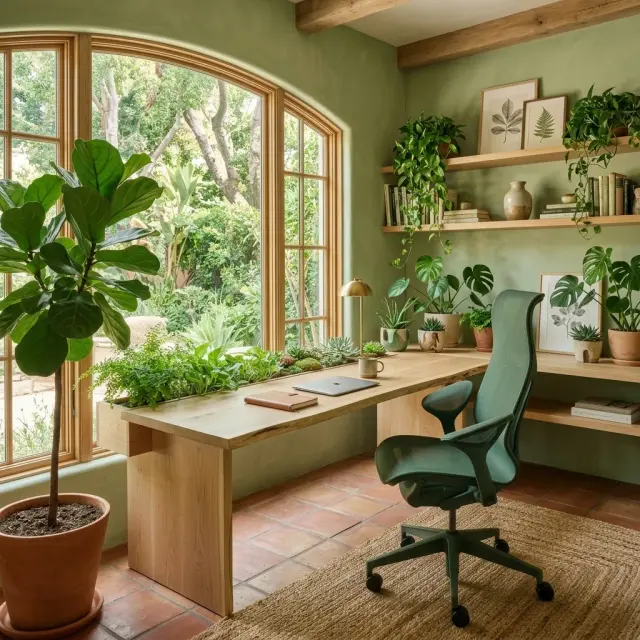
A client in Rhinebeck called me last fall because she'd spent six months renovating a guest room into a home office and could not get any work done in it. The room photographed beautifully — Roman shades, a marble desk, a velvet chair — but it never settled. We rebuilt the lighting plan in two weeks and the room finally became usable. Quiet luxury in a home office is not about the desk you order; it's about the discipline that comes before the desk. Below: eleven offices across the budget spectrum, the actual 2026 Hudson Valley costs to build them, and the framing-stage decisions that make the difference between a calm room and a quietly expensive one.
How I Read a Quiet Luxury Home Office
When a Hudson Valley client hands me a room they want turned into a home office, I read four things before I open a finish board: the natural-light direction (north and east light is best for screen work; west light is the hardest to manage), the acoustic profile (hard floors, hard walls, and bare windows make every video call sound thin), the cable and outlet plan (where the desk lands determines the floor box and the monitor power, and that has to be on the electrical rough-in drawing), and the chair zone (the chair is the only piece of furniture in the room you'll touch for forty hours a week — under-spending here is the single most common mistake). Get those four right and a $2,000 nook can outperform a $30,000 library.
After seven years running renovation design out of Beacon and Kingston, I've learned the home office is the room where quiet luxury is most often misread as a furniture-shopping problem. It's a planning problem. The eleven offices below cover the full range — from a $1,200 alcove a renter could pull off, up to a $39,000 full-millwork library — with the brand specs, real Northeast labor rates, and the framing-stage moves each one depended on. For the broader whole-home version of this aesthetic, my quiet luxury interior design pillar covers the principles applied across eight rooms.
Reading note. The numbering follows my client-walkthrough order — light to dark, simple to complex — not a ranking. Room #11 is not better than room #1; it's a different brief at a different budget for a different working temperament.
1. Minimalist Oak and Cream Serenity
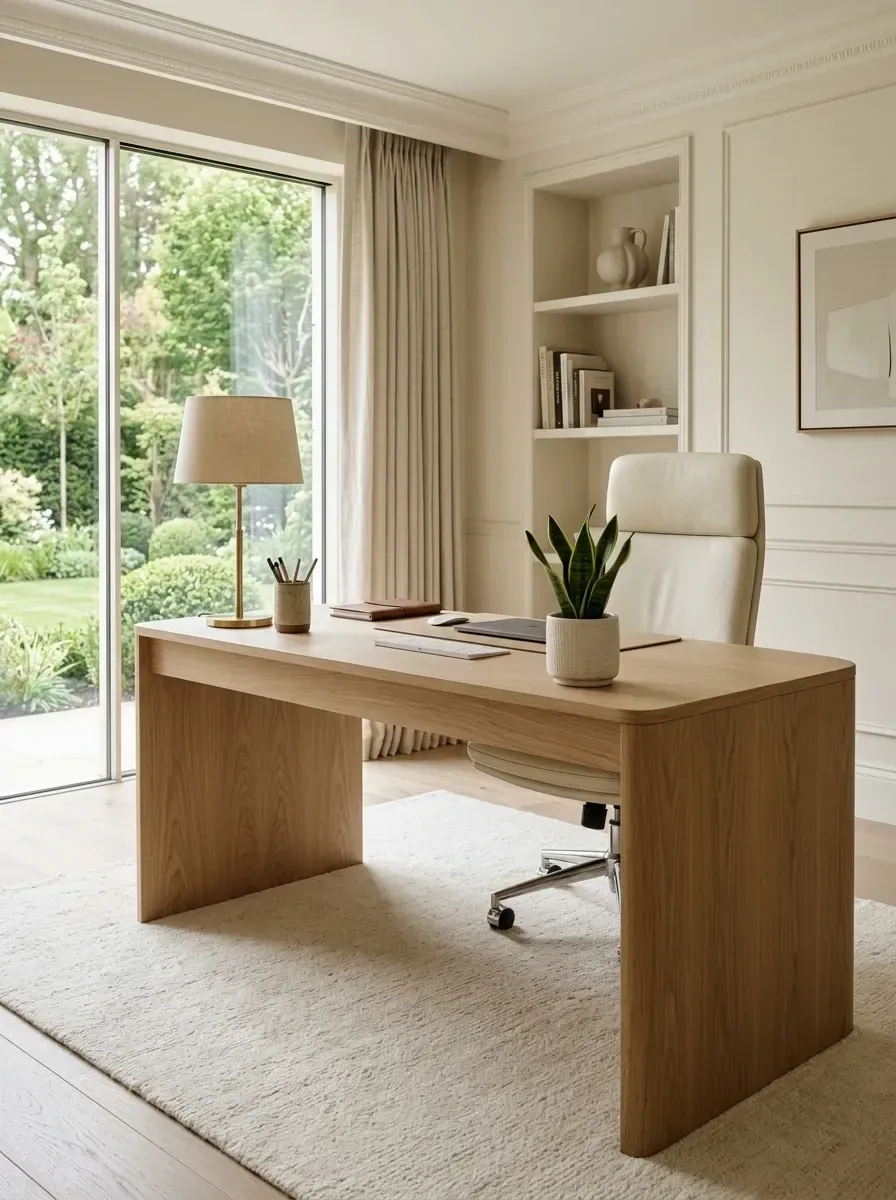
The win here is restraint, not budget. A waterfall-edge oak desk, full-height drapery, and a single built-in alcove styled with carefully grouped white ceramics — that's it. The wood grain wrapping over the edge of the desk to the floor reads as one continuous gesture, which is what makes the piece feel architectural rather than placed. The drapery runs floor to ceiling regardless of where the window actually starts, which is the trick that makes any room feel taller and quieter at the same time.
Plan-aware verdict: the waterfall desk is the splurge worth making. Solid white oak from a Hudson Valley shop runs $1,500–$3,000 in 2026, and it's the piece you'll keep through three moves. The built-in alcove is the framing-stage decision — drywall has to be detailed around blocking for a flush-finish bookcase, never built around a freestanding piece pushed into a niche. For drapery, specify a ceiling-mount track (not a window-mount rod) and 250% fullness in unlined Belgian linen — that's the spec that makes the panels read as architecture. Hudson Valley curtain workrooms run $500–$1,000 for a single window in this format.
Features
- Solid white oak waterfall-edge desk
- Floor-to-ceiling Belgian linen drapery, ceiling-mounted track
- Custom built-in alcove shelving
- Large oatmeal textured wool rug
- Single brushed brass task lamp
Cost Analysis (2026 Northeast)
| Decor Item (Qty) | Total Price Range |
|---|---|
| Solid Oak Waterfall Desk | $1,500 – $3,000 |
| High-Back Leather Office Chair | $800 – $1,500 |
| Large Textured Wool Rug (8×10) | $400 – $800 |
| Brushed Brass Table Lamp | $200 – $400 |
| Custom Floor-to-Ceiling Drapery | $500 – $1,000 |
| Built-In Shelving Unit (Materials & Labor) | $2,000 – $4,000 |
| Total Estimated Cost | $5,400 – $10,700 |
Color Palette
Soft Cream
#F2F0E6
Benjamin Moore Swiss Coffee (OC-45) or Farrow & Ball Slipper Satin (No. 2004) — warm undertone, no yellowing under afternoon light.
White Oak
#C4A484
Rift-cut white oak finished with Rubio Monocoat Pure or Bona Mega ONE in a flat sheen — flat enough to keep the grain visible but not glossy.
Oatmeal Beige
#DACCB4
Hand-woven Berber wool from Beni Rugs or a similar low-pile workshop weave — the texture grounds the desk without competing with the oak.
Brushed Brass
#B59E5F
Visual Comfort Goodman or Allied Maker hardware in unlacquered brushed brass — patinas in over a decade, never plates off.
Architect's note. Spec the drapery track at 6–10 inches above the window head and let the panels stack outside the trim, not in front of the glass. The window operates fully, the room reads taller, and the morning light is uninterrupted.
2. Moody Walnut and Deep Blue Study
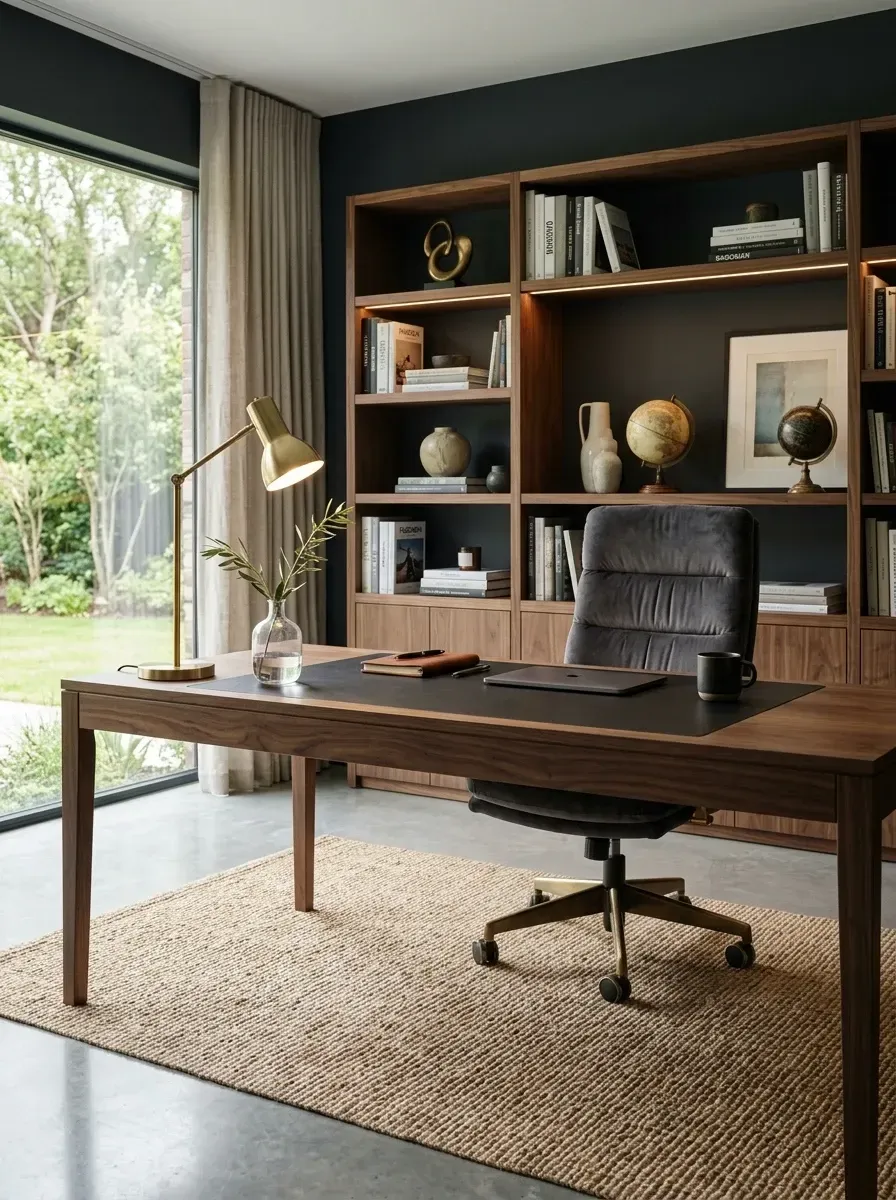
The deep palette here is doing real work. Charcoal blue walls plus dark walnut shelving plus a velvet chair makes the room cocoon around the desk — perfect for the kind of focused-writing client who can't function in a bright cream room. The integrated LED shelf lighting is the move that keeps the dark palette from going cave-like; it reads as a museum-grade detail at a fraction of the price of a custom display lighting plan.
Plan-aware verdict: dark walls actually reduce screen glare by lowering the ambient luminance the eye competes with — they're the better choice for any office where you do more than three hours of screen time a day. Custom walnut built-ins from a Beacon shop run $5,000–$10,000 for a full wall, and the integrated LED strips (warm-white 2700K, on a Lutron Caséta dimmer) add $500–$1,000 in labor and material. Specify a low-VOC walnut stain and water-based topcoat — the off-gas from oil-based finishes in a small office will make the room unusable for two weeks. Velvet on the chair is fine but make sure it's a performance velvet (Crypton or Sunbrella weave); workday wear destroys decorative velvet within eighteen months.
Features
- Custom dark walnut floor-to-ceiling built-in shelving
- Charcoal blue accent wall
- Mid-century walnut desk with brass legs
- Integrated 2700K LED shelf lighting on a dimmer
- Performance-velvet executive chair
Cost Analysis (2026 Northeast)
| Decor Item (Qty) | Total Price Range |
|---|---|
| Custom Walnut Built-In Wall | $5,000 – $10,000 |
| Mid-Century Walnut Desk | $1,500 – $3,000 |
| Performance-Velvet Executive Chair | $600 – $1,200 |
| Aged Brass Task Lamp | $300 – $600 |
| Large Jute Area Rug (8×10) | $300 – $600 |
| Integrated LED Shelf Lighting System | $500 – $1,000 |
| Total Estimated Cost | $8,200 – $16,400 |
Color Palette
Charcoal Blue
#2C3E50
Benjamin Moore Hale Navy (HC-154) at 75% formula, or Farrow & Ball Down Pipe (No. 26) — desaturated enough to read as a moody neutral, not a statement.
Dark Walnut
#4A3321
American black walnut, plain-sawn, finished with a low-VOC water-based clear or an oil-rubbed finish from Rubio Monocoat in Smoke.
Dark Grey Velvet
#545454
Crypton or Sunbrella performance velvet in charcoal — wipes clean, resists pilling, takes daily eight-hour use without distress.
Aged Brass
#A8894B
Buster + Punch or Armac Martin in unlacquered aged brass — the patina against dark walnut is the point.
Architect's note. When you spec integrated LED strips behind a shelf reveal, demand a 2700K warm-white tone with a CRI of 90+. Cool-white or low-CRI strips read clinical and flatten the wood grain — the entire luxury of the built-in evaporates.
3. Nature-Inspired Floating Desk
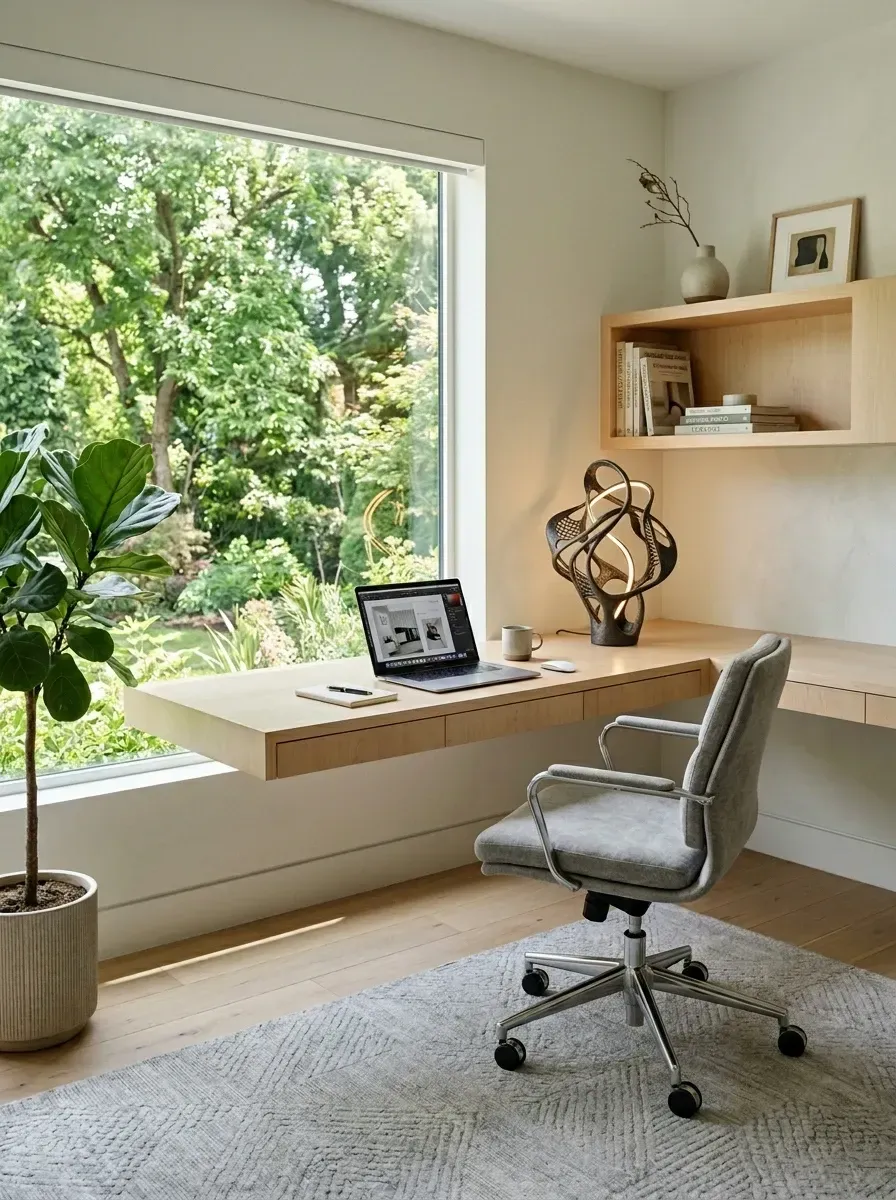
The defining move here is the desk facing the window, not the wall. That single orientation choice changes the way the room is used — the eye gets a "soft gaze" reset every time it leaves the screen, which reduces fatigue and the urge to scroll for stimulation. The custom floating desk is the second move; by keeping the floor visible underneath, the room reads larger than its actual footprint. The sculptural lamp does double duty as task light and the room's only piece of decor.
Plan-aware verdict: a floating desk is a structural decision, not a finish one. The wall behind it has to be reinforced with horizontal blocking during framing or with a French cleat into doubled studs as a retrofit. A 60-inch maple desk on properly installed cleat hardware will hold 200 pounds — but the cabinet shop has to know that's the spec before they fabricate. Cable management is the other thing that matters; specify a single grommet hole at the back-right corner and a cable channel running down to a floor outlet, decided on the electrical rough-in. Without it, you have a beautiful floating desk with a tangle of cords visible from every angle.
Features
- Custom floating maple wall-mounted desk facing a window
- Reinforced wall framing or French cleat hardware
- Sculptural bronze-patina LED table lamp
- Floating wall shelves above
- Tall fiddle leaf fig in ceramic planter
Cost Analysis (2026 Northeast)
| Decor Item (Qty) | Total Price Range |
|---|---|
| Custom Floating Desk Construction & Install | $1,500 – $3,000 |
| Upholstered Task Chair | $500 – $1,000 |
| Sculptural LED Table Lamp | $400 – $800 |
| Floating Wall Shelves (×2) | $300 – $600 |
| Patterned Jute Area Rug (6×9) | $300 – $600 |
| Tall Fiddle Leaf Fig & Planter | $150 – $300 |
| Total Estimated Cost | $3,150 – $6,300 |
Color Palette
Off-White
#F8F7F3
Benjamin Moore Simply White (OC-117) or Sherwin-Williams Pure White (SW 7005) — bright enough to bounce window light, soft enough not to glare.
Light Maple
#D4B895
Quartersawn hard maple or rift-cut beech with a hardwax oil — smoother grain than oak, brighter color, holds modern shapes well.
Cool Light Grey
#B0B0B0
A neutral grey textile (Maharam Mode or similar) that reads modern without going industrial.
Bronze Patina
#4A3B2A
A patinated bronze base (Allied Maker or Apparatus Studio) — the dark anchor that grounds the floating-everything composition.
Architect's note. When the desk faces a window, install a top-down/bottom-up cellular shade or a roller in a 5%-openness fabric (Mecho Shade or Hunter Douglas). It controls glare on the screen without blocking the soft-gaze view that's half the reason the desk is positioned there.
4. Classic Blue Built-Ins and Fireplace
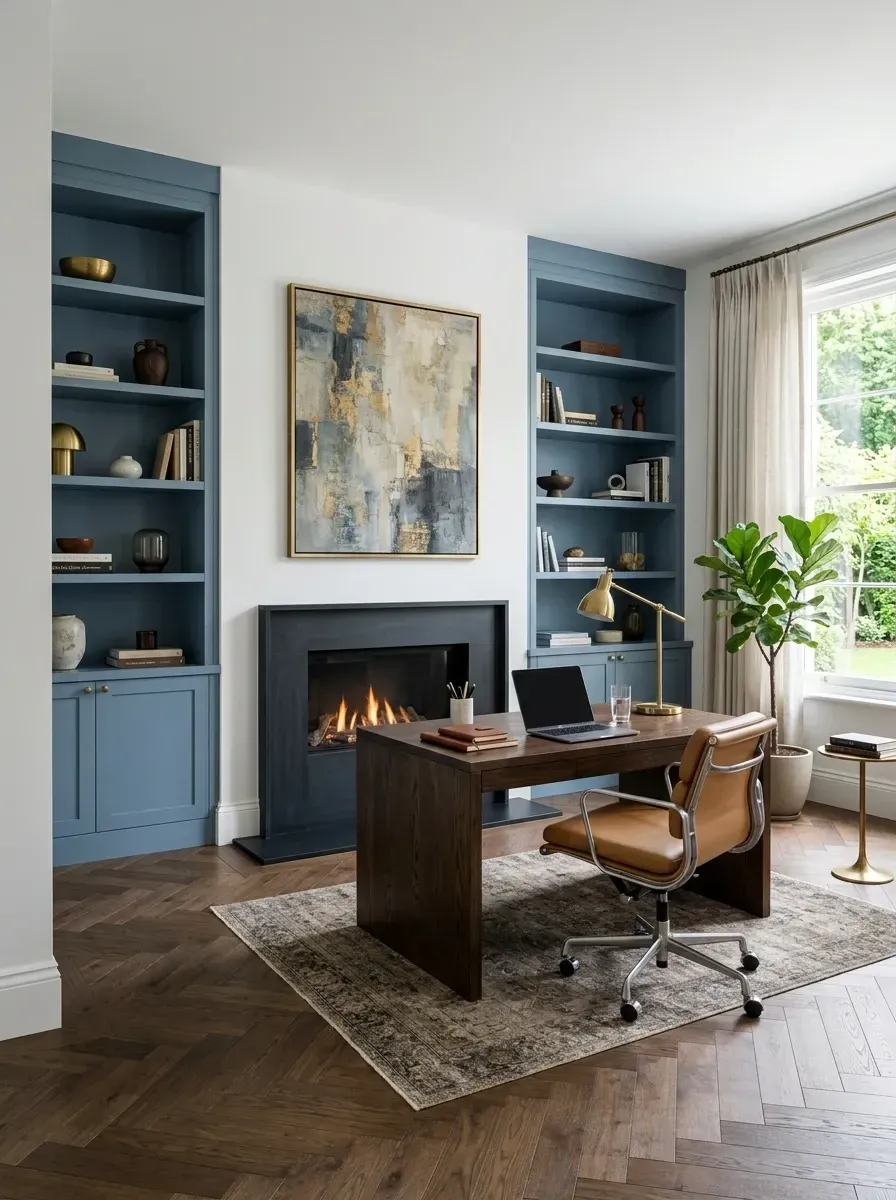
A working fireplace inside a working office is one of the most underrated luxury moves in the renovation playbook. It changes the room's relationship to the cold months — the office becomes the place you want to be in January, not the room you avoid. The slate-blue painted built-ins (a neutral, not a statement) and the herringbone oak floor are the architectural moves that lock the rest of the room into traditional-luxury vocabulary. Everything else can be calibrated lightly because those two surfaces are doing the heavy lifting.
Plan-aware verdict: a gas fireplace insert in a Hudson Valley renovation runs $4,000–$8,000 for the unit and $4,000–$7,000 for the venting and surround masonry — but it needs to be on the architectural plan from the start, because the venting requires a chase routed up through the floor system. Adding it after framing closes is a $20,000+ retrofit. The slate-blue paint is Sherwin-Williams Naval (SW 6244) or Farrow & Ball Hague Blue (No. 30); the navy-on-millwork format reads brighter than navy-on-walls because the eye expects cabinets to be lighter than the wall behind them. The Eames soft-pad management chair (Herman Miller, $4,500–$6,500 for the genuine) is the chair that costs the most and is most worth it; the budget-friendly Eames-style alternatives at $1,000–$2,000 are visually accurate but the cushion compresses within two years.
Features
- Floor-to-ceiling painted built-in cabinetry
- Gas fireplace insert with modern surround
- Herringbone medium oak flooring
- Eames-style soft pad management chair
- Large abstract canvas as the focal point
Cost Analysis (2026 Northeast)
| Decor Item (Qty) | Total Price Range |
|---|---|
| Custom Cabinetry & Fireplace Surround Renovation | $8,000 – $15,000 |
| Solid Wood Writing Desk | $1,200 – $2,500 |
| Eames-Style Soft Pad Management Chair | $1,000 – $2,000 |
| Vintage-Style Wool Rug (8×10) | $500 – $1,000 |
| Large Framed Abstract Canvas | $500 – $1,500 |
| Brass Reading Lamp | $200 – $400 |
| Total Estimated Cost | $11,400 – $22,400 |
Color Palette
Slate Blue
#4A6274
Sherwin-Williams Naval (SW 6244) or Farrow & Ball Hague Blue (No. 30) in a satin or eggshell finish for cabinetry durability.
Crisp White
#FFFFFF
Benjamin Moore Decorator's White (CC-20) — the neutral that lets the slate millwork register as the room's color.
Medium Oak
#8C6951
Solid white oak in a herringbone pattern, finished with a smoked Rubio Monocoat — warm enough to anchor blue without going orange.
Tan Leather
#A8763E
Full-grain saddle leather in a tan tannage — patinas in over five years and reads honest against the slate millwork.
Architect's note. When painting built-ins a deep color, prime the millwork with a stain-blocking primer (Zinsser BIN or Insl-X Stix) before two finish coats. Skipping primer on cabinetry guarantees tannin bleed-through within six months and a complete repaint in eighteen.
5. Scandi-Minimalist Light Wood Workspace
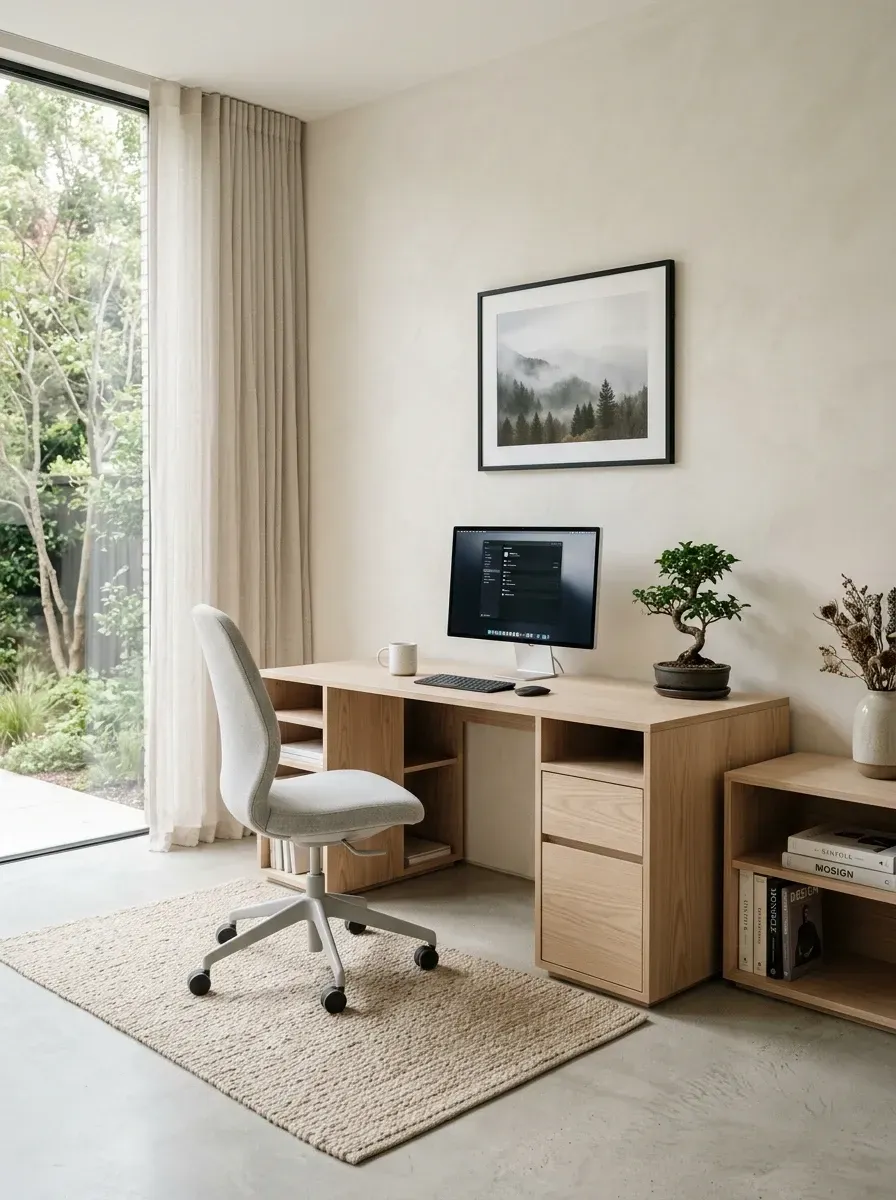
The point here is what's missing. The desk has integrated pedestal drawers so there's no surface clutter. The window is dressed in unlined sheer linen so the light is filtered, not blocked. The single bonsai sits on a low bookshelf as the only piece of decor — and it works because it's a real silhouette, not a vase of dried branches. This is the format that translates best to a renter's first home office: nothing here requires renovation, and the budget caps at under $4,000.
Plan-aware verdict: the Scandi format depends on the wood species reading honest. Specify ash, birch, or pale beech — never a maple veneer with a Scandi-marketing label. A solid ash desk from a Brooklyn shop or a Hudson Valley craftsman runs $800–$1,500 in 2026, and it'll outlast three flat-pack alternatives in the same price range. For the chair, Muuto Fiber, &Tradition Catch, or a vintage Wegner reissue from Carl Hansen sits in the $400–$1,000 range. Avoid the very-pale wood imports under $400 — the joinery fails within a year of daily use.
Features
- Solid pale ash desk with integrated pedestal drawers
- Floor-to-ceiling sheer linen curtains
- Single bonsai or sculptural plant focal point
- Large minimalist framed print
- Low pale-wood bookshelf
Cost Analysis (2026 Northeast)
| Decor Item (Qty) | Total Price Range |
|---|---|
| Solid Light Wood Desk with Drawers | $800 – $1,500 |
| Upholstered Office Chair (Muuto, &Tradition tier) | $400 – $800 |
| Jute Area Rug (5×8) | $200 – $400 |
| Large Framed Print | $150 – $300 |
| Bonsai Tree & Ceramic Pot | $50 – $150 |
| Low Pale-Wood Bookshelf | $300 – $600 |
| Total Estimated Cost | $1,900 – $3,750 |
Color Palette
Pale Beige
#E8E4D9
Farrow & Ball Slipper Satin (No. 2004) or Benjamin Moore Cloud White (OC-130) — warm-leaning neutral, no pink undertone.
Light Ash
#D3C3A8
Solid ash or birch with a Rubio Monocoat Pure or Osmo Polyx-Oil finish — Scandinavian-spec, low-VOC, ages well.
Light Grey Fabric
#BDBDBD
Kvadrat Remix or Maharam Mode in a soft grey — the textiles the Scandi designers actually use.
Natural Jute
#C2B280
A flatweave jute or sisal — adds the only coarse texture in a smooth-surfaced room.
Architect's note. A bonsai requires daily light from a south or east window and weekly watering from underneath, not on top. If you can't commit to either, swap in a small ZZ plant or a Sansevieria — both look architectural and tolerate weeks of neglect.
6. Chic Stone and Brass
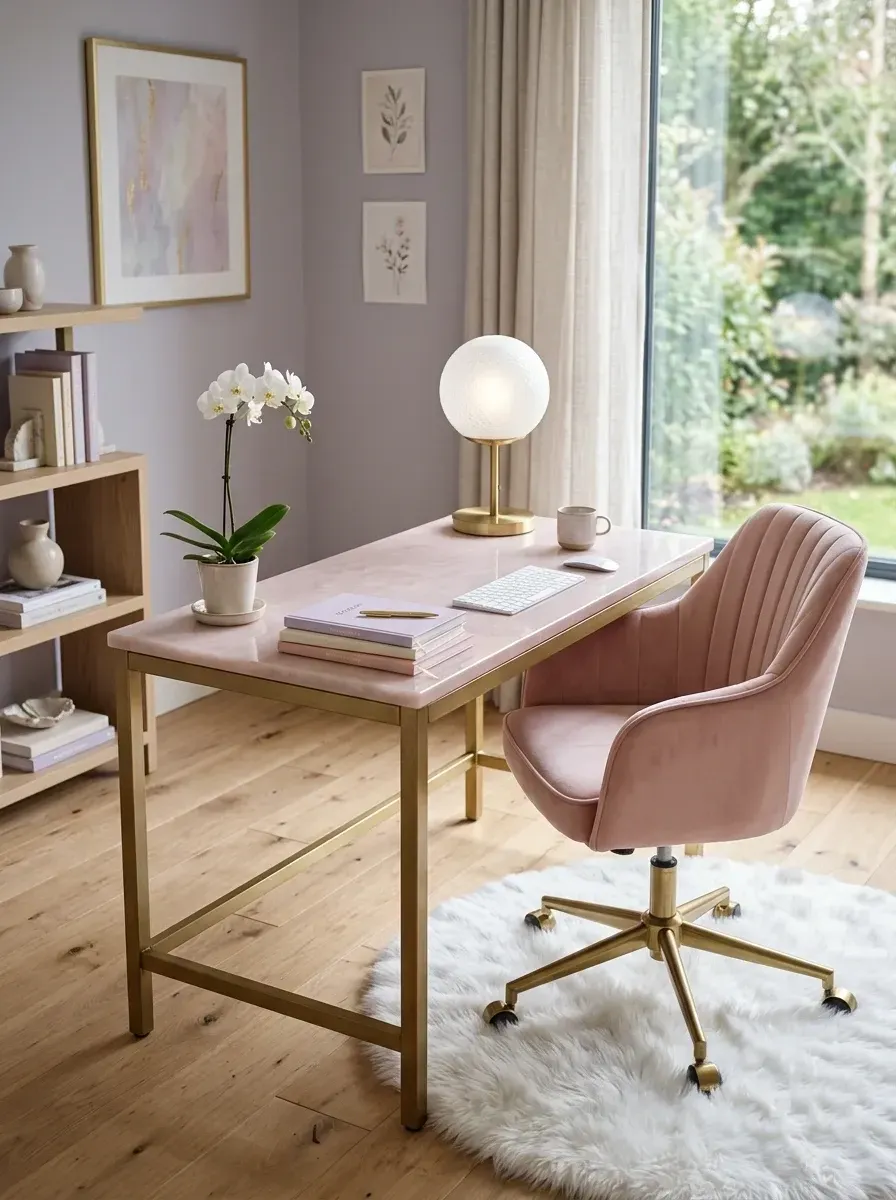
A softer, more feminine read of quiet luxury. The palette commits to a single warm direction — pale lilac-grey walls, dusty pink velvet, rose quartz, polished gold — and trusts the materials to do the work. The stone desk top is the splurge piece carrying the whole room; everything else calibrates to it. The layered sheepskin over hardwood adds the tactile counterpoint that prevents the smooth surfaces from going slick.
Plan-aware verdict: a stone-topped desk is heavier than people anticipate. A 60-inch slab of rose quartz or Calacatta Viola weighs 200–280 pounds depending on thickness — the metal base has to be welded steel, not a tubular import. Specify a 3/4-inch slab thickness with a polished bullnose edge from a regional fabricator (the Marble Institute member yards in the Hudson Valley keep small remnant slabs at 30–50% off full-slab pricing, perfect for a desk surface). Polished gold reads brassier and more reflective than brushed brass — it's the right finish for a glamour-leaning office and the wrong one for a study. Match all metals exactly: every fixture, every hardware piece, the lamp base, the chair frame. One mismatched metal will read as a mistake from across the room.
Features
- Rose quartz or pink marble desk top on gold metal base
- Dusty pink performance-velvet channel-tufted chair
- Polished gold globe and opal table lamp
- Layered faux sheepskin over hardwood
- Open gold and wood etagere shelf
Cost Analysis (2026 Northeast)
| Decor Item (Qty) | Total Price Range |
|---|---|
| Stone-Top Desk with Welded Gold Base | $1,000 – $2,000 |
| Performance-Velvet Desk Chair | $300 – $600 |
| Faux Sheepskin Rug | $100 – $200 |
| Gold & Opal Globe Lamp | $150 – $300 |
| Open Gold & Wood Etagere Shelf | $400 – $800 |
| Total Estimated Cost | $1,950 – $3,900 |
Color Palette
Pale Lilac Grey
#DCD0D8
Farrow & Ball Calluna (No. 270) or Benjamin Moore Wish (AF-680) — desaturated lavender that reads warm-grey in most light.
Rose Quartz
#E6C2C9
Rose quartz or Calacatta Viola in a 3/4-inch polished slab — request remnants from a Marble Institute fabricator.
Dusty Pink Velvet
#D497A3
Crypton or Sunbrella performance velvet in a clay-based pink — the desaturation is what keeps it sophisticated.
Polished Gold
#D4AF37
Visual Comfort or CB2 polished brass with a clear lacquer — a true polished-gold read, not satin.
Architect's note. Pink marble and rose quartz both etch from coffee, vinegar, and acidic citrus. Specify a topical sealer (Aqua Mix Sealer's Choice Gold) on day one and reseal annually — and live with the patina, because the alternative is a stone you can't actually use.
7. Grand Traditional Library Office
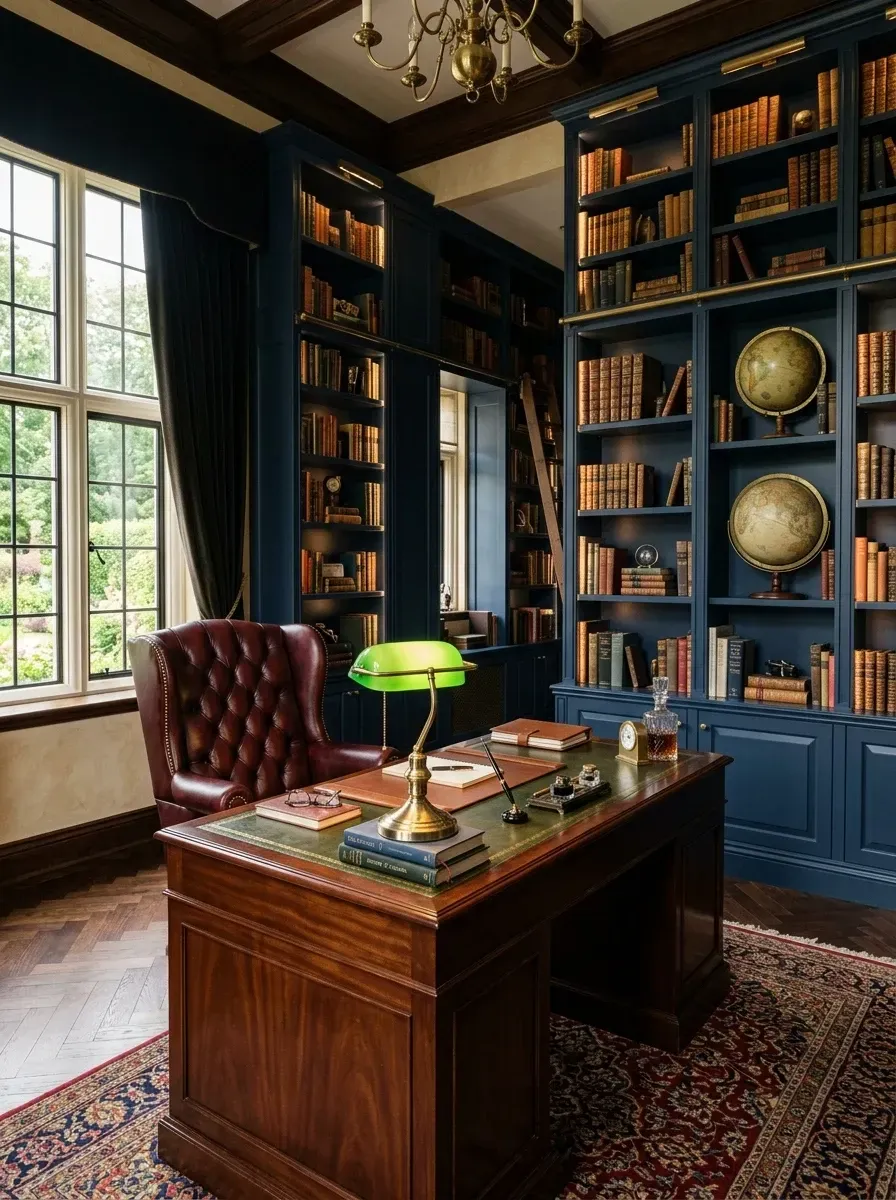
This is old-money quiet luxury at full scale. The room reads as architecture before it reads as furniture — coffered ceiling, deep-navy custom millwork to the ceiling, a rolling library ladder that's actually used. The mahogany desk with a leather inlay anchors the floor plane the way the millwork anchors the walls. Everything in the room is rigorously balanced; nothing is doing two jobs poorly. This is a format for a client who lives with the room for a decade-plus.
Plan-aware verdict: full-millwork libraries with rolling-ladder systems run $15,000–$25,000 in the Hudson Valley for a small room and double that for the Brooklyn brownstone version. The ladder hardware (Putnam Rolling Ladder Co. is the heritage spec, in production since 1905) is $3,500–$6,000 in solid brass on its own. Coffered ceilings in a renovation are a framing-stage decision — the ceiling joists need to be assessed for load and the coffer depth has to be coordinated with HVAC running above. Mahogany executive desks with leather inlay tops from a heritage maker (Restoration Hardware's Edwardian, or a custom Hudson Valley shop) run $3,000–$5,000; the genuine Chesterfield leather executive chair from Chesterfields of England or Pratt & Larson sits at $2,000–$4,000. This is the longest-payback format in the guide; it earns its $39,000 ceiling over thirty years of use.
Features
- Full-height custom navy library millwork with rolling Putnam ladder
- Coffered ceiling detail
- Mahogany executive desk with leather inlay top
- Chesterfield-style oxblood tufted leather executive chair
- Brass chandelier and bankers lamp
Cost Analysis (2026 Northeast)
| Decor Item (Qty) | Total Price Range |
|---|---|
| Custom Millwork & Library Ladder System | $15,000 – $25,000 |
| Mahogany Executive Desk with Leather Top | $3,000 – $5,000 |
| Tufted Leather Executive Chair | $2,000 – $4,000 |
| Brass Chandelier | $1,000 – $2,000 |
| Persian-Style Wool Rug (9×12) | $1,500 – $3,000 |
| Brass Bankers Lamp | $200 – $400 |
| Total Estimated Cost | $22,700 – $39,400 |
Color Palette
Deep Navy Blue
#1A2433
Benjamin Moore Hale Navy (HC-154) or Farrow & Ball Hague Blue (No. 30) — the heritage navy spec for traditional millwork.
Classic Mahogany
#673624
Honduran or Sapele mahogany with a hand-rubbed shellac or French polish — the heritage finish for a heritage form.
Oxblood Red
#591D1F
Full-grain analine-tanned leather, hand-tufted — patinas in over a decade and reads honest against the navy.
Antique Brass
#9C7C38
Hand-rubbed antique brass from Visual Comfort or Urban Electric Co. — never lacquered, always maturing.
Architect's note. When specifying a rolling-ladder library, the ceiling track must run unbroken across the entire shelving wall — no scarves, no joins. The ladder rolls smoothly only on a continuous bar, and the visible breaks read as construction errors against a heritage millwork backdrop.
8. Efficient and Cheerful Blue Nook
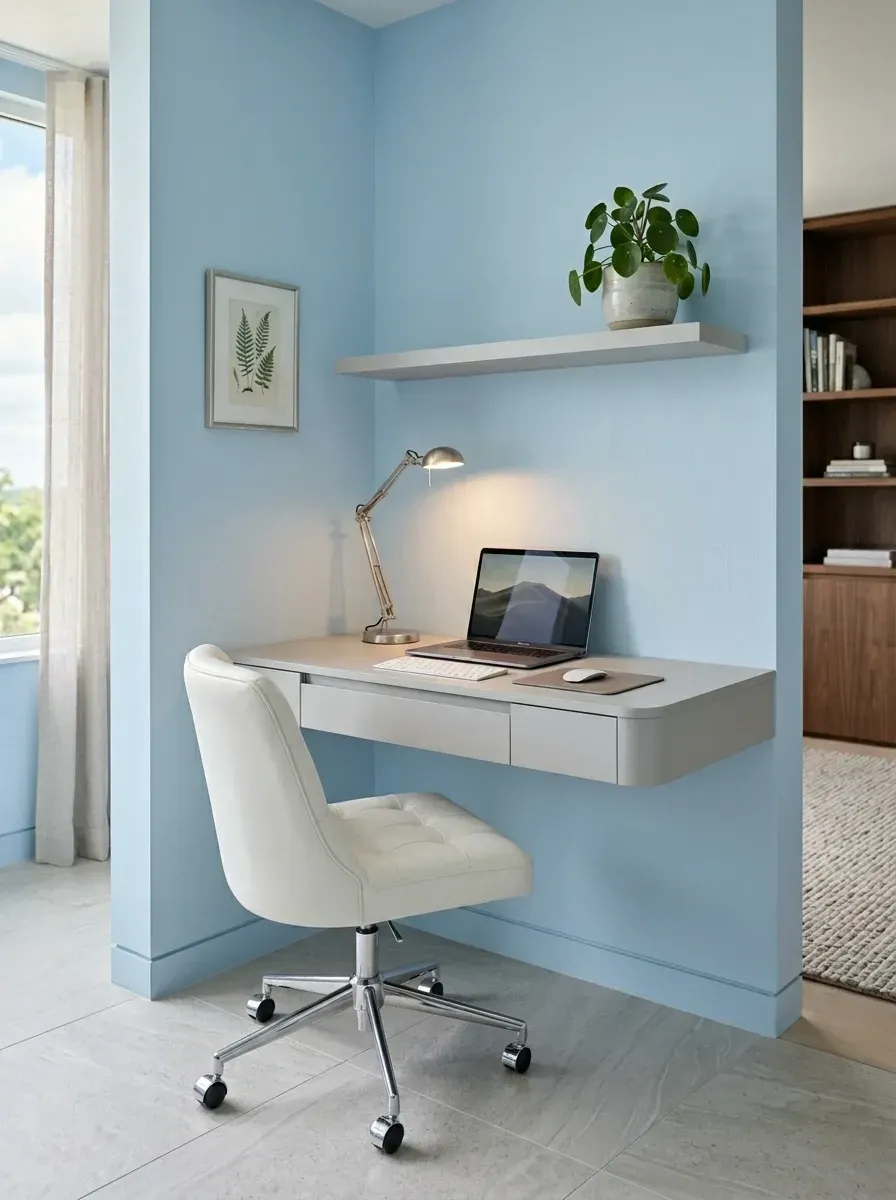
A repurposed closet or alcove turned into a working office is one of my favorite formats for clients in Brooklyn rentals or Hudson Valley walk-ups where the dedicated office isn't an option. The win here is the colored alcove — paint inside the niche becomes architecture in a way the same color on a full wall never does. The floating desk maintains the floor visibility that keeps a tight space from feeling claustrophobic. Total budget under $2,500 and the result reads as intentional, not a substitute.
Plan-aware verdict: this format is renter-compatible if the floating desk is hung on a French cleat that bolts into studs and the alcove paint is a removable peel-and-stick wallpaper or a high-quality flat. For owners, the alcove becomes a permanent built-in: paint Sherwin-Williams Atmospheric (SW 6505) or Farrow & Ball Skylight (No. 205) on the inside back wall, leave the side returns and surrounding walls in a warm white, and the contrast does all the work. Articulated desk lamps from Hay or Anglepoise (the original British design) are the right form for a tight space — they fold flat against the wall when not in use.
Features
- Repurposed alcove or closet as a dedicated workspace
- Painted color inside the niche only
- Custom floating desk on a French cleat
- White tufted desk chair
- Articulated desk lamp (Hay or Anglepoise)
Cost Analysis (2026 Northeast)
| Decor Item (Qty) | Total Price Range |
|---|---|
| Custom Floating Desk & Shelf Install | $800 – $1,500 |
| White Tufted Desk Chair | $200 – $400 |
| Articulated Desk Lamp | $100 – $200 |
| Paint & Supplies for Nook | $100 – $200 |
| Total Estimated Cost | $1,200 – $2,300 |
Color Palette
Sky Blue
#A2C4D9
Sherwin-Williams Atmospheric (SW 6505) or Farrow & Ball Skylight (No. 205) — desaturated daylight blue, calming for screen work.
Light Grey
#C0C0C0
Painted MDF or quarter-sawn maple in a soft grey — blends with the walls to keep the alcove visually small.
Crisp White
#FFFFFF
A white tufted upholstery from West Elm or CB2 — the fresh accent that makes the blue alcove feel curated rather than dated.
Brushed Steel
#AFAFAF
Anglepoise Original 1227 in brushed aluminum — the heritage articulated lamp, foldable, instantly recognizable.
Architect's note. When converting a closet to an office nook, leave the door framing and add a barn-door track outside the opening. You retain the option to close the office out of sight at the end of the workday — which matters more than any other single move for work-life separation.
9. Sculptural Modern Art Desk
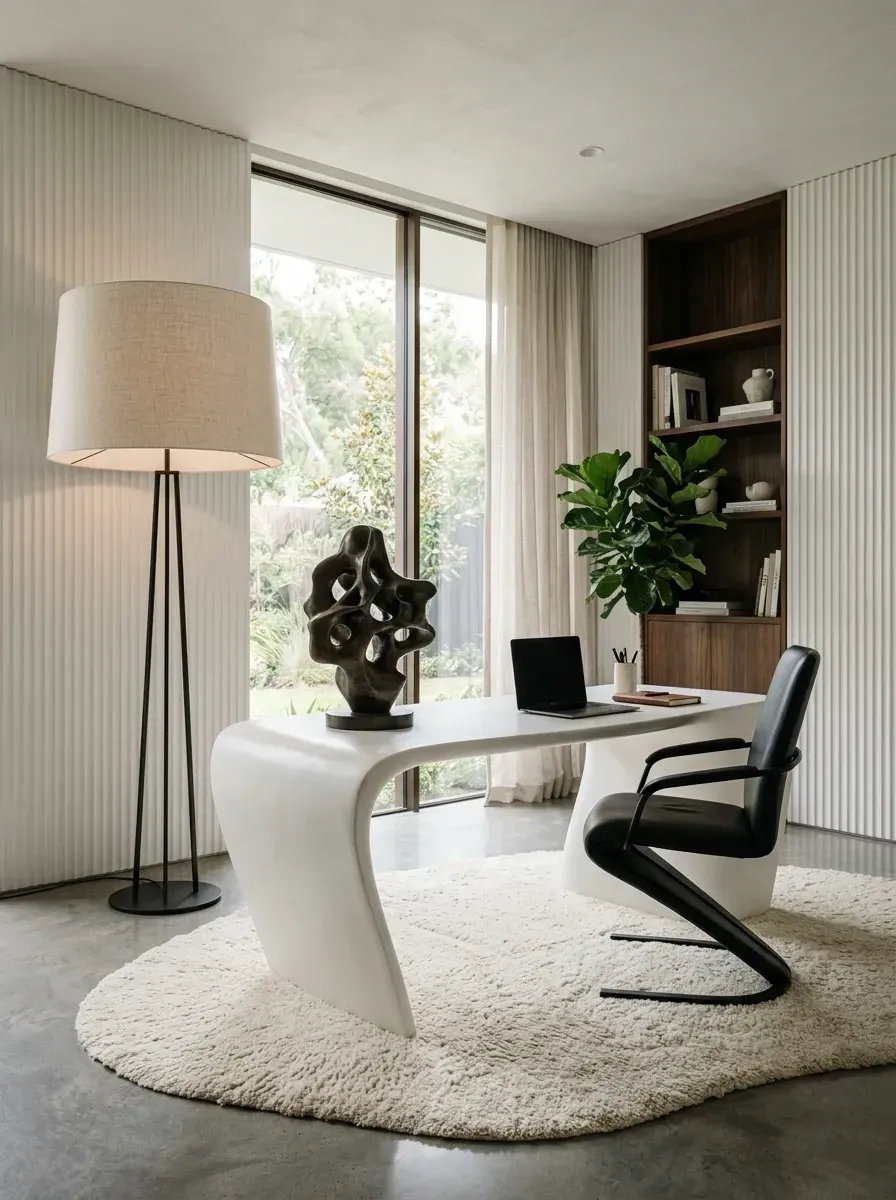
In this format, the furniture is the art. The sculptural white resin desk and the black cantilever chair are the only things in the room your eye is supposed to land on; everything else is calibrated to keep them readable. The fluted wall paneling adds texture without color, and the large round wool rug softens the room's right angles. This is the format for a client who treats the home office as a gallery space.
Plan-aware verdict: a cast-resin or composite-stone sculptural desk runs $3,000–$6,000 and arrives heavy — verify the floor structure under the install location, especially in a converted attic or a Brooklyn brownstone third floor. Fluted wall paneling can be specified two ways: real-wood fluted oak slats (premium spec, $4,000–$6,000 for a full wall installed) or a fluted MDF panel painted in a high-end matte (Benjamin Moore Aura Matte, $2,000–$4,000 installed). The MDF version reads identical from six feet — the differential goes to upgrading the cantilever chair to a vintage Knoll Bertoia or Cassina LC7. Round rugs from Beni Rugs or Armadillo in cream wool run $800–$1,500 in eight-foot diameter; the format softens hard-edged rooms in a way no rectangular rug does.
Features
- Sculptural matte white resin or composite stone desk
- Black designer cantilever chair
- Fluted vertical wall paneling (oak or painted MDF)
- Large round cream wool shag rug
- Dark bronze abstract floor sculpture
Cost Analysis (2026 Northeast)
| Decor Item (Qty) | Total Price Range |
|---|---|
| Sculptural Resin or Composite-Stone Desk | $3,000 – $6,000 |
| Designer Cantilever Chair | $800 – $1,500 |
| Large Abstract Sculpture | $1,000 – $3,000 |
| Fluted Wall Panel Installation | $2,000 – $4,000 |
| Large Round Wool Shag Rug (8 ft.) | $800 – $1,500 |
| Minimalist Tall Floor Lamp | $500 – $1,000 |
| Total Estimated Cost | $8,100 – $17,000 |
Color Palette
Matte White
#F5F5F5
Benjamin Moore Aura Matte in Chantilly Lace (OC-65) or a polished resin in matte white — both register as gallery-grade.
Matte Black
#1A1A1A
Powder-coated matte black on welded steel — Knoll Bertoia, Cassina LC7, or a contemporary cantilever from Hay.
Cream Wool
#EBE5D9
Hand-knotted cream wool shag (Beni Rugs, Armadillo, or Loloi) — the soft tactile counter to every hard surface in the room.
Dark Bronze
#4A3B2A
A patinated cast-bronze form — the dark, dense object that gives the white room its center of gravity.
Why this works. Three of the eleven offices in this guide rely on a specialty wall finish — fluted paneling (room 9), Venetian-grade plaster, or millwork to ceiling — to do work paint alone cannot. If your renovation budget can carry one architectural wall finish, that's the line item with the highest emotional return per dollar. Every other surface in the room can be standard.
10. Bohemian Green and Live-Edge Calm
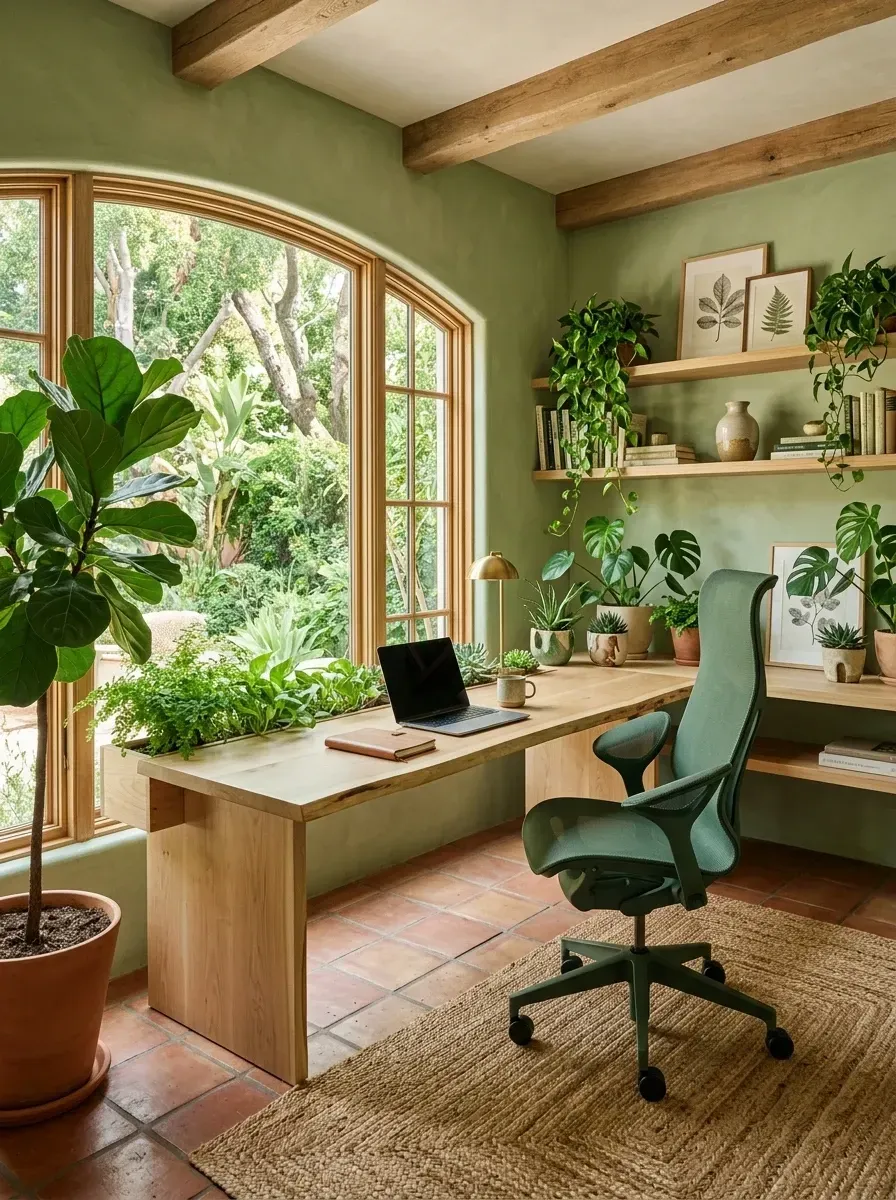
A sanctuary office. The walls are lime-wash, not paint — a velvety mineral finish that catches light differently from any flat coat — and the green shifts through the day from sage in the morning to slate in the afternoon. The live-edge oak desk preserves the bark profile on the back edge, which makes it look custom from across the room because it literally is. The Herman Miller Cosm in forest green is the chair that earns the budget; this is one of the rooms in the guide where the chair line-item is non-negotiable.
Plan-aware verdict: lime-wash from Portola Paints, Bauwerk, or Pure & Original requires a primer specific to the substrate (Portola's Lime-Wash Primer or a tinted base coat) and three coats applied with a flagged brush in a cross-hatch pattern. Hudson Valley painters who actually know lime-wash run $4–$7 per square foot — verify by asking for references on completed projects, because half the painters who advertise it apply it like a wash coat over latex and the result fails within a year. Live-edge desks from Beacon-area woodworkers (Asher Israelow, Matthew Hilton-style local makers) run $4,000–$8,000 in oak with floating shelf integration. Terracotta tile (Saltillo or Mexican Tecate Tile) is honest about its origins; specify a penetrating sealer and resign yourself to the patina because that's the design.
Features
- Sage green lime-wash painted walls
- Custom live-edge oak built-in desk and shelving
- Terracotta or Saltillo tile flooring
- Herman Miller Cosm high-back ergonomic mesh chair
- Collection of large plants and ceramic pots
Cost Analysis (2026 Northeast)
| Decor Item (Qty) | Total Price Range |
|---|---|
| Custom Live-Edge Desk & Shelving | $4,000 – $8,000 |
| Herman Miller Cosm High-Back Chair | $1,200 – $1,800 |
| Terracotta Tile Flooring (~150 sq ft installed) | $1,500 – $3,000 |
| Collection of Large Plants & Ceramic Pots | $500 – $1,000 |
| Jute Runner Rug | $200 – $400 |
| Total Estimated Cost | $7,400 – $14,200 |
Color Palette
Sage Green Lime-Wash
#94A38C
Portola Paints Lime-Wash in Sycamore or Bauwerk in Olive — applied in three brushed coats over a tinted primer.
Live-Edge Natural Oak
#C4A484
Hand-finished slab from a Hudson Valley woodworker — preserved bark edge, hardwax oil finish, no glossy poly.
Terracotta Tile
#B37457
Mexican Saltillo or Tecate Tile in 12×12 in. — penetrating sealer (Aqua Mix Sealer's Choice Gold), zero topical wax.
Forest Green Mesh
#4A6B4A
Herman Miller Cosm high-back in Glade or Forest mesh — the ergonomic spec that justifies its price tag in years three through ten.
Architect's note. Lime-wash needs to breathe — never seal it with a topcoat or a wax, no matter what a finish-store rep tells you. If it gets scuffed, touch it up with the same lime-wash material and let it self-blend. Sealing it locks in the marks permanently.
11. Warm Wood Craftsman Built-Ins
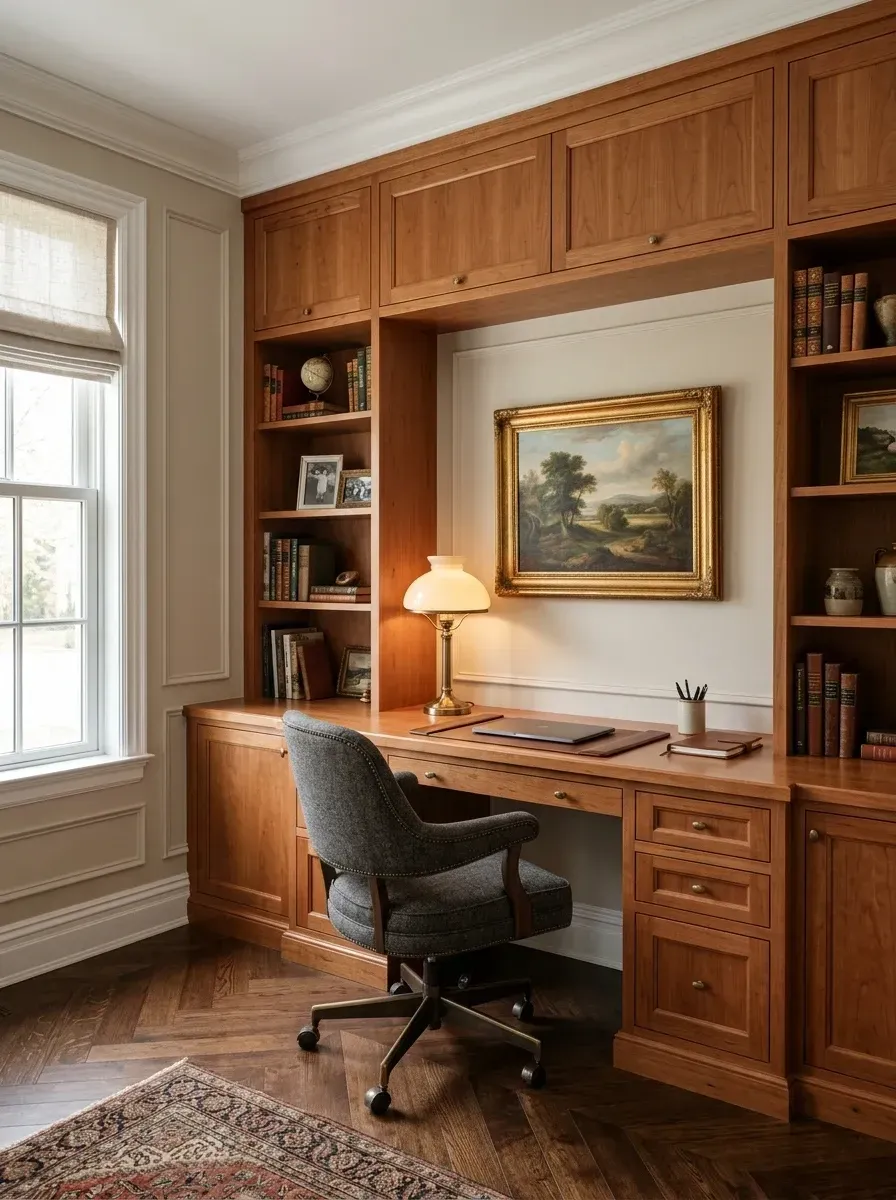
The warmest format in the guide. Floor-to-ceiling cherry built-ins and a herringbone oak floor wrap the room in wood the way a tailored suit wraps the body — every surface aligned, every joint considered. The central open back-painted shelving section is the move that prevents the wood-on-wood from going monotonous; it's a calibrated break that gives the room a focal point. The tweed chair is the right textile choice because it adds the only soft material in a room otherwise full of hard surfaces.
Plan-aware verdict: cherry millwork is a 30%+ premium over oak for the same footprint and is worth it only if the room actually gets the warm color reading you want — cherry darkens significantly over the first five years, and the room you build now is not the room you'll be working in by year ten. Specify a UV-cured topcoat (Bona Mega ONE or a waterborne 2K acrylic) to slow the darkening if needed. The painted-back center reveal should be in a soft cream (Benjamin Moore White Dove or Farrow & Ball Slipper Satin) — never pure white, which reads stark against warm wood. For the chair, performance tweed (Maharam Hallingdal or Kvadrat Hallingdal 65) over a hardwood frame outlasts any of the trendy wool-blend chairs at half the price.
Features
- Floor-to-ceiling warm cherry wood built-ins
- Integrated desk nook
- Central open back-painted shelving section
- Performance-tweed upholstered desk chair
- Herringbone medium-oak floor
Cost Analysis (2026 Northeast)
| Decor Item (Qty) | Total Price Range |
|---|---|
| Custom Cherry Wood Built-In Cabinetry | $12,000 – $20,000 |
| Performance-Tweed Desk Chair | $600 – $1,200 |
| Vintage-Style Brass Lamp | $200 – $400 |
| Framed Oil Painting | $500 – $1,500 |
| Patterned Wool Area Rug (6×9) | $400 – $800 |
| Total Estimated Cost | $13,700 – $23,900 |
Color Palette
Warm Cherry Wood
#966046
Solid American cherry, hand-rubbed oil finish or a UV-cured waterborne topcoat — patinas to a deeper ruby over a decade.
Warm Cream
#F0EAD6
Benjamin Moore White Dove (OC-17) or Farrow & Ball Slipper Satin (No. 2004) — never pure white against warm wood.
Grey Tweed
#7A7A7A
Maharam Hallingdal 65 or Kvadrat Steelcut Trio in a charcoal-leaning grey — durable, textured, ages without pilling.
Antique Gold
#B39B6F
Hand-rubbed antique gold from Visual Comfort or Hinkley — never lacquered, ages with the cherry.
Architect's note. Cherry wood reacts strongly to direct sunlight — a cherry built-in across from a south-facing window will darken unevenly within two years. Either rotate decor objects on the shelves regularly or specify a UV-blocking film on the window to keep the patina even.
Pro Tips From the Renovation Designer's Chair
- The chair is non-negotiable. The chair is the only piece of furniture you'll touch for forty hours a week, and it's the line item where homeowners reliably under-spend. A Herman Miller Aeron or Cosm at $1,200–$1,800 is the right tier; a Steelcase Gesture at $900–$1,400 is the budget-friendly equivalent. The $300 imported "ergonomic mesh" chairs fail within eighteen months and cause back pain you'll blame on the desk job, not the chair. Spend here first, everywhere else second.
- Every overhead light on a dimmer. A home office shifts from full-daylight to low-evening over a single workday, and the lighting has to follow. Lutron Caséta dimmers ($60 a switch installed) on the overhead and any sconces give you the ramp. Without dimmers, the room reads functional at noon and harsh at six — which is the time you most need it to feel calm.
- Cable management belongs on the rough-in drawing. Floor outlets, desk-side outlets, monitor-power runs, USB-C charging zones, and the path back to the network closet — all of this gets specified before drywall closes. The single most common renovation regret I hear is "I wish I'd put a floor box under the desk." Retrofit is $400–$800 per outlet and tears up flooring; rough-in is $80.
- Tactile accessories matter more than wall art. Replace the plastic on your desk with leather (a Smythson or Hightower blotter), brass (a substantial pen cup), ceramic (a thrown coffee mug), and solid wood (a small box or tray). The sensory feedback of touching real materials forty hours a week changes how the room reads. Wall art is what guests see; touchpoints are what you feel.
- Hide the technology you can. A monitor cantilever arm clears the desk surface. A printer goes in a closed cabinet, not on a console. A router lives in a network closet or behind a closed door. Visible tech is the single fastest way to break a quiet luxury room — every flashing LED is a competing focal point.
- Treat the acoustic profile as a design surface. Hard floors, hard walls, and bare windows make video calls sound thin and the room feel restless. A wool rug under the desk, full-height drapery on at least one window, and an upholstered chair are the three moves that quiet a room without acoustic panels. If the room still echoes, add a fabric-front bookcase or one upholstered wall panel — both read as decor, not treatment.
Cost-Saving Moves That Don't Read as Cuts
- Paint is the highest impact-per-dollar move. A gallon of Farrow & Ball, Benjamin Moore Aura, or Portola Paints in a complex color transforms a room for $400–$800. Don't forget the ceiling and trim — quiet luxury offices treat the fifth wall as a design surface.
- Upgrade the hardware, not the cabinets. Swapping builder-grade knobs and pulls on existing cabinetry to Buster + Punch, Armac Martin, or Rejuvenation hardware is a $200–$600 line item that makes a stock cabinet read custom. Spend on the touchpoints, save on the substrate.
- Stone remnants for a desk top. A 60-inch desk surface in Calacatta, Statuario, or rose quartz off a fabricator's remnant rack runs 30–50% under full slab pricing. Visit the yard, bring your dimensions, and let the available remnant pick your project.
- Semi-custom millwork over fully custom. A semi-custom built-in (KraftMaid Vantage, Decora Reserve, or a regional shop's stock-line) finished in the same wood species and stain reads identical to fully custom in 90% of installations. The 30–40% cost delta funds the lighting, hardware, and chair upgrade that visibly matter.
The Core Idea. A quiet luxury home office is not a furniture order; it's a planning discipline. The orientation of the desk to the natural light, the cable plan that lands on the rough-in drawing, the chair that doesn't get value-engineered, and the lighting that's all on dimmers — those decisions matter more than the price of any single piece. Build the room with that discipline and a $1,200 closet-nook will outwork a $30,000 millwork library that shipped without a plan.
Reader Questions on the Quiet Luxury Home Office
What defines quiet luxury in a home office?
Quiet luxury in a home office means high-quality natural materials, considered craftsmanship, and timeless detailing instead of branding or trend pieces. The hallmarks are restrained palettes (three or four colors, not seven), heavy use of natural materials (wool, oak, leather, linen, plaster), every light source on a dimmer, hidden technology, and a chair that costs more than the desk because it's the piece you actually touch. The result is a sophisticated workspace that doesn't announce itself but supports forty-hour weeks without fatigue.
How can I make my home office look expensive on a budget?
Declutter aggressively, invest in one foundational piece (chair, desk, or built-in — pick one), and put every overhead light on a Lutron Caséta dimmer. Replace plastic desk accessories with leather, brass, and ceramic touchpoints. Repaint the walls in a complex Farrow & Ball or Benjamin Moore historical-collection color. The $1,200 closet-nook in room 8 above uses the same principles as the $39,000 library in room 7 — the discipline is what costs nothing, and the materials follow as the budget allows.
What are the best colors for a calming home office?
Soft warm neutrals (Benjamin Moore Swiss Coffee OC-45, Farrow & Ball Slipper Satin No. 2004, Sherwin-Williams Accessible Beige SW 7036) are the classic specs. Deeper moody tones — Hale Navy HC-154, Down Pipe No. 26, Naval SW 6244, sage lime-wash — work just as well for clients who focus better in cocooning rooms. Avoid pure white (it glares with screen light) and pure black (it shows every speck of dust). The principle isn't which color but that the color has depth — a complex pigment from a heritage paint line, not a flat builder-grade tint.
Is custom built-in cabinetry worth the investment for a home office?
Conditionally. Built-ins maximize storage, hide clutter, and create the architectural read freestanding furniture rarely achieves — for a long-term hold (10+ years) in a primary home, they pay back in daily quality of life. For a 3-year flip or a rental, freestanding pieces from semi-custom lines like Room & Board, Crate & Barrel's solid-wood collection, or local Hudson Valley craftsmen will get you 80% of the look at 30% of the cost. The decision depends on tenure, not aesthetic preference.
How much does a quiet luxury home office actually cost in 2026?
In the Northeast, expect a primary home office in this aesthetic to land between $5,000 and $40,000 depending on whether you're working with paint and furniture (rooms 1, 5, 6, 8 — $1,200–$10,700) or full architectural millwork (rooms 2, 4, 7, 11 — $8,200–$39,400). The single biggest budget swing is custom millwork versus freestanding furniture; the second-biggest is the chair tier (Herman Miller / Steelcase versus generic ergonomic). Lighting, paint, and accessories are the smallest line items but have the highest impact per dollar.
Do I need a separate room for a quiet luxury office, or can it work in a shared space?
Both work with different ceilings. A dedicated room lets you control lighting, acoustics, and visual focus completely, and it gives you the work-life separation that matters for productivity. A shared space — a corner of a bedroom, an alcove off a hallway, a closet conversion (room 8 above) — works if you commit to a barn door or a heavy curtain that closes the workspace out of view at the end of the day. The room you can close is always more usable than the room you can't, regardless of finish.
Where to Read Next
If this guide helped, the natural follow-ups go in two directions. For the broader whole-home version of these principles, my quiet luxury interior design pillar covers the format across eight rooms. For the more enveloping, screen-friendly cousin to the moody offices in rooms 2 and 4, the quiet luxury bedroom guide picks up the same vocabulary in a sleeping space. And if a plant-heavy live-edge office (room 10) is the format that resonates, the biophilic bedroom guide goes deeper into the natural-materials thinking behind it.
Sources & Further Reading
- Architectural Digest. What Is Quiet Luxury? The Interior Design Trend, Explained. architecturaldigest.com
- Houzz Editorial. How Much Does a Home Office Cost? houzz.com
- Herman Miller Research. The Science of Office Ergonomics. hermanmiller.com
- Remodelista. 10 Secrets for a Calm Home. remodelista.com
- Lutron Electronics. Caséta Wireless Lighting Control — Residential Specification Guide. lutron.com
- Benjamin Moore. Color Trends and Historical Collection Specifications. benjaminmoore.com
- Farrow & Ball. Paint Color Encyclopedia & Specifications. farrow-ball.com
- Marble Institute / Natural Stone Institute. Care & Cleaning of Natural Stone Surfaces. naturalstoneinstitute.org
- Putnam Rolling Ladder Co. Heritage Library Ladder Specifications since 1905. putnamrollingladder.com
- NAHB / Hanley Wood. 2025 Cost vs. Value Report — Home Office Renovation ROI by Region. remodeling.hw.net

Nora Whitfield
Renovation Designer & Interiors Editor · Beacon, New YorkNine years of design-build renovation work across the Hudson Valley and the Northeast. Nora runs the Renovations, Room Guides and Renovation Mind desks — before-and-after studies, room-by-room design guides, and the long essays on why what we renovate matters.
More from Nora →
Reader notes