


The single most expensive mistake I see Hudson Valley parents make on a kids' room is buying themed furniture — the race-car bed, the princess vanity, the crib that only works as a crib. Three years later it all gets dragged to the curb on bulk-pickup day, and the family starts over. The Scandi Boho approach quietly fixes this. The trick isn't a style — it's a structural separation. Treat the room as two layers: the architectural shell (floor, walls, beds, dressers, built-ins) that has to last 18 years, and the decor layer (textiles, art, lighting, soft seating) that can change every two. Below, nine rooms that handle that split well, with the real Northeast cost ranges and the plan-aware decisions behind each one.
How I Read a Forever Room
When a Beacon or Rhinebeck client asks me to design a kids' room they won't have to redo every three years, I read four things before color or theme even comes up: the shell vs. layer split (which pieces are permanent and which are interchangeable), the scale of the furniture (always full or twin from day one — never toddler-scaled, never themed), the storage architecture (open access for toys at age three, closed access for clutter at age twelve, hangable space by age fifteen), and the flexibility of the wall plane (paint over wallpaper, picture rails over gallery nails, magnetic primer under the chalk paint). Get those four right and the same room serves a baby, a kid, and a teenager without a renovation in between.
Across seven years of Hudson Valley renovations, the families who get the most out of a kids' room are the ones who treat it like a small apartment — durable shell, replaceable furnishings — not like a stage set. The nine rooms below cover the realistic age range, from $1,200 nursery layouts to $4,500 teen-ready builds. For broader category context, our bedrooms and kids' rooms archive sits over the top of this room-by-room read.
Reading note. The numbering loosely follows age progression — nursery to teen — but each room can be lifted on its own. Pick the section closest to your child's current stage and ignore the rest.1. Geometric Feature Wall, Simple Bed
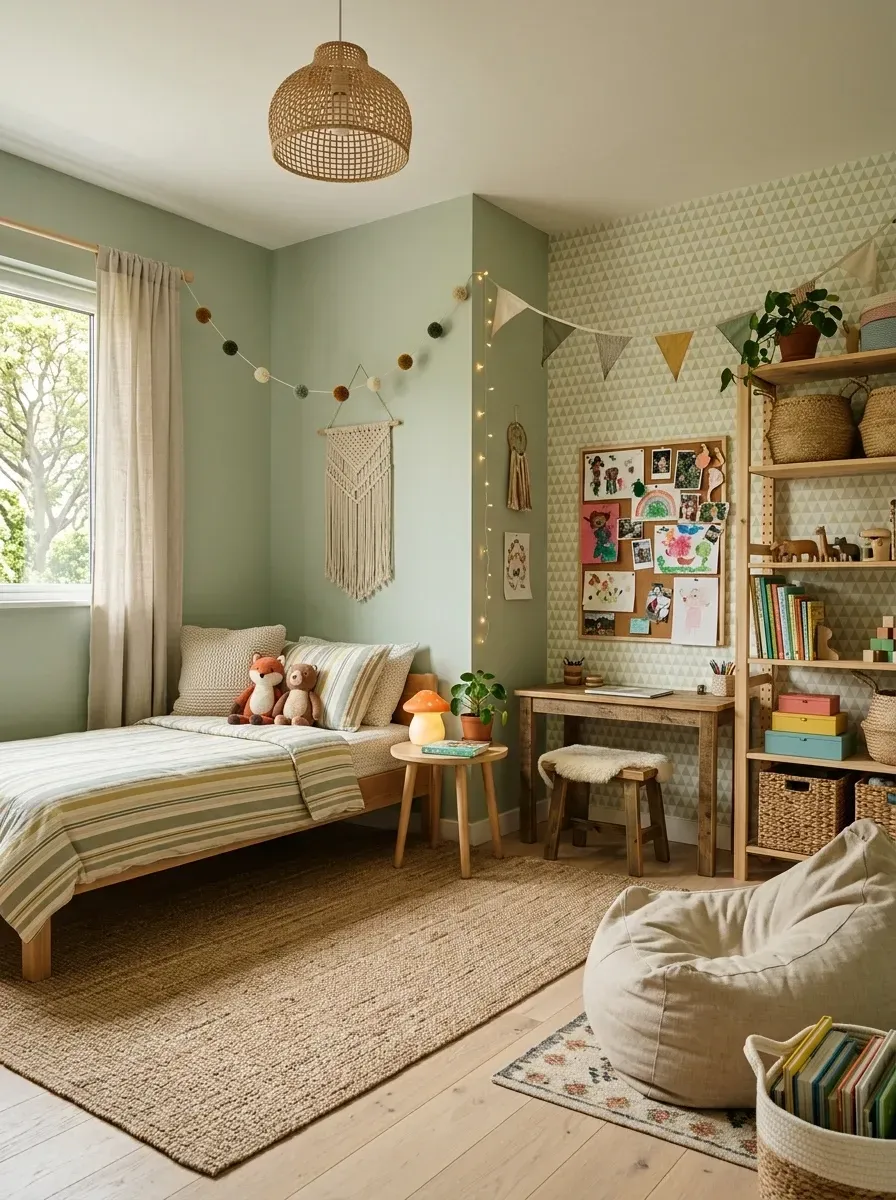
This is the cleanest illustration of the shell-vs-layer split. The architectural shell — sage paint, geometric wallpaper, twin-size bed, jute rug — is age-agnostic. Nothing here screams toddler or teen. The layered decor — pom-pom garland, stuffed animals, kid-scale bedding — is what swings between ages, and every piece is a five-minute swap. When the seven-year-old becomes a twelve-year-old, the garland comes down and a linen duvet replaces the cotton one. The room reads completely different. The construction cost has not changed.
Plan-aware verdict: the wallpaper is the line item I'd flag. Skip the peel-and-stick versions on a Hudson Valley plaster wall — they fail within two years on a textured surface. A traditional paste-the-wall paper from Hygge & West, Rifle Paper Co., or Cole & Son installed by a paper-hanger runs $300–$600 for one feature wall, and pulls off cleanly when the kid's tastes shift. Twin bed first, never toddler bed — you save $300–$500 by skipping the in-between purchase.
Features
- Geometric pattern wallpaper on a single feature wall
- Simple solid-pine twin bed frame
- Jute area rug (6×9)
- Sage green wall color (age-neutral)
- Removable styling: pom-pom garland, soft toys, kid-scale bedding
Cost Analysis (2026 Northeast)
| Decor Item (Qty) | Total Price Range |
|---|---|
| Geometric Wallpaper (One Feature Wall, Material + Install) | $300 – $600 |
| Simple Wood Twin Bed Frame | $200 – $500 |
| Jute Area Rug (~6×9) | $150 – $300 |
| Woven Rattan Pendant Light | $60 – $150 |
| Open Shelving Unit | $100 – $250 |
| Bean Bag Chair | $80 – $150 |
| Decor (Bedding, Garland, Lamp) | $300 – $500 |
| Total Estimated Cost | $1,190 – $2,450 |
Color Palette
Soft Sage Green
#A4B89D
Farrow & Ball Lichen (No. 19) or Sherwin-Williams Evergreen Fog (SW 9130) — desaturated greens that read as a neutral once they're up.
Cream & Sage Geometric
#E8E4D9
Hygge & West, Rifle Paper Co., or Cole & Son — paste-the-wall format, not peel-and-stick.
Natural Pine
#D6C29E
Solid pine or birch in a clear hardwax-oil finish — Plyroom, Oeuf NYC, or IKEA Sundvik for the budget end.
Muted Terracotta
#C78B6C
Pulled in through textile accents — Garbo & Friends, Coyuchi, or Lorena Canals washable cushions.
2. The Flexible Art Station
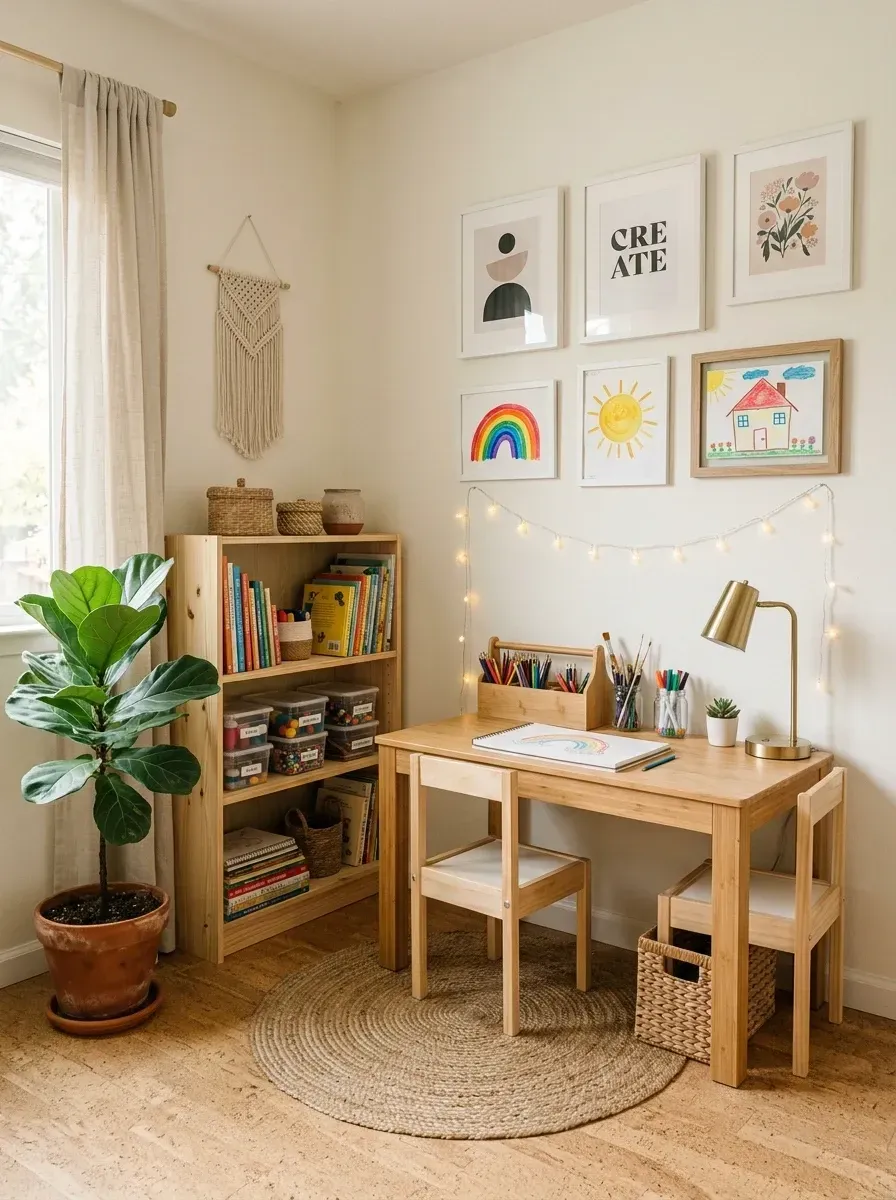
A dedicated activity zone is one of the highest-leverage moves in a kids' room — kids who have a defined work surface use it. The detail that makes this corner work is a little subtle: every frame on the gallery wall is the same size and the same color. That single rule is what lets crayon drawings get swapped for school photos at age six, then printed art at age twelve, then concert posters at age sixteen, all without re-hanging anything. Standardized frames are the cheapest forever-room move there is.
Plan-aware verdict: the desk should be sized like a small adult desk — roughly 42×24 inches and 28–30 inches tall — not toddler-scaled. A two-year-old uses it standing up, a six-year-old grows into the chairs, a sixteen-year-old uses it as a dressing table. Same piece, eighteen years. The string lights are the one element I'd remove around age ten — they read juvenile fast. For a Montessori-leaning equivalent, see our Montessori adventure room design guide.
Features
- Gallery wall of standardized frames (8×10 mat in 11×14 frame is the easiest size)
- Simple light-birch desk and two small chairs
- String lights for the early years (removable)
- Real plant in a woven basket — fiddle-leaf fig or rubber tree
- Small bookshelf within toddler reach
Cost Analysis (2026 Northeast)
| Decor Item (Qty) | Total Price Range |
|---|---|
| Simple Light-Wood Desk | $100 – $250 |
| Small Wood Chairs (×2) | $80 – $160 |
| Brass Task Lamp | $40 – $100 |
| Standardized Gallery Frames + Art Supplies | $150 – $300 |
| Small Bookshelf | $80 – $150 |
| Round Jute Rug | $50 – $100 |
| Large Potted Plant | $100 – $200 |
| Total Estimated Cost | $600 – $1,260 |
Color Palette
Warm Off-White
#F2F0E6
Benjamin Moore Simply White (OC-117) or White Dove (OC-17) in eggshell — wipeable for inevitable crayon excursions.
Light Birch
#E3D3B8
Solid birch or beech with a clear water-based finish — IKEA Sundvik scaled-up siblings or Plyroom for the design upgrade.
Foliage Green
#5F7A4E
Living color — fiddle-leaf fig, rubber tree, or pothos. Real plants only; faux ones never read right.
Primary Pops
#D94F4F
The room's only loud color. Concentrate it inside the gallery frames and let the rest of the palette stay quiet.
3. The Homework Zone with a Mature Palette
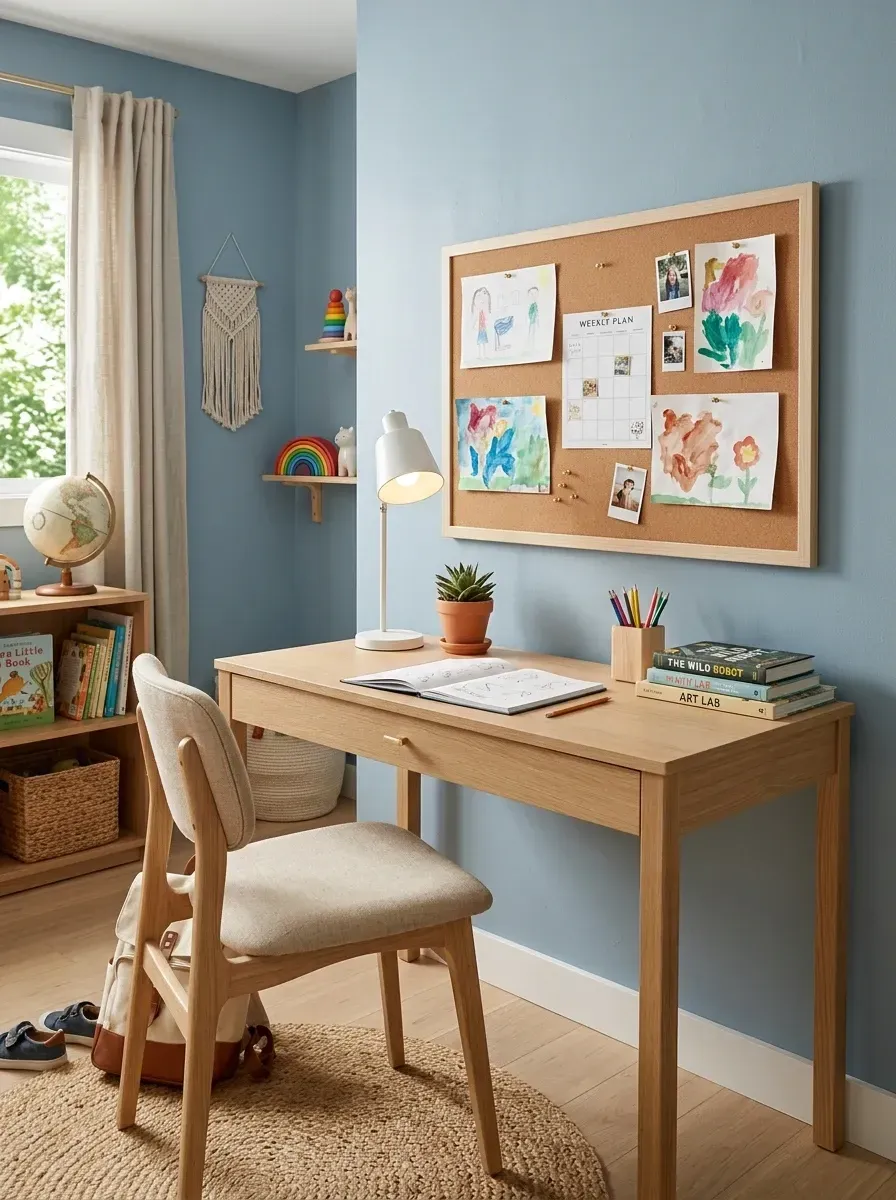
This is the same Scandi Boho language pushed three or four years later in the kid's life. The palette is darker and quieter — a slate blue that reads as a neutral once it's up, an oak desk with a real drawer for actual school stuff, an upholstered chair the kid can sit in for two hours of homework. The corkboard is the secret weapon — a 24×36 framed corkboard runs $50–$100 and absorbs every shifting interest the kid has, from soccer schedules to band-poster phases, without anyone touching the walls.
Plan-aware verdict: this room is the cleanest case for paint as the cheapest renovation tool there is. A single Hudson Valley painter can roll an accent wall in a kid's room in a half-day for $400–$700 with two coats and proper prep. Slate blues like Benjamin Moore Hale Navy (HC-154), Farrow & Ball De Nimes (No. 299), or Sherwin-Williams Riverway (SW 6222) will work for both an eight-year-old and an eighteen-year-old. The desk and chair should be full-adult-scale from day one.
Features
- Slate blue walls (paint, not wallpaper)
- Oak desk with single storage drawer
- Large framed corkboard for shifting interests
- Upholstered desk chair, oatmeal linen
- Floating shelves for plants and books
Cost Analysis (2026 Northeast)
| Decor Item (Qty) | Total Price Range |
|---|---|
| Oak Desk with Drawer | $300 – $600 |
| Upholstered Desk Chair | $150 – $300 |
| Modern Desk Lamp | $40 – $80 |
| Large Framed Corkboard | $50 – $100 |
| Floating Wall Shelves (×2) | $40 – $80 |
| Wall Paint (One Wall, Painter) | $200 – $400 |
| Desk Accessories & Decor | $100 – $200 |
| Total Estimated Cost | $880 – $1,760 |
Color Palette
Slate Blue
#7F96A6
Benjamin Moore Hale Navy (HC-154) or Farrow & Ball De Nimes (No. 299) — both age up gracefully from age eight through college.
Medium Oak
#B89B7B
Solid white oak finished with hardwax oil — Floyd, Gus Modern, or West Elm Mid-Century are reliable options.
Oatmeal Linen
#D9D2C5
Performance linen — specify a 50,000+ double-rub count, since kid use is harder on upholstery than adult use.
Terracotta & Rust
#C17A5B
Earthy accent tones brought in through small ceramics, a planter, or a single rust-colored throw cushion.
4. The Cozy Reading Nook
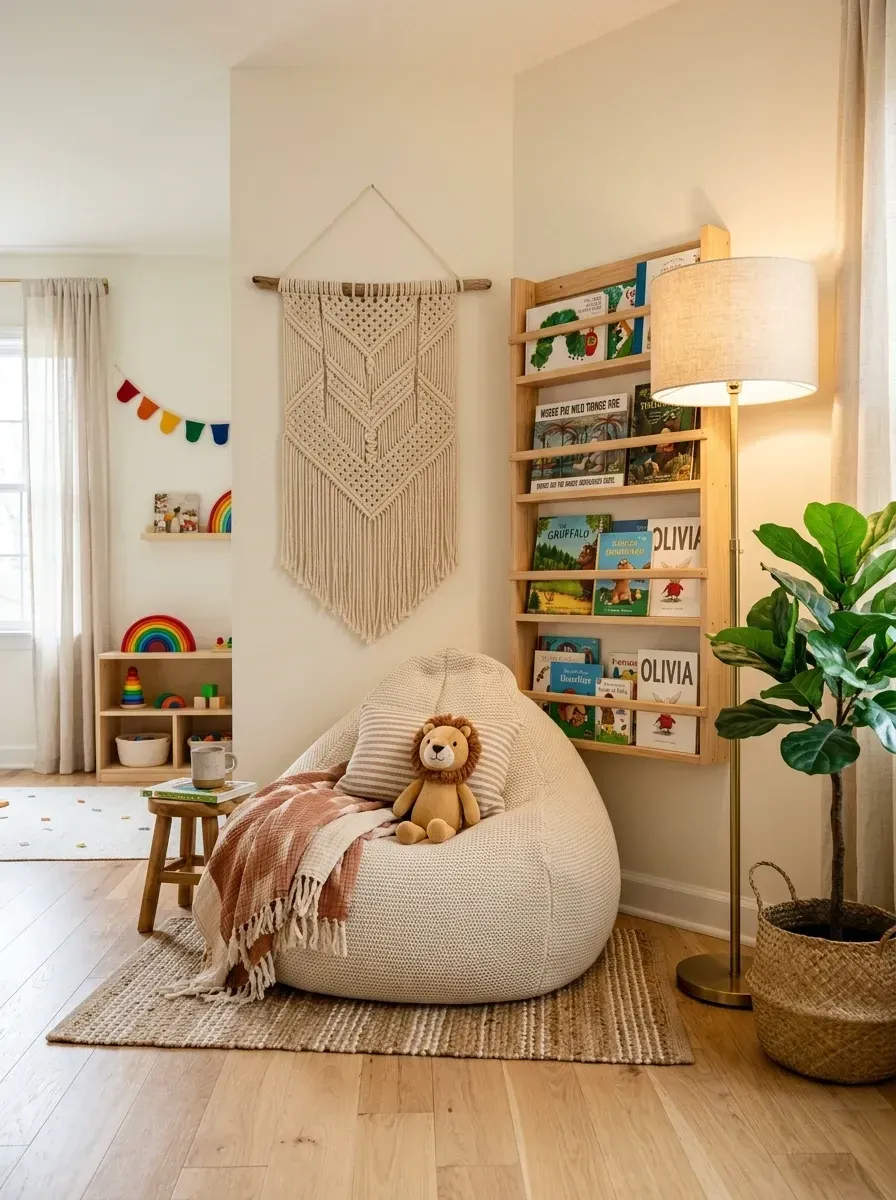
A reading nook does two structural jobs: it gives a kid an offline retreat in a screen-saturated house, and it carves a second functional zone out of a small bedroom. The forward-facing bookshelves are the move worth copying — when book covers face out instead of spines, kids actually choose books. Layered rugs (a softer wool over a flatter jute) define the boundary of the nook on a wood floor. The macrame is the only purely decorative element, and it can come down in five seconds when the kid outgrows it.
Plan-aware verdict: the lighting plan is the thing that gets skipped here, and shouldn't. A reading nook needs a 2700K–3000K warm bulb at 60–75 watts equivalent — bright enough to read by, warm enough to feel cozy. A floor lamp with a heavy weighted base is safer in a kid's room than a wall sconce that requires hard-wiring. Specify a dimmable bulb so the same nook serves both reading and bedtime.
Features
- Large knit-fabric bean bag chair
- Oversize macrame wall hanging
- Forward-facing wall bookshelves
- Layered rugs — wool over jute
- Tall potted plant in a basket
Cost Analysis (2026 Northeast)
| Decor Item (Qty) | Total Price Range |
|---|---|
| Large Knit Bean Bag Chair | $150 – $300 |
| Large Macrame Wall Hanging | $50 – $150 |
| Floor Lamp (Weighted Base) | $80 – $200 |
| Forward-Facing Wall Bookshelves (×2) | $100 – $200 |
| Low Wooden Shelf Unit | $60 – $120 |
| Layered Area Rugs | $150 – $250 |
| Large Plant in Basket | $80 – $150 |
| Total Estimated Cost | $670 – $1,370 |
Color Palette
Creamy White
#F7F4ED
Benjamin Moore White Dove (OC-17) or Sherwin-Williams Alabaster (SW 7008) in a flat finish — soft enough to recede.
Natural Wool & Cotton
#E8E0D5
Undyed wool and cotton — the macrame, the bean bag, and the rug all play in the same off-white register.
Pale Pine
#E5D7BD
Solid pine in a clear finish — nearly disappears against the wall, which is what you want for a small space.
Muted Rainbow
#D48C70
Softened primaries — book spines and small toys, never the rug or the bean bag itself.
5. The Scandi Boho Nursery Base
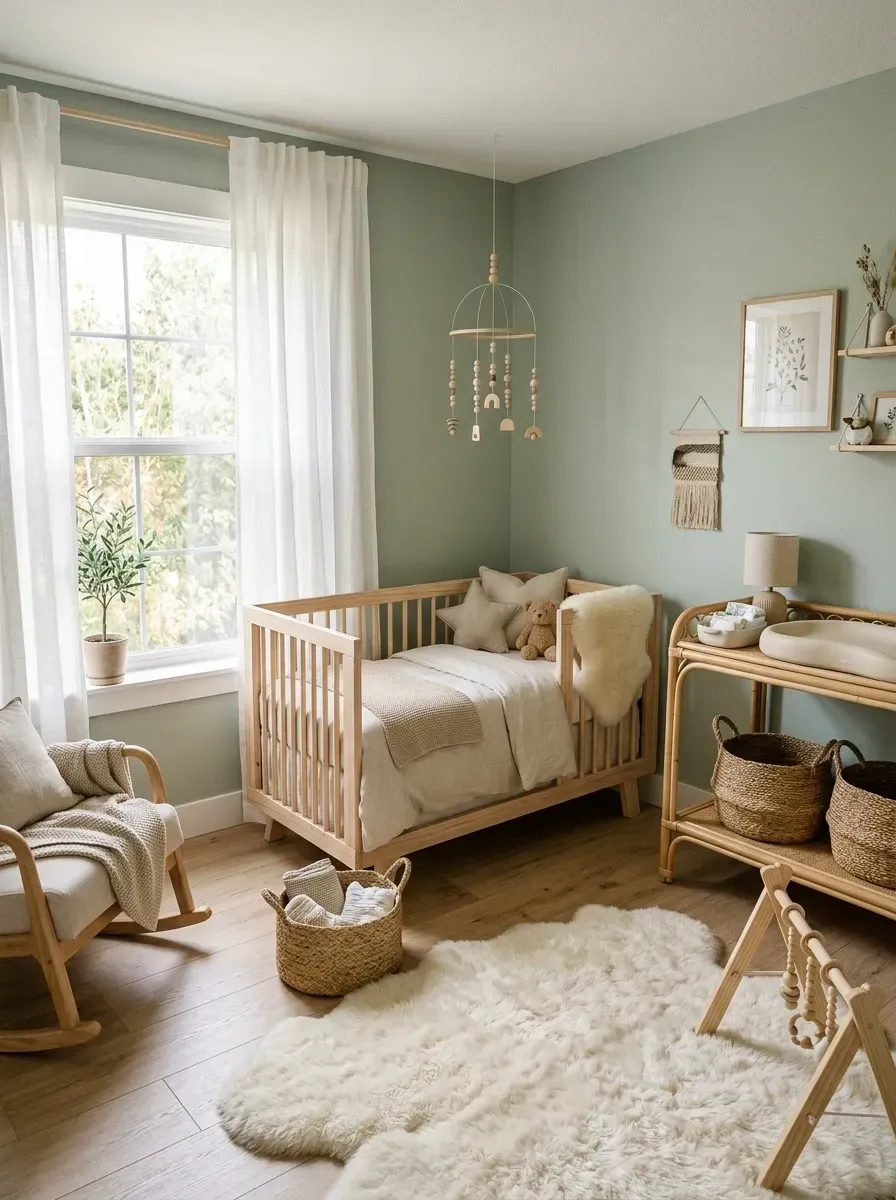
This is where the forever-room logic starts. The crib in this room is convertible — DaVinci Jenny Lind, Babyletto Hudson, or Nestig Cloud all convert to toddler beds and then daybeds, stretching $400 of crib over six or seven years instead of two. The "changing table" is actually a standard dresser with a removable topper, which means it serves as storage long after the diaper years end. The rocking chair is full-adult-scale and moves to a living room when the kid outgrows it. Almost nothing in this room is purely a baby item.
Plan-aware verdict: this is also where Hudson Valley clients overspend the most, in my experience. A nursery is the room people decorate with the most enthusiasm and the least planning, then re-do at age two when reality hits. The discipline is to buy convertible furniture and removable decor — not theme-driven anything. For an air-quality and biophilia layer, the same approach extends to our biophilic bedroom design guide.
Features
- Sage green walls (calm, age-neutral)
- Convertible crib (crib → toddler bed → daybed)
- Standard dresser + removable changing topper
- Real or faux sheepskin rug
- Adult-scale rocking chair (moves to living room later)
Cost Analysis (2026 Northeast)
| Decor Item (Qty) | Total Price Range |
|---|---|
| Convertible Crib | $300 – $700 |
| Standard Dresser + Changing Topper | $300 – $600 |
| Nursery Rocking / Glider Chair | $200 – $500 |
| Faux or Real Sheepskin Rug | $50 – $150 |
| Baby Mobile + Wall Decor | $100 – $250 |
| Wall Paint | $50 – $100 |
| Total Estimated Cost | $1,000 – $2,300 |
Color Palette
Calm Sage
#A6B6A2
Farrow & Ball Lichen (No. 19) or Benjamin Moore Saybrook Sage (HC-114) — gender-neutral and ages out of nursery cleanly.
Natural Birch
#E4D4BE
Solid birch or beech with a non-toxic, water-based finish — JPMA-certified pieces only for the crib.
Ivory & Cream
#F8F6F0
Organic cotton or muslin — Coyuchi, Garbo & Friends, or Hawkins New York are the references for warm cream.
Natural Rattan
#CFA982
Woven rattan and seagrass — baskets, the changing topper, mobile elements. Sustainable and long-lasting.
6. The Shared Bunk Room in Earth Tones
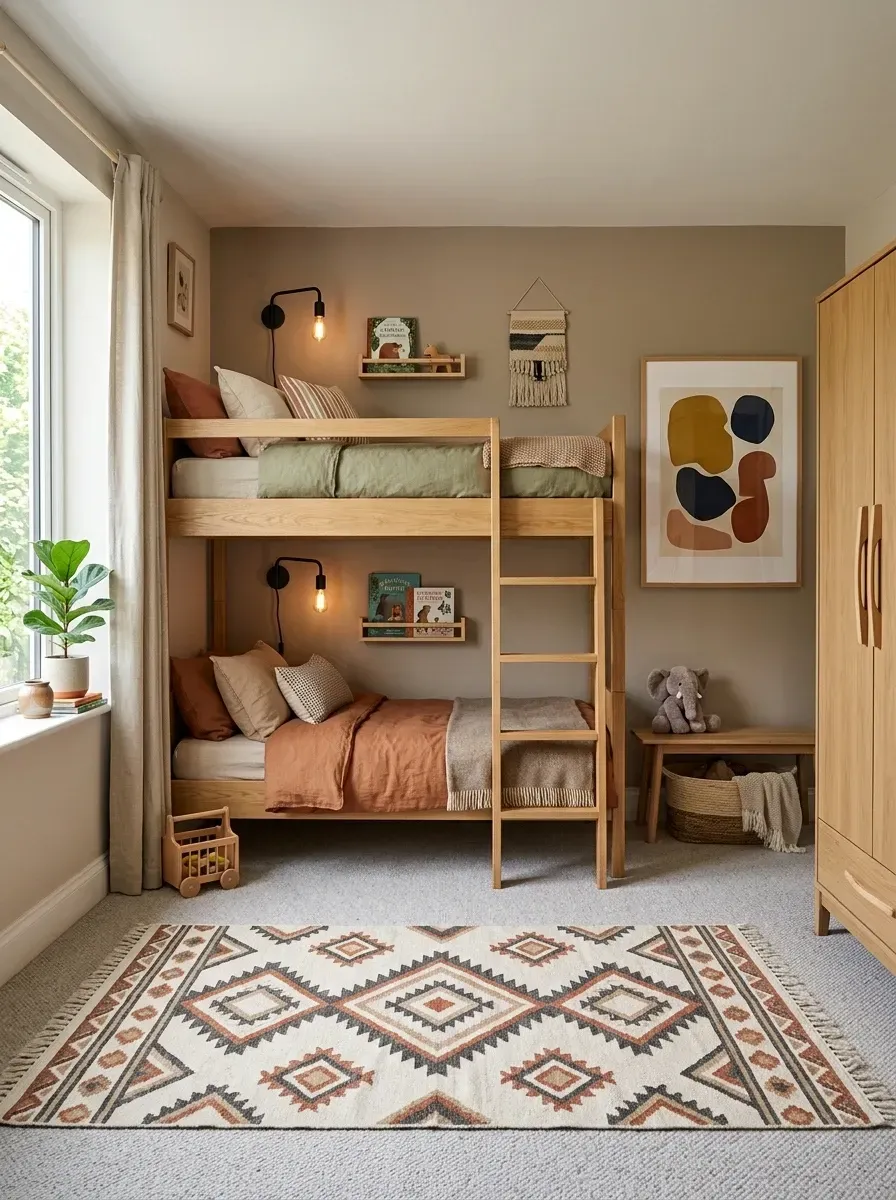
A shared bunk room is the most common floor-plan request I get from young Hudson Valley families — most of these old Victorians and Colonials only have three real bedrooms upstairs, so two kids share. The trick is not to make it look like a kindergarten. This palette of warm taupe, deep rust, and olive green is doing exactly that — it reads as a curated guest room more than a kids' bunk. The bedding is the only age-flexible piece, and at $200–$400 per set, it's the cheapest age-update in the room.
Plan-aware verdict: solid wood bunks last decades; tube-steel bunks bend at the upper rail by year three. Buy the solid wood version. Twin-over-twin is the right format — twin-over-full pushes the upper bunk too high in an 8-foot ceiling room. Wall sconces on each bunk on individual switches is the move that makes a shared room actually function — when one kid wants to read, the other can sleep.
Features
- Solid oak twin-over-twin bunk bed
- Earth-tone bedding — rust, olive, oatmeal
- Large patterned area rug to anchor
- Warm taupe walls
- Individual wall sconces per bunk
Cost Analysis (2026 Northeast)
| Decor Item (Qty) | Total Price Range |
|---|---|
| Solid Wood Bunk Bed Frame | $700 – $1,500 |
| Twin Mattresses (×2) | $300 – $800 |
| Bedding Sets (×2) | $200 – $400 |
| Large Patterned Area Rug | $300 – $600 |
| Wall Sconces (×2, Hardwired) | $200 – $500 |
| Large Wardrobe | $400 – $800 |
| Bench & Storage Basket | $150 – $250 |
| Total Estimated Cost | $2,250 – $4,850 |
Color Palette
Warm Taupe
#B0A79D
Sherwin-Williams Worldly Gray (SW 7043) or Benjamin Moore Edgecomb Gray (HC-173) — neutral with warmth.
Solid Oak
#B69A7B
Solid white oak with a hardwax-oil finish — Maine Bunk Beds, Room & Board, or a regional Hudson Valley shop are reliable specs.
Deep Rust
#A8634B
Linen or washed cotton in a rich earth tone — Garbo & Friends, Hawkins New York, or Coyuchi.
Olive Green
#8A9A75
Muted green linen that complements the rust without matching it — gives each kid their own visual zone.
7. The Built-In Storage Wall
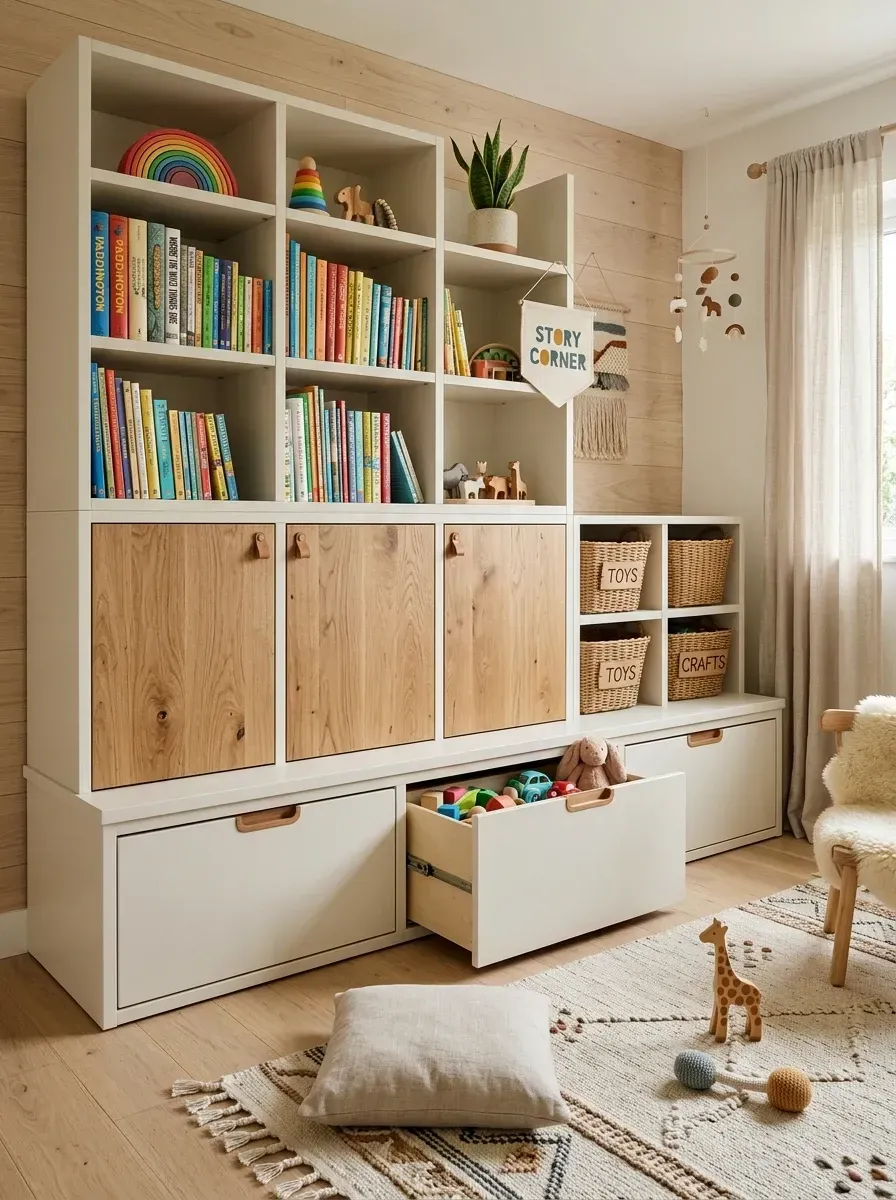
If there's one architectural move that justifies a renovation budget on a kids' room, it's a full-wall built-in. This unit is doing the work that ten separate furniture pieces would do: open display for cherished items, closed cabinets for clutter, large drawers for bulk toy storage, and visual continuity that makes a small room feel intentional. The white-oak fronts and a wood-plank back wall give it a Scandi Boho read that won't age out the way painted joinery would.
Plan-aware verdict: a fully custom built-in like this from a Hudson Valley cabinet shop runs $6,000–$11,000 installed. The clever budget move is the IKEA-Pax-or-Besta hack — buy the IKEA frames at $300–$700, then order custom oak fronts from Semihandmade or Reform for $1,200–$2,000 and have a local carpenter scribe and trim it in for $400–$600. You land at roughly $2,000–$3,500 installed for something that reads as $9,000 millwork.
Features
- Floor-to-ceiling integrated storage
- Wood-plank or shiplap feature wall behind
- Mix of open shelves, closed cabinets, and drawers
- Uniform woven seagrass baskets in lower cubbies
- White frames with white-oak fronts
Cost Analysis (2026 Northeast)
| Decor Item (Qty) | Total Price Range |
|---|---|
| Semi-Custom Storage (IKEA Pax + Custom Fronts + Install) | $2,000 – $3,500 |
| Wood Plank or Shiplap Wall (Material + Install) | $300 – $700 |
| Woven Seagrass Storage Baskets (×4–6) | $120 – $240 |
| Toys & Display Decor | $150 – $300 |
| Small Chair & Rug | $150 – $250 |
| Total Estimated Cost | $2,720 – $4,990 |
Color Palette
Clean White
#FFFFFF
Benjamin Moore Decorator's White (CC-20) on the IKEA carcass — keeps the unit reading light against the wood fronts.
White Oak
#D4C4A8
Solid or veneered white oak in a clear finish — Semihandmade Quarter Sawn or Reform Match are the natural specs.
Natural Woven Fiber
#E0D0B0
Seagrass or rattan baskets sized to the cubby — uniform sizing is what makes the unit read as architectural.
Playful Brights
#E8C946
All the room's color lives on the open-shelf toys, not on the structural elements — easy to update as the kid grows.
8. The Teen-to-Adult Sanctuary
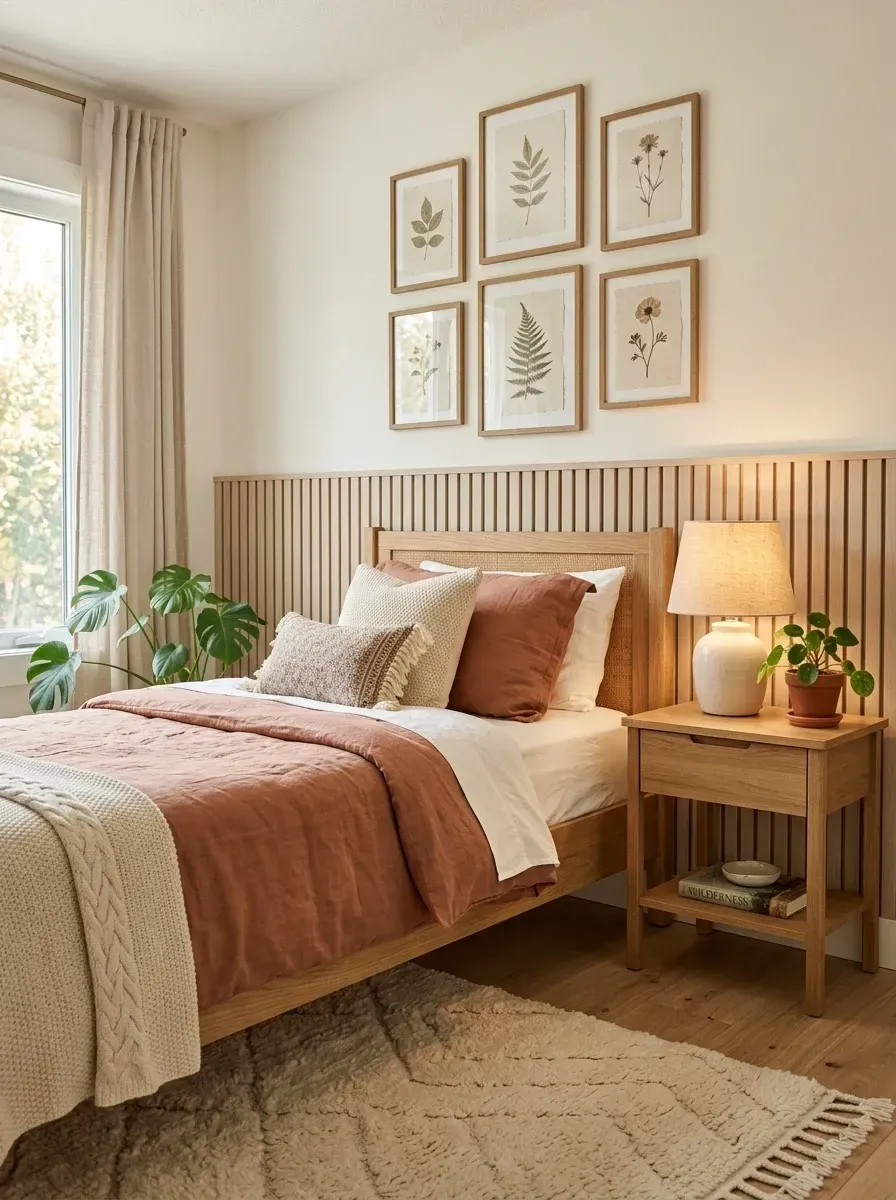
This is the room I'd show a high-school senior who's about to leave for college and ask: "would you be happy coming home to this?" If the answer is yes, the forever-room logic worked. The architecture is doing all the heavy lifting — a wood-slat headboard wall that costs $300–$800 in material, a queen-size bed that fits an adult, washed-linen bedding that beats any thread-count cotton on touch and durability. The botanical prints are the only purely decorative element, and they read sophisticated.
Plan-aware verdict: this is the version of the room I'd build from scratch in a renovation if the family had two kids and the budget. The slat wall is also a sound-dampening move worth knowing about — it adds enough mass to the headboard plane to absorb the bass-frequency noise that bleeds through interior walls in older Hudson Valley houses. For an adjacent style read on the same wall vocabulary, see our quiet luxury bedroom design guide.
Features
- Vertical wood-slat headboard wall
- Queen-size bed with cane headboard
- Washed linen bedding
- Curated gallery of botanical prints
- Solid walnut or oak nightstand
Cost Analysis (2026 Northeast)
| Decor Item (Qty) | Total Price Range |
|---|---|
| Wood Slat Wall (Material + Install) | $500 – $1,200 |
| Queen Bed Frame with Cane Headboard | $300 – $700 |
| Queen Mattress | $400 – $1,000 |
| Linen Bedding Set | $200 – $400 |
| Wood Nightstand | $150 – $300 |
| Ceramic Table Lamp | $80 – $150 |
| Gallery Frames + Prints (×6) | $200 – $400 |
| Large Textured Area Rug | $200 – $500 |
| Total Estimated Cost | $2,030 – $4,650 |
Color Palette
Soft Cream
#F3F1E3
Benjamin Moore White Sand (OC-10) or Sherwin-Williams Greek Villa (SW 7551) in flat — quiet enough to let the wood slats lead.
Natural Ash
#D9C6A9
Solid ash or oak slats with a clear hardwax-oil finish — pre-fab kits from Stikwood or custom-milled by a local Hudson Valley carpenter.
Baked Clay
#B37E68
Washed Belgian linen in a warm terracotta — Coyuchi, Cultiver, or Hawkins New York hold up to weekly wash.
Muted Sage & Olive
#94A384
Living color from real plants and framed botanicals — keeps the room organic without going twee.
9. The Painted Mural and Low Storage
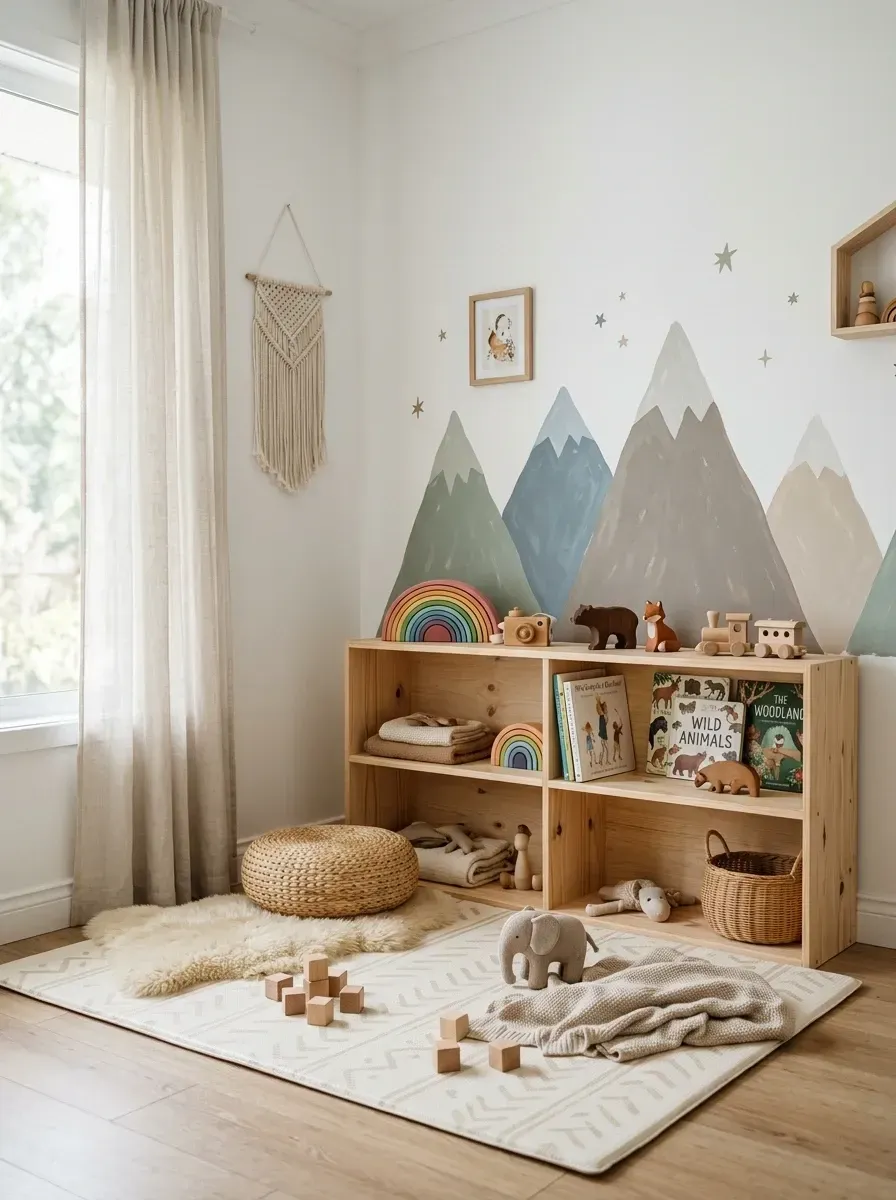
A painted mural is the single highest-impact, lowest-commitment move on this list. Three quarts of paint, a long weekend, and a pencil — total material cost under $150. When the kid outgrows mountains, two coats of white paint take it back to a blank wall. The low shelving is more important than the mural: at 30 inches tall and fully open, it sits in a Montessori register where toddlers can independently choose, use, and put back their own toys. That habit is the actual product; the mural is just decoration.
Plan-aware verdict: a hand-painted mural tends to look like a hand-painted mural, which is fine for a four-year-old's room. Keep the palette muted — the source uses soft blues and greens that read as Scandi rather than primary-school chaos. A washable rug from Lorena Canals or Ruggable runs $100–$250 and tolerates the spills, marker accidents, and snack attacks that happen on a play floor.
Features
- Hand-painted mountain mural in muted Scandi tones
- Low, open Montessori-style wood shelving
- Large washable cotton or polyester play rug
- Woven jute floor pouf
- Curated, accessible toy collection
Cost Analysis (2026 Northeast)
| Decor Item (Qty) | Total Price Range |
|---|---|
| Low Open Wooden Shelving Unit | $150 – $300 |
| Large Washable Play Rug | $100 – $250 |
| Paint for Mural (3–4 quarts + supplies) | $80 – $150 |
| Woven Floor Pouf | $60 – $120 |
| Toys & Decor | $150 – $250 |
| Total Estimated Cost | $540 – $1,070 |
Color Palette
Bright White
#FFFFFF
Benjamin Moore Chantilly Lace (OC-65) or Sherwin-Williams Pure White (SW 7005) — clean ground for the mural to read against.
Muted Blues & Greens
#8FA3B3
Three to four close-in tones from a Farrow & Ball or Benjamin Moore historical-collection palette — keep the contrast low.
Unfinished Pine
#E8DBB7
IKEA Trofast or a similar low-format toddler shelf — finished or sealed pine, roughly 30 inches tall.
Rainbow Brights
#E36E6E
Concentrate all the saturated color in the toys — wooden Grimm's stackers, Lovevery puzzles — so the architecture stays calm.
Pro Tips From the Renovation Designer's Chair
- Invest in the shell, save on the layers. Floor, walls, beds, dressers, and built-ins are permanent — spend on those. Bedding, art, lighting, and toys are interchangeable — keep that line item lean and rotate it as the kid grows.
- Layer themes, never build them. A space-themed room set is dead at age six. A navy duvet plus a constellation print plus a star projector reads as a space room and survives the transition because every piece has a second life.
- Buy full-size furniture from day one. Skip toddler beds, junior desks, and step-stool chairs. A twin bed and a 30-inch desk serve a kid from age four to twenty-five. The "they'll grow into it" complaint usually disappears within a year.
- Standardize your frames. A dozen identical 11×14 frames with 8×10 mats lets you rotate from finger paintings to school photos to band posters without re-hanging anything. This is the cheapest single design discipline in a kids' room.
- Plan the storage architecture by age tier. Toddlers need open access — Montessori-low shelves they can reach. School-age kids need closed cabinets to hide clutter parents see daily. Teens need hangable space and drawers. A good built-in does all three at once.
- Specify the electrical at the framing stage. Floor outlet under the desk, two-circuit wall sconces over the bunks, dimmable switch at the door, and at least one extra outlet near where the future TV or sound system will land. Adding any of these to a finished wall costs five times the rough-in price.
Cost-Saving Moves
- Hack the IKEA Pax or Besta. A floor-to-ceiling Pax wardrobe with custom Semihandmade or Reform fronts and a scribed trim-out by a local carpenter lands at $2,000–$3,500 installed — for a built-in that reads like $9,000 millwork. Same logic on the Besta, Ivar, and Bekvam systems.
- Paint as renovation. One accent wall in Hale Navy or Saybrook Sage transforms a kids' room for $250–$500 fully painted. No other renovation move at that price changes the room's read this much.
- Buy convertible everything. Convertible cribs, dressers that double as changing tables, full-size beds that wear different bedding — every "convertible" piece skips one furniture purchase down the road. A $500 convertible crib effectively replaces $1,200 in age-staged furniture.
- Swap, don't replace. Bedding, rug, lampshade, art, and a coat of paint is a $400–$800 refresh that takes a 6-year-old's room into a 12-year-old's room. The bones don't move.
The Core Idea. A forever-room kids' space is two layers, not one. Build the architectural shell to last 18 years — neutral paint, full-scale furniture, real built-ins, durable finishes. Then keep the decor layer cheap, bright, and replaceable. The kid's room evolves through bedding, art, and toys, not through demolition. The result is a room that grows with the child and a parent who never has to drag a race-car bed to the curb.
Reader Questions on Scandi Boho Kids' Rooms
What does Scandi Boho actually mean for a kids' room?
It's a hybrid. The Scandinavian half brings clean lines, light woods (birch, pine, ash), functional furniture, and a calm neutral base. The Bohemian half adds layered textiles, real plants, woven and natural-fiber accents, and a warmer, more collected feel than pure minimalism. For kids, the combination works because the Scandi shell stays age-neutral while the Boho decor layer is exactly the kind of stuff — macrame, baskets, sheepskin — that's easy and cheap to swap out as the child grows.
How do I actually design a kids' room that grows with my child?
Three rules. First, buy full-size furniture from day one — twin or full bed, standard 30-inch dresser, 28–30-inch desk. Skip toddler-scaled anything. Second, keep the architectural elements neutral and timeless: paint, flooring, and built-ins should not telegraph an age range. Third, put all the personality into items you can swap in five minutes — bedding, rug, art, lampshade, a few toys on display. Themed rooms fail at age four. Layered rooms keep working through college.
Is Scandi Boho expensive to achieve?
It's one of the more affordable design styles to execute, especially for kids. The base materials — pine, birch, cotton, jute, rattan — are inexpensive and widely available. IKEA, Plyroom, and Coyuchi cover the budget-to-mid range completely. The price escalates only when you add custom millwork or imported designer pieces. A complete room can land at $1,200–$2,500 if you're disciplined about which pieces to splurge on (the bed, the rug, the built-ins) and which to keep cheap (lighting, art frames, accessories).
What are the best wall colors for a Scandi Boho kids' room?
Stay in the muted, earthy register. Warm whites — Benjamin Moore White Dove (OC-17), Simply White (OC-117). Sage greens — Saybrook Sage (HC-114), Lichen No. 19. Slate blues — Hale Navy (HC-154), De Nimes No. 299. Warm taupes — Edgecomb Gray (HC-173), Worldly Gray (SW 7043). All of these read as a neutral once they're up and pair cleanly with both kid-bright accents (rust, mustard, terracotta) and grown-up textures (linen, walnut, brass). Avoid candy-pinks and primary blues — they age out fast.
How do I keep the room playful without making it look like a kindergarten?
Concentrate the playfulness in soft, removable, swap-able elements. A sheepskin rug, a macrame wall hanging, a chalkboard wall, a small indoor swing, a string of warm-white fairy lights, a canopy over a reading corner. Each of those reads as whimsical when a kid is six and comes down or out in five minutes when the kid is twelve. The rule: any element that takes more than a screwdriver to remove should not be themed. Anything that comes down in five minutes can be as playful as the kid likes.
Where to Read Next
If you're carrying these ideas across the upstairs floor plan, start with the broader bedrooms and kids' rooms archive. For a more activity-driven kids' brief, the same shell-vs-layer logic structures our Montessori adventure room design guide, and for a parent-suite read on the calm Scandi register, the rules carry over almost directly into the biophilic bedroom design guide.
Sources & Further Reading
- Architectural Digest on Scandinavian and Bohemian interior trends, including the hybrid Scandi-Boho aesthetic.
- Apartment Therapy for ongoing nursery and kids' room trend coverage and IKEA-hack documentation.
- The Spruce on practical kids' room design — storage, layout, and durability considerations.
- U.S. Consumer Product Safety Commission — Crib Information Center for current federal crib safety standards.
- HealthyChildren.org (American Academy of Pediatrics) for safe-sleep and nursery setup guidance.
- EPA — Indoor Air Quality on low-VOC paints and air quality in children's bedrooms.
- Remodelista for material-first reporting on Scandi joinery, plaster, and natural-fiber textiles.
- NAHB — Cost of Constructing a Home for benchmark labor and material data behind the renovation cost ranges quoted above.
- FSC US — Forest Stewardship Council on sustainably harvested wood specifications for kids' furniture.

Nora Whitfield
Renovation Designer & Interiors Editor · Beacon, New YorkNine years of design-build renovation work across the Hudson Valley and the Northeast. Nora runs the Renovations, Room Guides and Renovation Mind desks — before-and-after studies, room-by-room design guides, and the long essays on why what we renovate matters.
More from Nora →
Reader notes