

I've watched the all-white bedroom phase run its course in Hudson Valley renovations for seven years now, and the houses that age best are the ones that treat the bedroom as a nervous-system room, not a Pinterest board. What follows are eight bedrooms I've studied — each one designed around warm-spectrum light that respects your circadian rhythm, weighted natural-fiber textiles that ground the body, and color palettes pulled from limewash, plaster, velvet, boucle, and raw wood. I read each room the way I'd read a renovation plan: what's structural, what's surface, what would I keep, and where the budget actually lands in 2026.
How I Read a Sensory Bedroom
When a client in Beacon or Rhinebeck asks me to renovate the primary bedroom, the first thing I do is leave the floor plan at the kitchen table and walk the room at dusk. I want to see where the late afternoon light lands, where the cold air sits in February, and whether the existing fixture is throwing 4000K daylight into a room that should be running 2700K by 9 p.m. The plan will tell you the geometry, but the sensory experience is what determines whether you actually sleep in the room. That's the bridge I keep coming back to in this guide — the structural moves a thoughtful drafter would have made, and the finish-stage decisions that turn an ordinary bedroom into a room your body recognizes as rest.
Every room below gets the same read: the lighting strategy first (because melatonin is more important than throw pillows), then the weighted textile layer that does the actual sensory work, then the color palette and the realistic cost in 2026 Hudson Valley pricing. If you're working through your own bedroom renovation, you might also want my quiet luxury bedroom design guide for the finishing standards I keep coming back to, and the biophilic bedroom guide for the plant-and-material side of the same conversation.
1. Japandi Serenity with Warm Woven Light
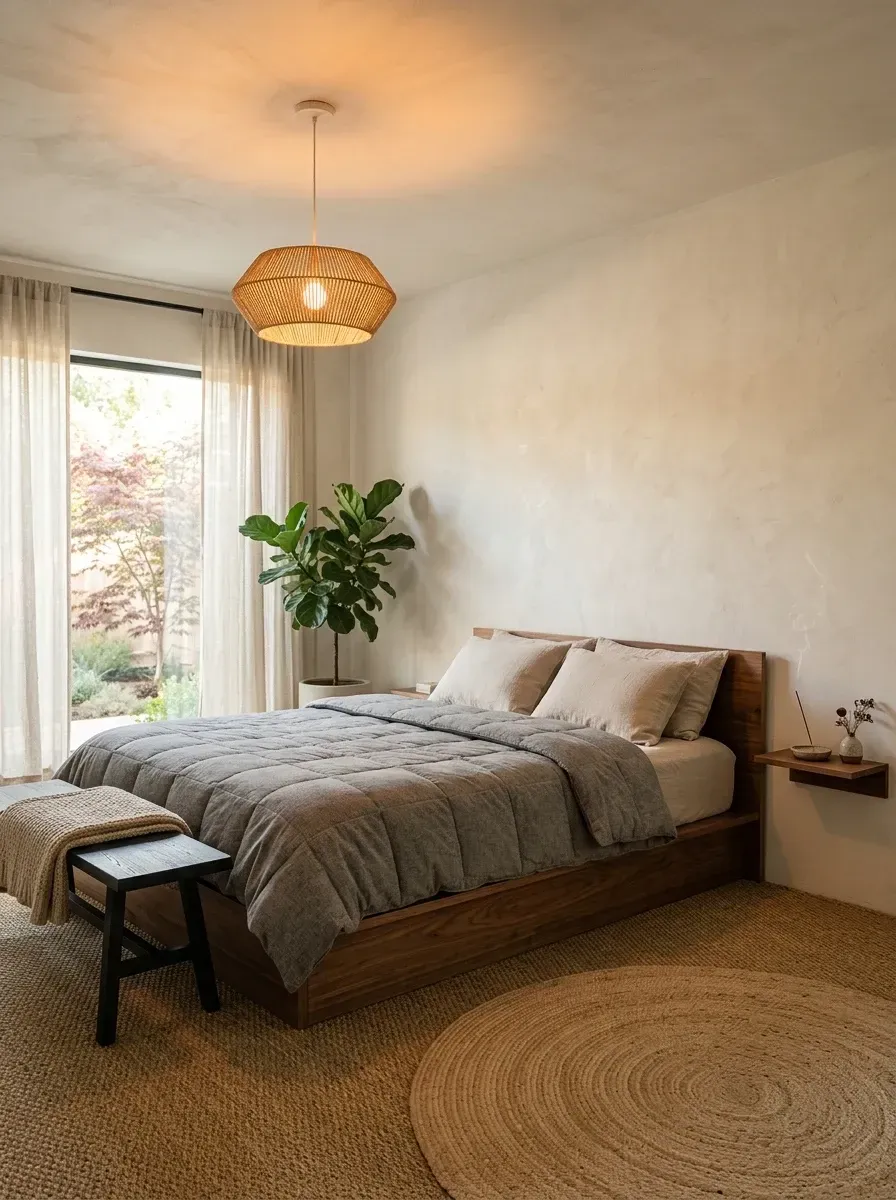
What's working here is the bottom-up build: a low walnut platform bed at roughly 12 inches deck height, crushed Belgian linen in greige, and a quilted coverlet thrown long enough to puddle on the jute. The woven rattan pendant — set on a 2700K filament bulb behind a Lutron Caséta dimmer — is doing the circadian work that overhead canister downlights cannot. The limewash walls in a creamy beige absorb light unevenly, which is exactly the point: flat paint reads as a screen, limewash reads as a surface.
Plan-aware verdict: the original drafter almost certainly specified one ceiling junction box dead-center. If you're renovating, this is the spot to add a wall-controlled fixture rough-in over each nightstand, plus a dimmable wall box that excludes the closet circuit. Doing it in the framing stage is roughly $400 in labor; doing it later means a fishing repair and patching the limewash, which never re-cures invisibly. Layered jute (a rectangular sisal under the bed, a smaller round one at the foot) gives you the weighted floor texture without the dust load of a high-pile rug.
Features
- Woven rattan pendant on 2700K filament bulb
- Creamy limewash walls (Portola Paints or Bauwerk)
- Walnut platform bed, low deck
- Layered jute rugs (sisal rectangle + round)
- Crushed Belgian linen bedding
Cost Analysis
| Decor Item (Qty) | Total Price Range |
|---|---|
| Woven Rattan Pendant Light | $150 - $400 |
| Walnut Platform Bed Frame (Queen) | $800 - $2,000 |
| Queen Mattress | $600 - $1,500 |
| Belgian Linen Duvet Cover Set | $180 - $350 |
| Textured Quilt / Coverlet | $100 - $250 |
| Large Sisal Rug (8x10) | $200 - $500 |
| Round Jute Rug (6') | $80 - $200 |
| Dark Wood Bench | $150 - $400 |
| Fiddle Leaf Fig in Planter | $100 - $250 |
| Floating Shelf & Decor | $50 - $150 |
| Sheer Linen Curtains & Rod | $60 - $150 |
| Limewash Wall Treatment (Material + Labor) | $500 - $1,200 |
| Total Estimated Cost | $2,970 - $7,350 |
Color Palette
Creamy Limewash
#E3DED1
A soft, textured off-white close to Portola Paints "Sand Castle" — warm enough to read as enveloping in lamp light.
Medium Walnut
#7A573E
A Rubio Monocoat Pure finish on black walnut keeps the grain honest and grounds the lower half of the room.
Greige Linen
#A9A499
Stone-washed Belgian flax — the kind that wrinkles correctly and doesn't read polyester at any time of day.
Natural Jute
#C3B091
Unbleached jute fibers reflect a slight gold cast under 2700K light, which is exactly what makes the room glow at night.
2. Sage and Cane Sanctuary
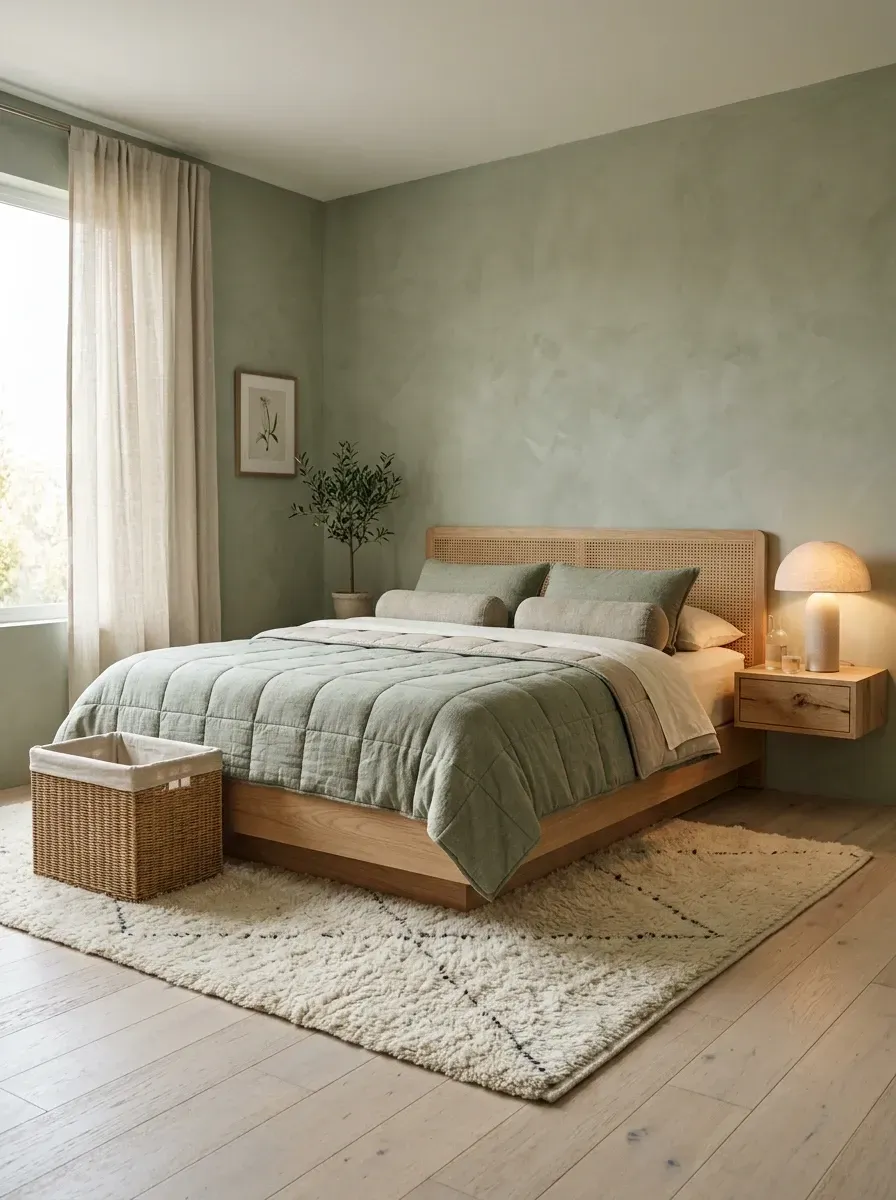
This room is built on three sensory layers. Sage limewash walls (close to Benjamin Moore HC-119 Kittery Point Green diluted in lime base) drop the visual temperature without going cold. A cane-paneled headboard in light oak adds a tactile gridded surface that catches morning light and shadows it across the bedding. Underfoot, a high-pile boucle rug — the kind you sink into when your feet leave the mattress — does the weighted-texture work that a flat wool rug can't.
Plan-aware verdict: a floating nightstand looks light, but it's a framing decision. You're loading a cantilevered shelf into a partition wall that probably has nothing more than 1/2-inch drywall on 2x4 studs at 16 inches on center. If the original plan ran a hidden 2x10 nailer at nightstand height, you're fine; if it didn't, you'll need to open the drywall and add backing before drilling French cleats. A Flos Bilboquet or West Elm mushroom-style lamp pointed down across the bed is the right call here — directional, glare-free, perfect for the last 30 minutes of the day.
Features
- Sage limewash walls (lime base, not flat latex)
- Cane and light oak bed frame
- High-pile boucle area rug
- Mushroom-style table lamp on dimmer
- Wall-mounted floating nightstand (backing required)
Cost Analysis
| Decor Item (Qty) | Total Price Range |
|---|---|
| Cane & Light Oak Bed Frame (Queen) | $900 - $2,200 |
| Queen Mattress | $600 - $1,500 |
| Floating Wood Nightstand | $150 - $400 |
| Mushroom Table Lamp (Flos / West Elm) | $80 - $250 |
| Large Boucle Area Rug (8x10) | $300 - $800 |
| Large Woven Lidded Basket | $80 - $180 |
| Linen Bedding Set with Bolsters | $250 - $500 |
| Olive Tree in Planter | $120 - $300 |
| Framed Art Print | $50 - $150 |
| Linen Curtains & Rod | $100 - $250 |
| Sage Limewash Treatment (Material + Labor) | $500 - $1,200 |
| Total Estimated Cost | $3,130 - $7,730 |
Color Palette
Muted Sage Green
#9CA998
A restful earthy green in the family of BM HC-119; the lime binder keeps it from going flat and dead.
Light Oak
#D3C1A5
Rift-sawn white oak with a hardwax oil finish — the cane panel reads cleaner against this tone than against red oak.
Creamy Off-White
#F2F0E6
A soft, clean neutral that brightens the room without going stark — anything cooler reads as office paint.
Soft Celadon
#B8C7B9
A lighter complementary green for the bolsters and lumbar; pulls the wall color forward in daylight.
3. Earthy Velvet Retreat
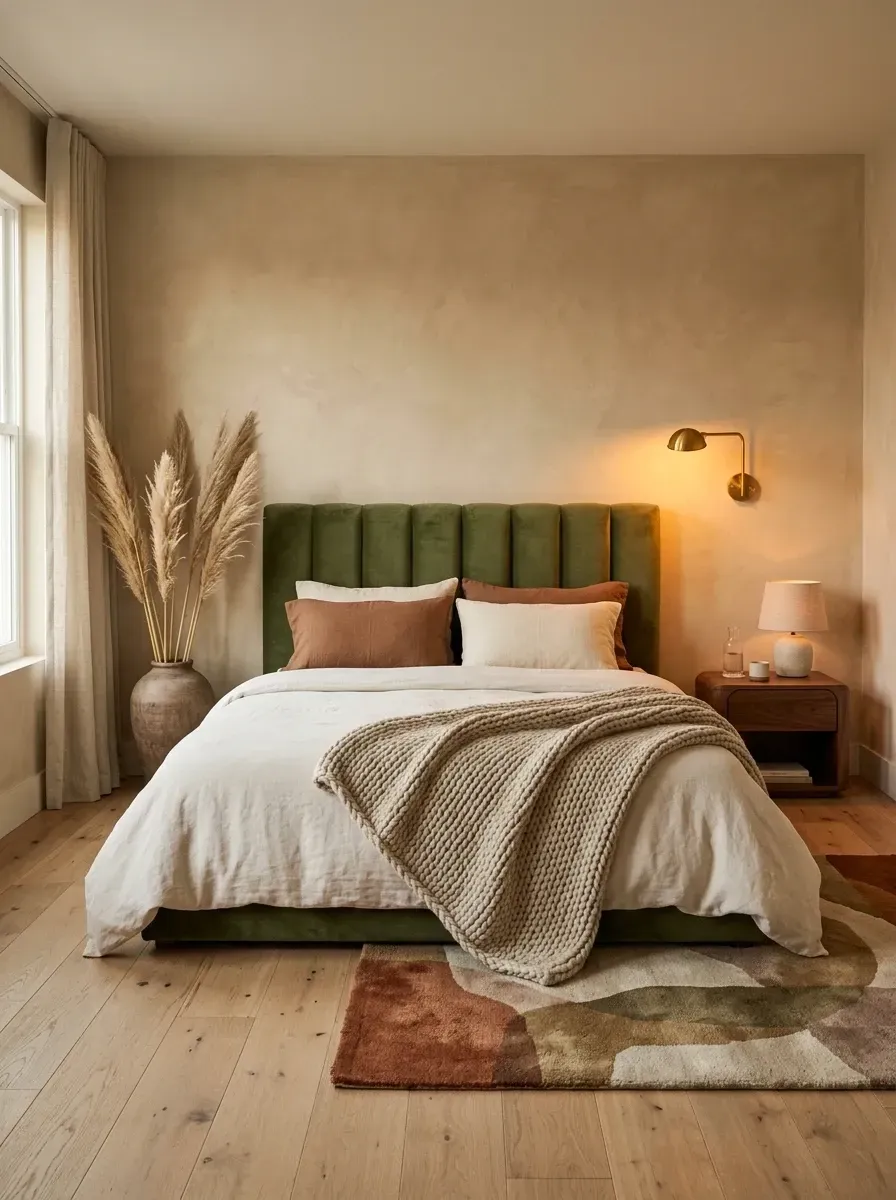
Velvet does sensory work that linen cannot — it absorbs sound, holds warmth against the skin, and pulls warm light into a deeper saturation. The olive-green channel-tufted headboard is the anchor here, paired with a chunky merino-wool knit throw heavy enough to function like a weighted blanket without the marketing. A brass wall sconce mounted at roughly 60 inches above the floor (low enough to read by, high enough not to bump when you sit up) replaces the bedside table lamp.
Plan-aware verdict: hardwired sconces require a wall box at sconce height, ideally on a 3-way switch with the room entry. A renovator who skips this step is buying a plug-in cord-cover solution that ages badly. The textured plaster — true Roman clay or American Clay, not a faux-paint kit — adds an enveloping wall texture that's worth the labor premium ($600 to $1,500) in any room you actually sleep in.
Features
- Olive velvet channel-tufted bed
- Heavy merino chunky knit throw
- Hardwired brass wall sconce
- Roman clay or American Clay wall finish
- Dried botanical arrangement in a rustic vase
Cost Analysis
| Decor Item (Qty) | Total Price Range |
|---|---|
| Velvet Channel-Tufted Bed Frame (Queen) | $800 - $1,800 |
| Queen Mattress | $600 - $1,500 |
| Brass Wall Sconce (hardwired) | $100 - $300 |
| Rounded Wood Nightstand | $200 - $500 |
| Small Table Lamp | $50 - $150 |
| Chunky Knit Merino Throw | $150 - $400 |
| Linen Bedding & Pillows | $250 - $550 |
| Abstract Area Rug (8x10) | $300 - $800 |
| Large Rustic Vase with Dried Botanicals | $100 - $250 |
| Roman Clay Wall Treatment (Material + Labor) | $600 - $1,500 |
| Total Estimated Cost | $3,150 - $7,750 |
Color Palette
Olive Green
#5E6B48
A grounded, luxurious green in the family of Farrow & Ball Treron — reads richer in velvet than in flat paint.
Warm Beige Plaster
#CDBEA6
Roman clay in a sandy warm beige — the tonal shift across the troweled surface is what makes the room feel old.
Terracotta Rust
#A65F41
A baked earthy red-brown that warms the olive without competing with it.
Aged Brass
#B4985A
Unlacquered solid brass develops a patina that reads as inherited rather than new.
4. Moody Texture Haven
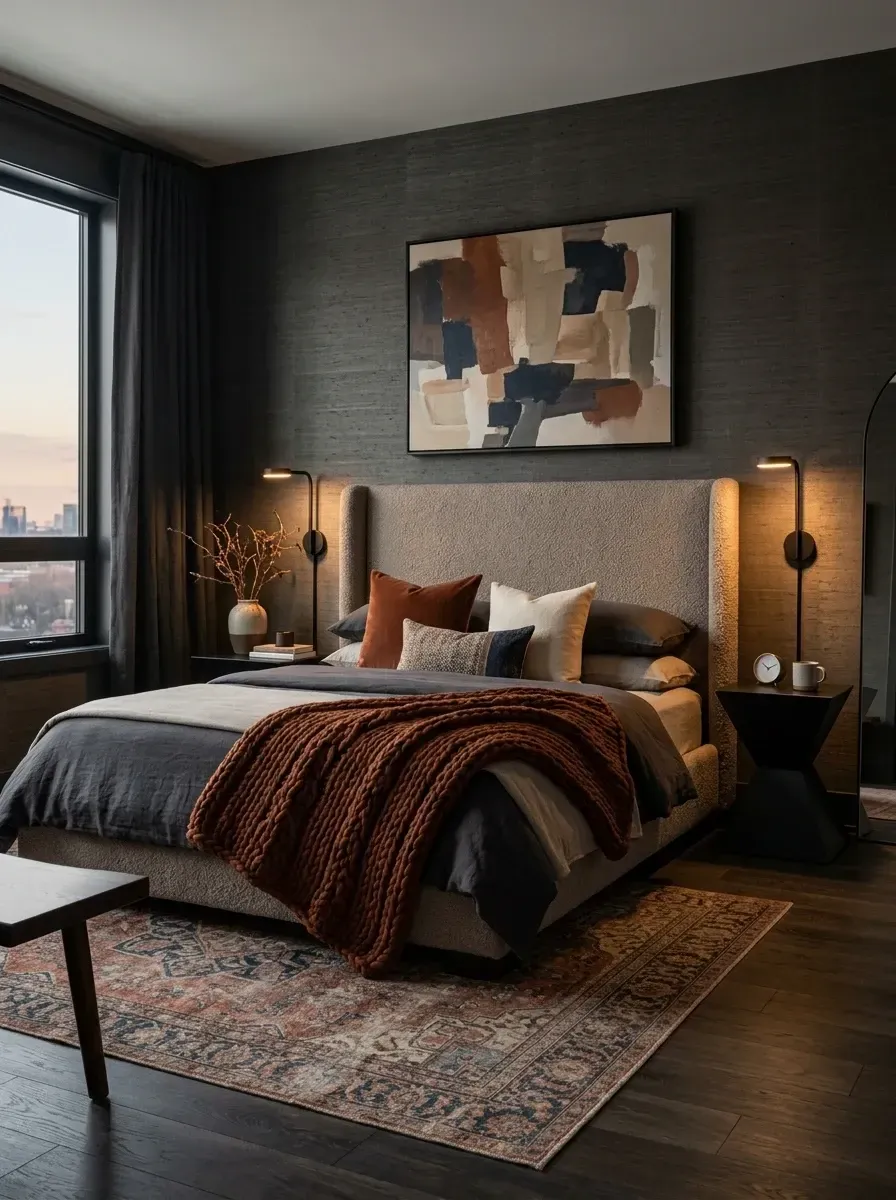
Dark walls work in a bedroom because the human eye reads a cocooning surround as safety — exactly the message you want at bedtime. The charcoal textured wallpaper here (something in the Phillip Jeffries or Arte grasscloth family) absorbs ambient light, which is why a light oatmeal boucle bed reads so cleanly against it. The rust chunky knit throw is the chromatic warmer — without it, the room would tip cold.
Plan-aware verdict: a Brooklyn brownstone primary bedroom is the natural home for this scheme — old plaster walls give the grasscloth a slightly imperfect substrate that improves the finished texture. The two black wall sconces flanking the bed should run on a single dimmer at the bedroom entry plus a separate switch at each sconce, which is a four-wire pull a finish electrician needs to plan during the framing inspection, not after the wallpaper is up.
Features
- Dark grasscloth or textured wallpaper
- Oatmeal boucle upholstered bed
- Twin dimmable black wall sconces
- Rust merino chunky throw
- Oversized abstract canvas art
Cost Analysis
| Decor Item (Qty) | Total Price Range |
|---|---|
| Boucle Upholstered Bed Frame (Queen) | $1,000 - $2,500 |
| Queen Mattress | $600 - $1,500 |
| Modern Black Wall Sconce (x2) | $200 - $600 |
| Geometric Side Table | $150 - $400 |
| Large Floor Mirror | $200 - $500 |
| Large Abstract Art Canvas | $150 - $400 |
| Patterned Vintage-Style Rug (8x10) | $300 - $800 |
| Chunky Knit Throw | $100 - $250 |
| Bedding & Decorative Pillows | $200 - $450 |
| Vase with Branches / Decor | $50 - $150 |
| Textured Wallpaper Installation (Material + Labor) | $800 - $2,000 |
| Total Estimated Cost | $3,750 - $9,550 |
Color Palette
Charcoal Texture
#363636
A deep, light-absorbing charcoal in the family of BM Wrought Iron 2124-10 — but textured, not flat.
Burnt Rust
#964B31
A warm, vibrant orange-brown that pops against the charcoal and reads richer at night under warm bulbs.
Oatmeal Boucle
#D9D0C1
A light, textured fabric — Maharam Mood Bouclé territory — that delivers softness and a high-contrast silhouette.
Matte Black
#222222
A defining, modern finish that crisps the silhouettes against the moody wall.
5. Minimalist Zen with Natural Light
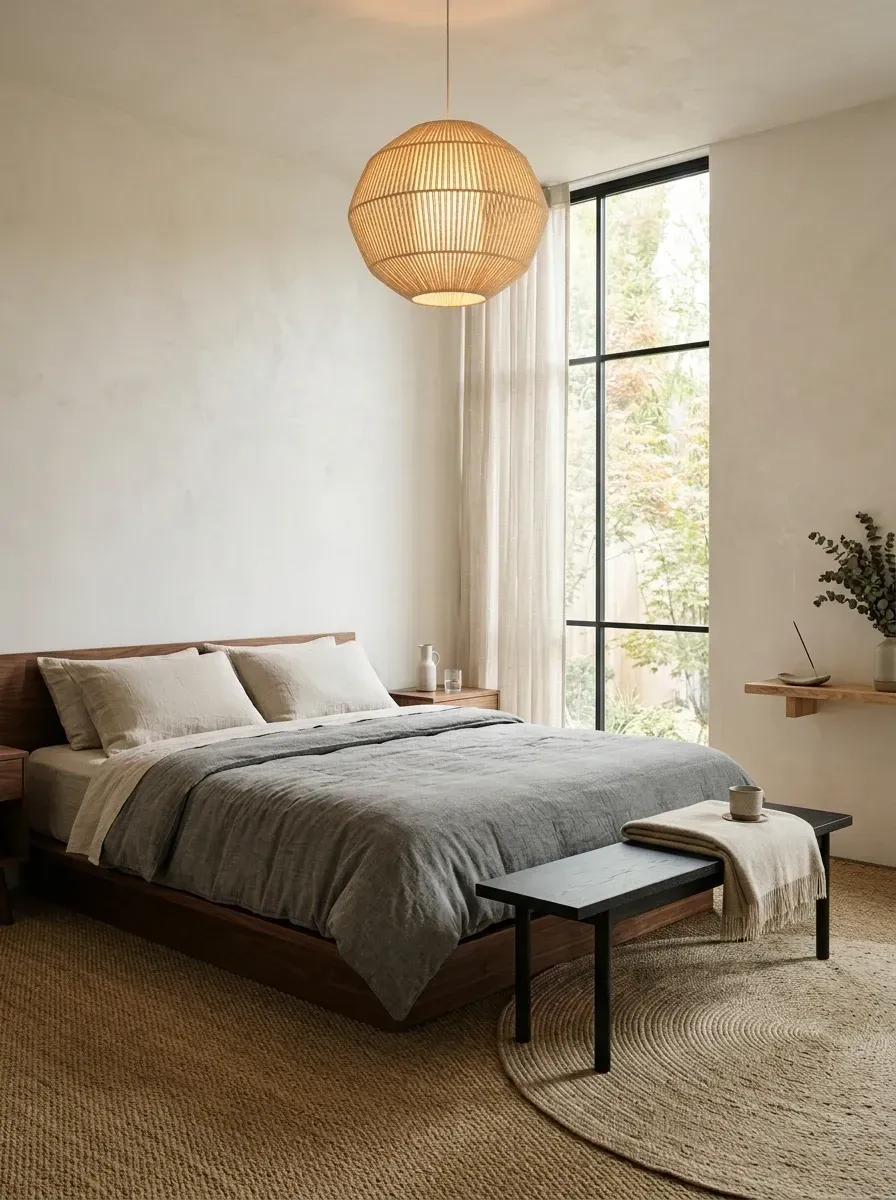
This room earns its calm through the architecture, not the decor. The large steel-frame Marvin or Crittall-style window pulls daylight deep into the room — that's the morning circadian signal your body needs to anchor sleep at night. The oversized bamboo pendant is sized correctly: roughly two-thirds the width of the bed, hung 32 inches above the mattress top, so it reads as architecture rather than fixture.
Plan-aware verdict: a steel-frame window in a load-bearing wall is a real structural decision, not a finish swap. You're enlarging a rough opening, sizing a new header — typically a flush-framed LVL — and you're carrying that point load down to the foundation. Not a renovation to start on a Saturday. If the plan offers it, take the daylighting; if it doesn't, leave the window alone and let the rest of the room do the work. The black bench at the foot of the bed is a Hans Wegner / Norm Architects move — a single dark line that defines the foot of the room.
Features
- Oversized bamboo or rattan pendant
- Large steel-frame window (Marvin or Crittall-style)
- Low walnut platform bed
- Washed linen bedding
- Minimalist black bench
Cost Analysis
| Decor Item (Qty) | Total Price Range |
|---|---|
| Walnut Platform Bed Frame (Queen) | $800 - $2,000 |
| Queen Mattress | $600 - $1,500 |
| Oversized Bamboo / Rattan Pendant | $250 - $600 |
| Minimalist Black Bench | $200 - $500 |
| Round Jute Rug (6'-8') | $100 - $250 |
| Linen Bedding Set | $200 - $400 |
| Floating Wood Shelf | $50 - $150 |
| Small Vases & Decor | $50 - $150 |
| Sheer Linen Curtains | $80 - $200 |
| Total Estimated Cost | $2,330 - $5,750 |
Color Palette
Soft Off-White
#F0EEE9
A warm white in the family of BM White Dove OC-17 — reads clean by morning, soft by lamp-light.
Natural Walnut
#7C5E48
FSC-certified American walnut in a hardwax oil — never urethane in a bedroom; you'll smell it for months.
Cool Grey Linen
#8A8F91
A muted neutral grey that balances the warm wood and white walls.
Matte Black
#1A1A1A
A sharp defining color — Marvin Ebony or RAL 9005 on the steel mullions reads as architecture.
6. Warm Embrace with Amber Glow
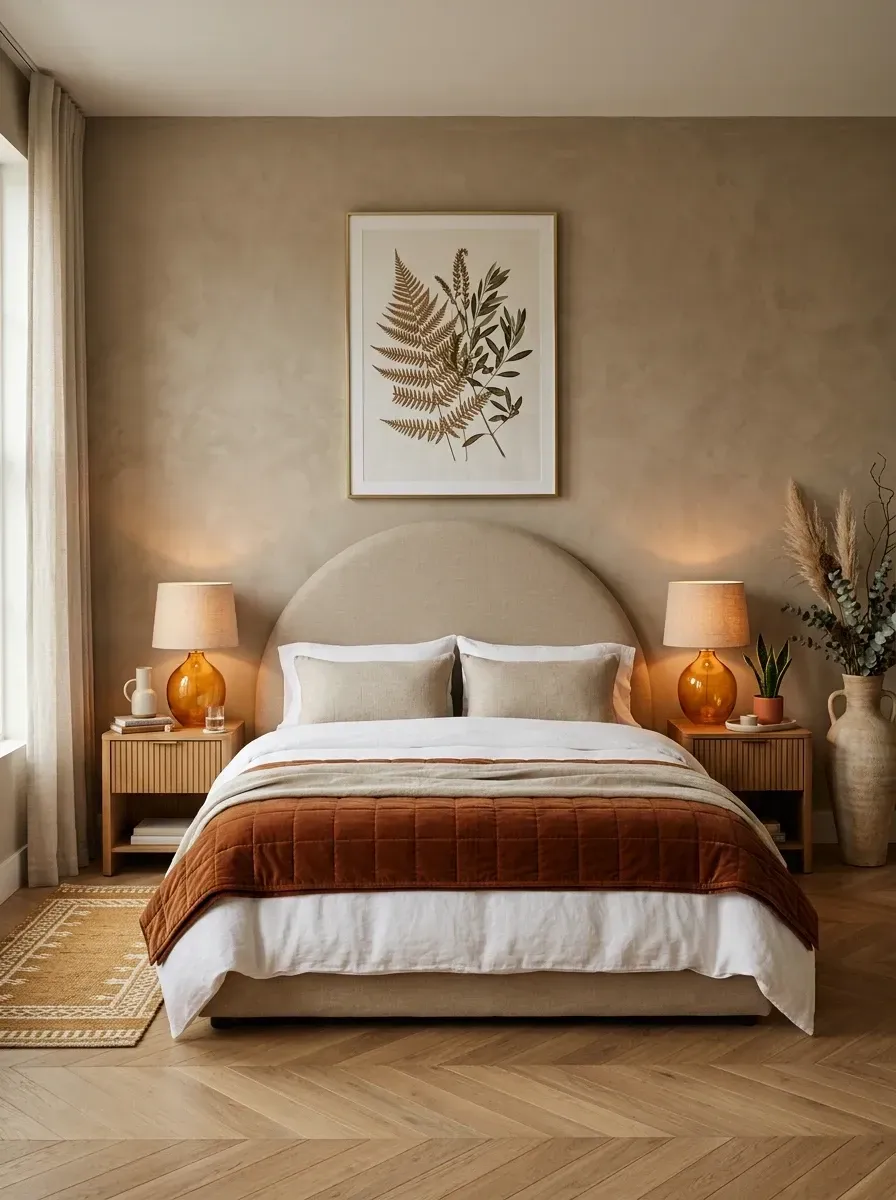
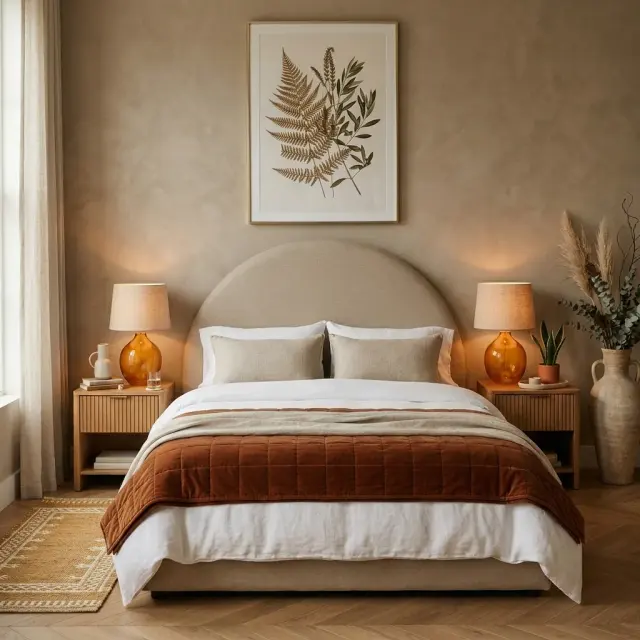
The defining feature of this room is the pair of amber glass table lamps. Amber glass filters out the short blue wavelengths that suppress melatonin, which is the same physical principle behind a Philips Hue "Wind Down" recipe — but here it's done with material rather than software. The arched upholstered headboard softens the room's geometry, and the fluted oak nightstands give you a vertical tactile rhythm that the eye can rest on.
Plan-aware verdict: arched headboards work in rooms with at least a 9-foot ceiling. In a standard 8-foot Northeast bedroom you'll either crowd the arch against the ceiling or have to take it off-center, which looks worse than a straight headboard. If the original plan called for an 8-foot plate, take that as a constraint and pick a flat upholstered headboard instead. The textured tan plaster wall is a Roman clay finish — the small variation in tone across the surface is what gives it the depth that flat paint can't deliver.
Features
- Pair of amber glass table lamps (2200K bulbs)
- Arched upholstered headboard
- Fluted white oak nightstands
- Rust velvet quilt over linen sheeting
- Roman clay tan plaster walls
Cost Analysis
| Decor Item (Qty) | Total Price Range |
|---|---|
| Arched Upholstered Bed Frame (Queen) | $800 - $2,000 |
| Queen Mattress | $600 - $1,500 |
| Fluted Oak Nightstand (x2) | $400 - $1,000 |
| Amber Glass Table Lamp (x2) | $200 - $500 |
| Large Framed Botanical Art | $150 - $400 |
| Large Ceramic Vase with Dried Botanicals | $150 - $350 |
| Layered Bedding Set (Linen + Velvet Quilt) | $300 - $650 |
| Small Decor & Books | $50 - $150 |
| Roman Clay Wall Treatment (Material + Labor) | $500 - $1,200 |
| Patterned Runner Rug | $80 - $200 |
| Total Estimated Cost | $3,230 - $7,950 |
Color Palette
Tan Plaster
#BDB09B
A warm sandy beige in Roman clay or Portola Lime Wash — surface depth that flat paint can't reproduce.
Burnt Rust
#9C5335
A rich autumnal orange — same color family as the amber glass, which is what makes the room read coordinated.
Light Oak
#C9B494
Rift-sawn white oak with vertical fluting — the tactile detail you notice with your hand on the way to bed.
Oatmeal Beige
#E6DED1
A soft neutral backdrop that lets the rust quilt and amber glass do the chromatic work.
7. Blue Velvet Dream
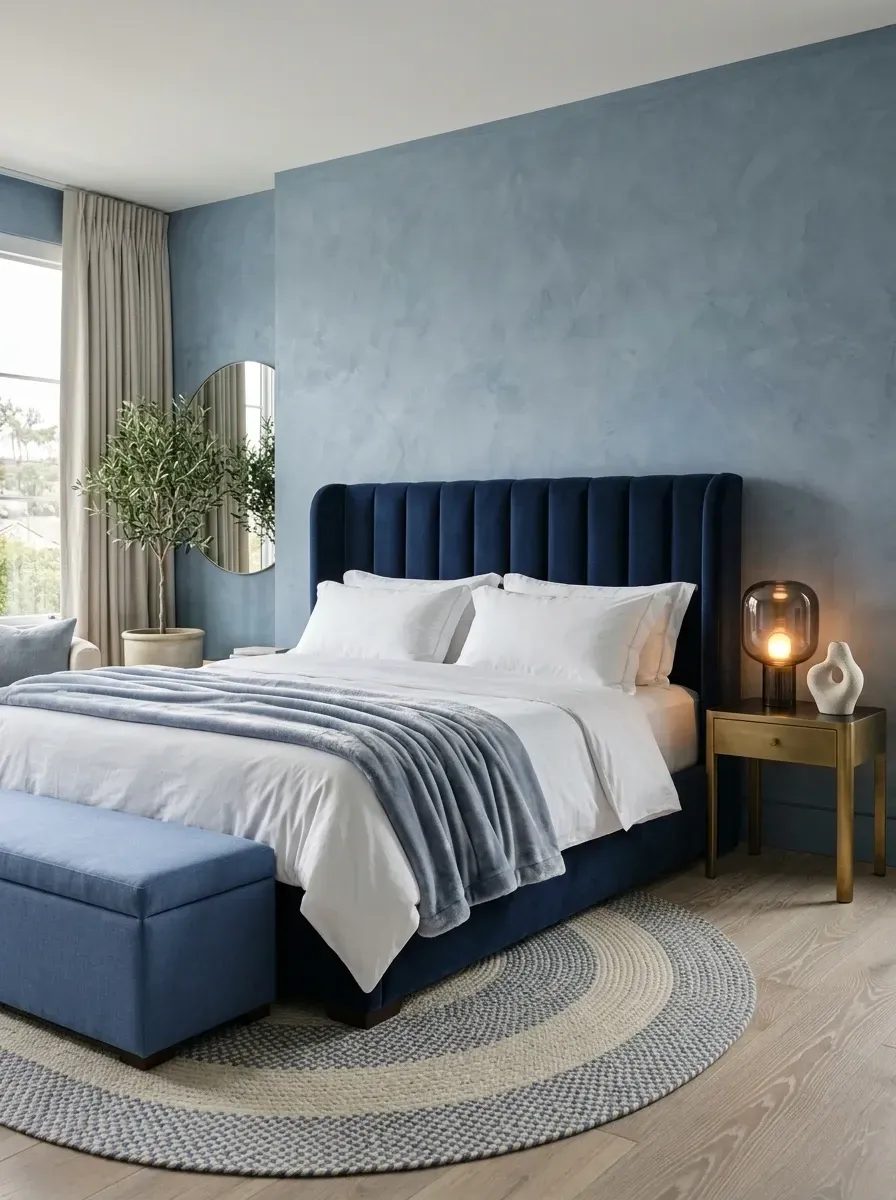
Blue is the under-discussed sensory color for bedrooms. Studies from the University of Surrey sleep group have consistently linked blue-walled rooms with the longest average sleep duration — provided the blue is deep, saturated, and paired with warm metals and warm light at night. The tall channel-tufted velvet bed in deep sapphire, the matching storage bench at the foot, and a textured blue wall finish make this a true monochrome envelope. Polished brass on the side table and the warm glow of a single glass table lamp are what keep it from going cold.
Plan-aware verdict: a tall headboard reading 60 to 66 inches above the floor needs a wall that can carry it visually. That means an 8-foot ceiling at minimum, ideally 9, and a wall length that gives at least 18 inches of breathing room on each side of the bed. If your existing plan has a closet bumping the bedroom wall short, that's the renovation: relocating or shrinking the closet to give the bed wall the geometry it needs.
Features
- Tall channel-tufted blue velvet bed
- Matching velvet storage bench
- Blue textured wall finish (Roman clay tinted)
- Polished solid brass side table
- Round braided wool rug
Cost Analysis
| Decor Item (Qty) | Total Price Range |
|---|---|
| Tall Blue Velvet Tufted Bed Frame (Queen) | $1,000 - $2,500 |
| Queen Mattress | $600 - $1,500 |
| Blue Velvet Storage Bench | $250 - $600 |
| Polished Brass Side Table | $150 - $400 |
| Glass & Metal Table Lamp | $100 - $250 |
| Round Braided Wool Rug (8') | $200 - $500 |
| Large Round Wall Mirror | $150 - $400 |
| Olive Tree in Planter | $120 - $300 |
| White Linen Bedding Set | $150 - $350 |
| Blue Textured Wall Treatment (Material + Labor) | $600 - $1,500 |
| Curtains & Rod | $100 - $250 |
| Total Estimated Cost | $3,420 - $8,550 |
Color Palette
Deep Sapphire Blue
#1C3D6E
A profoundly calming blue close to BM Hale Navy HC-154 — full-saturation territory that needs velvet to read warm.
Polished Brass
#CBA859
Solid polished brass — Waterworks Henry or CB2 Smart — provides the warm metallic counterweight.
Cool Crisp White
#F5F7FA
A clean white that keeps the deep blue from absorbing all the light in the room.
Muted Blue-Grey
#6A859C
A softer second blue in the wall finish — the tonal variation is what reads as plaster rather than paint.
8. Green and Wood Biophilic Hideaway
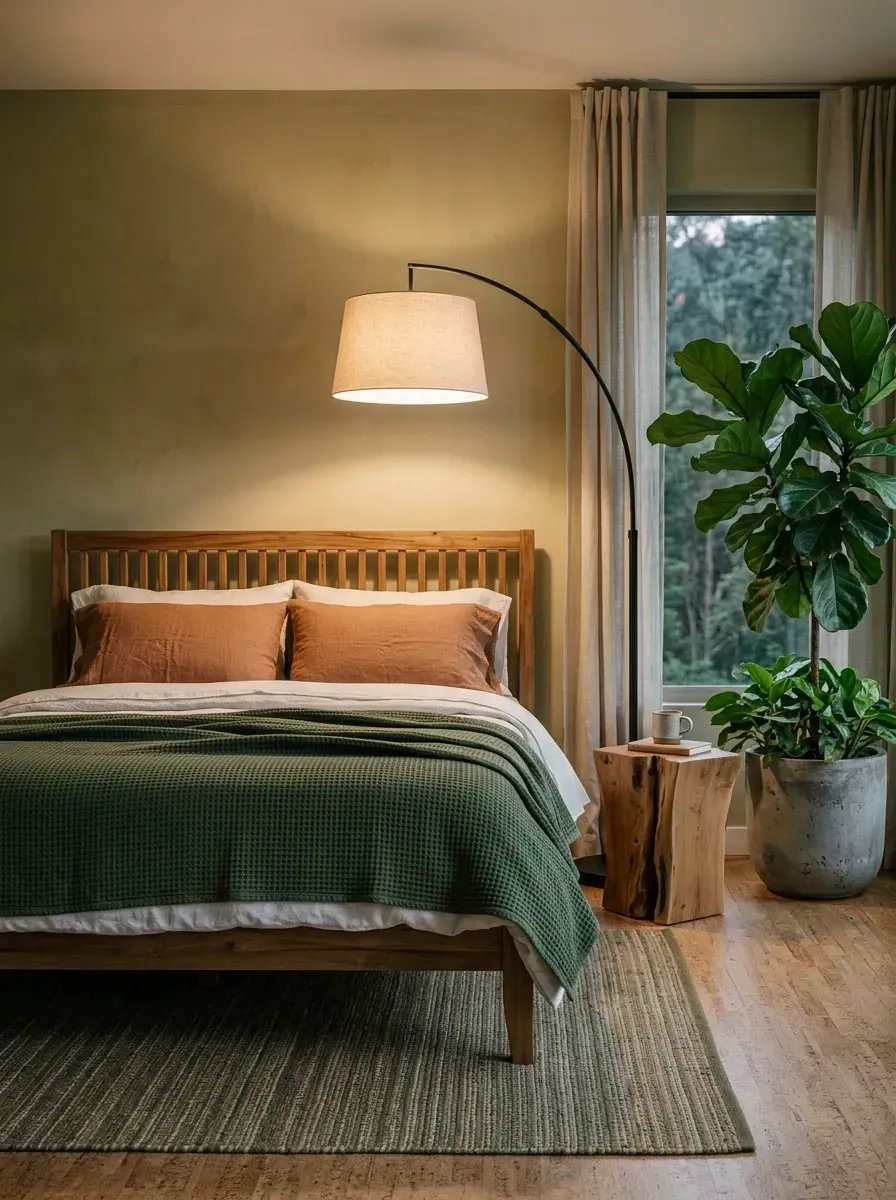
The biophilic move here is the wall color. A mossy forest-green limewash blurs the boundary between the bedroom and the woods outside the window, which is exactly what biophilic design research from Terrapin Bright Green has been pointing at for a decade. The spindle wood bed (a Shaker silhouette in honey-toned cherry or ash) is a low-visual-mass piece — it gives the eye somewhere to land without crowding the room. The live-edge stump side table is the textural surprise: raw bark, ring patterns, the kind of imperfection that a plywood box can never simulate.
Plan-aware verdict: a large fiddle leaf fig needs east or south light and a stable temperature — not a north-facing bedroom in a 1920s Hudson Valley colonial that drops to 58°F at night. If the plan offers the right window orientation, take it. If not, swap the fig for a snake plant or a ZZ — they survive what most bedrooms actually offer. The arc floor lamp does indirect ambient lighting that no ceiling can fixture can match.
Features
- Mossy green limewash walls
- Shaker-style spindle wood bed
- Live-edge wood stump side table
- Arc floor lamp with drum shade
- Large fiddle leaf fig in concrete planter
Cost Analysis
| Decor Item (Qty) | Total Price Range |
|---|---|
| Spindle Wood Bed Frame (Queen) | $700 - $1,800 |
| Queen Mattress | $600 - $1,500 |
| Live-Edge Wood Stump Side Table | $150 - $400 |
| Arc Floor Lamp with Drum Shade | $150 - $400 |
| Green Waffle Weave Blanket | $80 - $180 |
| Linen Bedding & Rust Pillows | $200 - $450 |
| Large Fiddle Leaf Fig in Concrete Planter | $200 - $500 |
| Textured Area Rug | $150 - $400 |
| Green Limewash Wall Treatment (Material + Labor) | $500 - $1,200 |
| Total Estimated Cost | $2,730 - $6,830 |
Color Palette
Mossy Forest Green
#6A7F57
An organic muted green close to BM Saybrook Sage HC-114 — but applied in limewash for the depth.
Warm Honey Wood
#B68E5D
Honey cherry or ash with a Rubio Monocoat finish — warm and lit-from-within when the arc lamp is on.
Earthy Terracotta
#B36A51
A baked earth tone that complements the green without competing with it.
Concrete Grey
#8D8D8D
Cast concrete — raw and industrial — contrasts the organic woods and limewash above it.
Pro Tips From the Renovation Designer's Chair
- Layer three light sources, never one. Ambient (pendant or flush), task (sconce or table lamp), accent (picture or floor lamp). A single overhead fixture is the visual equivalent of a fluorescent office at midnight — your nervous system reads it that way whether you notice or not.
- Spec your bulb color temperature, not just your fixture. 2200K to 2700K is the sleep range. Anything above 3000K is daylight territory and belongs in a kitchen or a bathroom vanity, not in a bedroom on a switch loop.
- Buy bedding by fiber, not by thread count. Belgian or French stone-washed linen, long-staple cotton percale, or TENCEL lyocell are the three honest choices. Anything labeled "1000 thread count microfiber" is polyester pretending.
- Wall texture earns the labor cost. Limewash, Roman clay, and grasscloth all read three-dimensional under raking lamp light. Flat latex paint reads as a screen — fine in a hallway, wrong in a primary bedroom.
- Get the wiring right before the wallpaper. Sconces, dimmers, and dedicated bedside circuits are framing-stage decisions. Retrofitting after the wall finish is in is twice the cost and never quite invisible.
- Engage the sense of smell deliberately. A reed diffuser in cedarwood, lavender, or vetiver, or a beeswax pillar candle on the dresser, builds a scent association the body recognizes as bedtime within about two weeks.
Cost-Saving Moves
- DIY the limewash on one accent wall first. Bauwerk and Portola both sell sample tins under $40. Test on the wall behind the bed — the wall least visible from the doorway — before committing to four walls and a contractor.
- Source the bed frame from local woodworkers, not catalog brands. A Hudson Valley furniture maker (Beacon, Hudson, Kingston are full of them) will build a queen walnut platform for $1,800 to $2,400 — the same range as a West Elm bed that ships in three boxes with cam locks.
- Skip the matching nightstand set. One vintage dresser as a side table next to a turned wood stump or marble pedestal reads more curated than two identical floating shelves from the same SKU.
- Buy chunky-knit throws off-season. February and March are the markdown months on heavy wool textiles. Same blanket, half the price.
Reader Questions on Sensory Bedroom Design
What's the single most important sensory change I can make in my bedroom?
Replace the overhead 4000K LED with a single dimmable pendant or pair of bedside lamps running 2200K to 2700K warm-spectrum bulbs. Light temperature is the dominant biological signal your body uses to know when to release melatonin. I've watched clients sleep better within a week of this swap alone, before they touched a single piece of furniture or textile. It costs less than $80 if you keep the existing fixture and just change the bulb.
Is limewash worth the extra labor over flat paint?
In a bedroom, yes. Limewash has a real mineral surface that reads three-dimensional under raking lamp light — flat latex paint can't reproduce that depth, which is why every dark-painted bedroom I see on builder-grade drywall ends up looking like a closet. The labor premium runs about $500 to $1,200 for a primary bedroom in the Hudson Valley, depending on whether the finisher does one or two coats. It's a one-time cost for a finish that ages well over fifteen to twenty years.
Are weighted blankets actually doing anything, or is it placebo?
The clinical evidence is real but modest — peer-reviewed work (the Ekholm study in the Journal of Clinical Sleep Medicine is the most cited) shows weighted blankets at roughly 10 percent of body weight improve sleep onset for adults with insomnia. That said, a heavy merino chunky knit throw and a layered quilt-over-duvet build give you most of the same proprioceptive pressure without buying a dedicated weighted blanket. The point is the felt weight on the body, not the brand on the label.
Can I do a sensory bedroom in a Brooklyn rental?
Yes — and the constraints actually help. Skip the limewash (peel-and-stick textured wallpaper from Chasing Paper or Tempaper does 80 percent of the job and comes off cleanly), skip hardwired sconces (plug-in cord-cover sconces from In Common With or Schoolhouse work), and put your money into the textile and lamp layers. A walnut platform bed, washed linen, a chunky throw, two amber-glass lamps with 2200K bulbs, and a sisal rug deliver the whole sensory experience without a single landlord conversation.
Which color palette ages best?
In my experience, warm beige plaster, sage green limewash, and deep walnut are the three palettes I've never seen a client regret after five years. Bold blues, charcoals, and saturated rusts read incredible in year one but require a stronger design conviction to live with long-term. If you're renovating once and not planning to repaint in three years, lean toward warm-neutral plaster on the walls and let the textiles carry the color shift.
Do I need a renovation, or just better decor, to get this look?
Most of these rooms can be reached with decor alone — bedding, lamps, a rug, a wall finish, and a single piece of statement furniture. Renovation territory is when you're moving a wall, enlarging a window, hard-wiring sconces, or running new circuits for bedside power. Read the plan honestly: if your existing geometry, wiring, and window placement are fine, this is a finish project. If they're fighting you, that's when a designer or contractor conversation earns its fee.
Where to Read Next
If the sensory framing here lands, the biophilic bedroom design guide covers the plant and natural-material side of the same conversation, and the dopamine bedroom guide is the opposite tonal pole — color-saturated, personality-forward sleep design. For a broader before-and-after read, nine bedroom transformations shows what these principles look like when applied to a real renovation rather than a fresh build. And the bedrooms and kids rooms category collects everything I've written on the subject.
Sources & Further Reading
- Terrapin Bright Green. 14 Patterns of Biophilic Design: Improving Health & Well-Being in the Built Environment. terrapinbrightgreen.com.
- Ekholm, B., et al. "A Randomized Controlled Study of Weighted Chain Blankets for Insomnia in Psychiatric Disorders." Journal of Clinical Sleep Medicine, 2020. jcsm.aasm.org.
- National Sleep Foundation. Bedroom Environment and Sleep Quality. thensf.org.
- U.S. Department of Energy. Lighting Choices to Save You Money — LED Color Temperature Guide. energy.gov.
- Marvin Windows and Doors. Signature Ultimate Window Specifications. marvin.com.
- Bauwerk Colour. Lime Paint Application Guide. bauwerkcolour.com.
- Portola Paints & Glazes. Lime Wash Product Overview. portolapaints.com.
- Remodelista. Editorial Archive: Bedrooms. remodelista.com.
- Architectural Digest. How to Design a Bedroom for Better Sleep. architecturaldigest.com.
- Lutron Electronics. Caséta Smart Dimmer Compatibility & Specifications. lutron.com.

Nora Whitfield
Renovation Designer & Interiors Editor · Beacon, New YorkNine years of design-build renovation work across the Hudson Valley and the Northeast. Nora runs the Renovations, Room Guides and Renovation Mind desks — before-and-after studies, room-by-room design guides, and the long essays on why what we renovate matters.
More from Nora →
Reader notes