

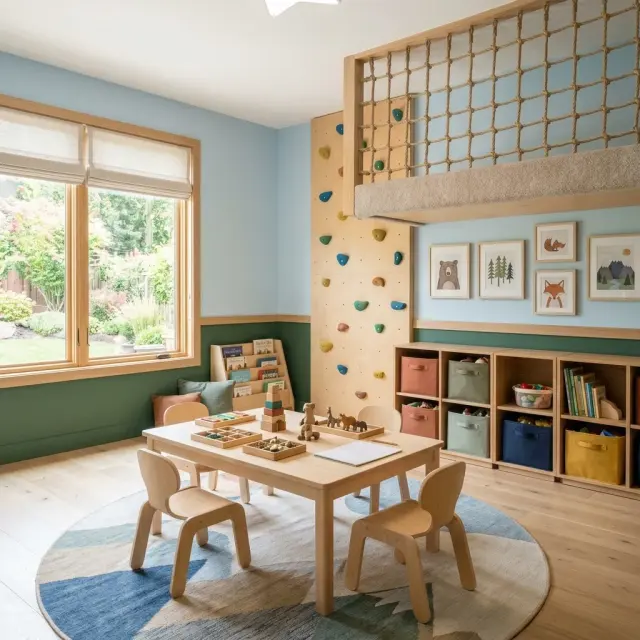
Most Pinterest-perfect kids' rooms photograph beautifully and fall apart in six months of real play. The ones that don't are built around a single discipline — invisible durability. Solid pine instead of veneer. Slate or LVP instead of laminate. Sealed cork instead of plush carpet. Below are ten Montessori-leaning playrooms and bedrooms that get the balance right between woodland-aesthetic calm and the structural reality of three muddy kids coming in from the backyard, with the framing-stage decisions and 2026 Northeast cost ranges that make each one buildable.
How I Read a Montessori Adventure Room
When a Hudson Valley family with kids hands me a playroom brief, I read four things before any design work: the flooring stack (what's actually installed underfoot, what underlayment lives below it, and how loud sound transfer is to the room below — playrooms over living rooms are a real acoustic issue), the wall durability protocol (semi-gloss painted drywall, scrubbable wainscoting, or shiplap — drywall in a play zone surrenders within a year), the safety stack on any vertical play element (climbing wall stud anchoring, loft fall-protection, mat thickness — these are not styling decisions), and the furniture material grade (solid wood vs. veneer vs. MDF — only one of those three can be sanded and re-finished after a kid takes a marker to it). Get those four right and the room is buildable, livable, and survives the next decade. Skip any of them and you're rebuilding in three years.
Seven years of running renovation design across Beacon, Rhinebeck, Kingston, and Brooklyn means I've inherited a lot of "designer playrooms" the previous owner installed for a Pinterest shoot and that the next family wants ripped out within two summers. The ten rooms below are the ones that survive. Real material specs, brand call-outs, and 2026 Northeast labor rates. For a useful companion piece on designing kids' spaces that grow with the child, the network's grow-with-me room essay covers the same thinking from a longer-horizon angle.
Reading note. The numbering moves from full-room renovations to minimal styling-only updates. A $5,000 climbing-wall build is not "better" than a $700 reading nook — they're different briefs at different budgets. Pick the entry point that matches your scope.1. The Two-Tone Climbing Wall Room
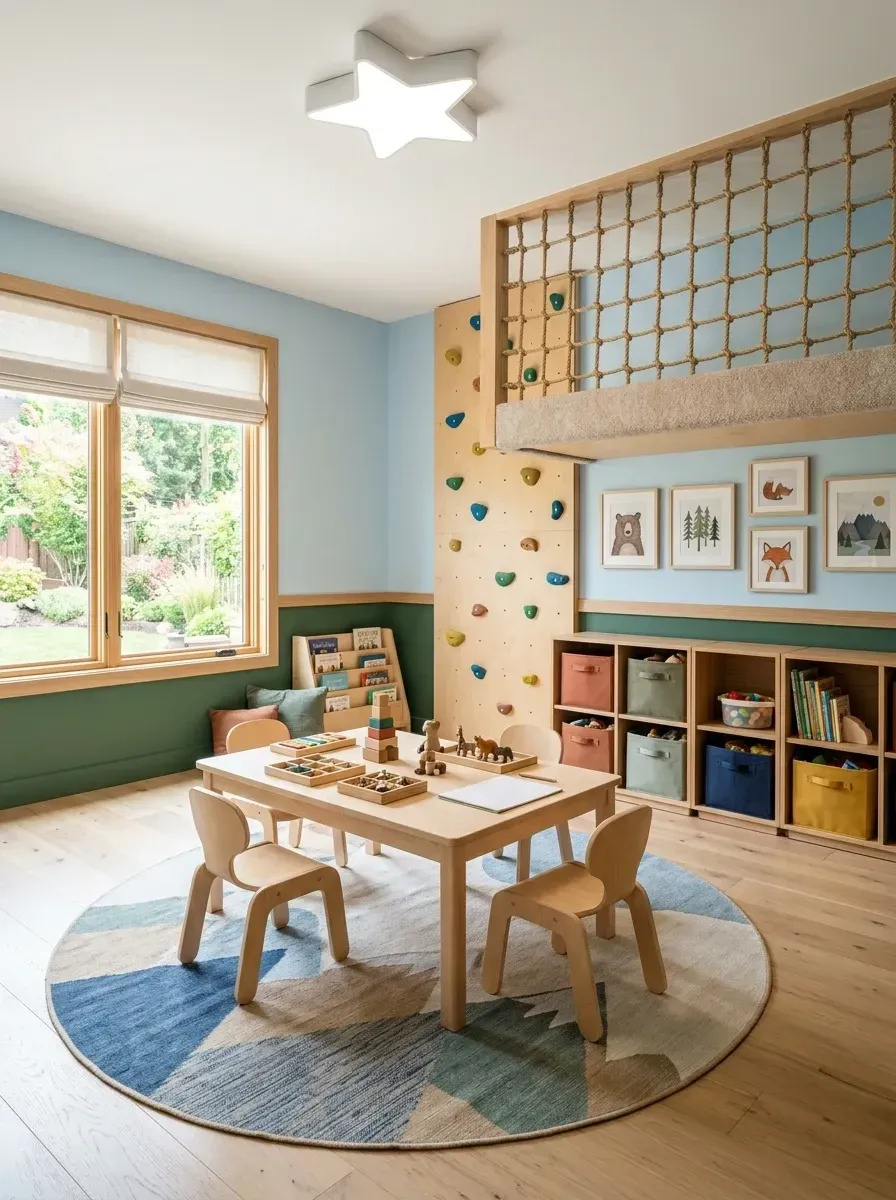
A smart paint move grounds the entire room. The forest green wainscoting at roughly one-third wall height anchors the active zone where the kids play; the lighter sky blue above keeps the room from feeling closed in. The plywood climbing wall is integrated cleanly into that paint line, so it reads as architecture instead of a piece of equipment bolted onto a wall. The elevated loft with safety netting adds a vertical play dimension that's a real differentiator in a primary playroom.
Plan-aware verdict: a residential climbing wall is not a finish-stage decision. The plywood backer (3/4" minimum, BC-grade or Baltic birch) must be lag-bolted into wall studs at every 16" o.c., and the holds need to be set on T-nuts pre-installed before the wall closes. Loft framing has to meet residential fall-protection requirements (IRC R312 for guards) — minimum 36" guard height, no climbable horizontals, openings under 4". This is a contractor-level build, not a weekend DIY.
Features
- Custom plywood climbing wall (3/4" Baltic birch with T-nuts)
- Elevated loft with code-compliant safety netting and 36" guard
- Two-tone wall paint (deep green wainscoting + sky blue above)
- Low solid-wood activity table and chairs (toddler-scale)
- Circular mountain-motif area rug
Cost Analysis (2026 Northeast)
| Decor Item (Qty) | Total Price Range |
|---|---|
| Custom Climbing Wall Materials & Labor | $1,500 – $2,500 |
| Custom Loft Netting and Frame | $500 – $1,000 |
| Low Wood Activity Table | $150 – $300 |
| Wood Playschool Chairs (×2) | $120 – $250 |
| Large Round Mountain Rug (8'–10') | $200 – $400 |
| Low Birch Shelving Units (×2) | $300 – $600 |
| Paint and Trim Materials | $200 – $400 |
| Total Estimated Cost | $2,970 – $5,450 |
Color Palette
Forest Green
#4A6B4A
Benjamin Moore Hunter Green (2041-10) or Sherwin-Williams Evergreens (SW 6447) in a scrubbable eggshell or satin finish.
Sky Blue
#AEC6CF
Farrow & Ball Borrowed Light (No. 235) or Benjamin Moore Beach Glass (1564) — calm, light, doesn't compete with the green.
Natural Birch
#D6C0A3
Baltic birch plywood with a clear hardwax oil — Sprout Kids, Lalo, or local Hudson Valley fabricator.
Muted Navy
#3C5A78
Low-pile machine-washable wool blend — Ruggable, Lorena Canals, or Annie Selke kids' line.
2. The Map Mural Reading Nook
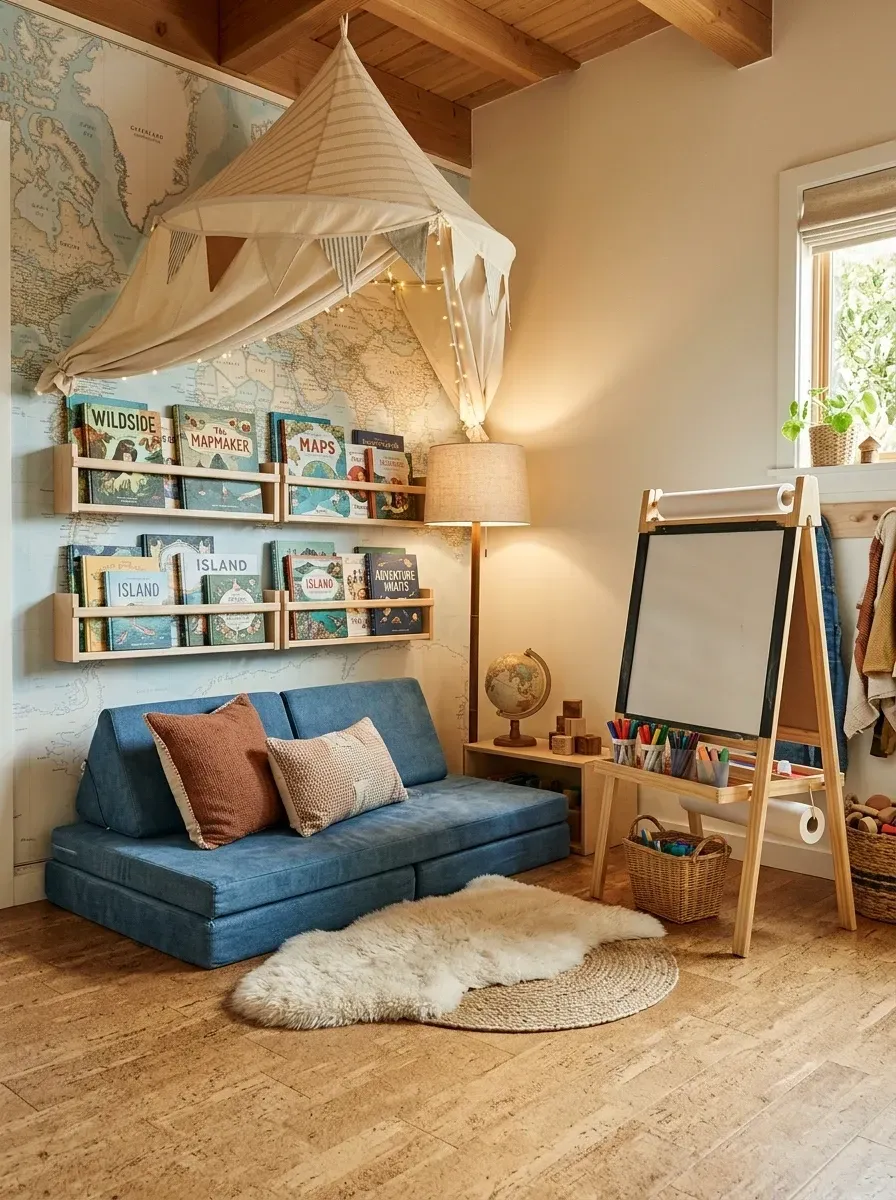
A small-footprint, big-imagination play corner. The full-wall map mural sets an immediate adventure tone; a Nugget-style fold-out foam couch sits on the floor, doubling as climbing structure and seating depending on the child's mood. Cork plank flooring is the right call here — soft underfoot, naturally antimicrobial, and warmer than wood or LVP for floor play. The fabric canopy with fairy lights creates a defined "den" zone within the larger room. Front-facing bookshelves are a Montessori essential — toddlers recognize covers, not spines.
Plan-aware verdict: cork flooring needs to be sealed properly to be truly mud-tolerant. Globus Cork or Forna delivers commercial-grade cork that comes pre-sealed; cheaper big-box cork tile usually needs a topical polyurethane after install or it stains in week one. Map murals as wallpaper (Pottery Barn Kids, Anewall, Nuwallpaper) are renter-friendly because they peel off cleanly, where painted murals don't.
Features
- Full-wall world map mural (peel-and-stick wallpaper)
- Fold-out foam play couch (Nugget, Ettomio, or Mama Hibachi)
- Fabric canopy with low-voltage fairy lights
- Front-facing wall bookshelves (4–6 across)
- Sealed cork plank flooring
- Wooden art easel
Cost Analysis (2026 Northeast)
| Decor Item (Qty) | Total Price Range |
|---|---|
| World Map Mural Wallpaper | $200 – $500 |
| Fold-Out Play Couch | $250 – $350 |
| Canvas Canopy with Lights | $50 – $120 |
| Front-Facing Wall Shelves (×4) | $100 – $200 |
| Wooden Art Easel | $60 – $120 |
| Small Sheepskin Rug | $50 – $100 |
| Total Estimated Cost | $710 – $1,390 |
Color Palette
Muted Aqua
#92B3B8
Anewall's vintage world map or Nuwallpaper Adventure Awaits — peel-and-stick stocks, removable for renters.
Denim Blue
#4F738E
Nugget couch in Atlantic or Ettomio in Denim — both certified Greenguard Gold for indoor air quality.
Natural Cork
#C4A484
Globus Cork or Forna ProTeak cork plank — pre-finished with commercial-grade urethane for high-traffic resistance.
Unbleached Canvas
#EDE6D6
100% cotton canvas in undyed natural — Numero 74 or Olli Ella canopy with battery-operated LED string lights.
3. The Woodland Decal Bedroom
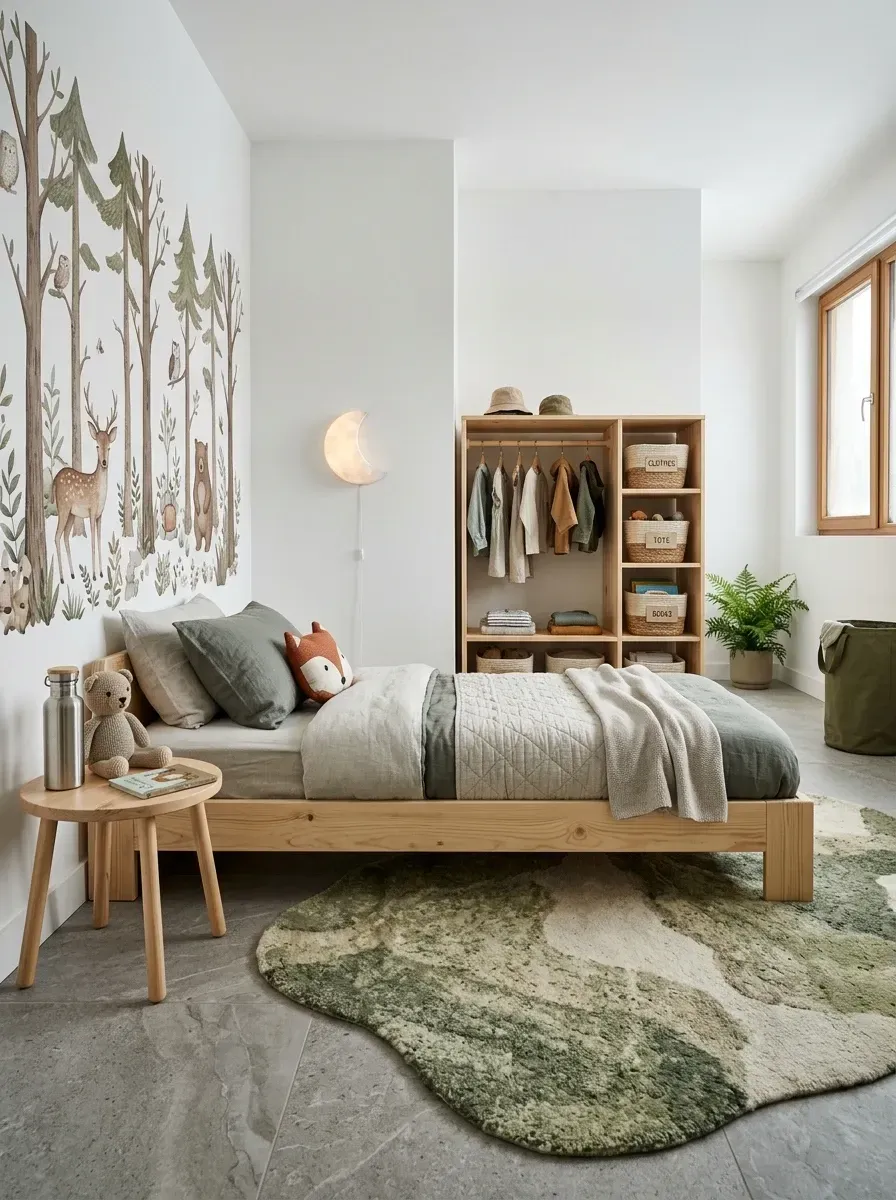
A renter-friendly format that delivers the woodland brief without the wallpaper or paint commitment. The wall decals (you can see the slight outline against the white drywall) read as "scene" from across the room and peel cleanly when the family moves or the child outgrows the theme. The flooring is large-format concrete-look porcelain — durable, waterproof, easy to clean, and visually quiet. The irregular moss-textured rug carries the warmth and softness load that the porcelain can't.
Plan-aware verdict: a low-profile or floor bed is a deliberate Montessori choice — it lets a toddler climb in and out independently, supporting the autonomy principle. Pick a solid pine or birch frame (Sprout Kids, Babyletto Hudson, Pottery Barn Kids Charlie) over MDF or veneer. Concrete-look porcelain in a kids' room reads cold underfoot but excellent for the parent doing the cleanup at 9 PM after a juice spill.
Features
- Large-scale removable woodland animal wall decals
- Low-profile solid pine bed frame (floor bed style)
- Irregularly shaped moss-textured area rug
- Open wooden Montessori-style wardrobe
- Large-format concrete-look porcelain tile flooring
Cost Analysis (2026 Northeast)
| Decor Item (Qty) | Total Price Range |
|---|---|
| Woodland Wall Decal Set | $150 – $300 |
| Low Solid Pine Twin Bed Frame | $200 – $400 |
| Twin Mattress and Linen Bedding | $300 – $600 |
| Irregular Moss Texture Rug (Large) | $200 – $450 |
| Open Wooden Wardrobe Unit | $300 – $600 |
| Small Side Table | $50 – $100 |
| Total Estimated Cost | $1,200 – $2,450 |
Color Palette
Forest Moss Green
#5F7146
Hand-tufted wool blend in irregular shape — Lorena Canals, Annie Selke kids', or Lalo's Forest Floor.
Raw Pine
#E5D1A8
FSC-certified solid pine with a non-toxic oil finish — Sprout Kids, Oeuf, or Babyletto Hudson collection.
Concrete Grey
#999999
Large-format porcelain (24×48 minimum) — Florim, Mosa, or Daltile in honed concrete look.
Sage Green
#8A9A86
Coyuchi Organic Linen or Magic Linen in Pale Sage — naturally ages soft, machine washable.
4. The Sage and White Wainscoting Room
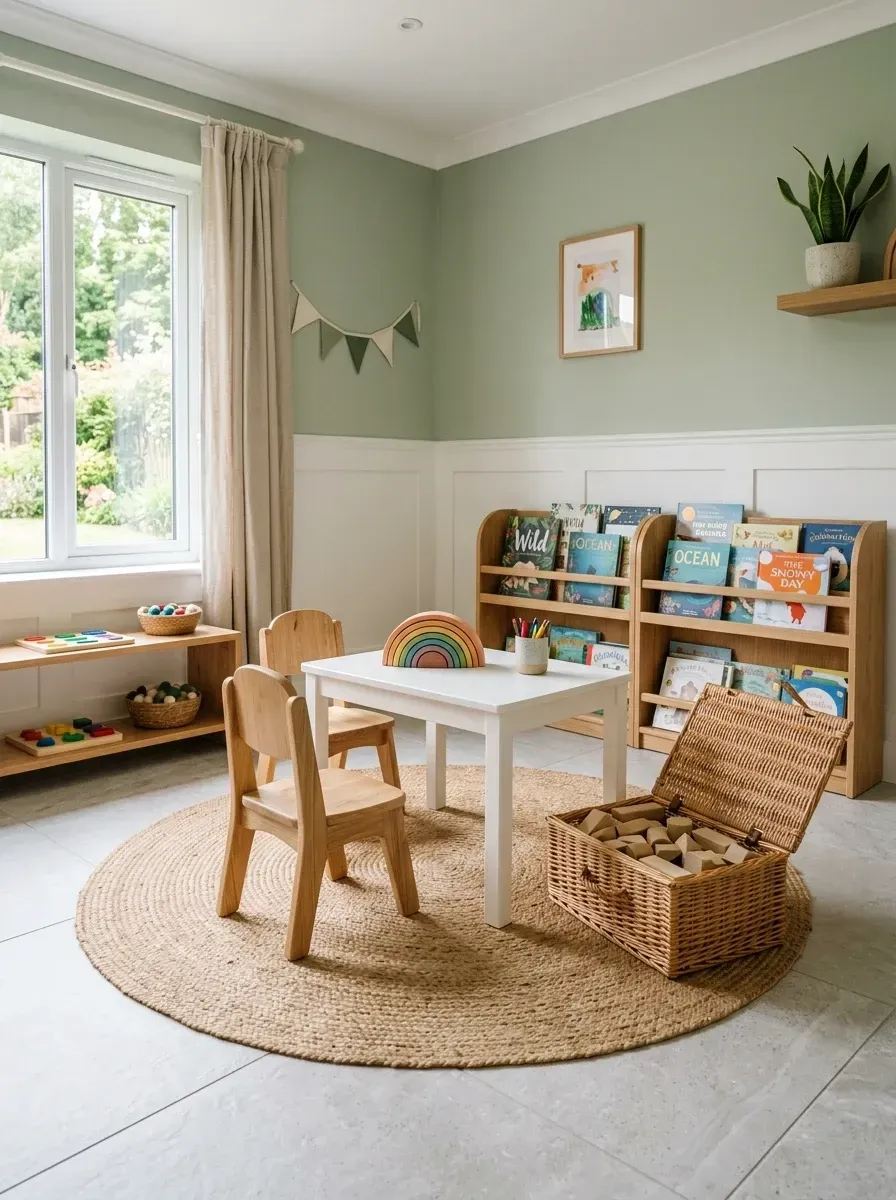
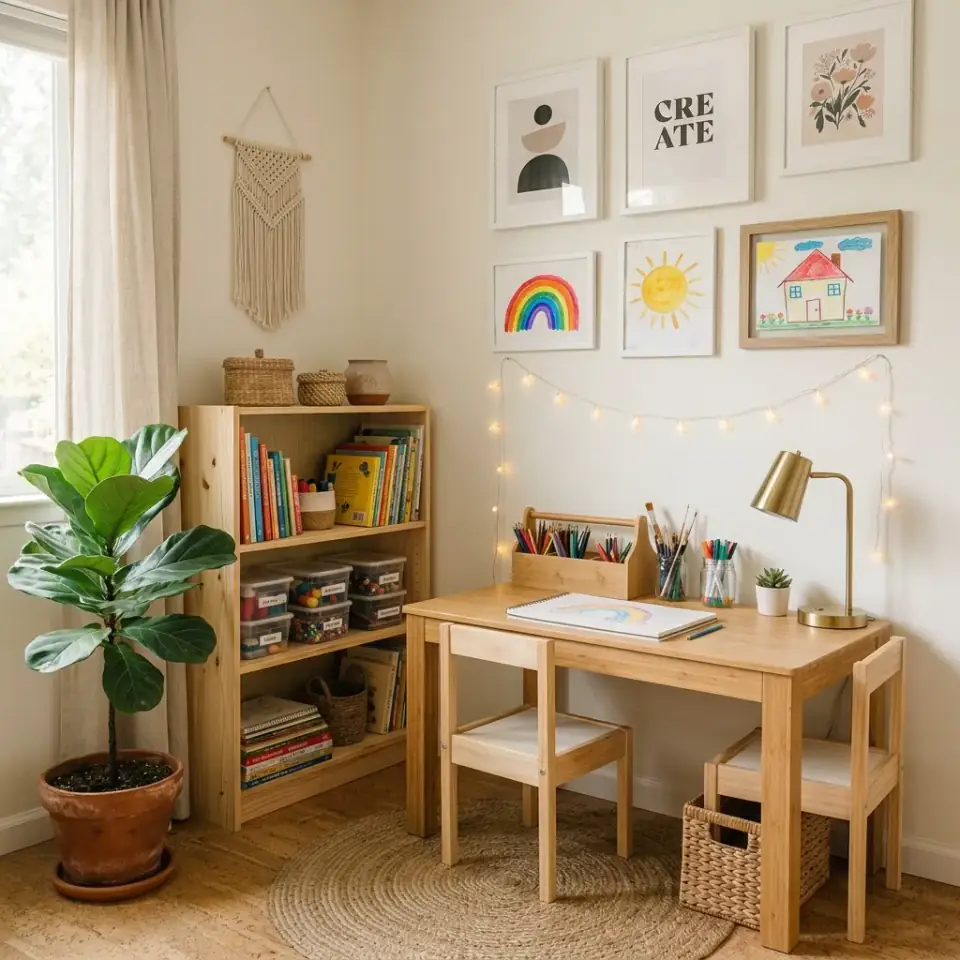
The most practical move in this whole guide is the white wainscoting at the lower half of the walls. Painted plywood or MDF panel (semi-gloss or gloss finish) is dramatically more durable and easier to wipe clean than drywall — muddy handprints, crayon, juice splash, all come off with a damp microfiber. The Montessori essentials are all here: low accessible shelves displaying activities at child eye level, a child-sized table and chair set for focused work, and natural-fiber jute underfoot.
Plan-aware verdict: install the wainscoting at 36"–40" off the floor — that hits the chair-rail line on most adult eye height while still covering the high-impact zone where toddlers actually scuff walls. Specify the panel as MDF (smoother finish, no grain telegraph) sealed with a high-quality acrylic semi-gloss paint. Jute rugs hide dirt remarkably well but are rough on bare knees — layer a smaller cotton or wool rug on top in the active play zone.
Features
- White wainscoting on lower walls (36"–40" height, semi-gloss MDF)
- Sage green upper walls (scrubbable acrylic finish)
- Large round natural jute area rug
- Low-profile solid wood bookcases (Montessori-style, child-accessible)
- Child-sized white activity table with solid wood chairs
- Wicker hamper for soft-toy storage
Cost Analysis (2026 Northeast)
| Decor Item (Qty) | Total Price Range |
|---|---|
| Wainscoting Materials & Installation | $500 – $1,000 |
| Paint (Green and White) | $100 – $200 |
| Large Round Jute Rug (6'–8') | $100 – $200 |
| Low White Activity Table | $80 – $150 |
| Solid Wood Chairs (×2) | $120 – $250 |
| Low Wooden Bookcases (×2) | $200 – $400 |
| Wicker Hamper / Basket | $40 – $80 |
| Total Estimated Cost | $1,140 – $2,280 |
Color Palette
Soft Sage Green
#9CAF88
Farrow & Ball Mizzle (No. 266) or Benjamin Moore Saybrook Sage (HC-114) in scrubbable matte or eggshell.
Crisp White
#FFFFFF
Benjamin Moore Decorator's White (CC-20) in semi-gloss — the hardest interior trim white available.
Natural Oak
#C7A673
Solid white oak Montessori shelves — Sprout, Lalo, Sabai Kids, or local Hudson Valley craftspeople.
Natural Jute Tan
#D2B48C
Hand-woven jute or jute-and-wool blend — Annie Selke, Dash & Albert, or Loloi Lily.
5. The Terracotta Forest Bedroom
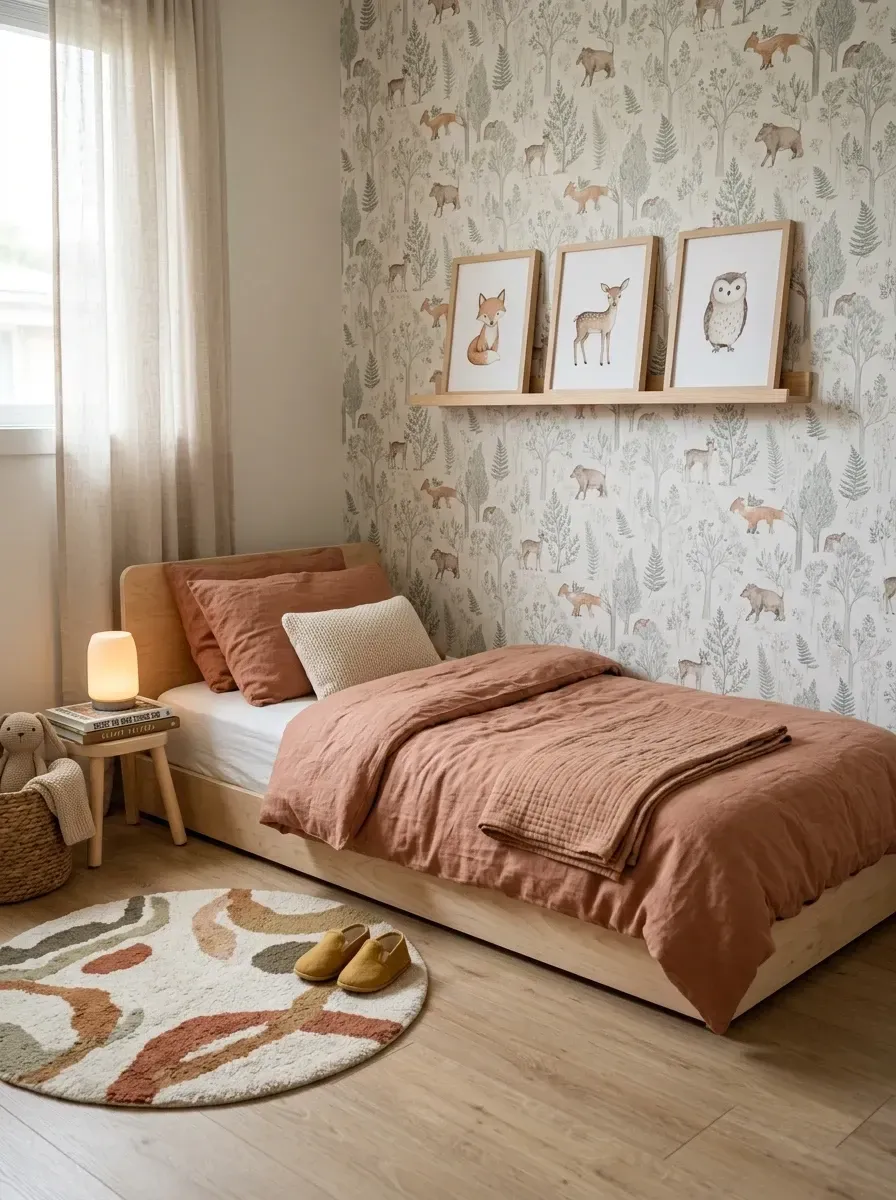
Busy wallpaper, calm bedding, and a low headboard-free platform bed that maximizes floor space. The terracotta linen duvet is the design move that ties the room together — linen as a kids' room textile is genuinely underrated. It softens with every wash, hides creases beautifully, and survives toddler abuse better than cotton percale or polyester. The wooden art ledge above the bed is safer than nailed-up frames and lets the family rotate art or display books without making new holes in the wall.
Plan-aware verdict: 100% flax linen bedding (Cultiver, Coyuchi, Magic Linen, Bole Road Textiles) costs $150–$300 for a twin set and lasts the child's entire decade in the room. The cheap polyester-cotton blend that Big Box stores sell for $40 will pill, fade, and need replacement within 18 months. Total ten-year cost favors the real linen by a wide margin — and it actually feels good against skin.
Features
- Vintage-style illustrated forest wallpaper
- Terracotta rust linen duvet and pillowcases
- Low wood platform twin bed (no headboard)
- Wooden art ledge (36"–48") with rotating prints
- Abstract patterned area rug (5'×7')
Cost Analysis (2026 Northeast)
| Decor Item (Qty) | Total Price Range |
|---|---|
| Wallpaper Materials & Installation | $300 – $700 |
| Terracotta Linen Duvet Set (Twin) | $150 – $300 |
| Low Wood Platform Twin Bed | $200 – $400 |
| Wooden Art Ledge (36"–48") | $30 – $60 |
| Framed Art Prints (×3) | $60 – $150 |
| Abstract Pattern Area Rug (5'×7') | $100 – $250 |
| Total Estimated Cost | $840 – $1,860 |
Color Palette
Terracotta Rust
#A05845
Cultiver Linen in Rust or Magic Linen in Cinnamon — 100% flax linen, machine washable, naturally wrinkle-tolerant.
Muted Olive Green
#848C6F
Hygge & West Forest, Sandberg Raphaël, or Sister Parish Sintra — vintage-illustrated stocks with kid-friendly scale.
Light Birch
#E3D2B4
Solid birch with hardwax oil finish — Sprout Kids platform bed or Oeuf Perch frame.
Mustard Yellow
#D8B254
Hand-tufted wool blend with a mustard pattern — Loloi, Annie Selke, or vintage Turkish runner.
6. The Ultimate Mud-Proof Entryway
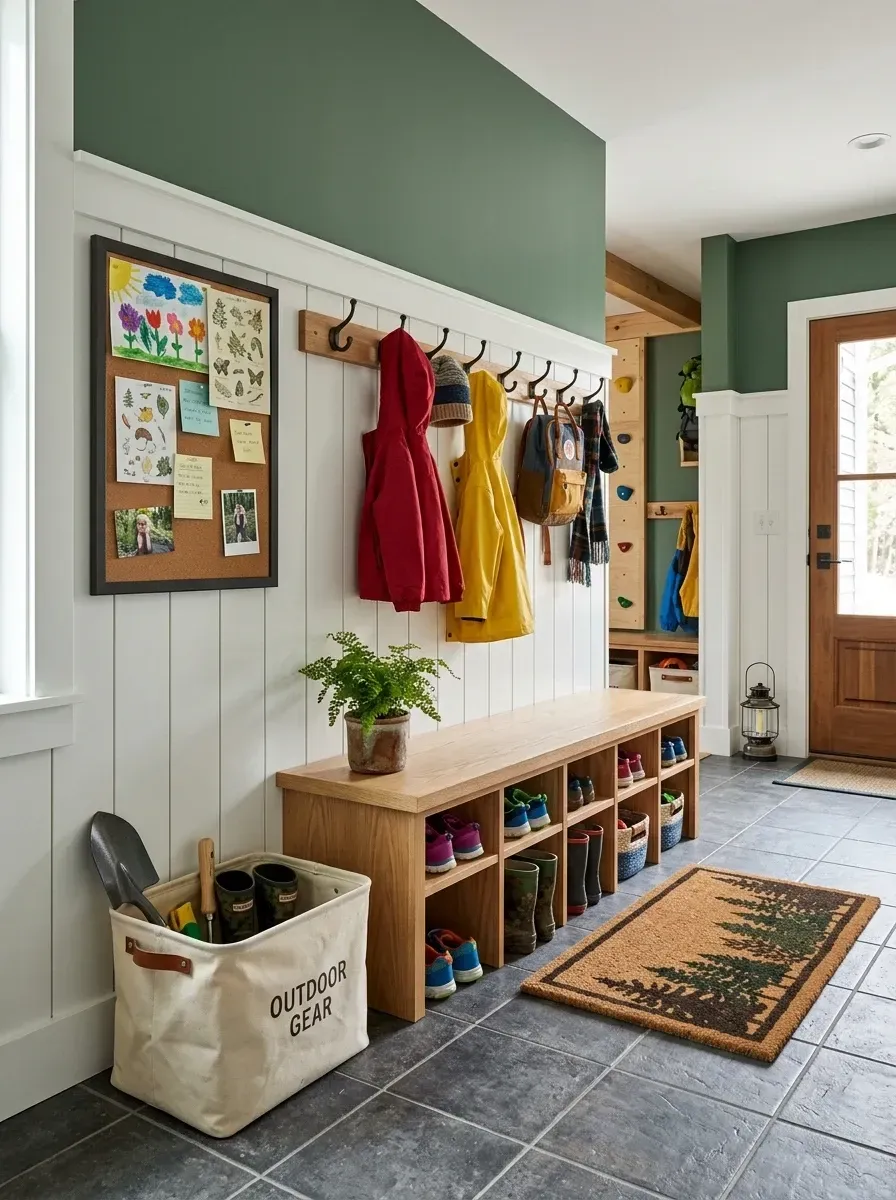
Functional design for a real Hudson Valley adventure family. Slate tile flooring is the most durable, waterproof, mud-tolerant residential flooring available — period. Vermont structural slate runs $8–$15 per square foot for material and the install holds up for 50+ years. The built-in wood bench with open shoe cubbies is the format I spec for every clients' family I work with — kids will always sit to remove shoes if there's a bench at the door, and they'll sometimes hang up a coat if there's a peg rail at their height. White shiplap wainscoting protects drywall from the inevitable backpack scuff zone.
Plan-aware verdict: slate must be sealed at install with a high-quality penetrating sealer (Aqua Mix Sealer's Choice Gold, Miracle Sealants 511 Impregnator) and re-sealed every 3–5 years. Skip the sealing step and the slate stains permanently from juice, mud, and pet accidents. Peg rails at 36"–42" height handle ages 4–10; install a second rail at 60" height for the parents and the older kids.
Features
- Sealed slate tile flooring (Vermont structural slate, gauged back)
- Built-in solid wood bench with open shoe cubbies
- White shiplap wainscoting with peg rail (kid-height + adult-height)
- Heavy coir doormat with tree-illustration design
- Canvas storage bin for rotating outdoor gear
Cost Analysis (2026 Northeast)
| Decor Item (Qty) | Total Price Range |
|---|---|
| Slate Tile Flooring & Installation (Small Area) | $600 – $1,200 |
| Custom Wood Bench with Cubbies | $400 – $800 |
| Shiplap Materials & Peg Rail Installation | $300 – $600 |
| Large Coir Doormat | $30 – $60 |
| Large Canvas Storage Bin | $25 – $50 |
| Total Estimated Cost | $1,355 – $2,710 |
Color Palette
Deep Forest Green
#3A5F4D
Farrow & Ball Studio Green (No. 93) or Benjamin Moore Salamander (2050-10) in scrubbable eggshell.
Off-White
#F2F2F0
Benjamin Moore Decorator's White (CC-20) in semi-gloss — the most scrubbable interior trim spec available.
Medium Oak
#B8936A
Solid white oak with marine-grade polyurethane finish — durable enough for daily seated boot removal.
Charcoal Slate
#555A5E
Vermont structural slate or Montauk Black slate — gauged back for easier install, ungauged front for natural texture.
7. The Organized Activity Zone
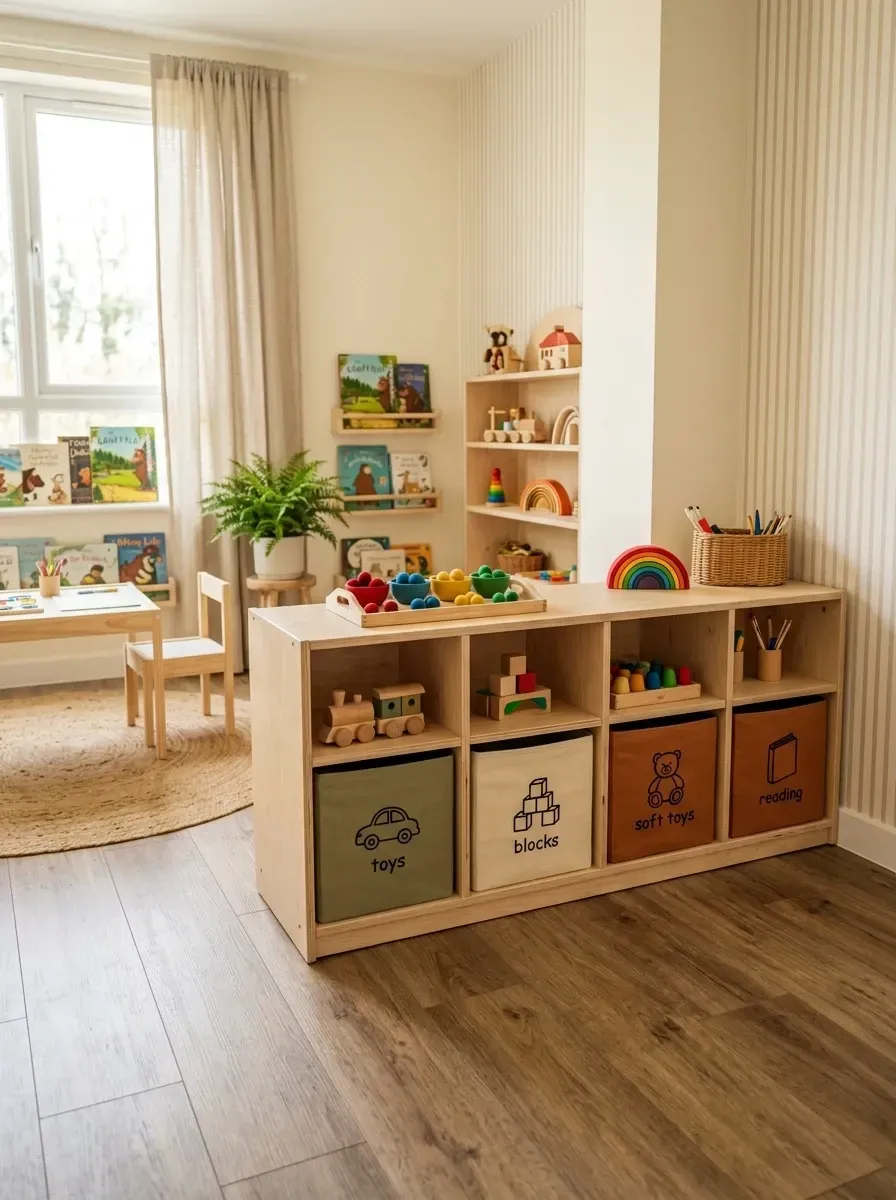
A textbook organized activity zone. The long, low birch plywood shelving unit is the centerpiece — deep enough to hold trays and bins, low enough that a 4-year-old can independently access every spot. Fabric storage bins with picture labels (not just text) let pre-readers participate in cleanup. The flooring is Luxury Vinyl Plank (LVP) — Coretec Pro, Pergo Outlast, or Karndean — which is genuinely the right answer for most playrooms. Waterproof, scratch-resistant, softer underfoot than tile, warmer than concrete, and quieter than hardwood for the room below. The Hudson Valley playroom that survives juice spills and Lego scatters and a beagle is usually on LVP.
Plan-aware verdict: spec the LVP at 6mm minimum thickness with a 20-mil wear layer for a real-use playroom. Cheaper 4mm LVP with a 12-mil wear layer dents under chair legs within a year. Install over a sound-attenuation underlayment (QuietWalk, Floor Muffler) if there's a living space below — without it, every Lego drop transfers as a thump downstairs.
Features
- Long, low birch plywood Montessori cubby shelving unit
- Fabric storage bins with picture labels (toddler-readable)
- Subtle striped wallpaper accent wall
- Small solid-wood table and chair set
- Luxury Vinyl Plank (LVP) flooring with sound-attenuation underlayment
Cost Analysis (2026 Northeast)
| Decor Item (Qty) | Total Price Range |
|---|---|
| Long Birch Plywood Cubby Unit | $400 – $700 |
| Fabric Storage Bins with Labels (×4) | $40 – $80 |
| Striped Wallpaper Accent Wall | $100 – $250 |
| Small Wood Table & Chair Set | $150 – $300 |
| Round Jute Area Rug (6') | $80 – $160 |
| Wall-Mounted Bookshelves (×2) | $40 – $80 |
| Total Estimated Cost | $810 – $1,570 |
Color Palette
Natural Birch
#E3D4B7
Baltic birch plywood with hardwax oil — uniform, repairable, sandable when scratched.
Warm Grey Stripe
#AFAEA9
Cole & Son Marquee Stripes or Schumacher Edwin Stripe — vinyl-coated for wipe-clean durability.
Olive Green
#7C8467
100% cotton canvas with leather labels — Olli Ella, Numero 74, or Open Spaces.
Medium Brown LVP
#96785B
Coretec Pro Plus or Karndean LooseLay in medium oak — 6mm+ thickness, 20-mil wear layer minimum.
8. The Cork Floor Teepee Corner
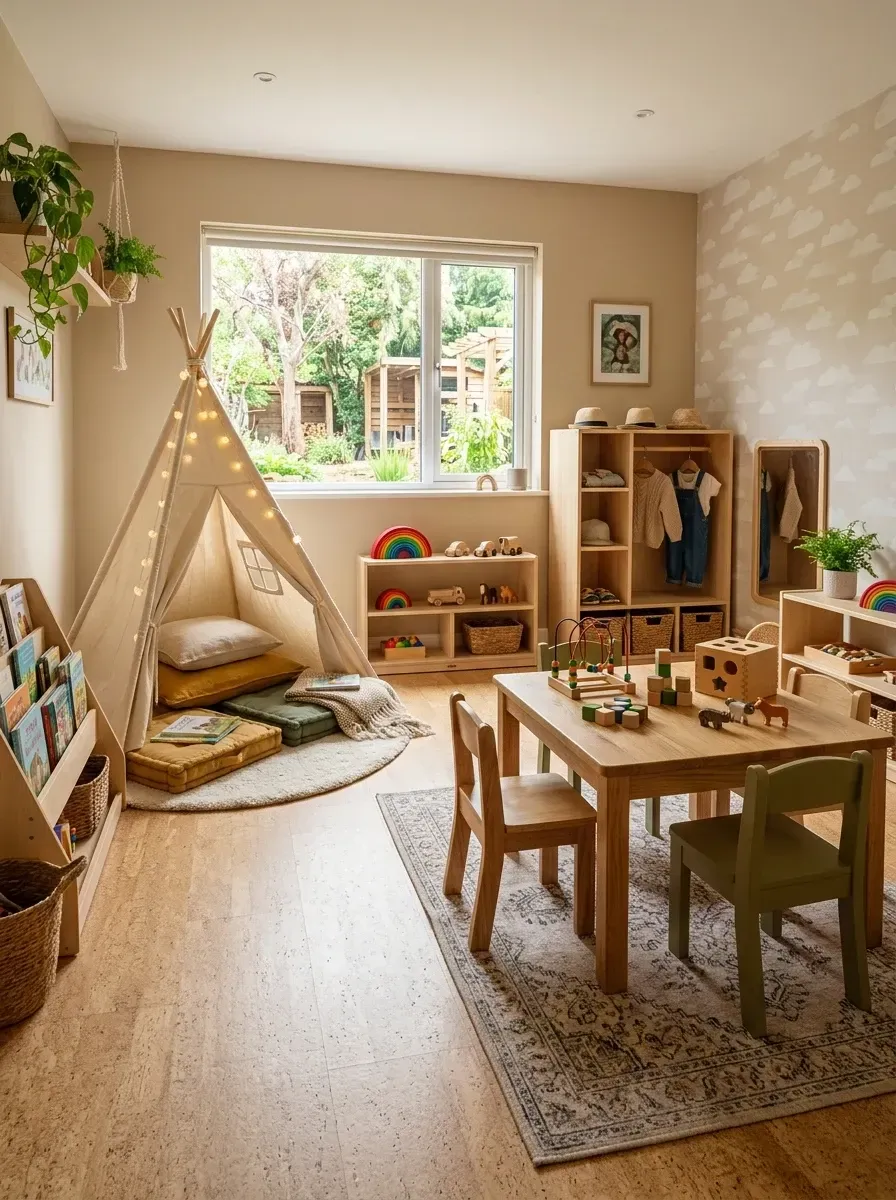
Cork plus canvas teepee plus cloud wallpaper — a quiet, warm play corner that delivers the woodland-cabin feel without committing to a full architectural renovation. Cork plank is the right flooring for a play space where kids will spend hours sitting and lying on the floor — it provides thermal break (warmer than wood, much warmer than tile), and the granular texture absorbs sound. The vintage-pattern rug hides spills and stains far better than a solid color. This is the format I recommend most often for Brooklyn brownstone playrooms where the room sees real use.
Plan-aware verdict: cork is soft and warm and sensitive to point loads. Always install wide felt pads under the legs of any furniture sitting on cork — chair legs especially. A toddler chair with metal nubs on the legs will cut tiny grooves into the cork by week three. The teepee poles need silicone or rubber feet so they don't slide on the cork during active play.
Features
- Canvas play teepee with battery-operated fairy lights and cushions
- Subtle cloud-pattern wallpaper
- Sealed cork plank flooring
- Vintage-style patterned area rug
- Solid wood activity table with painted accent chairs
- Open wooden wardrobe and Montessori shelving
Cost Analysis (2026 Northeast)
| Decor Item (Qty) | Total Price Range |
|---|---|
| Canvas Teepee with Lights & Cushions | $100 – $200 |
| Cloud Wallpaper Materials | $150 – $300 |
| Cork Flooring Materials & Install (per room) | $500 – $1,000 |
| Vintage-Style Area Rug (5'×7') | $150 – $350 |
| Solid Wood Activity Table & 2 Chairs | $200 – $400 |
| Open Wooden Wardrobe / Shelving Unit | $200 – $400 |
| Total Estimated Cost | $1,300 – $2,650 |
Color Palette
Pale Beige Clouds
#EBE5D9
Hibou Home Wonderland, Sian Zeng, or Mini Moderns Cloud — soft scale, kid-appropriate.
Natural Cork
#C8A88A
Globus Cork, Forna ProTeak, or Cali Bamboo Cork in natural — pre-finished commercial-grade urethane.
Muted Olive Green
#808E6E
Non-toxic kids' furniture paint — Sherwin-Williams Harmony or Benjamin Moore Natura, both Greenguard certified.
Cream Canvas
#F0EAD6
100% cotton canvas with FSC-certified pine poles — Numero 74, Olli Ella, or Lorena Canals teepee.
9. The Hand-Painted Mural & Concrete Floor
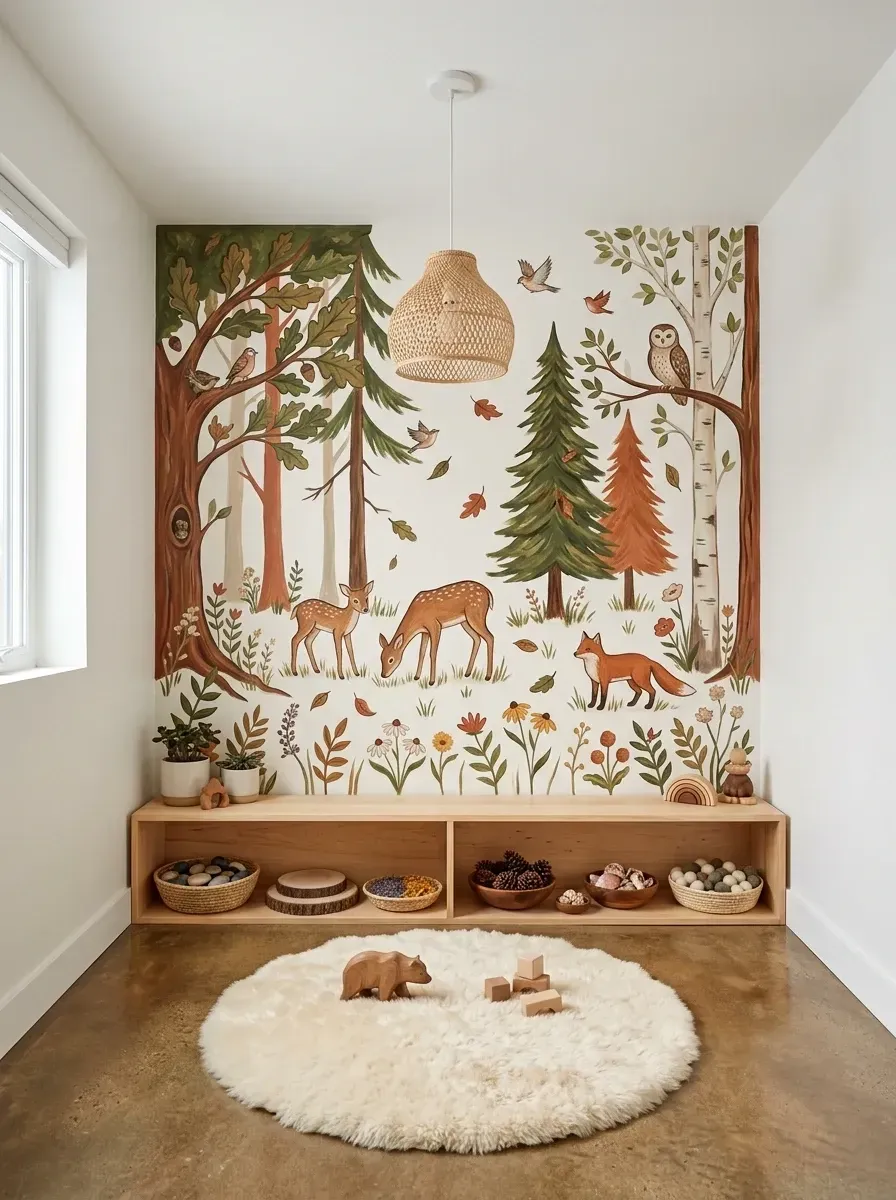
A full-architectural play space defined by two genuinely durable choices: a hand-painted mural and a polished concrete floor. The mural has no seams, no edges, no peel-up corners — paint over plaster outlasts wallpaper by decades. Polished concrete is essentially indestructible at the play scale (it's literally what commercial buildings are built with) and easy to mop. The long custom floating wood bench gives kids a seat without committing the floor footprint to a sofa, and a real sheepskin rug carries the warmth load that concrete alone can't deliver.
Plan-aware verdict: hand-painted murals are a permanent commitment, both visually and financially. Spec a timeless theme (forest, mountain, abstract pattern — not the latest Disney film) and budget $1,000–$3,000 for the muralist labor. A floating wood bench cantilevered from the wall needs structural blocking lag-bolted into framing — never just drywall anchors. Decide both at framing stage. Concrete floor + radiant heat in the slab is the right pairing for a Hudson Valley basement playroom; concrete without radiant is genuinely cold and unpleasant October through April.
Features
- Full-wall hand-painted forest animal mural
- Polished concrete flooring (with in-slab radiant heat for Northeast climate)
- Long custom floating wood bench / shelf (structurally anchored)
- Large real sheepskin rug
- Woven natural-fiber pendant light
Cost Analysis (2026 Northeast)
| Decor Item (Qty) | Total Price Range |
|---|---|
| Custom Hand-Painted Mural (Labor & Materials) | $1,000 – $3,000 |
| Polished Concrete Floor Finishing (per room) | $800 – $1,500 |
| Custom Floating Wood Bench (Materials & Install) | $500 – $1,000 |
| Woven Pendant Light Fixture | $100 – $250 |
| Large Real Sheepskin Rug | $150 – $300 |
| Total Estimated Cost | $2,550 – $6,050 |
Color Palette
Warm Brown
#8B5A2B
Low-VOC interior paint (Benjamin Moore Natura or Sherwin-Williams Harmony) in custom mixed earth tones.
Deep Moss Green
#4A5D23
Custom mixed deep green for the painted pine trees — eggshell finish for scrub-tolerance.
Polished Concrete Grey
#8C8C8C
Diamond-polished concrete with in-slab radiant heat — sealed with a penetrating densifier (Prosoco LS) plus matte topcoat.
Clear Maple
#D8C09D
Solid hard maple with marine-grade water-based polyurethane — durable enough for daily climbing.
10. The Minimalist Block Play Area
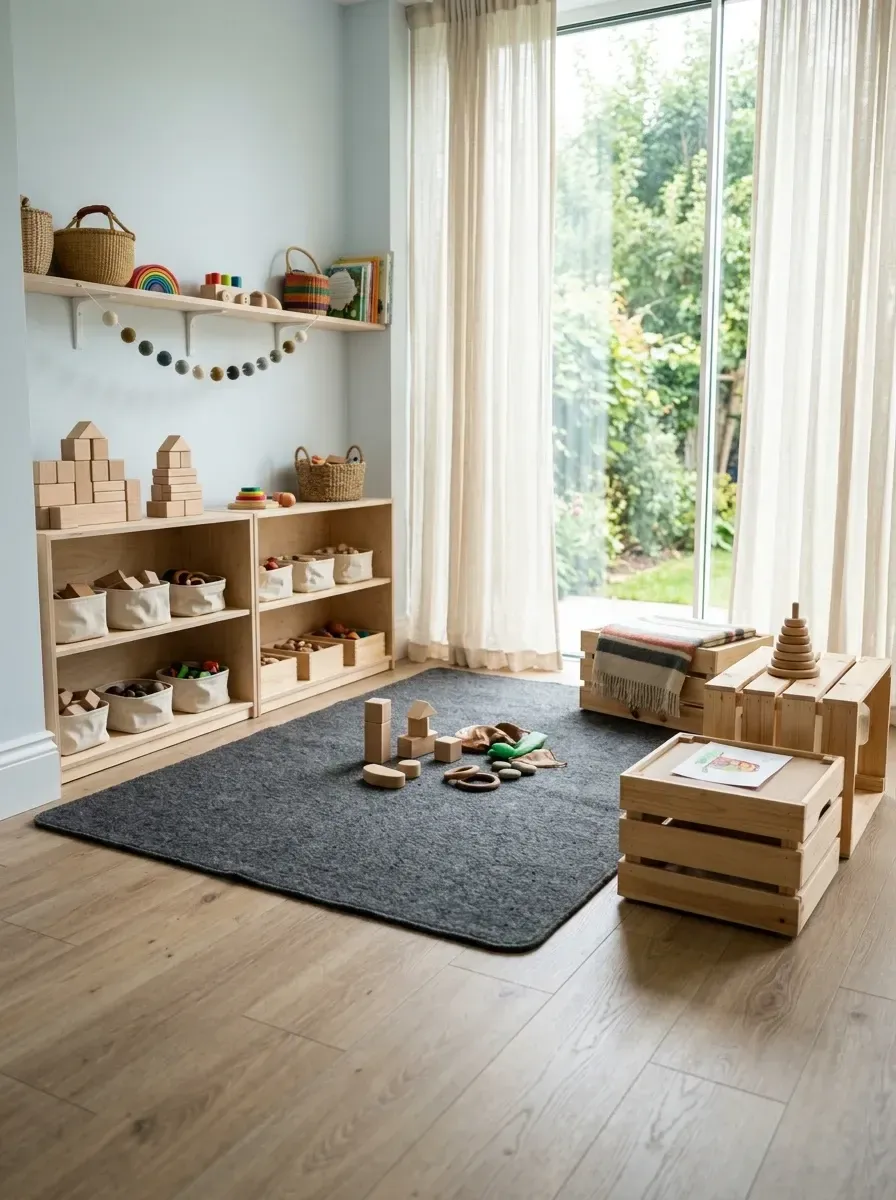
Hyper-minimalist Montessori. The room is built around block play, and every material decision serves that brief. The thick charcoal felt rug is the most important spec — felt provides a flat, firm, non-skid surface that block towers can actually stack on, where a plush carpet would topple them. Wooden crates double as storage and seating. Sheer floor-to-ceiling curtains soften the harsh natural light without blocking it. The Montessori principle on display here is "less is more" — fewer activities, displayed deliberately, give a child the space to focus deeply.
Plan-aware verdict: a true thick felt rug (Hay, Filzfelt, EZ Living) runs $200–$400 for a usable size — and it's the right call for serious block play. Vacuuming felt requires no beater bar (which would unfelt the surface over time) and high suction. If the family has pets, expect to maintenance the rug weekly; cat hair clings to felt aggressively.
Features
- Thick charcoal grey dense felt area rug (block-play surface)
- Simple wooden crates (storage + seating)
- Low open Montessori shelving units
- Floor-to-ceiling off-white sheer curtains
- Curated collection of natural unfinished wooden building blocks
Cost Analysis (2026 Northeast)
| Decor Item (Qty) | Total Price Range |
|---|---|
| Large Thick Felt Area Rug (8'×10') | $150 – $300 |
| Wooden Storage Crates (×4) | $60 – $120 |
| Low Open Shelving Units (×2) | $200 – $400 |
| Sheer Curtains and Rod | $100 – $200 |
| Large Wooden Block Sets (Multiple) | $200 – $500 |
| Total Estimated Cost | $710 – $1,520 |
Color Palette
Pale Ice Blue
#D0E0E3
Farrow & Ball Borrowed Light or Benjamin Moore Frostine (AF-5) — quiet, sleep-friendly, doesn't compete with the toys.
Charcoal Grey Felt
#4A4A4A
Hay Peas Wool Felt or Filzfelt Designtex Wool Felt — block-stable, sound-dampening, premium-quality felt.
Unfinished Pine
#E6D2B5
Solid pine crates and shelving (sand smooth, child-safe edges) — Plan Toys, Grimm's Spiel und Holz, or Tegu wooden blocks.
Off-White Sheer
#F5F5F0
Linen sheer or cotton voile — Pottery Barn Belgian Flax or West Elm linen sheer panel.
Pro Tips From the Renovation Designer's Chair
- Invest in material grade, not just aesthetics. The biggest mistake I see in playrooms is solid-wood-look furniture made from particle board with a veneer. Solid pine, birch, or oak can be sanded and refinished if a child takes a permanent marker to it; MDF or particle board cannot. Pay 30% more upfront for solid wood and skip the "we'll need to replace this in two years" cycle entirely.
- Layer your lighting. Don't rely solely on overhead recessed cans. Add floor lamps and table lamps with warm 2700K bulbs to create pockets of cozy light in the evening. The room transitions from active-play-bright to wind-down-dim across the evening, which supports the natural sleep cue. Every layer on its own dimmer.
- Build a mud-buffer at the door. Even if you can't do a full mudroom build (Section 6), create a transition zone at any door the kids use to come in from outside — coir mat plus shoe storage plus low hooks. Stopping the mud at the threshold is exponentially easier than cleaning it off the playroom rug. The network's interior renovation archive has more on threshold-zone design.
- Spec for ten years, not one. Kids' rooms are renovated more frequently than any other space because owners pick décor and toys for the child's current age. The format that survives is the one designed to grow — neutral wall colors, swappable wallpaper or decals, modular shelving, and a twin or low-platform bed. Decals come off; trendy themed wallpaper does not.
- Air quality matters more in kids' rooms. Specify Greenguard Gold or FloorScore-certified flooring, low-VOC paint (Benjamin Moore Natura, Sherwin-Williams Harmony, ECOS), and CertiPUR-US or GOLS-certified mattresses. Off-gassing affects children more per body weight than adults — this is not a marketing detail.
- Plan structural moves at framing. Climbing walls, lofts, floating benches, recessed shelving, and built-in window seats are framing-stage decisions. Decide them before drywall closes. Retrofitting any of them later is 2–3× the cost and never reads as clean.
Cost-Saving Moves That Don't Read as Cuts
- DIY the mural with vinyl decals. A hired muralist runs $1,000–$3,000; a quality removable wall decal set (Pottery Barn Kids, Mae Studios, RoomMates, Anewall) delivers similar visual scale for $150–$300 and comes off cleanly when the child outgrows the theme.
- Hunt secondhand solid wood. Hudson Valley estate sales, Facebook Marketplace, and Brooklyn stoop sales regularly turn up 1960s-era solid maple or walnut dressers and bookcases at $50–$150. A weekend of sanding and a non-toxic oil finish gives you a piece that outperforms anything new under $500.
- Cork or LVP over hardwood. Real white oak hardwood in a playroom runs $14–$22 per square foot installed and gets dented. Sealed cork or 6mm LVP delivers more durability for $5–$10 per square foot, better acoustic performance, and easier maintenance. Save the hardwood for the bedroom.
- Wallpaper one wall, paint the other three. A $30/roll designer wallpaper covering one accent wall costs a fraction of doing the entire room and delivers most of the visual impact. Paint the other three in a coordinated scrubbable eggshell.
- Buy bins and labels separately. Pre-made labeled storage systems run $30–$60 per bin from kids' specialty retailers. Plain canvas or seagrass bins from Target or IKEA cost $8–$15, and a custom photo-printed leather label is $5 each from any local etching shop. Same Montessori function, third the price.
The Core Idea. A Montessori adventure room that survives real kids and real wear is built around invisible durability — flooring that hides scuffs, walls that wipe clean, furniture that can be sanded and re-finished, textiles that wash hot and survive. The Pinterest aesthetic comes for free once the material grade is right; the materials are not optional. Spec for the ten-year hold, not the styled photo, and the room earns its keep through a decade of play instead of needing a redo at year three.
Reader Questions on Montessori Playrooms
What actually defines a Montessori-inspired playroom?
A Montessori playroom is built around three principles: accessibility (low open shelves at child eye level, activities reachable independently), order (every activity has a designated spot, picture-labeled storage, limited toy rotation to prevent overwhelm), and autonomy (a floor bed or low platform bed the child can enter independently, child-sized table and chair, hooks at child height). The aesthetic — natural wood over plastic, neutral palette, fewer toys — is downstream of those principles. A room with all-natural wood and twenty plastic toys jumbled on a shelf is not Montessori; a room with one well-organized shelf of six wooden activities is.
How do I make a kids' room genuinely durable and "mud-proof"?
Start with the floor. Slate tile (Section 6) is the most durable; LVP at 6mm with a 20-mil wear layer (Section 7) is the most cost-effective; sealed cork (Sections 2 and 8) is the warmest. All three resist scratches and mud far better than hardwood, carpet, or laminate. Continue with semi-gloss painted wainscoting on the lower walls (it wipes clean of crayon and juice), solid wood furniture rather than veneer-over-MDF (sandable when scuffed), and washable cotton or wool rugs rather than synthetic plush. The total cost premium for "real durable" over "looks durable" is roughly 25–40% upfront, and the 10-year cost is dramatically lower because nothing needs replacing.
Are Montessori playrooms expensive to set up?
Not necessarily. A meaningful Montessori-leaning playroom can be assembled for $700–$1,500 (Section 2 reading nook, Section 5 terracotta bedroom, or Section 10 minimalist block area) using semi-custom or thoughtfully sourced pieces. The Montessori philosophy actually argues against expensive — fewer, higher-quality toys and versatile furniture that grows with the child. Where the cost rises is on full architectural builds (climbing walls, lofts, custom millwork, built-in window seats), which can run $3,000–$10,000+. Pick the entry point that matches your scope and timeline.
What's the best way to organize toys in a Montessori playroom?
Replace the giant toy box with a low Montessori shelf (Sprout Kids, Lalo, IKEA Kallax laid horizontally) and fabric storage bins with picture labels. Each activity gets a designated spot — a tray, a basket, a labeled bin — and only 6–10 activities are displayed at once. The rest live in closet rotation. Front-facing bookshelves let pre-readers select books by cover, not spine. Hooks at child height (36"–42") let kids hang up coats and bags themselves, supporting the autonomy principle. The order is the design.
What flooring is best for a high-traffic kids' playroom?
In order of overall fit-for-purpose: LVP (Luxury Vinyl Plank) at 6mm thickness with a 20-mil wear layer — waterproof, scratch-resistant, warmer than tile, quieter than wood, $5–$8 per square foot installed; sealed cork plank — soft, warm, naturally antimicrobial, $7–$12 per square foot; slate tile — most durable for mudroom and entryway zones, cold without radiant heat, $8–$15 per square foot. Avoid plush wall-to-wall carpet (traps allergens, cannot be cleaned of juice spills) and unsealed concrete (cold, hard, unforgiving in a play context). For a Hudson Valley playroom over a finished basement, LVP with a sound-attenuation underlayment is almost always the right answer.
How do I design a kids' room that grows with the child?
Spec the bones for a 12-year-old, not a 4-year-old. Neutral scrubbable wall paint, removable wallpaper or decals (swappable across age stages), modular Montessori shelving that reconfigures as needs change, a twin or full bed that survives from preschool through middle school, and durable flooring that handles the full range from block play to homework chair scoot. The themed elements (woodland, dinosaurs, princesses, space) live in textiles, art, and decals — never in wallpaper, paint, or built-in millwork. That way every theme refresh is a 1-day project, not a renovation.
Where to Read Next
If this guide was useful, the natural next reads across the network sit in two directions. For more bedroom and kids' space material walk-throughs, the bedrooms and kids' rooms archive covers cross-format comparisons. For the longer-horizon thinking on designing kids' rooms that future-proof through every age stage, the grow-with-me room essay is the closest companion piece. And for the broader plan-first thinking that underpins material-honest design, the essay on the unconscious canvas covers the ground at a higher altitude.
Sources & Further Reading
- American Montessori Society. Montessori at Home — Setting Up the Prepared Environment. amshq.org
- Remodelista. Remodeling 101: The Best Wood Flooring for Kids and Pets. remodelista.com
- The Spruce. Playroom Organization Ideas. thespruce.com
- U.S. Consumer Product Safety Commission (CPSC). Residential Fall Protection and Loft Safety Guidelines. cpsc.gov
- American Academy of Pediatrics. Healthy Sleep Environment and Nursery Safety Recommendations.
- International Residential Code (IRC). Section R312 — Guards and Window Fall Protection.
- Greenguard Gold & FloorScore. Indoor Air Quality Certification Standards for Furniture and Flooring.
- Carpet & Rug Institute Green Label Plus. Low-Emissions Certification for Soft Floor Coverings.
- Coretec, Karndean, Pergo. Luxury Vinyl Plank Specification and Wear-Layer Guidelines.
- Globus Cork, Forna ProTeak. Cork Plank Flooring Sealing and Maintenance Specifications.
- NAHB / Hanley Wood. 2025 Cost vs. Value Report — Bedroom and Kids' Room Renovation ROI. remodeling.hw.net

Nora Whitfield
Renovation Designer & Interiors Editor · Beacon, New YorkNine years of design-build renovation work across the Hudson Valley and the Northeast. Nora runs the Renovations, Room Guides and Renovation Mind desks — before-and-after studies, room-by-room design guides, and the long essays on why what we renovate matters.
More from Nora →
Reader notes