

A dining room is the room I get the most "make it look expensive" briefs on, and almost always for the wrong reasons. Clients arrive with images of $30,000 chandeliers and $15,000 tables and think the line item is the look. It isn't. Quiet luxury in a dining room is about three structural decisions made before any furniture order goes in: the proportion of the table to the room, the height and dimming of the light over it, and the material count on the surfaces around it. Get those three right at the framing stage and the cheap version of the room reads as expensive. Get them wrong and the expensive version still reads as a hotel banquet hall. Below: nine dining rooms that handle the structural moves well, with the real Hudson Valley cost ranges and the plan-aware decisions behind each one.
How I Read a Quiet Luxury Dining Room
When I evaluate a dining room for a Hudson Valley renovation client, I read four structural moves before color or finish even comes up: the table-to-room proportion (a 96-inch table needs at least 36 inches of clear walk-around on every side, which sets the minimum room dimension), the light plane (pendant centered on the table, hung 30–34 inches above the surface, on a dimmable circuit — never a single non-dimmable fixture), the material count on the surfaces (floor, walls, ceiling, table, chairs, sideboard — keep distinct material reads to four or five maximum), and the edge discipline (where wainscot meets baseplate, where paneling meets ceiling, where the rug breaks the floor plane). Get those four right and the room composes itself.
Across seven years of running design-build projects out of Beacon and Kingston, the dining rooms that hold up over decades are the ones that resist the "statement piece" trap — the rooms where every element supports the table rather than competing with it. The nine rooms below cover the realistic spread, from $6,000 small-nook builds to $38,000 grand-room renovations. For a sister-room read on the same vocabulary, our quiet luxury living room design guide sits one wall away from this one in most floor plans.
Reading note. The numbering doesn't rank. Each room is a different brief — paneled formal, round nook, moody navy, organic Japandi — and each works for a different floor plan. Pick the one closest to your room shape and ignore the rest.1. Classic Paneling and Modern Brass
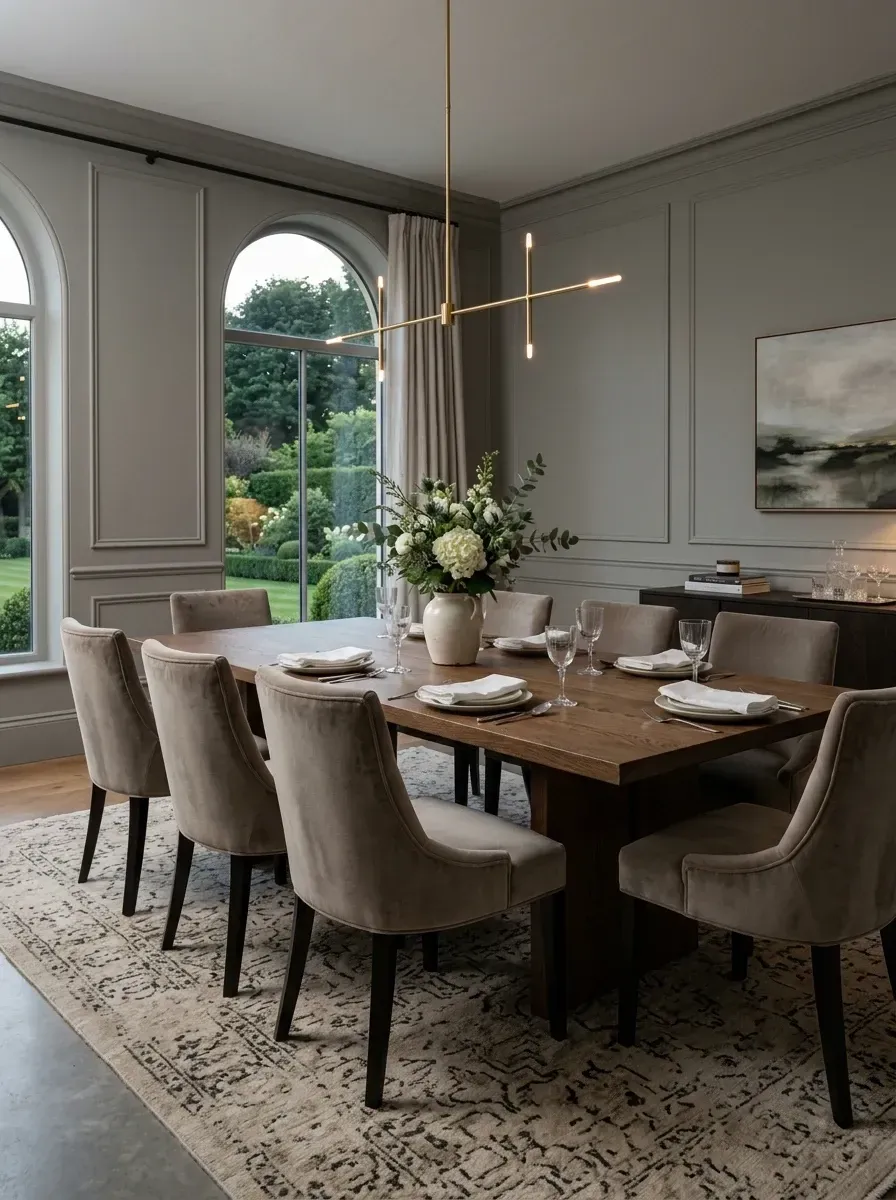
This room balances classical bones with modern fixtures, which is the Hudson Valley client's most common ask. The full-height paneling in a soft grey-green is doing the heritage-architecture job — it makes a 1920s or new-build room read as if it has been there for a century. The brass linear pendant is the modern counterpoint. What makes the composition work is that the pendant is sized correctly: a chandelier should run roughly half to two-thirds of the table's length, and this one is dialed in.
Plan-aware verdict: paneling is a framing-stage decision, not a finish-stage one. To make full-height paneling read as architecture rather than as glued-on trim, the rough wall has to be flat to within 1/8 inch over 8 feet — which means a skim-coat or fresh drywall before the millwork goes on. Skipping that step is the most common reason DIY paneling installs look "off." Hudson Valley cabinet shops charge $40–$70 per linear foot of paneling installed; an 8-foot wall lands at $3,500–$6,000 with prep, paint, and trim.
Features
- Full-height shaker or flat-panel wall paneling
- Linear brushed-brass pendant (52–72 inches long)
- 96-inch solid oak rectangular dining table
- Velvet upholstered chairs (8) in a taupe/oat tone
- Patterned vintage or vintage-style rug, sized for the table footprint
Cost Analysis (2026 Northeast)
| Decor Item (Qty) | Total Price Range |
|---|---|
| Custom Wall Paneling + Prep + Paint (One Wall) | $3,500 – $6,000 |
| Linear Brass Pendant Light | $600 – $1,500 |
| Solid Wood Dining Table (~96 in.) | $2,500 – $5,500 |
| Velvet Dining Chair (×8) | $2,400 – $4,800 |
| Large Patterned Area Rug (~10×14) | $1,200 – $3,000 |
| Solid-Wood Sideboard / Credenza | $1,500 – $3,500 |
| Large Framed Abstract Art | $500 – $1,500 |
| Total Estimated Cost | $12,200 – $25,800 |
Color Palette
Muted Grey-Green
#9EA39D
Farrow & Ball Pigeon (No. 25) or Benjamin Moore Saybrook Sage (HC-114) — keep wall and trim the same color so the paneling reads as architecture, not as decoration.
Medium Oak
#A68B6C
Solid white oak finished with hardwax oil — Rubio Monocoat or Osmo for the matte, hand-rubbed sheen.
Warm Taupe
#B5ACA1
Performance velvet — Kravet Lush, Romo, or Knoll Cato — specified at 50,000+ double rub for daily-use seating.
Brushed Brass
#C9A76B
Visual Comfort, Allied Maker, or Apparatus Studio — heritage form, modern fabrication, dimmable LED.
2. Soft Curves and Mixed Materials
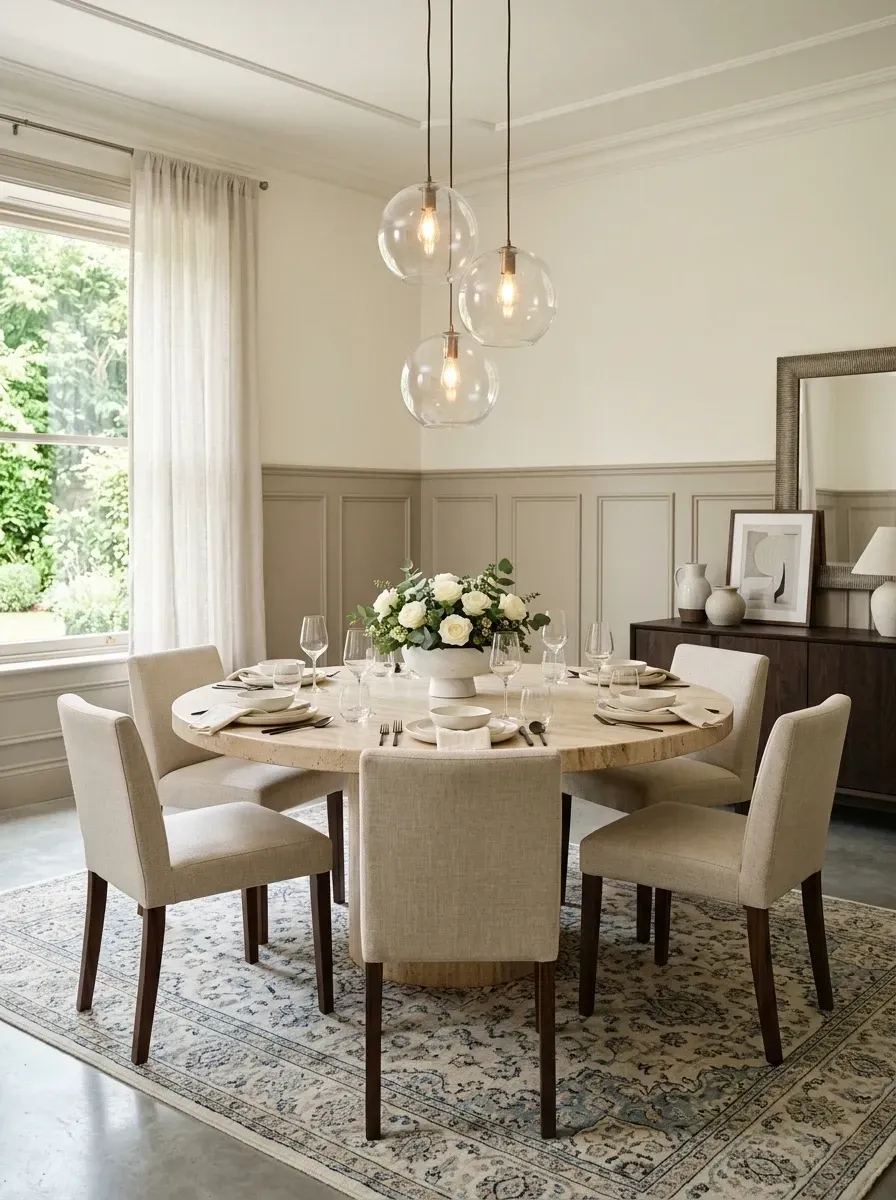
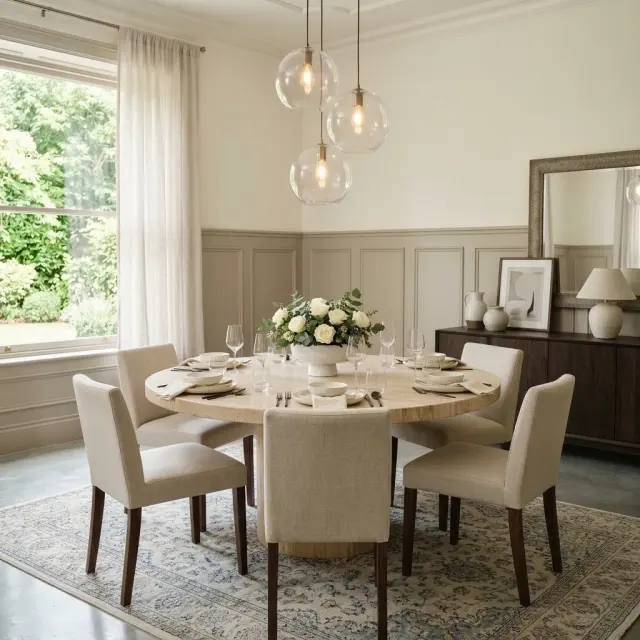
A round table changes the social dynamic of a dining room — every seat has eye contact with every other seat, which is why round tables are the right call for square-shaped rooms and for families who actually use the dining room rather than reserve it for holidays. The travertine here is the right stone for this style. Where marble reads cold and formal, travertine reads warm and ancient — the natural pitting and beige veining feel like material rather than performance. Curved chair backs echo the table's geometry, and the pendant cluster softens the verticality.
Plan-aware verdict: travertine tabletops need to be sealed, full stop. Specify a penetrating, breathable sealer (Tenax or Aldon) and re-seal every 18–24 months in a dining-use context. Red wine will stain unsealed travertine within 30 seconds. The wainscoting is the budget-controlled version of paneling — at 36–42 inches high it's roughly half the labor of full-height, and a Hudson Valley painter will install primed MDF wainscot for $1,500–$3,000 a wall including paint.
Features
- Round travertine pedestal table (54–60 inches diameter)
- Curved-back upholstered chairs (6) in oatmeal linen
- Cluster of three glass-globe pendants at varying heights
- Painted MDF wainscoting (waist-height)
- Dark walnut or oiled-oak sideboard
Cost Analysis (2026 Northeast)
| Decor Item (Qty) | Total Price Range |
|---|---|
| Wainscoting Install + Paint (One Room) | $1,500 – $3,000 |
| Round Travertine Pedestal Table | $3,000 – $6,500 |
| Upholstered Curved-Back Chair (×6) | $1,800 – $3,600 |
| Glass Globe Pendant (×3) | $750 – $1,800 |
| Large Patterned Area Rug | $1,000 – $2,500 |
| Dark Wood Sideboard | $1,500 – $3,500 |
| Total Estimated Cost | $9,550 – $20,900 |
Color Palette
Creamy Off-White
#F2F0E6
Benjamin Moore Simply White (OC-117) or White Dove (OC-17) — bright enough to bounce light from the windows.
Warm Beige
#CFC4B3
Sherwin-Williams Accessible Beige (SW 7036) or Benjamin Moore Bleeker Beige (HC-80) in eggshell — tougher to scuff than flat.
Natural Travertine
#E3D8C6
Honed Italian travertine with a penetrating sealer — the visible pitting is what makes the stone read as material.
Dark Walnut
#5C4738
Solid American black walnut with hardwax oil — gives definition without competing with the travertine.
3. Moody Blues and Modern Lines
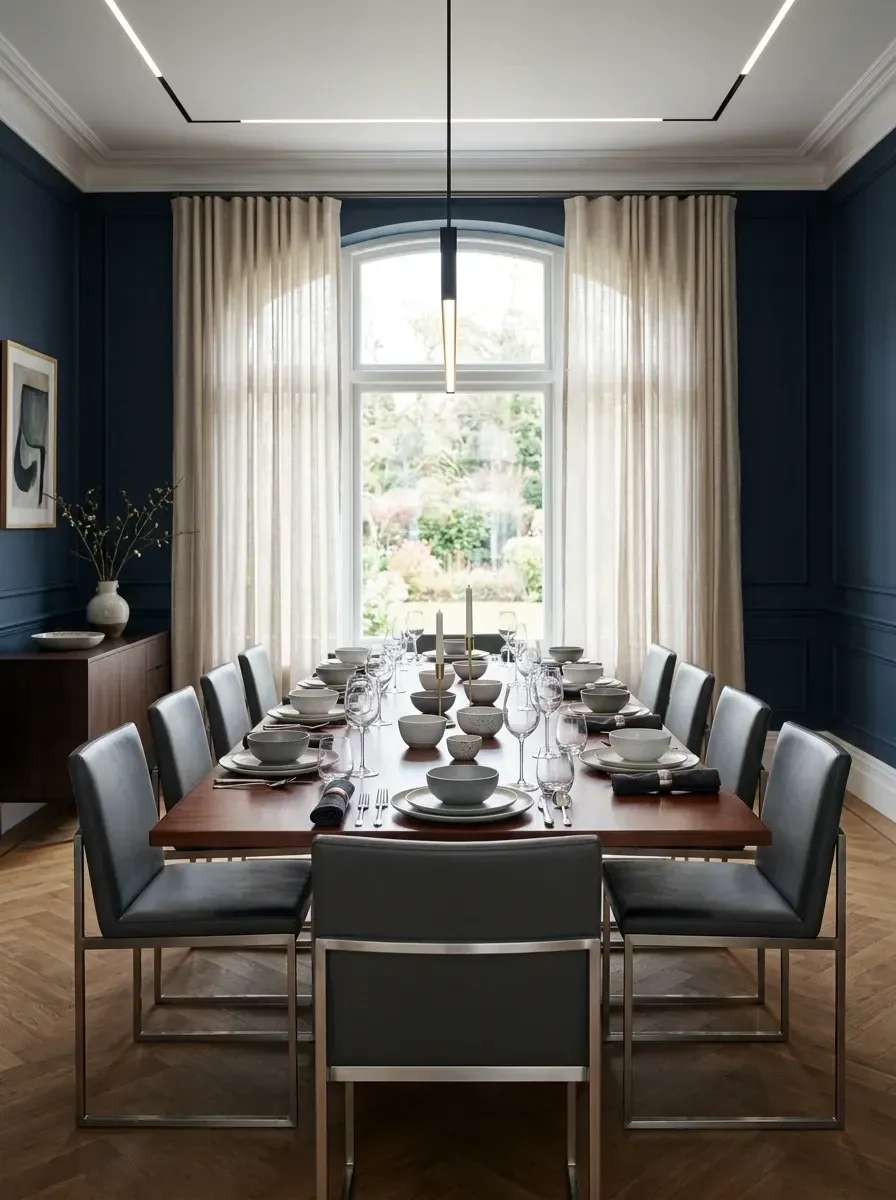
A moody dining room is a hospitality move at its core — the room is built to feel intimate, candlelit, and adult. The walls and wainscoting being the same dark color is the rule that makes this composition work. The moment you break that with a contrasting trim, the room reads as Restoration Hardware rather than as architecture. Herringbone oak underfoot is the warmth that keeps the space from going cold. The leather-and-metal chairs are wipeable, which matters in a high-use dining setting more than people admit.
Plan-aware verdict: a 4-inch oak herringbone floor in 200 square feet runs $4,000–$8,000 in the Hudson Valley installed, including the slip-tongue subfloor prep that herringbone requires (you can't lay it over standard ply without a 3/4-inch backer). The dark wall paint should be a Benjamin Moore Aura or Sherwin-Williams Emerald formulation — cheaper paints in deep saturations rub off on dining-chair backs and napkins within months.
Features
- Deep navy walls and wainscoting in a single color
- Herringbone medium-oak flooring
- Minimalist linear LED pendant (no visible diffuser)
- Long solid-walnut dining table (10–12 seats)
- Leather-and-metal chairs (10) for daily wipe-down durability
Cost Analysis (2026 Northeast)
| Decor Item (Qty) | Total Price Range |
|---|---|
| Wall Paneling + Prep + Premium Paint | $2,500 – $5,000 |
| Herringbone Wood Floor (~200 sq. ft. installed) | $4,000 – $8,000 |
| Minimalist Linear LED Pendant | $800 – $2,000 |
| Long Solid-Wood Dining Table | $3,000 – $6,000 |
| Leather & Metal Dining Chair (×10) | $4,000 – $8,000 |
| Walnut Sideboard | $2,000 – $4,500 |
| Total Estimated Cost | $16,300 – $33,500 |
Color Palette
Deep Navy
#2C3E50
Benjamin Moore Hale Navy (HC-154), Farrow & Ball Hague Blue (No. 30), or Sherwin-Williams Naval (SW 6244) in a matte or eggshell finish.
Medium Brown Oak
#99785F
4-inch rift-cut white oak in a herringbone pattern, finished with hardwax oil for a flatter sheen than poly.
Rich Walnut
#6B4F3C
Solid American black walnut with a clear oil finish — never stained-on walnut, which fades unevenly under candle and pendant light.
Charcoal Leather
#4A4A4A
Top-grain or full-grain leather — not bonded leather, which cracks at the seat front within five years of dining use.
4. Organic Warmth with Wood Cladding
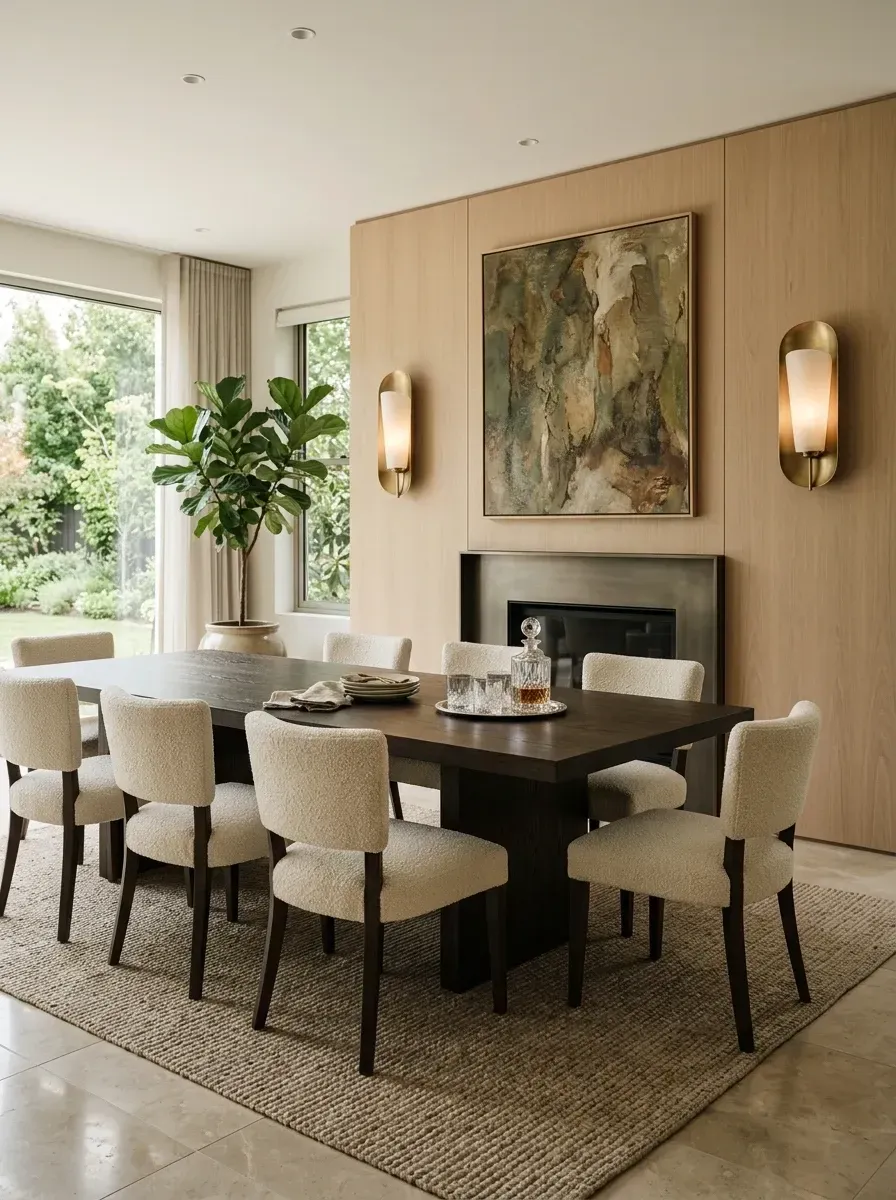
This room is the Japandi end of the quiet-luxury spectrum — Scandinavian restraint meets Japanese material reverence. Vertical wood cladding makes a standard 8-foot ceiling read taller, and the run of slats creates a visual rhythm that flat drywall never achieves. The fireplace is the focal point, but it's intentionally low-drama — a flush, linear gas unit with a brushed-metal surround. The boucle chairs are the soft layer that keeps the wood-and-metal palette from going clinical.
Plan-aware verdict: a wood-slat or wood-clad feature wall is one of those moves where the install quality decides whether the room reads $5,000 or $50,000. Furring strips behind the slats, mitered or quirked corners at the edges, and a backing strip painted black so the gaps don't show drywall — those three details separate a custom install from a YouTube DIY. A Hudson Valley carpenter charges $40–$60 per square foot installed for solid-ash slats with proper backing.
Features
- Vertical light-ash wood cladding (one feature wall)
- Modern linear gas fireplace with brushed-metal surround
- Boucle-upholstered dining chairs (8)
- Espresso-finished solid-wood dining table
- Brass wall sconces flanking the fireplace
Cost Analysis (2026 Northeast)
| Decor Item (Qty) | Total Price Range |
|---|---|
| Custom Wood Wall Cladding (Material + Install) | $3,000 – $6,500 |
| Linear Gas Fireplace Unit + Install | $4,000 – $8,000 |
| Dark-Wood Dining Table | $2,000 – $4,500 |
| Boucle Fabric Dining Chair (×8) | $3,200 – $6,400 |
| Brass Wall Sconce (×2, Hardwired) | $500 – $1,200 |
| Large Textured Area Rug | $1,200 – $3,000 |
| Total Estimated Cost | $13,900 – $29,600 |
Color Palette
Light Ash
#C8B298
Solid white ash or rift-cut white oak in a clear hardwax-oil finish — pre-fab from Stikwood or custom-milled by a regional carpenter.
Soft Off-White
#F0EFE7
Benjamin Moore Swiss Coffee (OC-45) or Sherwin-Williams Alabaster (SW 7008) in flat — recedes against the wood plane.
Espresso Wood
#4B3D33
Solid wood with an oxidized or fumed finish — not a stain. The dark tone provides the visual weight to anchor the room.
Aged Brass
#D4AF37
Unlacquered brass that develops a patina — Allied Maker or Visual Comfort have the right finish library for this look.
5. Minimalist Marble and Modernist Classics
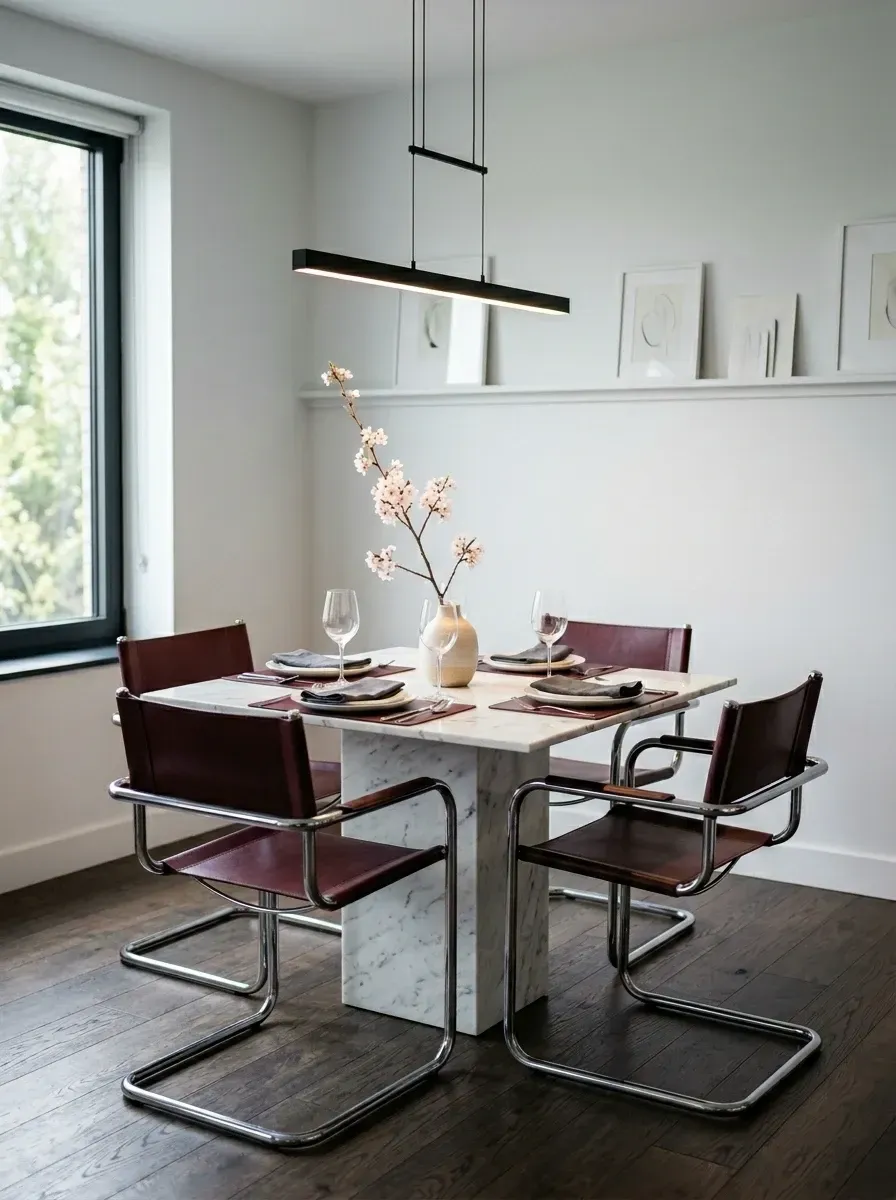
A small dining footprint forces every element to earn its place. The marble plinth table is doing three things at once — providing a focal point, eliminating the corner-leg crash that ruins small dining rooms, and holding the entire material weight of the composition. The cantilevered chairs are a Marcel Breuer / Mart Stam reference (Cesca, Cantilever, MR10) — these are 90-year-old designs that have outlived every trend. A Brooklyn brownstone or Hudson Valley apartment dining nook is exactly the floor plan this configuration was designed for.
Plan-aware verdict: a true marble plinth table runs heavy — typically 250–400 lbs for a 48-inch round. Plan the floor structure in older houses; vintage brownstones in particular have joist spans that can flex enough to make a heavy table read as unstable. The picture ledge is a budget-controlled gallery wall that lets the homeowner change the art quarterly without patching plaster. For an open-plan extension of this language, see our quiet luxury kitchen integrated appliances guide.
Features
- Solid Carrara marble plinth-base table (square or round, 42–48 in.)
- Cantilevered modernist chairs in burgundy leather (4)
- Ultra-thin linear LED pendant
- Built-in picture ledge for rotating art
- Dark wood floor for contrast against white walls
Cost Analysis (2026 Northeast)
| Decor Item (Qty) | Total Price Range |
|---|---|
| Solid Marble Plinth Table | $3,500 – $7,000 |
| Cantilevered Leather Chair (×4) | $2,000 – $4,800 |
| Minimalist Linear LED Pendant | $600 – $1,500 |
| Built-in Picture Ledge (Material + Labor) | $300 – $800 |
| Framed Art Prints (Set of 5) | $500 – $1,500 |
| Total Estimated Cost | $6,900 – $15,600 |
Color Palette
Pure White
#FFFFFF
Benjamin Moore Chantilly Lace (OC-65) — bright enough to make the dark floor pop, neutral enough to let the art lead.
Carrara Marble
#EAEAEA
Honed Carrara — softer veining than Statuario, warmer than Calacatta, sealed against acidic foods and red wine.
Burgundy Leather
#7A3333
Aniline-finished full-grain leather — Spinneybeck, Edelman, or Moore & Giles for the right depth of color.
Polished Chrome
#BCC6CC
Original-spec polished chrome — Knoll, Thonet, or vintage market sources for authentic Cesca / MR10 frames.
6. Rustic Luxe with Statement Art
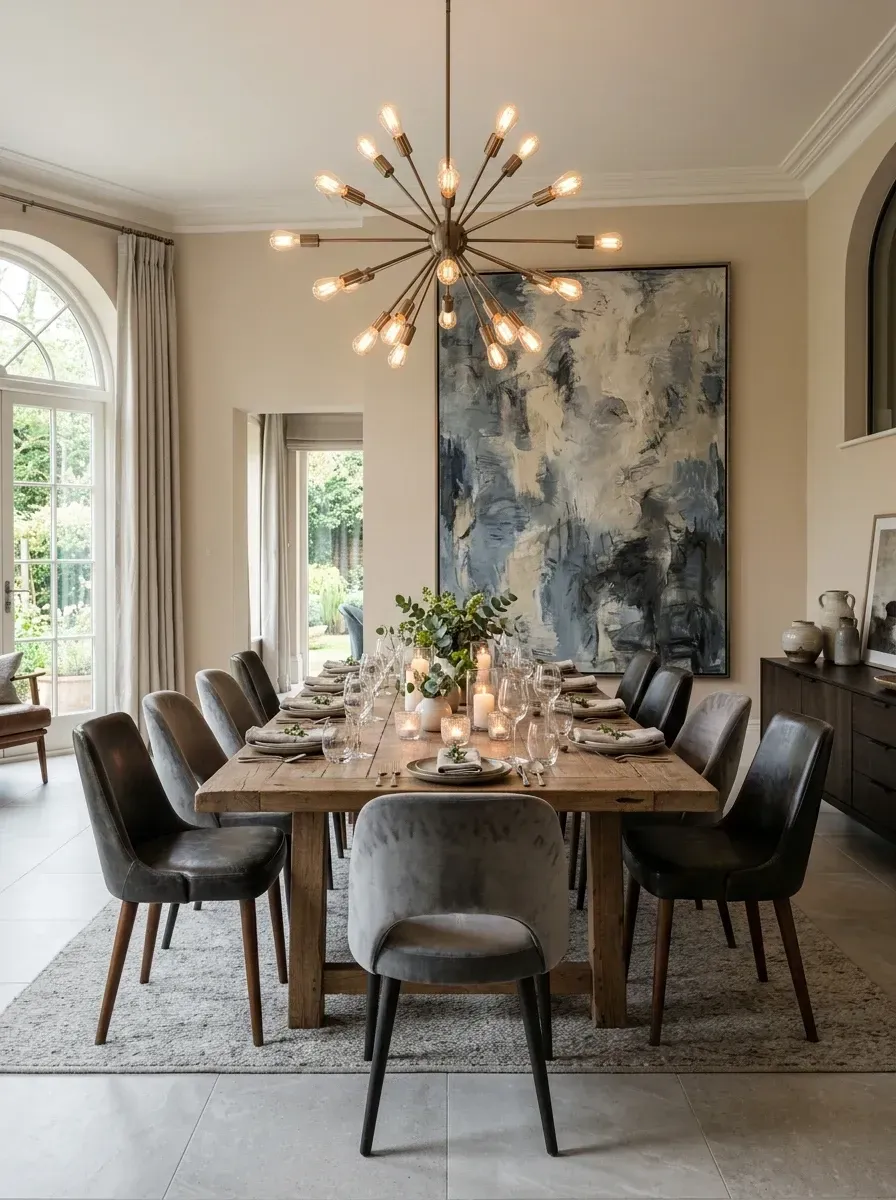
This is the dining room a Beacon weekend-house client builds when they actually entertain. The table is enormous — 10–12 feet — and the room reads luxurious because every other element scales to match: oversized art, oversized rug, oversized chandelier. A small chandelier over a 12-foot table reads as a hardware-store mistake; the sputnik here is sized correctly. The mixed chair styles at the heads vs. the sides is a deliberate move that adds character without going kitschy.
Plan-aware verdict: a 12-foot reclaimed-oak farm table from a regional Hudson Valley shop runs $5,000–$8,500 depending on slab and base. Big-box farmhouse-style imports at $1,500–$2,500 use thinner tops, lighter joinery, and a finish that wears unevenly. The difference shows after three holidays. A piece this large also dictates the floor plan — minimum room dimension is roughly 16×11 to leave 36 inches of walk-around on every side.
Features
- 10–12 ft. reclaimed-oak farmhouse table
- Oversized abstract painting (5×7 ft. minimum)
- Sputnik-style chandelier with Edison bulbs on dimmer
- Large-format porcelain tile flooring (24×48 in.)
- Mixed chair styles — upholstered at heads, simpler at sides
Cost Analysis (2026 Northeast)
| Decor Item (Qty) | Total Price Range |
|---|---|
| Large-Format Tile Flooring (~300 sq. ft. installed) | $4,500 – $9,000 |
| Large Reclaimed-Wood Dining Table | $3,500 – $7,500 |
| Upholstered Dining Chair (×10, mixed styles) | $3,000 – $6,000 |
| Large Sputnik-Style Chandelier | $800 – $2,000 |
| Oversized Original or Limited-Edition Art | $2,000 – $10,000 |
| Large Area Rug | $1,500 – $3,500 |
| Total Estimated Cost | $15,300 – $38,000 |
Color Palette
Warm Cream
#F2E8D5
Benjamin Moore Pale Oak (OC-20) or Farrow & Ball Slipper Satin (No. 2004) — the right warmth for a large entertaining space.
Reclaimed Oak
#A68B6C
True reclaimed oak with visible nail holes and weathering — finished with hardwax oil to feed the wood, not seal it.
Greige Porcelain Tile
#D3CDC4
Large-format (24×48 in.) porcelain in a stone or matte-cement look — durable, low-maintenance, visually expansive.
Muted Blues & Greys
#708090
The art is the source of cool tone in the room — pulls the warm wood and cream walls into balance.
7. Subtle Pattern and Airy Transparency
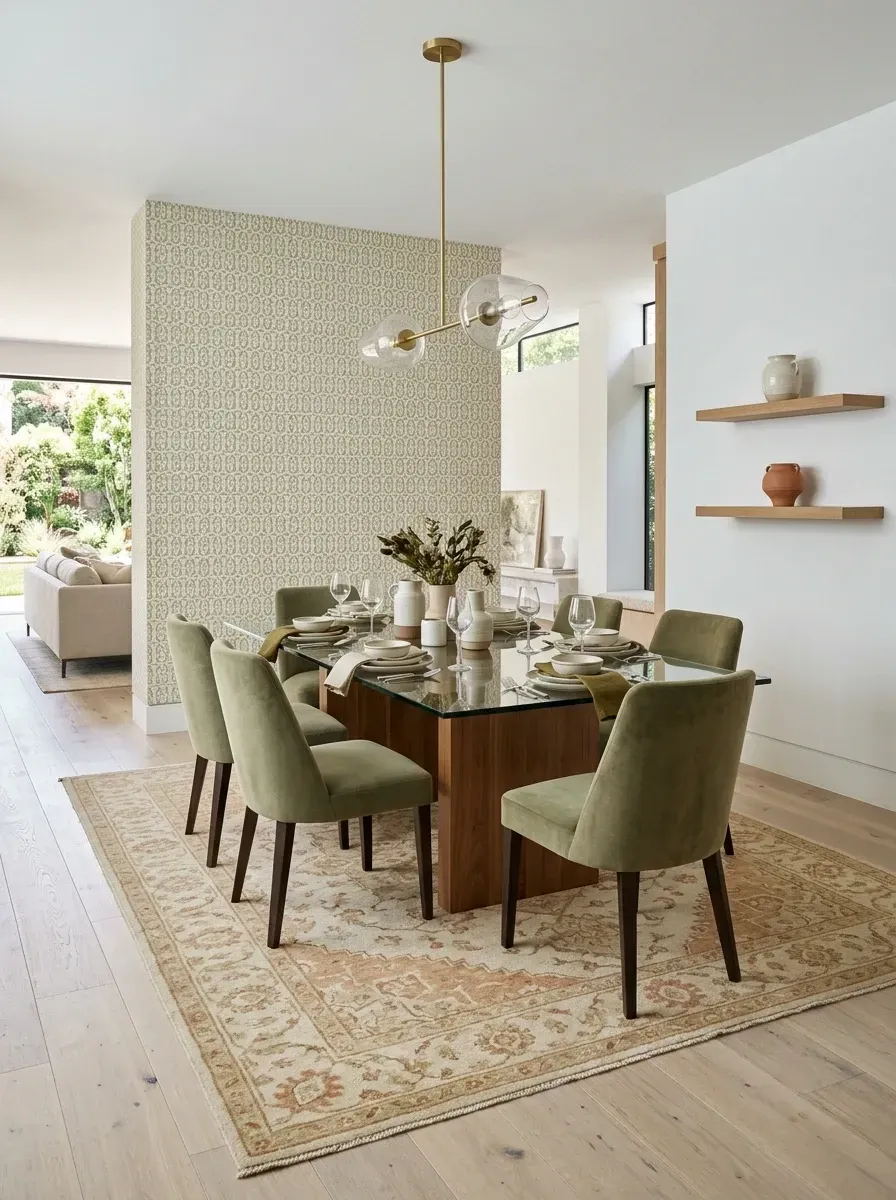
Pattern is allowed in quiet luxury — but only when it's restrained, small in scale, and tone-on-tone. The wallpaper here is doing exactly that: a small motif in two close-in tones that adds texture without adding visual noise. The glass-topped table is the second move that keeps this room airy — it lets the rug pattern show through, which means you don't need a third pattern fighting for attention. A glass top is also the right call when the table base itself is sculptural enough to deserve a clear view.
Plan-aware verdict: glass tabletops make a small dining room feel larger but they show fingerprints, water rings, and dust within hours of cleaning. Specify a low-iron glass top (pure clear, no green tint) at 1/2-inch minimum thickness — anything thinner reads cheap and chips at the edges. For wallpaper at this density, a Hudson Valley paper-hanger charges $300–$500 per double roll installed including primer.
Features
- Subtle small-scale tone-on-tone wallpaper (one feature wall)
- Glass-topped dining table with sculptural walnut base
- Olive green velvet upholstered chairs (6)
- Floating walnut shelves for curated ceramics
- Vintage or vintage-style patterned rug
Cost Analysis (2026 Northeast)
| Decor Item (Qty) | Total Price Range |
|---|---|
| Wallpaper + Install (Feature Wall) | $800 – $1,800 |
| Glass-Top Table with Wood Base | $1,500 – $3,500 |
| Velvet Dining Chair (×6) | $1,800 – $3,600 |
| Floating Wood Shelf (×2) | $300 – $700 |
| Vintage-Style Patterned Rug | $1,000 – $2,500 |
| Modern Brass Pendant Light | $500 – $1,200 |
| Total Estimated Cost | $5,900 – $13,300 |
Color Palette
Clean White
#FAFAFA
Benjamin Moore White Dove (OC-17) or Farrow & Ball Wevet (No. 273) — neutral enough to balance the patterned feature.
Beige & Sage Pattern
#D1CDB7
Phillip Jeffries, Schumacher, or Cole & Son in a small-scale tone-on-tone print — the pattern reads as texture from across the room.
Olive Velvet
#808055
Cotton or mohair velvet in deep olive — Romo Linara or Designtex Mohair Supreme are reliable specs.
Warm Walnut
#947249
Solid American black walnut on the table base and shelves — the warm wood anchors the cool palette.
8. Intimate Warmth with Dark Wood
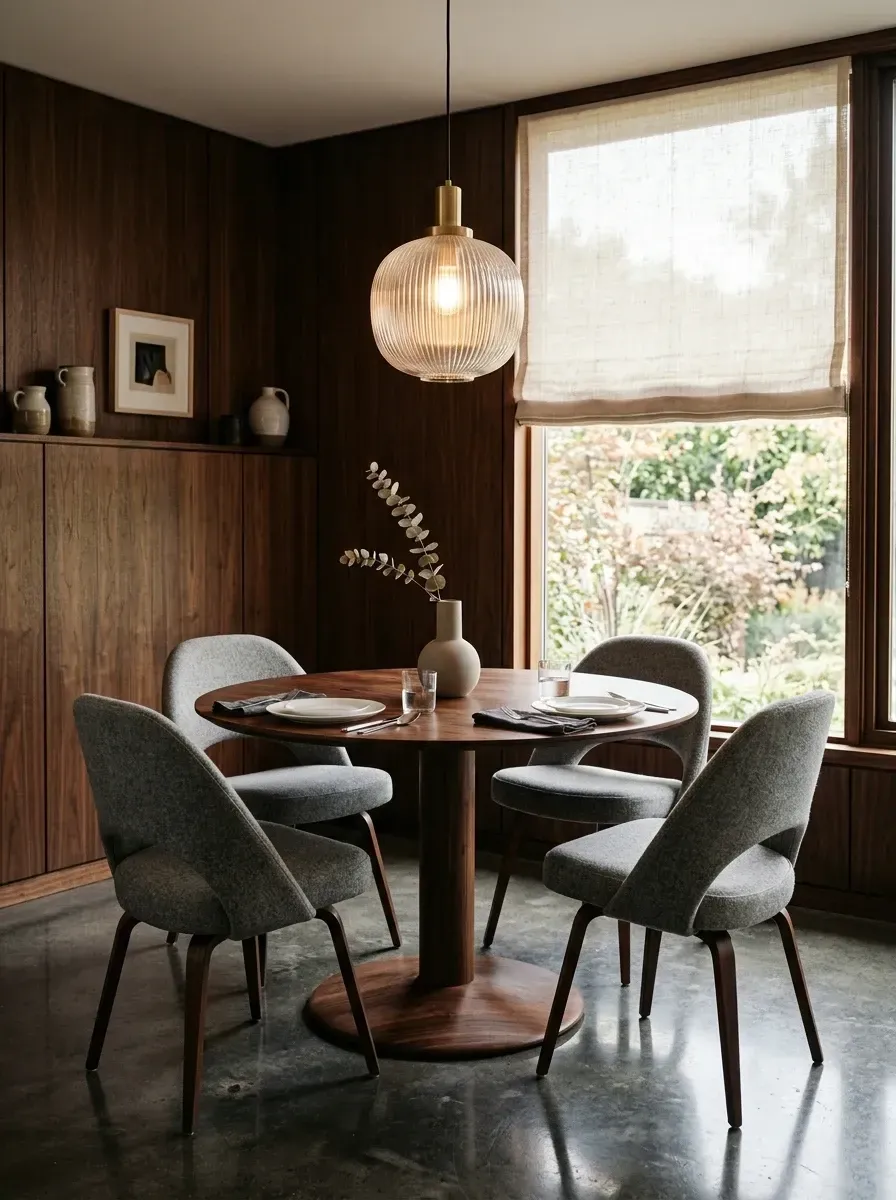
A walnut-clad nook is the move I recommend for clients with a small dining footprint who actually want to use it daily. Dark wood wraps a small space in a way that paint never can — it absorbs harsh light, dampens sound, and makes the room feel like it has been there forever. The reeded glass pendant is doing the second half of the work: textured glass diffuses the bulb, throws a flickering pattern across the table, and reads as material rather than as fixture. Concrete floor is the cool counterweight that keeps the wood from going oppressive.
Plan-aware verdict: this is the most expensive room on the list per square foot. Custom walnut paneling and integrated cabinetry from a Hudson Valley cabinet shop runs $500–$900 per linear foot installed for solid walnut, and a small nook can easily hit 16 linear feet of paneling once you account for the built-ins. Specify quarter-sawn walnut for the most stable grain pattern and the least seasonal movement — flat-sawn walnut warps in a humidity-cycled space.
Features
- Custom walnut wall paneling and built-ins (full-room wrap)
- Round walnut pedestal table (48–54 in.)
- Upholstered chairs with walnut legs (4)
- Reeded glass pendant, low-hung over table
- Polished or sealed concrete floor
Cost Analysis (2026 Northeast)
| Decor Item (Qty) | Total Price Range |
|---|---|
| Custom Walnut Paneling + Built-ins (Material + Labor) | $8,000 – $15,000 |
| Round Walnut Pedestal Table | $2,500 – $5,000 |
| Upholstered Walnut Chair (×4) | $2,000 – $4,000 |
| Reeded Glass Pendant Light | $400 – $1,000 |
| Custom Linen Roman Shade | $500 – $1,200 |
| Total Estimated Cost | $13,400 – $26,200 |
Color Palette
Rich Walnut
#6B4F3C
Quarter-sawn American black walnut with a hand-rubbed oil finish — the most stable grain pattern for full-room paneling.
Heathered Grey
#8C8C8C
Wool or linen-blend in heathered grey — Maharam, Kvadrat, or Sunbrella for daily-use durability.
Polished Concrete
#949494
Honed and sealed concrete — the right cool counterweight to the warm wood walls. Specify a low-VOC penetrating sealer.
Reeded Glass
#E5E5E5
Hand-blown reeded or fluted glass — Allied Maker, Lambert et Fils, or In Common With for the right diffused-light read.
9. Traditional Elegance, Soft Palette
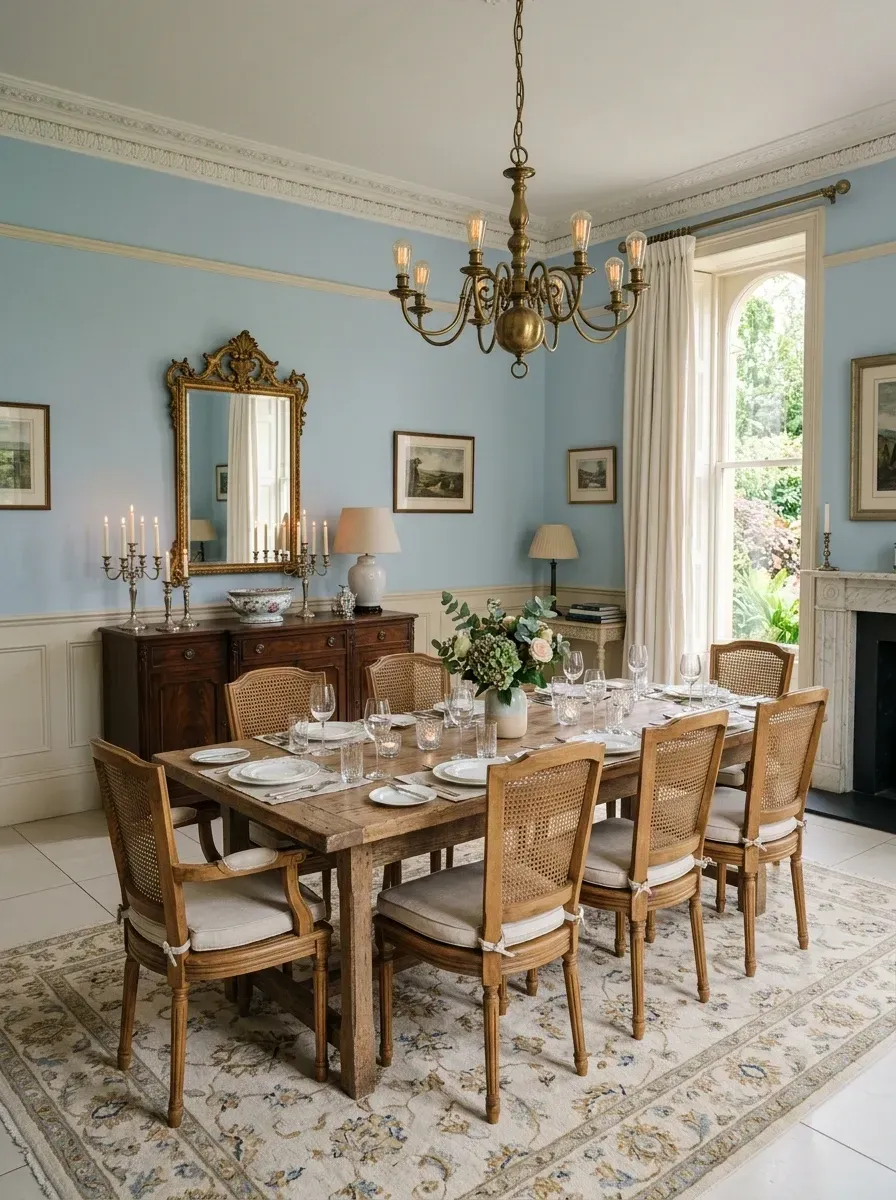
Quiet luxury and traditional design read as opposites only when traditional is done badly. Done well — soft palette, mixed antique and new, restrained pattern — traditional is one of the most quietly luxurious styles there is. The powder-blue upper wall against creamy wainscoting is a specifically Hudson Valley palette: it shows up in Rhinebeck farmhouses, Cold Spring colonials, and old Saugerties houses where the bones are good. Cane-back chairs are the textural lift that keeps the wood-heavy palette from going dark.
Plan-aware verdict: this room is ideal for older Hudson Valley houses with existing wainscoting, picture rails, and crown molding — the heritage architectural moves are already in place. The line item to spend on is the chandelier; the rest can be sourced from estate sales and consignment shops in the area at significant savings. For a connected reading on the same calm-traditional vocabulary, see our quiet luxury bedroom design guide.
Features
- Powder-blue upper walls + cream wainscoting
- Antique-style rustic oak farm table
- Cane-back dining chairs (8) with linen cushions
- Classic brass chandelier
- Large antique-style sideboard + ornate gilt mirror
Cost Analysis (2026 Northeast)
| Decor Item (Qty) | Total Price Range |
|---|---|
| Paint + Wainscoting Install | $2,000 – $4,000 |
| Antique-Style Rustic Wood Table | $2,500 – $5,500 |
| Cane-Back Dining Chair (×8) | $2,400 – $4,800 |
| Classic Brass Chandelier | $800 – $2,500 |
| Large Antique-Style Sideboard | $2,000 – $5,000 |
| Large Ornate Mirror | $500 – $1,500 |
| Large Traditional Patterned Rug | $1,500 – $3,500 |
| Total Estimated Cost | $11,700 – $26,800 |
Color Palette
Powder Blue
#A8C0CE
Farrow & Ball Borrowed Light (No. 235) or Benjamin Moore Quiet Moments (1563) — historic Hudson Valley shade.
Creamy White
#F5F5DC
Benjamin Moore White Dove (OC-17) or Sherwin-Williams Creamy (SW 7012) — warmer than pure white, contrasts gently with the blue.
Aged Pine / Oak
#A68B6C
Genuine antique or reclaimed oak — Hudson Valley estate sales, Beacon antique shops, or Hudson Antiques Center.
Aged Brass
#B5A642
Unlacquered brass that develops a dark patina — Visual Comfort, Schoolhouse, or vintage estate-find chandeliers.
Pro Tips From the Renovation Designer's Chair
- Dim everything. The single biggest atmospheric move in any dining room is putting every light source on a dimmer — pendant, sconces, picture lights, even buffet lamps. The same fixtures at 100% read as a hardware store and at 25% read as a restaurant. Specify low-load LED dimmers (Lutron Diva or Caseta) at the rough-in stage.
- Texture, not color. Quiet luxury dining rooms run on a small color palette and a wide texture spread. Linen napkins, wool rug, stone tabletop, leather chairs, oiled wood paneling. The texture variance does the visual interest job that bright color would do in a busier style.
- Edit the surfaces. A sideboard or buffet should display three or four objects at most, with breathing room between them. A single sculptural ceramic, a stack of two coffee-table books, a low candle. Anything more reads as clutter; anything less reads as forgotten.
- Upgrade the touchpoints first. Light-switch plates, cabinet hardware, drawer pulls, the chandelier itself. These are the small metal moments your hand or eye lands on dozens of times per meal. Solid brass, bronze, or hand-finished metal in those positions reads as quality before any furniture choice does.
- Specify the rug correctly. The rug in a dining room must be sized so all chairs — pulled out for sitting — still have all four legs on the rug. That's a minimum 24 inches of rug beyond the table edge on every side. Smaller rugs get caught on chair legs and fail the "pulled-out" test, which is when guests notice.
- Pendants follow the table, not the room. If your table is offset from the geometric center of the room (almost always true when there's a sideboard wall), the pendant centers on the table. Center-of-room is wrong. Plan the electrical box at framing once you know where the table is going.
Cost-Saving Moves
- Shop estate sales and antique shops in the Hudson Valley. Hudson, Beacon, Cold Spring, Rhinebeck, and Kingston have a strong inventory of solid-wood dining tables and sideboards at $500–$1,500 — pieces that would land at $4,000–$8,000 new. The patina is included.
- Hack a built-in sideboard. An IKEA Pax or Sektion base run with custom Semihandmade or Reform fronts and a stone or solid-wood top from a regional shop lands at $2,000–$3,500 installed for what reads as $9,000 millwork.
- Reupholster vintage chairs. A set of six solid-wood chair frames from an estate sale at $300–$600 plus $150–$250 per chair to reupholster in performance velvet lands at $1,200–$2,100 for a custom-feeling set. New equivalents start at $2,400.
- DIY the wainscoting. Primed MDF wainscot kits from a local lumberyard plus a long weekend with a miter saw lands at $400–$700 in materials for a single dining-room wall. A painter for the prep, prime, and two-coat finish lands at $400–$600 more — total $800–$1,300 vs. $1,500–$3,000 for fully pro install.
The Core Idea. A quiet luxury dining room is built on three structural decisions, made at framing, that no amount of expensive furniture later can fix: table-to-room proportion, dimmable layered lighting, and material count on the surfaces. Get those right and the cheap version reads expensive; get them wrong and the expensive version reads as a hotel banquet hall. Spend on the structural moves and shop the furniture wherever the value is — vintage, IKEA-hacked, or new.
Reader Questions on Quiet Luxury Dining Rooms
What actually defines a quiet luxury dining room?
A restrained color palette, three to five honest materials at most, and a focus on craftsmanship and proportion over visible logos or trend pieces. The room should read as deliberate without reading as decorated. Solid wood or stone on the table, real fabric on the chairs, real wood or plaster on the walls, real metal on the lighting. The opposite of quiet luxury isn't ugly — it's busy. A room with twelve different textures, four different metals, and three competing patterns can be expensive and still fail the test.
How do I make a dining room read as expensive on a tight budget?
Three moves matter more than any furniture purchase. First, replace the existing chandelier with a single sculptural pendant on a dimmer — total cost $400–$1,200 with a Hudson Valley electrician. Second, lay a large natural-fiber rug sized so all chair legs sit on it pulled-out — $1,000–$2,500. Third, declutter every surface in the room down to three or four intentional objects. None of those three is expensive, but together they shift the room's read more than a $5,000 table swap would on its own.
What are the best wall colors for a quiet luxury dining room?
Stay in the warm-neutral, earthy register. Creamy whites — Benjamin Moore White Dove (OC-17), Simply White (OC-117). Warm taupes and beiges — Edgecomb Gray (HC-173), Accessible Beige (SW 7036), Pale Oak (OC-20). Muted greens and blues — Saybrook Sage (HC-114), Pigeon (No. 25), Hale Navy (HC-154), Hague Blue (No. 30). Avoid candy-bright colors, primary-school primaries, and any color named after a fruit. Match wainscoting to wall — never break a paneled room with a contrasting trim.
Is quiet luxury the same as minimalism?
No. Minimalism is about reducing the count of objects in a room. Quiet luxury is about increasing the depth of materials in a room. A minimalist dining room can be empty, cold, and uninviting. A quiet luxury dining room is usually full of texture — heavy linen drapery, layered rugs, sculptural lighting, real stone tabletops, leather seating — but the visual count stays low because the palette is unified. They look similar in photos and feel completely different in person.
What kind of dining table is best for this style?
Two types work consistently. A solid-wood table — white oak, walnut, ash, reclaimed oak — with a hardwax-oil finish that ages and can be refinished decades later. Or a stone-topped table — travertine, honed marble, soapstone, or quartzite — on a sculptural base. Both share the same structural quality: real material, weight, and the kind of surface that improves with use. Avoid veneered tables, glass-only tables (unless the base is the focal point), and laminated MDF — none of those age into something better.
How do I size a dining chandelier correctly?
The chandelier's longest dimension should be roughly half to two-thirds the length of the table. For a 96-inch table, that's a 48–64-inch fixture. Hang it 30–34 inches above the table surface — close enough that the light pools on plates, far enough that a 6'2" guest doesn't graze it. Center the chandelier on the table, not the room. And put it on a dimmer rated for low-wattage LED loads — a non-dimmable fixture is a missed atmospheric opportunity in any dining context.
Where to Read Next
If you're carrying this language across an open plan, start with the broader living and dining archive. For the room one wall over, our quiet luxury living room design guide uses the same texture-and-restraint vocabulary, and for the network-wide style framework, the quiet luxury interior design guide sits over the top of all of these.
Sources & Further Reading
- Architectural Digest — "Quiet Luxury, Explained" on the cross-discipline definition that bridges fashion and interiors.
- Remodelista for ongoing material-first coverage of natural-fiber upholstery, plaster, lighting, and stone.
- Natural Stone Institute on travertine, marble, and quartzite specification, sealing, and care for dining surfaces.
- This Old House on wainscoting, full-height paneling, and herringbone hardwood-floor installation.
- Old House Journal for traditional dining-room architecture, plaster, and historic millwork references.
- NAHB — Cost of Constructing a Home for the labor and material benchmarks behind the cost ranges quoted above.
- Farrow & Ball Color Library for the reference palette behind Hague Blue, Pigeon, and Borrowed Light.
- Lutron Lighting Controls on dimmer compatibility for low-wattage LED dining-room fixtures.
- Dwell for editorial coverage of organic-modern dining rooms and modernist chair classics.

Nora Whitfield
Renovation Designer & Interiors Editor · Beacon, New YorkNine years of design-build renovation work across the Hudson Valley and the Northeast. Nora runs the Renovations, Room Guides and Renovation Mind desks — before-and-after studies, room-by-room design guides, and the long essays on why what we renovate matters.
More from Nora →
Reader notes