


A client in Beacon hired me last spring to figure out why her newly renovated living room felt expensive but not restful. The receipts were impressive — Italian sofa, Belgian linen, a quarried-stone coffee table — but the room read busy. Quiet luxury isn't a finish package; it's a discipline of subtraction. Below: eight rooms across hallway, living, dining, entry, reading nook, bedroom, and mudroom that handle that discipline well, the actual 2026 Hudson Valley costs to build them, and the framing-stage planning moves that separate a calm room from a quietly expensive one.
How I Read a Quiet Luxury Room
When I walk into a finished room and try to decide whether it actually achieves quiet luxury or just expensive-looking, I check four things in order: the palette discipline (how many distinct colors are in the room — usually three or four, never seven), the texture count (how many tactile materials carry the same color family without going flat), the shadow language (whether the lighting plan is layered or flat-overhead), and the negative space (whether the eye has somewhere to rest). Pass those four and the room reads calm whether the budget is $5,000 or $80,000. Fail any of them and a $50,000 furniture order still won't save it.
After seven years running renovation design out of the Hudson Valley — Beacon, Rhinebeck, Kingston, Cold Spring — I've learned that the discipline is mostly about restraint at the planning stage, not the shopping stage. The eight rooms below cover the full range of quiet luxury formats, from a $1,750 reading nook a renter could pull off to a $28,000 plastered living room that reads as architecture. For the kitchen-and-bath specific version of the same logic, my guide to integrated-appliance kitchens covers the most build-heavy version of this aesthetic.
Reading note. The numbering follows my client-walkthrough sequence — public-facing spaces first, private spaces last. It's not a ranking. Room #8 (mudroom) costs less than room #6 (living room) but uses every quiet luxury principle just as rigorously.1. The Art of the Hallway Gallery
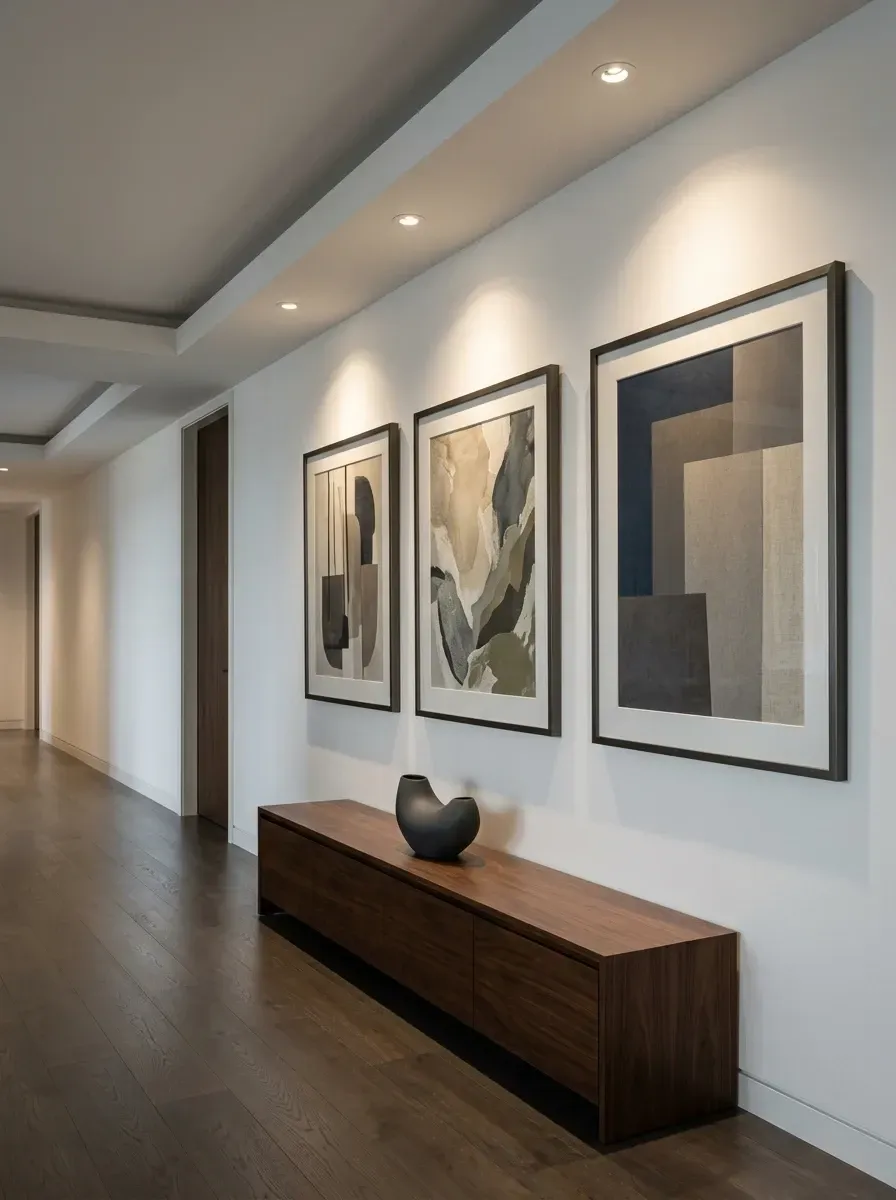
A hallway is the easiest space in the house to ignore and the easiest place to introduce gallery-grade lighting on a small budget. The win here is the rhythm of three identical frames, evenly spaced, lit by gimbaled recessed cans that point at the art rather than down at the floor. The low-slung walnut console grounds the wall without competing for attention — it acts as a horizontal anchor under three vertical pieces, which is the format that makes a corridor feel composed rather than cluttered.
Plan-aware verdict: this is a finish-stage win that depends on a framing-stage decision. The gimbal cans need to land roughly 24 inches off the wall on a separate dimmer circuit — which means specifying that on the electrical layout before drywall closes. Retrofitting gimbals into existing flat-can housings is possible but doubles the labor. The walnut floor is the other quiet move; rift-cut walnut in 5-inch planks (Bona hardwax oil finish, not poly) gives you the matte sheen that lets the light puddle correctly on the art. Budget around $2,750–$6,950 in 2026 Hudson Valley pricing for the full hallway, including the lighting retrofit.
Features
- Directed recessed gimbal lighting on a dedicated dimmer
- Large-scale matched triptych artwork, identical frames
- Rich walnut wide-plank flooring
- Low-profile walnut media console as horizontal anchor
- Single sculptural dark ceramic vessel
Cost Analysis (2026 Northeast)
| Decor Item (Qty) | Total Price Range |
|---|---|
| Large Framed Abstract Art (×3, matched frames) | $900 – $2,400 |
| Long Walnut Media Console (80 in.+) | $1,500 – $3,500 |
| Sculptural Dark Ceramic Vase | $50 – $150 |
| Recessed Gimbal Lighting Retrofit (×6, labor & materials) | $300 – $900 |
| Total Estimated Cost | $2,750 – $6,950 |
Color Palette
Pure White
#F5F5F5
Benjamin Moore Chantilly Lace (OC-65) or Sherwin-Williams Pure White (SW 7005) in a flat or matte sheen — gallery-style background that lets art and wood do the heavy lifting.
Dark Walnut
#4A3B2A
American black walnut, rift-cut, finished with Rubio Monocoat in Pure or Smoke. Adds substantial gravity without the orange undertone of stained oak.
Deep Charcoal Navy
#2C3539
The dark contrast inside the artwork — strong enough to register from twenty feet, subtle enough not to crowd the cream wall.
Warm Greige
#B8B0A4
A soft earthy tone in the prints that bridges the white wall and the dark frame — the visual handshake that keeps the wall from feeling stark.
2. Monochromatic Texture Layering
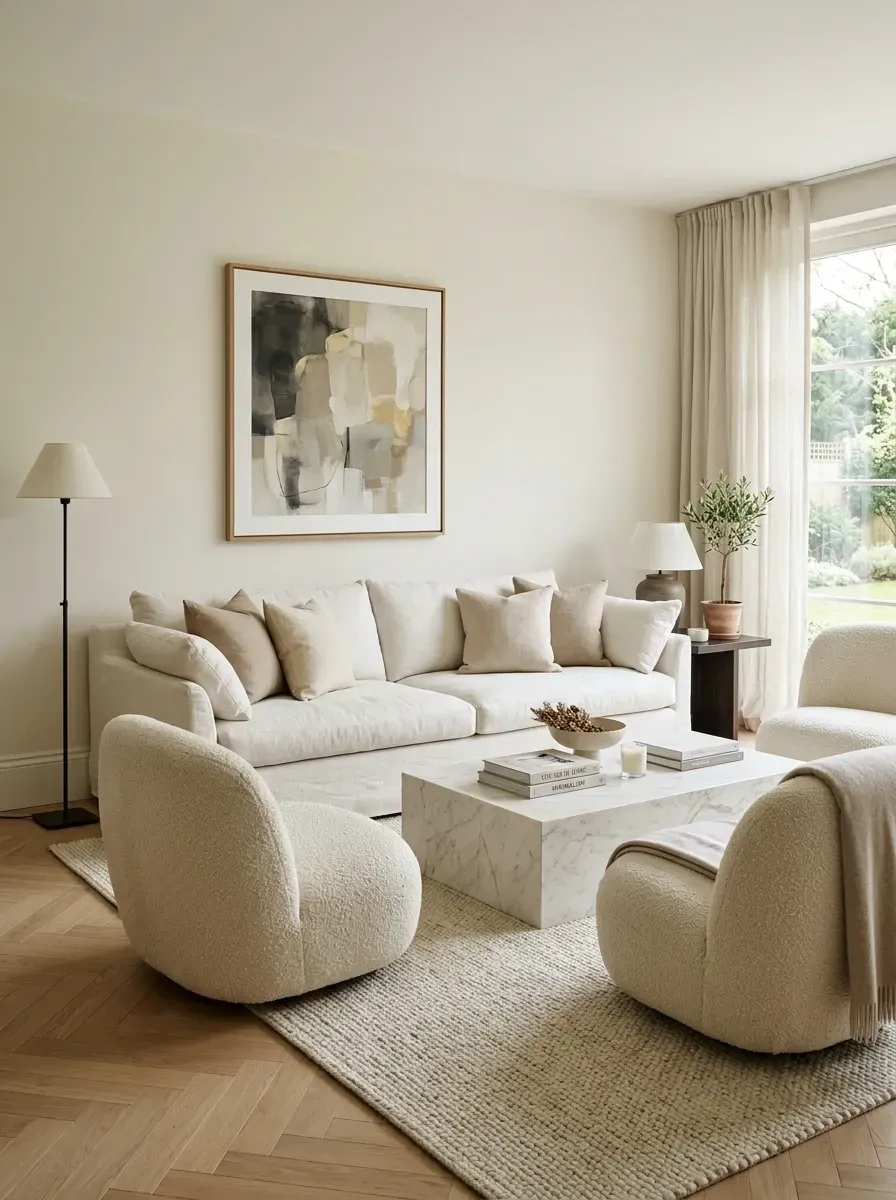
This is the format that scares clients the most and rewards them the most. A single creamy color family covers walls, sofa, chairs, and drapery — but four different materials carry that color: linen, bouclé, marble, and natural oak. Each material catches light differently, so what reads in a photo as one beige is, in person, four distinct tactile experiences. The herringbone floor is doing crucial work here: it introduces the only geometric pattern in the room, which is what stops the monochrome from going flat.
Plan-aware verdict: monochromatic rooms succeed or fail on the rug. The 9×12 jute-and-wool blend has to fit all four front legs of the sofa and chairs, and it has to be a different texture from the upholstery — never the same fabric in a near-matching tone. The marble plinth coffee table is the room's heaviest element by visual weight; a hollow or veneered substitute will betray itself in a year. For the herringbone floor, specify rift or quarter-sawn white oak with Bona Mega ONE or Rubio Monocoat — solid 5/8-inch planks, not engineered, if the budget allows.
Features
- Herringbone natural oak floors, hardwax oil finish
- Belgian linen slipcovered sofa
- Two bouclé swivel chairs
- Solid Carrara plinth coffee table
- Layered jute-and-wool rug, full furniture footprint
Cost Analysis (2026 Northeast)
| Decor Item (Qty) | Total Price Range |
|---|---|
| Large Belgian Linen Sofa (90 in.+) | $2,000 – $4,000 |
| Bouclé Swivel Chairs (×2) | $1,200 – $2,400 |
| Solid Marble Plinth Coffee Table | $1,000 – $2,500 |
| Jute / Wool Blend Rug (9×12) | $600 – $1,500 |
| Belgian Linen Drapery (×2 panels) | $200 – $500 |
| Total Estimated Cost | $5,000 – $10,900 |
Color Palette
Creamy Off-White
#F2EEDA
Benjamin Moore White Dove (OC-17) or Farrow & Ball Slipper Satin (No. 2004) — warm yellow undertone keeps the cream from going clinical.
Warm Beige Bouclé
#D9CFC1
Maharam Bouclette or Pierre Frey Mimic in a warm sand tone — a deeply tactile knit that holds shape and resists pilling.
Natural Oak
#C4A484
Rift-cut white oak, herringbone pattern, finished with Rubio Monocoat Pure or Bona Mega ONE in a flat sheen.
Carrara White Marble
#EDEAE6
Honed Carrara C — softer veining than Calacatta, lower price point, and the matte surface keeps it from competing with the linen.
3. The Botanical Dining Focal Point
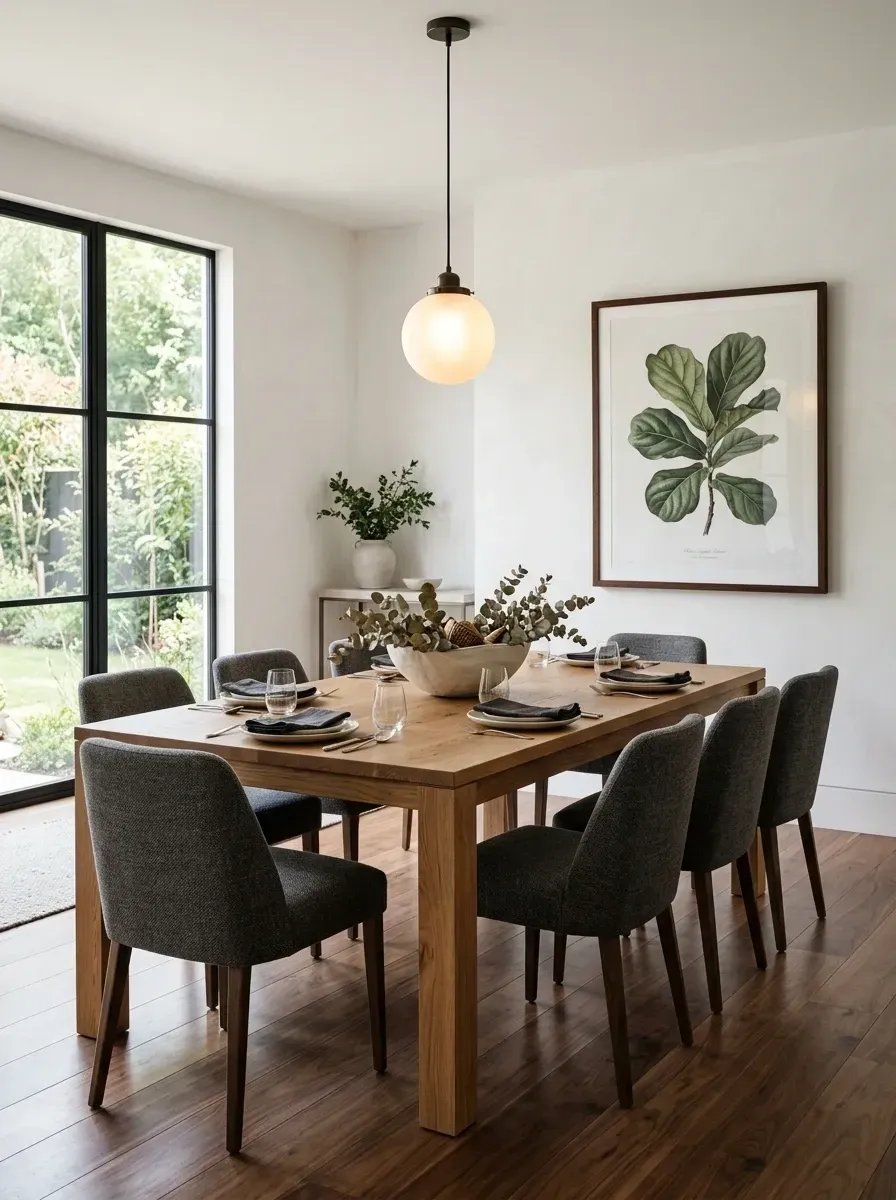
High-contrast moves used sparingly are a quiet luxury signature. The black steel window frames and the matching matte black globe pendant act as graphic punctuation against bright white walls — strong, but limited to two elements only. The solid oak table is the investment piece carrying the whole room; everything else is calibrated to support it. The single oversized botanical print does what a painting committee of four small prints cannot: it pulls the eye to one location and lets the rest of the wall stay quiet.
Plan-aware verdict: the black steel window frames are the framing-stage decision that makes this room work. Marvin Modern in Ebony or Andersen E-Series in Black are the standard specs; aluminum-clad replacement windows in matching black work as a retrofit but never read quite as crisp as the welded-steel originals on a 1920s rowhouse renovation in Brooklyn or a converted barn outside Hudson. For the table, specify a solid oak slab — never veneer over MDF — because the surface will get refinished three times in its life and a veneer cannot survive the first sanding. The dining chairs in charcoal performance velvet (Crypton or Sunbrella weave) are the cost-saving move; full leather doubles the chair budget.
Features
- Black steel-frame casement windows
- Solid medium-oak farmhouse table (eight-seat)
- Oversized single-piece botanical artwork
- Single matte-black globe pendant on dimmer
- Charcoal performance-velvet upholstered chairs
Cost Analysis (2026 Northeast)
| Decor Item (Qty) | Total Price Range |
|---|---|
| Solid Oak Dining Table (Eight-Seat) | $1,500 – $3,000 |
| Upholstered Dining Chairs (×8) | $1,600 – $3,200 |
| Large Framed Botanical Print | $250 – $500 |
| Globe Pendant Light (Matte Black) | $150 – $400 |
| Centerpiece Bowl & Branches | $200 – $400 |
| Total Estimated Cost | $3,700 – $7,500 |
Color Palette
Crisp White
#FFFFFF
Benjamin Moore Decorator's White (CC-20) or Sherwin-Williams High Reflective White (SW 7757) for maximum contrast against the black window frames.
Medium Oak
#A67B5B
Solid white oak with a Rubio Monocoat Smoked Oak treatment — warmer than rift-cut natural, deeper grain visibility.
Charcoal Grey
#505050
Crypton or Sunbrella performance velvet in a deep charcoal — wipes clean and resists wine, which matters at a dining table.
Matte Black
#212121
Marvin Modern in Ebony or Andersen E-Series in Black for the windows; pendant in matte powder-coated steel to match the frame finish exactly.
4. Architectural Entryway with Mixed Materials
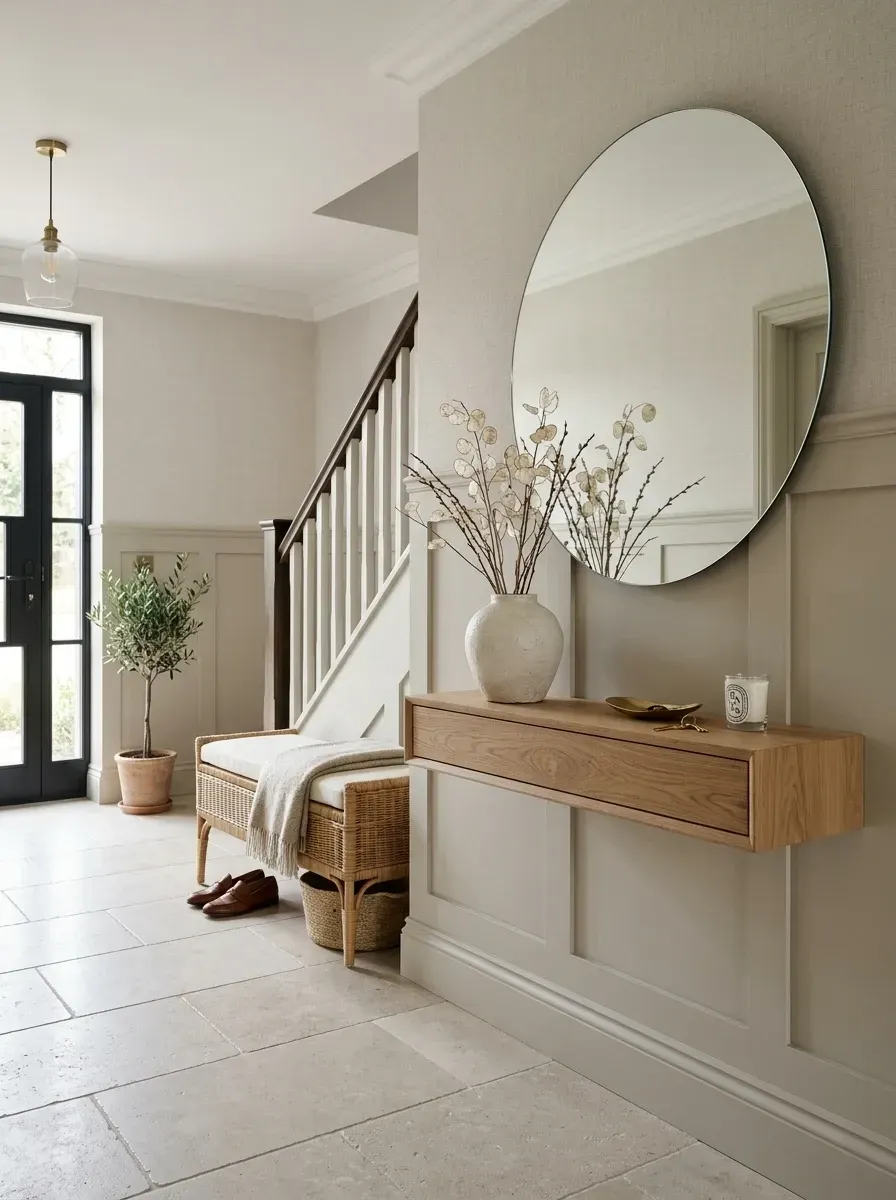
An entryway is the first room a guest reads, and one of the rooms most worth spending architectural-detail money on. The two-tone wainscoting here does heavy lifting — greige below, cream above — adding immediate historical weight without committing the whole hallway to a darker palette. The floating wood console keeps the limestone floor visible underneath, which is the move that keeps a tight foyer from feeling cramped. The material mix (limestone + rattan + oak + painted millwork) is what gives the room its layered feel without ever introducing a fourth color.
Plan-aware verdict: real wainscoting is built up from primed MDF rails and stiles installed over drywall, then painted on-site — not the pre-fabricated wainscot kits from big-box stores, which look thin and sit proud of the wall. Expect $1,000–$2,500 in labor and material for a small entryway in the Hudson Valley, with the painter's caulk-and-paint pass adding another half-day. The honed limestone floor is the splurge worth making in a foyer; it ages, develops patina, and forgives wet-boot traffic better than polished marble or porcelain. Specify a sealer (Aqua Mix Sealer's Choice Gold) and resign yourself to resealing every two to three years.
Features
- Two-tone painted MDF wainscoting
- Floating natural oak console shelf
- Large round mirror in dark frame
- Honed limestone tile flooring
- Woven rattan storage bench with cushion
Cost Analysis (2026 Northeast)
| Decor Item (Qty) | Total Price Range |
|---|---|
| Wainscoting Build & Paint (Small Entry, Labor + Material) | $1,000 – $2,500 |
| Honed Limestone Flooring (~100 sq ft installed) | $1,500 – $3,000 |
| Floating Oak Console | $300 – $800 |
| Large Round Mirror (36 in.+) | $200 – $500 |
| Woven Rattan Bench & Cushion | $400 – $900 |
| Total Estimated Cost | $3,400 – $7,700 |
Color Palette
Greige Taupe
#AFA495
Benjamin Moore Revere Pewter (HC-172) or Farrow & Ball Drop Cloth (No. 283) — sits on the warm-grey/beige line and grounds the wainscoting.
Soft Cream
#F2EEDD
Benjamin Moore Swiss Coffee (OC-45) or Sherwin-Williams Alabaster (SW 7008) — keeps the upper space airy without going pure white.
Natural Oak
#CBAF8F
Clear-finished white oak in a hardwax oil — light enough to contrast with the painted millwork, warm enough to read as natural.
Warm Limestone
#D9D0C1
Honed Jerusalem Gold or French Limestone in 24×24 in. tiles — minimal grout lines, sealed with Aqua Mix Sealer's Choice Gold.
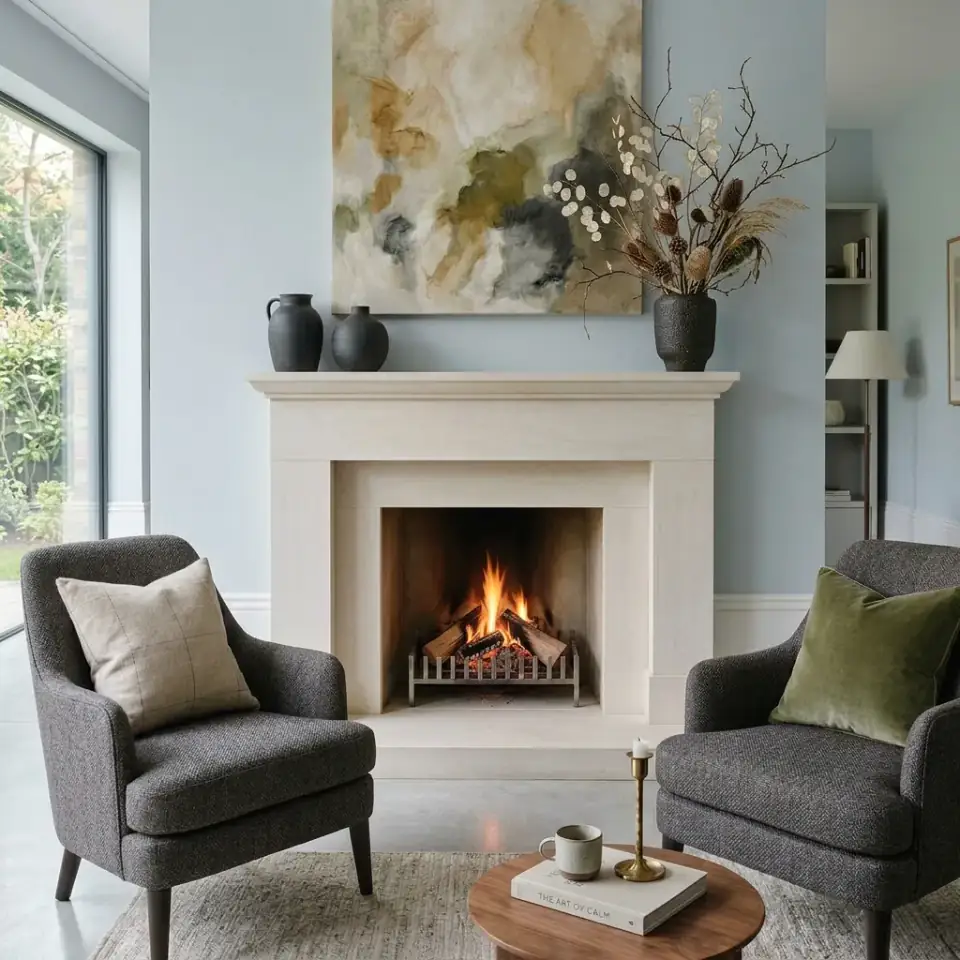
5. The Muted Color Accent Nook
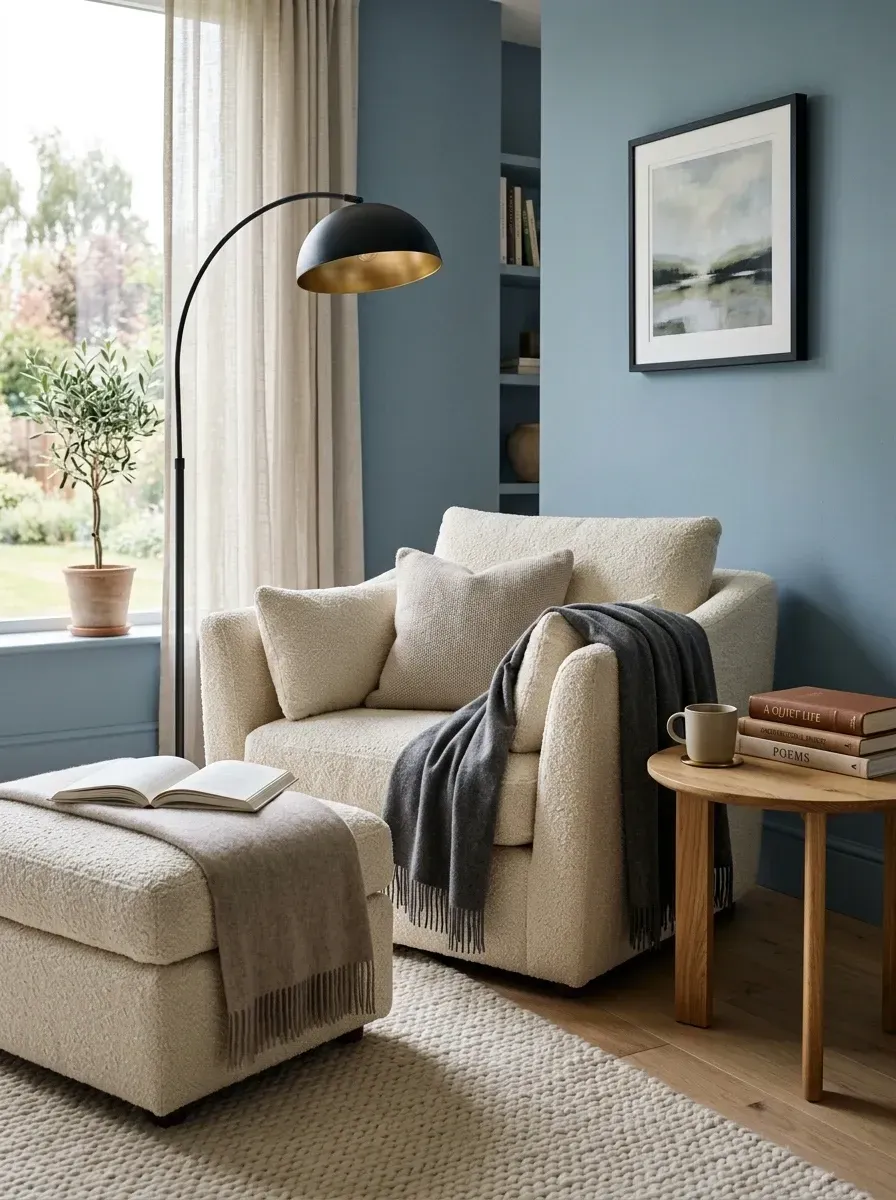
Quiet luxury isn't always neutral. A muted color used confidently can do the same enveloping work that a beige palette does — sometimes better. This reading nook commits to a single dusty steel-blue feature wall and lets the bouclé chair, the arched lamp, and the small oak side table sit against it. Every silhouette in the corner is a curve: the chair back, the lamp arc, the round table top, the rounded ottoman. That curve language is what makes the nook read as a soft pocket inside a square room.
Plan-aware verdict: this is the smallest-budget format in the guide and the one that translates best to renters. The single wall paint job runs $200–$400 in the Northeast — a long Saturday for one painter or one weekend for the homeowner. The bouclé chair and ottoman set is the investment piece; everything else is accessory. For renters in Brooklyn or Beacon walk-ups, peel-and-stick wallpaper in a similar steel-blue tone works as a substitute and removes cleanly at lease end. The arched floor lamp eliminates the need for a hardwired ceiling fixture, which matters because reading nooks rarely have one positioned correctly.
Features
- Dusty steel-blue accent wall
- Bouclé armchair and matching ottoman
- Arched matte-black floor lamp
- Round natural oak side table
- Charcoal wool layered throw
Cost Analysis (2026 Northeast)
| Decor Item (Qty) | Total Price Range |
|---|---|
| Bouclé Armchair & Ottoman Set | $1,000 – $2,000 |
| Arched Floor Lamp (Matte Black) | $200 – $500 |
| Small Round Oak Side Table | $150 – $350 |
| Wool / Cashmere-Blend Throws (×2) | $200 – $500 |
| Accent Wall Paint (Labor & Material) | $200 – $400 |
| Total Estimated Cost | $1,750 – $3,750 |
Color Palette
Dusty Steel Blue
#70879B
Farrow & Ball Lulworth Blue (No. 89) or Benjamin Moore Newburg Green (HC-158) — desaturated enough to be calming, saturated enough to enclose.
Cream Bouclé
#EFEBDD
Maharam Bouclette in Ivory or Pierre Frey Mimic — the go-to performance bouclé that resists pilling for a lounge chair that will get daily use.
Natural Oak
#BFA384
Solid white oak with a hardwax oil finish — bridges the cool blue and warm cream without picking a side.
Charcoal & Black
#333333
Matte black powder-coat for the lamp; a charcoal wool throw (Brahms Mount or Faribault) — the dark accents that keep the soft palette from going saccharine.
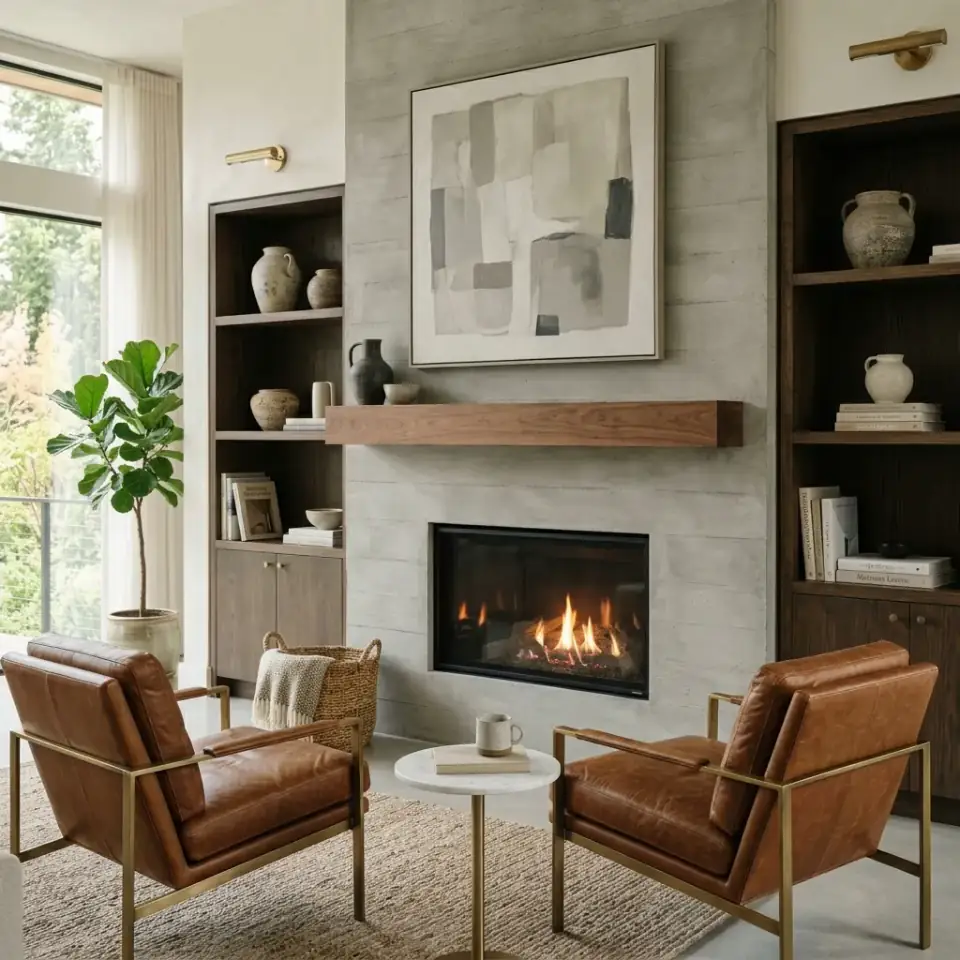
6. Symmetry and Plaster in the Living Room
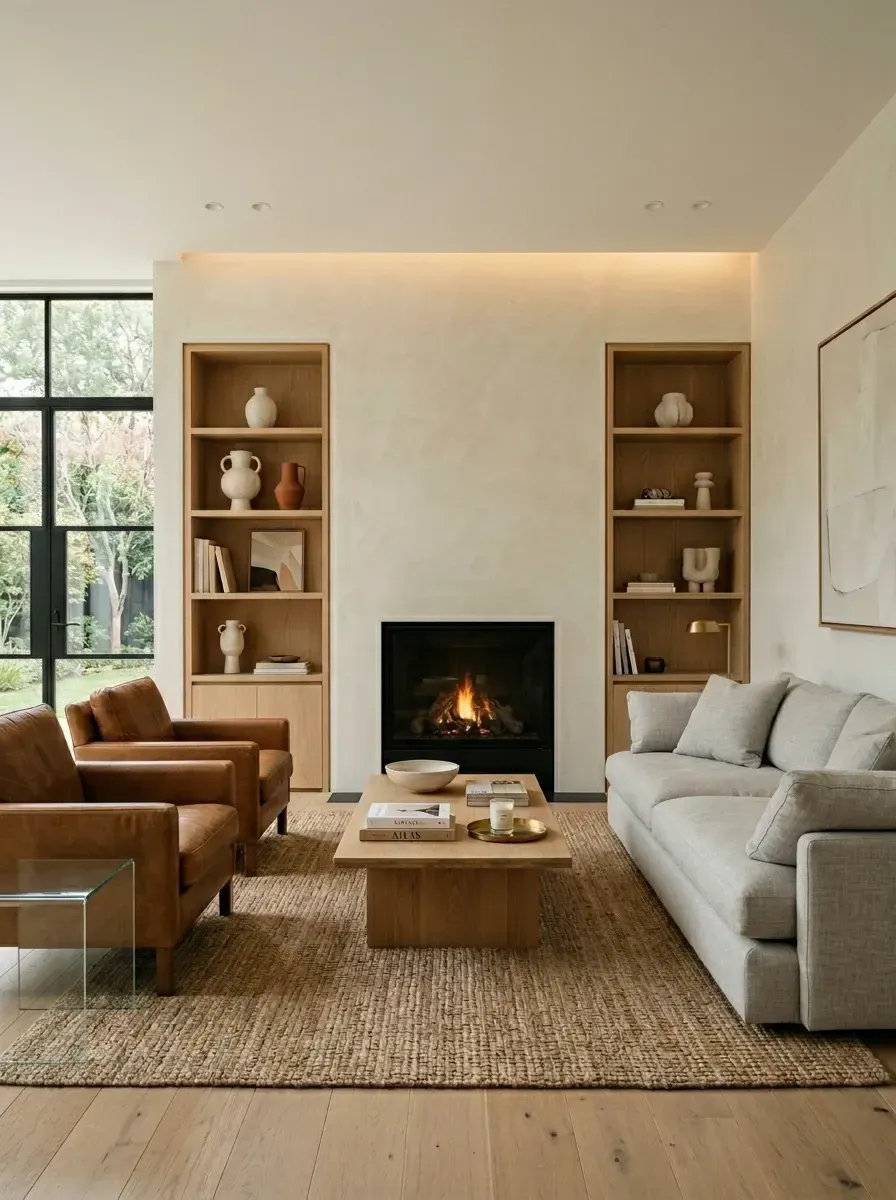
This is the living room as architecture. Twin custom oak built-ins flanking a central fireplace lock the room into perfect symmetry — there's no wandering for the eye, which is half of why the space reads calm. The walls are not painted drywall; they're Venetian plaster, hand-applied in two to four passes, with a final wax for sheen control. That finish reads from across a room as suede-like depth that paint cannot fake. The combination of leather chairs, linen sofa, and oak built-ins balances the visual weight: heavy on the chairs, light on the sofa, structural on the millwork.
Plan-aware verdict: this is the most build-heavy format in the guide and the one that earns the budget. Custom oak built-ins from a Hudson Valley shop run $5,000–$12,000 per unit ($10,000–$24,000 for the matched pair) and require shop drawings done before drywall closes — the studs need to be set to receive a flush-finish cabinet face, not a freestanding bookcase. Venetian plaster from a skilled trowel runs $8–$15 per square foot installed; in the Hudson Valley, finding a plasterer who actually knows the technique (not just an ad-listing) means asking for references on three completed projects before signing. For the chairs, full-grain saddle leather (Italian or American tannage) ages in over a decade; bonded leather will fail visually within three years.
Features
- Hand-applied Venetian plaster walls
- Symmetrical custom natural oak built-ins
- Saddle-tan full-grain leather lounge chairs
- Light grey Belgian linen sofa
- Minimalist white plaster fireplace surround
Cost Analysis (2026 Northeast)
| Decor Item (Qty) | Total Price Range |
|---|---|
| Custom Oak Built-In Shelving (×2 matched units) | $5,000 – $12,000 |
| Venetian Plaster Finish (Estimated full room) | $3,000 – $6,000 |
| Full-Grain Leather Lounge Chairs (×2) | $2,000 – $5,000 |
| Belgian Linen Sofa | $2,000 – $4,000 |
| Large Jute Area Rug | $500 – $1,200 |
| Total Estimated Cost | $12,500 – $28,200 |
Color Palette
Warm Plaster
#E6DACB
Marmorino or Stucco Veneziano in a warm putty tone, finished with carnauba wax for a low-sheen suede look.
Natural Oak
#C4AFA0
Rift-cut white oak with Rubio Monocoat Pure for the built-ins — dead-flat sheen, no orange undertone, ages gracefully over decades.
Saddle Tan
#9F6D43
Italian full-grain saddle leather (Cassina or Poltrona Frau quality tier) — the patina earned in five years is the design.
Light Grey Linen
#D3D3D3
Belgian flax linen in a soft pewter tone — cool counterpoint to the warm leather and plaster, keeps the palette from going amber.
7. Soft Luxe in a Bedroom Corner
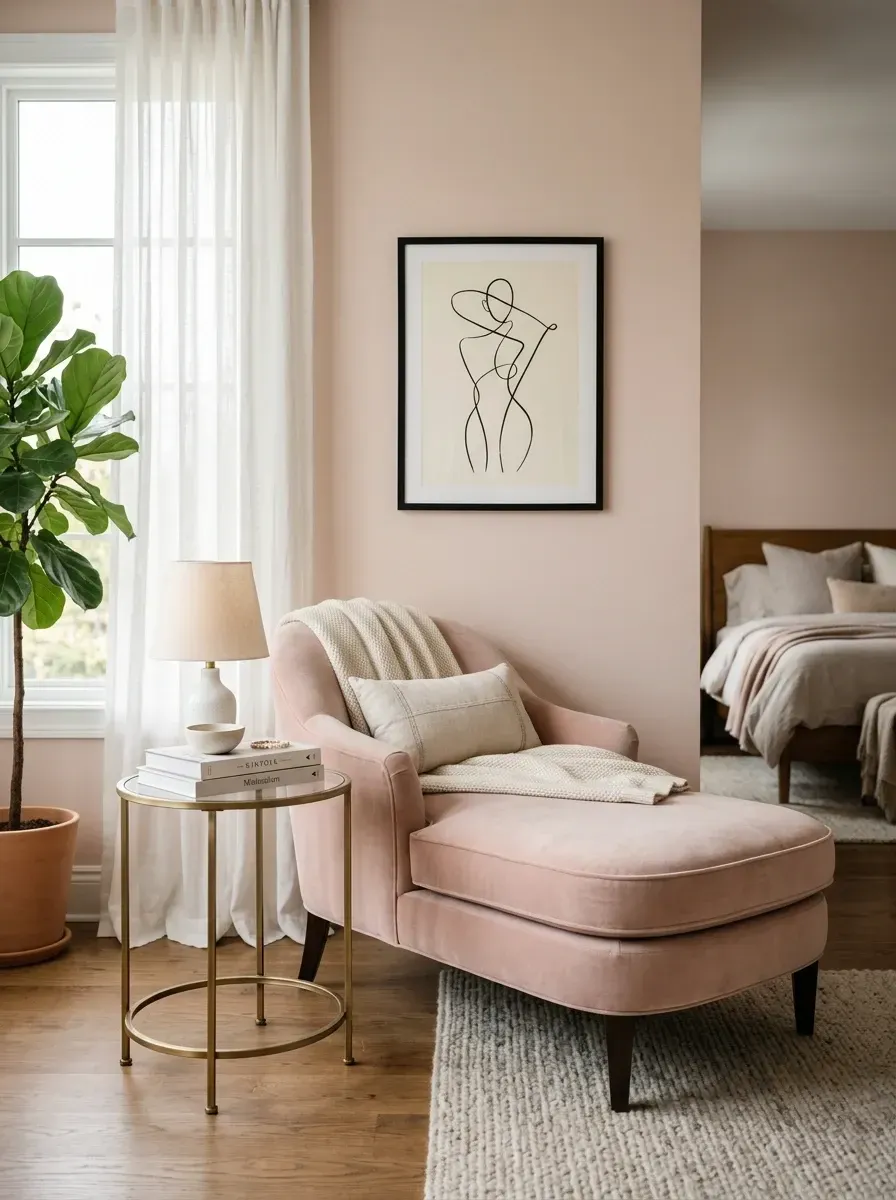
A softer, more feminine read of quiet luxury. The palette commits hard to blush — walls and chaise both — and trusts two things to keep it sophisticated: the desaturation of the pink, which is more clay than candy, and the velvet sheen of the chaise, which catches light differently from the matte wall. The brass side table and matching lamp base are the metallic punctuation. The fiddle leaf fig is non-negotiable; without that vertical green silhouette, the corner reads sweet. With it, the room reads composed.
Plan-aware verdict: blush only works as a wall color when it's properly desaturated — Farrow & Ball Pink Ground or Benjamin Moore Pink Bliss territory. Hot or cool pinks read juvenile in a bedroom, full stop. The velvet chaise is the splurge; performance velvet (Crypton or Sunbrella) over a hardwood frame runs $800–$1,800 in 2026 and lasts twenty years. Avoid the imported velvet-over-particleboard chaises in the $400 range — they sag within eighteen months and the legs detach. The faux fiddle leaf is the cost-saving move that's fine here; high-end fauxes from Nearly Natural or Afloral now read indistinguishable in photos and survive the low-light corners that kill real Ficus lyrata.
Features
- Desaturated blush wall color
- Performance-velvet chaise lounge
- Brushed brass and glass side table
- Tall fiddle leaf fig (real or premium faux)
- Minimalist line-art print
Cost Analysis (2026 Northeast)
| Decor Item (Qty) | Total Price Range |
|---|---|
| Velvet Chaise Lounge | $800 – $1,800 |
| Brushed Brass & Glass Side Table | $150 – $400 |
| Tall Fiddle Leaf Fig & Ceramic Pot | $200 – $450 |
| Framed Minimalist Line Art | $100 – $250 |
| Total Estimated Cost | $1,250 – $2,900 |
Color Palette
Blush Pink
#F0D3C9
Farrow & Ball Pink Ground (No. 202) or Benjamin Moore Pink Bliss (2093-70) — clay-based blush, no sweetness.
Rose Velvet
#E6B8B0
Crypton or Sunbrella performance velvet in dusty rose — the sheen is what keeps the matched-tone reading rich rather than flat.
Brushed Brass
#CBAA6D
Visual Comfort or Allied Maker hardware in unlacquered brushed brass — warm metallic that complements the blush instead of competing with it.
Verdant Green
#3A5F2D
Real or premium-faux Ficus lyrata (fiddle leaf fig) — the deep green silhouette is the room's structural counterweight.
8. Vertical Texture in a Modern Mudroom
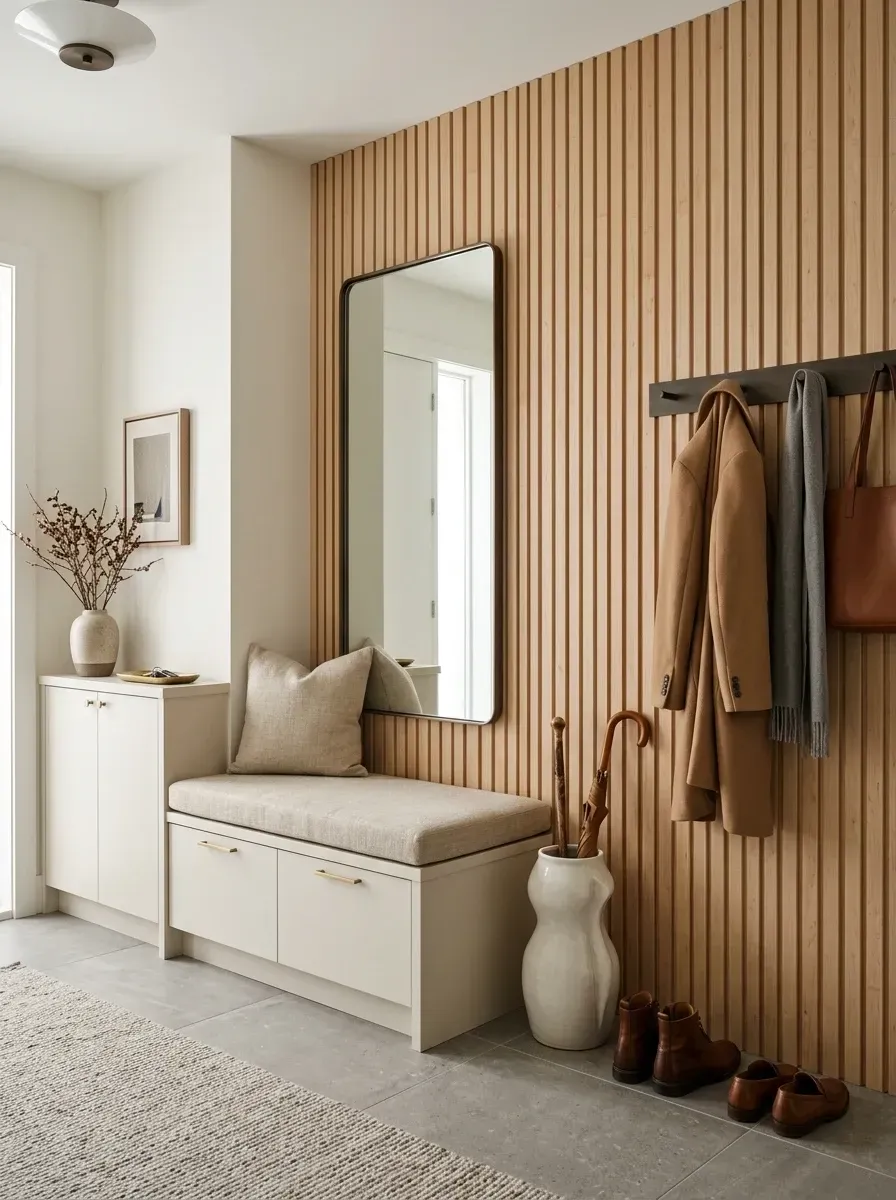
Mudrooms are usually designed last and it shows. This one is designed first — every surface is doing two jobs. The wood slat wall is texture and structure: vertical lines that stretch the ceiling visually while also carrying the coat hooks. The bench is storage and seating. The tile is durable and large-format, which means few grout lines, which means it actually stays looking clean. And the mirror, set tall and slim, doubles the apparent depth of a space that might be only four feet wide. The cream cabinetry tones-out the bench so it doesn't compete with the slat wall — the wall is supposed to win.
Plan-aware verdict: a wood slat wall is one of the highest impact-per-dollar moves in renovation work. White oak slats (1×2 or 1×3 actual, 1/2-inch reveal between) installed over a black-painted backing board run $1,000–$3,000 for a small mudroom in the Hudson Valley, and they last a decade with no maintenance. Specify rift-cut white oak — flatsawn slats cup over time and the joint reveals open up. The bench is the second-best move; build it as a cabinet shop piece with closed drawers below the lift-up seat, never open cubbies (open mudroom cubbies are guaranteed to look chaotic by month four). Concrete-look porcelain tile (Daltile or Bedrosian's StoneTalk line) at 24×24 inches gives you the look of poured concrete with grout lines you can ignore.
Features
- Floor-to-ceiling rift-cut white oak slat wall
- Custom painted storage bench with closed drawers
- Tall slim full-length mirror
- Large-format concrete-look porcelain tile
- Matte bronze coat hooks
Cost Analysis (2026 Northeast)
| Decor Item (Qty) | Total Price Range |
|---|---|
| Wood Slat Wall (Material & Labor) | $1,000 – $3,000 |
| Custom Storage Bench & Cushion | $1,200 – $2,500 |
| Tall Slim Framed Mirror | $300 – $600 |
| Concrete-Look Porcelain Tile (~80 sq ft installed) | $640 – $1,200 |
| Total Estimated Cost | $3,140 – $7,300 |
Color Palette
Natural Light Wood
#DDBEA0
Rift-cut white oak slats in a hardwax oil finish — clean grain, vertical rhythm, low maintenance over a decade of use.
Creamy Beige
#E8E2D5
Benjamin Moore Manchester Tan (HC-81) or Sherwin-Williams Accessible Beige (SW 7036) — warm enough to blend, cool enough not to yellow.
Concrete Grey
#9E9E9E
Daltile Volcanic Concrete or Bedrosian StoneTalk in 24×24 in. matte porcelain — durable, slip-rated, easy to clean from snow-melt and salt.
Matte Black / Bronze
#3E3B36
Rejuvenation or Schoolhouse coat hooks in matte black or oil-rubbed bronze — the dark anchor that defines the slat wall's vertical rhythm.
Pro Tips From the Renovation Designer's Chair
- Spend on touchpoints, save on backdrops. Door handles, light switches, faucet handles, drawer pulls, and upholstery fabrics are the surfaces your hand actually meets. Cheap hardware on a solid door breaks the illusion of the entire room — the touchpoint is what tells you whether luxury is real or staged. Spec Buster + Punch, Armac Martin, or Rejuvenation hardware on the doors that get used daily; budget brands are fine on the closet doors that don't.
- Every light source on a dimmer. A quiet luxury home shifts from functional daytime to enveloping evening because the lighting can shift. That requires a dimmer on every fixture — overhead, sconce, table lamp, floor lamp. Lutron Caséta is the standard residential spec; for a single room a $30 dimmer at the switch and a $40 plug-in module covers it. The room without dimmers always reads brighter and harsher than its furnishings deserve.
- Scale the rug to the furniture, not the room. The most common mistake I see in client homes is a 5×8 rug under a sectional that should sit on a 9×12. The rule: all front legs of all major seating pieces should rest on the rug. A rug too small floats the furniture and makes the entire seating zone read disjointed and cheap, regardless of what was spent on the sofa.
- Pick three colors and one accent — never seven. Walk into any failing-quiet-luxury room and count the distinct colors. You'll find seven. Walk into a successful one and you'll find three or four, with one accent. The discipline isn't about which colors; it's about how few. A room with three carefully chosen tones plus one accent reads composed at any budget.
- Plan finish materials before drywall closes. Wainscoting needs blocking. Floating shelves need backing. Large mirrors need stud locations. Wood slat walls need a black-painted substrate. Hidden ventilation needs framed channels. All of it is decided on the shop drawings before the plumber and electrician roughly land their boxes — retrofit is twice the price and never as clean.
- One organic element per room, minimum. Olive tree, fiddle leaf fig, eucalyptus stems in a vase, dried branches, a small herb bowl — every quiet luxury room I've designed includes at least one piece of nature with a real silhouette. It's the single move that prevents the room from reading like a furniture catalog.
Cost-Saving Moves That Don't Read as Cuts
- Paint is the highest impact-per-dollar move you can make. If plaster walls or paneling are out of budget, a fresh coat of a complex neutral from Farrow & Ball, Benjamin Moore Historical Collection, or Portola Paints transforms a room for $400–$800. The pigment depth in a real heritage paint reads from across the room; the cheap version reads flat and chalky.
- Premium faux botanicals over real on a budget. The high-end faux trees from Nearly Natural, Afloral, or Bloomscape have crossed the line where a six-foot faux Ficus lyrata at $300 is genuinely indistinguishable in a photograph from a real one at $450. Real plants cost more in mortality (especially in low-light corners) than they do at purchase — the math favors faux for any spot away from a window.
- Stone remnants over full slabs for accent surfaces. Marble fabricators in the Hudson Valley sell remnants from larger jobs at 30–50% off slab pricing — perfect for a fireplace surround, a vanity top, or a small coffee table. Visit the fabricator yard with your dimensions and let the size of the available remnant pick your project, not the other way around.
- Semi-custom millwork over fully custom. A semi-custom built-in (KraftMaid Vantage, Decora Reserve, or a regional shop's stock-line) finished with the same wood species and stain as a fully custom piece reads identical in 90% of installations. The 30–40% cost delta funds the lighting, hardware, or stone upgrade that visibly matters.
The Core Idea. A quiet luxury home is not the result of a furniture order; it's the result of a planning discipline. Restraint at the palette stage, layering at the texture stage, and controlled lighting at the finish stage matter more than the labels on the receipts. The best rooms in this guide aren't the most expensive ones — they're the ones where every surface is doing a job, and nothing is doing two jobs poorly. Build that way and a $5,000 room can read as calm and considered as a $50,000 one.
Reader Questions on Quiet Luxury
What exactly is quiet luxury in interior design?
Quiet luxury is an interior approach that prioritizes high-quality materials, craftsmanship, and timeless detailing over visible branding or trend cycles. The hallmarks are restrained palettes (three or four colors, not seven), heavy use of natural materials (linen, wood, stone, plaster, leather), layered lighting on dimmers, and rigorous editing — every surface doing a job, nothing doing two jobs poorly. The result is a sophisticated environment that doesn't announce itself but rewards being lived in.
How can I achieve a luxury look on a budget?
Spend on the elements your body actually touches every day — upholstery fabric, hardware, lighting fixtures, and one foundational piece like a sofa or solid wood table. Save on accessories, decorative objects, and low-traffic surfaces. Beyond that, the highest-impact moves are free: declutter aggressively, commit to a cohesive three-color palette, put every light on a dimmer, and add at least one organic element. A $1,750 reading nook (room 5 above) uses every quiet luxury principle as rigorously as a $28,000 plastered living room (room 6).
What are the key colors for a quiet luxury aesthetic?
The palette is restrained and rooted in nature — warm whites and creams, beiges and taupes, natural and dark wood tones, with muted accents like dusty steel-blue, sage green, blush, or charcoal. Specific reliable specs from the rooms above: Benjamin Moore Swiss Coffee (OC-45), Farrow & Ball Slipper Satin (No. 2004), Sherwin-Williams Accessible Beige (SW 7036), Benjamin Moore Revere Pewter (HC-172), and Farrow & Ball Pink Ground (No. 202). Saturated accent colors, when used, are always desaturated rather than primary.
Is quiet luxury the same as minimalism?
Not exactly. Both reject visual clutter, but minimalism leans into starkness, hard edges, and negative space, often with a cooler emotional register. Quiet luxury is warmer, more layered, and more tactile — it embraces texture, comfort, and material richness in a way that strict minimalism does not. A monochromatic quiet luxury room (room 2 above) commits to one color family but loads it with linen, bouclé, marble, and oak — four distinct tactile experiences. A minimalist version of the same room would strip out two of those textures in pursuit of visual silence.
Do I need to renovate to get a quiet luxury look, or can I do it with decor alone?
Both work, with different ceilings. Decor-only — paint, furniture, lighting, accessories — gets you 70% of the way there in any room and is what rooms 1, 2, 3, 5, and 7 above are demonstrating. Renovating to add wainscoting, plaster walls, a wood slat wall, or steel-frame windows pushes the result into architectural-design territory and is what rooms 4, 6, and 8 are about. If renovation isn't on the table, focus the budget on lighting (every fixture on a dimmer) and one specialty paint finish — that's the closest thing to plaster on a paint-only budget.
How long does a quiet luxury room actually last before it dates?
Materially, a decade-plus if specified well. Solid oak, full-grain leather, real plaster, natural stone, and Belgian linen all age in rather than out — they develop patina rather than wear. The rooms that date fastest are the ones that committed to a trend-forward accent (a specific peach, a particular sectional silhouette); the rooms that hold are the ones with restrained palettes and natural materials. The pillar pieces in any of the rooms above — the leather chairs, the oak built-ins, the marble plinth, the linen sofa — should still read well in 2036.
Where to Read Next
If this whole-home overview helps, the room-specific guides go deeper into each space. The quiet luxury living room guide dissects the format from rooms 2 and 6 in more detail, the bedroom guide covers the soft luxe palette from room 7 across the whole sleeping space, and the dining room guide picks up where room 3's high-contrast format leaves off. For the bath-and-kitchen build-heavy version of the same logic, my quiet luxury bathroom guide walks through twelve real builds.
Sources & Further Reading
- Architectural Digest. What Is Quiet Luxury? The Trend, Explained. architecturaldigest.com
- Houzz Editorial. The New Luxury Is Quiet, Personal, and Sustainable. houzz.com
- Remodelista. 10 Secrets for a Calm Home. remodelista.com
- Dwell. How to Layer Texture in a Neutral Room. dwell.com
- Benjamin Moore. Color Trends and Historical Collection Specifications. benjaminmoore.com
- Farrow & Ball. Paint Color Encyclopedia & Specifications. farrow-ball.com
- Marble Institute / Natural Stone Institute. Care & Cleaning of Natural Stone Surfaces. naturalstoneinstitute.org
- Lutron Electronics. Caséta Wireless Lighting Control — Residential Specification Guide. lutron.com
- NAHB / Hanley Wood. 2025 Cost vs. Value Report — Interior Renovation ROI by Region. remodeling.hw.net
- This Old House. How to Install Wainscoting: A Step-by-Step Guide. thisoldhouse.com

Nora Whitfield
Renovation Designer & Interiors Editor · Beacon, New YorkNine years of design-build renovation work across the Hudson Valley and the Northeast. Nora runs the Renovations, Room Guides and Renovation Mind desks — before-and-after studies, room-by-room design guides, and the long essays on why what we renovate matters.
More from Nora →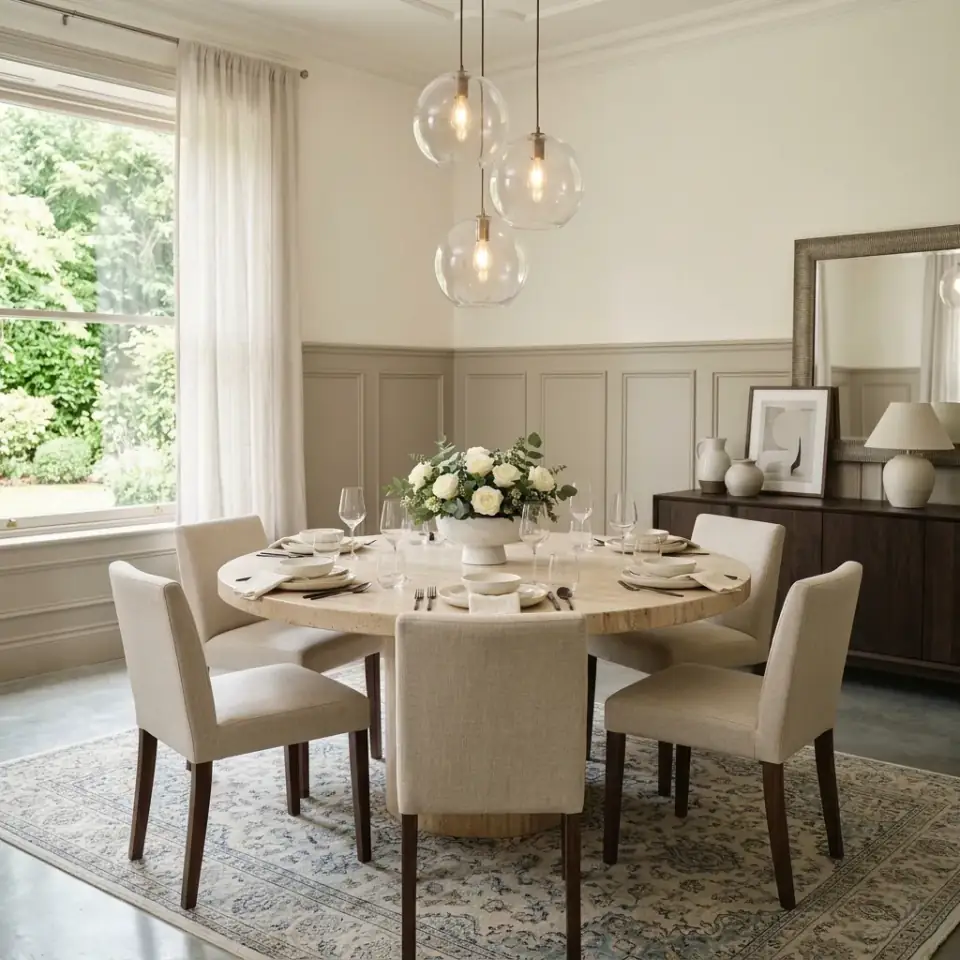
Reader notes