


Most bedrooms I'm asked to fix don't sleep well — and the owners can't tell me why. The walls are painted, the bed is fine, the light fixtures are correct. The problem is usually that nothing in the room engages the body the way an outdoor space does: no living material, no organic geometry, no varied surface depth. Below are eight bedrooms that quietly correct that, with the structural moves, real material specs, and 2026 Northeast cost ranges that make each one buildable.
How I Read a Biophilic Bedroom
Before I make a single material recommendation in a Hudson Valley bedroom renovation, I read four things: the circadian light plan (how the windows handle east-vs-west sunlight, and what the dimming system looks like at night), the material breath (whether the surfaces around the bed exchange humidity with the room or trap it — wood, wool, linen, lime plaster all breathe; vinyl, polyester, MDF do not), the tactile load (how many surfaces the body actually touches, from headboard to bedding to rug), and the sensory anchors (a single living plant, a single piece of organic geometry, a single piece of natural-fiber textile — the things that signal "outside" to a sleeping brain). Get those four right and the room sleeps. Skip any of them and the room photographs well but doesn't rest you.
Seven years of running renovation design across Beacon, Rhinebeck, Kingston, and Brooklyn brownstones has convinced me biophilic isn't a finish style — it's a sleep-hygiene argument made in materials. Real wood paneling, wool rugs, linen sheets, and a single 5-foot fiddle leaf fig will out-perform a $40,000 styled bedroom that bought all-new everything. The eight rooms below cover the full range, from $1,800 styling-only fixes to $10,000 architectural renovations, with brand specs and Northeast labor rates. For more in this lane, the network's bedrooms and kids' rooms archive covers cross-format comparisons.
Reading note. The numbering moves from light-and-airy to moody-and-cocooning. Both ends of the spectrum are valid biophilic answers — the right one for a given client depends on their preferred sleep environment, not on which photograph looks more impressive on Pinterest.1. The Living Wall Focal Point
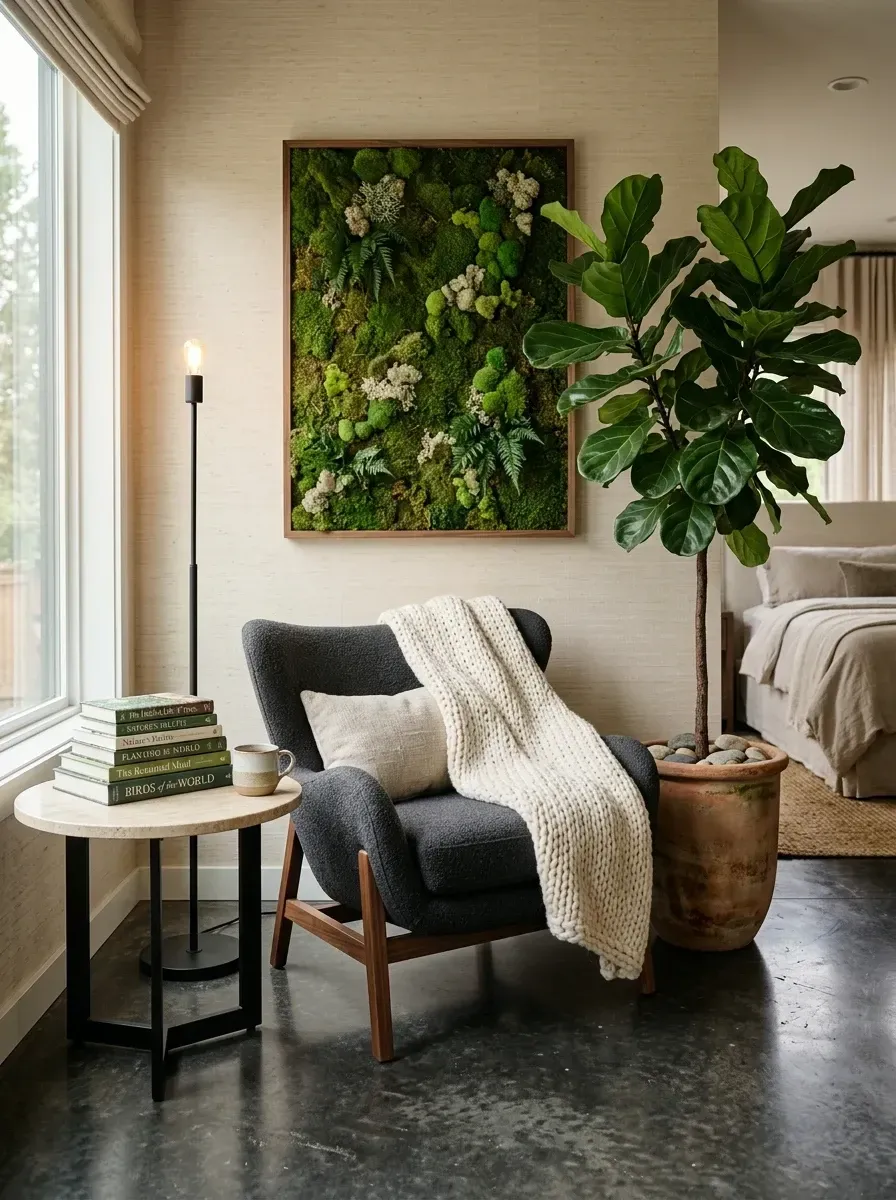
A corner-level biophilic move that punches above its budget. The framed preserved moss art delivers the visual weight of a living wall without the irrigation, lighting, or maintenance commitment — real moss, stabilized with a glycerin process, that holds its color for 8–10 years without water. A 5-foot fiddle leaf fig in an aged terracotta planter adds vertical scale; a chunky-knit wool throw and a textured charcoal armchair add the tactile range a polished concrete floor can't carry on its own. This is the corner I'd recommend to a Hudson Valley client renting an apartment they can't structurally renovate.
Plan-aware verdict: preserved moss panels (Garden On The Wall, Benetti Stone, Greenarea Italy) sit between $40 and $80 per square foot installed — a fraction of a real living wall, and zero monthly maintenance. The fiddle leaf fig is gorgeous in catalog photos and fragile in real Northeast bedrooms; if your room is north-facing or below 60% relative humidity, substitute a Rubber Plant (Ficus elastica) or a Bird of Paradise (Strelitzia) for similar visual weight with vastly better survival odds.
Features
- Framed preserved moss art installation (Garden On The Wall or Benetti)
- Large fiddle leaf fig in terracotta pot (or hardier substitute)
- Textured charcoal armchair (bouclé or slubbed wool)
- Polished concrete flooring
- Minimalist floor lamp with Edison bulb
Cost Analysis (2026 Northeast)
| Decor Item (Qty) | Total Price Range |
|---|---|
| Custom Framed Moss Art (36"×48") | $800 – $1,500 |
| Large Fiddle Leaf Fig (5–6 ft) | $150 – $250 |
| Large Terracotta Planter | $100 – $200 |
| Upholstered Armchair | $400 – $800 |
| Round Stone / Marble Side Table | $150 – $300 |
| Minimalist Floor Lamp with Edison Bulb | $80 – $150 |
| Chunky Knit Wool Throw | $100 – $180 |
| Total Estimated Cost | $1,780 – $3,380 |
Color Palette
Warm Cream
#ECEBE4
Benjamin Moore Swiss Coffee (OC-45) or Farrow & Ball Wimborne White — a soft neutral that lets the textures carry the room.
Charcoal Grey
#4A4A4F
Bouclé or slubbed-wool upholstery — a grounding deep tone that reads tactile, not just dark.
Aged Terracotta
#A36F56
A real-fired terracotta pot from Eye of the Day or Bergs Potter — synthetic resin pots fail this color test instantly.
Forest & Moss Green
#5C7046
Layered greens from preserved reindeer moss, sheet moss, and the fiddle leaf foliage.
2. The Horizon Line Wall
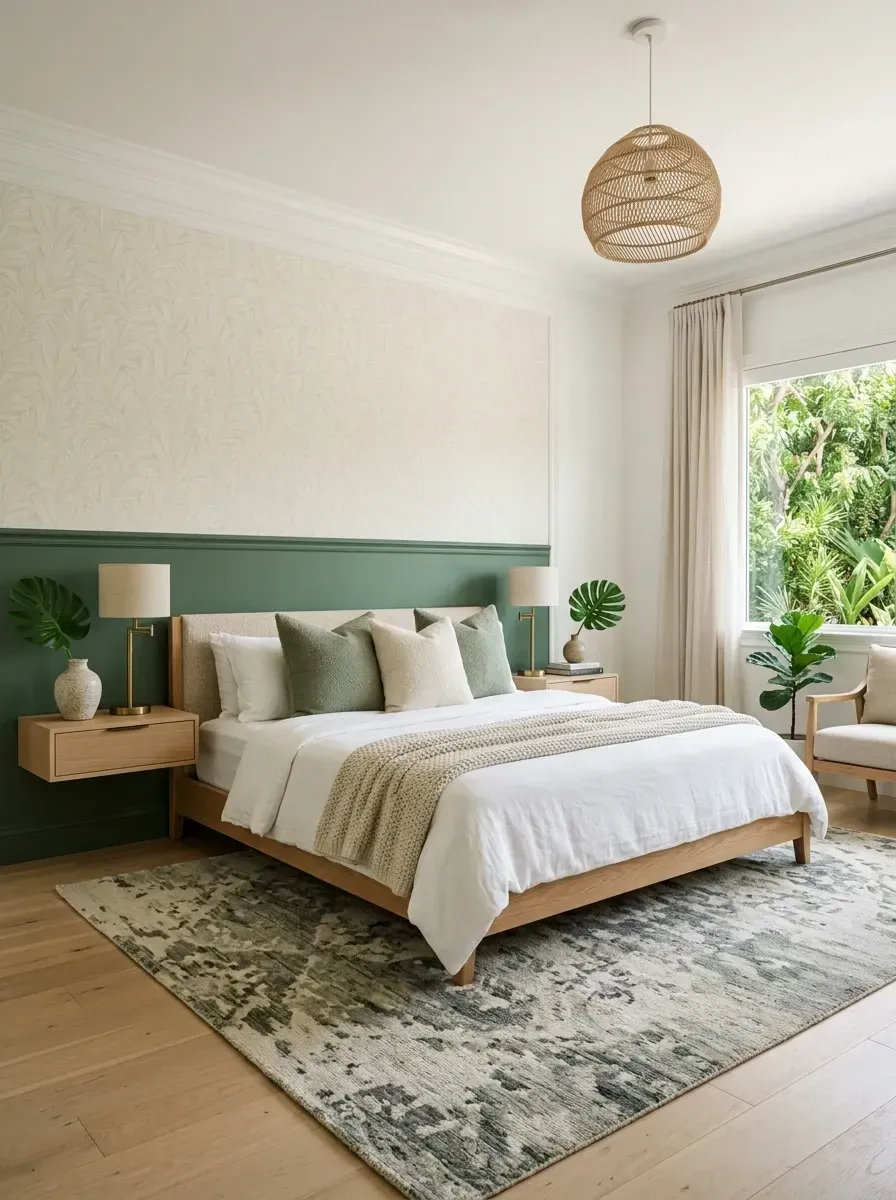
A horizon-line wall is one of the most effective bedroom moves I know. Forest green wainscoting at roughly one-third wall height, cream botanical wallpaper above, and the eye reads the same earth-meets-sky structure it spent a million years evolving to find calming. Light oak platform bed and floating nightstands keep the room visually airy; the woven rattan pendant adds the natural-fiber overhead texture that ceiling drywall can't deliver. This is the most "transitional" of the eight, and the easiest to drop into a 1920s Hudson Valley Colonial without an architectural fight.
Plan-aware verdict: wainscoting at exactly 32–36 inches off the floor (the classic "chair rail" height) reads dated. Push it to 42–48 inches for the contemporary horizon-line read. Wallpaper in a bedroom is a humidity question — most bedrooms don't have enough humidity to fail wallpaper, but bedrooms attached to en-suite baths do. Use a vinyl-coated stock if there's any shared-wall risk, regardless of the brand's "interior-only" labeling.
Features
- Two-tone wall: forest green wainscoting + botanical wallpaper above
- Light oak platform bed with low headboard
- Floating oak nightstands (matched pair)
- Woven rattan pendant light
- Large picture window with mature garden view
Cost Analysis (2026 Northeast)
| Decor Item (Qty) | Total Price Range |
|---|---|
| Paint & Wallpaper Installation (Materials + Labor) | $800 – $1,500 |
| Queen Light Oak Platform Bed | $600 – $1,200 |
| Floating Oak Nightstand (×2) | $300 – $600 |
| Woven Rattan Pendant Light | $150 – $300 |
| Patterned Area Rug (8×10) | $300 – $700 |
| Linen Curtains and Hardware | $150 – $250 |
| Bedside Lamps (×2) | $100 – $250 |
| Total Estimated Cost | $2,400 – $4,800 |
Color Palette
Forest Green
#3A5243
Farrow & Ball Studio Green (No. 93) or Benjamin Moore Hunter Green (2041-10) — a deep grounding green that reads "earth" reliably.
Off-White / Cream
#F2F0E6
Morris & Co. Pure Honeysuckle & Tulip or Sister Parish Mistral on a cream ground — historically informed botanical patterns.
Light Oak
#C4A484
Rift-cut white oak with a hardwax oil finish — Article, Crate & Barrel, or Hudson Valley local makers.
Natural Jute / Rattan
#D4C4A8
Hand-woven rattan pendant from Lostine, Serena & Lily, or Made Goods; jute or sisal rug from Annie Selke or Dash & Albert.
3. Blurring Indoor-Outdoor Boundaries
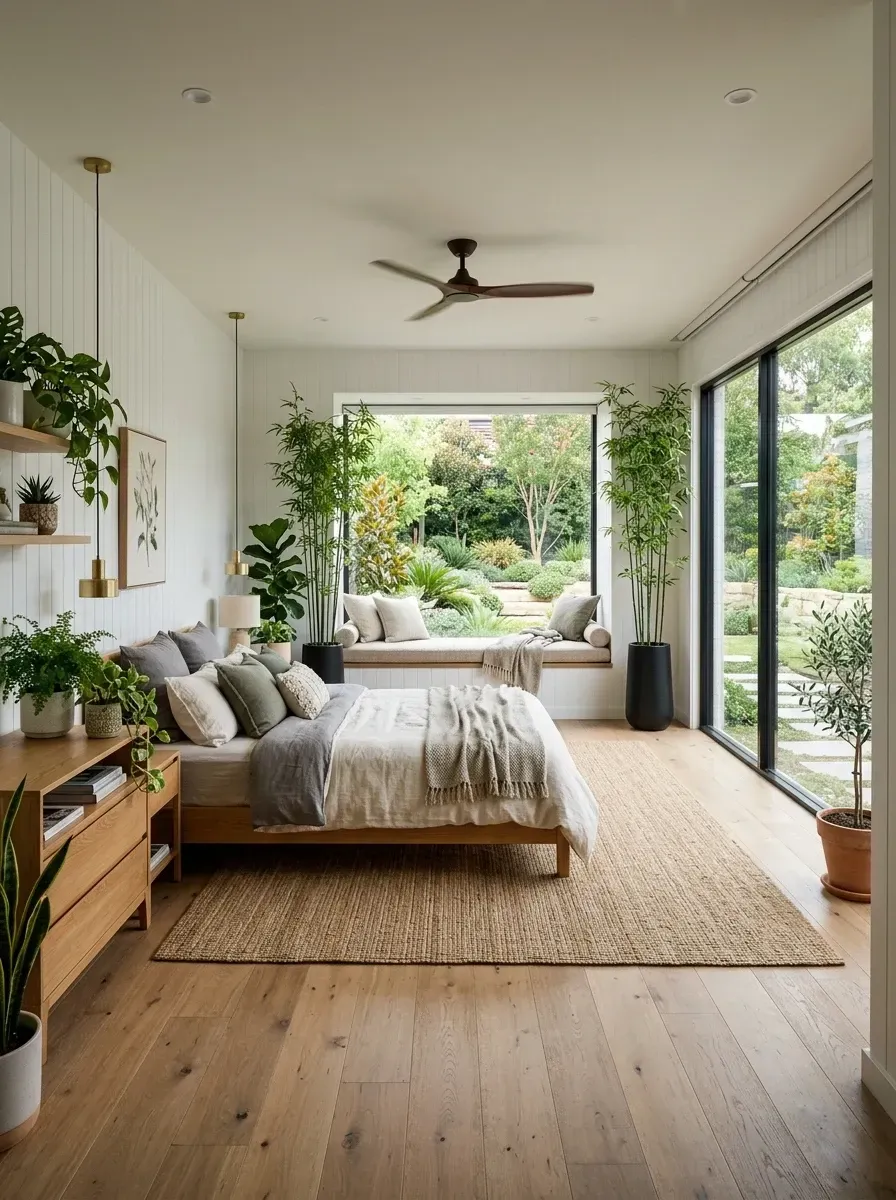
A masterclass in dissolving the indoor-outdoor line. The floor-to-ceiling picture window with a built-in bench creates a transitional moment — half indoors, half garden — and the vertical shiplap walls echo the verticality of mature trees outside, so the architecture itself feels continuous with the landscape. The bold move is bringing two or three large indoor trees inside in matte black planters, mirrored against trees visible through the window. Wide-plank honey oak flooring and a wood-blade ceiling fan reinforce the same material vocabulary inside that's already living outside.
Plan-aware verdict: a built-in window seat is a framing-stage decision, not a finish-stage one. The bench needs to be supported off the same studs that hold the window header, and the cushion depth (16"–22") drives the bench depth (18"–24") which drives how far the window has to be set back from the foundation. Owners who try to retrofit a window seat into an existing wall typically end up with a 12"-deep ledge that can't actually be sat on. Decide at framing.
Features
- Large picture window with built-in cushioned bench
- Vertical white shiplap walls (full height)
- Multiple large indoor trees in matte black planters
- Wide-plank honey oak flooring (5"+ widths)
- Ceiling fan with wood blades
Cost Analysis (2026 Northeast)
| Decor Item (Qty) | Total Price Range |
|---|---|
| Custom Window Seat (Millwork & Cushions) | $1,500 – $3,000 |
| Shiplap Wall Installation (Material & Labor) | $1,000 – $2,000 |
| Large Indoor Trees & Planters (×3) | $600 – $1,200 |
| Wood Frame Platform Bed | $700 – $1,500 |
| Large Jute Area Rug (9×12) | $400 – $800 |
| Ceiling Fan with Wood Blades | $300 – $600 |
| Wood Dresser / Console | $500 – $1,000 |
| Total Estimated Cost | $5,000 – $10,100 |
Color Palette
Crisp White
#FFFFFF
Benjamin Moore Simply White (OC-117) on the shiplap — bright but warm enough not to read clinical.
Honey Oak
#B89670
European white oak in 6"–8" board widths, finished with Rubio Monocoat 2C in Natural — the warm tone that anchors the whole palette.
Matte Black
#2C2C2C
Powder-coated matte black on planters, fan blades, and any window mullion — defines edges against white and oak.
Natural Linen / Jute
#CDC0A8
Coyuchi or Boll & Branch organic linen bedding; jute or sisal rug from Dash & Albert.
4. The Wood-Clad Cocoon
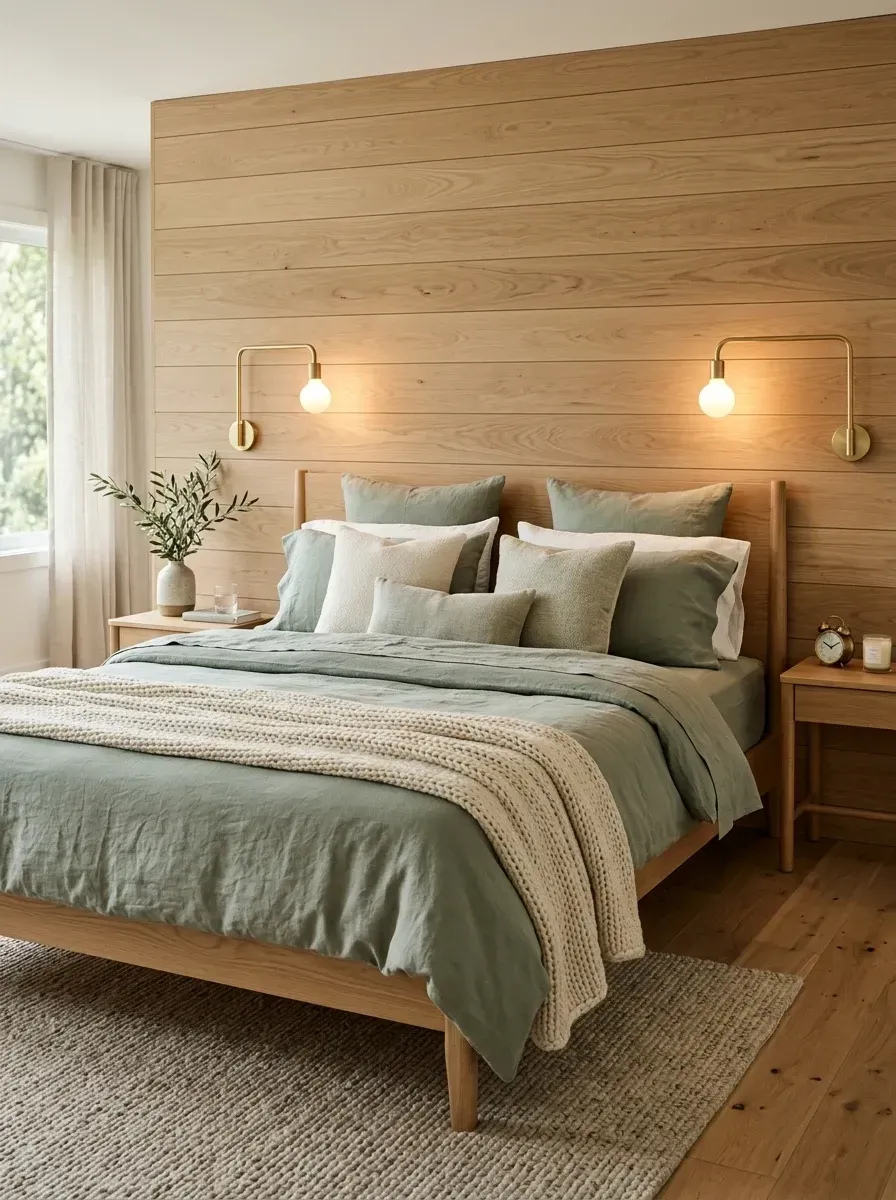
Wood as architecture rather than decor. The wide-plank oak wall behind the bed acts as an oversized integrated headboard, enveloping the sleeping zone in real material. Horizontal plank orientation visually widens the room — vertical orientation would have made it feel taller. Brass wall sconces flanking the bed cast warm 2700K wash light across the wood, picking up the grain. Layered linen bedding in soft sage and cream prevents the room from going sauna-warm; without those textile counterpoints, an all-wood envelope can read claustrophobic.
Plan-aware verdict: real solid-wood plank walls run $14–$25 per square foot installed depending on species and grade. Engineered veneer panels (StainOK, Wonderwall by Stikwood) get you 80% of the read at $6–$10 per square foot — worth considering on accent walls where the wood is visual rather than tactile. For Hudson Valley clients in 1920s plaster-and-lath houses, the wall behind the plank cladding needs a moisture barrier and a furring layer; skip those and the cladding will cup within two heating seasons.
Features
- Wide-plank light oak accent wall (horizontal orientation)
- Brass wall-mounted sconces flanking the bed
- Simple wood bed frame
- Layered linen bedding in sage and neutral tones
- Braided wool rug
Cost Analysis (2026 Northeast)
| Decor Item (Qty) | Total Price Range |
|---|---|
| Wood Plank Wall Installation (Material & Labor) | $1,200 – $2,500 |
| Brass Wall Sconces (×2) | $200 – $500 |
| Queen Wood Bed Frame | $500 – $1,000 |
| Linen Duvet Cover Set & Sheets | $300 – $600 |
| Assorted Linen Pillows & Throw | $200 – $400 |
| Braided Wool Area Rug (8×10) | $400 – $900 |
| Simple Wood Nightstands (×2) | $200 – $500 |
| Total Estimated Cost | $3,000 – $6,400 |
Color Palette
White Oak
#D3C1A5
Rift-cut white oak planks 4"–6" wide with a UV-stable hardwax oil — Stikwood Reclaimed Weathered or solid plank from a local Hudson Valley mill.
Soft Sage Green
#A4B0A0
Coyuchi Organic Crinkled Linen in Pale Sage or Cultiver in Sage — natural fiber, breathable, ages well.
Brushed Brass
#CCA366
Schoolhouse Hudson sconces or Cedar & Moss Yara — humble brass at honest prices.
Creamy Wool / Linen
#F0EEE4
Hand-braided New Zealand wool from Annie Selke; linen pillows from MagicLinen or Rough Linen.
5. Sky and Earth Tones
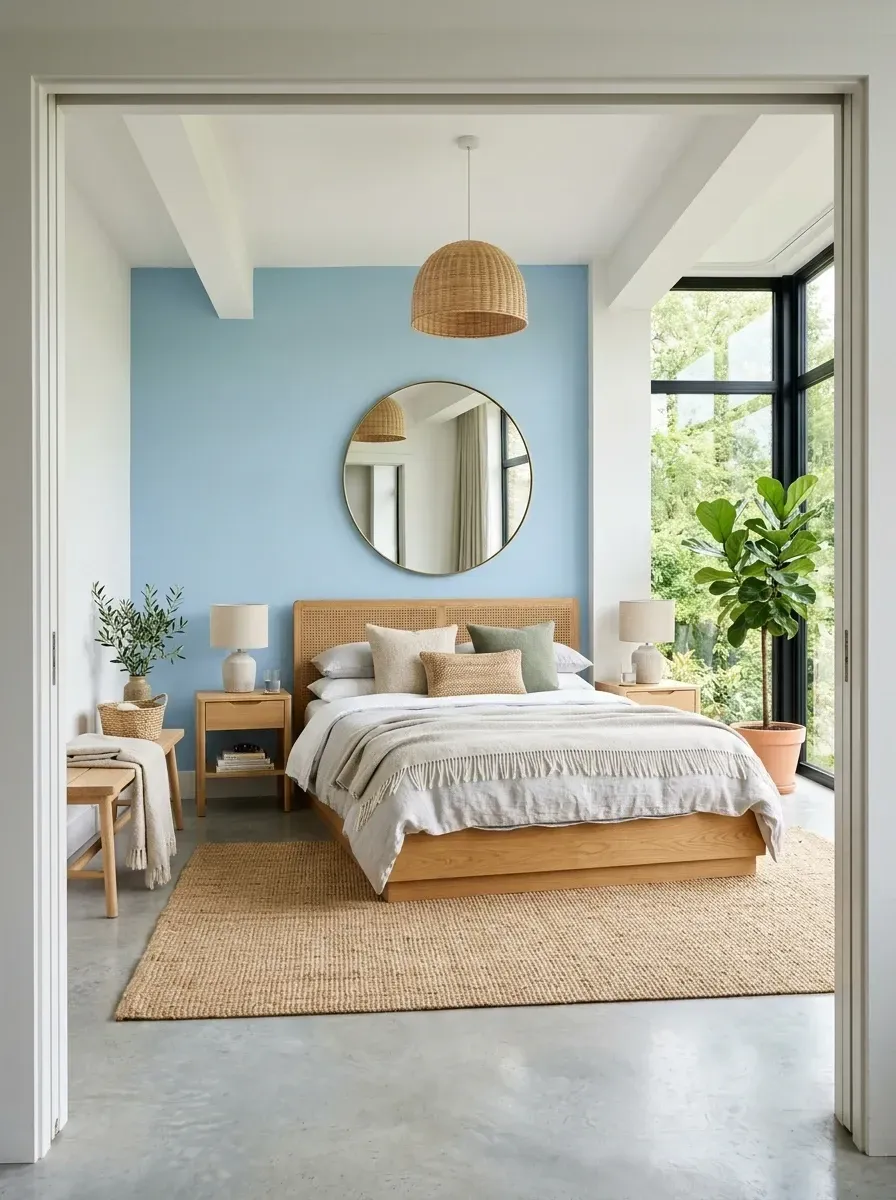
A clear cool-warm balance: the sky-blue accent wall reads "air," the cane-and-oak bed and the jute rug read "earth," and the room sleeps both. The strategic move here is the oversized round mirror placed opposite the window — it bounces natural light deeper into the room and reflects the outdoor green back, doubling the perceived nature exposure. Polished concrete underfoot grounds the lighter elements above. This is the format I'd recommend for a Hudson Valley weekend rental or a south-facing primary bedroom in Brooklyn that already gets strong daylight.
Plan-aware verdict: cane bed frames are beautiful and do not love high humidity for years. In a Hudson Valley summer at 70%+ relative humidity for weeks at a time, raw cane will loosen and re-tension multiple times. Spec a cane bed with a sealed (lacquered) cane panel rather than raw, or accept the maintenance commitment. A round mirror opposite a window is the cheapest "more daylight" trick available — bigger is better; aim for 36"–48" diameter.
Features
- Sky blue accent wall
- Cane and oak bed frame (sealed cane recommended)
- Large round mirror (36"–48", opposite window)
- Woven rattan pendant light and jute area rug
- Floor-to-ceiling corner window with garden view
Cost Analysis (2026 Northeast)
| Decor Item (Qty) | Total Price Range |
|---|---|
| Paint for Accent Wall & Room | $100 – $200 |
| Queen Cane & Wood Bed Frame | $800 – $1,600 |
| Large Round Mirror (36"–48") | $200 – $400 |
| Woven Rattan Pendant Light | $150 – $300 |
| Large Jute Area Rug (8×10) | $300 – $600 |
| Wood Nightstands (×2) | $300 – $700 |
| Fiddle Leaf Fig in Terracotta Pot | $100 – $200 |
| Total Estimated Cost | $2,150 – $4,000 |
Color Palette
Sky Blue
#A7C5D9
Farrow & Ball Borrowed Light (No. 235) or Benjamin Moore Beach Glass (1564) — calm, clean, sleep-friendly.
Natural Cane & Oak
#D9B98B
Sealed cane panels on solid oak frame — Anthropologie's Daybed Range, McGee & Co., or local Hudson Valley craftspeople.
Polished Concrete
#B0B0B0
Diamond-polished concrete in medium grey aggregate — sealed with a penetrating densifier rather than topical coating.
Natural Jute / Rattan
#CCB187
Hand-woven jute or sisal — Annie Selke, Dash & Albert, or West Elm's natural-fiber line.
6. The Moody Natural Sanctuary
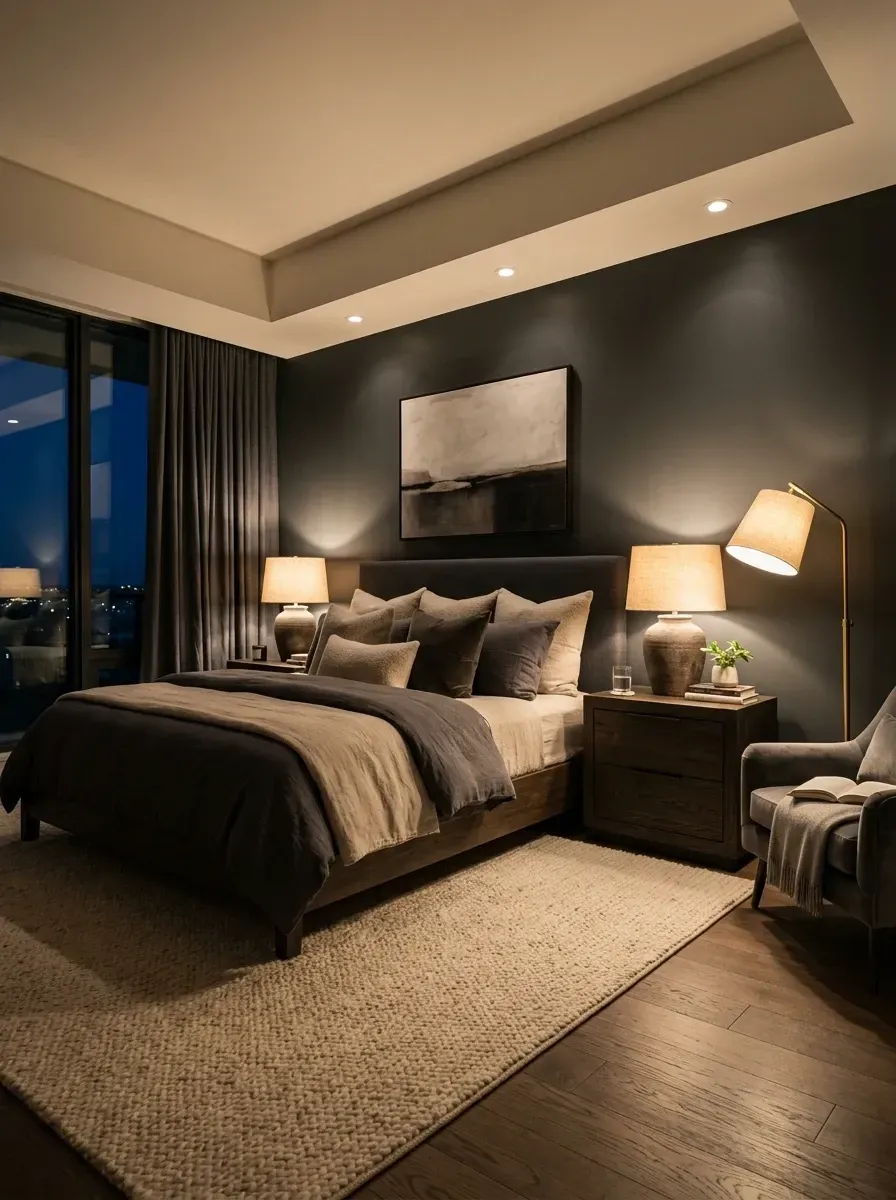
Biophilic doesn't have to mean bright. This room flips the brief — a deeply moody, cocoon-like space that mimics the sheltered safety of a sleeping nook in the natural world. Charcoal walls and ceiling tray, integrated warm cove lighting at the perimeter, sculptural ceramic table lamps, and a chunky wool rug. The lighting plan is the entire design here: no overhead fixture, no harsh task light, just multiple layers of 2700K warm sources that create pockets of cozy. The dark room can carry serious sleep performance for clients whose circadian rhythms benefit from full darkness on demand. The network's read on the psychology of space covers why dark, enveloping rooms calm a body that bright open ones cannot.
Plan-aware verdict: cove lighting is a framing-stage decision. The cove channel needs to be built into the ceiling tray detail by the carpenter, with concealed LED tape on a 0–10V or DALI dimmer that drops to 1% for sleep. Add it after the fact and it never looks intentional. Dark rooms also magnify any drywall imperfection — invest in a Level 5 finish on the walls, not the standard Level 4, before painting in charcoal.
Features
- Dark charcoal walls and ceiling tray (Level 5 drywall finish)
- Integrated warm 2700K cove lighting on dimmer
- Upholstered panel headboard bed
- Chunky woven wool rug
- Sculptural ceramic table lamps (matched pair)
Cost Analysis (2026 Northeast)
| Decor Item (Qty) | Total Price Range |
|---|---|
| Paint & Ceiling Tray Modification | $1,500 – $3,000 |
| LED Cove Lighting Installation | $500 – $1,000 |
| Upholstered Queen Bed | $800 – $1,800 |
| Chunky Wool Area Rug (8×10) | $600 – $1,200 |
| Dark Wood Nightstands (×2) | $400 – $900 |
| Sculptural Table Lamps (×2) | $300 – $700 |
| Velvet Accent Chair | $300 – $600 |
| Total Estimated Cost | $4,400 – $9,200 |
Color Palette
Charcoal Black
#2A2A2A
Benjamin Moore Onyx (2133-10) or Farrow & Ball Off-Black (No. 57) — deep enough to read as enveloping, not flat.
Warm Oatmeal / Beige
#D1C8B4
Hand-loomed New Zealand wool in oatmeal; linen bedding from Cultiver or Coyuchi in Pebble.
Dark Walnut
#4A3B2A
American black walnut nightstands with hardwax oil — Article, Joybird, or local Hudson Valley makers.
Slate Grey Velvet
#60656B
Mohair or performance velvet — Kravet or Romo fabric on a clean-lined slipper chair frame.
7. Architectural Canopy & Greenery
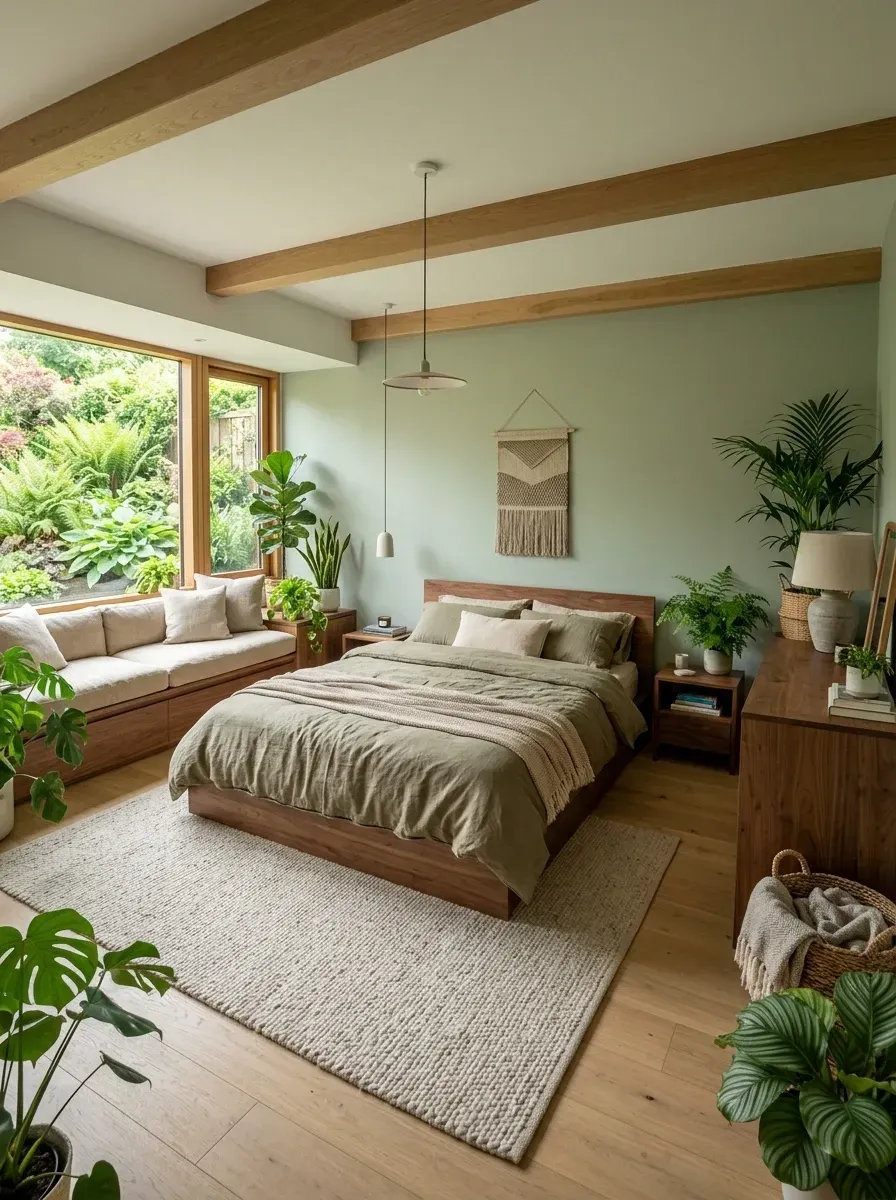
Architecture as canopy. The exposed wood beams overhead deliver the same sheltered-under-tree-branches signal a forest canopy does — a primal calming cue that actual ceiling drywall cannot. Soft sage green walls reinforce the foliage palette; the built-in window seat creates another transitional zone between the bed and the garden. Plants layered at three or four heights — floor pots, plant stands, dresser top, hanging — create a true indoor garden feel without committing to a $15K plumbed living wall. This is one of the most accessible biophilic formats on the list, and the easiest to layer in over a Hudson Valley weekend. The network's design-mindset essay on the unconscious canvas covers why these architectural cues work below conscious awareness.
Plan-aware verdict: real structural beams are an architectural decision; faux beams are a finish decision. Lightweight faux beams (Volterra, Custom Timber, Country Woodcraft) install in a day, run $40–$70 per linear foot, and read indistinguishable from real beams in everything except a structural inspector's eye. They're the right answer for any client who wants the look without an actual structural opening. Macrame wall hangings should use undyed natural cotton or jute rope — synthetic macrame fades, sheds, and reads off-key against real wood and plants.
Features
- Exposed (or faux) wood ceiling beams
- Soft sage green painted walls
- Built-in wood window seat with cushion
- Low platform bed
- Layered potted plants (8–12 plants at varying heights)
- Natural-fiber macrame wall hanging
Cost Analysis (2026 Northeast)
| Decor Item (Qty) | Total Price Range |
|---|---|
| Faux Wood Beam Installation (Material & Labor) | $1,500 – $3,000 |
| Paint for Room | $150 – $300 |
| Built-In Window Seat (Millwork & Cushions) | $1,200 – $2,500 |
| Wood Platform Bed | $600 – $1,200 |
| Wood Dresser | $500 – $1,000 |
| Assorted Potted Plants & Planters (×8+) | $300 – $600 |
| Textured Area Rug (8×10) | $300 – $700 |
| Total Estimated Cost | $4,550 – $9,300 |
Color Palette
Soft Sage Green
#9CAF88
Farrow & Ball Mizzle (No. 266) or Benjamin Moore Saybrook Sage (HC-114) — desaturated enough to read calm rather than decorative.
Medium Oak
#B38B59
Stained medium oak with a matte hardwax oil — Volterra faux beams or local Hudson Valley reclaimed timber.
Creamy Beige
#EBE5D5
Hand-loomed wool or cotton-and-jute blend — Annie Selke, Loloi, or Ben Soleimani.
Foliage Green
#3F603B
Layered greens from pothos, snake plants, peace lilies, ZZ plants, and Boston fern — humidity-tolerant Northeast bedroom survivors.
8. Texture-on-Texture Neutrality
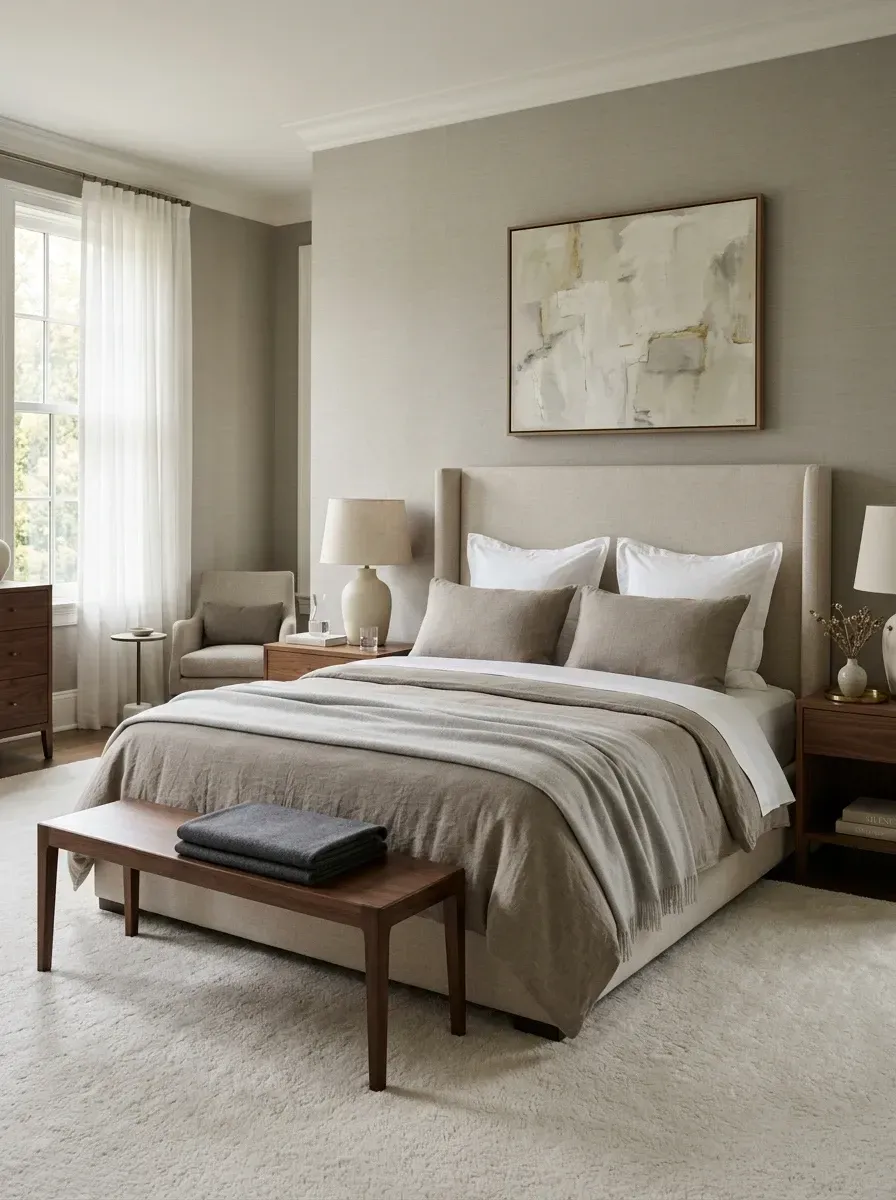
Sometimes the connection to nature comes from texture, not color. This room is a tactile-neutral study: greige grasscloth wallpaper that reads as woven fiber rather than printed pattern, an upholstered linen headboard, a walnut bench, layered linen bedding, a plush wool area rug. Every surface invites touch. By committing to a single greige-and-sand palette, the room foregrounds material differences instead of color contrast — and that's the move that delivers the calm-bedroom brief without going to bold-color territory. This is the format I recommend most often to clients with sleep sensitivity who find color stimulating.
Plan-aware verdict: grasscloth wallpaper (Phillip Jeffries, Schumacher, Innovations) is genuinely beautiful and not appropriate for a bedroom shared with a cat or a teenager who doesn't take shoes off — the natural-fiber surface scratches, dents, and stains permanently. Spec it where the surface won't be touched daily. For a more durable alternative with similar visual depth, faux grasscloth or paperweave from the same brands gets 80% of the read at half the maintenance fragility.
Features
- Greige grasscloth wallpaper (real or faux)
- Tall upholstered linen headboard (queen or king)
- Walnut bench at foot of bed
- Layered neutral linen bedding with wool throws
- Plush high-pile wool area rug
Cost Analysis (2026 Northeast)
| Decor Item (Qty) | Total Price Range |
|---|---|
| Grasscloth Wallpaper & Installation | $1,000 – $2,000 |
| Upholstered Linen Bed | $1,000 – $2,200 |
| Walnut Bench | $400 – $900 |
| Walnut Nightstands (×2) | $600 – $1,400 |
| Plush Wool / Blend Area Rug (9×12) | $800 – $1,800 |
| Premium Linen Bedding & Throws | $500 – $1,000 |
| Large Ceramic Lamps (×2) | $300 – $700 |
| Total Estimated Cost | $4,600 – $10,000 |
Color Palette
Greige Grasscloth
#BDB6A6
Phillip Jeffries Manila Hemp or Schumacher Sea Grass Cloth — natural sisal or hemp fiber on a paper backing.
Sand Linen
#D4CFC2
Belgian linen upholstery (Pure Linen or Designtex) on a shaped headboard frame — natural fiber, ages well.
American Walnut
#5C4033
FSC-certified American black walnut with hardwax oil — Sabai, Article, or local Hudson Valley craftspeople.
Off-White / Ivory
#F5F5F0
Hand-tufted New Zealand wool rug, cotton percale or linen bedding from Boll & Branch or Parachute.
Pro Tips From the Renovation Designer's Chair
- Lighting temperature is the make-or-break. Spec 2700K warm white throughout the bedroom — every fixture, every bulb. Cool 4000K bulbs disrupt circadian rhythm and make biophilic textures look flat and clinical. Put every layer (overhead, sconces, lamps, cove) on its own dimmer so the room can step from grooming-bright to sleep-dim across the evening.
- Real materials beat their substitutes for sleep performance. Solid wood breathes; MDF off-gasses. Wool regulates temperature; polyester fights it. Linen and cotton wick humidity; synthetic blends trap it. The biophilic argument isn't aesthetic — it's a building-science argument about what actually changes the air and the sound and the touch around a sleeping body. When budget forces a tradeoff, prioritize real materials on the surfaces you actually touch (bedding, headboard, rug) over the surfaces you only see (walls, ceiling).
- Multi-sensory beats single-channel. Biophilic isn't only visual. Add a small water feature for sound, lavender or cedar for scent, and natural-fiber textiles for touch. Three sensory channels engaged is the difference between "looks like a sanctuary" and "feels like a sanctuary" — and the latter is what actually rests you.
- Match the plant to the actual light. The single biggest plant failure I see is fiddle leaf figs in north-facing Northeast bedrooms. Match plant species to your room's real light reading, not its catalog vibe. Pothos, snake plant, ZZ plant, peace lily, and Cast Iron Plant survive low light and humidity drift; fiddle leaf, Bird of Paradise, and Olive tree need bright indirect minimum.
- Plan structural moves at framing. Window seats, wood plank walls, cove lighting, faux beams, and floating nightstands are all framing-stage decisions. Decide them before drywall closes. Retrofitting any of them later costs 2–3× and never reads as clean.
- Invest in the bed before the room. The single highest-ROI bedroom upgrade is the mattress and bedding, not the wallpaper or the rug. A $2,500 organic wool-and-latex mattress (Avocado, Naturepedic, Saatva Latex Hybrid) on a mid-grade frame outperforms a $1,000 polyfoam mattress in a $20,000 designer bedroom. Spend where the body actually contacts the room.
Cost-Saving Moves That Don't Read as Cuts
- Propagate, don't buy. Buy one good pothos or one snake plant and learn to propagate cuttings. A single mother plant can populate three or four pots over a year — free, and the plants are genuinely yours.
- Paint as wood. If wood paneling or beams are out of budget, deep earthy paint colors (sage, terracotta, warm beige) read grounding without the millwork. Farrow & Ball Card Room Green or Benjamin Moore Sherwood Green deliver more biophilic feel than entry-level wood veneer.
- Faux beams over real beams. Lightweight polyurethane faux beams (Volterra, Country Woodcraft) install in a day at $40–$70 per linear foot. Real reclaimed timber beams run $200–$500 per linear foot installed. The faux read indistinguishable from 8 feet away.
- Thrift the texture. Vintage solid-wood furniture, hand-made baskets, and ceramic lamps from estate sales and Hudson Valley antique markets typically have more material honesty than anything new under $500. The patina and weight read more biophilic than mass-market new.
- Preserved moss panels over living walls. $40–$80/sq ft installed instead of $100–$200, with zero monthly maintenance — the same biophilic visual at a fraction of the cost and commitment.
The Core Idea. A biophilic bedroom is a sleep-hygiene argument made in materials, not a styling category. The body sleeps better in rooms with breathing surfaces, varied tactile load, sensory anchors, and warm dim lighting — not because of any single move, but because the cumulative material honesty signals "outside" to a primal part of the brain that drywall and polyester cannot. Get the lighting plan, the material breath, the tactile range, and the sensory anchors right, and the room rests you. Skip any of them and the room photographs well and disappoints in person.
Reader Questions on Biophilic Bedrooms
What actually defines a "biophilic" bedroom beyond just adding plants?
Biophilic design connects to nature through multiple sensory channels — sight, touch, sound, scent — not just visual greenery. In a bedroom that means real natural materials (solid wood, wool, linen, lime plaster), abundant natural daylight or warm circadian-mimicking artificial light, organic shapes and patterns, and where possible actual living plants. The defining test is whether the surfaces around the bed engage the body the way an outdoor space does. A room with twenty plants and synthetic everything is still not biophilic; a room with one fiddle leaf fig, real wool bedding, oak floors, and lime-washed walls reads biophilic immediately.
Do I need a lot of natural light to make a biophilic bedroom work?
No, but you do need a thoughtful artificial-light plan. Low-light bedrooms can still be deeply biophilic if you specify warm 2700K LED lighting on dimmers across multiple layers (overhead, bedside, sconces, accent), and pick low-light-tolerant plants (snake plant, ZZ plant, pothos, peace lily, Cast Iron Plant). Cove lighting and warm-glow Edison bulbs deliver the late-evening "campfire light" register that the body associates with rest. Skip the cool 4000K bulbs entirely — they fight the biophilic intent and disrupt sleep.
Is biophilic design always expensive?
No. The most expensive moves (wood-clad walls, structural beams, large windows, plumbed living walls) are not required. A meaningful biophilic transformation can be done at $1,500–$3,000 with paint, real linen bedding, a wool rug, three to five thoughtfully chosen potted plants, and a single piece of preserved moss art. The expensive renovations buy faster and more dramatic transformations, but the styling-only path delivers most of the sleep-quality benefit at a fraction of the cost.
What are the best plants for a Northeast bedroom?
Pick for actual room conditions, not catalog photos. Reliable Northeast bedroom plants: snake plant (Sansevieria) for low light and dry tolerance; pothos for low light and humidity tolerance; ZZ plant (Zamioculcas) for the lowest-light corners; peace lily for medium-light spaces with seasonal humidity drift; Boston fern for higher-humidity bedrooms attached to baths; Bird of Paradise or Rubber Plant as the large statement piece in a south- or east-facing room. Avoid fiddle leaf figs in any north-facing room — they sulk dramatically and die quietly.
What's the highest-impact single biophilic move I can make this weekend?
Replace your bedding with real linen or organic cotton percale. The tactile difference of real natural fiber against the body for eight hours a night outperforms any single visual change in the room. Coyuchi, Boll & Branch, Parachute, Cultiver, and MagicLinen all deliver — the cheap end of real linen is roughly $200 for a queen sheet set and worth every dollar. Pair that with a single 5-foot-tall plant and one warm 2700K bedside lamp on a dimmer, and you've made the three highest-leverage biophilic moves available without any contractor involvement.
Will biophilic features actually improve my sleep quality?
The peer-reviewed research from Terrapin Bright Green's 14 Patterns of Biophilic Design and from sleep environment studies suggests yes — natural materials, organic geometries, and circadian-aligned lighting do measurably reduce stress hormones, lower resting heart rate, and improve sleep onset latency. The effect size varies by individual and by how comprehensively the design is executed, but the direction is consistent. Don't expect a single new houseplant to fix insomnia, but expect a fully biophilic bedroom (light + material + tactile + sensory) to deliver a real night-over-night sleep improvement that most clients notice within two to three weeks.
Where to Read Next
If this guide was useful, the natural next reads across the network sit in two directions. For more bedroom-specific design and material walk-throughs, the bedrooms and kids' rooms archive covers cross-format comparisons. For the broader plan-first thinking that underpins material-honest design, the essay on the unconscious canvas is a good companion piece. And for the psychology of how rooms shape daily living, the unseen architect covers the same ground at a higher altitude.
Sources & Further Reading
- Terrapin Bright Green. 14 Patterns of Biophilic Design. terrapinbrightgreen.com
- Architectural Digest. The Ultimate Guide to Biophilic Design. architecturaldigest.com
- National Sleep Foundation. Sleep Environment and Sleep Quality Recommendations. thensf.org
- American Society of Interior Designers (ASID). Biophilic Design and Wellbeing in Residential Spaces.
- U.S. Department of Energy. Lighting Color Temperature and Circadian Rhythm Guidelines.
- Energy Star. Residential Window and Glazing Performance Specifications. energystar.gov
- Forest Stewardship Council (FSC). Certified Wood Source Standards for Interior Applications.
- Coyuchi, Boll & Branch, Cultiver. Organic Linen and Cotton Bedding Specifications.
- Garden On The Wall, Benetti Stone, Greenarea Italy. Preserved Moss Panel Specification Sheets.
- NAHB / Hanley Wood. 2025 Cost vs. Value Report — Bedroom and Primary Suite Renovation ROI. remodeling.hw.net

Nora Whitfield
Renovation Designer & Interiors Editor · Beacon, New YorkNine years of design-build renovation work across the Hudson Valley and the Northeast. Nora runs the Renovations, Room Guides and Renovation Mind desks — before-and-after studies, room-by-room design guides, and the long essays on why what we renovate matters.
More from Nora →
Reader notes