

A client in Cold Spring once told me her bedroom looked like a magazine but slept like a hotel lobby — beautiful and unsettling. We pulled the gallery wall, replaced the four nightstand objects with two, swapped polyester bedding for Belgian linen, and added drapery from ceiling to floor. Same furniture, same paint. The room finally became restful. Quiet luxury in a bedroom is not what you add; it's what you take away. Below: eight bedrooms across the budget spectrum, the actual 2026 Hudson Valley costs to build them, and the framing-stage decisions that make a sleeping space actually sleepable.
How I Read a Quiet Luxury Bedroom
When a Hudson Valley client hands me a bedroom they want turned into a sanctuary, I read four things before opening a finish board: the natural-light direction (east-light bedrooms wake easily; west-light bedrooms hold afternoon heat and need different drapery), the acoustic profile (hard floors and bare windows make every footstep land in the room — a bedroom that echoes never feels restful), the circulation footprint (the path from doorway to bed to bath has to be uninterrupted; walking around furniture every morning erodes the calm faster than any visual issue), and the touch surfaces (sheets, duvet, headboard upholstery, drawer pulls — anything your hand will meet in the dark). Get those four right and the room becomes a place you actually fall asleep in, regardless of finish budget.
After seven years running renovation design out of Beacon and Kingston, I've learned that bedrooms are the room where homeowners most often confuse luxury with abundance — more pillows, more art, more furniture, more pattern. The quiet luxury format reverses that instinct. The eight bedrooms below cover the full range, from a $3,000 paneled-wall format anyone can DIY up to a $12,700 wood-clad-ceiling primary with custom millwork. For the broader whole-home version of these principles, my quiet luxury interior design pillar covers the format applied across eight rooms.
Reading note. The numbering follows my client-walkthrough order — neutral palettes first, deeper colors second — not a ranking. Room #5 (terracotta) is not better than room #1 (paneled neutral); they're different briefs for different temperaments and different houses.1. The Power of Subtlety: Paneled Walls and Layered Linens
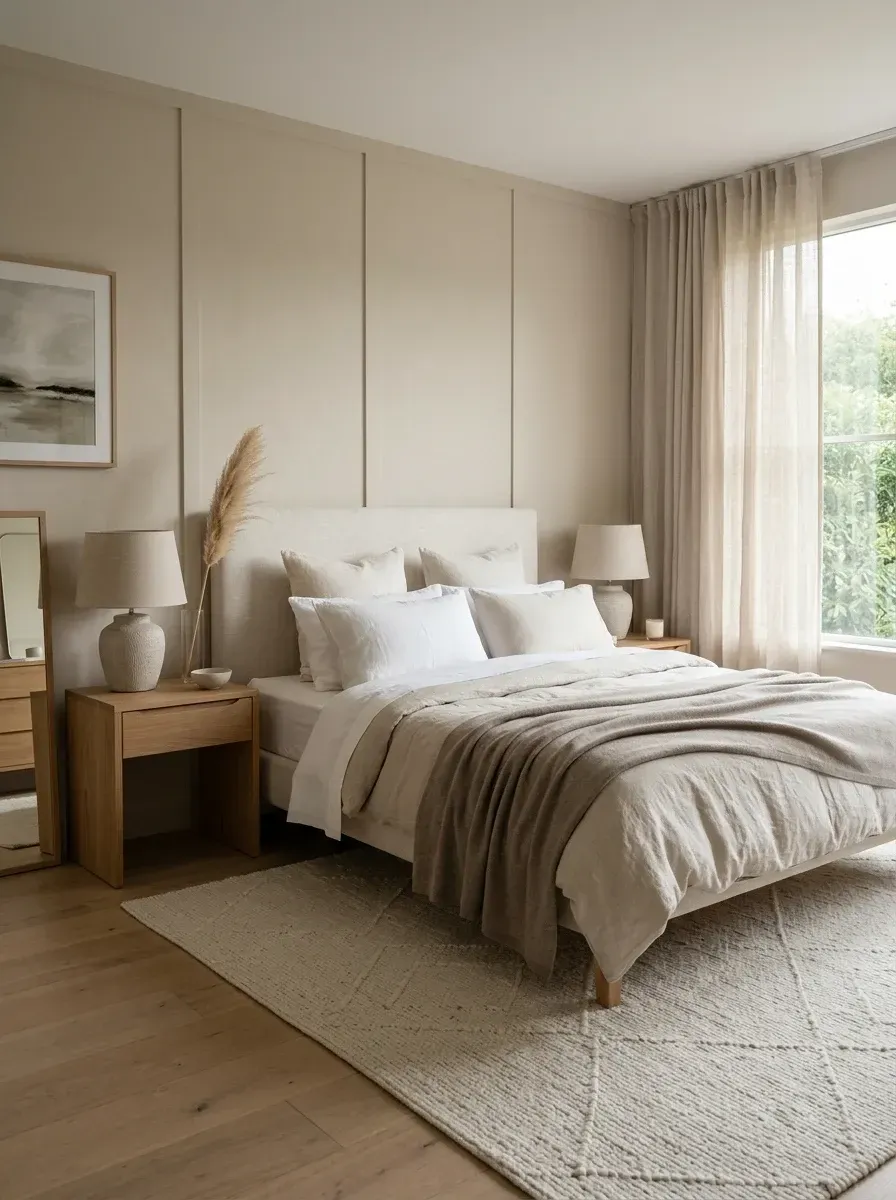
The architecture is doing the decoration. Picture-frame applied molding on the wall behind the bed gives the room historical weight without committing to a piece of art that will date faster than the wall. The bedding is the second move — three textile weights in the same warm-neutral family (crisp percale, washed Belgian linen, a heavier oatmeal throw) layered so the eye can read each tactile experience individually. The small-scale ceramic lamps and slim oak nightstands are deliberately quiet so nothing competes with the wall and the bed.
Plan-aware verdict: wall molding is one of the highest impact-per-dollar moves in a renovation playbook. Built up from primed MDF rails and stiles installed over drywall, then caulked and painted on-site, it runs $1,000–$2,500 in labor and material for a single accent wall in the Hudson Valley. The pre-fabricated wainscot kits from big-box stores look thin and sit proud of the wall — avoid them. For bedding, specify 100% Belgian flax linen in a stone-washed weave (Cultiver, Parachute, or Brooklinen's linen line) at $350–$700 for a full set; lighter cotton-linen blends pill within a year of weekly washing. The drapery in a bedroom should always be ceiling-mounted with floor-puddling fabric, never window-mounted with hem-hovering panels.
Features
- Picture-frame applied wall molding
- Three-weight layered Belgian linen bedding
- Minimalist white oak nightstands
- Textured ceramic table lamps
- Ceiling-mounted floor-to-ceiling sheer curtains
Cost Analysis (2026 Northeast)
| Decor Item (Qty) | Total Price Range |
|---|---|
| Upholstered Bed Frame (Queen) | $800 – $1,500 |
| Belgian Linen Bedding Set (Duvet, Sheets, Shams) | $350 – $700 |
| Textured Linen Throw Blanket | $100 – $250 |
| Minimalist Oak Nightstand (×2) | $500 – $1,200 |
| Ceramic Table Lamp (×2) | $200 – $500 |
| Large Textured Wool Area Rug (8×10) | $400 – $1,000 |
| Wall Paneling Materials & Labor | $1,000 – $2,500 |
| Floor-to-Ceiling Sheer Curtains & Hardware | $200 – $500 |
| Total Estimated Cost | $3,550 – $8,150 |
Color Palette
Soft Taupe
#D2CFC4
Benjamin Moore Revere Pewter (HC-172) or Farrow & Ball Drop Cloth (No. 283) — sits on the warm-grey/beige line and absorbs morning light without yellowing.
Creamy Off-White
#F0EFE7
Belgian flax linen in stone-washed cream — Cultiver, Parachute, or Brooklinen's linen line.
Light Oak
#C8B295
Rift-cut white oak with a hardwax oil finish (Rubio Monocoat Pure or Osmo Polyx-Oil) — flat sheen, no orange undertone.
Oatmeal Linen
#BFAFB2
Heavier 220-gsm Belgian linen throw — Brahms Mount or Hawkins New York for the hand-loomed weight.
2. Volume and Void: Balancing High Ceilings with Low Furniture
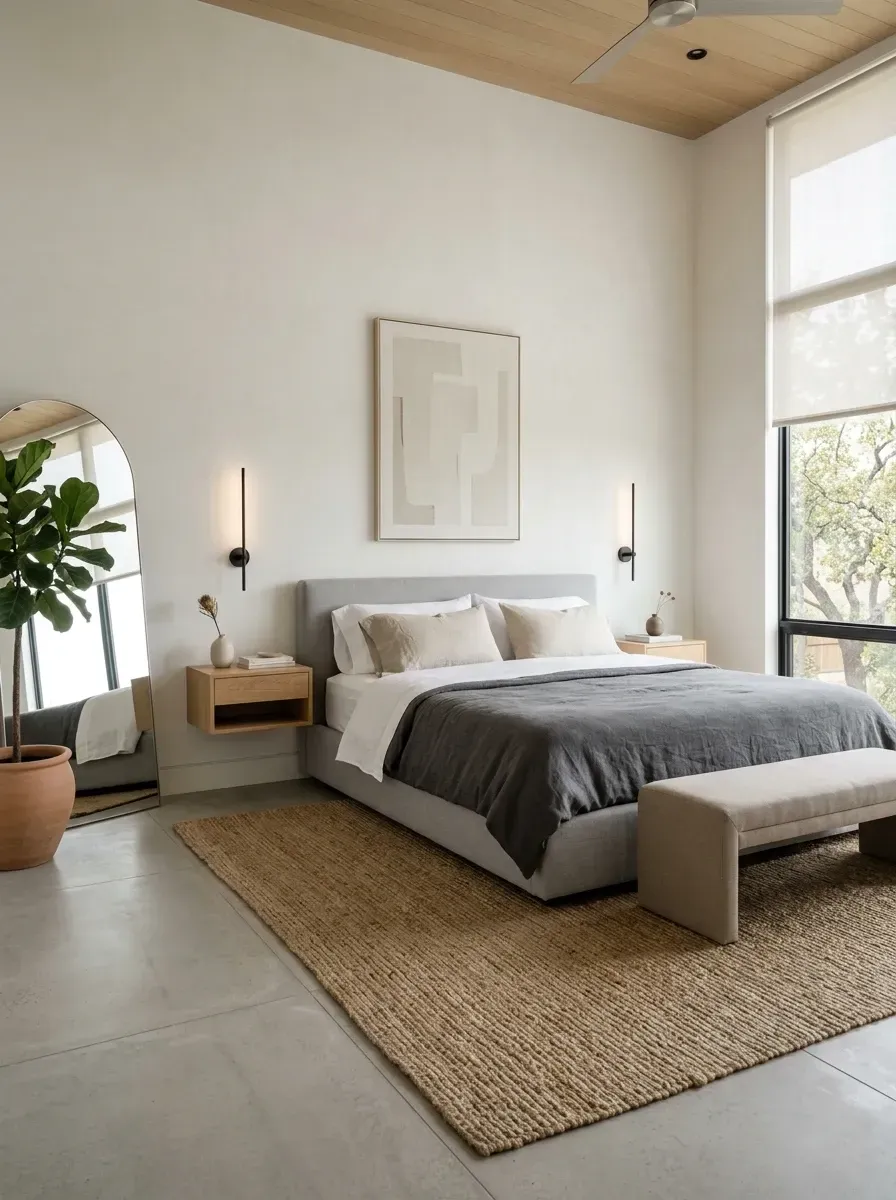
A volume problem solved with three moves. The ceiling is clad in warm honey-wood planks running parallel to the bed wall — that single material reads as a fifth wall and visually drops the ceiling height enough to make the room feel intimate. The bed is a low-profile platform with the headboard at 36 inches, not 60, which keeps the eye from being drawn upward into all that empty volume. The jute rug runs nine-by-twelve and defines the entire sleeping zone — without it, the polished concrete floor would make the room feel cavernous regardless of how warm the ceiling is.
Plan-aware verdict: ceiling cladding is a framing-stage decision. The strapping has to be installed during rough framing or as a furring layer over existing drywall, with adequate fastening into the joists. White oak or hemlock T&G plank in 5–7 inch widths runs $2,500–$5,000 in material plus labor for a typical 12×14 primary in the Hudson Valley. Polished concrete floors are only luxurious if the slab is genuinely flat (within 1/8 inch over 10 feet); on a renovation over a wood subfloor, a polished microcement overlay (BedrosianHaus, Diamond Concrete) is the better spec. Floating nightstands need stud-aligned French cleats and a 200-pound load rating; check that with the cabinet shop before they fabricate.
Features
- High ceilings clad in warm honey-wood planks
- Polished concrete or microcement floors
- Low-profile upholstered platform bed
- Floating wood nightstands on French cleats
- Large-scale arched floor mirror
Cost Analysis (2026 Northeast)
| Decor Item (Qty) | Total Price Range |
|---|---|
| Low-Profile Upholstered Bed (King) | $1,200 – $2,500 |
| Linen Bedding Set with Charcoal Duvet | $400 – $800 |
| Floating Wood Nightstand (×2) | $400 – $1,000 |
| Minimalist Brass Wall Sconce (×2) | $300 – $700 |
| Large Jute Area Rug (9×12) | $500 – $1,200 |
| Upholstered End-of-Bed Bench | $300 – $600 |
| Large Arched Floor Mirror | $400 – $900 |
| Wood Ceiling Cladding (Materials & Labor) | $2,500 – $5,000 |
| Total Estimated Cost | $6,000 – $12,700 |
Color Palette
Decorator's White
#F3F3F3
Benjamin Moore Decorator's White (CC-20) or Sherwin-Williams Pure White (SW 7005) — bright neutral that lets the wood ceiling read as the warm element.
Polished Concrete Grey
#AFAFAF
Polished concrete or a microcement overlay (BedrosianHaus or Diamond Concrete) — cool foundation that reflects the wood ceiling.
Warm Honey Wood
#D0A87C
White oak or hemlock T&G plank, hardwax oil finished — the warmth that counterbalances the concrete.
Charcoal Grey
#555555
A heavyweight charcoal duvet (Brahms Mount or Coyuchi) — the dark anchor at the room's center.
3. Artful Simplicity: A Focal Point in a Sea of Calm
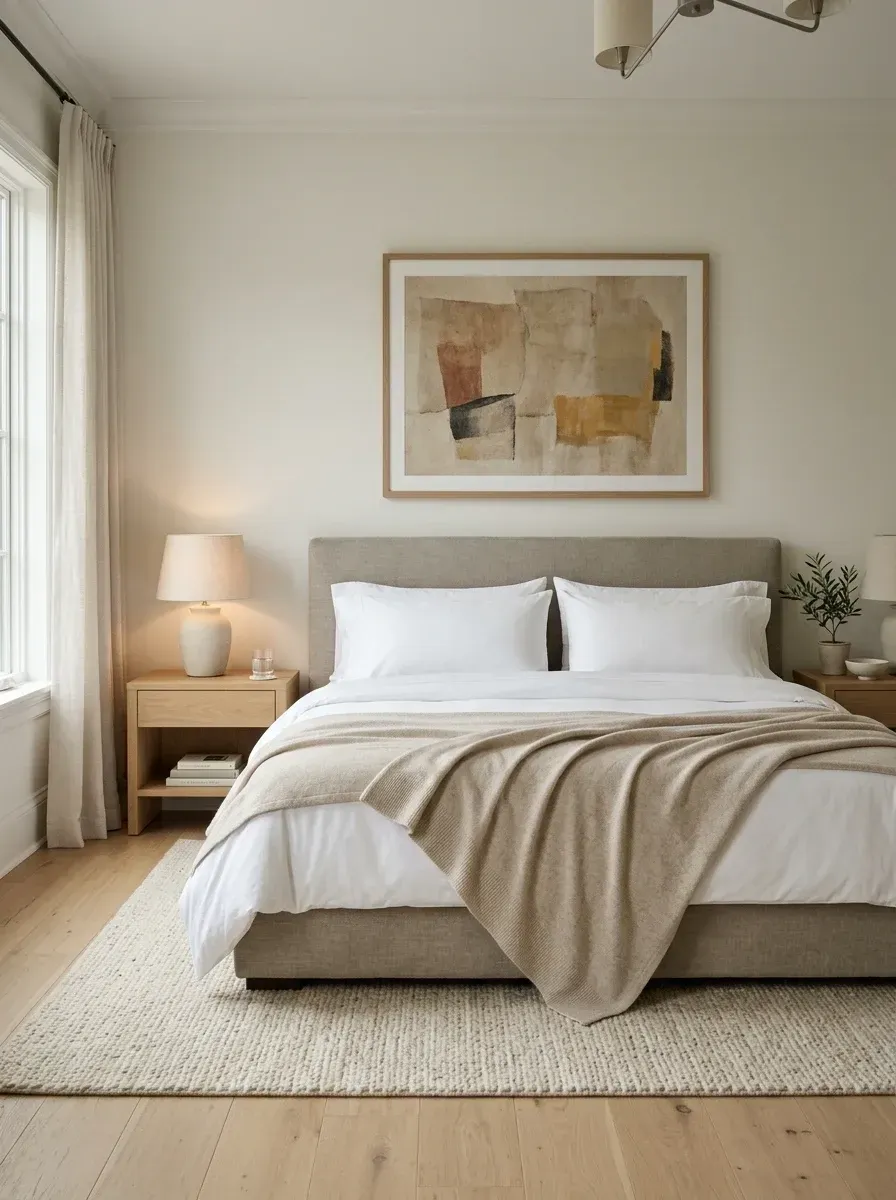
One piece of art does the entire decorative job here. The oversized abstract above the bed sets the warm-ochre and rust palette for everything else, which is exactly the point — every other tone in the room is borrowed from inside that frame. The supporting cast (linen headboard, percale sheets, cashmere-blend throw, oak nightstands) is intentionally restrained because the art is doing the talking. The cashmere-blend throw at the foot of the bed is the tactile reward that makes the room read luxurious from the moment you sit down.
Plan-aware verdict: a single statement piece scales correctly when it's roughly 60–70% of the bed-frame width — for a queen, that's a 40–48 inch wide frame. Smaller pieces float and look apologetic; larger pieces push past the headboard and create visual mismatch. For art at this scale, a custom giclée print on cotton rag from a regional fine-art printer ($300–$800 framed) reads as well as an original at this color palette. Cashmere-blend throws (5–10% cashmere with merino wool) from Brahms Mount, Hawkins New York, or Frette run $150–$400 and last a decade with hand-washing — pure cashmere is a $400–$900 splurge that pills faster than the blend.
Features
- Single large-scale abstract art print
- Upholstered linen bed frame
- Cashmere-blend throw at foot of bed
- Classic light oak nightstands
- Layered woven wool rug
Cost Analysis (2026 Northeast)
| Decor Item (Qty) | Total Price Range |
|---|---|
| Upholstered Linen Bed Frame (Queen) | $900 – $1,800 |
| White Percale Cotton Bedding Set | $200 – $500 |
| Cashmere / Wool Blend Throw Blanket | $150 – $400 |
| Classic Oak Nightstand (×2) | $600 – $1,400 |
| Ceramic Table Lamp (×2) | $200 – $500 |
| Large Framed Abstract Art Print | $300 – $800 |
| Woven Wool Area Rug (8×10) | $500 – $1,200 |
| Linen Curtains & Hardware | $150 – $400 |
| Total Estimated Cost | $3,000 – $7,000 |
Color Palette
Soft Greige
#E2DDD5
Benjamin Moore Edgecomb Gray (HC-173) or Sherwin-Williams Accessible Beige (SW 7036) — the workhorse warm neutral.
Light Oak
#C9B297
Rift-cut or quarter-sawn white oak with a Rubio Monocoat hardwax oil — timeless, never trendy.
Warm Ochre
#C5A373
An earthy ochre pulled from the artwork into the throw blanket — cohesion without matchy-matchy.
Crisp White & Cream
#F8F8F4
Percale cotton from Cultiver, Coyuchi, or Boll & Branch — crisp finish, ages soft.
4. Quiet Color: Soft Blues and Built-Ins for Tranquility
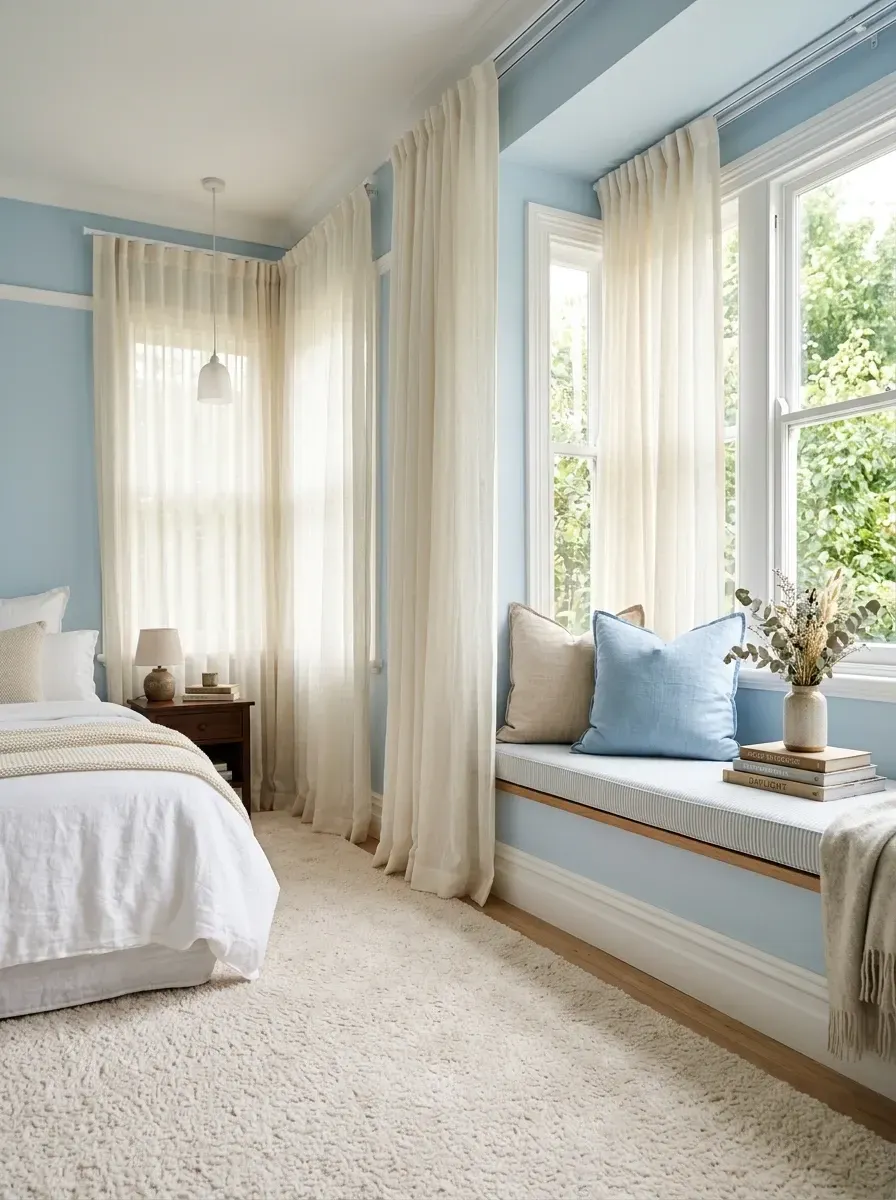
Color works in a quiet luxury bedroom only when it's properly desaturated. The wall here reads as a pale sky-blue but it's actually a heavily-grayed-out blue — closer to a warm grey with a blue cast than to anything you'd call "blue paint" in a swatch deck. The custom built-in window seat is the architectural move; it adds storage, eliminates the need for any other freestanding furniture in front of the window, and creates a reading nook that becomes the room's secondary focal point. The full-window-wall sheers are doing the heavy lifting on light diffusion.
Plan-aware verdict: a custom window seat with cushion runs $1,500–$3,500 in the Hudson Valley depending on whether the bench has integrated drawer storage or open cubbies — drawer storage doubles the cost and is worth it. Specify a 2-inch high-density foam cushion wrapped in a 100% Belgian linen cover with a separating zipper for cleaning. Wall-to-wall sheers on a ceiling-mounted Mecho or Forest Group track in 250% fullness run $500–$1,200 and transform the window into an architectural feature rather than a punched-opening. The high-pile wool carpet (50–60 oz weight, wool over a felt pad) is the splurge worth making in a bedroom — bare feet on cold mornings register the difference immediately.
Features
- Pale desaturated sky-blue walls
- Custom built-in window seat with storage
- Ceiling-mounted floor-to-ceiling sheers
- White Belgian linen bedding
- High-pile wool carpet on felt pad
Cost Analysis (2026 Northeast)
| Decor Item (Qty) | Total Price Range |
|---|---|
| Upholstered Bed Frame (Queen) | $700 – $1,500 |
| White Belgian Linen Bedding Set | $300 – $600 |
| Custom Built-In Window Seat & Cushion | $1,500 – $3,500 |
| Assorted Linen Bench Pillows | $150 – $350 |
| Floor-to-Ceiling Sheers (Multiple Panels) & Track | $500 – $1,200 |
| Small Wooden Nightstand | $200 – $500 |
| Pendant Light | $100 – $300 |
| High-Pile Wool Area Rug | $300 – $700 |
| Total Estimated Cost | $3,750 – $8,650 |
Color Palette
Pale Sky Blue
#C4D7E3
Farrow & Ball Borrowed Light (No. 235) or Benjamin Moore Quiet Moments (1563) — desaturated blue, reads neutral in afternoon light.
Soft White
#F9F9F9
Belgian flax linen sheers and percale-cotton bedding — Cultiver, Parachute, or Coyuchi.
Chambray Blue
#9FB6CD
A slightly deeper indigo-leaning blue in linen weave for tonal layering.
Sandy Beige
#DCD3C3
Warm-leaning sand neutral that grounds the cool blue palette without going cold.
5. Earthen Elegance: Terracotta Walls and Woven Textures
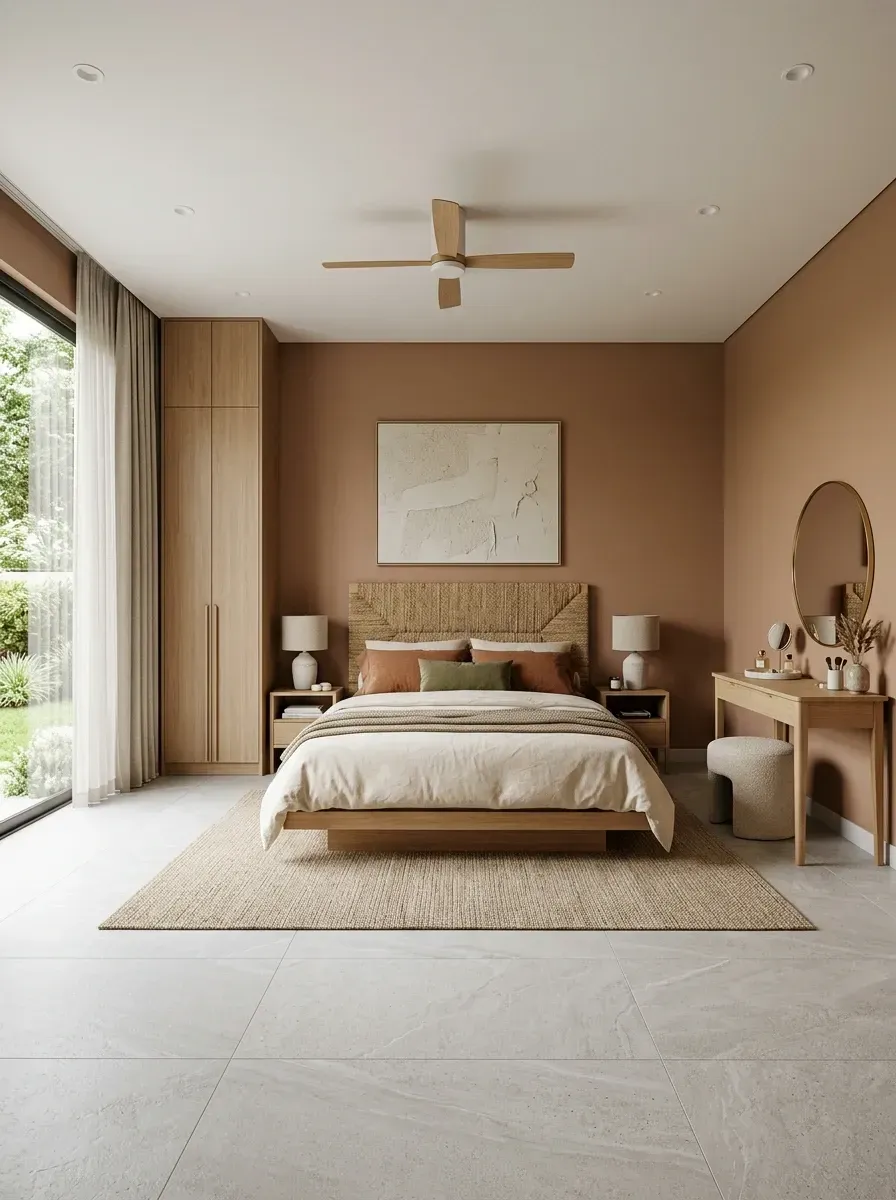
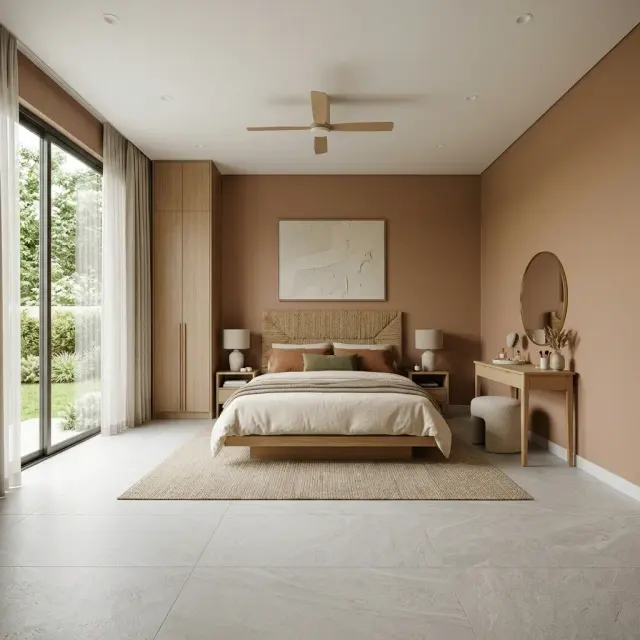
A warmer read of quiet luxury. The terracotta wall is a confident commitment but it's an earth-tone, not a saturated red — closer to an Italian fresco than to anything you'd call "orange." The woven seagrass headboard is the hero piece and the move that keeps the strong wall color from feeling overdone; the natural texture brings the conversation back to nature, and the jute rug echoes that texture on the floor plane. The dedicated vanity area is one of the most underrated quiet luxury moves in a bedroom — it pulls the morning routine off the nightstand and out of the bathroom counter, which keeps both surfaces clear.
Plan-aware verdict: terracotta wall paint is hard to specify because most "terracotta" swatches go orange in lamp light. The reliable specs are Farrow & Ball Red Earth (No. 64) and Benjamin Moore Audubon Russet (HC-51) — both have enough brown in them to stay earthy. For the headboard, a real seagrass weave from Hudson Valley shops or Serena & Lily runs $1,200–$2,500 and outlasts the rattan-veneer alternatives that fail at the seams within two years. The vanity stool in bouclé reads luxurious but specify a performance bouclé (Maharam or Pierre Frey Mimic) — decorative bouclé pills within months of daily use. For the rug, jute over a felt pad; jute on bare wood is rough on bare feet and slides.
Features
- Muted terracotta painted walls
- Oversized woven seagrass headboard
- Floating light oak bed frame
- Dedicated vanity table with round mirror
- Large jute area rug
Cost Analysis (2026 Northeast)
| Decor Item (Qty) | Total Price Range |
|---|---|
| Woven Seagrass Headboard & Bed Frame (Queen) | $1,200 – $2,500 |
| Linen & Cotton Bedding Set | $300 – $600 |
| Wood Nightstand (×2) | $600 – $1,400 |
| Ceramic Table Lamp (×2) | $250 – $600 |
| Large Jute Area Rug (9×12) | $500 – $1,200 |
| Wood Vanity Table | $400 – $1,000 |
| Round Vanity Mirror | $150 – $400 |
| Performance Bouclé Vanity Stool | $150 – $350 |
| Total Estimated Cost | $3,550 – $8,050 |
Color Palette
Muted Terracotta
#B07C63
Farrow & Ball Red Earth (No. 64) or Benjamin Moore Audubon Russet (HC-51) — earthy, not orange.
Natural Seagrass / Jute
#C9B790
Real woven seagrass from Serena & Lily or a Hudson Valley shop — never rattan veneer over MDF.
Light Oak
#CDAD85
White oak in a hardwax oil — light enough to read modern against the warm terracotta.
Creamy Beige
#E8E0D2
Linen-cotton blend in stone-washed cream — Coyuchi, Cultiver, or Boll & Branch.
6. Modern Romance: Plaster Walls and Sculptural Lighting
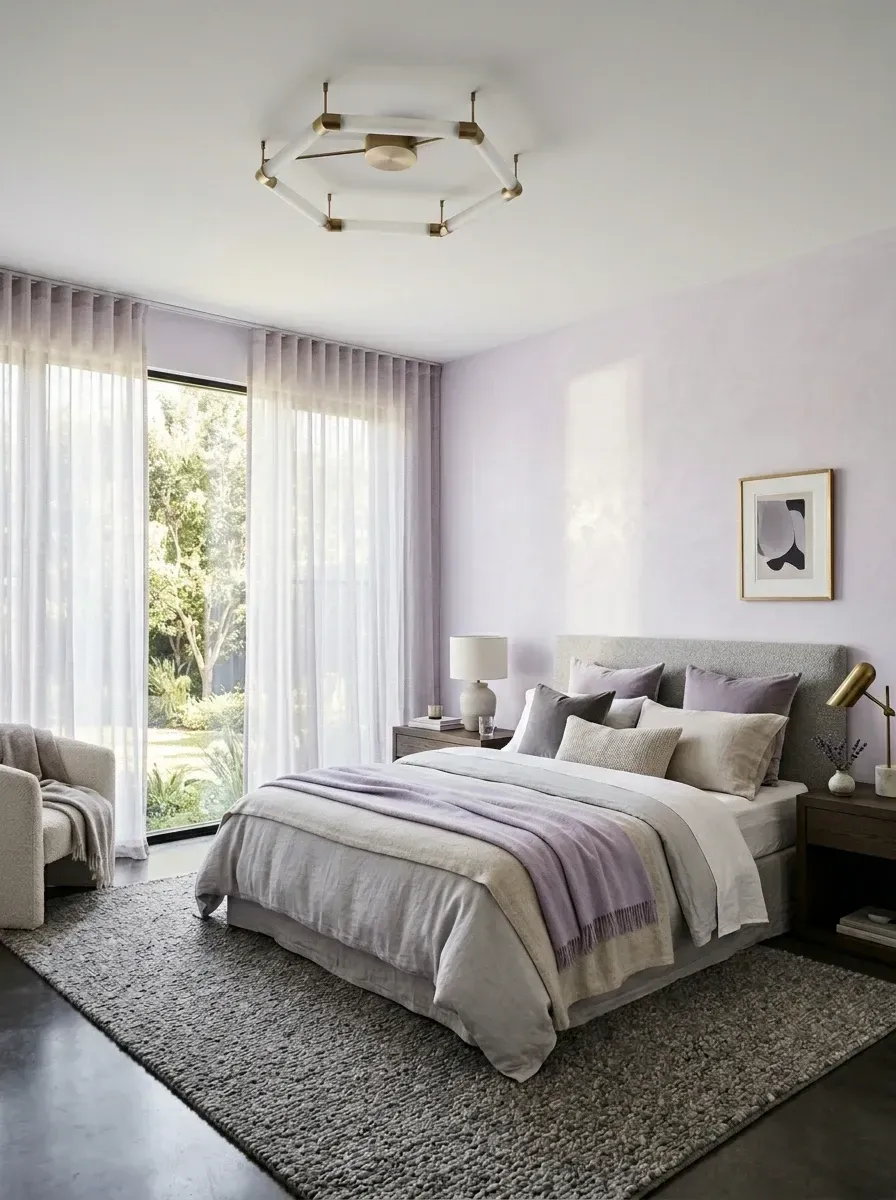
Quiet luxury with a romantic edge. The walls are not painted — they're hand-applied Roman clay or Venetian plaster in a barely-there lavender that reads more like a warm grey than a color. The plaster catches light in a way flat paint cannot, with subtle troweled movement that adds depth from across the room. The sculptural chandelier is treated as art rather than lighting; the seeded glass and matte brass form is the room's only piece of decoration. Layered bedding in linen and velvet pulls muted plum and grey from the wall finish into the textile zone.
Plan-aware verdict: Roman clay (Portola Paints, Bauwerk, Pure & Original) is the lower-cost cousin of true Venetian plaster — applied in two trowelled coats over a tinted primer at $4–$8 per square foot. Venetian plaster proper is $8–$15 per square foot and requires a different applicator skillset. In the Hudson Valley, finding a finisher who can actually do either means asking for references on three completed projects, because a wash-coat over latex sold as "plaster" is the most common bait-and-switch in regional finish work. For the chandelier, sculptural fixtures from Apparatus Studio, Allied Maker, or Lindsey Adelman run $600–$1,500 in scaled-down residential formats; the boutique-glass-blower lookalikes from CB2 or West Elm run $300–$600 and read identical at this scale.
Features
- Roman clay or Venetian plaster lavender walls
- Sculptural brass and seeded glass chandelier
- Upholstered grey bed
- Layered linen and velvet bedding in muted plum
- Performance-bouclé reading armchair
Cost Analysis (2026 Northeast)
| Decor Item (Qty) | Total Price Range |
|---|---|
| Upholstered Grey Bed Frame (Queen) | $900 – $1,800 |
| Mixed Linen / Velvet Bedding & Pillows | $400 – $800 |
| Modern Brass & Seeded Glass Chandelier | $600 – $1,500 |
| Dark Wood Nightstand | $300 – $700 |
| Brass Bedside Sconce | $150 – $400 |
| Textured Wool Area Rug (8×10) | $500 – $1,200 |
| Performance-Bouclé Armchair | $400 – $900 |
| Specialty Plaster Wall Finish (Materials & Labor) | $1,500 – $3,000 |
| Total Estimated Cost | $4,800 – $10,300 |
Color Palette
Pale Lavender Mist
#DFD6E5
Portola Paints Roman Clay in a tinted lavender, or Farrow & Ball Calluna (No. 270) — desaturated enough to read as warm grey.
Medium Grey
#959595
Medium-grey performance linen for the headboard, wool rug to match — the grounding plane.
Muted Plum
#8E748F
A deeper richness pulled from the wall plaster's pigment — never a clean purple, always a smoky one.
Satin Brass
#C6A872
Unlacquered satin brass from Visual Comfort or Allied Maker — patinas in over a decade.
7. Softened Geometries: The Round Rug as a Design Anchor
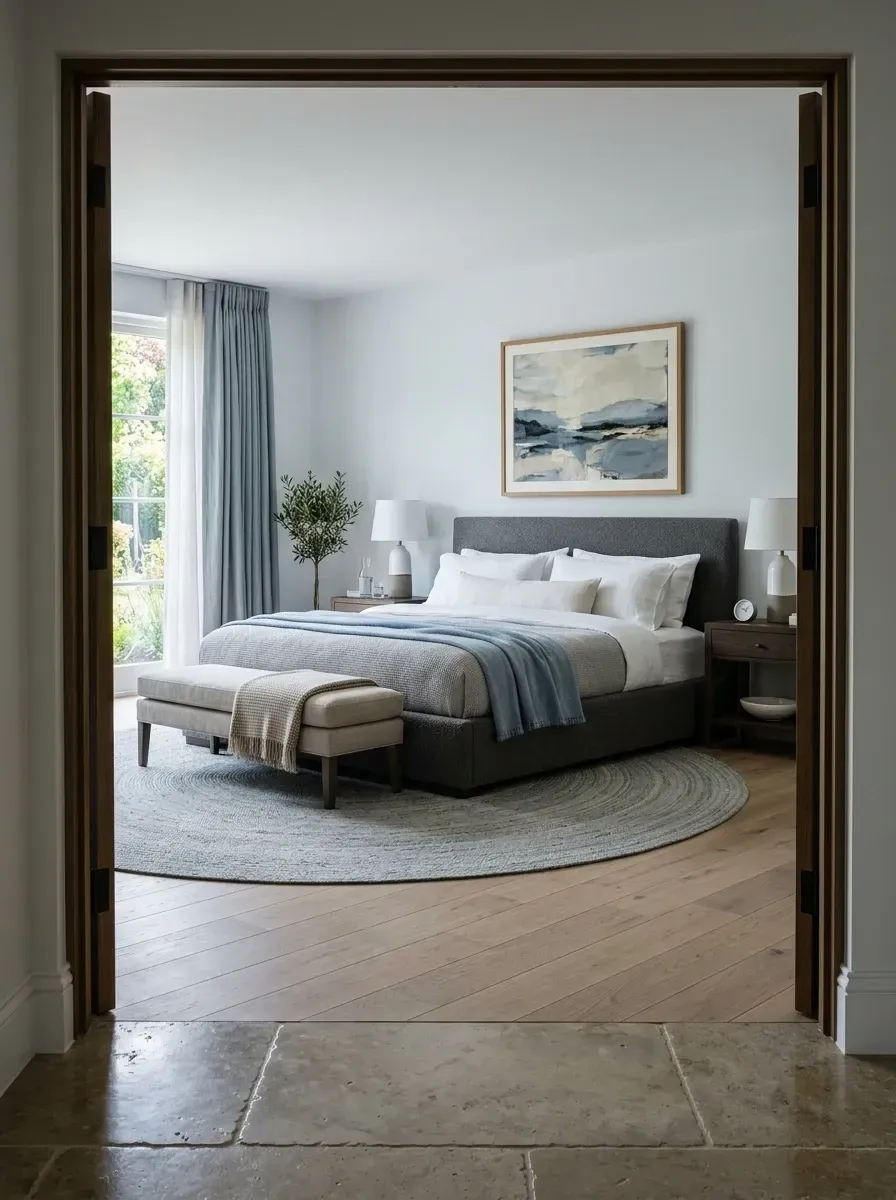
Shape is doing what color usually does. The room is full of right angles — bed, bench, nightstands, doorway frame — and the round braided rug is the single move that softens all of them. It's the same trick architects use when they round one corner of a hallway to break up a long sightline; the curve registers as restful before the eye does any conscious analysis. The faux olive tree in the corner is the necessary organic counterweight; without it, the cool grey-and-blue palette would read clinical instead of calm.
Plan-aware verdict: round wool rugs at 8–10 feet diameter run $400–$1,000 from Beni Rugs, Armadillo, or Hudson Valley weavers; specify a felt pad underneath because round rugs slide on hardwood worse than rectangular ones. Faux olive trees at the 6-foot-plus scale have crossed the realism threshold over the last two years; the high-end fauxes from Nearly Natural, Afloral, or Bloomscape run $250–$600 and stay alive in low-light corners that would kill a real Olea europaea. For the slate-blue accent textiles, specify a single weave family across the curtains and the throw — a cotton-linen blend in matched tones — never a polyester drapery paired with a wool throw, because the sheen mismatch reads instantly cheap.
Features
- Large round natural braided wool rug
- Upholstered charcoal grey bed and bench
- Slate blue linen drapery and matching throw
- Tall faux olive tree
- Wide-plank medium oak flooring
Cost Analysis (2026 Northeast)
| Decor Item (Qty) | Total Price Range |
|---|---|
| Upholstered Grey Bed Frame (King) | $1,000 – $2,200 |
| White Bedding with Slate Blue Throw | $300 – $600 |
| Upholstered End-of-Bed Bench | $300 – $700 |
| Dark Walnut Nightstand (×2) | $500 – $1,200 |
| Ceramic Table Lamp (×2) | $200 – $500 |
| Round Braided Wool Rug (8–10 ft. dia) | $400 – $1,000 |
| Slate Blue Linen Curtains & Hardware | $200 – $500 |
| Tall Faux Olive Tree & Planter | $250 – $600 |
| Total Estimated Cost | $3,150 – $7,300 |
Color Palette
Pale Blue-Grey
#D0D7DD
Benjamin Moore Misty (1535) or Farrow & Ball Skylight (No. 205) — recedes visually and reflects daylight without glare.
Charcoal Grey
#636363
Charcoal performance linen — Crypton or Sunbrella weave that handles eight years of daily contact.
Slate Blue
#7A8B99
A cotton-linen blend in slate, matched across drapery and throw — single weave family for visual cohesion.
Medium Oak
#B4936D
Wide-plank white oak with a smoked Rubio Monocoat finish — warm enough to anchor the cool palette.
8. Subtle Pattern: Wallpaper and Walnut for a Cozy Retreat
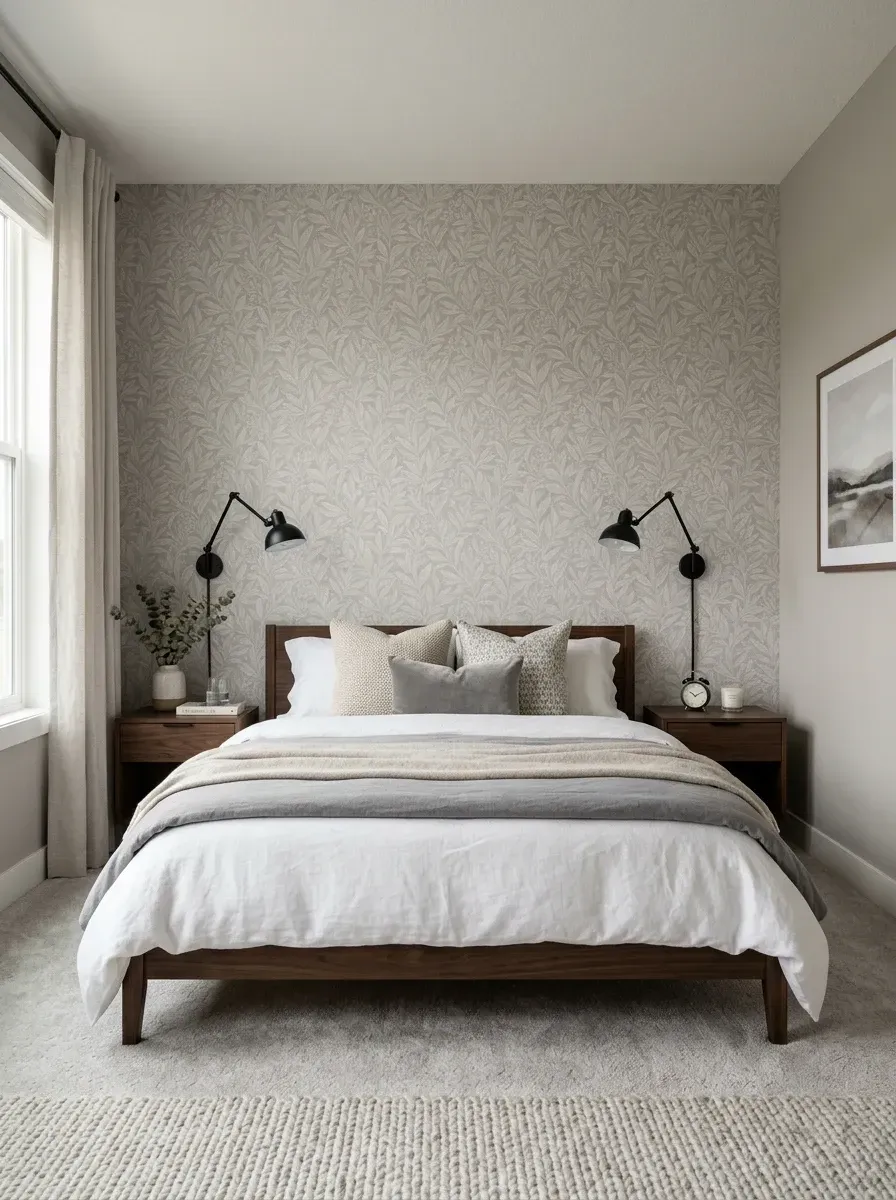
Wallpaper belongs in a quiet luxury bedroom only when it's properly disciplined. The pattern here is low-contrast tone-on-tone botanical — close enough to a single color that the eye reads it as a texture from across the room rather than as an image. The walnut bed and matching nightstands are the room's strongest move; mid-century walnut at this scale is an investment piece that ages in over decades. The matte black swing-arm sconces are the modern punctuation that keeps the otherwise traditional room from drifting period.
Plan-aware verdict: low-contrast wallpapers from Schumacher, Cole & Son, or Sandberg run $150–$300 per single roll; a typical Hudson Valley bedroom needs 4–6 rolls plus installation labor (figure $40–$60 per roll for installation). Avoid the high-saturation patterns that look great at the showroom and fight you in person every morning. American walnut bed frames from heritage makers (Stickley, Thos. Moser, Hudson Valley shops like Asher Israelow) run $1,200–$2,800 in queen and outlast three big-box veneer alternatives. The swing-arm sconces from Visual Comfort, Cedar & Moss, or Hinkley should be hard-wired to a switch at the doorway and a switch at the bedside — never plug-in cords running across the wall, which break the entire luxury read.
Features
- Low-contrast tone-on-tone botanical wallpaper
- Mid-century American walnut bed
- Matching walnut nightstands
- Hardwired matte black swing-arm wall sconces
- Chunky knit hand-loomed wool rug
Cost Analysis (2026 Northeast)
| Decor Item (Qty) | Total Price Range |
|---|---|
| American Walnut Bed Frame (Queen) | $1,200 – $2,800 |
| Linen & Cotton Bedding Set | $300 – $600 |
| Walnut Nightstand (×2) | $800 – $1,800 |
| Matte Black Swing-Arm Sconce (×2, hardwired) | $250 – $600 |
| Chunky Knit Wool Area Rug (8×10) | $500 – $1,200 |
| Wallpaper (Material & Install for One Wall) | $500 – $1,500 |
| Small Framed Botanical Print | $100 – $300 |
| Total Estimated Cost | $3,650 – $8,800 |
Color Palette
Grey & Beige Botanical
#C9C5BD
Schumacher Acanthus Stripe in stone, Cole & Son Hummingbirds in mineral, or a Sandberg low-contrast tone-on-tone print.
Rich Walnut
#6F4E37
Solid American walnut, plain-sawn, finished with a hand-rubbed oil — Stickley, Thos. Moser, or a Hudson Valley craftsman.
Warm White
#F2F0E6
Belgian linen and cotton in a stone-washed warm white — bridges the wallpaper and the walnut.
Matte Black
#222222
Powder-coated matte black on welded steel sconces — Visual Comfort or Cedar & Moss.
Pro Tips From the Renovation Designer's Chair
- Spend on touchpoints, save on display surfaces. The bedroom is the room with the highest touch-to-look ratio in the house — sheets, duvet, headboard upholstery, drawer pulls, the lamp switch you fumble for at 6am. Spec Belgian linen sheets, a real-down or down-alternative duvet, solid brass drawer pulls, and a substantial lamp switch your hand can find without a glance. The wall art and decorative objects matter much less than these touchpoints.
- Every light source on a dimmer. Bedrooms shift from morning daylight to evening reading to dim wind-down across a single day, and the lighting has to follow. Lutron Caséta dimmers ($60 a switch installed) on the overhead, sconces, and lamp circuits give you the ramp. The room without dimmers reads functional in the morning and harsh at 10pm — which is the time you most need it to feel calm.
- Edit the bedside surface ruthlessly. The nightstand should hold a lamp, a glass of water, and one book. Nothing else. Every additional object — the phone charger, the hand cream, the journal, the glasses, the second book, the candle — visibly erodes the sense of calm before you even look at it. Use a drawer for everything that's not actively in use tonight.
- Drapery is structural. Floor-to-ceiling, ceiling-mounted, with at least 250% fullness — these aren't decorative choices, they're acoustic and luminance-control choices. Curtains that float above the floor or sit at the window head break the entire luxury read. Fabric panels also absorb 15–25% of room reverberation, which is what makes the bedroom feel hushed.
- Pick three colors and one accent — never seven. Bedrooms that fail at quiet luxury usually fail because the palette has crept up to six or seven distinct tones over years of pillow purchases. Strip back to three core colors plus one accent borrowed from the art or the headboard, and the room re-resolves immediately.
- One organic element per room, minimum. A real or premium-faux olive tree, a Ficus lyrata, eucalyptus stems in a bedside vase, dried branches in a corner planter — every quiet luxury bedroom I've designed includes at least one piece of nature with a real silhouette. It's the move that keeps the room from reading like a hotel.
Cost-Saving Moves That Don't Read as Cuts
- DIY applied molding. Picture-frame molding from pre-cut MDF rails (Lowe's, Home Depot, or Roman Ogee from a local lumberyard) painted the same color as the wall costs $200–$400 in materials for a feature wall and a half-day of labor — versus $1,500–$2,500 for a contractor install. The visible difference at six feet is zero.
- Linen-cotton blend over pure linen. A 50/50 linen-cotton sheet set from Boll & Branch, Coyuchi, or Brooklinen runs $200–$350 versus $400–$700 for pure Belgian linen. The blend is softer initially, ages similarly, and the tactile read at a six-month mark is almost identical.
- Premium faux botanicals over real. A high-end faux Ficus lyrata or olive tree at the six-foot scale runs $250–$450 from Nearly Natural or Afloral, versus $400–$700 for a real plant that may or may not survive the bedroom's typical low light. The math favors faux for any spot away from a south or east window.
- Stone remnants for vanity tops. If a vanity table or floating shelf is part of the bedroom, a 24-inch slab of Calacatta or Statuario from a regional fabricator's remnant rack runs 30–50% under full-slab pricing. Visit the yard with your dimensions and let the available remnant pick your project.
The Core Idea. A quiet luxury bedroom is the result of subtraction, not accumulation. The lighting plan, the drapery height, the ruthless edit of the nightstand, and the one organic element matter more than the price of any single piece of furniture. Build the room with that discipline and a $3,000 paneled bedroom outsleeps a $30,000 cluttered one — every night, for a decade.
Reader Questions on the Quiet Luxury Bedroom
What is the quiet luxury approach in a bedroom?
Quiet luxury in a bedroom means high-quality natural materials, considered craftsmanship, and timeless detailing instead of branding or trend pieces. The hallmarks are restrained palettes (three or four colors plus one accent), heavy use of natural materials (linen, wool, oak, walnut, plaster), every light source on a dimmer, a ruthlessly edited nightstand, and ceiling-mounted floor-length drapery. The result is a sleeping space that doesn't announce itself but supports actual rest.
How can I make my bedroom look expensive on a budget?
Declutter aggressively (negative space reads as luxurious in a bedroom faster than in any other room), invest in one foundational piece — usually the bed or the bedding — and put every overhead light on a Lutron Caséta dimmer. Replace builder-grade hardware on closet doors and dressers with solid brass or matte-black pulls from Rejuvenation or Buster + Punch. Repaint the walls in a complex Farrow & Ball or Benjamin Moore Historical Collection color. The discipline costs nothing; the materials follow as the budget allows.
What are the best colors for a calming bedroom?
Warm neutrals (Benjamin Moore Edgecomb Gray HC-173, Sherwin-Williams Accessible Beige SW 7036, Farrow & Ball Slipper Satin No. 2004) are the workhorse specs. Desaturated nature-inspired tones — sage green, sky blue (Quiet Moments 1563), muted terracotta (Audubon Russet HC-51), Roman-clay lavender — work just as well for clients who don't respond to beige. The principle isn't which color but that it has depth — a complex pigment from a heritage paint line, not a flat builder-grade tint that reads cardboard at 8pm.
What is the difference between minimalism and quiet luxury in a bedroom?
Both reject visual clutter, but the goals are different. Minimalism reduces objects to the bare essentials and often leaves a stark, cool register. Quiet luxury keeps roughly the same number of objects but loads them with tactile richness — a layered linen-and-wool bedding stack, an oak headboard, a high-pile wool rug, plaster walls. A minimalist bedroom can feel hotel-like in the wrong way; a quiet luxury bedroom feels lived-in and warm. The difference is texture and material quality, not object count.
How much does a quiet luxury bedroom actually cost in 2026?
In the Northeast, expect a primary bedroom in this aesthetic to land between $3,000 and $13,000 depending on whether you're working with paint and furniture (rooms 1, 3, 7 — $3,000–$8,150) or full architectural intervention like ceiling cladding or built-ins (rooms 2, 4, 6 — $4,800–$12,700). The single biggest budget swing is custom millwork (built-in window seats, ceiling cladding, applied paneling) versus paint-and-furniture. Bedding, lighting, and accessories are the smallest line items but have the highest impact per dollar.
Should I use wallpaper or paint in a quiet luxury bedroom?
Either works, with discipline. Paint is the safer bet for first-time clients — a complex heritage-collection neutral or a desaturated color like Roman-clay lavender, terracotta Audubon Russet, or Quiet Moments blue. Wallpaper works only when the pattern is low-contrast tone-on-tone (Schumacher, Cole & Son, Sandberg in their muted lines) and reads as a texture from across the room rather than as a graphic. High-contrast or bold pattern wallpaper fights the eye every morning and breaks the calm. If in doubt, paint, and use the savings on better bedding.
Where to Read Next
If this guide helped, the natural follow-ups go in two directions. For the broader whole-home version of these principles, my quiet luxury interior design pillar covers eight rooms across hallways, living spaces, and entries. For the more nature-forward cousin to the terracotta and seagrass format in room 5, the biophilic bedroom guide goes deeper into natural-materials thinking. And if a workspace has to coexist with the sleeping zone, my quiet luxury home office guide covers eleven offices that share the same vocabulary.
Sources & Further Reading
- Architectural Digest. What Is Quiet Luxury? The Interior Design Trend, Explained. architecturaldigest.com
- The Spruce. Bedroom Lighting Ideas to Set the Right Mood. thespruce.com
- Elle Decor. The Best Linen Sheets, Tested and Reviewed. elledecor.com
- Remodelista. 10 Secrets for a Calm Home. remodelista.com
- Benjamin Moore. Color Trends and Historical Collection Specifications. benjaminmoore.com
- Farrow & Ball. Paint Color Encyclopedia & Specifications. farrow-ball.com
- Lutron Electronics. Caséta Wireless Lighting Control — Residential Specification Guide. lutron.com
- Cultiver. Belgian Flax Linen Bedding Care & Construction Guide. cultiver.com
- NAHB / Hanley Wood. 2025 Cost vs. Value Report — Bedroom Renovation ROI by Region. remodeling.hw.net
- This Old House. How to Install Picture-Frame Wall Molding: A Step-by-Step Guide. thisoldhouse.com

Nora Whitfield
Renovation Designer & Interiors Editor · Beacon, New YorkNine years of design-build renovation work across the Hudson Valley and the Northeast. Nora runs the Renovations, Room Guides and Renovation Mind desks — before-and-after studies, room-by-room design guides, and the long essays on why what we renovate matters.
More from Nora →
Reader notes