
A sustainable garden party works best when seating, shade, tableware and lighting can be reused at later gatherings. The ten setups below compare adaptable outdoor layouts, durable materials and illustrative 2026 Northeast planning ranges. The figures are planning estimates rather than bids, and each direction can be scaled to the site and guest count.
How to Assess a Garden Party Setup
Four checks guide the assessment of a garden party setup: the zone plan (how the lawn or patio breaks into 3–4 distinct activity rooms — beverage, dining, lounge, photo — and how guests circulate between them), the weather contingency (the actual percentage chance of a 4 PM thunderstorm in a Northeast July, and the canopy or pivot plan that doesn't ruin the day), the material durability under one outdoor day (which "indoor pieces brought outside" can handle dew, sun fade, and one accidental wine spill, and which can't), and the lighting layer plan (how the space transitions visually from 4 PM golden-hour to 9 PM lantern-and-string-lights as the evening matures). Get those four right and the party photographs beautifully and runs flawlessly. Skip any of them and you're hosting at the mercy of a single thunderstorm.
The ten setups below cover the full range — a $700 styling-only beverage station to an $11,000 connected multi-zone garden layout — with illustrative Northeast planning ranges and brand-level specs. For more in this lane, the site's outdoor renovations archive covers the structural side (pergolas, hardscape, lighting plans) in more depth than this article can cover.
The numbering moves from individual styled vignettes to fully connected garden layouts. Pick the entry point that matches your scope — a single considered beverage station can carry a small dinner party as completely as a $10K full-garden setup carries a wedding.
The considered Beverage Station
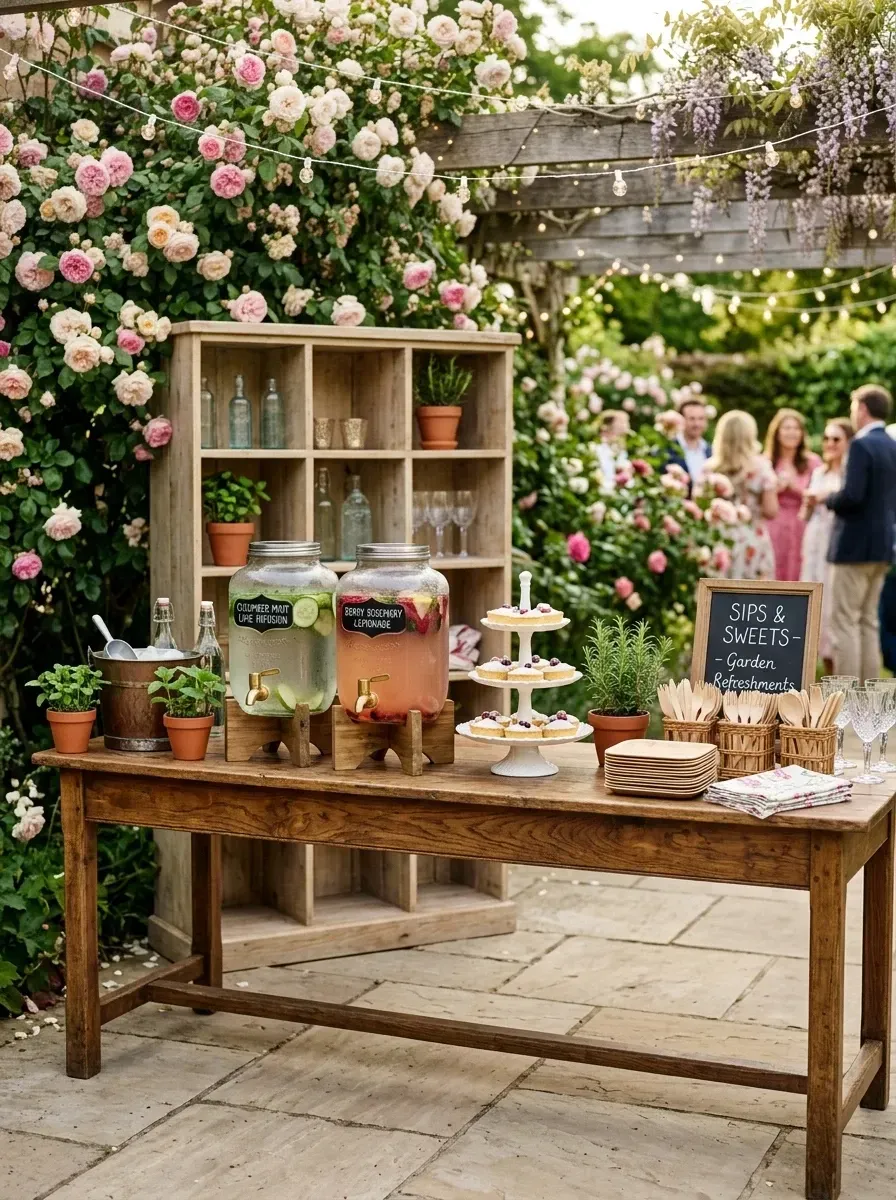
A functional beverage zone that earns its place as a focal point. The rustic hutch carries the vertical interest a flat side table can't deliver, and the glass dispensers (drink visibility is most of the design) let guests serve themselves without a host bottleneck. Potted herbs and a few cut roses tie the station back to the garden itself — the design move that makes the station read as part of the garden rather than equipment dropped on the lawn. This is the format A practical recommendation is for any party over 12 guests where you don't want to be pouring drinks all afternoon.
A hutch or shelving piece outdoors needs to be either weather-rated furniture (Sutherland, Brown Jordan, Restoration Hardware Aspen teak) or an indoor piece you commit to bringing in before nightfall. Real solid-wood vintage hutches survive a single dry day fine; one rainstorm or one heavy dew can warp doors and split joinery permanently. Plan a "bring it back inside by 8 PM" rule into the day.
The considered Beverage Station direction brings together rustic vintage or solid-wood shelving unit / hutch, glass beverage dispensers on wooden stands, potted herbs and fresh florals from the garden, chalkboard signage for drink labels, and vintage-style wooden console table.
Budget notes for The considered Beverage Station
Vintage-Style Wooden Hutch: $400 – $800. Rustic Wooden Console Table: $300 – $600. Glass Beverage Dispenser with Stand (×2): $80 – $160. Small Chalkboard Sign: $15 – $30.
Assorted Terracotta Pots & Plants: $50 – $100. Ceramic Cake Stand (×2): $40 – $80. Total Estimated Cost: $885 – $1,770.
Use chalkboard signage with menu pricing language ("garden gin lemonade," "elderflower spritz") rather than just product names. Guests order more confidently when the drink reads as a considered menu item than when it reads as "grab a drink from the dispenser."
The Boho-Chic Lounge Zone
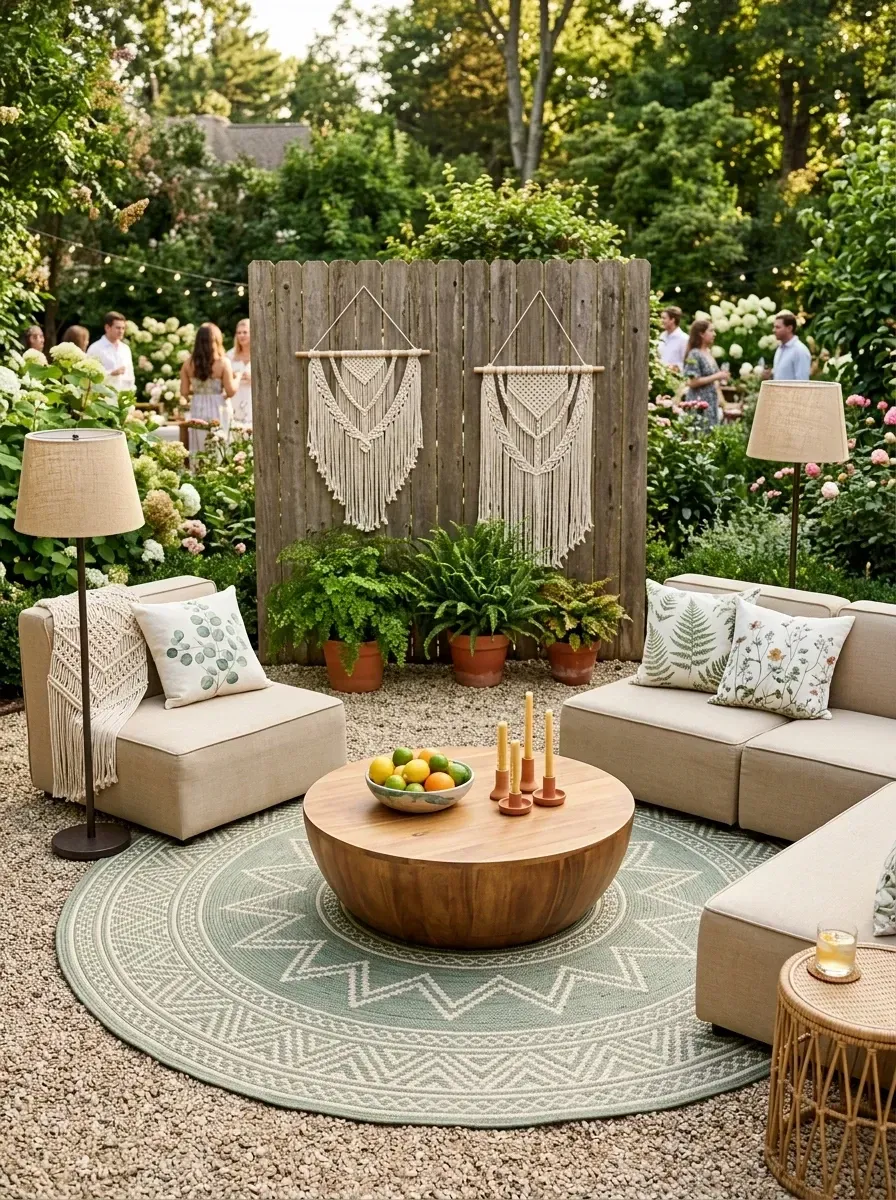
A distinct outdoor "room" carved out of the larger garden footprint. The round jute rug is the anchoring move — without it, the sectional and chair would float on the lawn or patio and the eye would never read the seating area as a defined zone. The wooden fence draped with macrame wall hangings provides the backdrop wall the room would otherwise lack. Modular outdoor sectional + armless chair + coffee table = enough seating for 6–8 guests in flexible conversation. Layered textiles (knit throws, botanical pillows) give the textural depth that hard outdoor furniture can't carry alone.
Outdoor sectional fabric matters more than the frame. Spec a Sunbrella or Crypton-rated solution-dyed acrylic — they shed water, resist UV fade for 5+ years, and clean with mild soap. Cheaper "outdoor fabric" that's just polyester with a water-repellent topcoat fades to a different color within one summer. The macrame backdrop should come down before any rain — natural cotton macrame mildews aggressively if left out wet.
The Boho-Chic Lounge Zone direction brings together large round natural jute area rug (8'–10'), modular outdoor sectional sofa with Sunbrella or Crypton fabric, macrame wall hangings (removed before weather), round wood or stone coffee table, and potted ferns and outdoor-rated floor lamp.
Budget notes for The Boho-Chic Lounge Zone
Modular Outdoor Sectional (3-piece): $1,200 – $2,500. Armless Outdoor Chair: $300 – $600. Large Round Jute Rug (8'–10'): $200 – $400. Round Wood Coffee Table: $250 – $500.
Large Macrame Wall Hanging (×2): $100 – $200. Outdoor Floor Lamp: $150 – $300. Assorted Outdoor Pillows & Throw: $150 – $300. Total Estimated Cost: $2,350 – $4,800.
Outdoor floor lamps need to be IP44 rated minimum (splash-tolerant) and plugged into a GFCI exterior outlet. Battery-operated lanterns or solar-charging lamps from Hay or Tala are the simpler path if there's no exterior outlet within reach.
Dramatic Dining Under a Canopy
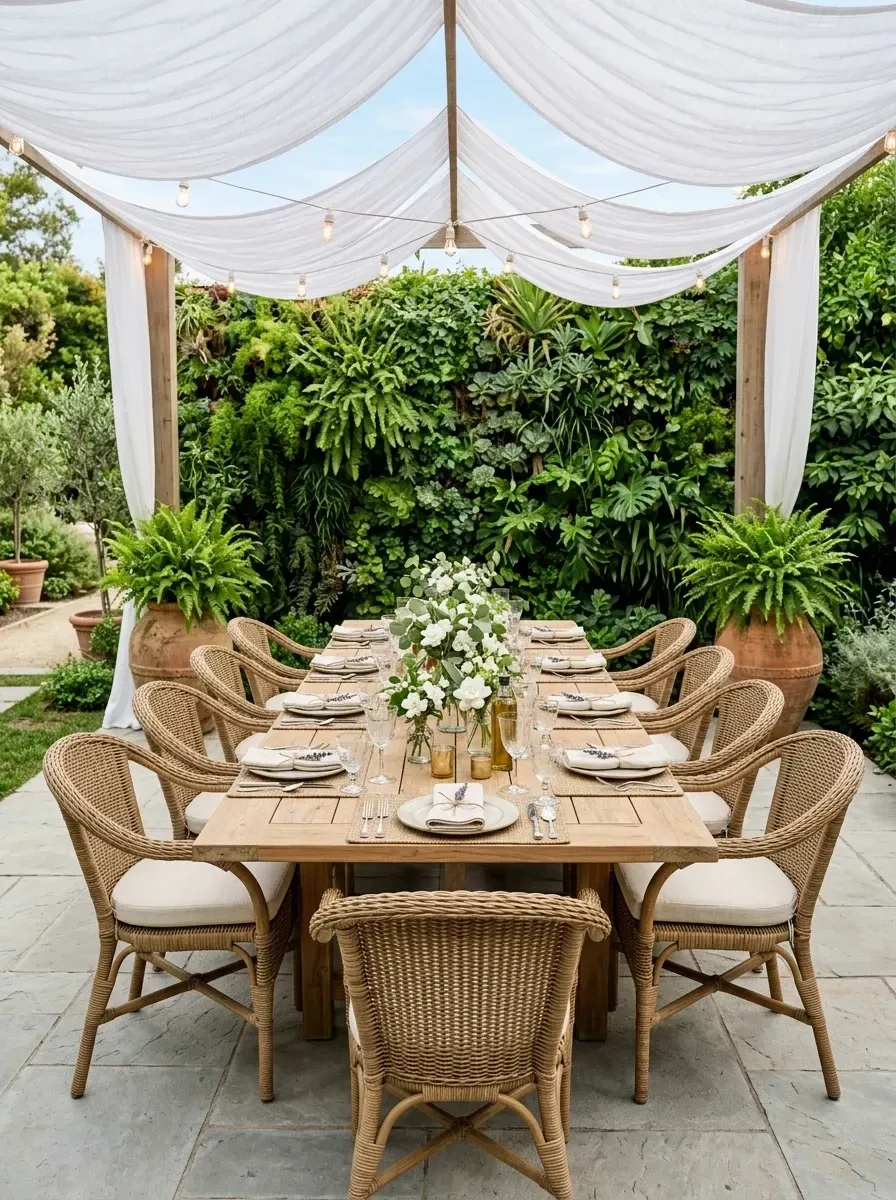
The most architecturally ambitious of the ten. Sheer white fabric draped over a pergola is the move that transforms a flat outdoor dining setup into a tented event space — it diffuses harsh midday sun, creates an intimate enclosure, and reads romantic at every hour. Teak dining table and rattan chairs are the long-haul outdoor furniture choices: teak silvers gracefully and lasts 30+ years, rattan with marine-grade wrapping handles a few seasons of the Northeast weather. The living wall backdrop is the most expensive element on this setup but delivers a photo-day-ready scene. The single green-and-white floral centerpiece is the right scale — anything more elaborate competes with the foliage backdrop and dilutes both.
Pergola structural rating and canopy fabric attachment are framing-stage decisions. The pergola needs to be designed for the load of a tensioned fabric panel plus wind loading — not just standard residential pergola loading for vines. Use grommet panels with marine-grade lashing or a tension-cable system; tying sheets on by hand will untie within an hour in any breeze. Living walls need irrigation, drainage, and a weekly maintenance contract — see the site's deeper read on living-wall logistics in the design-mindset essay on the unconscious canvas.
The Dramatic Dining Under a Canopy direction brings together sheer white fabric canopy properly attached to pergola, long solid teak dining table (8–10 ft), woven rattan dining chairs (×8, marine-grade wrapping), lush living wall backdrop (irrigated and maintained), large terracotta planters flanking the table, and outdoor string lights woven through the canopy.
Budget notes for Dramatic Dining Under a Canopy
Long Teak Dining Table (8–10 ft): $1,500 – $3,000. Woven Rattan Dining Chair (×8): $1,600 – $3,200. Sheer Outdoor Fabric Bolts & Hardware: $200 – $400. Outdoor String Lights (×4 strands): $80 – $160.
Large Terracotta Planter (×2): $200 – $400. Living Wall Installation (~8'×8'): $1,000 – $2,500. Total Estimated Cost: $4,580 – $9,660.
Pergola load reality. Standard residential pergolas are sized for vine load (5–10 lbs per square foot). A tensioned fabric canopy plus wind loading can spike that to 25–40 lbs per square foot at peak. Get an engineer's letter before adding canopy fabric to an existing pergola, or design the pergola for the fabric load from the start.
Rustic Elegance Under the Rose Arbor
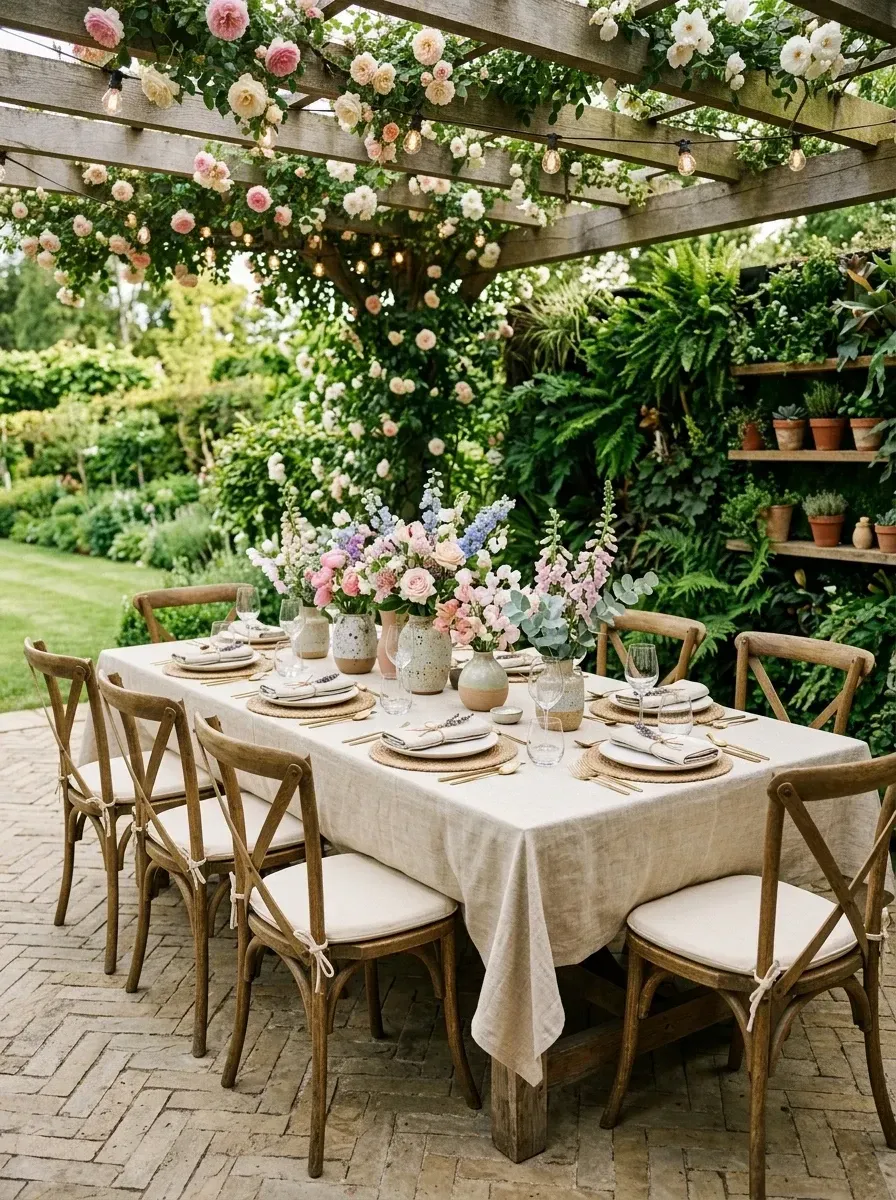
The "rustic elegance" format is the Northeast wedding-photographer favorite for a reason. The weathered cedar pergola laden with climbing roses creates a romantic natural enclosure that no installed canopy can match — but the pergola has to have been built and the roses planted at least 3–4 seasons earlier to reach the maturity in the photo. The tablescape carries the polish: oatmeal linen tablecloth, cluster of ceramic vases with garden-cut pastel florals, classic wooden cross-back chairs (the silhouette that works in both rustic and refined settings). The combination of rugged overhead beams and delicate tabletop details is the whole design move.
Climbing roses on a pergola is a 3–5 year project. David Austin roses (Munstead Wood, Gertrude Jekyll, Strawberry Hill) are the most reliable for Northeast climates and require trellis training every spring. If you don't have a mature rose-covered pergola, fabric-and-faux-greenery garlands (Restoration Hardware, Pottery Barn outdoor) deliver the visual at one-day-of-setup speed without the multi-season commitment.
The Rustic Elegance Under the Rose Arbor direction brings together weathered cedar pergola with mature climbing roses, natural oatmeal linen tablecloth (washable, reusable), wooden cross-back dining chairs (×8), cluster of mismatched ceramic vases with garden-cut pastel florals, and woven placemats and matching linen napkins.
Budget notes for Rustic Elegance Under the Rose Arbor
Wooden Farmhouse Dining Table: $800 – $1,500. Wood Cross-Back Chair (×8): $1,200 – $2,400. Large Linen Tablecloth: $100 – $200. Collection of Ceramic Vases (×5–7): $150 – $300.
Woven Placemat Set (×8): $80 – $160. Linen Napkin Set (×8): $60 – $120. Total Estimated Cost: $2,390 – $4,680.
A cluster of 5–7 mismatched small vases at varying heights reads more "garden gathered" than a single tall centerpiece. Source the vases over time from estate sales, antique shops, and Brimfield — the mismatched look is the sustainable choice and the more interesting visual choice.
The Intimate Bamboo Seating Nook
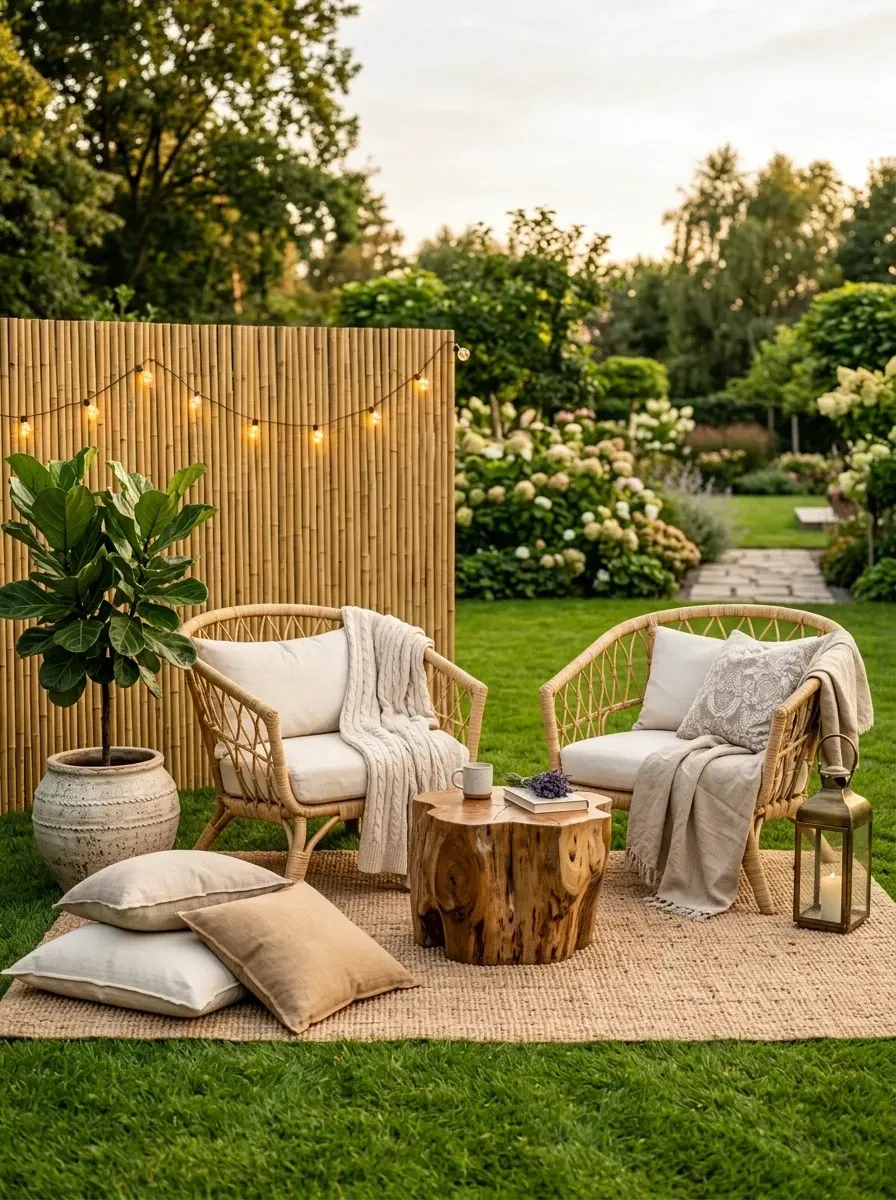
A cost-effective privacy-and-conversation corner. The bamboo screen is the affordable shortcut — $80–$150 for a pre-made 6'×6' panel that delivers immediate enclosure and visual texture. Pair of rattan lounge chairs plus a tree stump coffee table is the quietest, most natural seating arrangement available. Large jute rug grounds the zone; floor pillows extend casual seating without committing more furniture footprint. This is the format A practical recommendation is most often for clients who want a designed corner without committing to a full structural pergola or seating renovation.
Bamboo screens last 2–4 seasons in the Northeast — they're not a permanent install, they're a renewable consumable. Stake them properly with steel ground anchors so wind doesn't lay them flat at the first storm. Tree stump tables look casual and weigh 80–150 lbs depending on species; once placed, they don't move easily, so commit to the location.
The Intimate Bamboo Seating Nook direction brings together bamboo privacy screen with string lights (steel-staked), pair of natural rattan lounge chairs with weather-rated cushions, natural tree stump coffee table, large jute area rug (6'×9'), floor pillows and chunky knit throws, and large decorative lantern (battery-operated).
Budget notes for The Intimate Bamboo Seating Nook
Bamboo Privacy Screen (~6'×6'): $80 – $150. Rattan Lounge Chair with Cushion (×2): $400 – $800. Tree Stump Coffee Table: $150 – $300. Large Jute Rug (6'×9'): $150 – $300.
Floor Pillow (×3): $150 – $300. Knit Throw Blanket (×2): $60 – $120. Large Decorative Lantern: $50 – $100. Total Estimated Cost: $1,040 – $2,070.
A single oversized lantern at floor level reads more designed than three small ones spread across the rug. Place it offset from the center of the rug — at a 1/3 line — for the strongest compositional read.
The Vintage-Inspired Dessert Bar
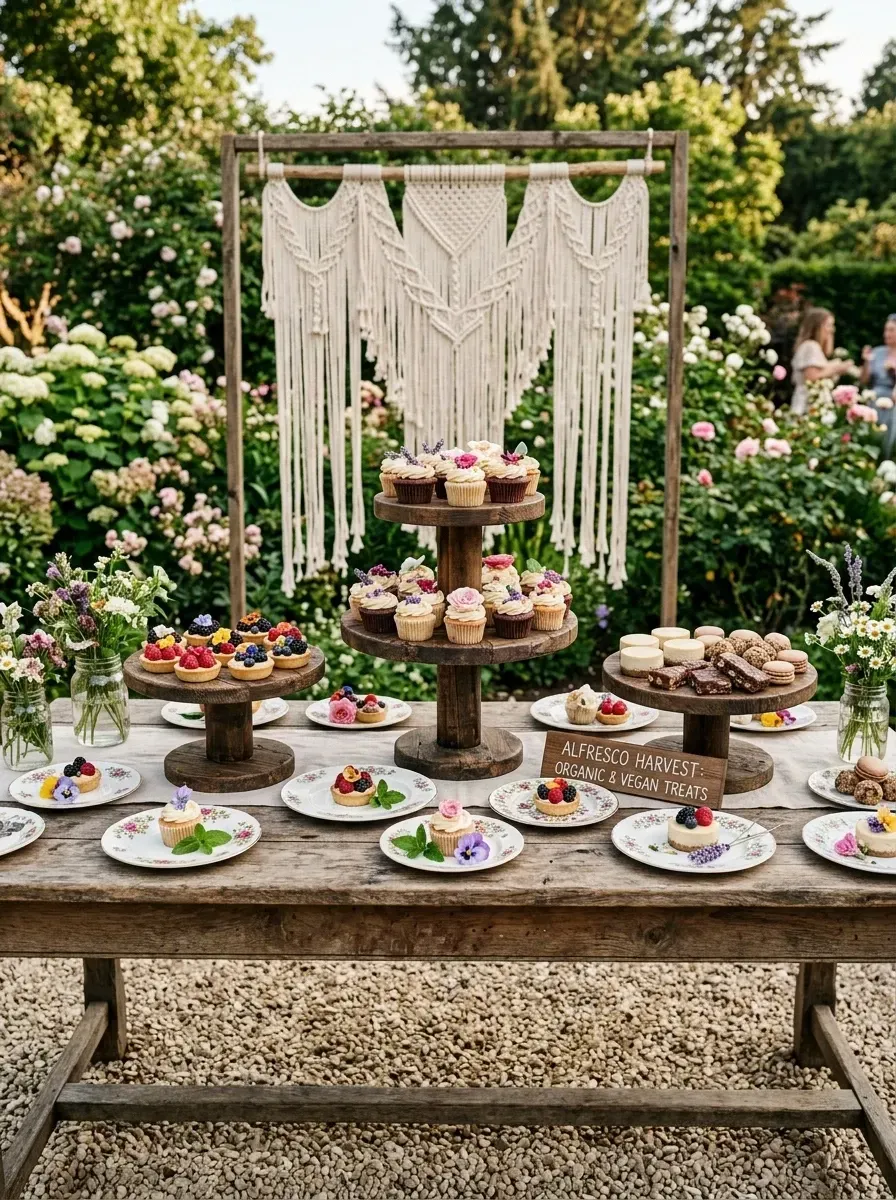
Sustainable styling at its most expressive. The wooden arch framed with macrame creates the photo-moment backdrop a flat dessert table can't deliver. The mismatched floral plates are the design — vintage china collected over time delivers a charming, gathered look that no new "matching set" can match. Tiered wooden stands create height variation across the table, which is the move that improves a flat spread of cookies into a styled dessert scene. This format leans hard on sourcing — the plates, the stands, even the wooden sign all benefit from secondhand provenance over new purchase.
A wooden wedding arch is essentially a sturdy frame. Buy it once ($150–$300), keep it disassembled in storage between events, and reuse it for the next decade of birthdays, anniversaries, and celebrations. Same logic applies to the macrame backdrop — a $100 purchase that serves a dozen events. This is what "investment in reusable staples" actually looks like in practice.
The Vintage-Inspired Dessert Bar direction brings together wooden archway with large macrame backdrop curtain, rustic reclaimed-wood trestle table, tiered wooden serving stands (3-tier), mismatched vintage floral dessert plates (×20), and custom wooden signage and small garden florals.
Budget notes for The Vintage-Inspired Dessert Bar
Wooden Wedding Arch / Arbor: $150 – $300. Large Macrame Backdrop Curtain: $100 – $250. Rustic Wooden Trestle Table: $400 – $800. 3-Tier Wooden Serving Stand: $60 – $120.
Wooden Cake Stand (×2): $80 – $160. Set of Vintage Floral Dessert Plates (×20): $100 – $200. Custom Wooden Sign: $30 – $60. Total Estimated Cost: $920 – $1,890.
Build the vintage china collection over months, not days. Six estate sale visits across a year typically yields a coherent 20-plate set at one-quarter the cost of a single rental order — and you own the plates afterwards.
The Floral Swing Photo Moment
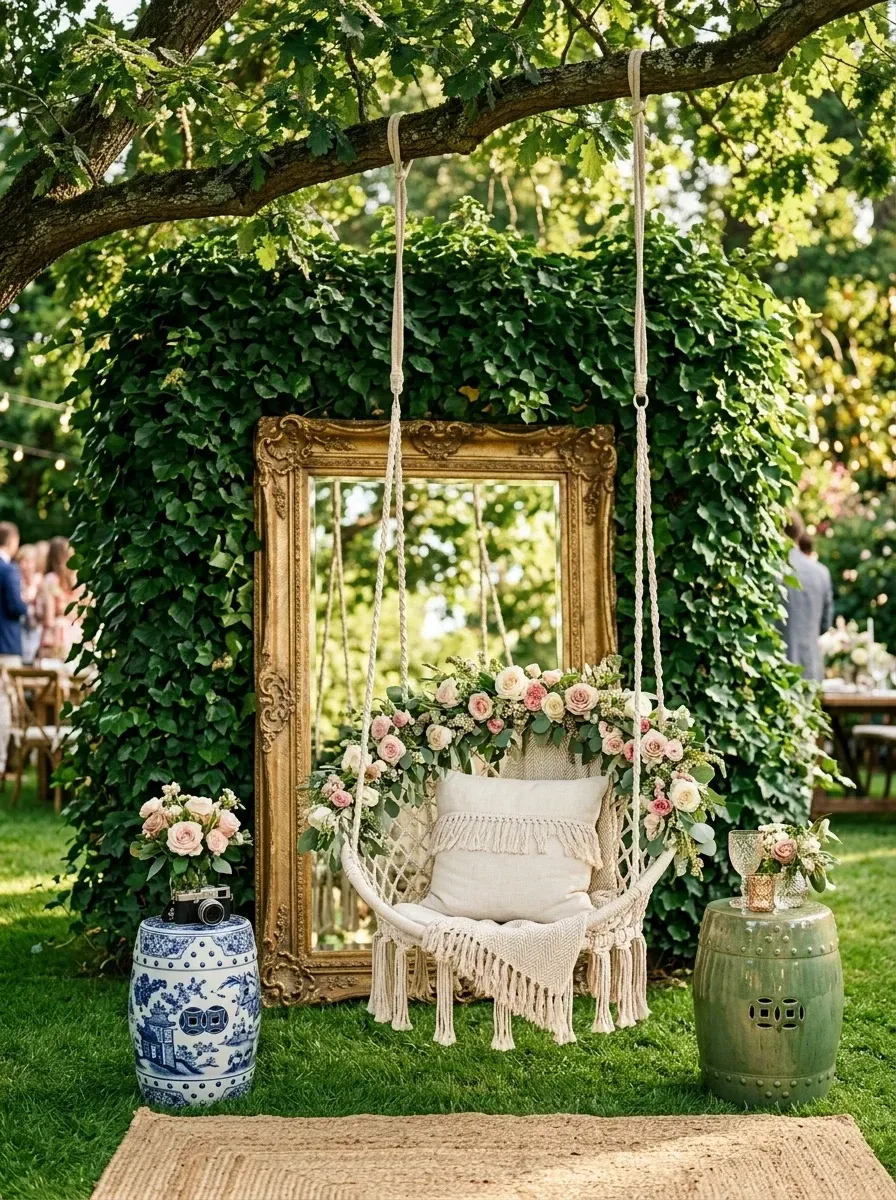
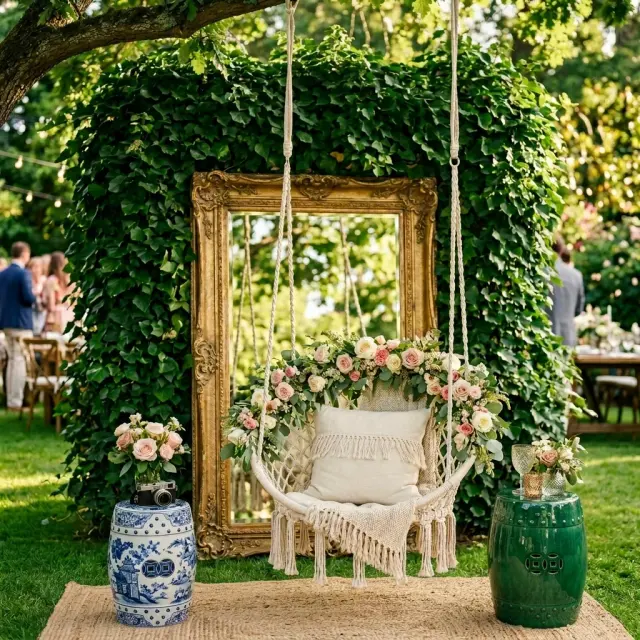
Modern parties need a designated photo moment, and this one is flawlessly executed. The macrame hanging swing draped with a fresh rose and greenery garland is the centerpiece. The strongest design move is the ornate gold mirror leaning against the ivy wall — it reflects light and the surrounding greenery, doubles the perceived depth of the space, and reads as a "secret garden doorway" in photographs. Ceramic garden stools provide a useful spot for drinks or props without cluttering the frame. This is the format that drives social-media coverage of a party — guests photograph it, post it, and your hosting reputation grows.
Hang the swing from a structurally rated tree branch (minimum 8" diameter, healthy hardwood) or a dedicated A-frame swing stand — never from a pergola crossbeam, which isn't engineered for the dynamic load of a swinging adult. A custom fresh-floral garland from a local the Northeast florist runs $150–$300 and lasts the day; for a multi-day event, swap to a high-quality faux garland (Afloral, Lulu's Decor) that reads as fresh from 4 feet away.
The Floral Swing Photo Moment direction brings together cream macrame hanging swing chair (structurally hung), fresh rose-and-greenery floral garland on the swing, large ornate antique gold leaning mirror (~6 ft), blue-and-white chinoiserie ceramic garden stools (×2), small jute runner rug under the swing, and vintage camera or styling prop.
Budget notes for The Floral Swing Photo Moment
Macrame Hanging Chair: $80 – $150. Large Ornate Gold Mirror (~6 ft): $250 – $500. Ceramic Garden Stool (×2): $200 – $400. Small Jute Runner Rug: $40 – $80.
Custom Fresh Floral Garland for Swing: $150 – $300. Total Estimated Cost: $720 – $1,430.
Swing safety reality. A macrame swing dynamically loaded with an adult guest exerts roughly 2.5× their body weight at the hang point. Use a structurally rated branch (8" diameter minimum, no visible rot, healthy bark) or a purpose-built A-frame stand — not a pergola crossbeam, an arbor lattice, or any decorative structure. Get an arborist to confirm any tree branch before you hang from it.
The Tactile Tablescape Detail
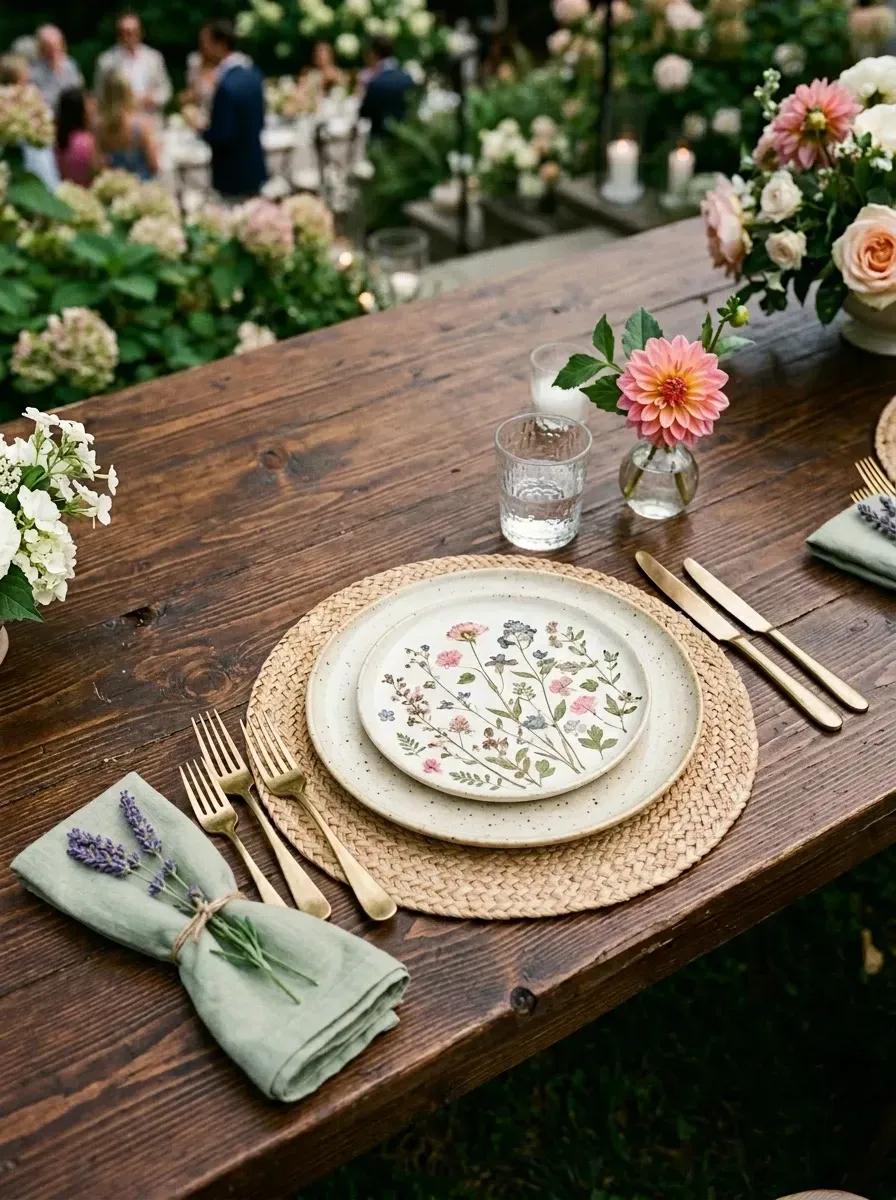
A close-up that explains the whole sustainable-tablescape philosophy in one frame. Five layers of natural material: dark farmhouse wood table, woven hyacinth placemat, speckled ceramic plate, sage green linen napkin, brushed gold cutlery. The single fresh lavender sprig tucked into the napkin is the sensory detail every guest notices and remembers — almost free, profoundly thoughtful. Mixing brushed gold cutlery with rustic-natural materials is the move that prevents "rustic" from sliding into "casual" — the polish is what keeps the table reading as designed.
This is the entry-level investment. $270–$540 covers four place settings of high-quality reusable staples that survive a decade of dinner parties, weeknight family meals, and outdoor entertaining. Skip the disposable single-use route forever after this kit is built. The cost-vs-value math overwhelmingly favors investing once and reusing, both economically and environmentally.
The Tactile Tablescape Detail direction brings together woven water hyacinth placemats (4-piece set), speckled ceramic dinner plates with subtle floral motif, sage green linen napkins (4-piece set), brushed gold 5-piece cutlery place settings, and small clear glass vases or fresh herb sprigs per setting.
Budget notes for The Tactile Tablescape Detail
Set of 4 Woven Placemats: $30 – $60. Set of 4 Floral Ceramic Plates: $60 – $120. Set of 4 Linen Napkins: $40 – $80. 5-Piece Gold Cutlery Place Setting (×4): $120 – $240.
Small Clear Glass Vase (×4): $20 – $40. Total Estimated Cost: $270 – $540.
Why this layer kit works. The five-layer place setting (wood table → woven placemat → ceramic plate → linen napkin → metal cutlery + herb sprig) is the sustainable-luxury formula in microcosm. Build this kit once. Every garden party you host for the next decade starts here.
The Secret Garden Bistro Set
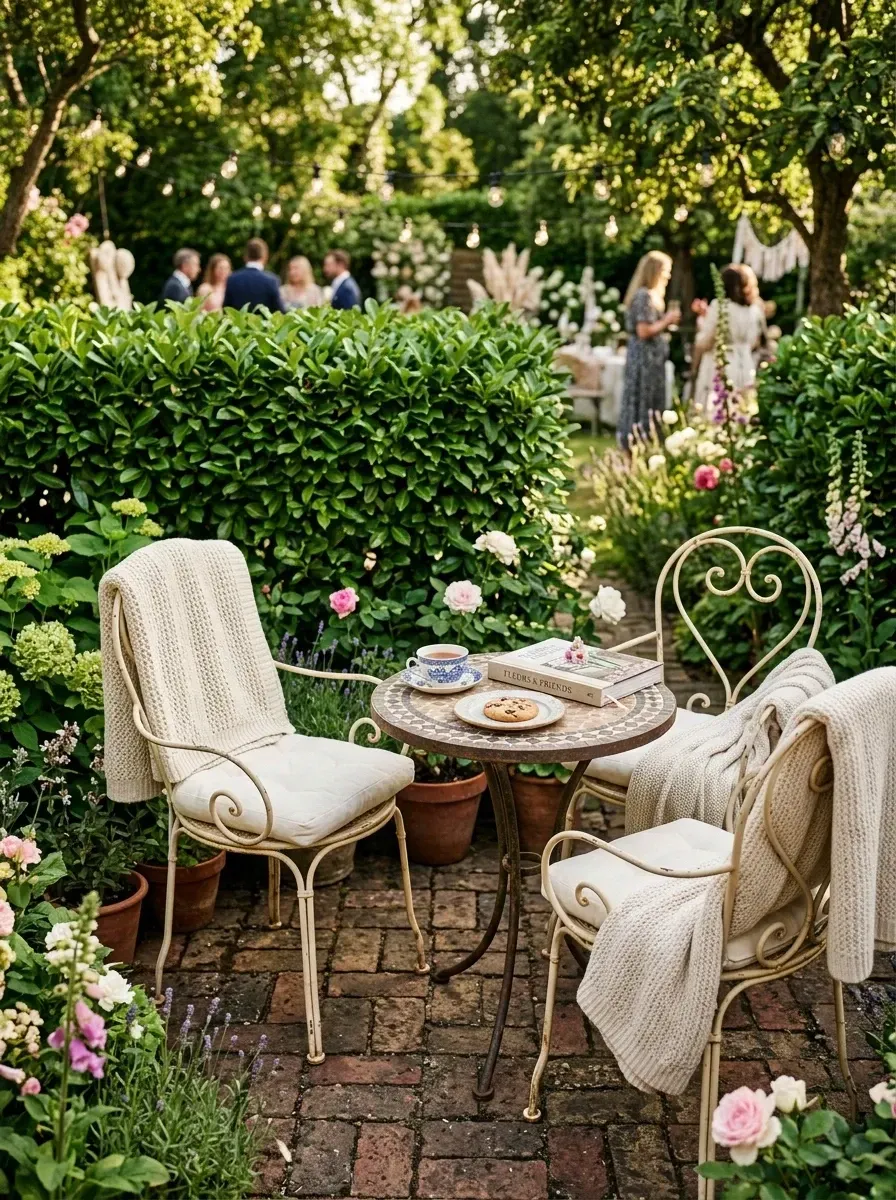
The bistro-set format is for the small footprint — a balcony, a brownstone garden, the corner of a larger lawn, or a back-of-yard meditation spot. Mosaic table and wrought iron chairs are the classic European-cafe setup, scaled to two people. Knit throws and outdoor cushions soften the metal furniture to make extended sitting comfortable; without them, a wrought iron chair becomes punishing after 20 minutes. Pea gravel patio is the practical European-courtyard finish — chic, permeable, drains naturally, and at $1.50–$3 per square foot installed, it's the cheapest hardscape format that still reads "designed."
Pea gravel needs a properly compacted base layer (4" of crushed stone) and a steel or stone edge restraint to keep it contained. Skip the base layer and the gravel disappears into mud after one rain. Wrought iron furniture should be powder-coated, not just spray-painted; powder coat lasts 8–10 years against rust where spray paint chips and rusts within two seasons in the Northeast winter.
The Secret Garden Bistro Set direction brings together mosaic-top bistro table, powder-coated wrought iron chairs (×2) with cushions and throws, pea gravel patio (4" compacted base + edge restraint), dense green hedge background (privet, hornbeam, or boxwood), and potted plants and overhead string lights.
Budget notes for The Secret Garden Bistro Set
Mosaic Bistro Table: $150 – $300. Wrought Iron Bistro Chair (×2): $120 – $240. Outdoor Seat Cushion (×2): $40 – $80. Chunky Knit Throw Blanket (×2): $80 – $160.
Gravel Patio Material (~100 sq ft): $100 – $200. Assorted Terracotta Pots: $50 – $100. Total Estimated Cost: $540 – $1,080.
Pea gravel patios benefit from a stabilizing grid (Gravelpave2, NDS EZ-Roll) under the gravel itself. The grid keeps the gravel from migrating, supports rolling chair legs without divots, and adds maybe $0.75 per square foot to the install. Worth every penny on a frequently used patio.
The Connected Garden Layout
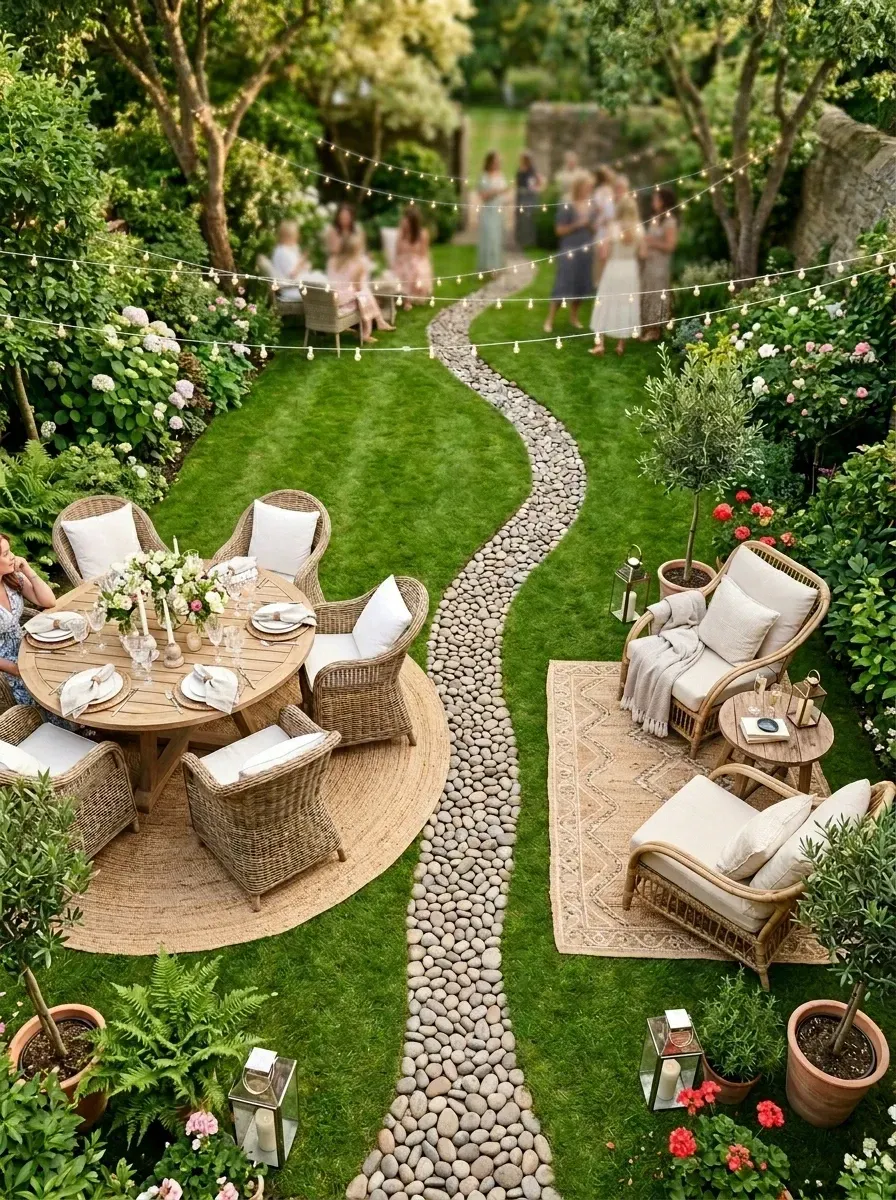
The full architectural picture. The winding river stone pathway is the move that makes the entire garden read as a coordinated event space rather than three separate pieces of furniture on a lawn. Each zone (dining, lounging, bar) is anchored by its own large jute rug. Consistent material palette across the zones — teak, wicker, jute, stone — ties everything together visually. The hardscape pathway is the long-term infrastructure investment; the furniture and rugs serve every event for years afterwards.
A winding stone pathway is genuine landscape construction — base prep, stone selection, fitting, jointing, and final compaction. the Northeast landscape labor runs $50–$80 per square foot for a quality stone path with proper base. Cheap "stepping stones on grass" approaches fail by year two — the stones sink, the grass dies underneath, and you're left with mud-and-stone. Spend the money once on a properly built path that lasts a generation.
The Connected Garden Layout direction brings together winding river stone pathway connecting zones (properly base-prepped), round teak dining set anchored on jute rug, wicker lounge set anchored on second jute rug, expansive green lawn between zones, commercial-grade overhead string lights spanning the layout, and large lanterns at zone transitions.
Budget notes for The Connected Garden Layout
Round Teak Dining Table & 4 Wicker Chairs: $2,000 – $4,000. 4-Piece Wicker Lounge Set with Cushions: $1,500 – $3,000. Large Round Jute Rug (×2): $300 – $600. River Stone Pathway Materials & Labor (~30 ft): $1,500 – $3,000.
Commercial-Grade String Lights (~100 ft): $150 – $300. Assorted Large Lanterns (×4): $160 – $320. Total Estimated Cost: $5,610 – $11,220.
Commercial-grade string lights (Bistro Pro, Brightech Ambience Pro) cost 2–3× the home-store version and last 5–10× longer in real outdoor service. The cheap strings fail at the bulb sockets within a season; the commercial-grade survive ten Northeast winters. The math overwhelmingly favors the upgrade.
Planning checks for The Connected Garden Layout
Build a kit, not an event. The clients who host beautiful garden parties year after year aren't renting — they've built a kit of high-quality, neutral, reusable staples (linen napkins, ceramic plates, glass dispensers, jute rugs, brass cutlery, vintage china) that get recombined for every event. The first party costs more; every party after that costs the cost of flowers and food. The math compounds in your favor.
Bring indoor pieces outside for one day. A vintage wood console table, a favorite armchair, a brass candlestick collection — items not designed for outdoor service handle one dry afternoon fine. They add character that purely-outdoor furniture can't deliver. Just commit to bringing everything back inside before dew or weather arrives.
Layer the lighting like architecture. Plan four lighting layers for any evening party: overhead string lights for general ambiance, ground-level lanterns to define paths and zones, table-level candles or hurricane lamps for intimate glow, and a single statement piece (a chandelier in a tree, an oversized lantern at the bar). Every layer dimmable or with adjustable intensity.
Spec a weather contingency. A Northeast July afternoon has a real chance of a 4 PM thunderstorm. Plan a 30-minute pivot — covered porch, garage, indoor table, large patio umbrella — that the host and one helper can execute without panic. The party that has a Plan B beats the party that prays for sun.
Forage the centerpieces. Garden-cut roses, branches of flowering quince, ivy trailings, herb sprigs, even interesting weeds — all read more "garden party" than store-bought cut flowers and cost nothing. Walk the property the morning of with shears and an empty trug.
Invest in commercial-grade string lights. Bistro Pro, Brightech Ambience Pro, or any UL-rated commercial outdoor string light costs 2–3× the home-store version and lasts 5–10× longer. They survive the Northeast winters intact; the cheap version fails by August of the first year.
Budget priorities for Sustainable Garden Party Design
Forage florals. Before calling a florist, walk your own garden, your neighbor's overgrown hedge (with permission), or the local meadow. Branches, ivy, hydrangea blooms, even ornamental grasses make distinct sculptural arrangements at zero cost.
Build the vintage china kit over time. Six estate sale visits across a year typically yield 20+ matched-but-mismatched bone china dessert plates at $5–$15 each — a fraction of a single rental order, and you own them afterwards.
Repurpose indoor pieces. An indoor console table works as a bar. An indoor bookcase becomes a beverage hutch. A vintage rug from the dining room defines a lounge zone for an afternoon. Shop your own house first.
Skip the canopy, use a mature tree. If your property has a large mature oak, maple, or elm with a wide spreading canopy, set the dining table directly under it. Natural canopy is free, more romantic than tensioned fabric, and weather-friendly to a degree fabric isn't.
Sun&Rain bistro lights from local hardware before specialty. Local the Northeast hardware stores stock UL-rated outdoor string lights at 30–40% less than online specialty retailers. Same product spec, lower price.
The Core Idea. The garden party that photographs beautifully and runs flawlessly is built on a small kit of high-quality reusable staples — linen, jute, teak, ceramic, glass, vintage china — recombined for every event. Investments are front-loaded; every event after the first costs the price of flowers, food, and a few extra lanterns. Plan the zones, spec the durable materials, layer the lighting, and have a rain plan. The aesthetic comes for free once those bones are right.
Questions about Sustainable Garden Party Design
Concentrate the budget on a few high-quality reusable staples — linen napkins, a versatile wooden serving board, a set of glass beverage dispensers, a stack of mismatched vintage china plates — instead of disposable decor. Use your garden's existing beauty: garden-cut florals, herb sprigs, and branches as centerpieces, mature trees as canopy, existing furniture brought outside for the day. A genuinely chic garden party for 12 guests can be built for $500–$1,000 in reusable infrastructure that serves every party for the next decade.
What are the most sustainable decor choices for an outdoor party?
Choose materials that are reusable or repurposable: glass beverage dispensers instead of plastic bottles, ceramic plates instead of disposable, linen tablecloths and napkins instead of paper, potted plants instead of cut flowers when practical, and vintage or secondhand decor instead of new. Avoid single-use plastics entirely. the Northeast estate sales and Brimfield Antique Show are excellent sourcing channels for vintage china, brass, and ceramic that adds character without new production. The most sustainable purchase is the one that gets used hundreds of times.
Large outdoor rugs are the strongest tool — they immediately define a "room" within a larger lawn. A 9' round jute rug under a dining table reads as a dining room; another rug 20 feet away under lounge furniture reads as a separate lounge. Reinforce zones with visual dividers (potted plants, bamboo screens, low hedges, or a change in flooring like gravel adjacent to grass). A winding stone or gravel pathway physically connects the zones and tells guests how to move through the space.
What kind of lighting is best for an evening garden party?
Layered lighting is the formula. Start with overhead bistro string lights for general illumination at roughly 8–10 feet above the dining or lounge zone — they should be commercial-grade UL-rated for true outdoor durability. Add ground-level lanterns to define pathways and zone edges. Finish with table-level candles, hurricane lamps, or low pillar holders for intimate glow at the dining table. Specify warm-tone bulbs (2200K–2700K) throughout — anything cooler reads clinical and fights the romantic atmosphere.
Is it okay to use indoor furniture outside for a single party?
For a temporary event in dry weather, yes — bringing indoor pieces like a wooden dining table, chairs, area rugs, or a bookcase outside can add character that purely-outdoor furniture rarely matches. The rules: check the weather forecast within 12 hours of the event, pick pieces that aren't antique or moisture-sensitive, lay rugs directly on grass or hardscape (not on damp earth), and commit to bringing everything back inside before dew sets in or any rain. A single dry afternoon doesn't damage indoor furniture; an overnight stay or unexpected rain does.
What's the most important Plan B for the Northeast summer party?
A 30-minute pivot plan for a sudden 4 PM thunderstorm. The Northeast climate means a real chance of a passing storm during any July or August afternoon party. Identify in advance: which covered space (porch, garage, finished basement, indoor great room) you'll move the dining and beverage zones to, who's responsible for relocating which items, and how you'll communicate the pivot to guests without panic. The party that has a smooth Plan B reads as restrained even when the weather doesn't cooperate; the party without a plan reads as chaos.
For the structural and hardscape side of garden infrastructure (pergolas, pathways, lighting plans, zone planning), the outdoor renovations archive covers design fundamentals. For the broader plan-first thinking that underpins material-honest entertaining, the essay on the unconscious canvas is a good companion piece. And for the psychology of how considered outdoor rooms shape guest experience, the unseen architect covers the same ground at a higher altitude.
Sources & Further Reading
- Architectural Digest. How to Throw a Chic Garden Party. architecturaldigest.com
- Remodelista. 10 Ideas for Sustainable Party Decor. remodelista.com
- Houzz. How to Create Distinct Zones in Your Backyard. houzz.com
- Forest Stewardship Council (FSC). Certified Teak and Outdoor Hardwood Sourcing Standards.
- Sunbrella / Glen Raven. Outdoor Performance Fabric Specifications.
- UL (Underwriters Laboratories). UL 1598 Outdoor Luminaire and String Light Safety Standards.
- American Society of Landscape Architects (ASLA). Residential Landscape Design Guidelines for Outdoor Entertaining.
- Royal Horticultural Society. Climbing Rose Cultivation and Pergola Training Guidelines.
- U.S. National Climatic Data Center (NOAA). Northeast Summer Thunderstorm Climatology.
- Brown Jordan, Sutherland, Restoration Hardware. Outdoor Teak Furniture Specification & Care Documentation.
- NAHB / Hanley Wood. 2025 Cost vs. Value Report — Outdoor Living and Hardscape ROI. remodeling.hw.net

Renovations & Interiors Desk
Renovation Studies & Room Guides · Northeast United States research focusThe Renovations & Interiors Desk develops sourced room guides and editorial concept studies without presenting concepts as completed client work.
More from this desk →
Reader notes