

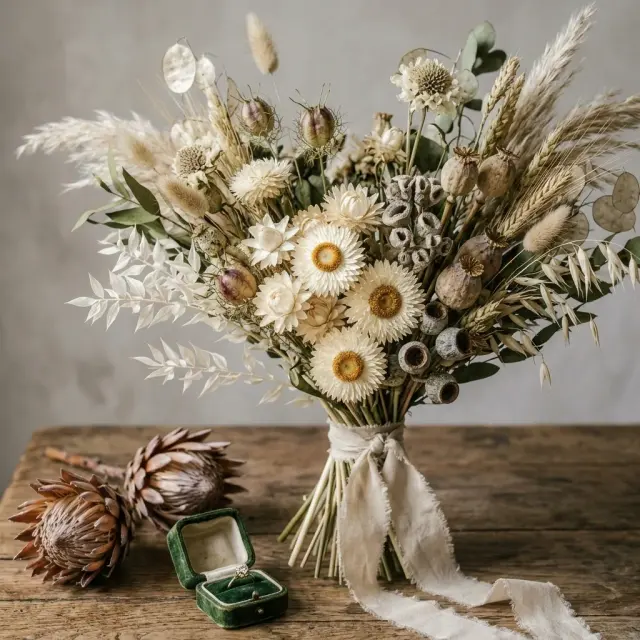
Half my Hudson Valley clients renovate barns and old estates that end up doubling as wedding venues — and the same plan-aware thinking that drives a good renovation drives a good wedding install. Where does the eye land? What holds the structural weight? What survives a 90-degree June afternoon at a Rhinebeck barn or a damp October ceremony at a Beacon estate? Below: seven dried-floral and foraged decor vignettes — ceremony arches, feasting runners, lounge zones, dessert stations — read the way I'd read them as a renovation designer pulled in to consult, with brand-specific sourcing, real Hudson Valley budget ranges, and the venue-fit notes that separate the photographs that work from the photographs that look forced.
How I Read a Wedding Install
When a Beacon or Rhinebeck couple asks me to walk a venue with them before booking — usually a 19th-century barn in Columbia County, a converted Catskills mill, or a Hudson estate carriage house — I read four things before I think about style. First, the structural rigging plan: where can a 40-pound floral cloud actually hang? Most barn ceilings I see are post-and-beam, which means you rig from the beam, not the boards. Second, the natural light cycle: a south-facing arched window does dramatic things to dried protea at 3 p.m. and nothing at 6 p.m. — schedule the photographs before you schedule the toasts. Third, the floor surface: polished concrete, original wide-plank pine, herringbone, and slate each take different chair-foot pads and need different protective measures. Fourth, the microclimate: damp barns silver pampas grass in a single weekend, and humid August air collapses a baby's breath cloud in four hours.
Pass those four and you have a styling problem; fail any of them and you have a logistics problem that has to be solved first. The seven vignettes below cover the full spectrum from a $185 detail flatlay to a $16,000 minimalist dining install — pricing reflects 2026 Hudson Valley sourcing, with venues, florists, and rentals based out of the Kingston-to-Rhinebeck corridor and the lower Catskills. For a deeper read on the same sustainable-celebration philosophy applied outdoors, the sustainable garden party guide is the natural companion to this piece, and the quiet luxury dining room guide is useful when you're translating a feasting-table look into year-round home use.
1. Minimalist Dining Under a Floral Cloud
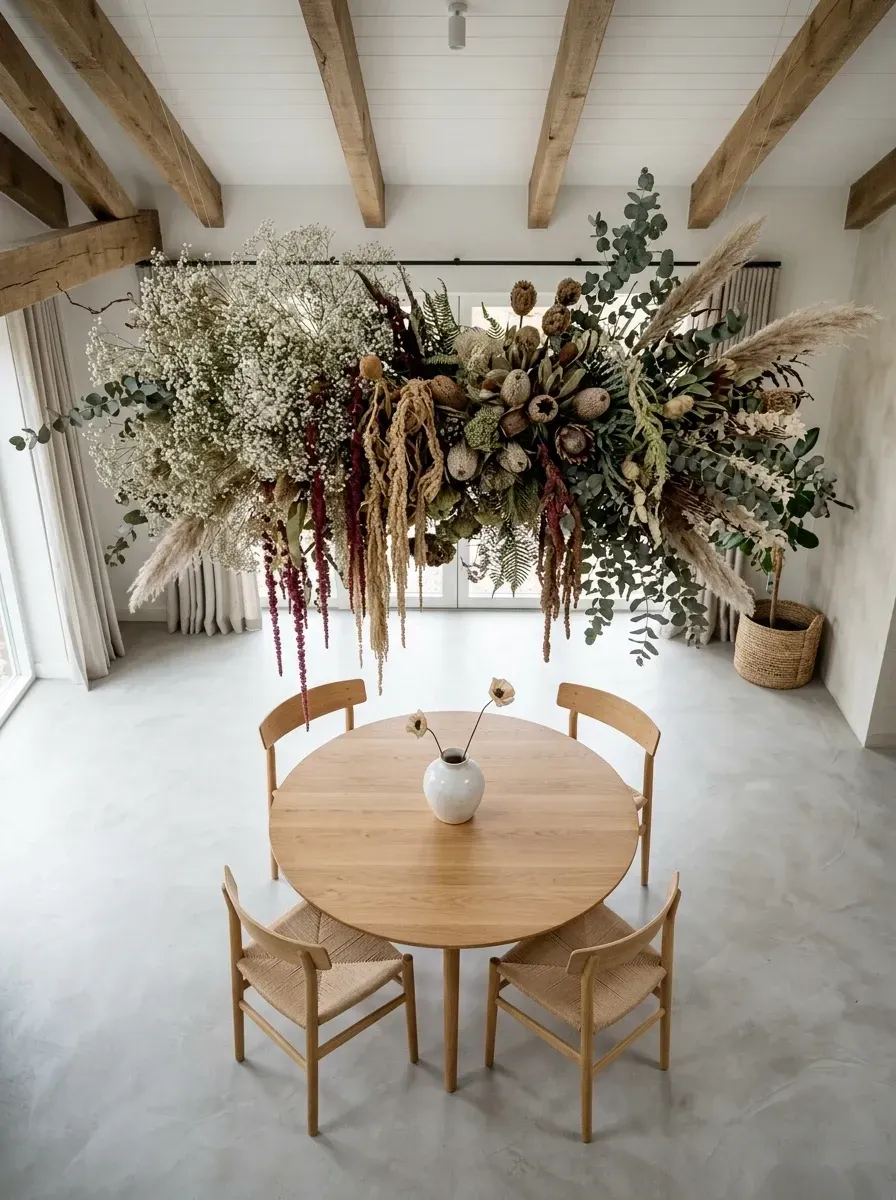
Scandi minimalism meets the untamed cloud — a massive suspended installation of dried baby's breath, ferns, pampas, and protea floats over a round oak pedestal table. The room's restrained palette (polished concrete, plaster walls, exposed beams) acts as the blank canvas. The Wegner-style wishbone chairs are the right scale for an intimate sweetheart-plus-witnesses configuration rather than a full reception. This is the look I'd recommend for a private vow ceremony at a Hudson estate or a small-format dinner in a Catskills modern barn.
Plan-aware verdict: the cloud is a framing-stage decision, not a styling-stage one. A 40-to-60-pound dried installation needs to rig directly from a structural beam — not from a board, not from a hook screwed into ceiling sheetrock, not from a chain over a pendant. Insist on an event rigger with a Hudson Valley-licensed structural sign-off (Eventect, NYC Stagehands) and load-rated cable plus carabiners (Black Diamond, Petzl industrial). The cloud assembles on the ground, gets lifted with a pulley, and locks off. Budget $1,500–$4,000 for a custom 4-foot-by-4-foot cloud from a regional florist like Hops Petunia (Hudson) or Lewis Miller Design (NYC, willing to travel up the Hudson line).
Sourcing & cost (2026 Hudson Valley)
| Item (Qty) | Price Range |
|---|---|
| Large round oak pedestal table (Crate & Barrel, RH) | $800 – $2,500 |
| Wishbone-style chair (x4) (Carl Hansen CH24 or DWR alt) | $600 – $1,400 |
| Custom dried floral hanging cloud (Hops Petunia / Lewis Miller) | $1,500 – $4,000 |
| Large woven basket (Sumatra rattan, Serena & Lily) | $35 – $140 |
| Polished concrete floor (~300 sq ft) — build-out only | $1,500 – $3,600 |
| Faux wood ceiling beams (~45 linear ft, decorative) | $2,250 – $4,500 |
| Total estimated | $6,685 – $16,140 |
Color Palette
Cementitious polish with a 1500-grit finish — light-reflective without being mirror-glossy.
White oak finished with Rubio Monocoat Pure (clear) — preserves grain without yellowing.
Benjamin Moore White Dove (OC-17) or Sherwin-Williams Alabaster (SW 7008) — warm-leaning whites that flatter dried botanicals.
The signature material of the wishbone chair seat — Danish woven paper cord, holds up beautifully under event use.
2. The Enchanted Mirror Seating Chart
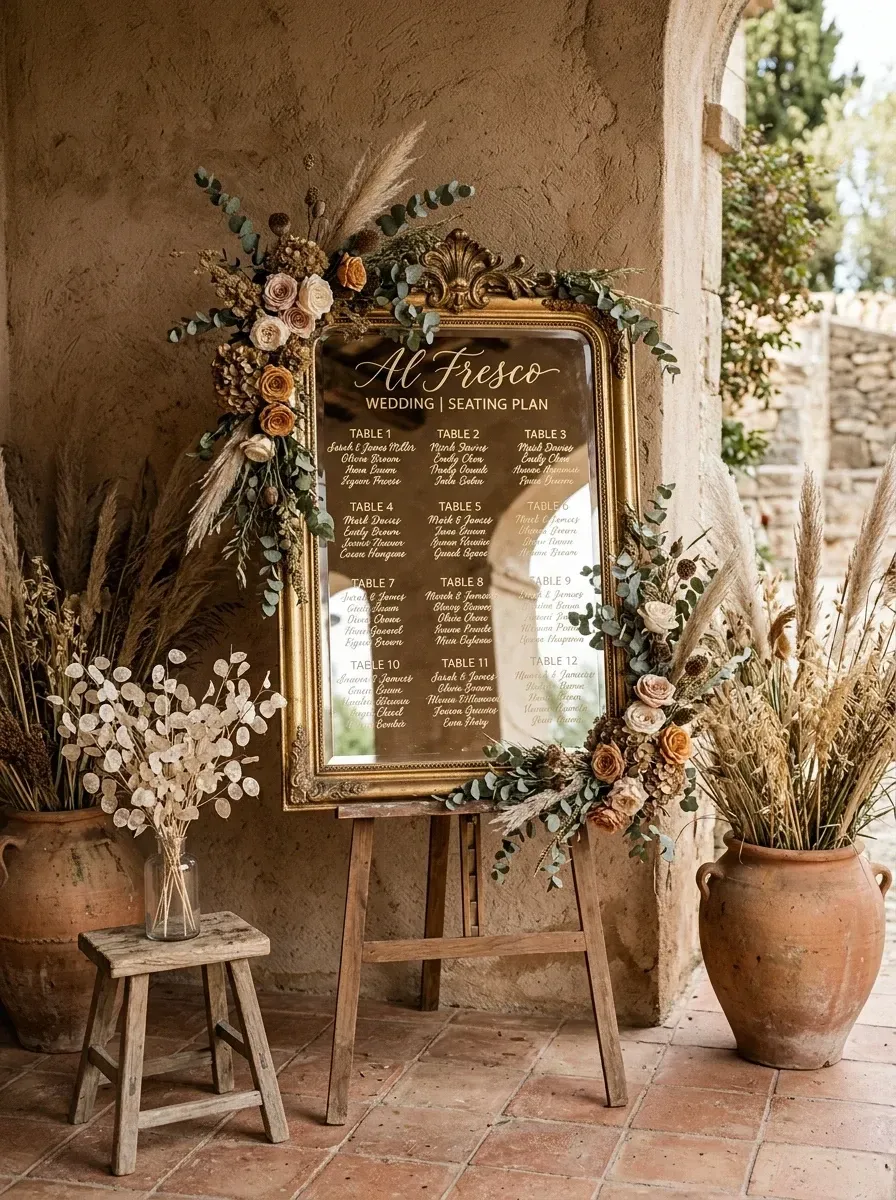
Old-world garden, asymmetric and unforced. The ornate gold mirror on a rustic easel becomes the seating chart — calligraphy applied as a removable vinyl decal so the mirror can be repurposed after the event. The dried floral swag drapes one upper corner and the opposite lower edge, the deliberate asymmetry that prevents the install from reading like a costume. The two large terracotta urns flanking the easel ground the composition with weight; without them, the easel reads thin against the stucco wall.
Plan-aware verdict: source the mirror at Hudson Valley estate sales (Rhinebeck Antiques Market, Beacon's Antiques on Main, Stormville Flea) — a real 1880s gilt-frame French rococo mirror runs $300–$700 at antique trade prices and brings authenticity no reproduction can match. Use 3M removable vinyl for the calligraphy and verify the decal pulls clean on a test corner of the glass before the wedding. Weight the urn bases with sand or bagged play stone if the install is outdoors — a 30 mph gust at a Catskills hilltop ceremony will tip a top-heavy urn within minutes. Pampas grass is dust-sensitive; canopy or transport it covered until 60 minutes before guest arrival.
Sourcing & cost (2026 Hudson Valley)
| Item (Qty) | Price Range |
|---|---|
| Large ornate gold mirror (vintage estate sale) | $300 – $1,200 |
| Custom calligraphy vinyl decal (3M / Cricut artisan) | $30 – $80 |
| Rustic wooden artist's easel | $50 – $150 |
| Large terracotta urn (x2) (Eye of the Day, Campo de' Fiori) | $160 – $500 |
| Bunch of pampas grass for 2 urns (Hudson Valley dried-floral co-op) | $160 – $400 |
| Custom dried floral mirror swag | $150 – $350 |
| Total estimated | $850 – $2,680 |
Color Palette
Limewash or Roman clay plaster (Portola Paints, Bauwerk) — actual mineral texture, not a faux finish.
Real gilt patina on a vintage frame — gold spray paint never reads the same in photos.
Italian Impruneta terracotta (Eye of the Day, Campo de' Fiori) — frost-rated for Hudson Valley outdoor use.
Reclaimed oak or chestnut from regional Hudson Valley salvage yards (Olde Good Things, Architectural Salvage Warehouse).
3. Rustic Elegance — Bouquet and Details
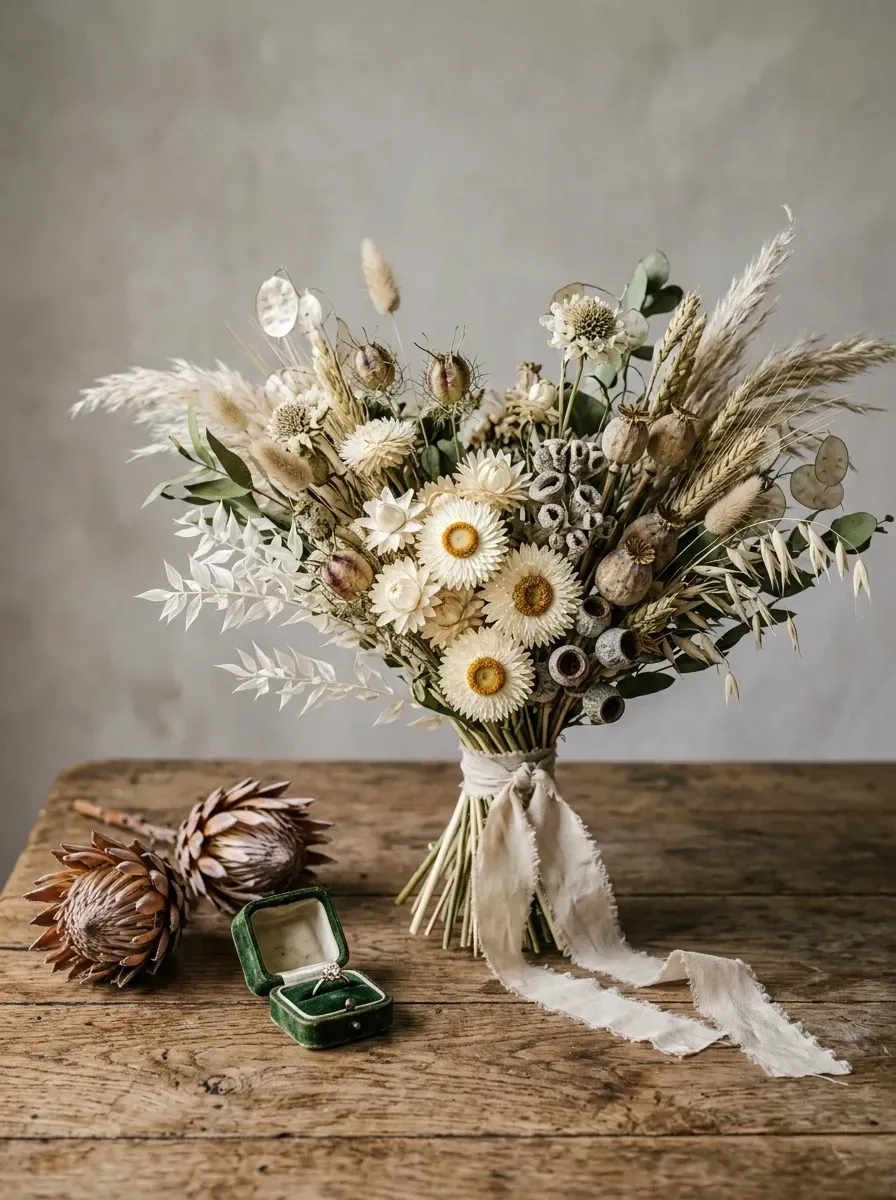
This is the photographer's vignette — the close-up that ends up in the album cover spread. The bouquet (strawflower, king protea, bunny tails, grasses, raw silk ribbon) does the heavy lifting; the two loose protea stems echo the bouquet without competing; the emerald velvet ring box is the single jewel-tone accent that lifts the whole composition from muted to deliberate. Photographers shoot this on a north-facing window at 9 a.m. for the soft, diffused light that flatters dried botanicals.
Plan-aware verdict: dried bridal bouquets are a real material discipline. Strawflower and bunny tails hold their shape for years; baby's breath and lavender hold color for months; eucalyptus silver gum dries beautifully but sheds heavily on darker fabrics — avoid pairing it with deep velvet boxes or charcoal linens unless you want lint in every photo. Source a dried bouquet from a regional florist (Hops Petunia in Hudson, The Hudson Hippie in Saugerties) rather than a national mail-order; the regional florists work from drying stocks they harvested locally over the previous summer and the textural quality is visibly different. Raw silk ribbon (Silk & Willow, Frou Frou Chic) is the small detail that separates a $40 supermarket bouquet from a $250 custom one.
Sourcing & cost (2026 Hudson Valley)
| Item (Qty) | Price Range |
|---|---|
| Custom dried-flower bridal bouquet | $100 – $250 |
| Velvet ring box (The Mrs. Box, vintage) | $15 – $40 |
| Dried king protea stem (x2) | $20 – $50 |
| Rustic wooden plank surface (rental / prop) | $50 – $150 |
| Total estimated | $185 – $490 |
Color Palette
Hudson River driftwood plank or hand-aged reclaimed oak — the unforced patina dried florals deserve.
Roman clay or troweled Venetian plaster in a soft greige — neutral foreground tone that flatters every wedding color story.
Italian silk velvet from The Mrs. Box, Frou Frou Chic, or a vintage 1920s ring box from Etsy.
Hand-dyed mulberry silk ribbon — Silk & Willow, Tono & Co, or Frou Frou Chic.
4. Botanical Dessert Bar on a Vintage Console
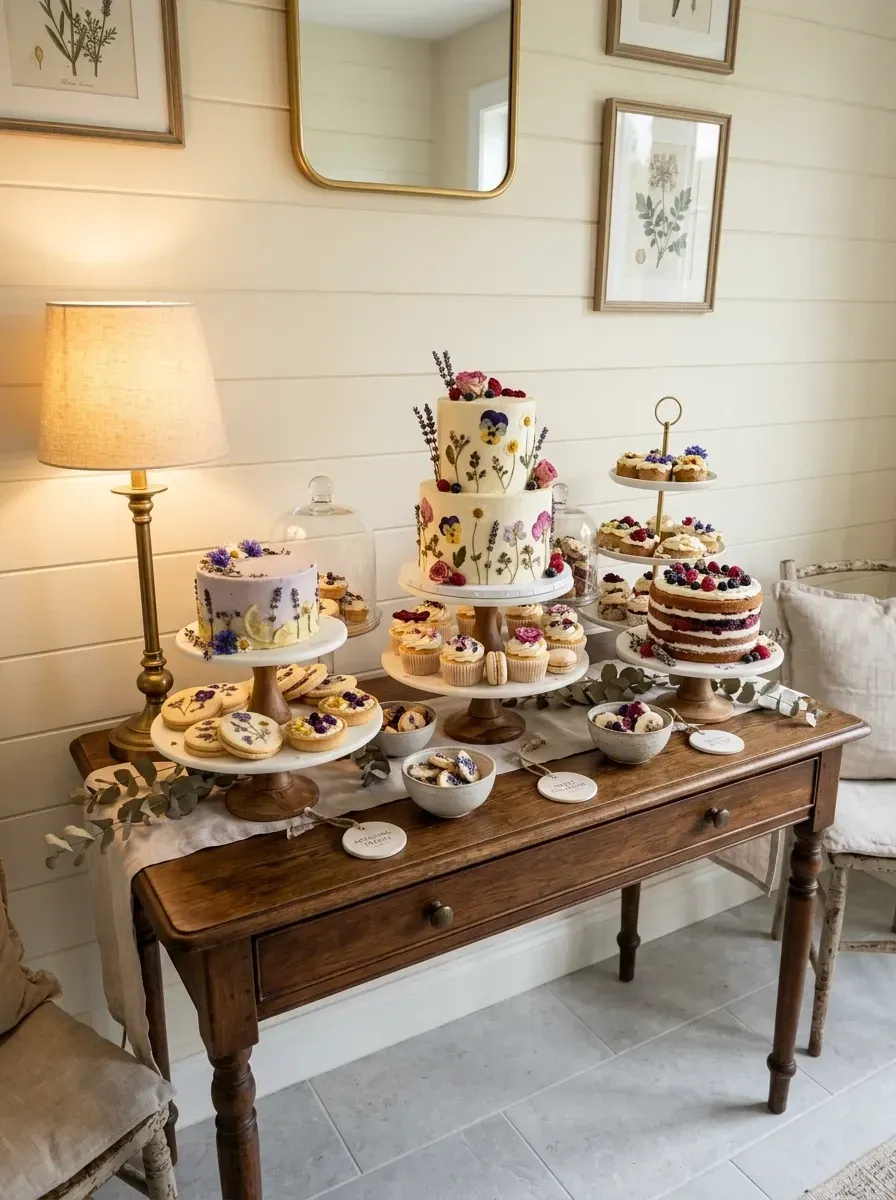
Edible flowers as the styling tool, a vintage console as the framework. The dessert station has weight and asymmetry — cake stand on the left, lamp on the right, framed botanical prints climbing the shiplap wall. The brass lamp is the move that turns the whole thing from buffet to vignette; without an evening light source, the table goes flat the moment the sun drops at a fall wedding. This is the look that wins at a Catskills farmhouse venue, a Beacon riverside cottage rental, or any small-format Hudson Valley reception under 50 guests.
Plan-aware verdict: edible flowers are a food-safety discipline, not just a styling one. Use only certified culinary edibles (pansies, nasturtiums, calendula, rose petals, violets, borage) sourced from a licensed grower — Marx Foods, Gourmet Sweet Botanicals, or a Hudson Valley CSA like Migliorelli or Ironwood Farm. Never decorate cakes with flowers from a florist's cooler unless the florist explicitly confirms food-safe handling; ornamental flowers are often pesticide-treated and not safe to eat. Vintage console tables source well at Hudson, Cold Spring, and Saugerties antique shops — a real 1920s walnut piece runs $400–$700 and outclasses any reproduction.
Sourcing & cost (2026 Hudson Valley)
| Item (Qty) | Price Range |
|---|---|
| Vintage walnut console table (Hudson Valley antique shop) | $300 – $800 |
| Assorted cake stands (x5) (Mosser Glass, vintage milk glass) | $150 – $400 |
| Brass table lamp (Schoolhouse, Visual Comfort) | $100 – $300 |
| Framed antique botanical prints (x3) | $120 – $300 |
| Shiplap wall install (~100 sq ft) — build-out only | $300 – $1,100 |
| Total estimated | $970 – $2,900 |
Color Palette
Benjamin Moore Chantilly Lace (OC-65) or Simply White (OC-117) on primed pine shiplap.
Aged American walnut with the original 1920s shellac patina intact — never refinish a sound antique console.
Schoolhouse Electric or Visual Comfort burnished brass — the warm metallic that flatters edible flowers under tungsten light.
Hand-loomed Belgian or Lithuanian linen runner from Hawkins New York or Cultiver — the small detail that softens a hard table edge.
5. The Boho-Chic Wedding Lounge
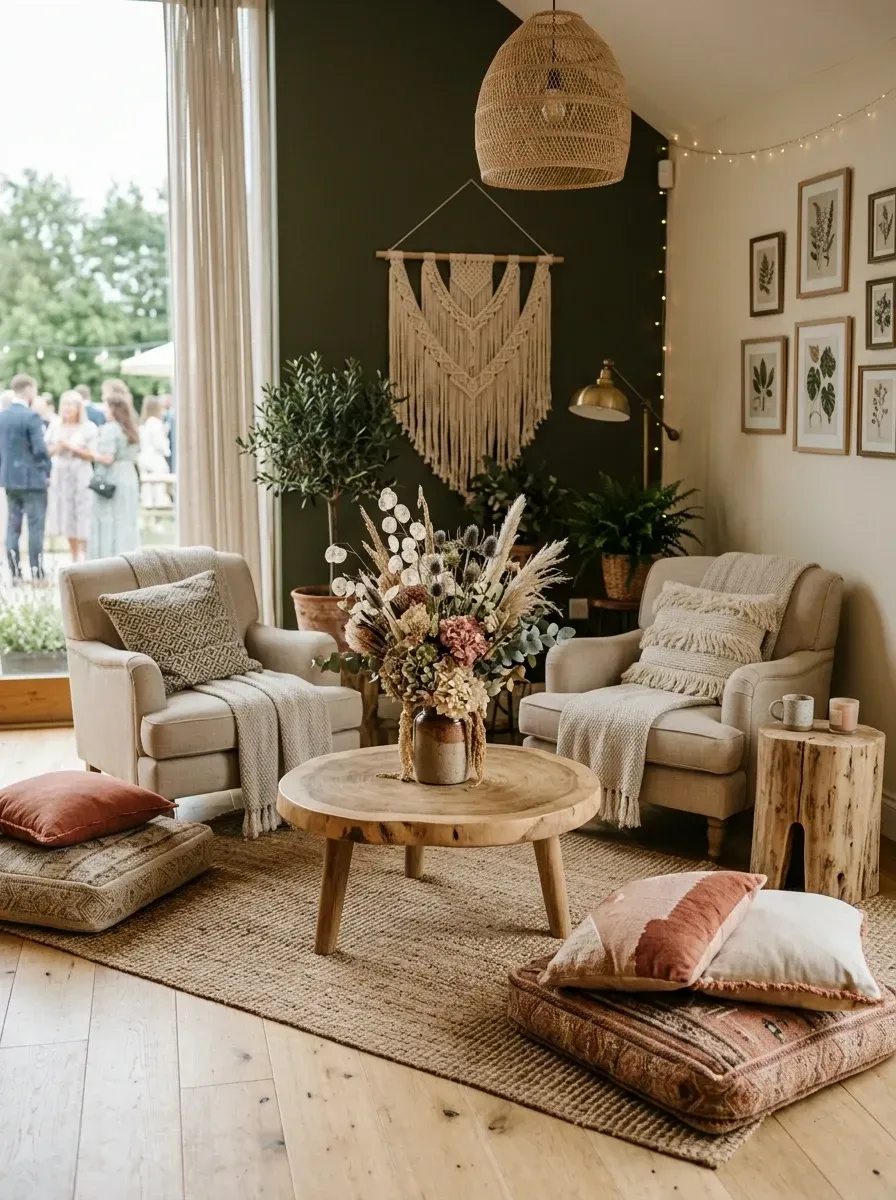
The lounge is the zone guests gravitate to between courses, after the toasts, and during the third hour of dancing when they need to sit somewhere that isn't an assigned-seating chair. This one combines a deep-forest accent wall (the move that makes the photograph) with oatmeal linen lounge chairs, a wood-slice coffee table, jute rug, floor cushions, and a macrame hanging. The string lights are the lighting layer that turns a styled vignette into a place people actually sit.
Plan-aware verdict: a real lounge needs four square feet of clear floor per occupant, which means a 12-by-12 zone holds about 8 guests comfortably. The forest-green accent wall is venue-supplied or temporary — at most Hudson Valley barns you can use removable Tempaper or a freestanding plywood-and-paint flat that disappears the morning after. Linen armchairs from RH Cloud Collection, West Elm Harmony, or Apt2B's outlet hold up to event rental cycles; cheaper foam-fill chairs sag visibly by the third event. Place a 5-by-8-foot jute rug under the front legs of the chairs to anchor the zone — the rug pulled fully under everything is the move that separates a designed lounge from a furniture pile.
Sourcing & cost (2026 Hudson Valley)
| Item (Qty) | Price Range |
|---|---|
| Beige linen lounge armchair (x2) (RH, West Elm, Apt2B) | $600 – $1,600 |
| Round wood-slice coffee table | $150 – $400 |
| Large jute area rug (5×8 or 6×9) | $100 – $300 |
| Large hand-knotted macrame wall hanging | $80 – $250 |
| Floor cushions (x3) (Pampa, The Citizenry, Lulu and Georgia) | $120 – $300 |
| Live-edge tree-stump side table | $80 – $180 |
| Accent wall paint (Farrow & Ball / Tempaper) | $300 – $600 |
| Total estimated | $1,430 – $3,630 |
Color Palette
Farrow & Ball Studio Green (No. 93) or Benjamin Moore Hunter Green (2041-10) — Hudson Valley fall-foliage register.
Heavyweight Belgian linen (RH Cloud, West Elm Harmony) — performance-grade for event rental cycles.
Hand-knotted Indian jute rug and cotton-cord macrame — pair them so the fiber tones echo across both pieces.
Untreated white oak or maple slice — finish with a clear food-safe oil so guests' drinks don't watermark the surface.
6. Rustic Feasting With a Dried Floral Runner
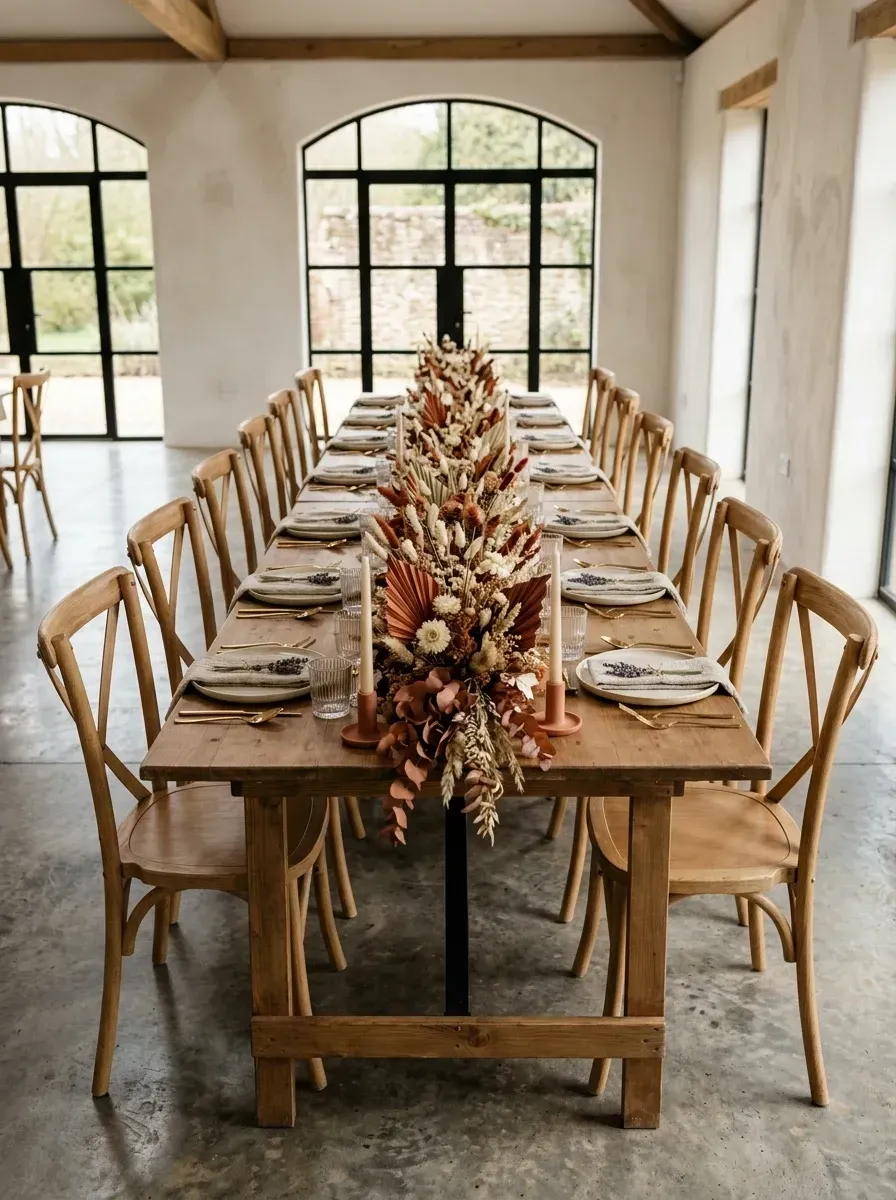
The heart of the reception. A long communal farm table with cross-back chairs and a continuous dried botanical runner running its full length — palm leaves, bunny tails, preserved grasses, small strawflowers, all in the warm autumnal palette that flatters Hudson Valley October light. The runner is low — never above the height of a wineglass — so guests can see across the table and conversation flows. Stoneware plates and linen napkins keep the settings simple enough that the runner stays the focus.
Plan-aware verdict: a 12-foot continuous runner from Hops Petunia, The Hudson Hippie, or Flowers Sage runs $500–$1,200 in 2026 Hudson Valley pricing and is built in three or four overlapping sections so the install crew can place each segment without disturbing place settings. Cross-back chairs (Bistro Chairs, Beachview Event Rentals, Hudson Valley Vintage Rentals) run $80–$150 per chair to rent for the day — buying outright at $200–$400 per chair only makes sense if you'll re-rent them. Taper candles in terracotta holders need 9-inch-minimum drip cups; the dripless versions (Vance Kitira, Bluecorn beeswax) still drop wax onto a runner if the room temperature climbs above 78°F.
Sourcing & cost (2026 Hudson Valley)
| Item (Qty) | Price Range |
|---|---|
| Long rustic farm table (rental, Hudson Valley Vintage Rentals) | $1,000 – $3,000 |
| Wooden cross-back chair (x12) (rental) | $960 – $1,800 |
| Custom 12-ft dried floral table runner (Hops Petunia / Flowers Sage) | $500 – $1,200 |
| Terracotta candle holders (x4) (Eye of the Day) | $60 – $160 |
| Stoneware dinner set (12 settings) (East Fork, Year & Day) | $150 – $400 |
| Total estimated | $2,670 – $6,560 |
Color Palette
Reclaimed pine or oak with a medium oil finish — Hudson Valley barn vernacular, recognizable on sight.
Sealed concrete with a 1500-grit polish — the cool industrial floor that flatters the warm tabletop.
Italian Impruneta terracotta candle holders — the earthy red that pulls dried strawflower and palm together.
Architectural arched steel-frame windows (Crittall, Optimal Windows) — the black grid that frames a Hudson Valley fall view.
7. The Modern Botanical Ceremony Arch
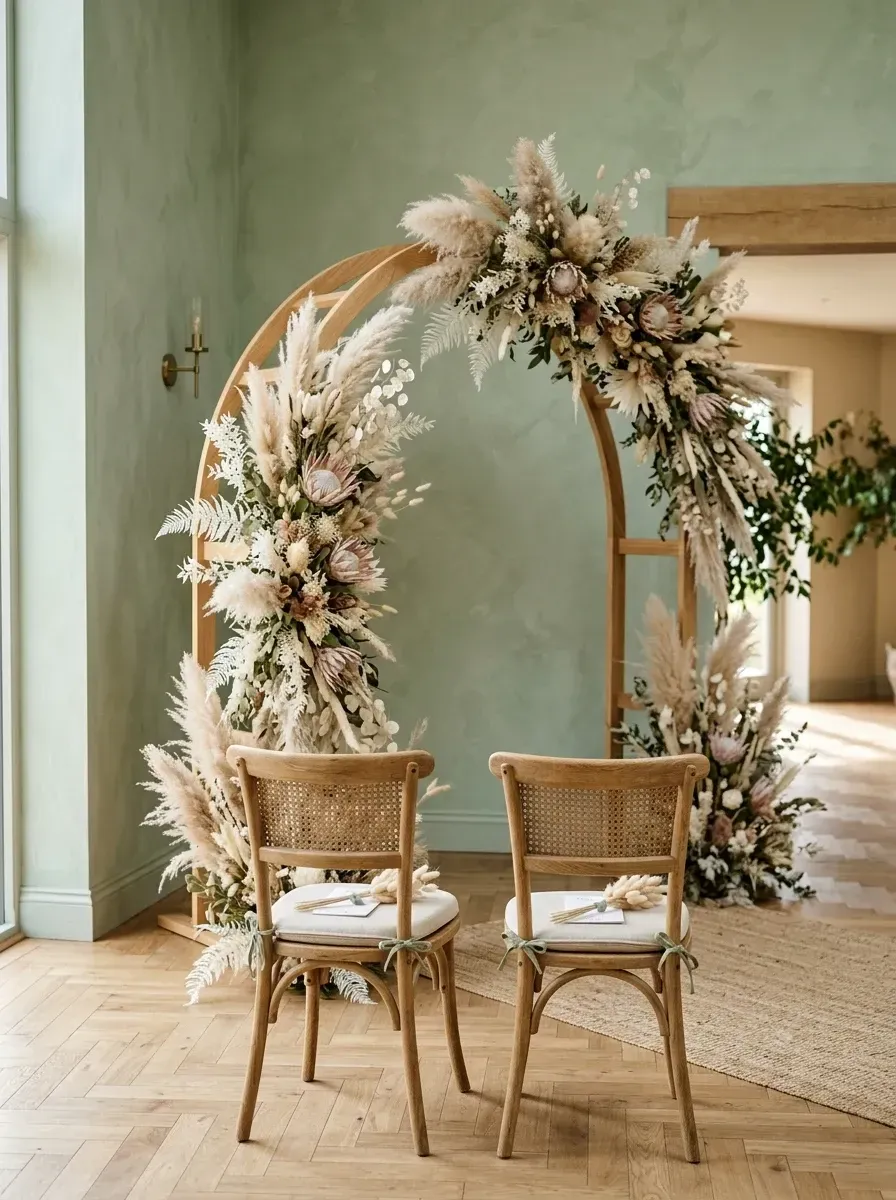
A contemporary altar reading. A rounded blonde-wood arch carries an asymmetrical floral installation clustered at the upper-left corner — not a symmetric drape, not a full coverage. That deliberate asymmetry is what makes the photograph contemporary instead of traditional. The cane-back chairs (one for each partner) and a jute runner on a herringbone floor against a sage plaster wall complete the look. This is the indoor ceremony I'd specify for a 30-to-60-guest wedding at a converted Hudson Valley distillery, a Catskills modern barn, or a Beacon riverfront warehouse.
Plan-aware verdict: a 7-foot wooden circular arch needs proper foot anchoring or it tips in the first gust at an outdoor wedding — fill the steel sleeve feet with concrete or buried sandbags, never freestand on grass. Rent (don't buy) the arch frame from a regional wedding-rental house (Aceity, Hudson Valley Vintage Rentals) at $150–$300 for the day; buying the frame outright only pays back if you'll resell. The floral installation drops onto the arch in three sections that interlock so the install crew can mount it in under 20 minutes on the morning of. Textured sage plaster (Portola Paints Roman Clay in “Bandera”) is a 1-day application, water-cleanup, and removable for venue spaces that don't permit permanent paint.
Sourcing & cost (2026 Hudson Valley)
| Item (Qty) | Price Range |
|---|---|
| Wooden circular arch structure (rental or build) | $300 – $800 |
| Custom dried floral installation for arch | $800 – $2,000 |
| Cane-back dining chair (x2) (Sika Design, Serena & Lily) | $300 – $700 |
| Large jute runner rug | $60 – $150 |
| Textured Roman clay wall (~200 sq ft) — venue prep | $800 – $1,600 |
| Herringbone wood floor (~200 sq ft) — venue prep | $3,000 – $6,000 |
| Total estimated | $5,260 – $11,250 |
Color Palette
Portola Paints Roman Clay in Bandera or Farrow & Ball Mizzle (No. 266) on a Roman clay finish.
European ash or white oak finished with Rubio Monocoat Pure — the blonde tone that flatters dried pampas.
Indonesian rattan cane back (Sika Design, Serena & Lily) paired with hand-knotted Indian jute.
European oak herringbone, oil-finished — the floor pattern that lifts an indoor ceremony from event to architecture.
Pro Tips From the Renovation Designer's Chair
- Rig from structure, not from styling. Floral clouds, hanging installations, and overhead garlands have real weight. Insist on a licensed event rigger with a Hudson Valley structural sign-off, load-rated cable, and the venue's beam-attachment confirmation in writing. The visual payoff is enormous; the failure mode is catastrophic.
- Schedule the photographs to the light, not to the timeline. Dried botanicals flatter under soft north-facing morning light and warm late-afternoon side-light. Schedule the bouquet flatlay at 9 a.m., the ceremony at 3 p.m., the lounge shots at 5 p.m. — and accept that midday hard light is the worst possible read on dried material.
- Plan repurpose at the same time you plan the install. Dried bouquets, runners, and arch installations don't die at midnight. A pre-arranged donation route — Wedding Recyclers, Repeat Roses, Random Acts of Flowers, or a local Hudson Valley nursing home — turns a styling cost into a community gesture. Decide before the wedding, not after.
- Source locally before sourcing nationally. Hudson Valley dried-floral suppliers (Hops Petunia in Hudson, The Hudson Hippie in Saugerties, Flowers Sage in Beacon, Catskill Foraged Goods) work from local drying stocks harvested the previous summer. The textural quality, the freshness, and the carbon footprint all beat national mail-order. Pay the regional premium; it shows in the photographs.
- Test the venue before you commit the install. A 75-degree barn in May humidifies dried baby's breath into a saggy mass by Sunday morning. A 92-degree August converted-mill space drops every pampas frond within four hours. Visit the venue at the same time of day and season your wedding will be, and observe the temperature, the humidity, and the light. Then plan the materials.
- Edible flowers are food, not decor. Only flowers from a licensed culinary grower (Marx Foods, Gourmet Sweet Botanicals, a regional Hudson Valley CSA) belong on food guests will eat. Florist-cooler flowers are typically pesticide-treated and unsafe. If you can't verify food-safe sourcing in writing, decorate the platters, not the food itself.
Cost-Saving Moves That Don't Show
- Forage responsibly. Hudson Valley meadows, rail-trail edges, and your own property yield seed heads, grasses, branches, dock, goldenrod, and Queen Anne's lace in late summer. Never forage on state park land or private property without permission. Dry your foraged stock in a cool dark closet for three to four weeks — most material is ready by Labor Day for a fall wedding.
- DIY-dry roses and lavender. Plan three to six months ahead. Hang bunches upside down in a dry, dark, well-ventilated closet — roses, lavender, eucalyptus, statice, and amaranth all dry beautifully without specialized equipment. One DIY arrangement at home plus one professional install at the ceremony arch is the cost-saving sweet spot.
- Rent the structural pieces, buy the small ones. Farm tables, cross-back chairs, the arch frame, the lounge furniture — rent. Cake stands, ring boxes, candle holders, vases, ribbon, linen napkins — buy used at Hudson Valley antique markets where every piece costs a third of new retail and patinas correctly.
- Reuse the install across the day. The arch flowers move to the head table after the ceremony. The seating-chart pampas restocks the lounge for the after-party. The dessert-station florals get bundled into guest take-home wraps as the night winds down. One install team, three placements — the small move that cuts a florist invoice by 30%.
Reader Questions on Dried & Foraged Wedding Decor
How far in advance should I order dried-floral wedding decor?
For a regional Hudson Valley florist (Hops Petunia, The Hudson Hippie, Flowers Sage) handling a full wedding install — bouquet, runner, ceremony arch, and accent pieces — book six to nine months in advance. Smaller pieces like a single bridal bouquet and boutonnieres can be ordered three to four months out. If your wedding involves a custom-grown component (your florist drying their own strawflowers, calendula, or amaranth for a specific palette), plan a full year ahead so they can plant in spring for an autumn drying cycle. National mail-order operations can deliver in two to four weeks, but the textural and color quality is consistently lower than what regional growers offer.
What is a realistic dried-floral wedding decor budget for a 100-guest Hudson Valley wedding in 2026?
For a 100-guest wedding using dried and foraged decor as the primary visual story — bridal bouquet, bridesmaid bouquets, boutonnieres, a ceremony arch installation, three or four floral runners across feasting tables, bar styling, and a seating-chart vignette — expect $6,500 to $14,000 in 2026 Hudson Valley pricing. Adding a large overhead floral cloud or a full lounge zone pushes that to $10,000 to $20,000. Compared to fresh-flower equivalent, dried decor runs roughly 20% lower per arrangement but the labor cost can offset the savings if you commission custom installations. The real economic advantage is repurpose — guests can take pieces home and the bridal bouquet keeps indefinitely.
Do dried florals hold up at outdoor Hudson Valley weddings in different seasons?
Spring and early summer are the riskiest seasons for outdoor dried-floral installations in the Hudson Valley — humidity peaks in May and June and rebounds in late July through August, sagging baby's breath, collapsing pampas, and silvering eucalyptus within hours. Late September through October is the optimal window: low humidity, warm afternoon light, and the natural autumnal palette that dried botanicals were drying toward all summer. For a humid-season outdoor ceremony, plan a covered installation (tented arch, sheltered lounge, or a quick move-indoors plan). Tabletop pieces and bouquets hold up far better than overhead clouds in challenging weather.
Are pampas grass and dried palm fronds sustainable choices?
Pampas grass is the conversation. Imported pampas (most of the U.S. market) is grown in Argentina or China and trucked or shipped thousands of miles, so the carbon footprint is significant. Regionally grown pampas exists — California's Central Coast produces it, and a small number of Hudson Valley farms are experimenting with cold-hardy cultivars — but the supply is limited. The truly sustainable version of this aesthetic uses Northeast-foraged alternatives: native grasses (little bluestem, switchgrass, big bluestem), wild oats, dock seed heads, and milkweed pods. The visual texture is comparable, the carbon footprint is dramatically lower, and the materials support local meadow ecology.
Can dried-flower decor be repurposed after the wedding?
Yes — and this is the strongest argument for the entire approach. Bridal bouquets keep indefinitely if stored away from direct sunlight; many couples have theirs reframed in a shadowbox by a local Hudson Valley framer. Runners and arch installations break down into smaller home-decor pieces — wreaths, console-table arrangements, dried-flower bundles for guest bedrooms. Larger installations can be donated to local nursing homes (Northern Dutchess Residential Health Care, Wingate at Beacon), to Random Acts of Flowers, or to Wedding Recyclers, all of which have Hudson Valley pickup networks. Plan the repurpose route before the wedding so the install team knows the day-after disassembly plan.
What's the difference between dried, preserved, and silk wedding flowers?
Dried flowers are real botanicals air-dried or kiln-dried after harvest — strawflower, lavender, baby's breath, statice, pampas grass, and many seed heads dry well. Preserved flowers are real botanicals treated with glycerin or specialized solutions that replace plant moisture with a stabilizer, keeping the bloom flexible and color-vibrant for one to three years — preserved roses and preserved eucalyptus are the most common. Silk (or other synthetic) flowers are not real plants at all; high-end silks (Diane James, Winward Designs) are convincing but use petroleum-derived materials and zero biodegradability. For sustainable weddings, dried and preserved are the natural choices; silk is the compromise when a specific color or shape isn't available in real material.
Where to Read Next
If this wedding-decor study was useful, the sustainable garden party decor guide is the natural outdoor companion to the indoor vignettes above, and the quiet luxury dining room guide shows how to translate the feasting-table aesthetic into year-round home use. For the full sweep of celebration content across the site, the celebrations archive is the place to browse, and the living and dining category covers the room-by-room thinking that informs every install above.
Sources & Further Reading
- Slow Flowers Society. Local-Floral Sourcing Guide & American Grown Floral Calendar — regional florist directory and seasonal availability. slowflowers.com
- Association of Specialty Cut Flower Growers (ASCFG). Cut & Dried — A Guide to Drying Cut Flowers for Wedding and Event Use. ascfg.org
- Society of American Florists. Sustainable Floral Industry Standards & Wedding Floral Trend Reports. safnow.org
- U.S. Food & Drug Administration. Guidance on Edible Flower Safety for Foodservice Use — pesticide and food-safe sourcing standards.
- Wedding Recyclers & Repeat Roses. Floral Donation Networks & Wedding Sustainability Resources — pickup logistics and donation routing. repeatroses.com
- Martha Stewart Weddings & Brides. Dried Floral Wedding Trend Coverage 2025–2026 — editorial trend reporting.
- Marx Foods & Gourmet Sweet Botanicals. Edible Flower Product Catalogs & Culinary Safety Documentation. marxfoods.com
- The Mrs. Box, Silk & Willow, Frou Frou Chic. Heirloom Ring Box & Hand-Dyed Silk Ribbon Product Documentation.
- Roman Clay & Limewash Wall Finishes — Portola Paints & Bauwerk Color application guides. portolapaints.com
- Hudson Valley Tourism Board. Regional Wedding Venue Directory — Beacon, Rhinebeck, Hudson, Kingston, Catskills Corridor.

Nora Whitfield
Renovation Designer & Interiors Editor · Beacon, New YorkNine years of design-build renovation work across the Hudson Valley and the Northeast. Nora runs the Renovations, Room Guides and Renovation Mind desks — before-and-after studies, room-by-room design guides, and the long essays on why what we renovate matters.
More from Nora →
Reader notes