

A backyard pool is the single most consequential outdoor project most homeowners ever take on — half landscape design, half civil engineering, all permit. After seven years walking Hudson Valley jobsites and reading hundreds of pool drawing sets, I've come to think of the "staycation pool" not as a feature but as a small building with water in it. The nine examples below cover the range I see clients actually consider, from a modest porcelain-decked rectangle to a full hillside resort. Each one is read the way I'd read it before sketching: structure first, services second, finishes last.
How I Read a Pool Project Before Drawing It
Every successful pool I've worked on answers four questions before a single shovel goes in the ground: where does the water table actually sit, what's the structural soil situation, where does the equipment pad live with respect to noise and service access, and what does the local pool code require for fencing and setbacks. On a Hudson Valley site that means a frost line at 42 inches, NYS Residential Code Appendix V for swimming pools, mandatory 48-inch perimeter fencing with self-closing self-latching gates, and a written winterization plan because the equipment will freeze and burst if you don't drain it properly each November.
My second pass is treating the pool surround as architecture. The decking is the floor, the boundary planting or fence or retaining wall is the walls, and the pergola or shade sail or open sky is the ceiling. The nine examples below each commit to those three planes differently. None of them are "just a pool" — they are pool plus deck plus seating plus lighting, every layer detailed before any of them gets built. If you'd like a smaller-scale read on this same outdoor-room logic, my garden corner transformations piece runs the same playbook at 60-square-foot scale.
1. Modern Minimalist Pool with Integrated Planters
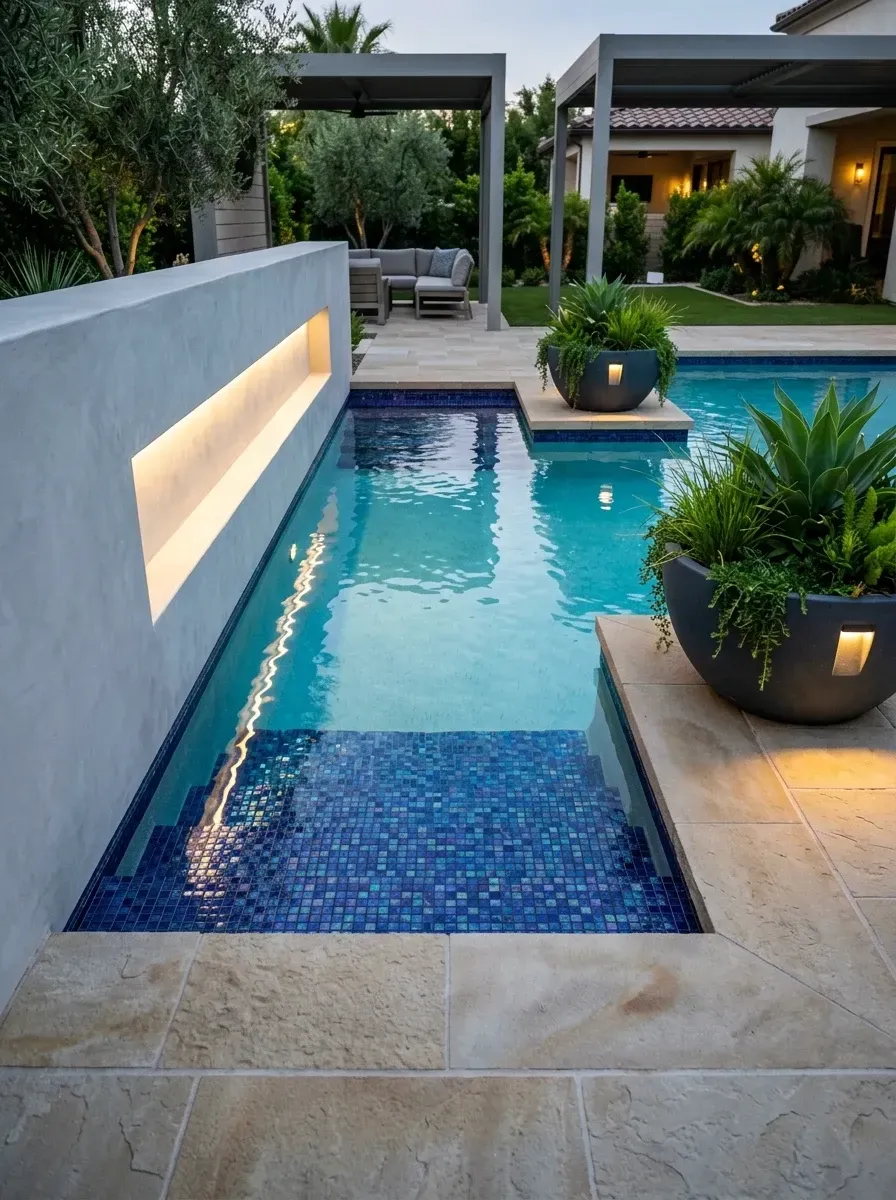
This is the cleanest entry point for a luxury rectangular pool, and almost everything that makes it work happens at the framing-and-rough-in stage. The recessed LED reveal in the concrete feature wall needs the conduit run through the formwork before the pour — there is no clean retrofit for that detail. The mosaic spa-to-pool spillover is a hydraulic decision: a separate variable-speed pump (Pentair IntelliFlo3 or Hayward TriStar VS), a properly sized spillway, and a return manifold sized to the surface area you want moving. Done right, the spa feeds the pool with a quiet sheet of water; done wrong, it gurgles.
The sculptural concrete planters holding agave are the disciplined choice. Agave is borderline for USDA Zone 5–6, so on a Hudson Valley project I substitute hardy yucca (Yucca filamentosa "Color Guard") or a tall Sansevieria stand in summer that overwinters indoors. The large-format pavers — porcelain like Mirage Tecnica or Iris Diesel Living in a polished concrete look — sit on adjustable pedestals over a fallen sub-base, never on sand. Pedestal decking around a pool is the smart call because it gives you maintenance access to anything that fails underneath.
Features
- Integrated LED wall reveal (cast into formwork, not surface-mounted)
- Concrete planter wall with through-color render finish
- Mosaic tile spa with sheet-of-water spillover
- Large-format porcelain pavers on adjustable pedestals
- Sculptural round concrete planters with hardy yucca
Cost Analysis
| Item (qty) | Total price range |
|---|---|
| Custom concrete planter wall with cast-in LED reveal | $5,000 - $10,000 |
| Large round concrete planters with hardy yucca (×2) | $600 - $1,700 |
| Mosaic pool tiles for spa & spillway (Bisazza or Mosaicos Venecianos) | $3,000 - $7,000 |
| Porcelain paver decking on pedestals (≈500 sq ft, material + labor) | $7,500 - $15,000 |
| Louvered aluminum pergola (Struxure or Renson, in background) | $8,000 - $20,000 |
| Total estimated cost | $24,100 - $53,700 |
Color Palette
Concrete Grey
#959595
Through-color render — K Rend silicone TC in a custom mid-grey, not painted blockwork.
Sandstone Beige
#C8B29A
Porcelain in a warm sandstone — Mirage Norr Beige or Atlas Concorde Boost Stone.
Cobalt Blue
#0047AB
Glass mosaic in a cobalt blend — Bisazza Saint Tropez or Trend Liquid pool series.
Warm White LED
#FFF4E0
2700K, 24V IP67 strip — driver located in a serviceable junction box, never buried in render.
2. Travertine Lounge with a Round Fire Pit
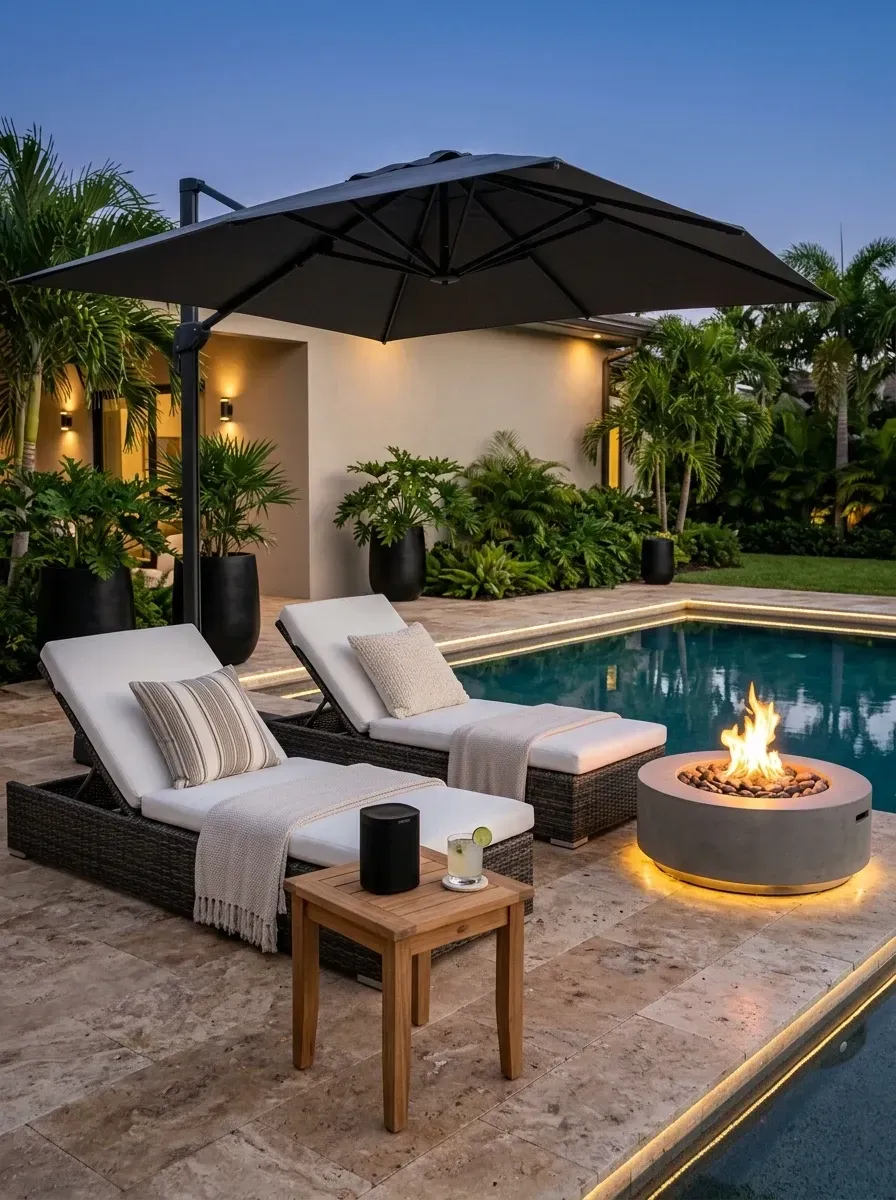
Travertine is the right call for a pool deck in the Northeast for the same reason it's wrong for Phoenix or Charleston — it stays cool underfoot and weathers honestly through freeze-thaw. The pieces that matter are calibration (a 20mm vein-cut or cross-cut tile, never a 12mm honed slab), the bonding method (full mortar bed on a properly fallen and reinforced slab), and the sealer (penetrating, not topical — Aqua Mix Sealer's Choice Gold or Miracle 511 Impregnator). A topical sealer will fail at the first ice storm and look like a yellowed garage floor by year two.
The round concrete fire pit pretends to be portable furniture but is structurally serious. A propane line buried below frost (or a portable bottle in a hidden compartment) and a UL-listed burner with a windscreen are not optional in the Northeast. The big cantilever umbrella (Tuuci, Shademaker Polaris, or Treasure Garden) needs a properly anchored in-ground base — a 200-pound rolling base does not survive an actual Hudson Valley summer storm. Plan the anchor at the same time as the deck.
Features
- Vein-cut travertine pavers on a full mortar bed
- Woven all-weather rope chaise lounges with Sunbrella cushions
- Cantilever umbrella with in-ground anchor
- Round concrete fire pit with propane line or hidden bottle compartment
- Warm-white LED channel along the pool coping
Cost Analysis
| Item (qty) | Total price range |
|---|---|
| Woven chaise lounges with Sunbrella cushions (×2) | $1,200 - $3,000 |
| Large cantilever umbrella with in-ground anchor | $600 - $2,500 |
| Round concrete fire pit with gas burner | $800 - $2,500 |
| Teak side table (Gloster, Sutherland, or comparable) | $150 - $400 |
| Large black GFRC planters (×2) | $300 - $800 |
| In-ground LED channel lighting (≈50 ft installed) | $2,500 - $5,000 |
| Travertine paver decking (≈400 sq ft, material + labor) | $4,800 - $10,000 |
| Total estimated cost | $10,350 - $24,200 |
Color Palette
Warm Taupe
#A39284
Vein-cut travertine in a warm taupe — quarry-direct from MSI or Stoneville.
Charcoal Grey
#36454F
A grounded dark accent — powder-coated aluminum umbrella frame, GFRC planters in a charcoal pigment.
Off-White Sunbrella
#F8F4E6
Sunbrella Canvas Natural or Canvas Antique Beige — the only outdoor fabric I specify for a Northeast pool deck.
Teak Brown
#8F5E3A
FSC-certified teak, oiled with Semco or left to weather to silvery grey.
3. High-Tech Evening Pool with Multi-Layer Lighting
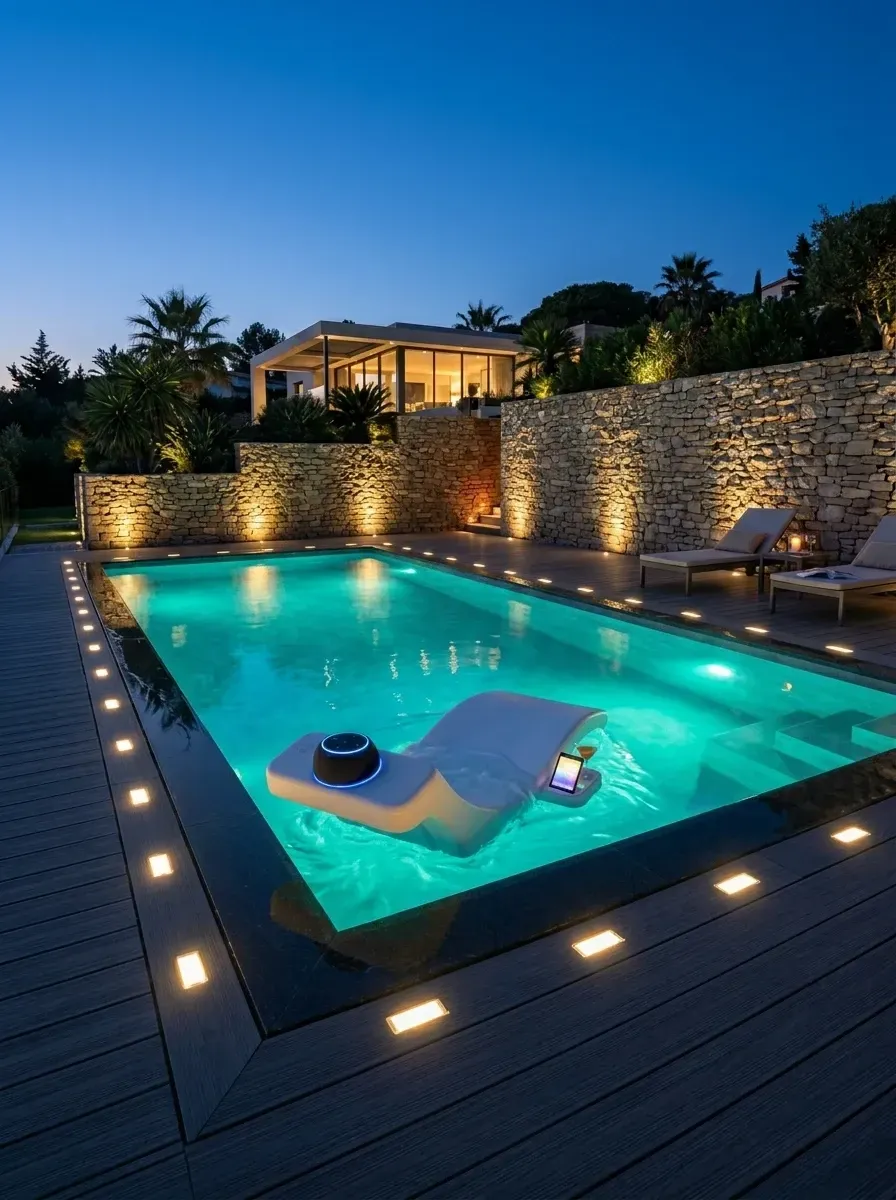
A multi-layer pool lighting plan is three separate circuits, three separate controls, and three separate purposes. Pool-shell lighting (Pentair IntelliBrite or Hayward ColorLogic LED in a niche light) handles the swimming environment. Landscape uplights on the stone retaining wall (FX Luminaire or Kichler 12V) handle the architectural drama. Integrated deck lights along the composite (Trex DeckLighting or LMT Mercer brass step-lights) handle code-required safety. On the drawings every circuit gets its own transformer, its own GFCI protection, and its own dimmer — pooled together they fail and confuse, separated they let the homeowner actually live with the lighting.
The textured stone retaining wall is the visual anchor, but it is also a structural element doing real work on the grade. In the Hudson Valley I draw retaining walls over 4 feet tall with engineered drainage (a perforated 4-inch sock pipe, a #57 gravel chimney, and proper weep holes) and a stamped engineer's design. The visual texture — a stack-bond dry-laid look with mortared structural courses behind — is the right finish. Skip the engineering and the wall bows by year five.
Features
- Color-changing pool-shell LED (Pentair IntelliBrite or Hayward ColorLogic)
- Warm-white deck lights integrated into composite
- Low-voltage uplights washing stone wall texture
- Engineered retaining wall with drainage chimney
- App-controlled smart-speaker floating lounger
Cost Analysis
| Item (qty) | Total price range |
|---|---|
| High-end floating pool lounger (Pigro Felice or Funboy) | $800 - $1,500 |
| Waterproof smart speaker (Sonos Move 2 or JBL Charge 5) | $150 - $400 |
| Engineered stone retaining wall (≈500 sq ft face, material + labor + drainage) | $15,000 - $30,000 |
| Composite decking on framed sub-frame (≈800 sq ft, material + labor) | $8,000 - $17,600 |
| Three-circuit landscape and deck lighting (transformers, controllers, fixtures) | $1,600 - $4,500 |
| Total estimated cost | $25,550 - $54,000 |
Color Palette
Warm Stone Beige
#BDB29F
A dry-stack natural stone with mortared structural courses — Boral Cultured Stone or Eldorado Cliffstone.
Dark Grey Composite
#4A4A4A
Trex Transcend Island Mist or NewTechWood Magellan Westminster — fade-rated and stain-resistant.
Cyan Turquoise
#00FFFF
A scene preset on the IntelliBrite controller — useful for parties, dimmable to a quieter setting nightly.
Warm White
#FDF4DC
2700K LED step-lights, IP65, hard-wired through a GFCI-protected circuit.
4. The Japanese-Inspired Poolside Retreat
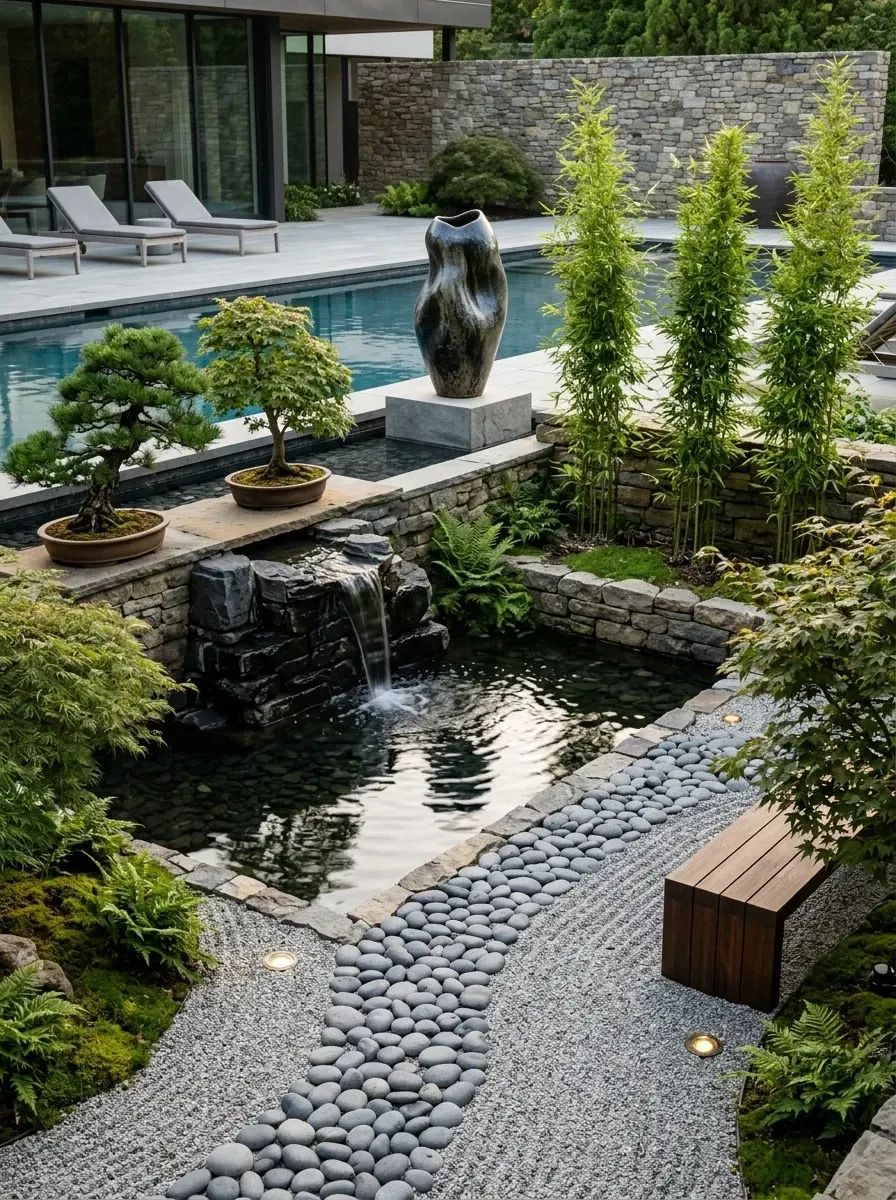
A water feature with a pond beside a chlorinated pool is a chemistry problem hiding inside a styling problem. The two systems have to be completely separated — different pumps, different filtration, different water lines. The pond uses a bog-filter biological system (Aquascape Signature Series or Atlantic Water Gardens BioFalls); the pool uses a sand or DE filter and a sanitizer. Cross-contaminate them and you kill either the fish or the swimmers. On the drawings the equipment pads sit in separate compounds with separate power feeds.
Bamboo planting is where this design lives or dies. Running bamboo (Phyllostachys) will eat a Hudson Valley property line in three years if you don't install a 60-mil HDPE root barrier 30 inches deep at the time of planting. Clumping bamboo (Fargesia) is the right answer for cold climates and won't run, but it grows slower and looks sparser the first three seasons. Set the expectation honestly with the client. For pieces on this same calm-and-planted register, my forest-bathing nook walkthrough covers the planted-screen logic in more detail.
Features
- Bog-filtered waterfall and pond on separate equipment from the pool
- Pebble pathway with stepping stones and puck lights
- Clumping bamboo screen with HDPE root barrier
- Mature bonsai trees on rotation (indoor in winter)
- Anchored stone abstract sculpture as focal point
Cost Analysis
| Item (qty) | Total price range |
|---|---|
| Custom waterfall + bog-filtered pond construction | $10,000 - $30,000 |
| Large abstract stone sculpture with anchored pedestal | $2,500 - $11,500 |
| Mature bonsai trees on display rotation (×2) | $500 - $2,500 |
| Clumping bamboo planting (Fargesia, with HDPE barrier) | $500 - $1,500 |
| Pebble ground cover and stepping-stone path (material + labor) | $2,500 - $5,500 |
| Slat-style wooden bench (cedar or thermally modified ash) | $300 - $800 |
| Pond and path lighting system | $800 - $2,000 |
| Total estimated cost | $17,100 - $53,800 |
Color Palette
Light Grey
#D3D3D3
Mexican beach pebble or Trentino river pebble — 20–40mm sizing, sourced from a stone yard, not a landscape big-box.
Dark Slate
#2F4F4F
Wet-look slate or basalt boulders — selected for character, not uniformity.
Living Green
#228B22
Fargesia bamboo, hardy ferns (Dryopteris erythrosora), bonsai on rotation — chosen for zone hardiness, not aesthetic copy.
Medium Teak Brown
#8B4513
FSC teak or thermally modified ash, oiled with Penofin Verde or Sansin Enviro.
5. Pergola Dining at the Pool's Edge
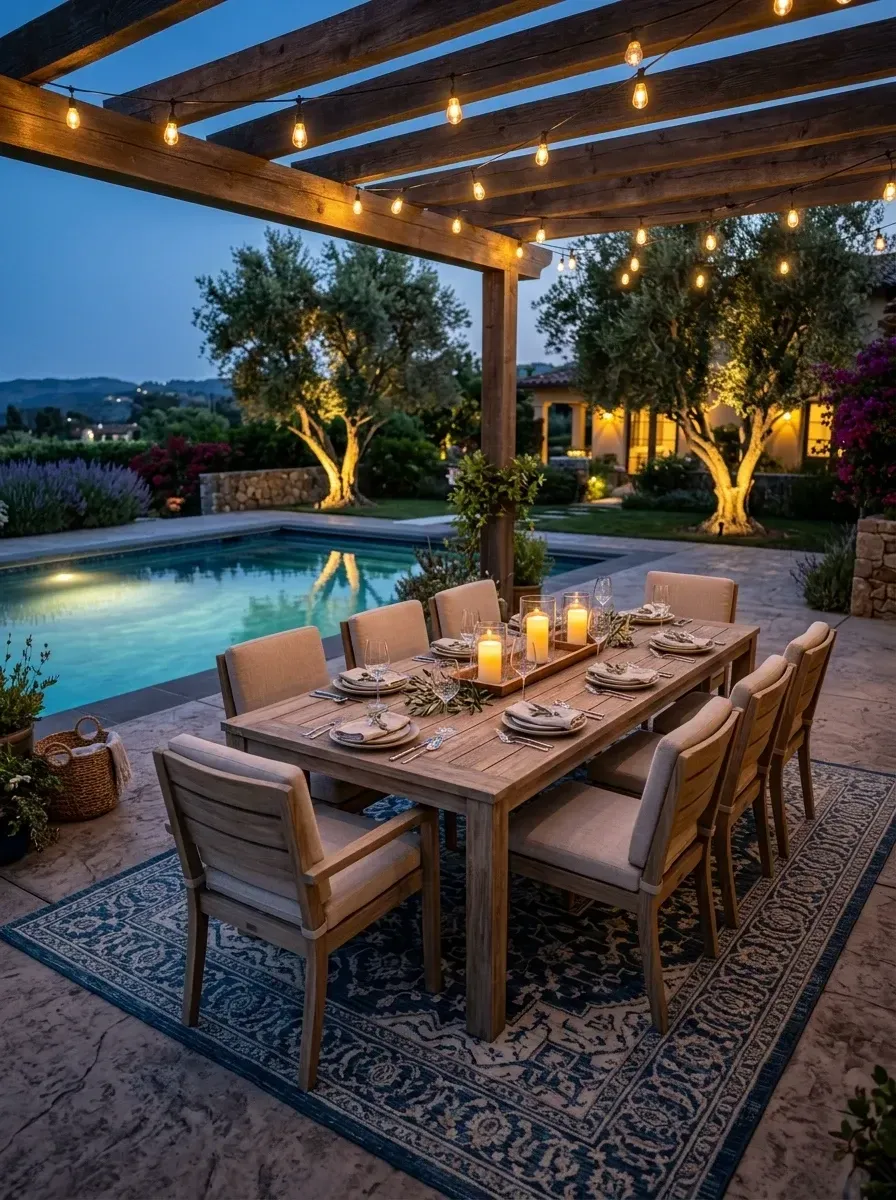
A solid-timber pergola at the pool's edge is a foundation project, not a furniture purchase. Posts sit on concrete piers below frost (42 inches in the Hudson Valley) with embedded Simpson Strong-Tie post bases — never set directly in concrete or in surface saddles. The roof structure depends on the load: a true wood pergola can carry a covered roof and snow load if you've engineered for it; an aluminum louvered roof (Struxure, Renson Camargue) handles snow load by default but reads as a different material altogether. Pick one architecturally; don't try to look like wood with aluminum or vice versa.
A teak table for eight at the water's edge is also a code conversation in some jurisdictions — proximity to the pool counts toward setback and barrier rules. The outdoor rug needs to be a flatweave indoor-outdoor (Dash & Albert, Loloi Mateo, or Annie Selke) that drains and dries; a thick pile traps water and breeds mildew. Commercial-grade bistro lights with stainless catenary cable are the only kind I spec — consumer-grade strands die after one Hudson Valley winter even if you take them down.
Features
- Engineered timber pergola on frost-depth piers
- Commercial-grade bistro lights on stainless catenary
- Long teak dining table (FSC-certified, oil-finished)
- Upholstered dining chairs in Sunbrella fabric
- Flatweave indoor-outdoor rug, drains and dries
Cost Analysis
| Item (qty) | Total price range |
|---|---|
| Engineered wood pergola on concrete piers (material + labor) | $5,000 - $15,000 |
| Commercial-grade bistro string lights, installed | $300 - $800 |
| Large FSC teak dining table (≈9 ft) | $2,500 - $6,000 |
| Upholstered dining chairs in Sunbrella (×8) | $2,400 - $6,400 |
| Large indoor-outdoor flatweave rug (≈9×12) | $300 - $1,000 |
| Place settings for eight + candle centerpiece | $550 - $1,350 |
| Total estimated cost | $11,050 - $30,550 |
Color Palette
Weathered Wood Brown
#7B5E46
Pressure-treated or thermally modified pine for the pergola; FSC teak for the table.
Beige Taupe
#C0B2A3
Sunbrella Canvas Antique Beige or Heather Beige — the textile that survives Northeast summers.
Deep Blue
#283757
Indigo or deep navy — Dash & Albert Diamond Indigo or Loloi Mateo.
Warm Amber
#FFB347
2200K bistro bulbs, dimmable, on a stainless catenary cable.
6. Open-Air String-Light Dining Canopy
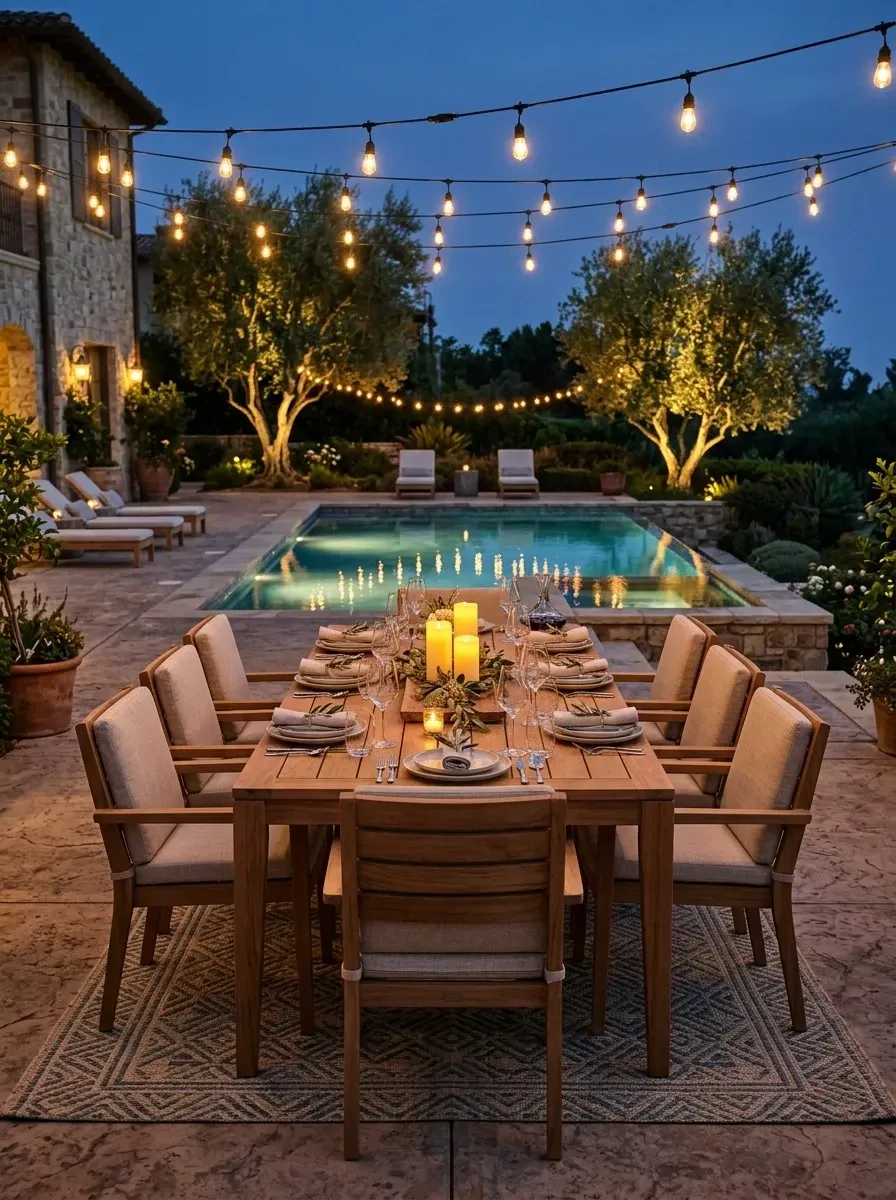
This is the same dining program as transformation #5 with the pergola swapped out for a string-light canopy. Architecturally it's the lighter, faster, cheaper move — and the right call if zoning, setback, or budget makes a built pergola impossible. The drawings need to call out the anchor strategy for the catenary: stainless lag bolts into solid blocking on the house, opposing 4×4 cedar or steel posts set in concrete at the far end. Tensioned wire between mature trees is a temporary install at best; mature tree growth will eventually pull the anchor loose or wound the tree.
Teak weathers to a silvery grey if left untreated and stays a rich golden brown if oiled twice a year with Semco Teak Sealer or a Sansin product. Both are honest — pick one and commit. The mistake I see most often is partial oiling: a homeowner oils once, doesn't repeat, and ends up with a streaky two-tone table that reads as deferred maintenance. The natural centerpiece of olive branches, herbs, or seasonal fruit is the right move because it costs nothing and reads more designed than a $300 store-bought arrangement. For a related celebration-and-styling read, the sustainable garden party decor guide goes deeper on outdoor table styling.
Features
- Multi-strand bistro canopy on stainless catenary
- Long FSC teak dining table, 8 ft minimum
- Teak chairs with Sunbrella cushions
- Geometric flatweave outdoor rug
- Natural-element centerpiece (olive branches, candles, fruit)
Cost Analysis
| Item (qty) | Total price range |
|---|---|
| Bistro string lights, multi-strand on stainless catenary with posts | $500 - $1,500 |
| Large FSC teak dining table (≈8–9 ft) | $2,500 - $6,000 |
| Teak dining chairs with Sunbrella cushions (×8) | $3,200 - $7,200 |
| Large outdoor rug (≈9×12) | $300 - $1,000 |
| Place settings for eight + natural centerpiece | $600 - $1,400 |
| Large terracotta planter with olive or hardy substitute | $200 - $500 |
| Total estimated cost | $7,300 - $17,600 |
Color Palette
Warm Teak
#A0785A
FSC teak — Gloster, Sutherland, Skagerak, or comparable.
Light Beige
#E8E0D5
Sunbrella Canvas Natural — UV-resistant and water-shedding.
Blue Grey Geometric
#778899
A muted blue-grey geometric — Dash & Albert Tangier or Annie Selke Tegan.
Warm Yellow
#FDD023
2200K bistro LED — dimmable on a smart relay (Lutron Caséta outdoor module).
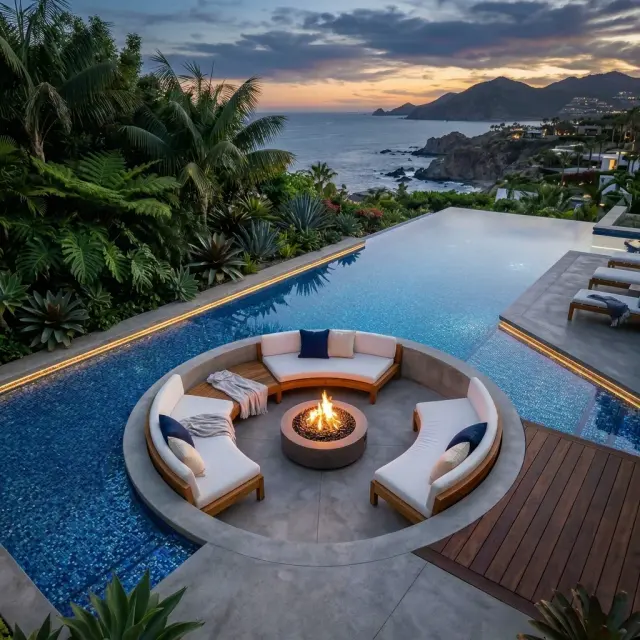
7. Sunken Lounge Inside an Infinity Pool
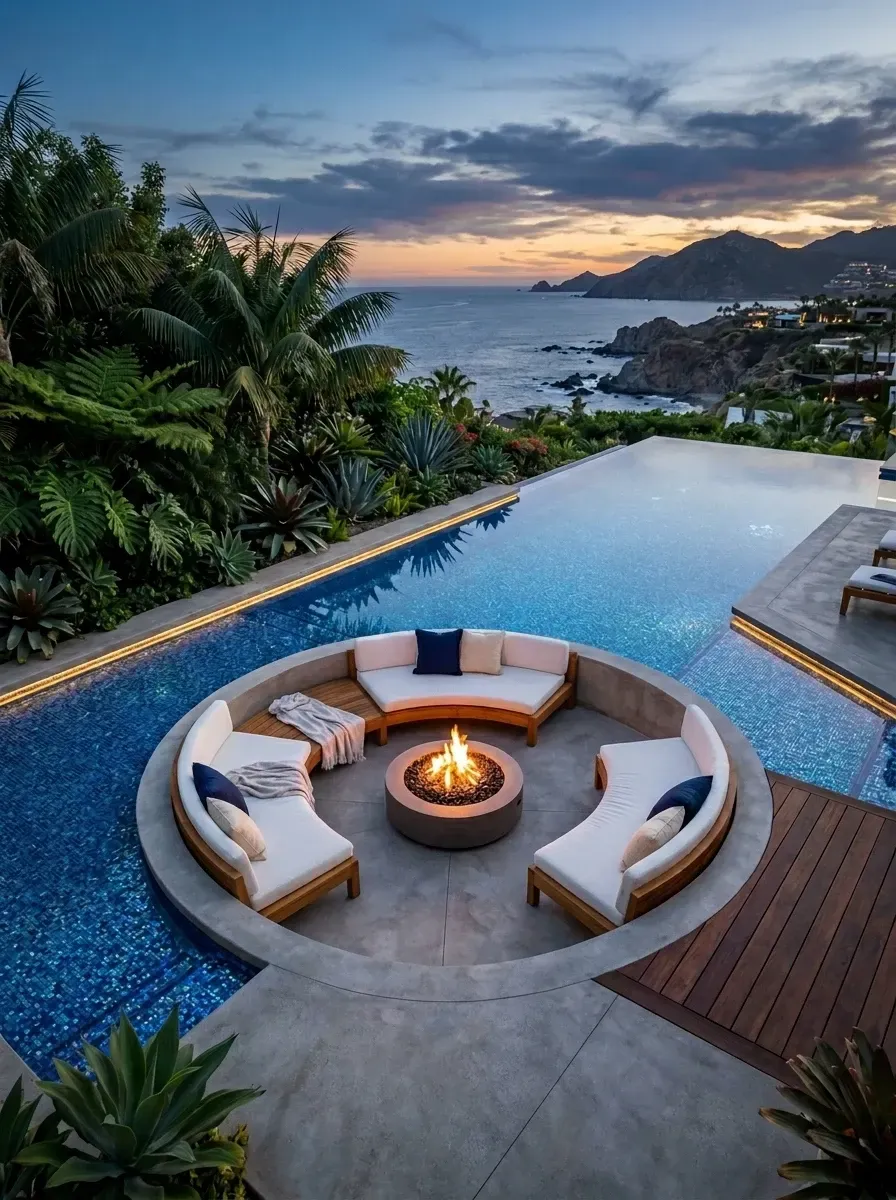
A sunken lounge inside a pool is the most structurally demanding feature on this list — you are pouring an island inside a watertight tank. The drawings need a stamped engineer's design for the bench and floor of the sunken area, properly waterproofed at every cold joint, with rebar dowels keying the lounge floor into the pool shell. The fire pit at the center adds a gas line that has to be sleeved, sealed, and pressure-tested before any concrete encapsulates it. None of this is optional. A sunken lounge built without that engineering will leak into the pool shell or crack at the joint within two seasons.
The infinity edge is the second structural conversation. A true infinity edge is a precise weir wall, a catch basin sized for the entire weir volume plus surge, and an over-sized circulation pump (Pentair IntelliPro VSF or Hayward EcoStar) that can fill the weir without sound. The water you see disappearing over the edge is being pumped back from a hidden catch basin below — that's the whole illusion. The teak decking accent inside a wet zone is fine if it's FSC plantation teak with a stainless fastener system; non-plantation teak in a wet zone is a sustainability problem and often a quality problem too.
Features
- Engineered circular sunken lounge inside the pool shell
- True infinity edge with sized catch basin and surge pump
- Central gas fire pit on a sealed, pressure-tested line
- Built-in concrete benches with custom Sunbrella cushions
- FSC plantation teak decking with stainless fastener system
Cost Analysis
| Item (qty) | Total price range |
|---|---|
| Engineered sunken lounge construction (concrete, waterproofing, rebar) | $30,000 - $60,000 |
| Custom curved cushions and pillows (Sunbrella, marine-grade) | $5,000 - $10,000 |
| Central built-in gas fire pit with UL-listed burner | $3,000 - $6,000 |
| Infinity-edge premium (catch basin, surge pump, weir wall) | $15,000 - $30,000 |
| FSC teak decking section (material + labor) | $2,000 - $5,000 |
| Integrated LED strip lighting under benches | $1,000 - $2,500 |
| Total estimated cost | $56,000 - $113,500 |
Color Palette
Deep Ocean Blue
#005F8B
The pool finish choice — a Diamond Brite or Pebble Tec interior in a deep blue blend reads this color in real light.
Crisp White
#FFFFFF
Sunbrella Canvas White with marine-grade trim — quick-dry foam cores.
Navy Blue
#000080
Sunbrella Navy or Captain Navy — accent only, swappable seasonally.
Rich Teak
#8D5F3F
FSC plantation teak, oiled and maintained on a six-month cycle.
8. Sleek Modern Pool with an Automatic Cover
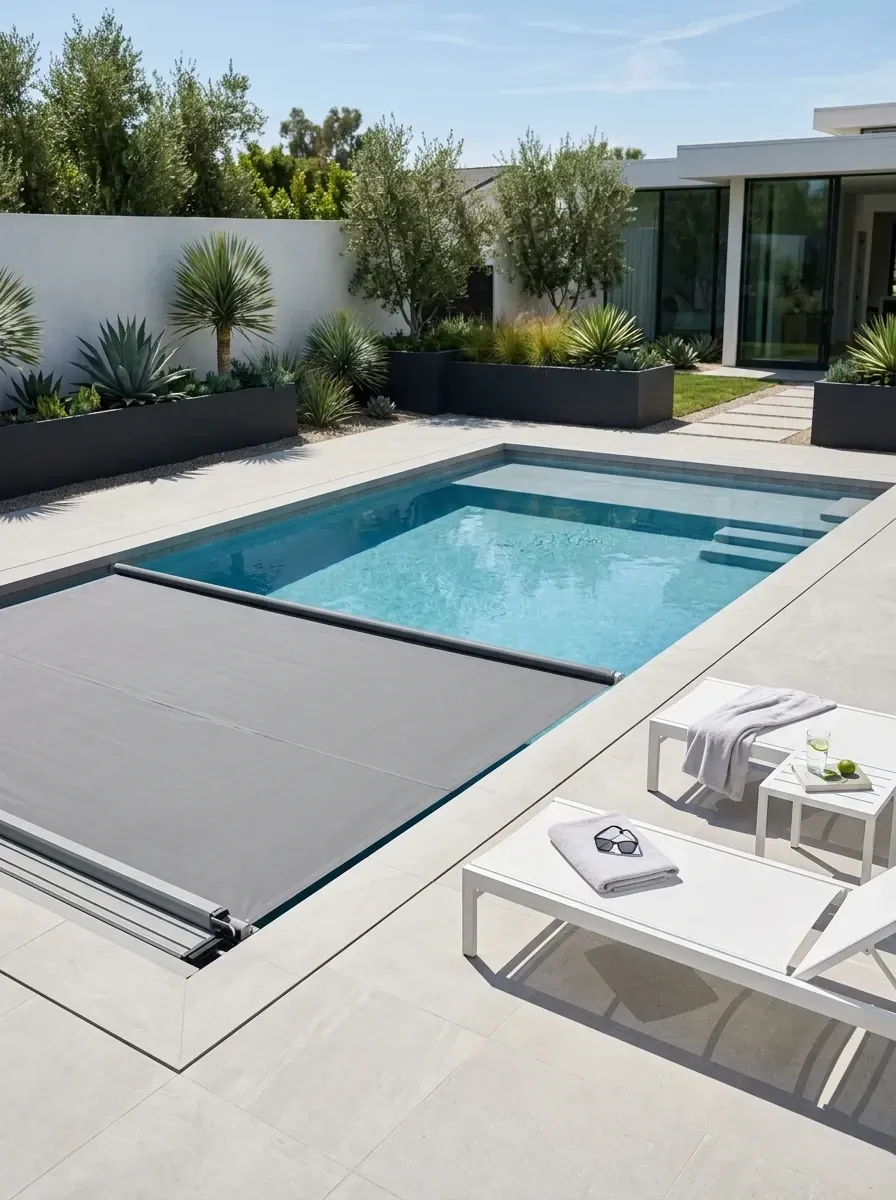
An automatic pool cover (Coverstar Eclipse, Cover-Pools Save-T, or Pool Cover Specialists) is the single best decision a Northeast homeowner can make on a new build. It pays back in three ways at once: child-safety compliance (most municipalities accept an ASTM F1346-compliant cover in lieu of a separate fence), heating cost reduction (40–70 percent depending on use pattern), and chemical and evaporation savings. The catch is that it has to be designed into the pool from day one — the cover housing sits at the deep end with its own structural pocket and motor, the tracks recess into the coping, and the pool dimensions are sized to standard cover widths.
The minimalist deck is the right finish for an auto-covered pool because the cover itself reads as part of the architecture when retracted. Large-format porcelain (Atlas Concorde, Florim, or Mirage in 24×48 or 32×32) installed on adjustable pedestals over a fallen slab keeps the look clean and gives full service access to anything that fails below. Long dark planters (Pottery Pots Beton, Capi Lux, or a custom GFRC fabricator) flanking the deck add the architectural anchor without the labor of a built-in planter wall.
Features
- Integrated automatic safety cover (Coverstar or equivalent)
- Large-format porcelain decking on adjustable pedestals
- Long GFRC or metal planters with architectural grasses
- White powder-coated aluminum sun loungers
- Architectural planting — Miscanthus, Calamagrostis, or hardy yucca
Cost Analysis
| Item (qty) | Total price range |
|---|---|
| Integrated automatic pool cover system (Coverstar / Cover-Pools) | $10,000 - $20,000 |
| Large-format porcelain decking (≈800 sq ft, material + labor) | $12,000 - $20,000 |
| Long metal or GFRC planter (×2) | $1,000 - $3,000 |
| Architectural planting (grasses, agave or hardy yucca) | $500 - $1,500 |
| Powder-coated aluminum sun loungers (×2) | $800 - $2,000 |
| Aluminum side table | $100 - $300 |
| Total estimated cost | $24,400 - $46,800 |
Color Palette
Cool Light Grey
#B0B0B0
Mirage Tecnica Grey or Florim Industrial Grey — 20mm exterior porcelain, rectified edge.
Dark Charcoal
#333333
Powder-coated steel or pigmented GFRC in a deep charcoal — Capi Lux or a custom fabrication.
Pure White
#FFFFFF
Powder-coated marine-grade aluminum — Tribù, Gloster, or Brown Jordan.
Muted Green
#8F9E8B
Miscanthus sinensis "Morning Light" or Calamagrostis "Karl Foerster" — zone-hardy, architectural form.
9. The Full Hillside Resort Complex
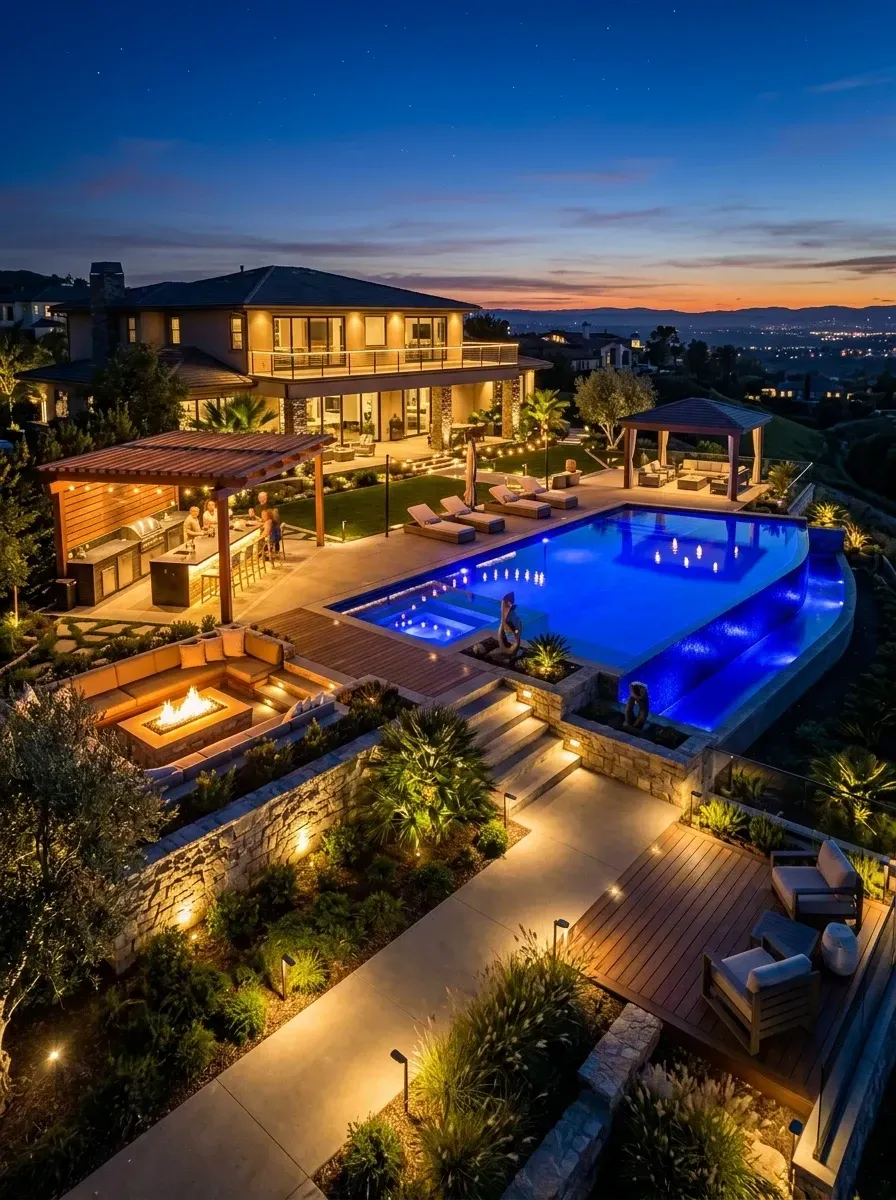
A project at this scale is no longer a pool — it's a master-planned outdoor building program. The hillside grade alone is half the budget: retaining walls, drainage, stair construction, and grading account for a third of the line item in every similar project I've worked on. The pool, spa, infinity edge, shallow shelf, and equipment compound need to be coordinated with the landscape contractor before either of them starts, because the structural pool shell is the foundation everything else is referenced from. On the drawings I show the pool first, then the retaining wall network, then the outdoor kitchen and pergola, then the connector paths, then the lighting — in that order, because each layer depends on the one before it.
The outdoor kitchen at this scale typically includes a built-in gas grill (Wolf Outdoor or Lynx Sedona), a refrigerator (Sub-Zero Designer Series or U-Line), a ventilation hood if it sits under a roof, a sink with hot and cold water, and an L-shaped bar with a stone or quartzite top. Every appliance is a permit and every plumbing run is a setback question. The lighting at this scale is no longer DIY territory — a comprehensive plan from a lighting designer (FX Luminaire, Vista Pro, or a local specialist) on a smart controller (Lutron Caséta Outdoor or Coastal Source) is the only way it works as a unified scene.
Features
- Custom pool with spa, shallow shelf, and infinity edge
- Full outdoor kitchen with high-end built-in appliances
- Sunken fire-pit lounge with built-in seating
- Multiple gazebos and seating zones connected by stone paths
- Engineered hillside retaining walls with proper drainage
- Comprehensive smart-controlled landscape lighting plan
Cost Analysis
| Item (qty) | Total price range |
|---|---|
| Large custom pool + spa (infinity edge, shallow shelf, full automation) | $150,000 - $300,000 |
| Full outdoor kitchen (Wolf/Lynx, Sub-Zero, sink, pergola) | $40,000 - $80,000 |
| Sunken fire-pit lounge with engineered seating | $20,000 - $40,000 |
| Gazebo structures (×2) | $10,000 - $30,000 |
| Hardscaping — stone retaining walls, pavers, stairs | $50,000 - $150,000 |
| Comprehensive landscape lighting on smart controller | $10,000 - $25,000 |
| Outdoor furniture program (loungers, dining, deep seating) | $20,000 - $50,000 |
| Total estimated cost | $300,000 - $675,000 |
Color Palette
Vibrant Cobalt
#0020C2
A scene preset on a Pentair IntelliCenter or Hayward OmniLogic — adjustable for the mood, not locked at one color.
Warm Beige Tan
#CDBA96
Natural Pennsylvania bluestone or Indiana limestone — sourced and detailed consistently across all elevations.
Warm Amber Gold
#FFBF00
2700K landscape uplights and 2200K fire features — coordinated on a single smart controller.
Medium Cedar
#966F33
Western Red Cedar or Accoya for the pergolas, FSC ipe or thermally modified ash for decking sections.
Pro Tips From the Renovation Designer's Chair
- Design the equipment pad first. Pumps, filters, heaters, controllers, and the cover motor all live somewhere. That somewhere needs power, service access, noise buffering, and code-compliant clearances. Pick the location on day one, before the pool shape, because pad placement constrains pipe runs and pipe runs constrain the pool layout.
- Pull the safety-cover decision early. An automatic safety cover changes the pool dimensions, the coping detail, and often the local code compliance path. Decide on it before the pool is dimensioned, not after.
- Spec three lighting layers. Pool-shell light for swimming, deck-and-step light for safety, landscape and architectural up-light for drama. Each on its own circuit with its own dimmer. The single-circuit pool with one switch is the most common reason a beautiful build looks ordinary at night.
- Frost line is structural, not advisory. In the Hudson Valley that's 42 inches. Pergola piers, fire-pit footings, planter footings, and any vertical structure must sit below it. Surface saddles fail on a Northeast pool deck within three years.
- Choose Sunbrella for every cushion, every umbrella, every pillow. The pretender fabrics fade and grow mildew on a Hudson Valley pool deck. Sunbrella has the only track record I trust here, and the price delta over off-brand acrylics is small relative to the replacement cycle.
- Plan winterization at build time. Drain-down valves at the low points, a removable pump strategy for water features, and a written closing checklist. Hand the checklist to the homeowner with the project closeout. A pool without a winterization plan is a pool that bursts.
Cost-Saving Moves
- Porcelain pavers over natural stone. Mirage, Atlas Concorde, and Florim 20mm exterior porcelain in a travertine or limestone look delivers about 90 percent of the visual and arguably better freeze-thaw behavior at 40–60 percent of natural-stone pricing.
- Portable fire features over built-in. A high-quality propane fire table (Solo Stove Mesa XL or RH Pierre) is one-fifth the cost of a built-in gas pit, requires no excavation, and moves when the homeowner's pattern of use changes.
- Commercial bistro lights over fully hard-wired landscape lighting. A 100-foot run of commercial-grade bistro lights on two cedar posts lights a 600-square-foot patio for under $500 in materials. Hard-wired equivalents start at five times that.
- Phase the build over two or three seasons. Pool shell, decking, and one seating zone in season one. Outdoor kitchen, pergola, and lighting in season two. Plantings and finishing layer in season three. Phasing the spend lets cash flow keep pace with the project and gives you time to live with each phase before committing to the next.
Reader Questions on Luxury Pool Design
What's a realistic 2026 budget for a luxury in-ground pool plus surround in the Hudson Valley?
A turnkey rectangular gunite pool with a basic concrete deck, single-color LED, and a manual cover lands around $90,000–$130,000. Adding a spa with spillover, an automatic safety cover, porcelain decking, and a small lounge zone brings it to $160,000–$240,000. A full hillside complex with infinity edge, outdoor kitchen, and multi-zone landscape lighting is $300,000–$700,000 depending on grade, retaining wall scope, and finish level.
Do I really need an automatic safety cover, or is a manual cover enough?
In New York and most surrounding states, a code-compliant barrier is mandatory — typically a 48-inch perimeter fence with self-closing self-latching gates, or an ASTM F1346-compliant automatic safety cover in place of the fence. A manual tarp cover is not code-compliant for child safety. Beyond compliance, the automatic cover pays back in heating cost, chemical savings, and evaporation reduction. On a Hudson Valley install it's the single highest-leverage line item.
Can I have a pool and a koi pond near each other without chemistry problems?
Yes, but only if they're hydraulically separated systems with their own pumps, filtration, and water supply. Chlorine, salt, or any pool sanitizer will kill fish on contact, and the bog filtration of a healthy pond will throw off the chemistry of a pool quickly. Run them as two adjacent but unrelated systems, with their equipment pads in separate compounds. Cross-contamination is not a small problem to clean up.
Which pool finish is best for a Northeast climate — plaster, aggregate, or tile?
For a Hudson Valley pool I almost always specify a polished aggregate interior (Pebble Tec, Pebble Sheen, or Diamond Brite). It handles freeze-thaw cycling better than plaster, resists staining, and weathers without the "scaly" look plaster develops by year eight. All-tile interiors are stunning but four to six times the cost and need a specialist installer who understands cold-climate tile failure. Plaster is the budget option but the shortest-lived in the Northeast.
How early should I involve a landscape architect or designer on a pool project?
Before the pool builder, ideally. The pool's siting, dimensions, equipment pad, and deck layout all interact with the larger landscape, drainage, and circulation plan. Engaging a designer after the pool builder has committed shape and dimensions means you're decorating around a pool rather than designing one. On every successful project I've worked on, the designer and the pool contractor were in the same room before either committed to a shovel location.
What's the most common mistake homeowners make on luxury pool builds?
Underestimating the deck, the lighting, and the surround. The pool itself is typically 50–60 percent of the build budget; the other 40–50 percent is decking, planting, lighting, seating, fencing, and equipment screening. Homeowners who budget the pool well and the surround badly end up with a beautiful body of water sitting in an unfinished landscape. Plan and budget the whole picture, not just the water.
Where to Read Next
If you're working through the smaller-scale outdoor decisions that complement a pool program, the backyard forest-bathing nook walkthrough covers planted-screen and quiet-corner logic that drops cleanly into a poolside garden. The biophilic tiny-balcony notes apply the same small-outdoor-room thinking to apartment-scale spaces. For the wider topic pillar — every outdoor renovation piece on the site in one place — the outdoor renovations category is the right index.
Sources & Further Reading
- New York State Department of State, Residential Code Appendix V — Swimming Pools: Pool barrier, fencing, and safety-cover requirements.
- U.S. Consumer Product Safety Commission: Pool Safely — Child Drowning Prevention Resources.
- Pentair IntelliCenter Documentation: Pool Automation and IntelliBrite Lighting Spec Sheets.
- Coverstar Eclipse Engineering: Automatic Safety Cover Engineering Documentation.
- ASTM International: ASTM F1346 — Standard Performance Specification for Safety Covers.
- USDA Plant Hardiness Zone Map: USDA Plant Hardiness Zones — confirm before specifying olives, agave, or bamboo.
- Sunbrella Technical Data: Sunbrella Outdoor Furniture Fabric Specifications.
- Aquascape Pond Design Resources: Bog Filtration and Pond Construction Guides.
- NAHB Cost vs. Value Report: Outdoor Renovation Return-on-Investment Data.
- Trex Engineering Guide: Composite Deck Sub-Frame, Pedestal, and Fastener Documentation.

Nora Whitfield
Renovation Designer & Interiors Editor · Beacon, New YorkNine years of design-build renovation work across the Hudson Valley and the Northeast. Nora runs the Renovations, Room Guides and Renovation Mind desks — before-and-after studies, room-by-room design guides, and the long essays on why what we renovate matters.
More from Nora →
Reader notes