

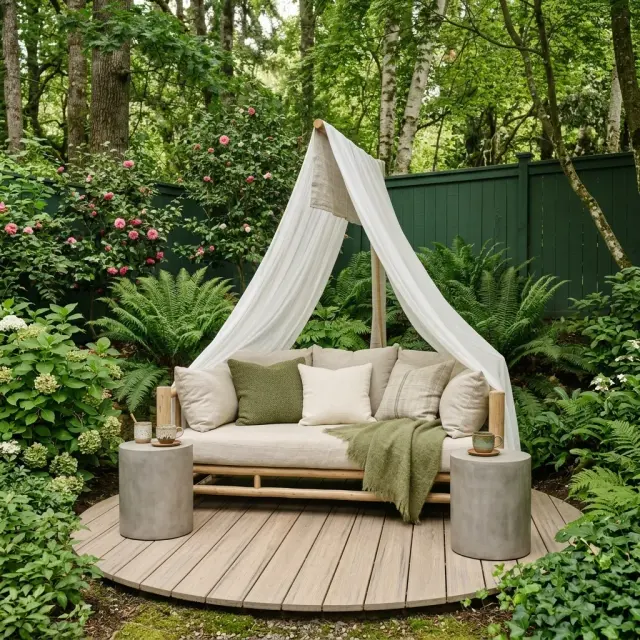
A forest-bathing nook is the most overdesigned and underbuilt outdoor project I see in Hudson Valley back gardens. Clients want the Japanese shinrin-yoku calm — soft moss, layered light, the sound of moving water — and they almost always start with a Pinterest board and a contractor quote, in that order. The actual sequence is reversed. A forest-bathing nook works when four structural decisions are made before any furniture or plant order goes in: drainage, frost-protected footings, electrical for layered lighting, and the sight line that decides whether the nook reads as escape or as backyard furniture. Below: twelve outdoor nooks that handle those decisions well, with the real Northeast cost ranges and the framing-stage moves behind each one.
How I Read a Forest-Bathing Nook
When a Beacon, Rhinebeck, or Cold Spring client asks me to carve a quiet retreat out of an existing yard, I read four things before any furniture or plant order goes in: the drainage path (where storm water actually moves across the site, sloping at 1/4 inch per foot minimum away from the house), the frost-protected footings (every post, pergola pier, and fence anchor in the Hudson Valley needs to clear 42 inches of frost depth — a non-negotiable code-and-physics issue), the electrical plan (GFCI-protected 20-amp outdoor circuits for layered lighting and any water feature, run before paving goes in), and the sight line from the house (the nook needs to read as a destination from the kitchen window — that's what gets it used).
Across seven years of running design-build out of the Hudson Valley, the outdoor nooks that get used daily are the ones planned with these four moves in mind from day one — not the prettiest in the photo, but the most resolved on the site. The twelve nooks below cover the realistic spread, from $850 minimalist gravel zones to $16,650 zen decks. For an adjacent biophilic read on the same calm-and-greenery vocabulary applied indoors, see our biophilic bedroom design guide.
Reading note. The numbering doesn't rank. Each nook fits a different yard size, sun exposure, and budget — a small Brooklyn brownstone garden, a mid-sized Beacon weekend house, a large Rhinebeck country property. Skip to the section closest to your actual site.1. Modern Wood & Greenery Retreat
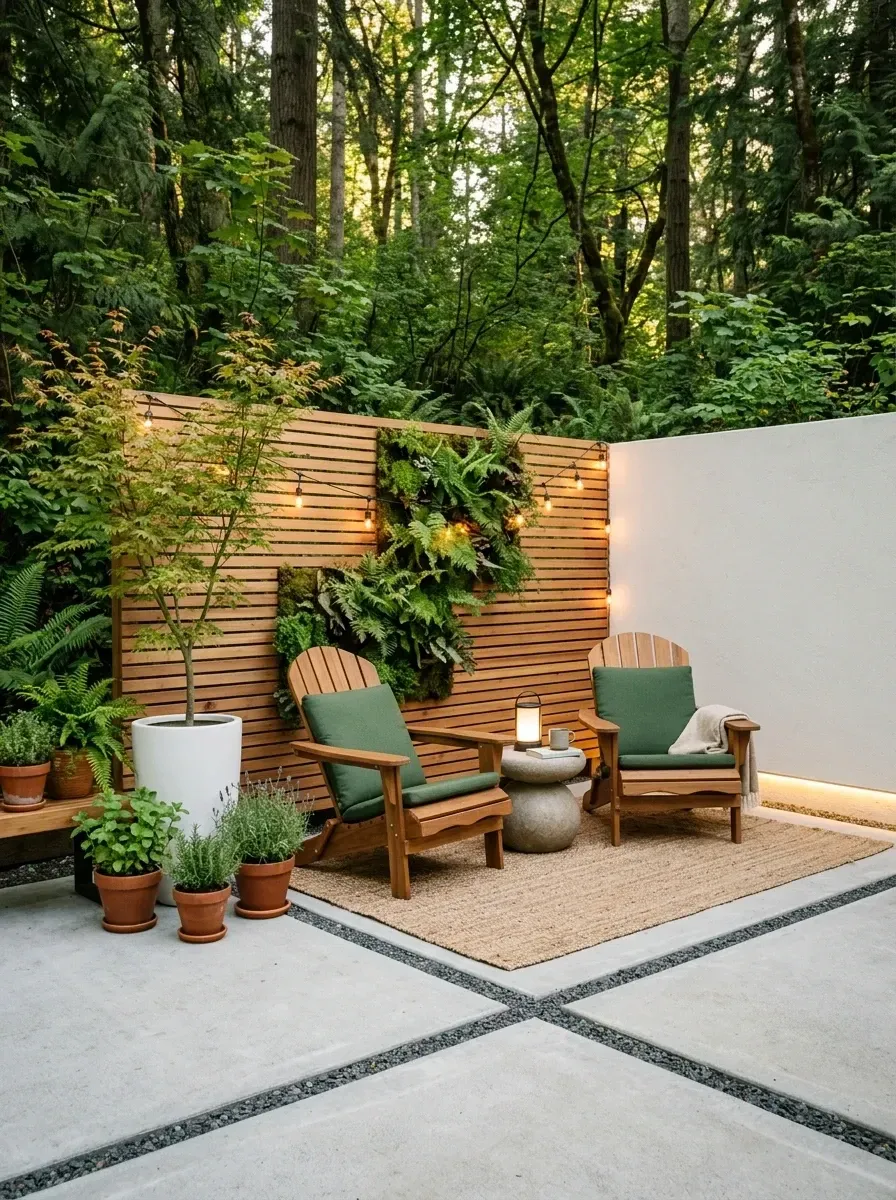
A cedar slatted screen is the most cost-effective outdoor architectural move in the Hudson Valley. It creates privacy without blocking light or airflow, costs roughly $20–$35 per linear foot in Eastern white cedar from a regional mill, and reads as architecture rather than as fence. The vertical garden mounted on the screen is the secondary move that turns a flat backdrop into a living wall — and a small footprint into a generously planted nook. Adirondack chairs with Sunbrella performance cushions are the daily-use furniture that justify the build.
Plan-aware verdict: cedar slats need pressure-treated 4x4 posts set in concrete piers below the 42-inch Hudson Valley frost line, full stop. Skipping the proper footing is the most common reason these screens lean within two seasons. Specify Sunbrella or Outdura performance fabric on the cushions at 40,000+ double rub — anything less degrades within a single Hudson Valley summer of UV and humidity. String lights should be on a GFCI-protected outdoor circuit, not extension cords from the garage.
Features
- Cedar slatted privacy screen on frost-protected piers
- Vertical garden of ferns, trailing ivy, and native pothos
- Solid-wood Adirondack chairs (Loll Designs or regional maker)
- Jute outdoor rug to define the seating zone
- Bistro string lights on a dedicated GFCI circuit
Cost Analysis (2026 Northeast)
| Decor Item (Qty) | Total Price Range |
|---|---|
| Custom Cedar Slatted Screen (~8×8 ft.) | $800 – $1,500 |
| Wooden Adirondack Chair (×2) | $300 – $800 |
| Sunbrella Outdoor Cushions (×2) | $100 – $250 |
| Stone Side Table | $80 – $200 |
| Large Jute Outdoor Rug | $150 – $400 |
| Large White Planter (×2) | $100 – $300 |
| Vertical Garden Hardware Kit | $50 – $150 |
| Outdoor String Lights + GFCI Outlet | $140 – $300 |
| Total Estimated Cost | $1,720 – $3,900 |
Color Palette
Warm Cedar
#B87E4D
Eastern white cedar, sealed with a UV-resistant penetrating oil (Penofin or Cabot Australian Timber Oil) — re-coat every two years.
Forest Green
#355E3B
Sunbrella Forest Green or Outdura Spectrum performance fabric at 40,000+ double rub — UV-stable, fade-resistant.
Light Concrete
#BDBDBD
Existing or poured concrete pad — sealed with a penetrating siloxane to prevent winter spalling in the Hudson Valley freeze cycle.
Matte White
#F0F0F0
Frost-resistant fiberstone or fiber-cement planters — never terracotta in zones 5–6, which cracks at the first hard freeze.
2. Minimalist Zen Deck
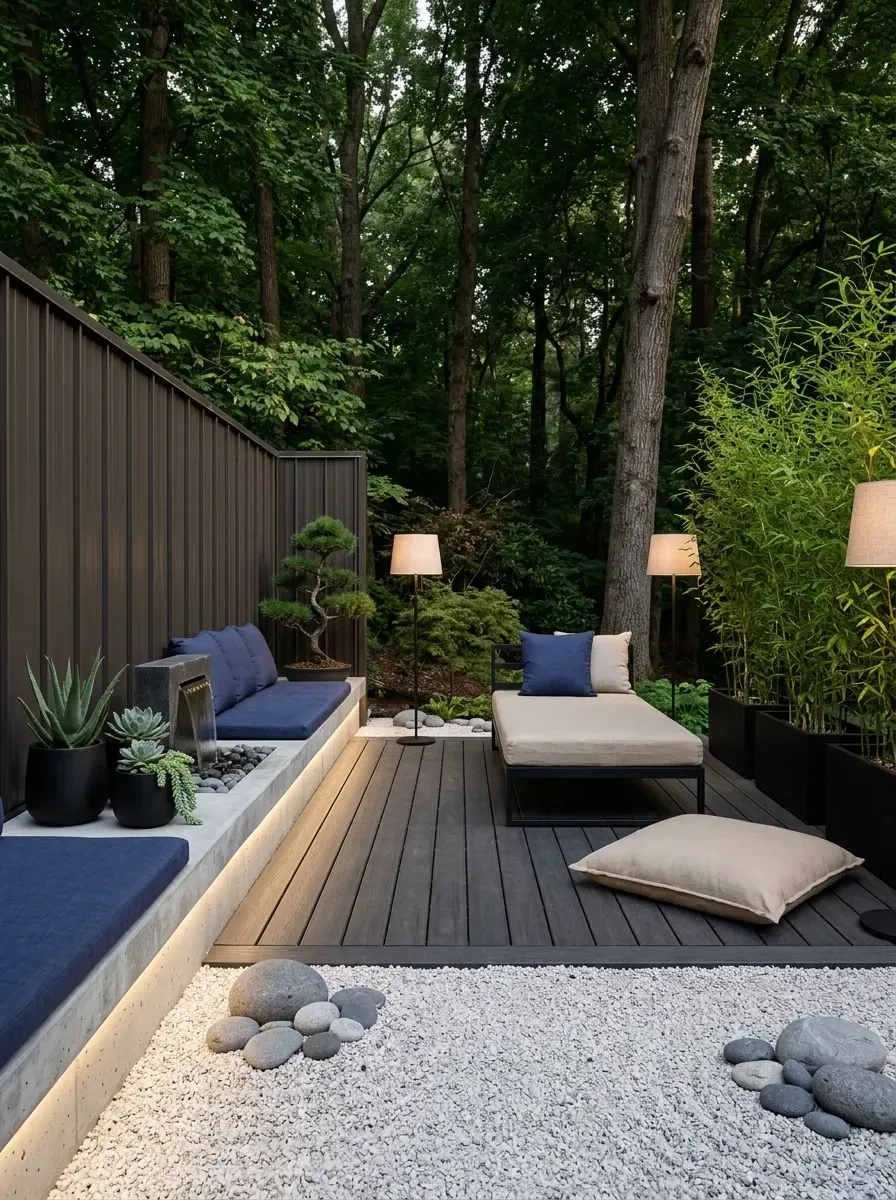
A modern zen deck reads as architecture when the boundary between the platform and the surrounding landscape is intentional, not accidental. Dark composite decking — TimberTech, Trex, Fiberon — pairs well with raw concrete because both materials recede visually, letting the bamboo and Japanese maple framing become the actual decoration. The integrated LED strip under the bench is the move that pulls the deck into evening hours; without it, the dark deck disappears at 8 p.m.
Plan-aware verdict: composite decking runs $30–$60 per square foot installed in the Hudson Valley, including pressure-treated joists, hidden fasteners, and the post footings. Hidden fasteners (Trex Hideaway or TimberTech Concealoc) are the difference between a deck that reads as architectural and one that reads as builder-grade. The bubbling water feature needs a buried recirculating reservoir and a GFCI-protected pump on its own switch — never plug the pump into a string-light outlet shared with other loads.
Features
- Dark composite decking with hidden fasteners
- Built-in raw concrete bench with integrated LED under-lighting
- Modern recirculating water feature on a GFCI circuit
- Modern chaise lounge for a second seating posture
- Tall outdoor floor lamps (Cerno, Bega) for dimmable evening light
Cost Analysis (2026 Northeast)
| Decor Item (Qty) | Total Price Range |
|---|---|
| Composite Decking Install (~150 sq. ft.) | $4,500 – $9,000 |
| Corrugated Metal Fence Panel (~10 ft.) | $200 – $500 |
| Custom Concrete Bench + LED Under-Lighting | $1,500 – $3,500 |
| Custom Sunbrella Bench Cushions | $300 – $800 |
| Modern Recirculating Water Feature | $200 – $600 |
| Modern Chaise Lounge | $400 – $1,200 |
| Outdoor Floor Lamp (×2) | $300 – $800 |
| Outdoor Floor Pillows (×2) | $100 – $250 |
| Total Estimated Cost | $7,500 – $16,650 |
Color Palette
Dark Charcoal
#363636
TimberTech Antique Leather or Trex Vintage Lantern in a dark composite — UV-stable, no annual staining required.
Raw Concrete
#9E9E9E
Cast-in-place concrete with a smooth or honed finish — sealed with a penetrating siloxane, not topical sealer.
Navy Blue
#202A44
Sunbrella Captain Navy or Indigo — deep, serene, complements moving water visually.
Sand Beige
#CFC4A6
Sunbrella Heritage Char or Stone — soft warm neutral that contrasts the dark deck.
3. Rustic Pergola Hideaway
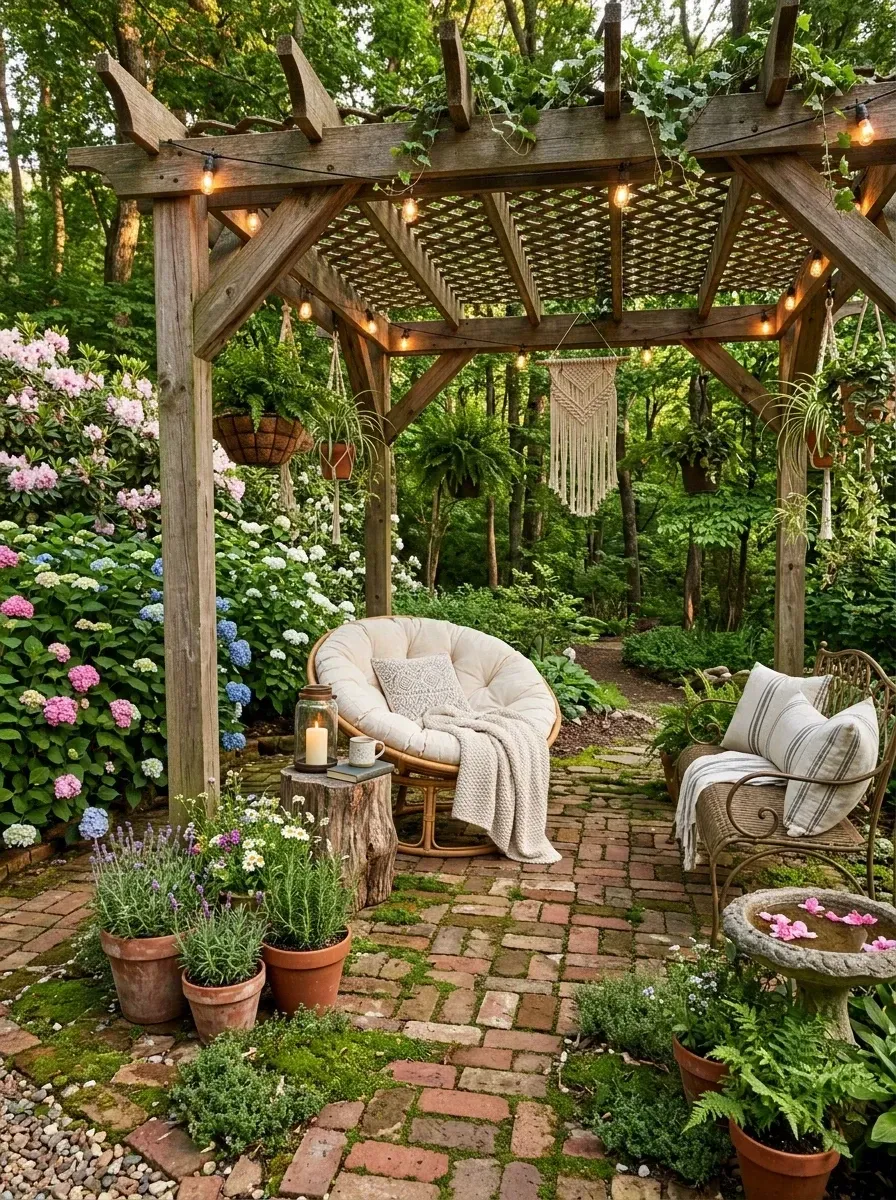
A pergola changes the geometry of an outdoor nook in a way that nothing else does. It defines the seating area without adding walls, casts a slatted shadow pattern that moves through the day, and creates an obvious anchor for hanging plants, lighting, and textiles. The brick paver patio is the historic Hudson Valley material — 1880s farmhouses and 1920s Cold Spring cottages all built on red brick — so the rustic-cottage register reads as honest rather than as theme-park.
Plan-aware verdict: a 10×10 cedar pergola needs four 6×6 posts set in concrete piers below the 42-inch frost line, with proper galvanized post anchors (Simpson Strong-Tie ABU66Z) bridging post-to-pier. The post itself never touches concrete — that's what causes rot in two years on Hudson Valley installations. Pergola kits from big-box stores assume Zone 7 framing; the Northeast freeze cycle requires upgraded fasteners and the proper anchor detailing. Budget $1,500–$3,500 for proper installation by a regional carpenter.
Features
- Solid cedar pergola on frost-protected piers
- Brick paver patio (~100 sq. ft.)
- Hanging rattan papasan chair on a heavy-duty ceiling hook
- Vintage metal bench from a Hudson Valley estate sale
- Clustered terracotta pots and macrame plant hangers
Cost Analysis (2026 Northeast)
| Decor Item (Qty) | Total Price Range |
|---|---|
| Cedar Pergola (~10×10 ft.) Installed | $1,500 – $3,500 |
| Brick Paver Patio Install (~100 sq. ft.) | $1,500 – $3,500 |
| Outdoor Papasan Chair + Cushion | $200 – $500 |
| Vintage-Style Metal Bench | $150 – $400 |
| Tree-Stump Side Table | $50 – $150 |
| Macrame Wall Hanging + Plant Hangers | $80 – $200 |
| Frost-Resistant Terracotta Pots (×10) | $100 – $300 |
| Concrete Birdbath | $50 – $150 |
| Total Estimated Cost | $3,630 – $8,700 |
Color Palette
Weathered Cedar
#8B7355
Eastern white cedar left to silver naturally — the right call for a rustic register, no annual sealing.
Rustic Brick
#A55D35
Reclaimed Hudson Valley red brick on a compacted gravel base with polymeric sand joints — handles the freeze-thaw cycle.
Terracotta Orange
#E2725B
Frost-resistant Italian terracotta (Impruneta) — survives the Hudson Valley winter outdoors with minimal protection.
Creamy Beige
#F5F5DC
Sunbrella Heritage Cream or Wheat — bright enough to lift the shaded space.
4. Stone & Fern Grotto
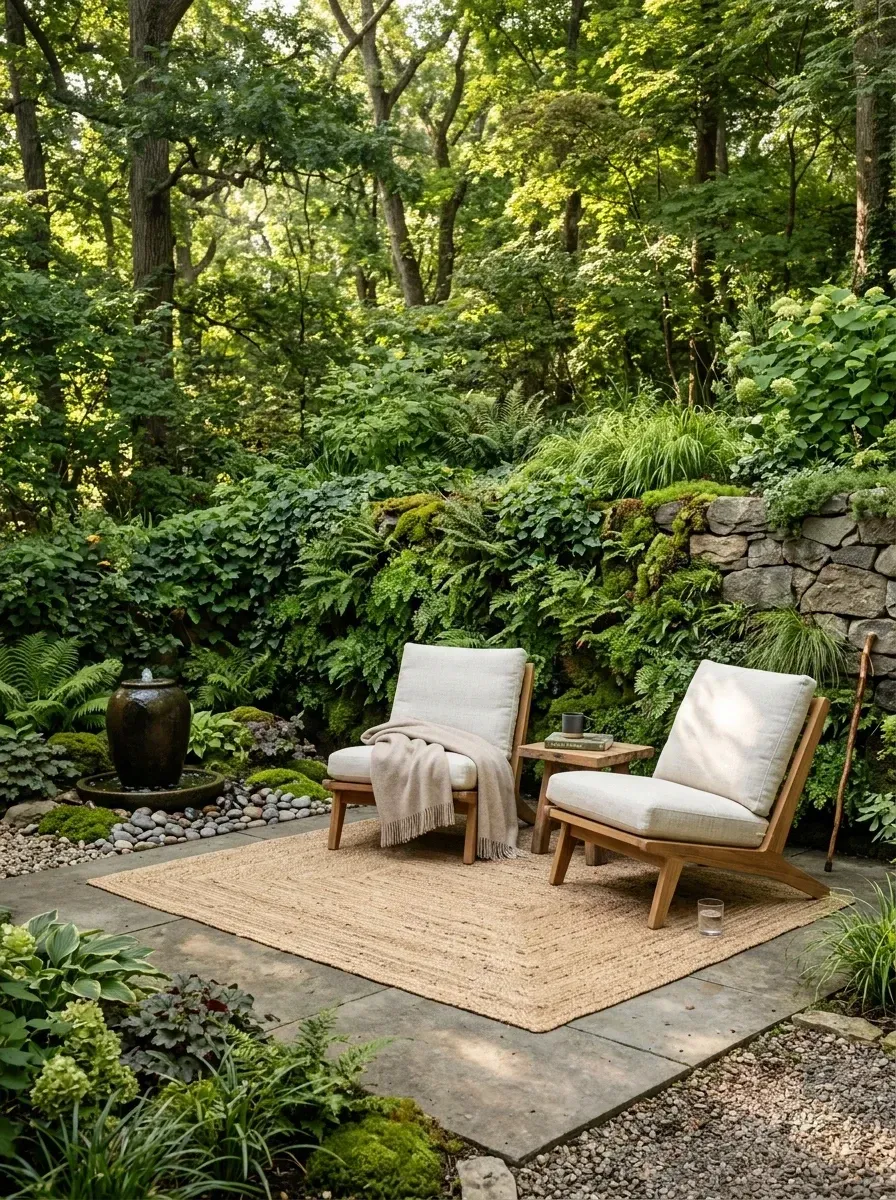
A grotto-style nook leans into the Hudson Valley's actual landscape — bluestone bedrock, mossy retaining walls, fern colonies that establish themselves over a single season. The stone retaining wall is doing two structural jobs simultaneously: holding back a slope and creating an enclosure that reads as ancient rather than as new construction. Low-profile teak lounge chairs keep your eye level near the ground, where moss and ferns are. An urn fountain is the auditory layer — moving water masks road noise from a distance.
Plan-aware verdict: a stone retaining wall in the Hudson Valley should be Pennsylvania bluestone or local fieldstone, dry-laid or mortared on a poured concrete footing below 42-inch frost depth. Real stone is roughly $50–$80 per square face foot installed by a regional mason; cultured (concrete) stone is half that but reads as fake within five years. For an adjacent biophilic-bath read on the same stone-and-greenery vocabulary, see our biophilic bathroom design and texture ideas.
Features
- Bluestone or fieldstone retaining wall on a frost-protected footing
- Pennsylvania flagstone patio (~80 sq. ft.)
- Low-profile teak lounge chairs (×2)
- Dark bronze urn fountain on a buried recirculating reservoir
- Dense fern and moss plantings (cinnamon, ostrich, Christmas fern)
Cost Analysis (2026 Northeast)
| Decor Item (Qty) | Total Price Range |
|---|---|
| Stone Retaining Wall (Material + Mason Labor) | $2,000 – $5,000 |
| Flagstone Patio Install (~80 sq. ft.) | $1,200 – $2,800 |
| Teak Lounge Chair (×2) | $800 – $2,000 |
| Sunbrella Outdoor Cushions (×2) | $200 – $500 |
| Small Wood Side Table | $80 – $200 |
| Urn Water Feature + Pump + Reservoir | $250 – $600 |
| Jute Outdoor Rug | $100 – $300 |
| River Stones & Decorative Gravel | $50 – $150 |
| Total Estimated Cost | $4,680 – $11,550 |
Color Palette
Natural Stone Grey
#8D918D
Hudson Valley bluestone or Pennsylvania fieldstone with natural moss and lichen developing in joints over time.
Warm Teak
#BD8B4F
Solid Burmese or plantation-grown teak — silvers naturally without sealing, lasts 30+ years outdoors.
Oatmeal Beige
#D9D0C1
Sunbrella Heritage Wheat or Cast Pumice — soft warm neutrals that disappear into the natural palette.
Dark Bronze
#332F2B
Cast iron, weathered bronze, or basalt — dark stone or metal that becomes the visual anchor of the grotto.
5. Winding Path to Quietude
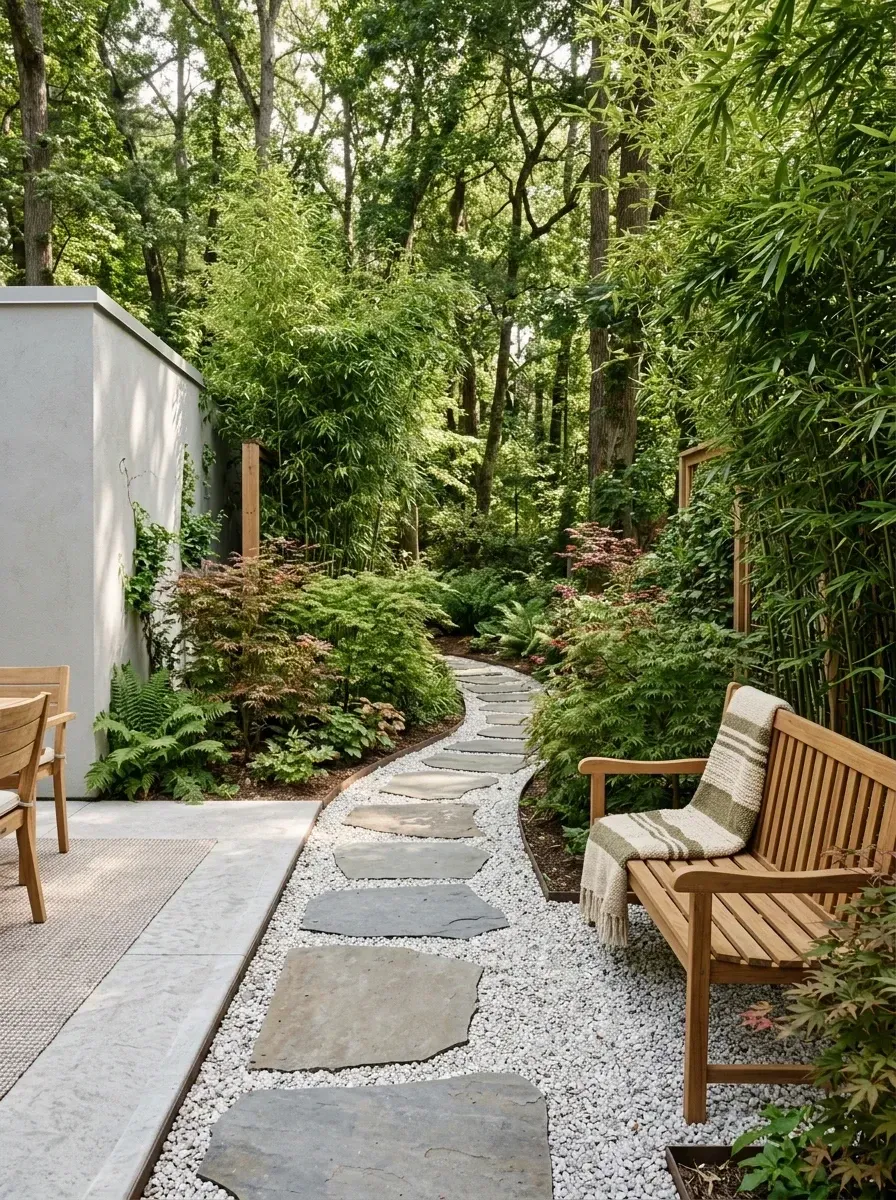
The journey is the design. A winding path forces the user to slow down, look around, and arrive somewhere intentional — exactly the structural shift that shinrin-yoku research describes. The high-contrast pairing here — dark flagstone in white gravel — is the move that registers visually. The destination bench is small and simple, which is correct: the path is the experience, the bench is just the period at the end of the sentence.
Plan-aware verdict: clumping bamboo (Fargesia robusta or Fargesia rufa) is the only bamboo to plant in a Hudson Valley garden. Running bamboo (Phyllostachys species) is invasive and will wreck a yard within a decade — legally restricted in some Northeast counties. Specify clumping varieties only. The flagstone path needs a 4-inch compacted gravel base under each stone to prevent winter heaving; skipping the base means re-leveling every spring.
Features
- Curved flagstone stepping-stone path
- White limestone gravel base for high contrast
- Simple teak garden bench at the destination
- Clumping bamboo (Fargesia) screen for privacy
- Smooth concrete wall as architectural backdrop
Cost Analysis (2026 Northeast)
| Decor Item (Qty) | Total Price Range |
|---|---|
| Flagstone Path Install (Material + Labor) | $1,000 – $2,500 |
| White Limestone Gravel (~1 ton) | $100 – $300 |
| Teak Garden Bench | $400 – $1,000 |
| Bamboo Fence Panel (×2) | $100 – $250 |
| Outdoor Throw Blanket | $30 – $80 |
| Total Estimated Cost | $1,630 – $4,130 |
Color Palette
Blue-Grey Flagstone
#778899
Hudson Valley bluestone or Pennsylvania bluestone — the regional flagstone, naturally cool-toned.
White Limestone
#F8F8F8
3/8-inch crushed limestone or marble chips — bright contrast that makes the dark stones read as a path.
Natural Teak
#BA8C63
Solid teak — a regional Hudson Valley furniture-maker (Country Casual, Westminster Teak) has more durable construction than imports.
Smooth Concrete
#B0B0B0
Cast-in-place concrete with a smooth or sandblasted finish — sealed against winter spalling.
6. Moody Basalt Fountain Corner
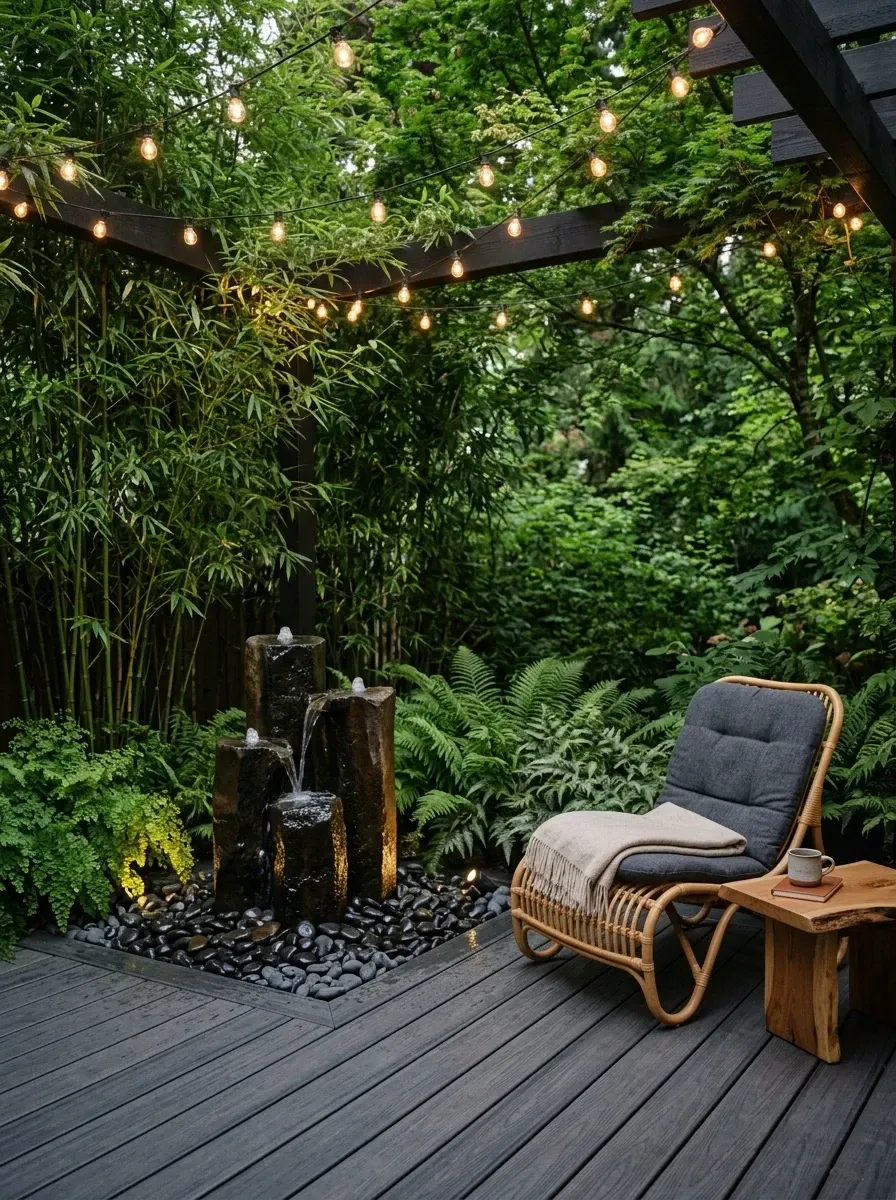
A moody outdoor nook is the call when the existing landscape is already lush — the dark palette absorbs into the surrounding foliage rather than competing with it. Basalt columns are the right water feature for this register: dark, sculptural, and visually quiet when not running, dramatic when wet. Three columns at staggered heights (typically 3, 4, and 5 feet) read as composition rather than hardware. The rattan chair softens the dark-on-dark palette without breaking it.
Plan-aware verdict: basalt columns plus a hidden recirculating reservoir is a $1,200–$2,500 kit installation, but it requires roughly 18 inches of below-grade depth for the reservoir and a GFCI-protected pump on a 10-amp dedicated circuit minimum. Test the pump on a low-flow setting first — a basalt column at full flow sounds more like a kitchen sink than meditation, which defeats the entire purpose. A small flow rate is correct.
Features
- Dark composite decking (~100 sq. ft.)
- Custom black-painted cedar pergola
- Three-column basalt fountain on a hidden reservoir
- Rattan lounge chair with Sunbrella cushion
- Live-edge wood side table
Cost Analysis (2026 Northeast)
| Decor Item (Qty) | Total Price Range |
|---|---|
| Composite Decking Install (~100 sq. ft.) | $3,000 – $6,000 |
| Custom Cedar Pergola (Painted Black) | $1,500 – $3,500 |
| Basalt Column Fountain Kit (3 columns + reservoir + pump) | $1,200 – $2,500 |
| Black River Stones for Basin | $100 – $250 |
| Rattan Lounge Chair + Cushion | $300 – $700 |
| Live-Edge Side Table | $150 – $400 |
| Bistro String Lights + GFCI Outlet | $50 – $120 |
| Total Estimated Cost | $6,300 – $13,470 |
Color Palette
Matte Black
#2B2B2B
Benjamin Moore Onyx (2133-10) or Sherwin-Williams Tricorn Black (SW 6258) in an exterior matte — touch-up annually.
Natural Basalt
#1C1C1C
Real basalt columns — typically sourced from the Pacific Northwest or domestic quarries, deep black when wet.
Warm Rattan
#D2B48C
Synthetic resin wicker (Polyrattan) for outdoor durability — natural rattan rots within two seasons in Northeast humidity.
Live-Edge Wood
#A0522D
Sealed live-edge walnut or oak slab — sealed for outdoor use with a marine-grade spar urethane.
7. Contemporary Fire-Pit Lounge
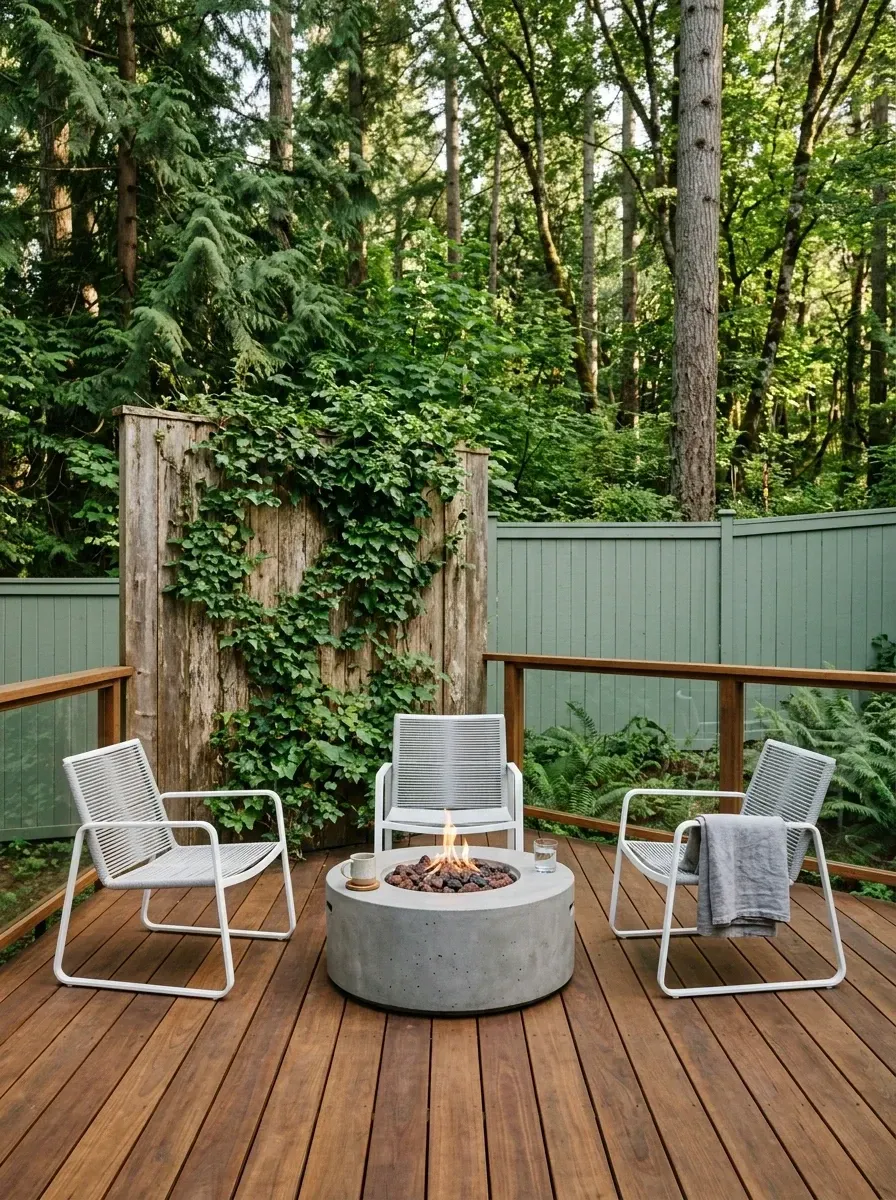
A fire pit changes how a backyard reads in October and November — the season most Hudson Valley back gardens get abandoned. A natural-gas or propane concrete fire pit (Solus Decor, Yardbird, or Restoration Hardware Outdoor) extends usable evenings by two months. White rope chairs are the right pairing: they read modern, dry quickly, and don't compete visually with the fire as the focal point.
Plan-aware verdict: a gas fire pit needs a gas line stub from the house and a dedicated shut-off valve, plus electrical for the ignition module — both specified at the framing/landscape stage, before paving goes in. A wood-burning fire pit is cheaper but requires a 10-foot clearance from any combustible structure and is restricted in many Hudson Valley municipalities. Check local fire-code regulations before committing.
Features
- Solid wood deck (~200 sq. ft.)
- Round natural-gas concrete fire pit
- White woven-rope lounge chairs (×3)
- Sage-green painted fence as backdrop
- Vertical rustic wood privacy screen panel
Cost Analysis (2026 Northeast)
| Decor Item (Qty) | Total Price Range |
|---|---|
| Wood Decking Install (~200 sq. ft.) | $5,000 – $10,000 |
| Round Concrete Gas Fire Pit (Plumbed) | $1,500 – $3,500 |
| White Rope Lounge Chair (×3) | $900 – $2,400 |
| Rustic Wood Privacy Screen Panel | $200 – $500 |
| Fence Painting (Materials Only) | $100 – $250 |
| Linen Outdoor Throws (×2) | $60 – $150 |
| Total Estimated Cost | $7,760 – $16,800 |
Color Palette
Rich Brown Wood
#8B5A2B
Pressure-treated pine or ipé hardwood with an exterior oil stain — re-coat every two years for ipé, annually for pine.
Sage Green
#8F9E8B
Sherwin-Williams Evergreen Fog (SW 9130) or Farrow & Ball Lichen (No. 19) in a low-VOC exterior finish.
Smooth Concrete
#A9A9A9
Cast concrete with a sandblasted or honed finish — sealed against winter spalling.
Clean White
#FFFFFF
UV-stable polyethylene rope on powder-coated aluminum frame (Tuuci, Kettal, or Loll Designs).
8. Zen Meditation Circle
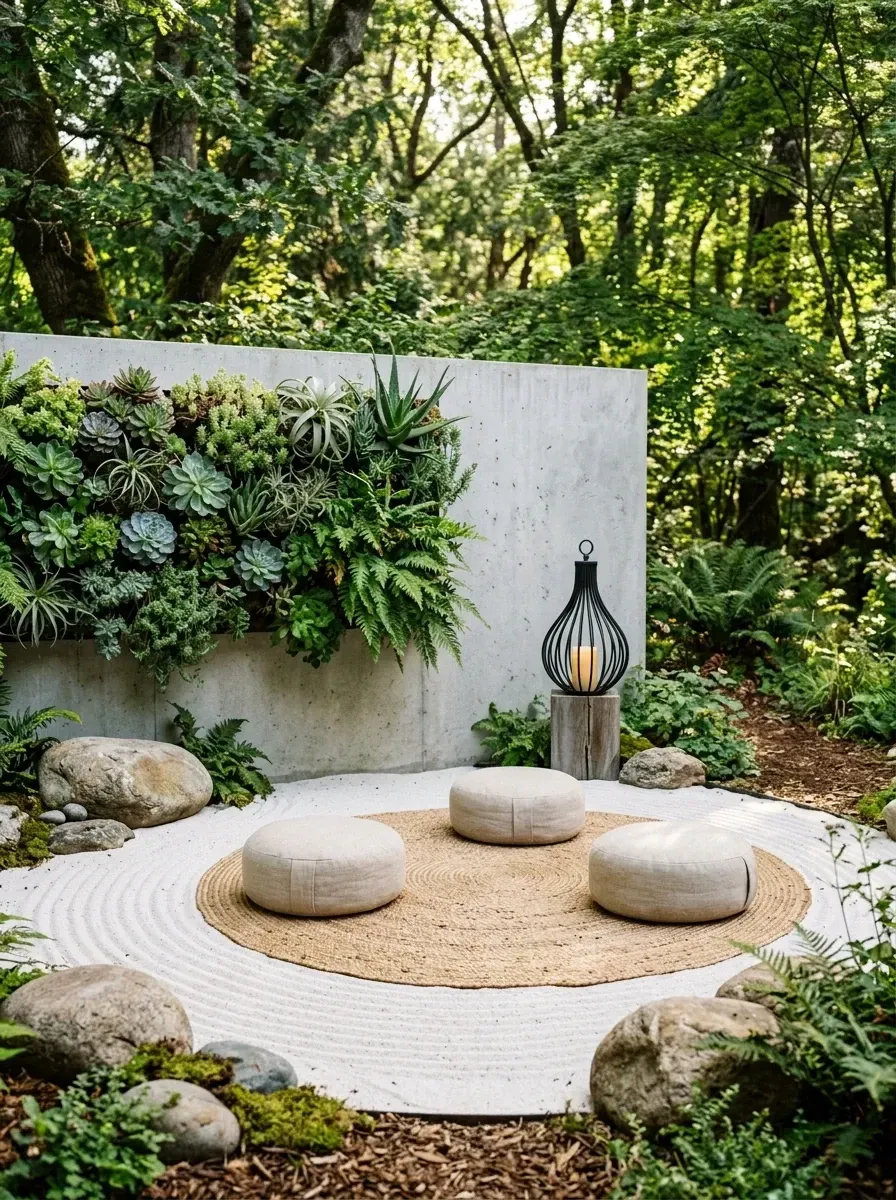
A dedicated meditation circle is the most function-specific outdoor nook on this list. The circular layout matters — circles facilitate group focus and individual centering in a way that linear seating doesn't. Raked gravel does double duty: it reads as visual texture and the act of raking is itself a meditative practice (Japanese karesansui tradition). The vertical succulent wall provides the green-living backdrop without requiring irrigation that water-hungry ferns would.
Plan-aware verdict: meditation cushions need to be brought inside between sessions. Outdoor-rated buckwheat-hull or kapok cushions exist but break down faster than indoor versions. A water-resistant outdoor storage box near the circle (cedar deckbox, $200–$400) holds the cushions when not in use. The succulent wall needs roughly 6 hours of direct sun for the typical Hudson Valley palette (Sedum, Sempervivum, Echeveria); shade-side walls need a different plant list.
Features
- Circular layout on raked white gravel
- Round jute outdoor rug at the center
- Four buckwheat-hull or outdoor-rated meditation cushions
- Vertical succulent garden on a poured concrete wall
- Central matte-black outdoor lantern as focal point
Cost Analysis (2026 Northeast)
| Decor Item (Qty) | Total Price Range |
|---|---|
| Poured Concrete Wall (~8×6 ft.) | $1,000 – $3,000 |
| Vertical Garden System (Planters + Hardware) | $200 – $500 |
| Cold-Hardy Succulent Plants (~50) | $200 – $400 |
| Fine White Zen Gravel (~0.5 ton) | $50 – $150 |
| Large Round Jute Outdoor Rug | $100 – $300 |
| Meditation Cushion Set (×4) | $200 – $600 |
| Large Outdoor Lantern | $50 – $150 |
| Wood Stump Pedestal | $30 – $80 |
| Total Estimated Cost | $1,830 – $5,180 |
Color Palette
Light Grey Stone
#D3D3D3
Crushed limestone or marble chips for the gravel; smooth-finish concrete for the wall — bright, neutral, reflective.
Natural Beige
#E6DBBF
Outdoor jute rug from Loloi or Dash & Albert; cushions in Sunbrella Heritage Wheat or natural cotton canvas.
Succulent Green
#8FA382
Cold-hardy Sempervivum, Sedum spurium, and Sedum kamtschaticum varieties — survive Hudson Valley zone 5b winters.
Matte Black
#222222
Powder-coated steel or cast iron — the dark anchor at the geometric center of the circle.
9. Enchanted Evening Lounge
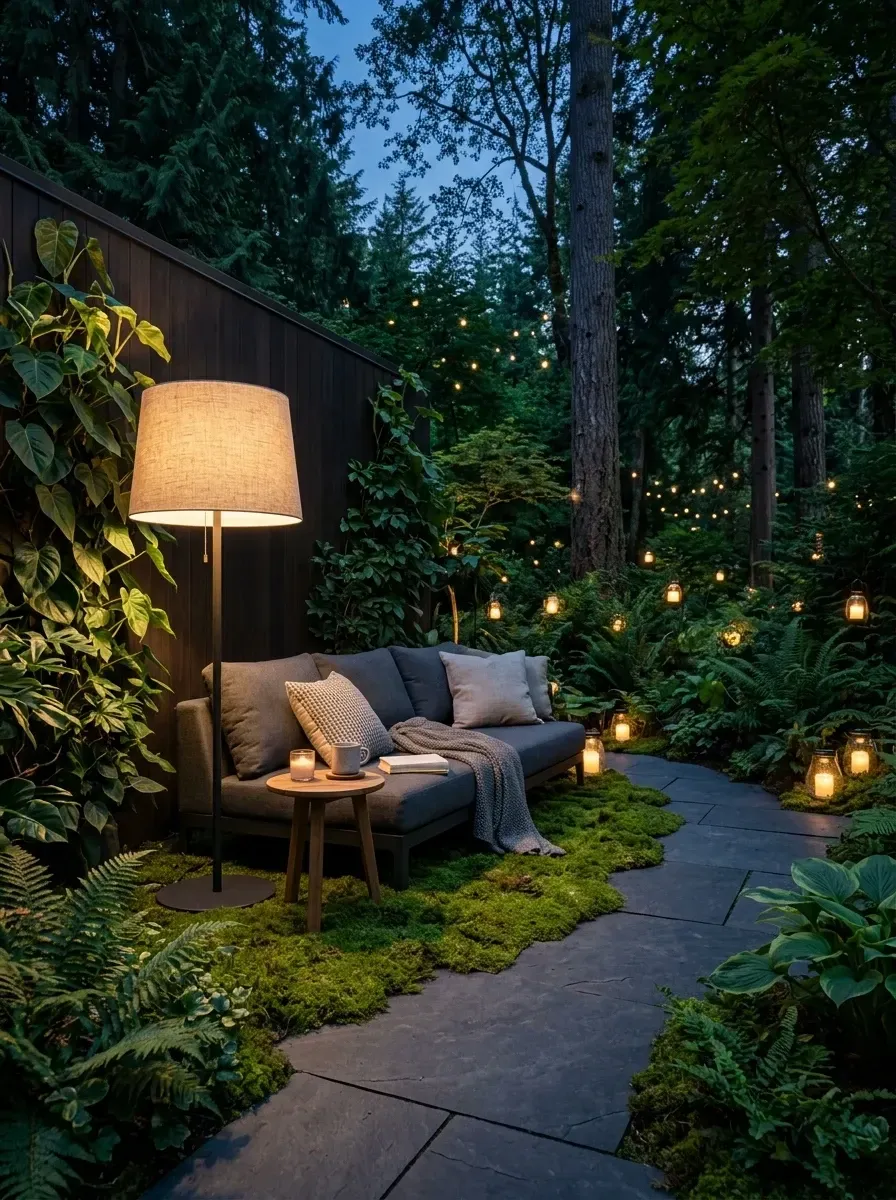
An evening-focused nook is the right call for any Hudson Valley client whose backyard is otherwise unused after 7 p.m. The structural rule is layered light at three heights: overhead (string lights in the tree canopy at 10–12 feet), eye level (floor lamp at 5–6 feet), and ground (lanterns at 1–2 feet). All three sources must be on dimmable circuits and all three must use 2200K–2700K warm bulbs. Cool-white outdoor lighting kills the magic instantly.
Plan-aware verdict: outdoor moss ground cover (Irish moss, Scottish moss, or hair-cap moss) is climate-perfect for the Hudson Valley but requires the right light conditions — partial shade to deep shade, north-facing or under tree canopy. Sunny moss installations fail. The path-and-moss combination needs a 4-inch compacted gravel sub-base and irrigation setup for the first establishment season. For an adjacent biophilic outdoor read on smaller sites, see our biophilic tiny balcony ideas guide.
Features
- Lush moss ground cover (Irish moss, Scottish moss, hair-cap moss)
- Flagstone stepping path through the moss
- Modern weatherproof outdoor sofa
- Three-tier layered lighting (string, floor lamp, lanterns)
- Dark-stained fence as backdrop
Cost Analysis (2026 Northeast)
| Decor Item (Qty) | Total Price Range |
|---|---|
| Flagstone Path Install (~50 sq. ft.) | $800 – $1,800 |
| Moss Install (Labor + Plant Material) | $500 – $1,500 |
| Modern Outdoor Sofa | $800 – $2,500 |
| Round Wood Side Table | $80 – $200 |
| Large Outdoor Floor Lamp | $250 – $600 |
| Assorted LED Lanterns (×5) | $100 – $250 |
| Tree-Wrapped String Lights (×3 strands) | $60 – $150 |
| Outdoor Throws & Pillows | $100 – $250 |
| Total Estimated Cost | $2,690 – $7,250 |
Color Palette
Deep Charcoal
#212121
Benjamin Moore Black Forest Green or Sherwin-Williams Iron Ore in an exterior matte — recedes into night shadow.
Dark Slate Grey
#4A4A4A
Hudson Valley bluestone or charcoal-toned flagstone — naturally darker tones blend into evening shadows.
Medium Grey
#808080
Sunbrella performance fabric on aluminum or teak frame — Tuuci, Skagerak, or Gloster.
Warm Amber (2200K)
#FFC371
2200K filament-look LED bulbs across all three lighting tiers — never above 2700K outdoors at night.
10. Rustic Vertical Herb Garden
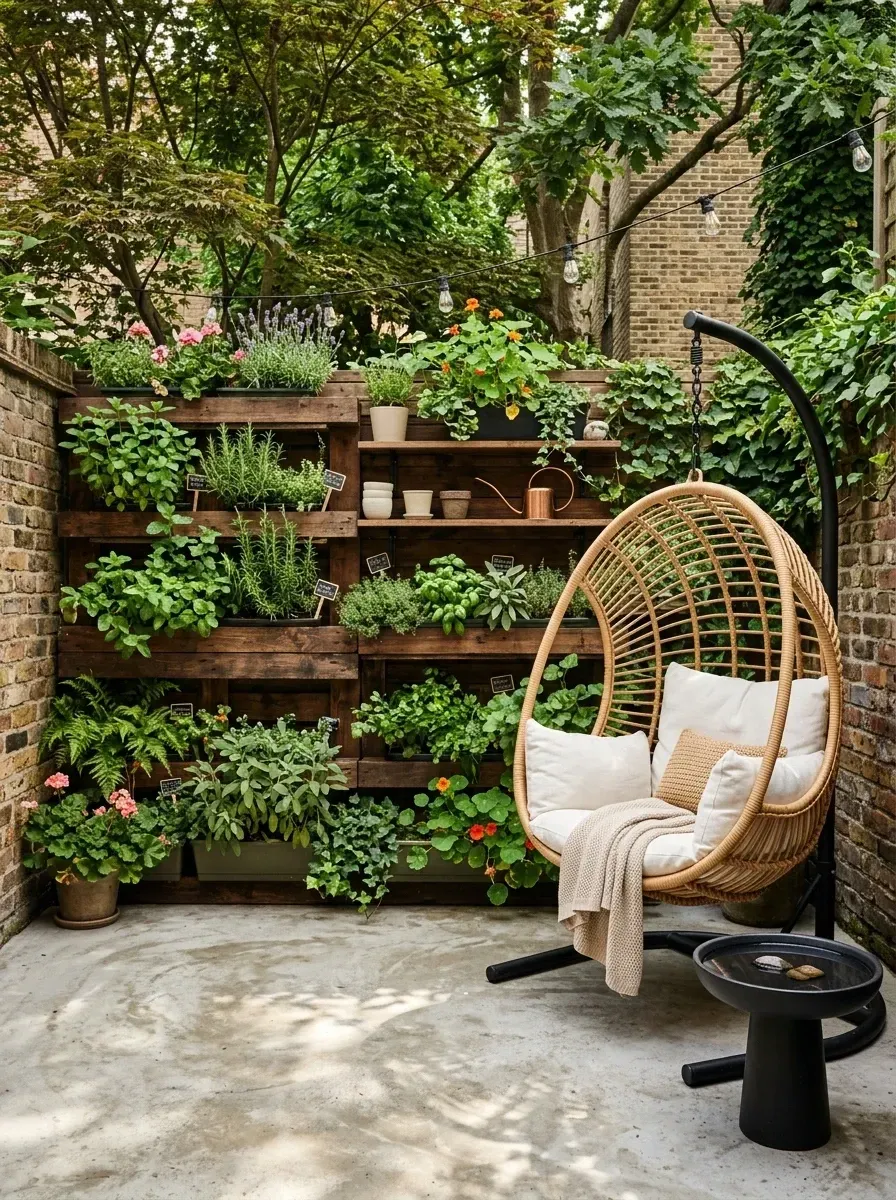
The pallet herb wall is the highest-impact, lowest-cost outdoor nook on this list. The structural elements — wooden pallets, terracotta pots, brick wall, hanging chair — total under $1,000 in materials. The work is in the planting plan and the visible discipline of how the herbs are arranged. A real herb wall engages smell as well as sight — lavender, rosemary, mint, thyme, sage — which is exactly the multi-sensory engagement shinrin-yoku research describes.
Plan-aware verdict: not all wood pallets are safe to use outdoors. Look for the "HT" stamp (heat-treated) on the pallet — never "MB" stamp (methyl-bromide treated, which is toxic and not legal for residential use). Untreated pallets work but rot within two seasons; treated pallets double the lifespan. The hanging egg chair needs a 250-pound minimum-rated ceiling hook bolted into structural framing, not just into mortar.
Features
- DIY pallet shelving wall (heat-treated pallets only)
- Hanging rattan egg chair with steel stand or ceiling hook
- Small black metal side table
- Assorted terracotta and ceramic herb pots
- Bistro string lights overhead
Cost Analysis (2026 Northeast)
| Decor Item (Qty) | Total Price Range |
|---|---|
| DIY Pallet Shelving Wall (Materials) | $100 – $300 |
| Hanging Rattan Egg Chair + Stand | $300 – $800 |
| Small Black Metal Side Table | $40 – $100 |
| Frost-Resistant Terracotta Pots (×20+) | $200 – $500 |
| Bistro String Lights + GFCI Outlet | $130 – $200 |
| Total Estimated Cost | $770 – $1,900 |
Color Palette
Rustic Brick
#964B00
Existing brick courtyard wall — natural variation is what makes the pallet wall read as authentic.
Dark Stained Wood
#5C4033
Heat-treated wood pallets sealed with an exterior penetrating stain — Cabot or Olympic in dark walnut.
Natural Rattan
#E3CBA6
Synthetic resin wicker (Polyrattan) for outdoor durability — natural rattan rots in Northeast humidity.
Aged Concrete
#B4B4B4
Existing concrete pad — sealed with a low-VOC penetrating siloxane to handle Hudson Valley freeze cycles.
11. Luxurious Canopy Daybed
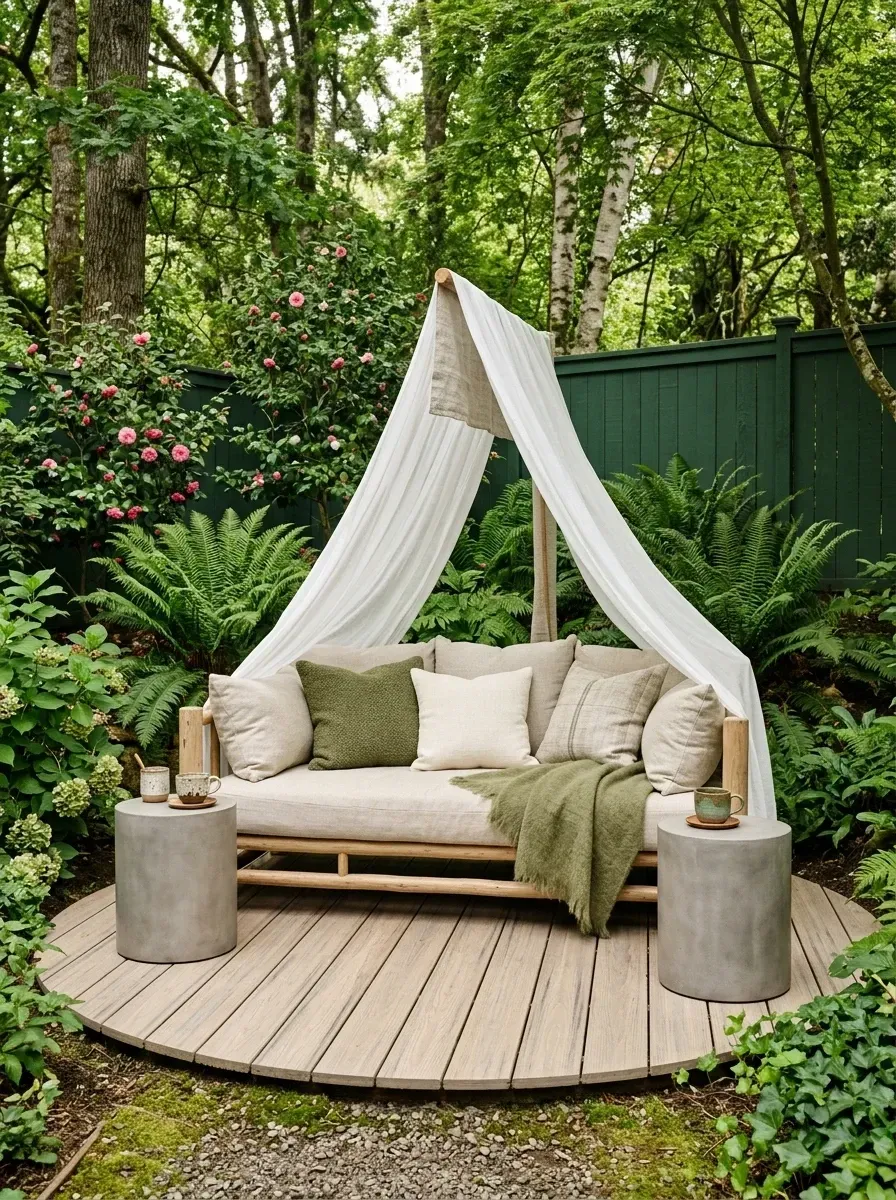
A canopy daybed is the spa-resort end of the outdoor-nook spectrum — and it's appropriate for any Beacon weekend-house client who actually does daytime relaxation in the backyard. The round wooden deck is the architectural move that elevates this from "outdoor furniture set" to "designed outdoor room." A custom round deck is roughly 25–40% more expensive than a square deck of the same square footage because of the cutting and joinery — but it's the geometry that makes the composition work.
Plan-aware verdict: outdoor canopy fabric is a maintenance commitment. Sunbrella canopy fabric ($25–$45 per yard, custom-cut) is UV-stable and water-resistant but still needs to come down before the first hard freeze and before any major Northeast wind event. Build the canopy frame so the fabric panels can be unhooked seasonally. Permanent outdoor canopies in the Hudson Valley shred or mildew within a single year if left up year-round.
Features
- Large light-oak canopy daybed with removable canopy fabric
- Custom 10-foot diameter round wood deck
- Round concrete side tables (×2)
- Sage green and cream Sunbrella pillows and throws
- Lush biophilic planting backdrop
Cost Analysis (2026 Northeast)
| Decor Item (Qty) | Total Price Range |
|---|---|
| Custom Round Wood Decking (~10 ft. diameter) | $2,500 – $5,000 |
| Outdoor Daybed with Canopy Frame | $1,000 – $3,000 |
| Sunbrella Daybed Cushion + Canopy Fabric | $500 – $1,200 |
| Round Concrete Side Table (×2) | $300 – $700 |
| Sage and Neutral Sunbrella Pillows + Throws | $150 – $400 |
| Total Estimated Cost | $4,450 – $10,300 |
Color Palette
Light Oak / Ash
#C2B280
Solid white oak or ash with marine-grade spar urethane — Skagerak, Gloster, or a regional Hudson Valley furniture maker.
Soft Cream
#FDFBF7
Sunbrella Heritage Cream or Outdura Sail Cloth — UV-stable, water-resistant, washable.
Muted Sage Green
#7F8C6D
Sunbrella Cast Sage or Dover Sage — desaturated greens that connect to the planting backdrop.
Smooth Concrete
#AFAFAF
Cast concrete with a sealed honed finish — frost-tolerant if drained and elevated 1–2 inches off the deck surface.
12. Minimalist Gravel & Grasses
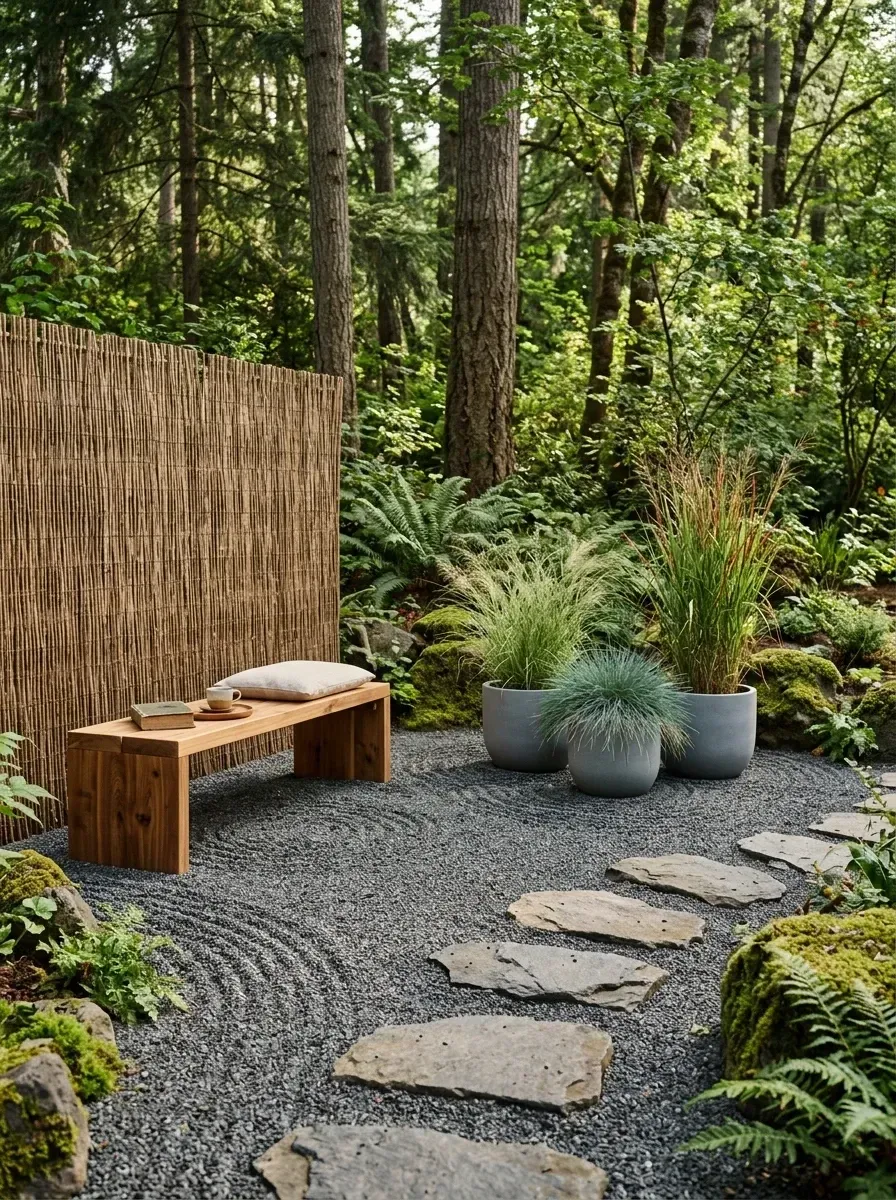
A minimalist gravel-and-grasses garden is the easiest forest-bathing nook to maintain in a Hudson Valley climate — almost no water, almost no winter prep, almost no replanting. Three large modern planters of ornamental grasses (Hakonechloa macra, Pennisetum, Calamagrostis) read as architectural punctuation against a dark gravel ground. The simple bench is a destination, not a feature. This configuration is the right choice for a client who wants the calm without the maintenance.
Plan-aware verdict: dark grey landscape gravel must be installed over a proper weed barrier (commercial-grade landscape fabric, not the thin homeowner version) on a compacted base. Skipping the fabric means weeding by hand every spring forever. The ornamental grasses listed are Northeast-hardy perennials — they die back in winter and regrow in spring. Don't replace them; trust the cycle. Total annual maintenance: one spring cutback, one fall clean-up.
Features
- Raked dark granite landscape gravel
- Large irregular fieldstone stepping stones (×5)
- Simple cedar minimalist bench
- Three large modern matte grey concrete or composite planters
- Clumping bamboo (Fargesia) backdrop
Cost Analysis (2026 Northeast)
| Decor Item (Qty) | Total Price Range |
|---|---|
| Dark Grey Landscape Gravel (~1.5 tons) | $150 – $400 |
| Large Flagstone Stepping Stones (×5) | $100 – $250 |
| Minimalist Wooden Bench | $200 – $500 |
| Bamboo Rolled Fencing (~15 ft.) | $100 – $250 |
| Large Modern Planter (×3) | $300 – $900 |
| Total Estimated Cost | $850 – $2,300 |
Color Palette
Dark Grey Granite
#4F4F4F
3/8-inch crushed granite or basalt — uniform color, sharper visual register than pea gravel.
Natural Fieldstone
#808080
Local Hudson Valley fieldstone with irregular shapes — connects the garden to the regional geology.
Warm Cedar / Teak
#AD7F4F
Eastern white cedar or teak — sealed annually with a UV-resistant penetrating oil.
Matte Grey Concrete
#696969
Frost-resistant fiberstone or fiber-cement composite (not real concrete, which cracks in Northeast freeze cycles).
Pro Tips From the Renovation Designer's Chair
- Frost-protected footings or it doesn't matter. Every post, pier, pergola anchor, and retaining-wall footing in the Hudson Valley needs to clear 42 inches of frost depth. Skipping this is the most common reason outdoor structures lean, crack, or fail within five years. Specify it on every drawing.
- Layer your lighting at three heights. Overhead string lights at 10–12 feet, eye-level floor lamps or wall sconces at 5–6 feet, ground-level lanterns or path lights at 1–2 feet. All three on dimmable circuits with 2200K–2700K warm-white bulbs. Cool-white kills outdoor mood every time.
- Engage all five senses, deliberately. Forest bathing isn't visual decoration — it's multi-sensory immersion. Sight (greenery, layered light), sound (water feature, wind chimes, rustling bamboo), smell (fragrant herbs — lavender, rosemary, jasmine), touch (varied textures of stone, wood, textile), and movement (running water, swaying grasses). Specify each one.
- Define the "outdoor room" with edge moves. Outdoor rugs, transitions in flooring (decking to gravel to flagstone), pergolas, privacy screens, or even a deliberate change in elevation. Without an edge, the nook reads as backyard furniture; with an edge, it reads as a destination.
- Use Sunbrella or Outdura performance fabrics, never indoor textiles. A 50,000+ double-rub UV-stable performance fabric outlives anything you'd put in a living room. Cushions and pillows in cotton, linen, or velvet degrade within a single Hudson Valley summer of UV exposure.
- Specify clumping bamboo, never running bamboo. Fargesia robusta, Fargesia rufa, or Fargesia nitida are clumping varieties that stay where you plant them. Phyllostachys and other running varieties will destroy a yard within a decade and are restricted in some Hudson Valley counties. Read the species label before you buy.
Cost-Saving Moves
- DIY the linear projects. Pallet herb walls, gravel paths, string-light installations, and small flagstone stepping-stone runs are well within a homeowner's skill range with a long weekend. The savings: $40–$60 per hour of labor avoided.
- Choose gravel over pavers. Pea gravel or crushed limestone runs $50–$150 per ton installed vs. $20–$30 per square foot for paver patios. The aesthetic register is different but equally valid for a calm-nook context.
- Buy small, plant patient. A 1-gallon Japanese maple at $35–$50 reaches mature 10-foot height in 4–6 years. A 6-foot specimen at the nursery costs $400–$800. The math always favors patience for fast-growing Hudson Valley trees.
- Shop estate sales for outdoor furniture. Hudson Valley estate sales (Hudson, Beacon, Cold Spring) regularly include teak benches, cast-iron urns, and vintage stone planters at 40–60% off retail. Real teak at 30 years old is more durable than current production.
- Run pergola posts off concrete piers, not into ground. A Sonotube pier at $30–$50 each plus proper Simpson Strong-Tie anchors lets the wood post sit above grade — extending pergola life from 10 years to 25+ years. The Hudson Valley clay-and-freeze conditions reward this detail every time.
The Core Idea. A backyard forest-bathing nook is not a furniture-and-plant problem. It's a structural design problem solved at four points before any decorative decision: drainage, frost-protected footings, layered electrical, and the sight line from the house. Get those four right and a $1,000 nook reads as a destination. Get them wrong and the most expensive deck in the Hudson Valley reads as backyard furniture. Build the bones first. The calm follows.
Reader Questions on Backyard Forest-Bathing Nooks
What does forest bathing actually mean, and does my backyard count?
Forest bathing — Japanese shinrin-yoku — is a structured outdoor practice of slow, intentional sensory engagement with a wooded or planted environment. Research from Nippon Medical School (Dr. Qing Li) documented measurable cortisol drops, blood-pressure reductions, and immune-marker improvements after 90+ minutes of slow forest immersion. A backyard absolutely counts if the design supports the practice — multi-sensory greenery, the absence of visual or auditory clutter, and a destination that pulls you away from screens. The forest doesn't have to be 1,000 acres; it has to be designed for slow, immersive use.
Do I need a huge yard to build a forest-bathing nook?
No. Some of the most effective nooks I've designed in the Hudson Valley fit in a 100-square-foot footprint — a single corner, a strip beside the garage, a Brooklyn brownstone garden the size of a parking space. Small footprints actually force the design discipline that large yards lack — every element has to earn its place. The brick courtyard with the pallet herb wall (nook #10 above) lands at under $2,000 fully built and reads as more architecturally resolved than many $20,000 backyards I've walked through.
What plants are right for a forest-bathing nook in the Hudson Valley?
Stay in the Northeast-native register and the proven adaptive imports. Trees: Japanese maple (Acer palmatum), river birch, serviceberry. Shrubs: oakleaf hydrangea, mountain laurel, witch hazel. Ground cover: Pennsylvania sedge, ferns (cinnamon, ostrich, Christmas), Irish or Scottish moss in shade. Ornamental grasses: Hakonechloa macra (Japanese forest grass), Pennisetum, Calamagrostis. Bamboo: clumping Fargesia only, never running varieties. Avoid: invasives like Japanese barberry and burning bush; Cornell Cooperative Extension publishes the current Hudson Valley invasive list quarterly.
How much does a backyard nook actually cost in 2026?
The honest spread is wide. A minimalist gravel-and-grasses zone (nook #12 above) lands at $850–$2,300 with DIY labor on the gravel and stepping stones. A mid-budget pergola hideaway with a brick patio runs $3,600–$8,700 with a Hudson Valley contractor. A full zen deck with custom concrete bench, water feature, and integrated lighting clears $7,500–$16,650. The luxury end — canopy daybeds, large stone retaining walls, basalt fountains — reaches $15,000+. Pick the configuration that matches your site, your sun exposure, and your maintenance tolerance, not the magazine spread.
Do I need a permit to build a deck or pergola in the Hudson Valley?
Often, yes. Most Hudson Valley municipalities require permits for: decks more than 30 inches above grade, structures larger than 200 square feet, anything attached to the house, and any electrical or gas-line work. Pergolas under 200 sq. ft. and not attached to the house are sometimes exempt — but the threshold varies by town. Beacon, Rhinebeck, Kingston, and Hudson all have different ordinances. Always pull the permit before pouring concrete. Unpermitted structures complicate home-sale title work and can be ordered demolished by code enforcement.
Can I keep an outdoor nook usable through winter?
Partially yes, with the right structural moves. A natural-gas or propane fire pit extends usable evenings well into November. A pergola with retractable side panels blocks Hudson Valley wind on shoulder-season afternoons. An outdoor electric heater on a covered structure works above 40°F. Below freezing, the nook is hibernating — but the structure should be designed to handle winter without intervention: drained water features, removed canopy fabric, stored cushions, salt-tolerant materials at the foundation. Build for the winter, use it in three other seasons.
Where to Read Next
If you're working through the broader outdoor program, start with the outdoor renovations archive. For a smaller-footprint biophilic read, our biophilic tiny balcony ideas guide applies the same calm-and-greenery rules at apartment scale. For a celebration-zone extension of these nooks, see our chic sustainable garden party decor ideas.
Sources & Further Reading
- National Park Service — Forest Bathing on the formal practice, history, and benefits of shinrin-yoku.
- USDA Forest Service on managed forest health and the broader research underpinning nature-based wellness.
- This Old House — Deck Construction on framing, footings, and Northeast deck-building practice.
- Cornell Cooperative Extension on Hudson Valley native plants, invasive lists, and regional gardening guidance.
- Brooklyn Botanic Garden for Northeast-appropriate plant lists and seasonal gardening recommendations.
- Sunbrella Performance Fabrics on outdoor textile durability ratings, UV stability, and care.
- NAHB — Cost of Constructing a Home for benchmark labor and material data behind the cost ranges quoted above.
- Lutron Lighting Controls on outdoor-rated dimmer specifications for landscape and string lighting.
- Natural Stone Institute on bluestone, fieldstone, basalt, and flagstone specification and outdoor care.
- Aquascape on residential water-feature engineering, pump sizing, and winterization.

Nora Whitfield
Renovation Designer & Interiors Editor · Beacon, New YorkNine years of design-build renovation work across the Hudson Valley and the Northeast. Nora runs the Renovations, Room Guides and Renovation Mind desks — before-and-after studies, room-by-room design guides, and the long essays on why what we renovate matters.
More from Nora →
Reader notes