


A client in Beacon handed me a 14×16 ft. living room last winter — beige walls, vertical blinds, a sectional that didn't quite fit, a coffee table from the previous owner. The bones were fine; the room had simply never been designed. That's the most common renovation brief in the Hudson Valley, and the easiest one to get wrong. Below: ten different design identities for the same builder-grade living room, the framing-stage planning each transformation depended on, and the brand-level material specs that separate a living room that reads designed from one that reads decorated.
How I Read a Living Room Reset
When a Hudson Valley client hands me a builder-grade living room they want to redo, I read four things before I think about style: the natural-light direction (north-light rooms read cool and need warm furnishings; west-light rooms heat up and need different drapery and lighter fabrics), the circulation footprint (the path from doorway to seating to TV to outside has to be uninterrupted; people walking around a sectional every day erodes the room faster than any visual issue), the focal-point geometry (most builder-grade rooms have two competing focal points — fireplace and TV wall — and the renovation has to pick one), and the acoustic profile (hard floors and bare windows make every conversation echo; without absorption, the room never feels intimate).
After seven years running renovation design out of Beacon and Kingston, I've learned that the living room is the room most often confused for a furniture-shopping problem. It's not. The ten resets below cover the full stylistic range — from Scandi minimalism to grand custom built-ins — but they all depend on the same four architectural decisions made before any sofa lands. For the broader whole-home version of these principles, my quiet luxury living room design guide covers the format in deeper detail across multiple budgets.
Reading note. The numbering follows my client-walkthrough order — light palettes first, deeper colors second, custom-millwork last — not a ranking. Transformation #6 (built-ins) costs five times what transformation #5 (modern statement) does, but the planning rigor behind both is identical.1. Serene Scandi Minimalism
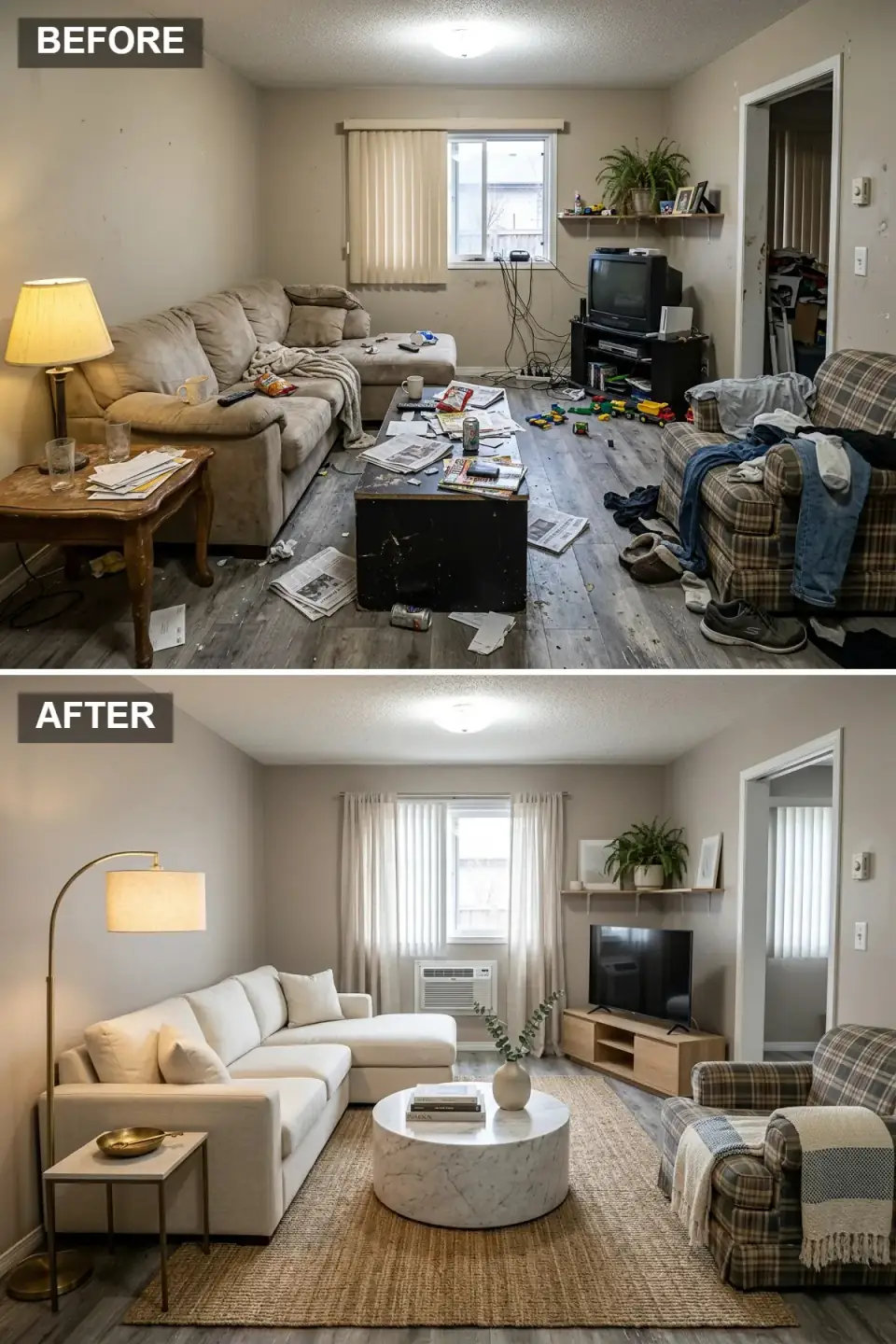
The win is restraint. The cluttered black coffee table is gone, replaced by a single round Carrara plinth that's heavier visually than the entire arrangement it replaced. The oatmeal Belgian linen sofa carries the room's warmth; the jute rug defines the seating zone in a way the original had never bothered to. Floor-to-ceiling sheers replace the vertical blinds — the single biggest format change in any builder-grade reset.
Plan-aware verdict: Scandi rooms succeed or fail on the rug and the drapery. Specify a 9×12 jute-and-wool blend (Beni Rugs, Armadillo, or Hudson Valley weavers) at $600–$1,500; the rug needs to be wide enough that the front legs of all seating sit on it. The drapery is ceiling-mounted on a Mecho or Forest Group track at 250% fullness in unlined Belgian linen — never window-mounted on a basic rod, which kills the entire architectural read. The marble plinth coffee table needs to be solid stone, not honeycomb-core veneer; a 30-inch round Carrara plinth from a regional fabricator runs $1,000–$2,500.
Color Palette
Warm Greige
#BDB6AD
Benjamin Moore Revere Pewter (HC-172) or Sherwin-Williams Accessible Beige (SW 7036) — the workhorse warm neutral.
Oatmeal Linen
#D9D0C1
Belgian flax linen slipcovered sofa from Cultiver, Cisco Home, or a Hudson Valley upholsterer — washable, ages soft.
Carrara White Marble
#F0EFEF
Honed Carrara C plinth from a Marble Institute fabricator — softer veining than Calacatta, lower price point.
Natural Jute
#C1A684
Hand-woven jute or jute-wool blend from Beni Rugs or Armadillo — texture that grounds the room.
2. Mid-Century Modern Revival
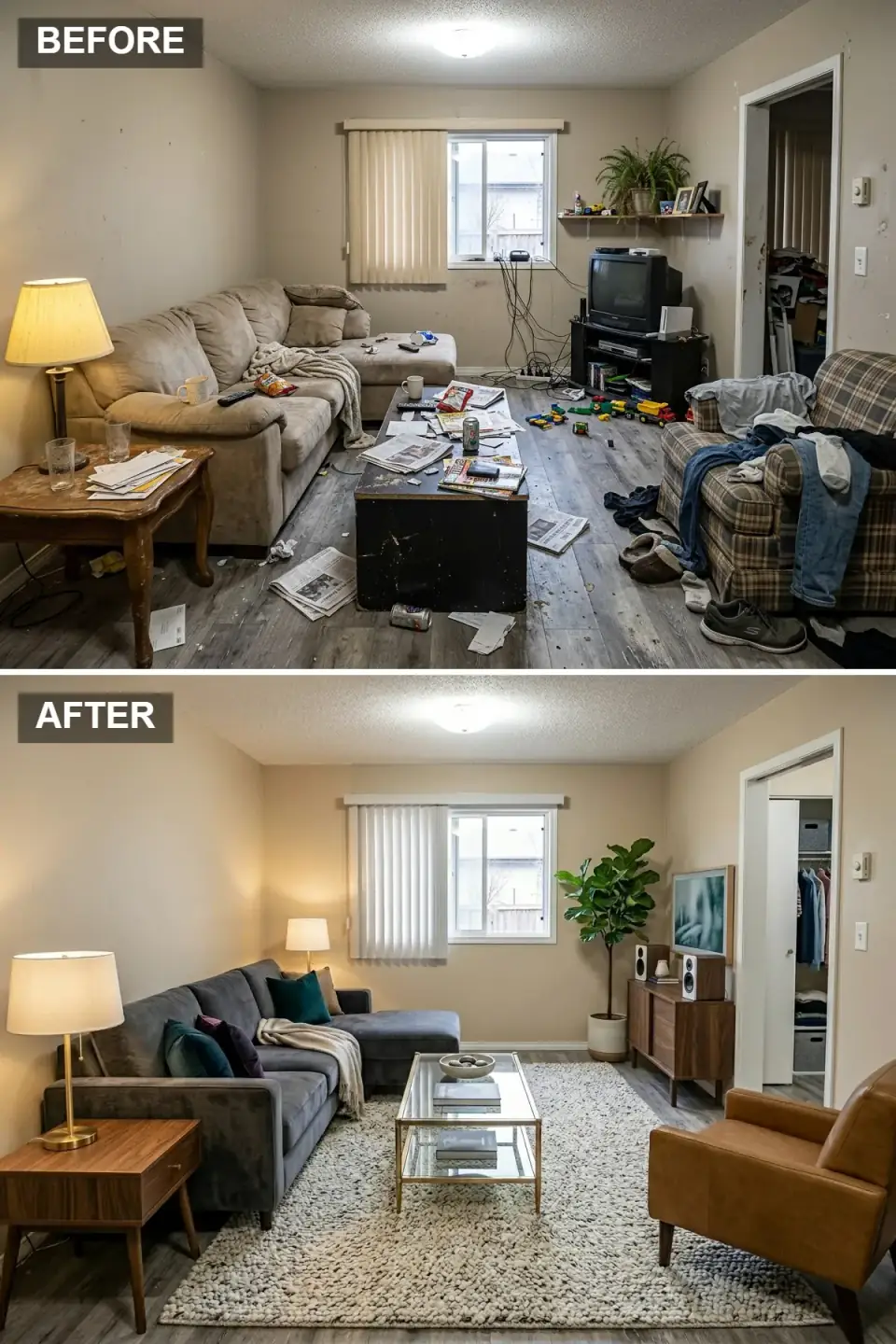
The format depends on three signature moves: walnut wood, full-grain leather, and clean tapered legs. The dark charcoal sectional anchors the floor plane; the cognac leather armchair is the room's warmest object, doing the same heritage-craft duty a Wegner or Cassina chair has done in design magazines for sixty years. The walnut media console with hairpin legs floats above the floor — a deliberately mid-century proportion that keeps the small room from feeling closed in.
Plan-aware verdict: mid-century furniture rewards quality. A solid-walnut media console from a Hudson Valley craftsman or a heritage maker (Stickley, Thos. Moser) at $1,500–$3,000 reads architectural; the same form in walnut veneer over particleboard at $400 reads catalog. For the leather armchair, full-grain cognac leather from Cassina, Norr11, or a vintage 1960s reissue runs $1,500–$3,500 — the cheaper bonded-leather alternatives fail visually within three years. The fiddle leaf fig (Ficus lyrata) is the period-correct large plant; a six-foot specimen in a ceramic planter from West Elm or CB2 runs $200–$450 and survives four hours of indirect light.
Color Palette
Pale Beige
#DBCFB8
Benjamin Moore Manchester Tan (HC-81) or Farrow & Ball Slipper Satin (No. 2004) — neutral that lets walnut and leather register.
Cognac Leather
#965A2D
Italian or American full-grain saddle leather (Cassina or Norr11 quality tier) — patinas in over five years.
Walnut Wood
#6B4733
Solid American black walnut, hand-rubbed oil finish — Stickley, Thos. Moser, or a Hudson Valley shop.
Charcoal Grey
#4F5359
Performance linen or wool in charcoal (Maharam Mode or Crypton weave) — handles daily use over a decade.
3. Rustic Farmhouse Charm
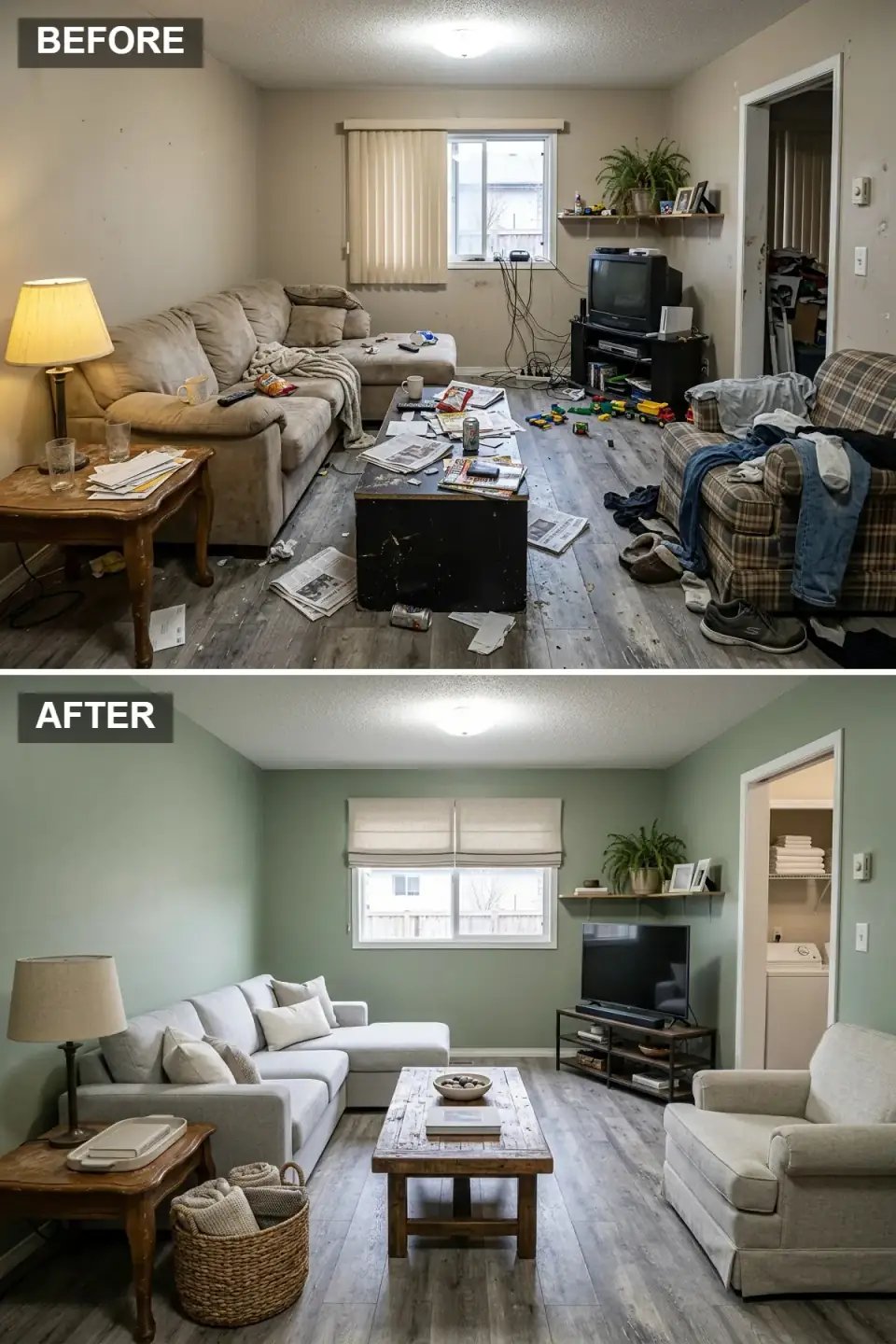
A sage-green wall changes the room's emotional register before any furniture lands. Soft, properly desaturated sage (closer to a warm grey-green than to anything you'd call "green" on a swatch) reads as a calming neutral that pairs with both light dove-grey upholstery and warm reclaimed-wood pieces. The reclaimed pine coffee table is the heart of the format — its visible saw marks, mineral stains, and subtle warps are exactly the imperfections a uniform big-box "rustic" piece can never replicate.
Plan-aware verdict: real reclaimed wood (Hudson Valley wood salvagers, or regional sources like Pioneer Millworks) runs $800–$2,500 for a coffee table at this scale and has the hand-touched authenticity that drives the format. The sage green spec to use is Farrow & Ball Lichen (No. 19), Benjamin Moore Saybrook Sage (HC-114), or Sherwin-Williams Evergreen Fog (SW 9130) — never a saturated kelly or hunter green. Roman shades in unbleached linen replace vertical blinds and add the acoustic absorption builder-grade rooms typically lack. The industrial-pipe shelving must be properly anchored into studs (not just drywall anchors) — at 6 ft. tall, a loaded shelf weighs 200+ pounds.
Color Palette
Soft Sage
#94A38D
Farrow & Ball Lichen (No. 19) or Benjamin Moore Saybrook Sage (HC-114) — desaturated sage, never a saturated green.
Reclaimed Pine
#7F634B
Salvaged barn-wood pine from a Hudson Valley wood reclaimer or Pioneer Millworks — visible grain, patina earned, not faked.
Light Dove Grey
#C4C4C4
Performance linen-cotton blend in dove grey — Crypton or Sunbrella weave for daily-use durability.
Natural Linen
#D4CFC4
Belgian flax linen in stone-washed cream — softens with each wash, reads honest against the painted walls.
4. Colorful Eclectic Energy
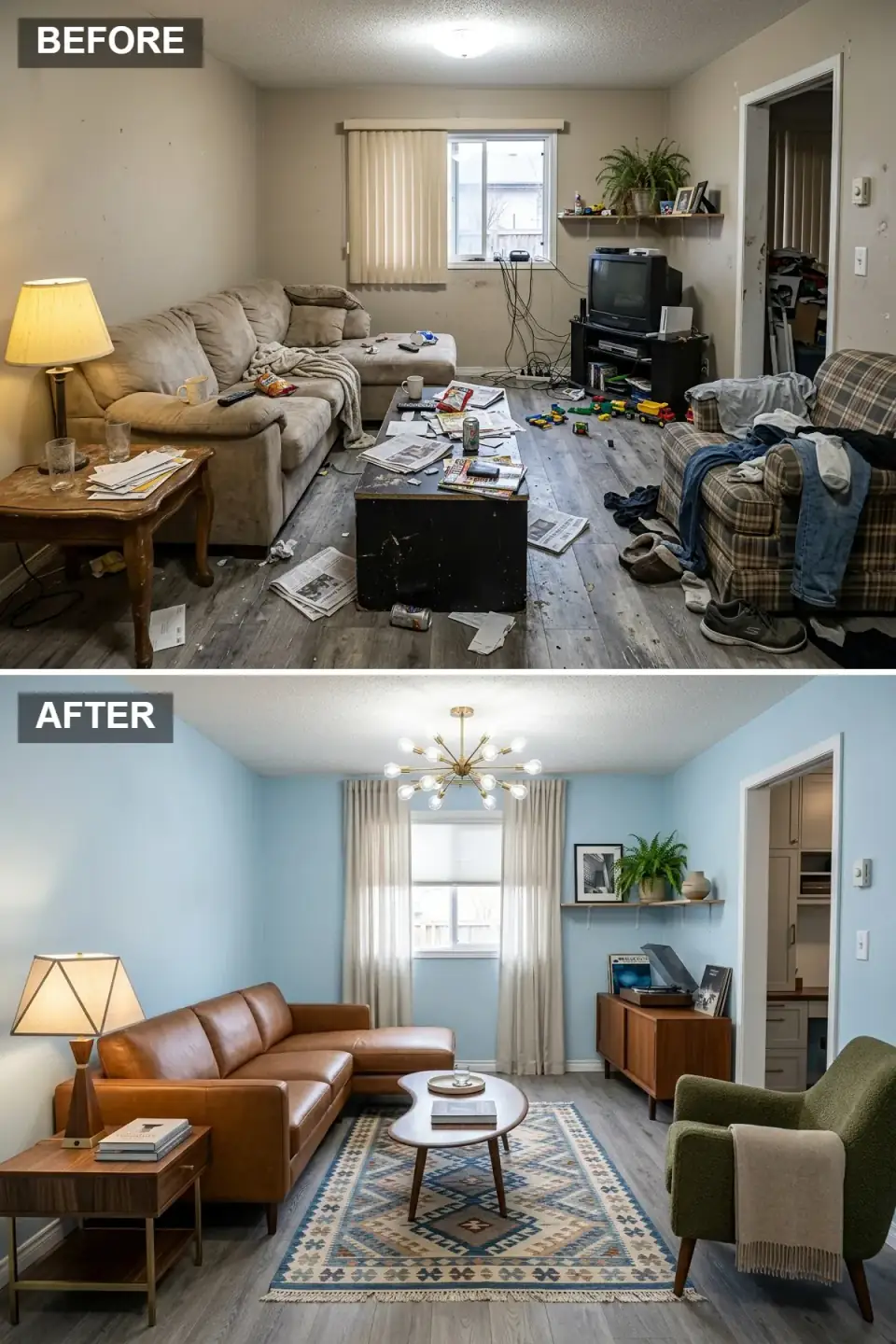
A confident, color-forward reset built on three disciplined moves. The wall is desaturated sky-blue, not a primary blue; the tan leather sectional and olive armchair come from the same earthy palette family rather than fighting the wall. The patterned vintage-style rug ties everything together by repeating two or three of the room's other colors in its pattern — that's the rule that keeps eclectic from collapsing into chaos. The sputnik brass chandelier is the period-perfect punctuation.
Plan-aware verdict: eclectic rooms succeed when the rug does the color cohesion work. A vintage Persian, Turkish, or Moroccan-style rug in a 9×12 with three repeated colors from the room's palette runs $1,000–$3,000 from regional rug yards or Beni Rugs; a contemporary printed alternative runs $400–$800 and gives 80% of the visual register. For the sky blue, Farrow & Ball Skylight (No. 205) or Benjamin Moore Wedgewood Gray (HC-146) — both have grey undertones that keep them from going aquatic. The sputnik chandelier is heavy (15–25 pounds for residential models); install with a properly rated ceiling box and a swag chain to a stud, not just drywall.
Color Palette
Sky Blue
#A7C5D9
Farrow & Ball Skylight (No. 205) or Benjamin Moore Wedgewood Gray (HC-146) — desaturated, never primary.
Tan Leather
#996633
Full-grain tan saddle leather sectional (Cassina, Article, or Restoration Hardware) — patinas over years of use.
Olive Green
#5F6B41
Performance velvet or wool in muted olive — Maharam or Pierre Frey weave for the eclectic register.
Cerulean Blue
#3B6D8C
A vintage Turkish or Moroccan flatweave that pulls cerulean and tan into the same composition.
5. Sleek Modern Statement
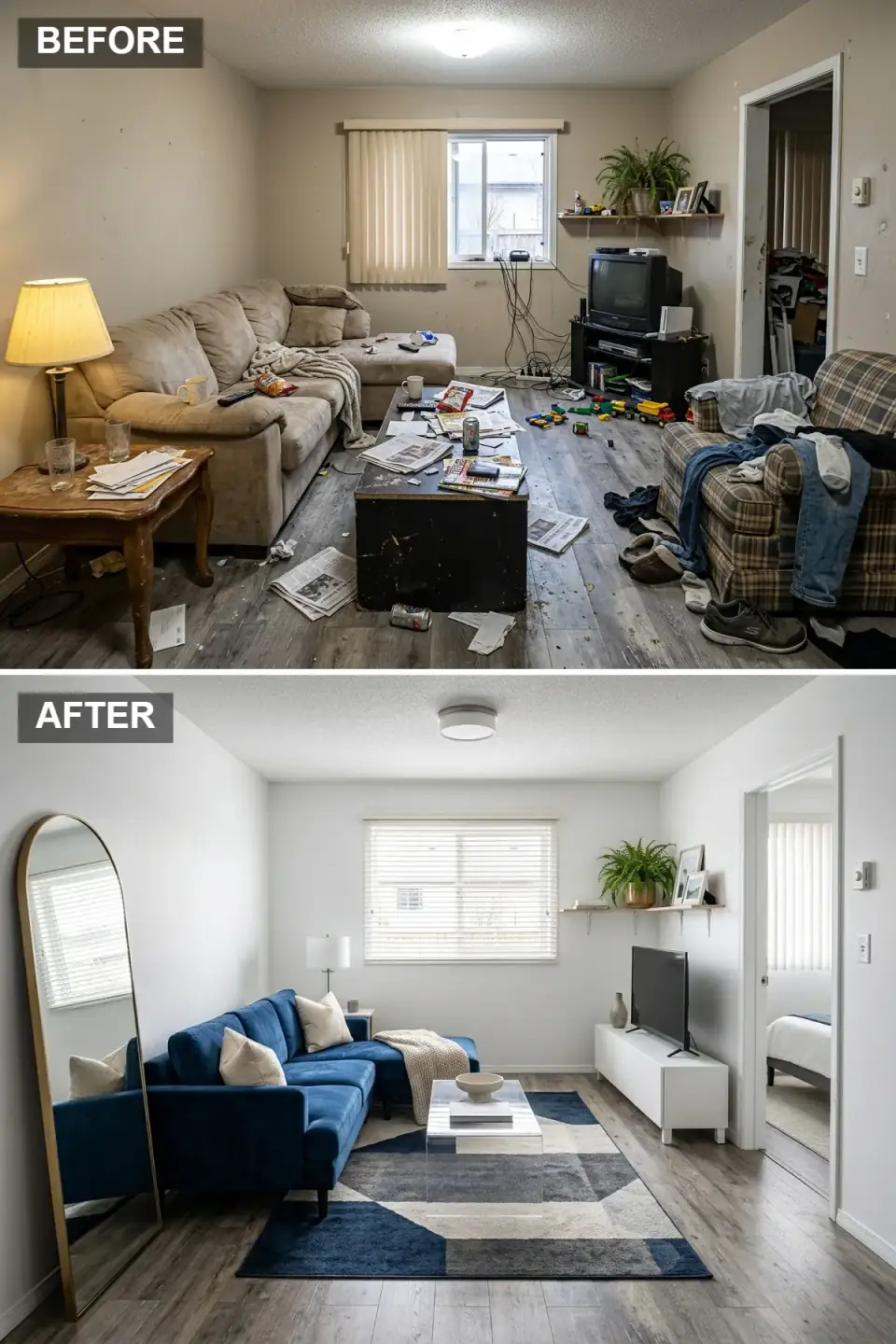
A high-contrast statement room. Crisp white walls plus a sapphire-blue velvet sectional plus an acrylic coffee table that nearly disappears reads as gallery-grade modern. The acrylic table is the smartest move here — at this saturation level, any other coffee table would compete with the sofa for the eye's attention. The arched floor mirror does double duty: it adds a curved silhouette in a room full of right angles, and it bounces the light from across the room.
Plan-aware verdict: bold-color upholstery only works in performance fabric. Specify a Crypton or Sunbrella performance velvet in sapphire (Maharam Velvet 2 in Sapphire, or Robert Allen Spirit Velvet) — pure cotton velvet pills within eighteen months under normal use. The acrylic table needs to be cast acrylic (not extruded) at minimum 1-inch thickness; the cheaper extruded versions yellow within three years. For the wall paint, Benjamin Moore Chantilly Lace (OC-65) or Sherwin-Williams Pure White (SW 7005) — both bright enough to bounce light without cooling the room. The arched floor mirror should be at least 60 inches tall and properly anchored to a stud through the back frame.
Color Palette
Pure White
#F5F5F5
Benjamin Moore Chantilly Lace (OC-65) or Sherwin-Williams Pure White (SW 7005) in matte — bright, holds against the bold upholstery.
Sapphire Velvet
#003366
Crypton Velvet or Sunbrella performance velvet in sapphire — pills-resistant, color-fast over a decade.
Matte White
#EFEFEF
Lacquered matte-white floating console (Muuto, Article, or a regional cabinet shop) — clean, minimalist, screen-friendly.
Cast Acrylic
#E0E0E0
Cast acrylic at 1-inch+ thickness from CB2 or Restoration Hardware — never extruded, which yellows.
6. Luxe Custom Built-Ins
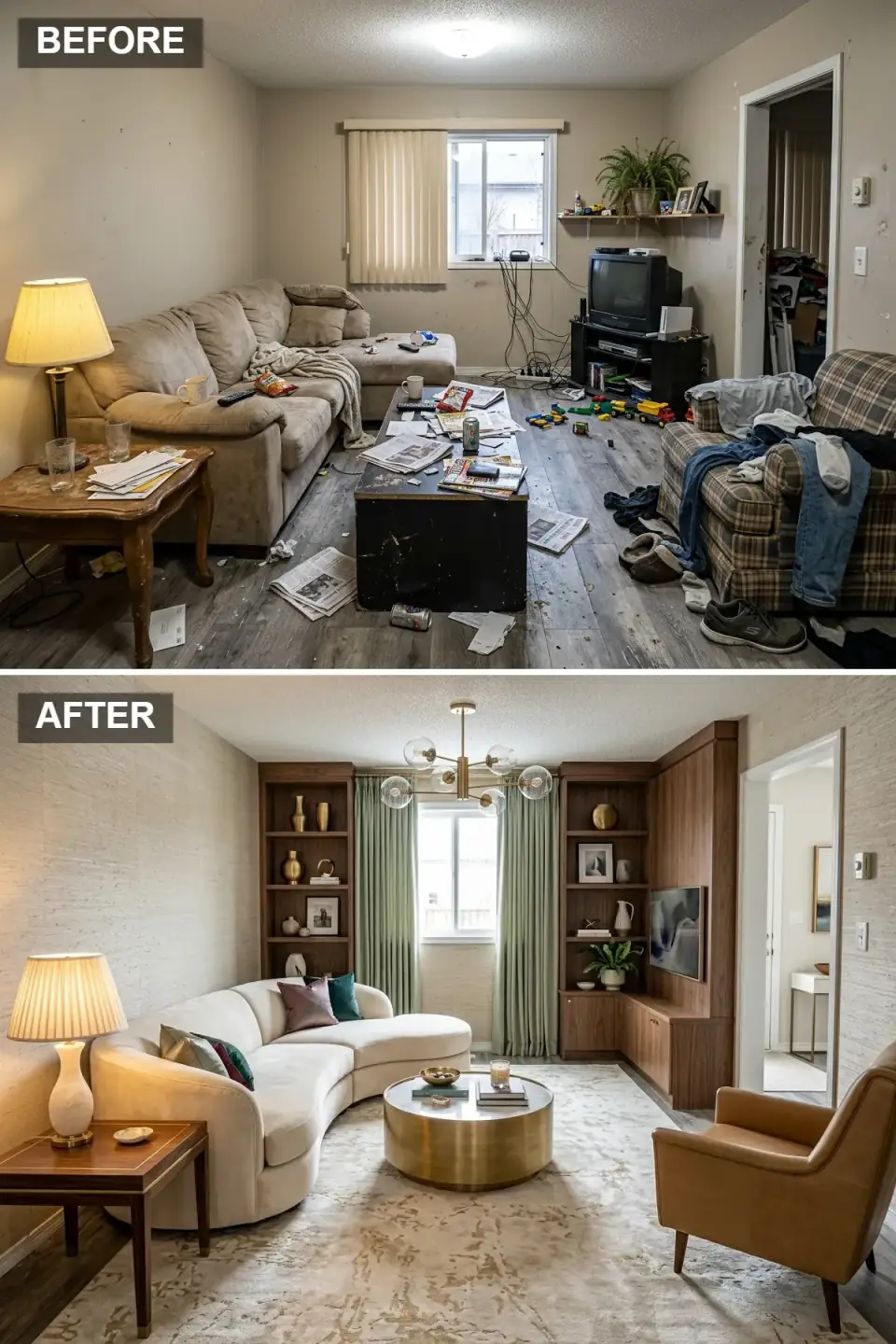
The most build-heavy reset in the guide and the one that earns its budget. A wall-to-wall custom walnut built-in transforms the room from "decorated box" to "architecture" — the millwork doesn't fight the rest of the furniture; it carries the entire vocabulary. Curved cream bouclé sofa, leather armchair, brass coffee table, grasscloth walls — every surface reads considered because the millwork did the work of telling the rest of the room what to be.
Plan-aware verdict: a wall-to-wall custom walnut built-in from a Hudson Valley shop runs $12,000–$25,000 in 2026 — and it's a framing-stage decision, not a finish-stage one. The wall behind has to be reinforced with horizontal blocking during framing or with backing plates as a retrofit; the cabinet shop has to coordinate with the electrician for the TV power and HDMI runs before drywall closes; the surrounding walls have to be truly plumb (out-of-plumb framing reads as gaps in a flush-finish built-in). Grasscloth wallpaper from Phillip Jeffries, Schumacher, or Cole & Son runs $200–$400 per single roll plus installation. The curved cream bouclé sofa needs performance bouclé (Maharam Bouclette or Pierre Frey Mimic) — decorative bouclé pills in months under daily use.
Color Palette
Rich Walnut
#5C4033
Solid American black walnut, plain-sawn, hand-rubbed oil finish — Hudson Valley shop or Stickley quality tier.
Cream Bouclé
#F2EBD9
Maharam Bouclette or Pierre Frey Mimic on a curved hardwood frame — performance-grade for daily use.
Brushed Brass
#B5A642
Round brushed-brass-and-stone or solid brushed-brass plinth (Allied Maker or CB2) — never lacquered.
Textured Grasscloth
#D0C5B4
Phillip Jeffries Manila Hemp or Schumacher Sisal in a warm beige — texture that catches light beyond flat paint.
7. Organic Botanical Retreat
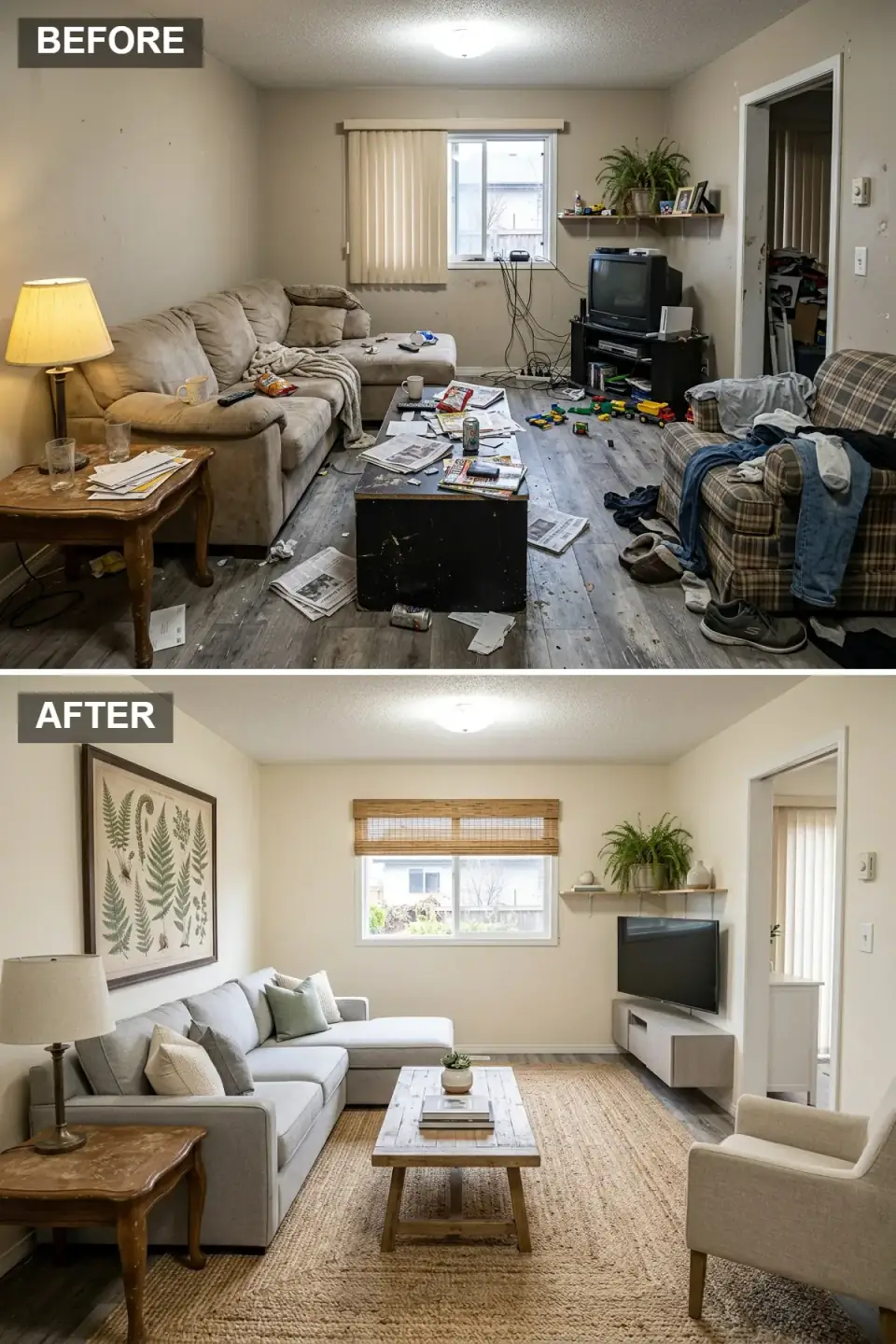
A light, airy, deeply organic reset. The bamboo roman shades replace vertical blinds and immediately transform the window from a punched-opening into a soft architectural feature. The floating wood media console keeps the floor visible, which makes a 14×16 ft. room read closer to 16×18. The single oversized botanical print is the room's only piece of decor — and it works because nothing else is competing for the eye.
Plan-aware verdict: woven bamboo or natural-fiber roman shades from Hartmann & Forbes, The Shade Store, or Hudson Valley window-treatment shops run $300–$700 per window depending on size and lining. Specify a privacy liner for any room with neighbor visibility — bare bamboo lets light through both ways at night. The floating media console needs reinforced wall framing; specify a French cleat with stud-aligned fasteners and a 200-pound load rating. The oversized botanical print should be roughly 70% of the wall width above the sofa — anything smaller floats; anything larger crowds. Print on cotton rag from a fine-art printer (Mpix, Bay Photo, or a regional shop) runs $400–$1,200 framed in walnut or oak.
Color Palette
Creamy Off-White
#F0ECE2
Benjamin Moore Swiss Coffee (OC-45) or Farrow & Ball Slipper Satin (No. 2004) — warm undertone, no yellowing.
Natural Bamboo
#C9B28F
Hartmann & Forbes or The Shade Store woven bamboo roman shades with a privacy liner — replace any vertical blinds first.
Weathered Oak
#8B7D6B
Reclaimed or natural-finish white oak with visible grain — Pioneer Millworks or a Hudson Valley shop.
Heather Grey
#B0B0B0
Performance linen-cotton blend (Crypton or Sunbrella) in a soft heathered grey for daily-use durability.
8. Warm and Moody Bohemian
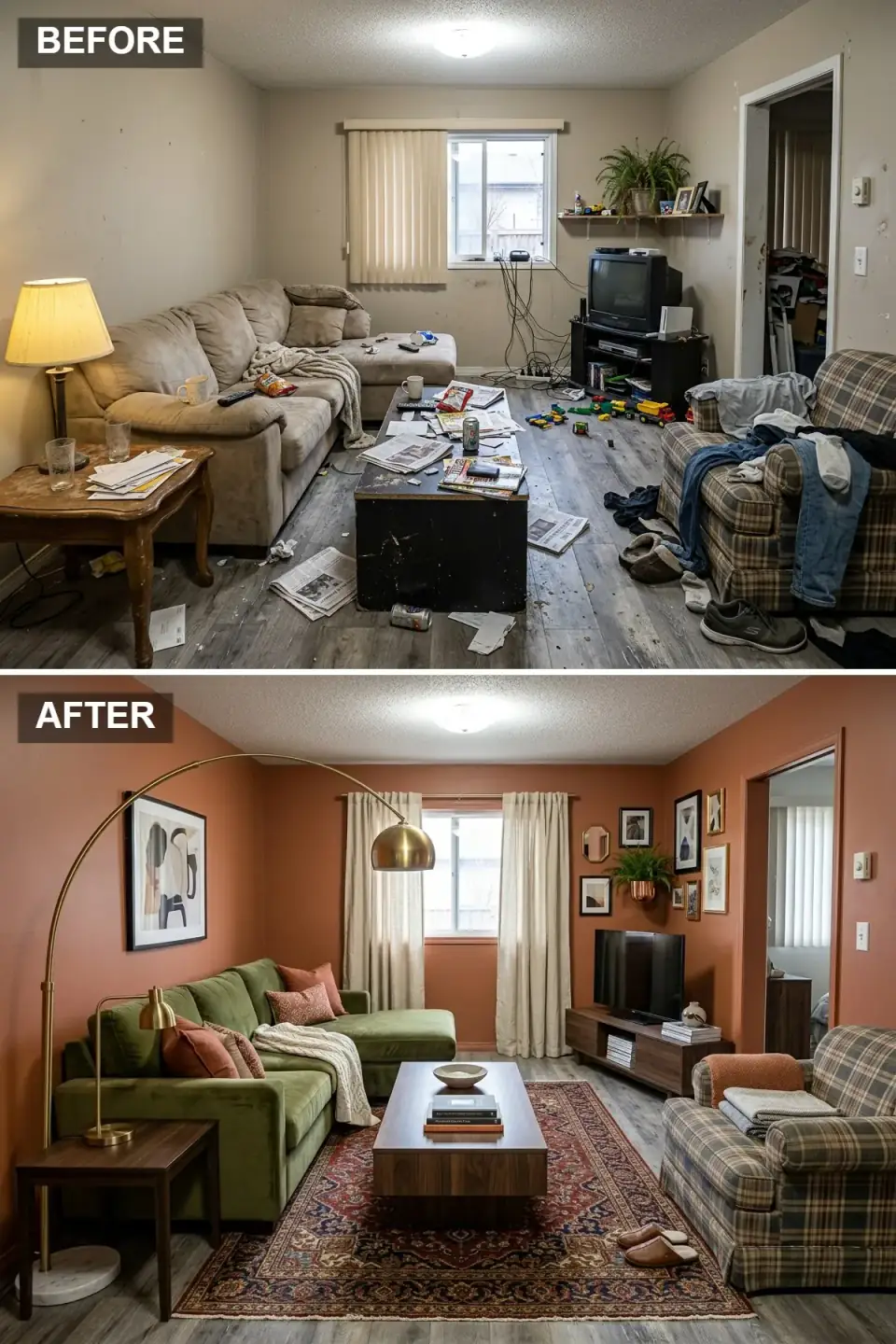
The opposite end of the palette spectrum from the Scandi reset. A rich terracotta wall envelops the room and immediately changes its emotional register. The deep forest-green velvet sectional and dark walnut furniture are doing the same earth-tone work the walls are; nothing here is cool, nothing is sterile. The arc floor lamp solves the lighting problem (no overhead fixture in the right place) without rewiring; the curated gallery wall is the format-defining decorative move.
Plan-aware verdict: terracotta walls only work when properly desaturated. Farrow & Ball Red Earth (No. 64), Benjamin Moore Audubon Russet (HC-51), or Sherwin-Williams Cavern Clay (SW 7701) — all earth-pigmented, never primary orange. Test at three times of day before committing; terracotta swings dramatically between morning pink, afternoon true, and evening brown. Forest-green velvet on a sectional needs to be performance velvet (Crypton or Sunbrella weave); decorative-grade velvet pills within twelve months. The arc floor lamp (Cedar & Moss, Visual Comfort, or a vintage George Nelson reissue) provides directional task light without ceiling-fixture rewiring — an underrated move for older Hudson Valley homes with limited overhead lighting.
Color Palette
Warm Terracotta
#A05A42
Farrow & Ball Red Earth (No. 64) or Benjamin Moore Audubon Russet (HC-51) — earth-pigmented, never orange.
Forest Green Velvet
#4A5D3F
Crypton or Sunbrella performance velvet in deep forest green — handles daily use, holds color.
Dark Walnut
#473224
Solid American walnut with a hand-rubbed oil finish — heritage maker or regional craftsman.
Deep Red
#802A2A
A vintage Persian or Turkish flatweave with deep reds, ochres, and indigos — anchors the bohemian palette.
9. Cool Monochrome Minimalism
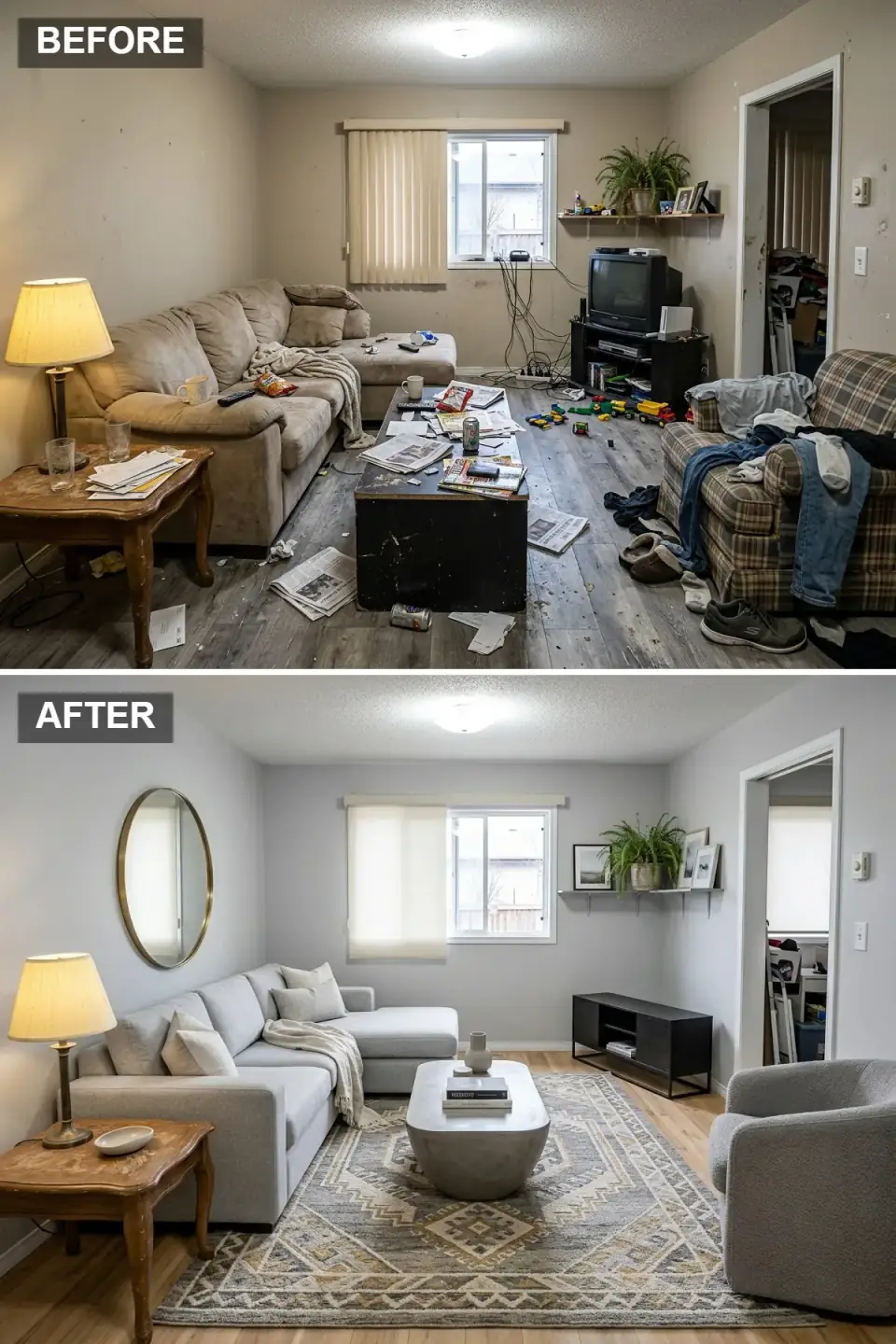
A rigorous monochrome with industrial discipline. Light grey walls, medium grey sectional, charcoal armchair, concrete coffee table, matte black media console — every tone in the room is carrying the same color discipline at a different value. The single round mirror breaks the right-angle geometry without breaking the palette. This is the format that succeeds or fails on commitment; any single piece in the wrong tone (a warm beige throw, a brown wood frame) breaks the entire composition.
Plan-aware verdict: a cast concrete coffee table is heavier than people anticipate (60–80 pounds for a small plinth). Verify the floor structure can take the load, especially in older Hudson Valley homes with original 2×6 floor joists. For the wall paint, Benjamin Moore Stonington Gray (HC-170) or Farrow & Ball Pavilion Gray (No. 242) — cool-leaning, not warm. Performance tweed from Maharam Hallingdal 65 or Kvadrat Steelcut Trio at $80–$150 per yard for upholstery; the cheaper polyester tweeds pill within months. The matte black media console (Muuto, Article, or a regional powder-coater) needs welded-steel construction, not stamped sheet metal.
Color Palette
Cool Light Grey
#D3D3D3
Benjamin Moore Stonington Gray (HC-170) or Farrow & Ball Pavilion Gray (No. 242) — cool-leaning grey in matte.
Cast Concrete
#8C8C8C
Cast concrete plinth from a regional fabricator (BedrosianHaus, or a Hudson Valley concrete shop) — sealed with penetrating sealer.
Matte Black Steel
#1A1A1A
Powder-coated welded steel — Muuto, Article, or a regional powder-coater. Never stamped sheet metal.
Light Grey Tweed
#A9A9A9
Maharam Hallingdal 65 or Kvadrat Steelcut Trio — durable performance tweed, ages without pilling.
10. Textured Organic Modern
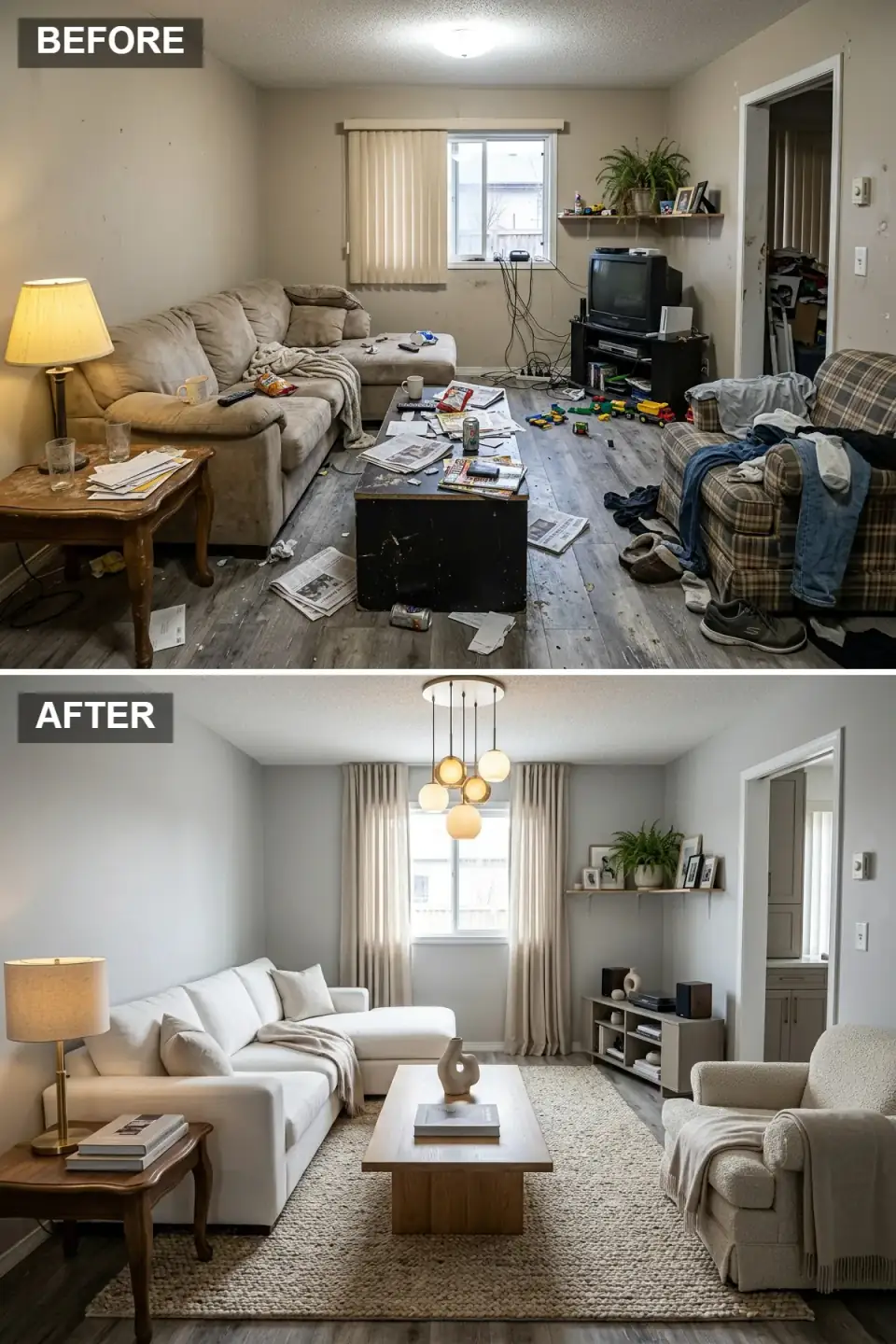
A texture-forward neutral reset. Ivory linen sofa, cream bouclé armchair, raw oak coffee table, chunky-knit wool rug — four distinct tactile experiences in roughly the same color family, layered so the eye reads each individually. The pendant cluster overhead replaces a single builder-grade fixture and provides the layered ambient lighting the original room never had.
Plan-aware verdict: this format depends on textile quality. Belgian linen sofas (Cisco Home, Cultiver, or a Hudson Valley upholsterer) at $2,500–$5,000; performance bouclé from Maharam Bouclette or Pierre Frey Mimic at $80–$150 per yard. The chunky-knit hand-loomed wool rug runs $1,200–$3,000 from Beni Rugs, Armadillo, or Hudson Valley weavers in a 9×12 — and it adds 25%+ acoustic absorption to the room, which is the unsung win of every textured natural-fiber rug. The pendant cluster needs careful electrical planning; a three-pendant ceiling-canopy box rated for the combined weight, on a single dimmer switch, is the right spec — three separate fixtures wired in series will fail one bulb at a time and look broken.
Color Palette
Cream Bouclé
#E8E0D5
Maharam Bouclette in Ivory or Pierre Frey Mimic — performance bouclé that resists pilling under daily use.
Raw Oak
#A89078
Solid white oak block, hardwax oil finish (Rubio Monocoat Pure), with visible saw marks or live edge — one of a kind.
Chunky Wool Knit
#CFC5B8
Hand-loomed chunky-knit wool from Beni Rugs or Armadillo — adds 25%+ acoustic absorption to the room.
Ivory Linen
#F2F0EB
Belgian flax linen slipcovered sectional from Cisco Home, Cultiver, or a Hudson Valley upholsterer — washable, ages soft.
Pro Tips From the Renovation Designer's Chair
- Layer lighting in three tiers — ambient, task, accent — and put every fixture on a dimmer. The single most common failure in a builder-grade living room is one harsh overhead fixture, no dimmer, no lamps. The fix is three light sources at minimum: an overhead (chandelier, pendant, or recessed cluster), a floor or arc lamp for task, and one or two table lamps for accent. Lutron Caséta dimmers ($60 a switch installed) are the standard residential spec.
- Paint is the single highest-leverage move you can make. A repaint with a complex heritage-collection color (Farrow & Ball, Benjamin Moore Historical, Portola Paints) transforms a room for $400–$800 in materials and a weekend of labor. The pigment depth of a real heritage paint reads from across the room; the cheap version reads cardboard at 8pm.
- Replace vertical blinds first, before any other change. Vertical blinds telegraph "builder-grade" louder than any other single element in a living room. Replace with ceiling-mounted floor-to-ceiling sheers, with woven bamboo or natural-fiber roman shades, or with linen drapery in 250% fullness. The wall behind any window operating on vertical blinds reads as construction site until those blinds come down.
- Scale the rug to the seating, not the room. The most common renovation rug error is a 5×8 under a sectional that needs a 9×12. Rule: all front legs of all major seating pieces sit on the rug. A rug too small floats the furniture and makes the entire seating zone read disjointed and cheap, regardless of how much was spent on the sofa.
- Pick three colors plus one accent — never seven. Builder-grade rooms accumulate colors over years of pillow purchases. Strip back to three core colors plus one accent borrowed from the art or upholstery, and the room re-resolves immediately. The discipline isn't which colors; it's how few.
- One organic element per room, minimum. A real or premium-faux olive tree, a Ficus lyrata, eucalyptus stems in a vase, dried branches — every successful living room reset I've designed includes at least one piece of nature with a real silhouette. It's the single move that prevents the room from reading like a furniture catalog.
Cost-Saving Moves That Don't Read as Cuts
- Upgrade the lighting before the furniture. Replacing a single builder-grade overhead fixture with a real pendant or sputnik chandelier and adding a floor lamp does more for a room's emotional register than any single sofa swap — at $400–$1,200 total.
- Paint instead of wallpaper for color commitment. A complex heritage paint (Farrow & Ball Red Earth for the bohemian, Benjamin Moore Saybrook Sage for the farmhouse, Stonington Gray for the monochrome) at $400–$800 installed delivers 80% of the visual impact of textured wallpaper at 25% of the cost.
- Premium faux botanicals over real on a budget. A six-foot faux Ficus lyrata or olive tree from Nearly Natural or Afloral runs $250–$450, versus $400–$700 for a real plant that may not survive the room's typical light conditions. Real plants cost more in mortality than at purchase.
- Stone remnants for plinth coffee tables. A 30-inch round Carrara or Calacatta plinth off a regional fabricator's remnant rack runs 30–50% under full-slab pricing. Visit the yard with your dimensions and let the available remnant pick the project.
The Core Idea. A builder-grade living room is not a furniture-shopping problem. It's a planning problem that runs from the lighting plan to the wall finish to the rug scale, with the sofa as the last layer applied. The lighting layers, the window treatments, the paint depth, and the discipline of choosing three colors plus one accent matter more than any single piece you put in the room. Build the reset with that discipline and any of the ten transformations above is reachable on the same footprint.
Reader Questions on Living Room Transformations
How much does a complete living room transformation cost?
In the 2026 Northeast, a full living room reset including paint, new sofa, coffee table, rug, lighting, and window treatments typically lands between $5,000 and $25,000 depending on furniture tier and whether millwork is involved. The Scandi minimalism, sleek modern, and monochrome formats land near $5,000–$10,000; the textured organic, mid-century, and bohemian formats run $10,000–$18,000; the custom-built-ins reset (transformation 6) runs $25,000–$50,000+ because of the millwork. Lighting and window treatments are the smallest line items but have the highest impact per dollar.
What is the single highest-impact change I can make to a builder-grade living room?
Replacing vertical blinds with ceiling-mounted floor-to-ceiling drapery or natural-fiber roman shades. The blinds telegraph builder-grade louder than any other element in the room; replacing them transforms the window from a punched-opening into an architectural feature. Second-highest is repainting the walls in a complex heritage color (Farrow & Ball, Benjamin Moore Historical, Portola). Third is replacing a single builder-grade overhead fixture with a real chandelier or pendant on a dimmer.
Should I commit to one design style or mix several?
Commit to one core style, mix two complementary ones at most. The eclectic transformation above (#4) is a deliberate two-style mix — mid-century furniture in a colorful Bohemian palette — and it succeeds because the rug pulls the colors together and the wood tones across the furniture are matched. A genuine three-or-four-style mix almost always reads as confused rather than collected. Pick a primary register (Scandi, mid-century, farmhouse, modern, bohemian) and let one secondary influence color the accents.
What size rug do I need for my living room?
Rule: the front legs of all major seating pieces should rest on the rug. For a typical 14×16 ft. living room with a sofa and two armchairs, that means a 9×12 minimum, often a 10×14 if the seating arrangement is generous. A 5×8 rug under a full sectional looks like a missed delivery and erodes the entire renovation budget visually. If a properly scaled rug is out of reach, layer a smaller rug over a larger jute or sisal — the layered base makes both rugs read intentional.
Are custom built-ins worth the investment for a living room?
Conditionally. For a long-term hold (10+ years) in a primary home, built-ins maximize storage, hide TV technology, and create the architectural read freestanding furniture rarely achieves — they pay back in daily quality of life and resale presentation. For a 3-year flip or a rental, freestanding pieces from regional makers, Crate & Barrel's solid-wood collection, or Stickley get you 80% of the look at 25% of the cost. The decision depends on tenure, not aesthetic preference. Custom walnut built-ins in the Hudson Valley run $12,000–$25,000 for a wall-to-wall installation.
What colors work best in a small living room?
Both light and dark formats work; avoid the middle. Light bodies (Benjamin Moore Swiss Coffee OC-45, Farrow & Ball Slipper Satin No. 2004) reflect light and read open. Dark bodies (Hale Navy HC-154, terracotta Audubon Russet HC-51, charcoal Stonington Gray HC-170) blur the corners and make the room feel bigger and more intimate at once — a common counterintuitive result. The format that fails most often in small living rooms is medium-saturation builder-grade beige, which reads neither airy nor enveloping. Pick a side and commit.
Where to Read Next
If this guide helped, the natural follow-ups go in two directions. For the deeper restraint-focused version of the Scandi (#1), modern (#5), and built-ins (#6) formats, my quiet luxury living room design guide covers the format with more brand specs and budget tiers. For the broader whole-home philosophy underneath all ten transformations, the quiet luxury interior design pillar applies the same discipline across eight rooms. And if the warm-and-moody bohemian (#8) or the textured organic modern (#10) is the format that resonates, the moody organic modern kitchen guide goes further into the same vocabulary in a different room.
Sources & Further Reading
- Architectural Digest. Living Room Design Trends and Layout Principles. architecturaldigest.com
- Remodelista. 10 Secrets for a Calm Home. remodelista.com
- Dwell. How to Layer Texture in a Neutral Living Room. dwell.com
- Benjamin Moore. Color Trends and Historical Collection Specifications. benjaminmoore.com
- Farrow & Ball. Paint Color Encyclopedia & Specifications. farrow-ball.com
- Lutron Electronics. Caséta Wireless Lighting Control — Residential Specification Guide. lutron.com
- Marble Institute / Natural Stone Institute. Care & Cleaning of Natural Stone Surfaces. naturalstoneinstitute.org
- The Shade Store. Roman Shade and Drapery Construction Specifications. theshadestore.com
- NAHB / Hanley Wood. 2025 Cost vs. Value Report — Interior Renovation ROI by Region. remodeling.hw.net
- This Old House. How to Install Custom Built-In Cabinetry. thisoldhouse.com

Nora Whitfield
Renovation Designer & Interiors Editor · Beacon, New YorkNine years of design-build renovation work across the Hudson Valley and the Northeast. Nora runs the Renovations, Room Guides and Renovation Mind desks — before-and-after studies, room-by-room design guides, and the long essays on why what we renovate matters.
More from Nora →

Reader notes