
The term gets thrown around as if it means "loud color everywhere," which is wrong. That's the structural difference between a bedroom that sparks joy for a decade and one that reads as a 2024 Instagram trend in 2027. Below: nine bedrooms that handle that color-versus-permanence split well, with the real the illustrative 2026 Northeast planning ranges and the framing-stage decisions behind each one.
How to Assess a Dopamine Bedroom
Four checks guide the assessment of a dopamine bedroom: the shell vs. layer split (which elements are permanent and which are interchangeable — color belongs almost entirely in the layer category), the color count (one dominant color, one supporting, one accent — a maximum of three saturated personal hues; more than that and the room reads chaotic), the texture variance (velvet, boucle, linen, wool — saturated colors only read as luxurious when the materials carrying them are honest), and the swap-out plan (when the homeowner outgrows the current palette in 4–6 years, what's removed and what stays). Get those four right and a bold bedroom ages well; miss any and you'll be repainting in three.
The nine bedrooms below cover the realistic spread, from $1,600 Scandi-playful builds to $6,500 jewel-tone glam configurations. For a kid-room companion that handles the same shell-and-layer split, see our Scandi Boho kids' room design guide.
The numbering doesn't rank. Each bedroom is a different brief — earthy boho, Scandi pop, jewel-tone glam, cottagecore, industrial, velvet glam, pastel, eclectic vintage, family-centric — and each fits a different kind of homeowner. Pick the section closest to what actually makes you happy.
Earthy Bohemian Luxe
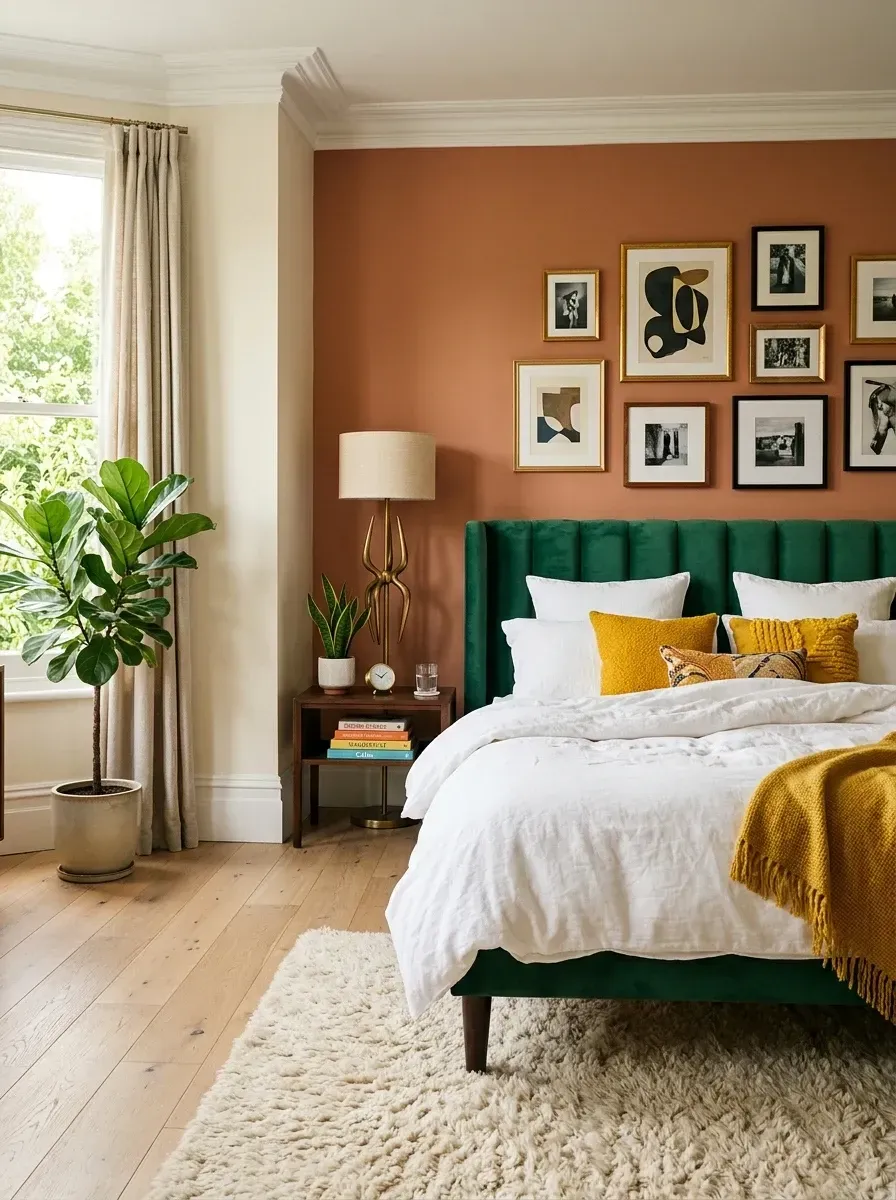
Both colors are deeply saturated, but both have a lot of black mixed into them — they read as earthy rather than as primary. That's the trick. A pure red wall plus a Kelly green bed would tip into garish within a year; the desaturated cousins of those colors stay sophisticated. The mid-century walnut furniture is doing the architectural work of grounding the saturated layer.
The accent wall is the swap-out element here, not the bed. Repainting one wall is a $80–$250 weekend project; reupholstering a velvet bed is a $1,200–$2,000 investment. Specify the bed frame in a color you'll commit to for at least 8 years, and let the wall be the changing variable. Use Benjamin Moore Aura or Farrow & Ball Estate Emulsion for the terracotta — cheaper paints in saturated colors fade unevenly under direct light within 18 months.
The Earthy Bohemian Luxe direction brings together terracotta single-accent wall (changeable), emerald green performance velvet upholstered queen bed, mid-century modern solid walnut nightstand and dresser, eight-frame considered gallery wall in mixed metal frames, and large fiddle-leaf fig in a woven floor basket.
Budget notes for Earthy Bohemian Luxe
Terracotta Accent Wall (Premium Paint + Painter): $200 – $450. Queen Velvet Bed Frame: $700 – $1,400. Solid-Walnut Mid-Century Nightstand + Dresser: $600 – $1,200. Sculptural Brass Table Lamp: $150 – $300.
Gallery Wall Frames + Art (×8): $250 – $500. Large Fiddle-Leaf Fig + Pot: $150 – $300. Textured Wool Shag Rug (8×10): $250 – $500. Linen Curtains + Hardware: $150 – $300.
Bedding + Throw Blankets: $200 – $400. Total Estimated Cost: $2,650 – $5,350.
A gallery wall succeeds when the frames vary in size but the spacing between them is consistent. Lay the entire arrangement on the floor first, photograph it, and then transfer to the wall using painter's tape outlines. Skipping this step is why most DIY gallery walls look off.
Scandi-Playful Minimalism
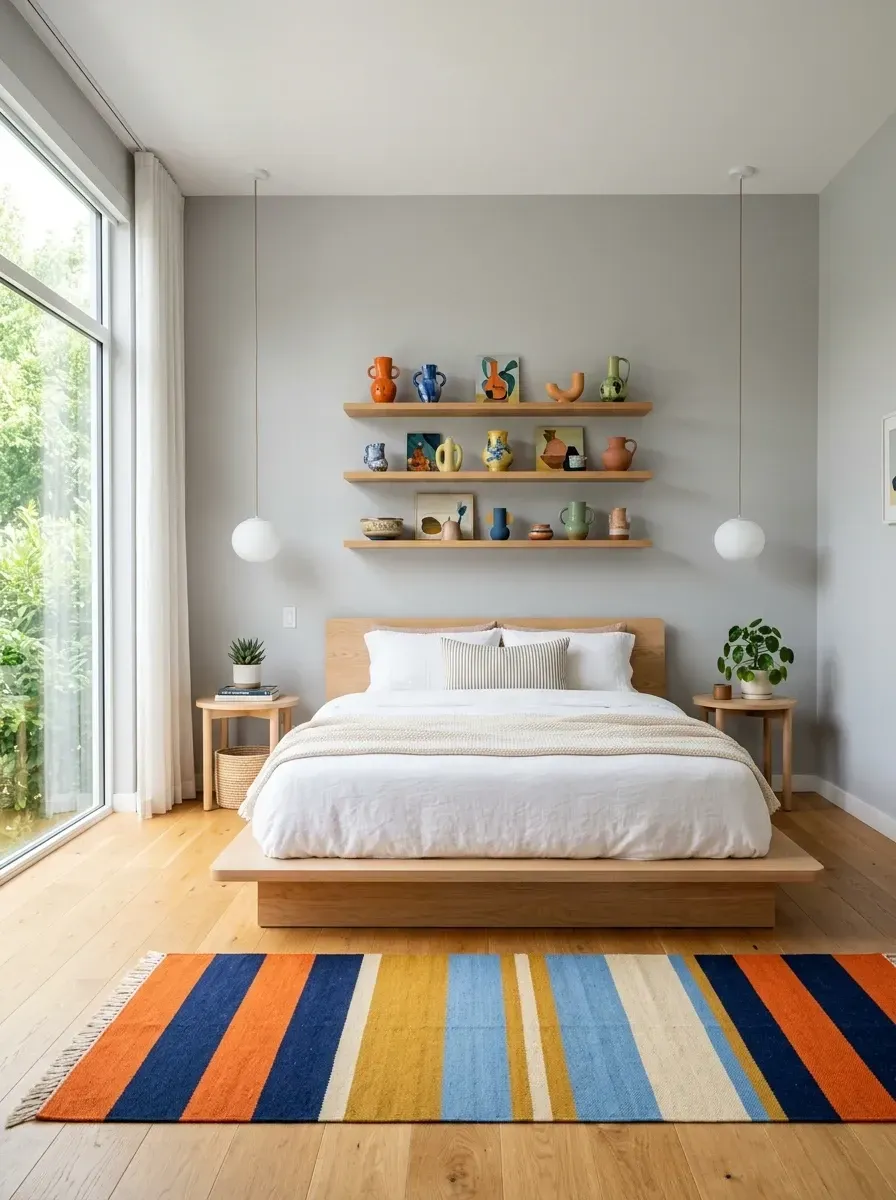
Scandi-playful is the easiest dopamine vocabulary to keep age-appropriate over time — because the saturated color is concentrated entirely in objects you can swap. The wall is pale grey. The bed is light ash. The bedding is white linen. The shelves are open and architectural. All the joy lives in the ceramic collection, the rug, and a few accent textiles. When the homeowner moves in three years from "tangerine and cobalt" to "sage and clay," nothing structural changes.
The discipline here is uniform shelf composition. Three floating shelves at consistent spacing read as architectural; three at random heights read as catalog. Specify hidden bracket hardware (Floating Shelf Co. or custom from the Northeast carpenter) and lag-bolt into studs — open shelves loaded with ceramics carry significant weight. Linen bedding from Coyuchi, Cultiver, or Hawkins New York holds up to weekly wash and ages into a softer hand than thread-count cotton.
The Scandi-Playful Minimalism direction brings together low light-ash platform bed (queen), three floating wood shelves on hidden brackets, considered saturated ceramic collection, bold striped wool area rug, and minimalist white globe pendant lights as bedside reading.
Budget notes for Scandi-Playful Minimalism
Pale Grey Wall Paint: $50 – $100. Queen Light-Ash Platform Bed: $500 – $1,000. Floating Wood Shelves on Hidden Brackets (×3): $150 – $300. considered Ceramic Vase Collection: $250 – $500.
Colorful Striped Rug (6×9): $200 – $400. Globe Pendant Lights (×2): $150 – $300. Small Side Tables (×2): $150 – $300. Linen Bedding Set: $150 – $300. Total Estimated Cost: $1,600 – $3,200.
Light pendants over the bedside instead of table lamps free up the nightstand surface and read as architectural. Hang at 24–28 inches above the nightstand, on a dimmable wall switch — never on a switched-cord pendant.
Dramatic Jewel-Tone Retreat
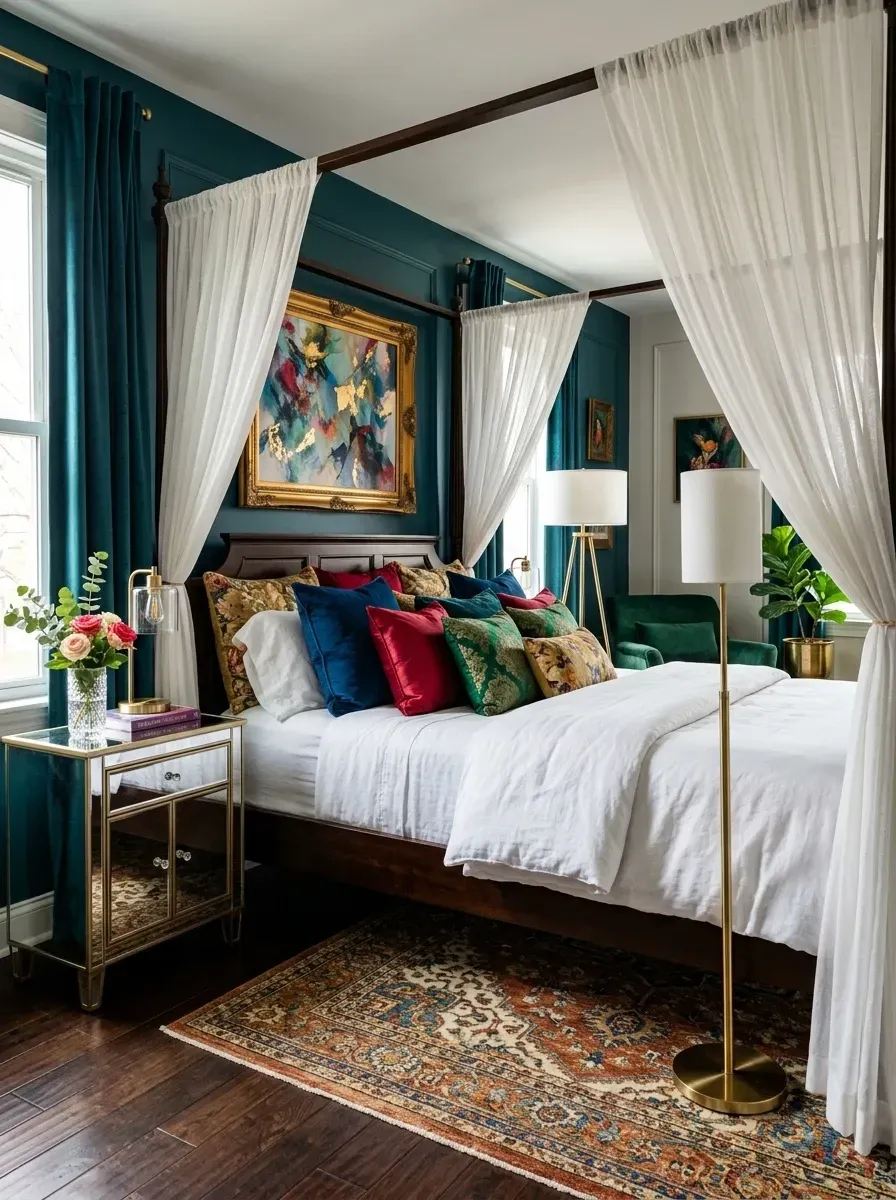
Jewel-tone glam is dopamine decor at its richest — and the configuration most often misread by clients trying to do it themselves. The rule: dark wall plus dark furniture plus dark textiles plus one bright metal accent. The mistake: dark wall plus light furniture plus mixed-metal hardware. The mixed version reads as confused; the matched version reads as opulent. Deep teal walls absorb light and read sophisticated; the four-poster bed with sheer canopy adds vertical drama; jewel-toned bedding and ruby velvet upholstery layer the warmth.
Dark saturated wall paint in the Northeast bedroom with limited natural light needs a high-quality conversion finish — Benjamin Moore Aura or Sherwin-Williams Emerald — and proper layered electrical. Three independent dimmable circuits minimum: overhead, sconces or pendants, table lamps. Without dimmers, a moody bedroom either glares too bright or sits too dim. Plan the circuits at framing, before drywall.
The Dramatic Jewel-Tone Retreat direction brings together deep teal painted walls (premium catalyzed conversion finish), dark walnut four-poster queen bed, sheer linen canopy curtains (removable seasonally), mirrored nightstand and ruby velvet accent chair, and large ornate gold-framed statement art.
Budget notes for Dramatic Jewel-Tone Retreat
Premium Deep Teal Paint + Painter: $300 – $600. Queen Four-Poster Walnut Bed: $800 – $1,600. Sheer Linen Canopy Curtains: $100 – $200. Mirrored Nightstand: $200 – $400.
Ruby Velvet Accent Chair: $300 – $600. Large Gold-Framed Statement Art: $300 – $600. Patterned Wool Area Rug (8×10): $300 – $600. Jewel-Tone Bedding + Pillows: $250 – $500.
Gold Floor + Table Lamps + Dimmable Circuits: $400 – $750. Total Estimated Cost: $2,950 – $5,850.
A canopy needs solid attachment at four corners and a tension point at the bed's headboard or footboard. Sheer linen canopy fabric is roughly $30–$50 per yard from a fabric store; specify rod-pocket construction so the fabric removes for laundry without disturbing the canopy frame.
Sunny Cottagecore Charm
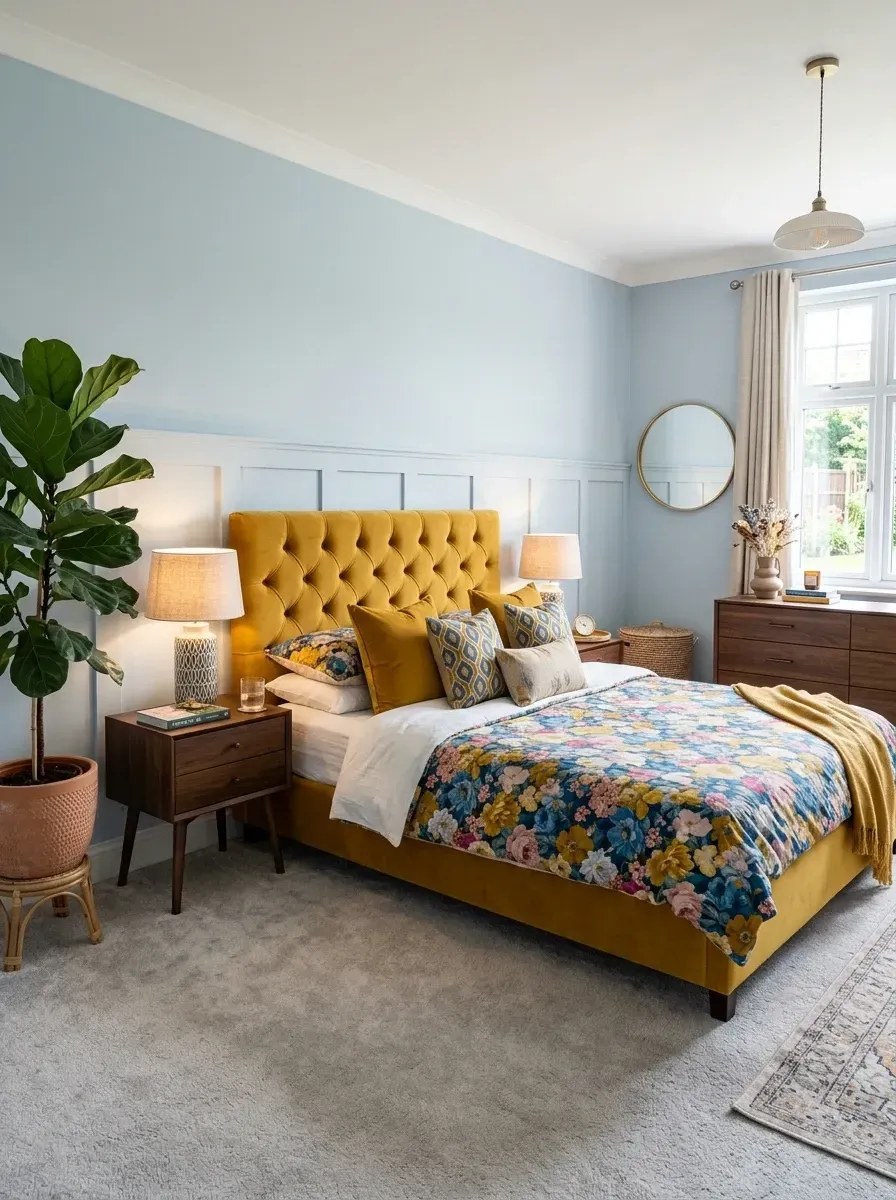
Cottagecore done well is one of the most enduring dopamine vocabularies — the underlying design language is roughly a hundred years old, which keeps the saturated colors anchored in tradition rather than in trend. The yellow velvet bed is the focal feature; the powder-blue wainscoting plus white upper wall is the architectural framing that makes the bed read as deliberate rather than as random. Floral bedding provides the secondary pattern layer; the rest of the room is calm.
Wainscoting is the move that improves this configuration from "decorated" to "architecturally renovated." Pre-primed MDF wainscot installed by the Northeast carpenter runs $400–$700 per wall including paint — and it's a permanent improvement that survives any future redecoration. The yellow bed is the high-personality item; specify a cleanable performance velvet (Sunbrella indoor or Designtex Mohair Sunshine) so a single coffee spill doesn't end the relationship.
The Sunny Cottagecore Charm direction brings together sunshine yellow tufted velvet upholstered queen bed, powder blue MDF wainscoting + crisp white upper walls, vibrant floral cotton bedding, mid-century medium-oak nightstand and dresser, and large round gold mirror as light-bouncing feature.
Budget notes for Sunny Cottagecore Charm
Wainscoting Materials + Install + Paint: $600 – $1,400. Queen Yellow Velvet Bed: $600 – $1,200. Mid-Century Medium-Oak Dresser + Nightstand: $600 – $1,200. Floral Cotton Duvet + Pillows: $150 – $300.
Large Round Gold Mirror: $150 – $300. Ceramic Table Lamps (×2): $200 – $400. Patterned Area Rug (6×9): $150 – $300. Total Estimated Cost: $2,600 – $5,400.
A round mirror should be sized to roughly two-thirds the width of the dresser or bed underneath it. Smaller and it floats; larger and it dominates. The 36–42 inch diameter range works for most the Northeast bedroom dressers.
Creative Industrial Loft
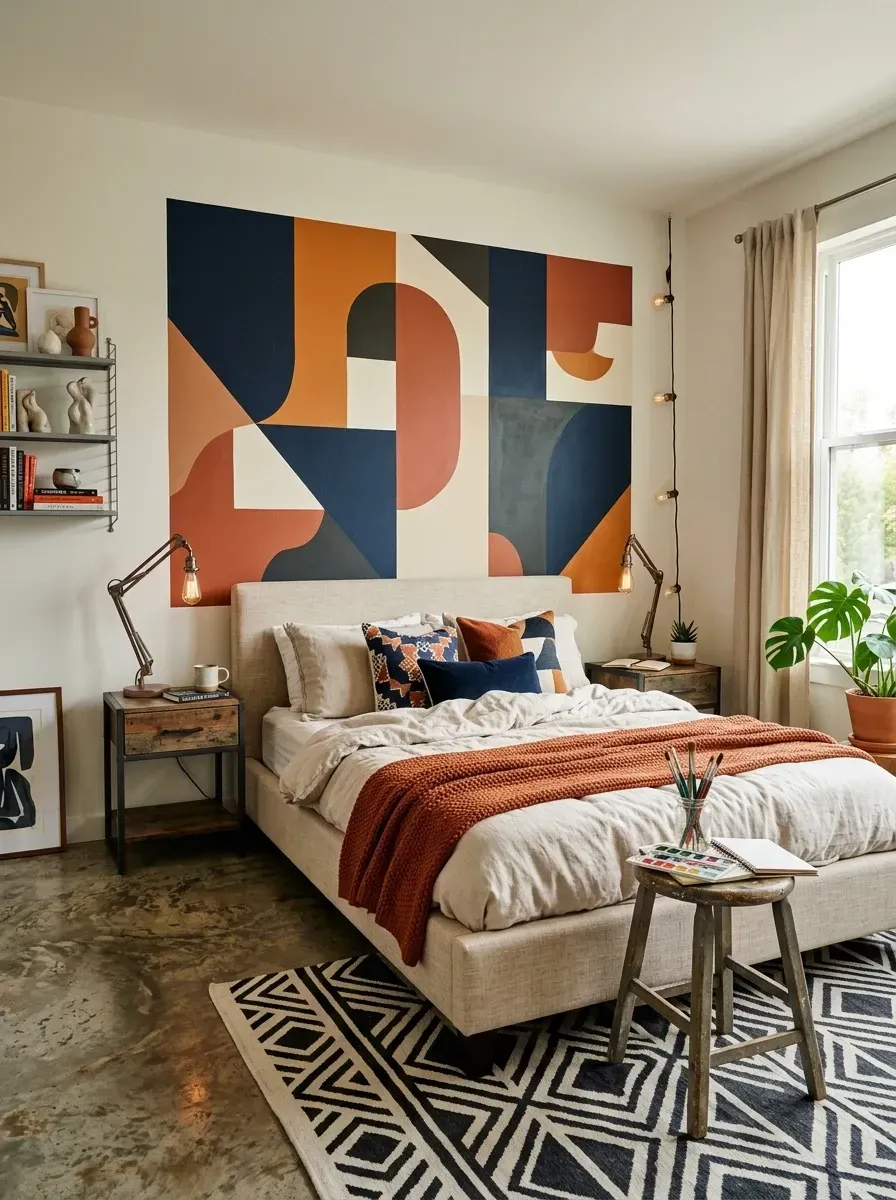
A hand-painted geometric mural is the highest-impact, lowest-cost personality move on this list. Materials run under $200; the work is the planning. The configuration here is right: rust and navy on a single feature wall, the rest of the room calm. Concrete floors and Edison-bulb string lights are the industrial-loft register that makes the mural read as art rather than as DIY accident. This vocabulary belongs in Brooklyn and Newburgh lofts and Hudson textile-mill conversions where the existing architecture supports the register.
A wall mural is a layer-element, not a structural one — but it does require Level-4 drywall finish to read correctly. Bumpy or imperfect drywall behind a graphic mural shows every flaw. Skim-coat the wall first ($300–$500 added by the Northeast drywaller). Specify a 2–4 inch foam roller and Frog Tape Delicate Surface for crisp graphic edges. Test paint on a sample board first to verify color saturation.
The Creative Industrial Loft direction brings together hand-painted geometric wall mural in two saturated colors, sealed exposed concrete floors, industrial metal-and-wood nightstands, layered area rugs (jute base + patterned overlay), and edison-bulb string lights as ambient layer.
Budget notes for Creative Industrial Loft
Wall Mural Paint + Supplies + Skim Coat: $400 – $700. Upholstered Queen Bed Frame: $400 – $800. Industrial Nightstands (×2): $300 – $600. Industrial Desk Lamps (×2): $150 – $300.
Layered Rugs (Large Jute + Patterned Wool): $300 – $600. Edison String Lights + GFCI Outlet: $80 – $160. Linen Bedding + Chunky Knit Throw: $250 – $500. Metal Wall Shelving Unit: $100 – $200. Total Estimated Cost: $1,980 – $3,860.
When painting graphic mural lines, apply painter's tape, then seal the tape edge with a thin layer of the base wall color first. That base coat seals the tape and prevents the saturated mural color from bleeding under. Pull the tape while the paint is still slightly tacky.
Sophisticated Velvet Glam
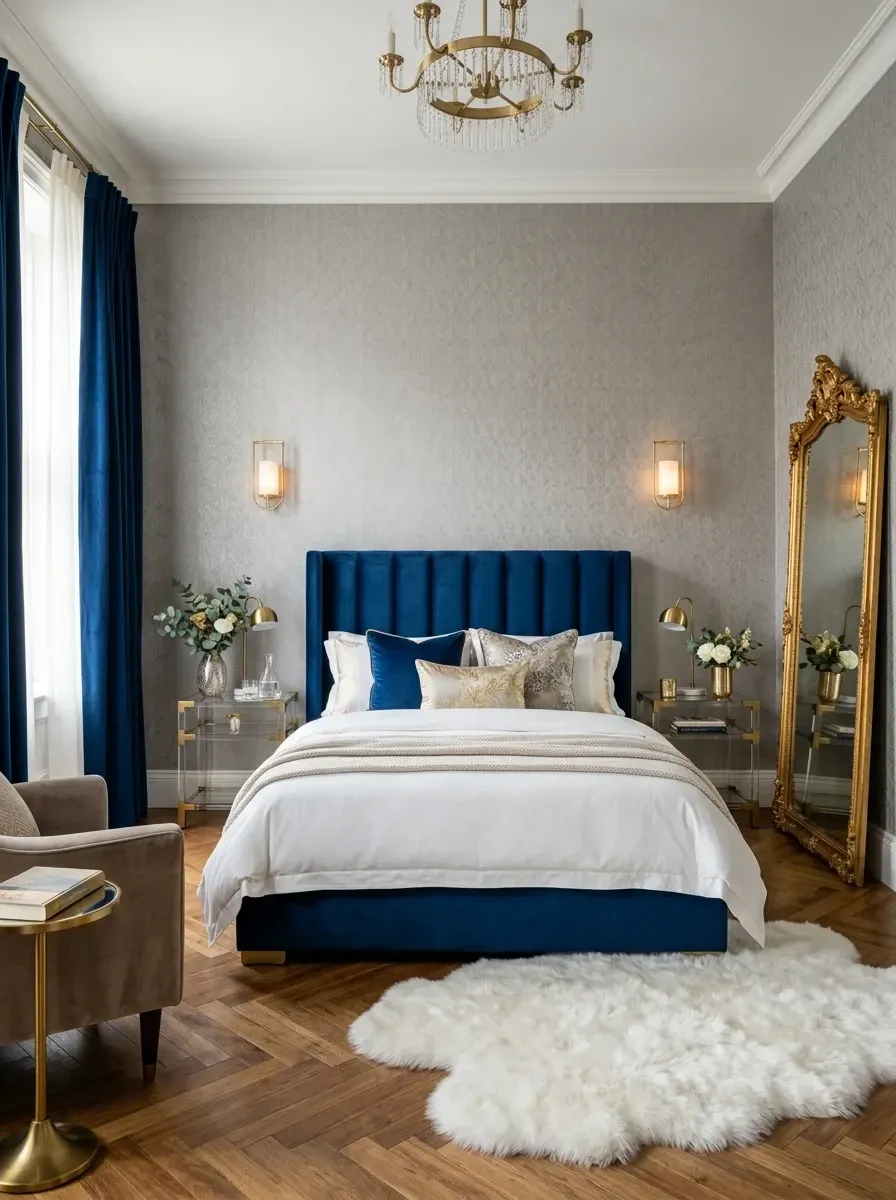
Velvet glam is dopamine decor at its most sophisticated — and the configuration that ages the best of any saturated-color bedroom. The reason: the saturation is concentrated in one color (navy) carried across multiple textures (velvet bed, velvet curtains, faux-fur rug). Single-color discipline is what separates this from the maximalist jewel-tone version. Subtle small-scale grey wallpaper provides the textural backdrop without adding a competing color. Acrylic furniture takes up zero visual weight, letting the navy and gold lead.
This is the highest-budget configuration on the list, primarily because of the wallpaper, herringbone floor, and lighting. Wallpaper from Phillip Jeffries, Cole & Son, or Schumacher runs $80–$150 per double roll plus $300–$500 in installation per wall. Specify a paste-the-wall format on a primed surface — never peel-and-stick on the Northeast plaster wall, which fails within 18 months. The crystal chandelier and sconces all need to be on independent dimmable circuits.
The Sophisticated Velvet Glam direction brings together navy blue channel-tufted velvet queen bed, subtle small-scale grey patterned wallpaper, large ornate gold leaner mirror, clear acrylic nightstands (×2), and crystal chandelier + gold wall sconces on dimmable circuits.
Budget notes for Sophisticated Velvet Glam
Wallpaper + Professional Install: $500 – $1,000. Queen Navy Velvet Bed: $800 – $1,600. Acrylic Nightstands (×2): $400 – $800. Large Ornate Gold Leaner Mirror: $400 – $800.
Crystal Chandelier + Dimmable Circuit: $500 – $900. Wall Sconces (×2, Hardwired + Dimmable): $300 – $600. Velvet Curtains (×2 panels): $150 – $300. Faux Fur Rug: $100 – $200.
Velvet Armchair + Side Table: $400 – $800. Total Estimated Cost: $3,550 – $7,000.
Velvet curtains in a sun-facing the Northeast bedroom will fade within 5–7 years. Specify a UV-resistant lining or use a sheer underlayer to filter direct sunlight. Re-evaluate the curtains every spring — fading appears at the bottom hem first.
Fresh Pastel & Pop Art
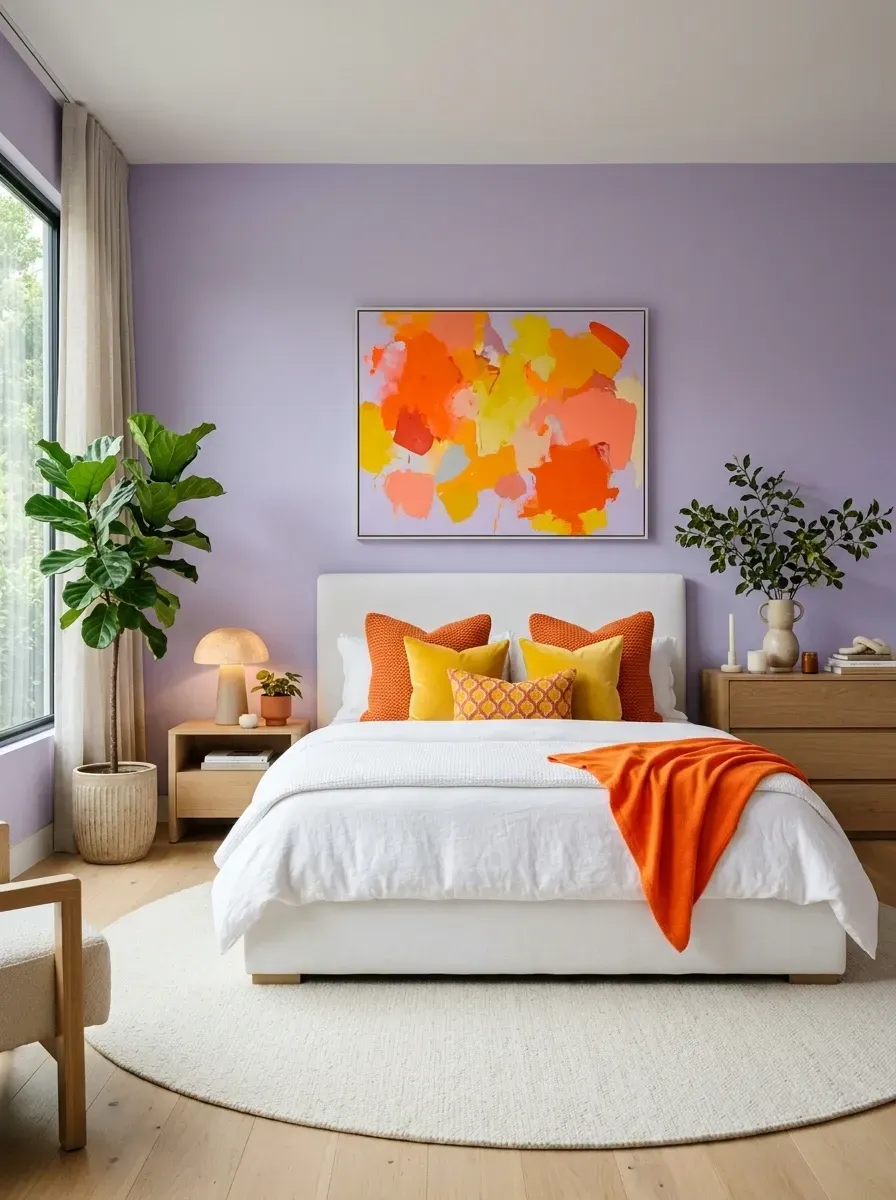
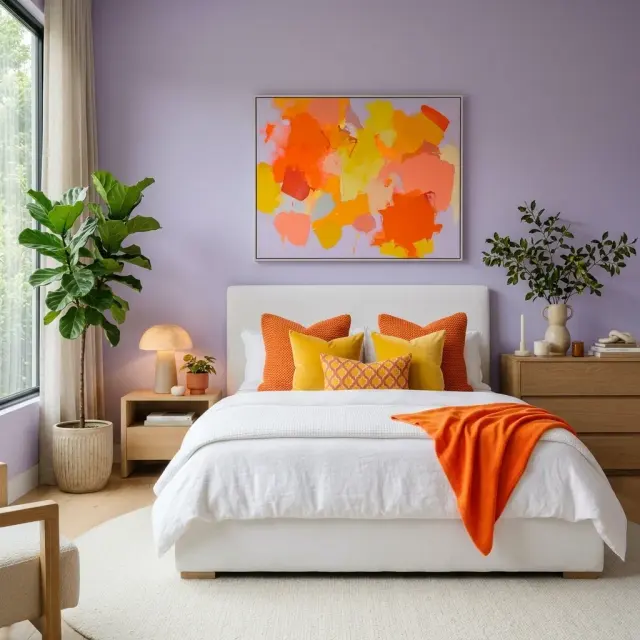
Pastel walls plus saturated art is one of the cleverest dopamine decor configurations — the wall reads as a quiet neutral while the abstract canvas does all the chromatic work. Moving the energy from the wall to the art also moves it to a layer that's easy to swap. When the homeowner moves on from "lavender plus orange," the canvas comes down and the room is essentially neutral again. The mushroom-shaped table lamp is the playful sculptural object that carries the energy when the art isn't doing it.
A large abstract canvas is the line item worth investing in here. A genuinely original 4×6 foot canvas from a regional artist runs $800–$1,800 and appreciates over time; a printed reproduction at the same scale runs $200–$400 and reads as decoration. the Northeast has a strong art scene (Hudson, Northeast communities, Garrison) where original pieces at this size are accessible. The lavender wall is age-neutral enough to last decades.
The Fresh Pastel & Pop Art direction brings together soft lavender wall paint (calm, age-neutral), large vibrant abstract wall art (the joyful element), white linen-upholstered queen bed, modern light-oak dresser and nightstand, and large round wool area rug + mushroom table lamp.
Budget notes for Fresh Pastel & Pop Art
Lavender Wall Paint + Painter: $200 – $400. Queen White Linen-Upholstered Bed: $600 – $1,200. Modern Light-Oak Dresser + Nightstand: $800 – $1,600. Large Original Abstract Canvas: $300 – $1,800.
Large Round Wool Area Rug: $300 – $600. Accent Bedding + Throw: $250 – $500. Mushroom Table Lamp: $100 – $200. Total Estimated Cost: $2,700 – $6,600.
A round rug under a rectangular bed should extend roughly 24 inches beyond the bed perimeter on the sides — small enough that the bedside tables sit on the floor, not the rug. Anything larger and the geometry fights itself.
Eclectic Vintage Bohemian
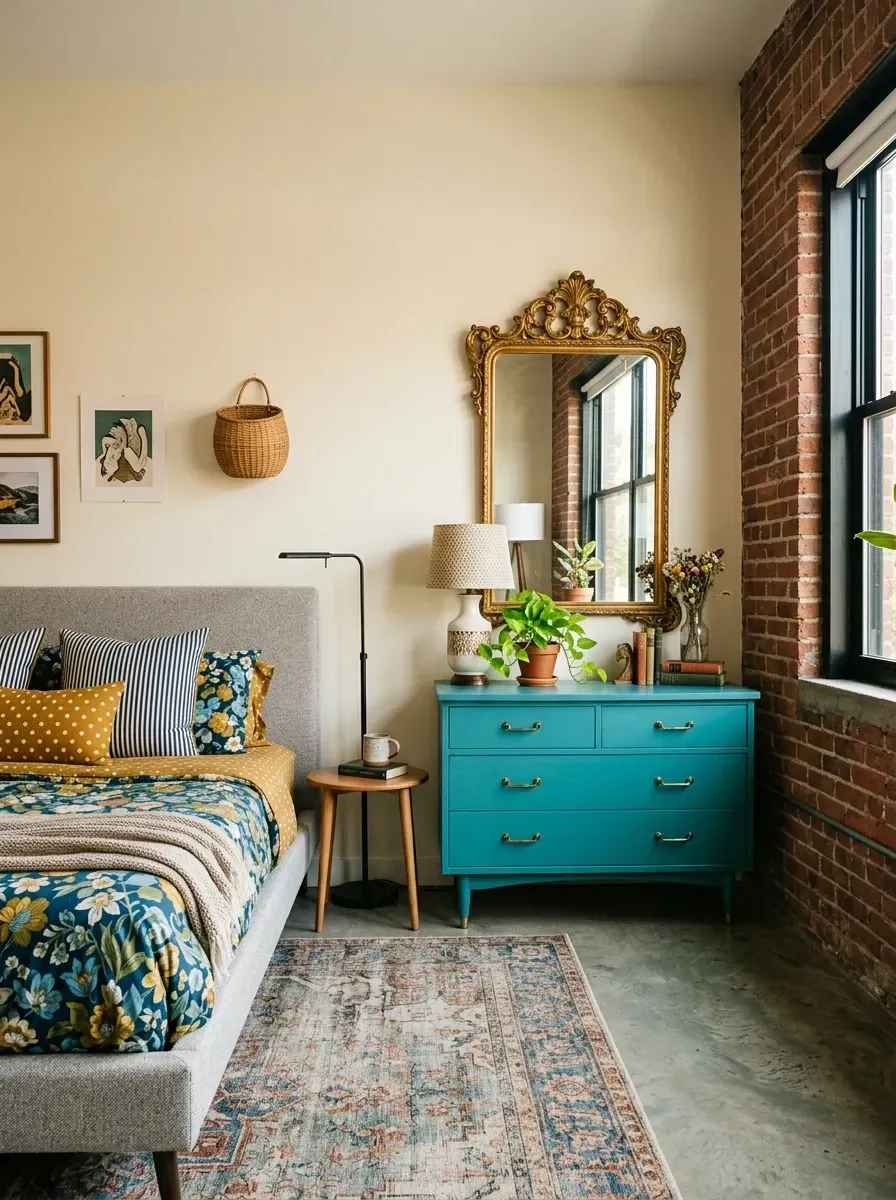
An eclectic vintage bohemian bedroom is one of the most authentic dopamine vocabularies because it's built from collected pieces, not considered catalog purchases. The exposed brick wall is the architectural feature that anchors the room; everything else is accumulated over time. A turquoise dresser repainted from a thrifted base is the focal feature; an ornate gold mirror borrowed from an estate sale balances the vibrancy. This is the right register for a Northeast communities weekend house, a Newburgh row house, or any Brooklyn brownstone with original architecture worth keeping.
The budget here is heavily DIY-driven, which is honest to the eclectic vocabulary. A thrifted dresser at $50–$200 plus $50–$100 in paint and hardware lands at $150–$300 for what would cost $1,500 new. The eclecticism only works if there's discipline behind it — pick one feature color (turquoise here), one anchoring metal (gold), and one ground plane (concrete or vintage rug). Without those three, eclectic tips into chaotic.
The Eclectic Vintage Bohemian direction brings together exposed sealed brick wall (architectural feature), vintage thrifted dresser repainted in bright turquoise, ornate antique gold wall mirror, mix of floral and patterned bedding, and sealed concrete floor with vintage runner rug.
Budget notes for Eclectic Vintage Bohemian
Vintage Dresser (Thrift + Paint + Hardware): $200 – $500. Ornate Gold Wall Mirror (Vintage / Estate): $250 – $500. Upholstered Bed Frame: $400 – $800. Patterned Bedding Set: $150 – $300.
Vintage-Style Runner Rug: $100 – $250. Floor + Table Lamps (Mixed Metals): $180 – $350. Assorted Vintage Wall Art + Decor: $150 – $300. Plants + Terracotta Pots: $100 – $200. Total Estimated Cost: $1,530 – $3,200.
A repainted vintage dresser needs three things to read intentional rather than thrift-store: prime the original finish first (Zinsser BIN shellac), use a satin or eggshell topcoat in cabinet-grade paint, and replace the hardware. Keeping the original orange-from-1985 hardware undermines the entire transformation.
Cheerful Family-Centric room
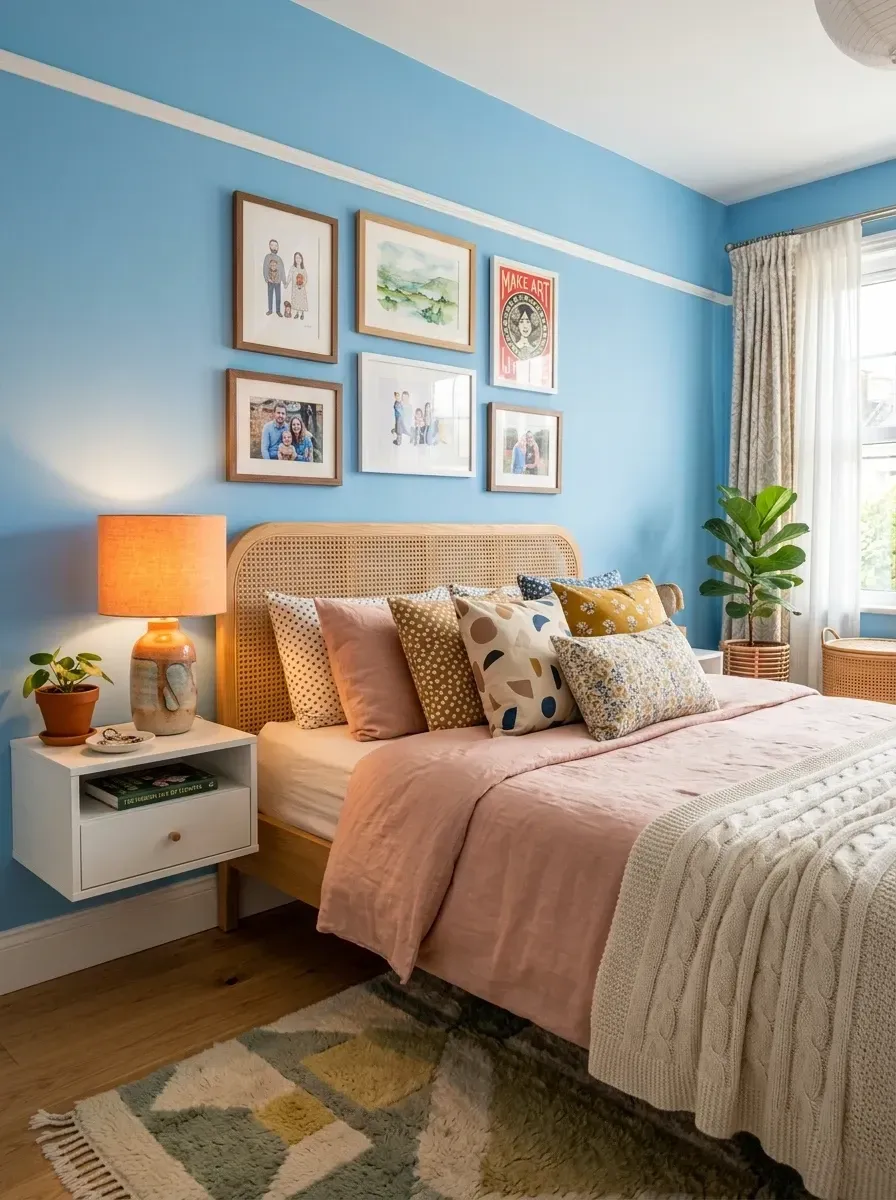
The family-photo gallery wall is the most authentic dopamine decor move there is — because the joy is built into the meaning of the objects, not into the saturation of the colors. The room itself is restrained: sky blue walls, a cane bed, a single floating nightstand, layered rugs. The personality lives entirely in the considered photos. This is the configuration A practical recommendation is most for primary bedrooms in family homes — it stays joyful through life stages without requiring rebuilds at every age.
Standardize the gallery frames. Six identical frames in one finish (warm brass or matte black) at the same size (11×14 with 8×10 mat) lets the homeowner rotate photos quarterly without re-hanging. Skip this rule and a family gallery wall becomes a hodgepodge within two years. The cane and oak bed is the right call for the Northeast primary bedroom — durable, breathable in summer humidity, and ages well over decades.
The Cheerful Family-Centric room direction brings together sky blue painted walls (calm, cheerful base), cane and warm-oak queen bed frame, six-frame personalized family photo gallery wall, floating modern white nightstand, and layered patterned and textured area rugs.
Budget notes for Cheerful Family-Centric room
Sky Blue Wall Paint: $60 – $120. Queen Cane & Oak Bed Frame: $700 – $1,400. Floating Modern White Nightstand: $100 – $250. Standardized Gallery Frames + Prints (×6): $200 – $400.
Layered Rugs (Patterned + Textured Wool): $250 – $500. Mix-and-Match Bedding Set: $200 – $400. Ceramic Table Lamp: $80 – $150. Potted Fiddle-Leaf Fig: $100 – $200. Total Estimated Cost: $1,690 – $3,420.
Cane bed frames need humidity tolerance — the Northeast summers run 60–80% humidity, which can loosen the cane weave over time. Specify a sealed cane (lacquered or oil-finished) rather than raw, and re-tighten the cane every 3–5 years if it begins to sag.
Planning checks for Cheerful Family-Centric room
Color belongs in the layer, not the shell. Floor, ceiling, primary furniture, and built-ins should stay neutral and timeless. The saturated personal colors live in paint, fabrics, art, and accessories — items you can swap when tastes evolve. Skip this rule and you'll be doing a major renovation every 4–6 years.
Three saturated colors maximum. One dominant (the bed, the wall, or the rug — pick one), one supporting (curtains, accent furniture), and one accent (small objects, pillows, art highlights). More than three saturated personal colors and a bedroom tips into chaotic, regardless of how well you execute each one individually.
Use premium paint for saturated colors. Benjamin Moore Aura, Sherwin-Williams Emerald, or Farrow & Ball Estate Emulsion. Cheaper paints in deep tones fade unevenly within 18 months under indirect light, faster under direct sun. The cost difference is $30–$50 per gallon — worth every dollar.
Specify performance fabric on the bed. A queen velvet bed is a $700–$1,600 line item; a coffee or wine spill on standard upholstery is a $1,200 reupholstery job. Performance velvet (Romo Linara, Designtex Mohair, Sunbrella indoor) runs the same money as standard fabrics today and saves the reupholstery five years from now.
Layered lighting matters more than the wall color. Three light sources at three heights — overhead, mid (sconces or pendants), low (table lamps or floor lamps) — all on dimmable circuits. A dopamine bedroom with a single overhead fixture reads as bright at noon and dim at 9 p.m. Layered, dimmable lighting is what makes saturated colors look correct at every hour.
Standardize the swappable. Gallery frames, throw pillows, accent ceramics — keep at least one dimension constant across each category. Six 11×14 frames let you change photos without re-hanging. Three matched accent pillows let you change the throw color without buying a new set. The discipline keeps a personal room from collapsing into clutter.
Budget priorities for Dopamine Decor Bedrooms
DIY the wall mural or accent wall. One quart of premium paint plus painter's tape plus a long weekend equals a $200–$400 high-impact transformation. Compared to a $1,500 statement wallpaper install or a $2,000 statement headboard, paint is the highest-leverage budget move in any saturated-color bedroom.
Thrift the dresser, paint it loud. the Northeast estate sales (Hudson, Northeast communities, Cold Spring, Northeast communities) regularly include solid-wood dressers at $100–$300. Add $50–$100 in primer, premium furniture paint, and new hardware, and you've replaced a $1,500 new dresser for under $400.
Make your own large-scale art. A 4×6 foot canvas from Blick at $80, plus a tube of premium acrylic in two saturated colors, plus a long weekend, equals a custom abstract that would sell for $1,200–$1,800 from a regional artist. The trick is restraint — three to five large brushstrokes, not 50 small ones.
Standardize and rotate. Buy one set of 8 matched frames at IKEA (Knoppäng or similar) for $80 total. Swap the prints quarterly with photos, magazine cutouts, kid art. Same wall, completely different read every season — for the cost of the photo prints.
The Core Idea. A joyful bedroom isn't a chaos of color — it's a disciplined neutral architectural shell with two or three saturated personal colors held entirely in the swappable layer (textiles, art, accent paint). Get that split right and a bold bedroom ages well; miss it and you'll be repainting in three years. Build the bones plain. Let the joy live in the layer.
Questions about Dopamine Decor Bedrooms
What does dopamine decor actually mean?
Dopamine decor is a design vocabulary that intentionally uses saturated color, personally meaningful objects, and tactile textures to create rooms that feel uplifting and joyful. The term borrows from the brain's pleasure-and-reward chemistry — surrounded by colors, art, and objects you genuinely love, the room becomes a sensory cue for positive mood. Done well, it's not just bright color for its own sake; it's considered joy. Done badly, it's chaotic clutter. The discipline lies in the structural rules — a neutral architectural shell, three saturated colors maximum, and personal meaning behind the objects on display.
You will, if the colors are baked into the architecture. The structural fix: keep saturated color in the layer (paint, textiles, art, accent furniture), not the shell (floor, primary cabinetry, bed frame, structural built-ins). Repainting one wall is a $150–$400 weekend project; repainting a full architecturally tinted bedroom is a $2,000–$4,000 renovation. Think of saturated color as a four-to-six-year investment, not a forever commitment. When tastes evolve, only the layer changes.
Do bold colors interfere with sleep?
Less than the popular advice suggests. Sleep Foundation research on bedroom color points more strongly to lighting quality, screen exposure, and consistent sleep routines than to wall color. That said, very high-saturation primary colors (pure red, electric yellow, neon green) can mildly improve alertness for some sleepers; the desaturated cousins of those colors — terracotta instead of red, ochre instead of yellow, sage instead of neon — tend to be sleep-neutral. If sleep is a concern, focus on dimmable layered lighting and dark-out window treatments before adjusting wall color.
Three rules. First, vary the pattern scale — one large-scale pattern (a 6-inch-repeat wallpaper or a bold rug), one medium (a striped pillow), one small (a tiny geometric on bedding). Second, share a common color across all patterns so they read as related. Third, leave plenty of solid-color breathing room between patterns — a solid-color duvet between a patterned headboard and patterned pillows, a solid wall between a patterned rug and patterned curtains. Mix without a unifying color or with too many same-scale patterns and the room collapses.
Is dopamine decor budget-friendly?
It can be one of the most budget-friendly design vocabularies, because the highest-impact moves (paint, accent walls, DIY art, thrifted-and-painted furniture) are inexpensive and the highest-cost moves (built-ins, custom millwork, structural renovation) are largely irrelevant to the style. A complete dopamine bedroom can land at $1,600–$3,200 with disciplined execution — see the Scandi-playful and family-centric configurations above. The luxury versions ($5,000–$7,000+) are aesthetic choices, not requirements.
Are some colors better avoided in a primary bedroom?
There are very few hard "avoid" colors, but a few cautions. Pure neon-bright colors (electric yellow, fluorescent pink) are fatiguing on bedroom walls — fine in pillow accents, hard on a 9×12 wall. Cool stark whites (anything below 86 on the Light Reflectance Value scale) read clinical in a north-facing the Northeast bedroom; warm whites (Benjamin Moore White Dove, Simply White) work better. Very dark saturated colors require excellent layered lighting to feel cozy rather than oppressive — if the bedroom has limited natural light and limited electrical infrastructure, a dark moody palette will feel like a cave rather than a retreat.
For the calmer, restraint-driven cousin to this guide, our quiet luxury bedroom design guide covers the same shell-and-layer thinking with a quieter color brief. For a nature-driven approach to bedroom calm, see our biophilic bedroom design guide.
Sources & Further Reading
- Architectural Digest on dopamine decor, saturated-color trends, and current interior design coverage.
- Pantone Color Institute on color trends, color psychology research, and annual color forecasting.
- Sleep Foundation — Bedroom Environment on the relationship between bedroom color, lighting, and sleep quality.
- Sherwin-Williams Color Forecast for annual color trend projections and saturated-color guidance.
- Benjamin Moore Color Trends for paint specifications, conversion finishes, and durability data.
- Farrow & Ball Color Library for the historic and saturated-color palette referenced throughout.
- House Beautiful for editorial coverage of personality-driven bedroom design.
- Domino for ongoing reporting on eclectic and personality-led interior styling.
- NAHB — Cost of Constructing a Home for benchmark labor and material data behind the cost ranges quoted above.
- Lutron Lighting Controls on dimmer compatibility and layered-lighting specifications for residential bedrooms.
Type your paragraph here

Renovations & Interiors Desk
Renovation Studies & Room Guides · Northeast United States research focusThe Renovations & Interiors Desk develops sourced room guides and editorial concept studies without presenting concepts as completed client work.
More from this desk →
Reader notes