


Most of the bathrooms I'm asked to fix are not broken. They're sterile. Glossy white subway, chrome fixtures, builder-grade vanity, and a chrome rail towel warmer that rusts in three winters. The work isn't a finish refresh — it's a tactile reset. Below: nine bathrooms that reject the showroom-clean default in favor of raw stone, lime plaster, ofuro wood, and living foliage, with the framing-stage decisions and 2026 Northeast cost ranges that make each one possible.
How I Read a Biophilic Bathroom
When a Hudson Valley client tells me they want a "spa bathroom," I read four things before any showroom visit: the wall surface protocol (what's actually waterproof — paint, plaster, stone, tile), the structural load plan (a concrete tub fully filled is 1,200–1,800 lbs sitting on framing that was sized for cast iron at half that), the ventilation calculation (humid bathrooms with porous surfaces need 110+ CFM of dedicated exhaust, not the 50 CFM builder default), and the light-temperature plan (textured walls under cool 4000K LED look like dirty drywall). Get those four right and the room reads sanctuary. Get any of them wrong and the textures fight the room instead of carrying it.
After seven years running renovation design out of Beacon and Kingston, I've come to believe biophilic isn't a finish style — it's a building-science argument. Lime plaster, real stone, raw wood, and live plants all behave differently from drywall and ceramic, and they reward homeowners who plan around their behavior. The nine bathrooms below cover the full range, from $4K Scandi-styling moves to $25K integrated living walls, with real material specs and Northeast labor rates. For a broader category lens, the network's kitchens and baths archive covers cross-format comparisons in more depth.
Reading note. The numbering is order-of-walkthrough, not ranking. A $4K potted-plant bathroom (Section 5) can carry more sanctuary feeling than a $25K living-wall installation (Section 4) if the bones are right and the styling is honest.1. The Organic Modern Concrete Retreat
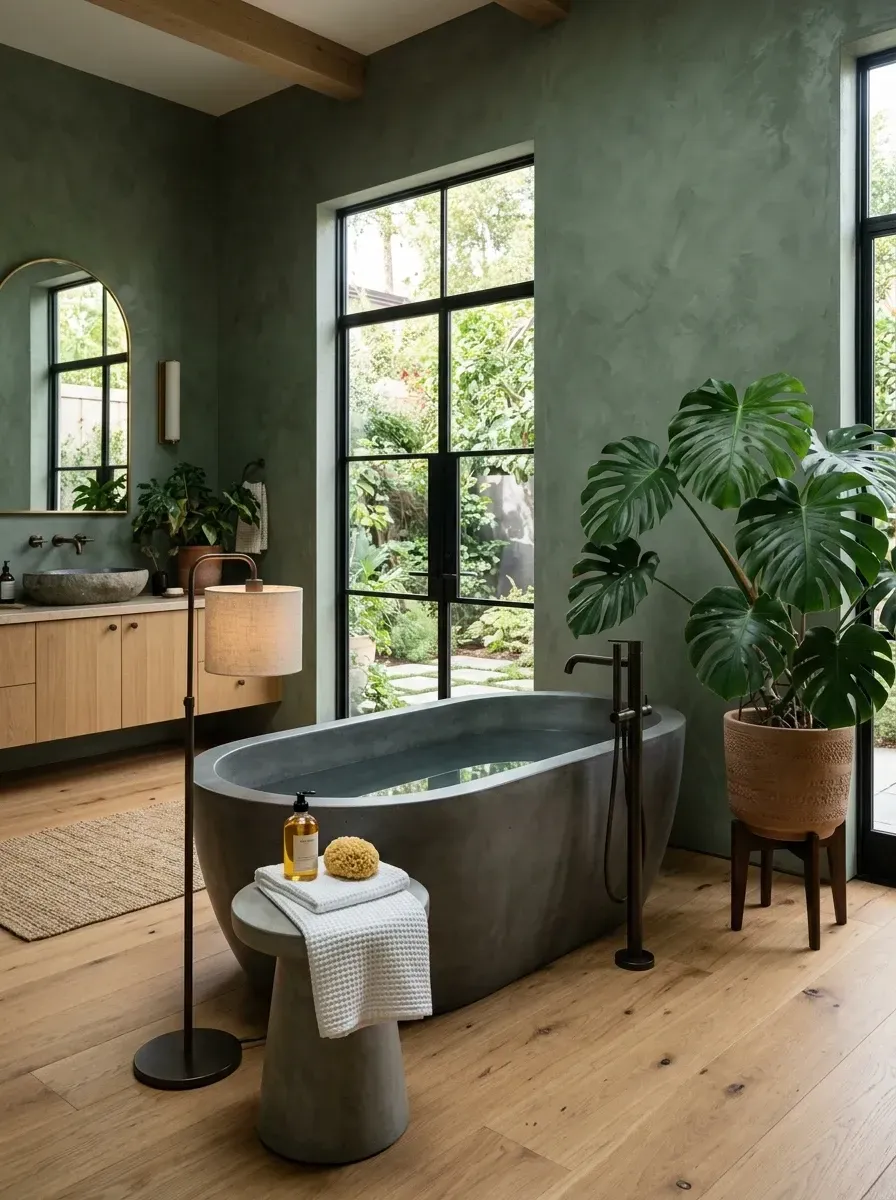
A textbook example of how textured walls warm up an industrial centerpiece. The freestanding concrete tub is the heavy grounding gesture; without the lime wash on the walls, the room would read industrial-cold rather than organic-modern. Sage green Bauwerk Lime Wash or Portola Paints' Roman Clay in a similar tone gives the walls a velvety, suede-like depth that absorbs light rather than bouncing it back. Black-framed steel windows pull the garden into the room as a living color element.
Plan-aware verdict: a concrete tub of this size weighs 600–900 lbs empty and 1,500+ lbs filled. In any pre-1980 Hudson Valley house, a structural engineer needs to look at the joist span and either sister the joists or add a beam in the basement before the tub is delivered. This is non-negotiable, and it's the cost most clients don't see coming.
Features
- Textured sage green lime wash walls (Bauwerk or Portola Roman Clay)
- Freestanding concrete soaking tub (Native Trails or Concretti Designs)
- Floor-to-ceiling steel-frame windows (thermally broken)
- Large-format Monstera deliciosa in a planter
- Light white oak floating vanity
Cost Analysis (2026 Northeast)
| Decor Item (Qty) | Total Price Range |
|---|---|
| Freestanding Concrete Tub | $3,500 – $6,000 |
| Floor-Mount Tub Filler (Bronze) | $800 – $1,500 |
| Lime Wash Wall Treatment (Material + Labor) | $2,000 – $4,000 |
| Custom White Oak Floating Vanity | $2,500 – $4,500 |
| Large Monstera Plant in Planter | $200 – $400 |
| Brass Arch Floor Mirror | $300 – $600 |
| Total Estimated Cost | $9,300 – $17,000 |
Color Palette
Sage Green Lime Wash
#8A9A85
Bauwerk Lime Wash in Mizzle or Portola Roman Clay in Verdigris — the textural depth that flat paint can't replicate.
Raw Concrete Grey
#7D8082
Polished or honed concrete from Native Trails NativeStone or a custom-cast tub from Concretti — pick a sealer rated for daily wet exposure.
Light White Oak
#CDBFA3
Rift-cut white oak with Rubio Monocoat 2C in Pure or Natural — the matte finish reads honest where lacquer reads corporate.
Oil-Rubbed Bronze
#3B332B
Sun Valley Bronze or Rocky Mountain Hardware in dark patina — ages with the wood and the wash.
2. Pattern Play with Slatted Wood
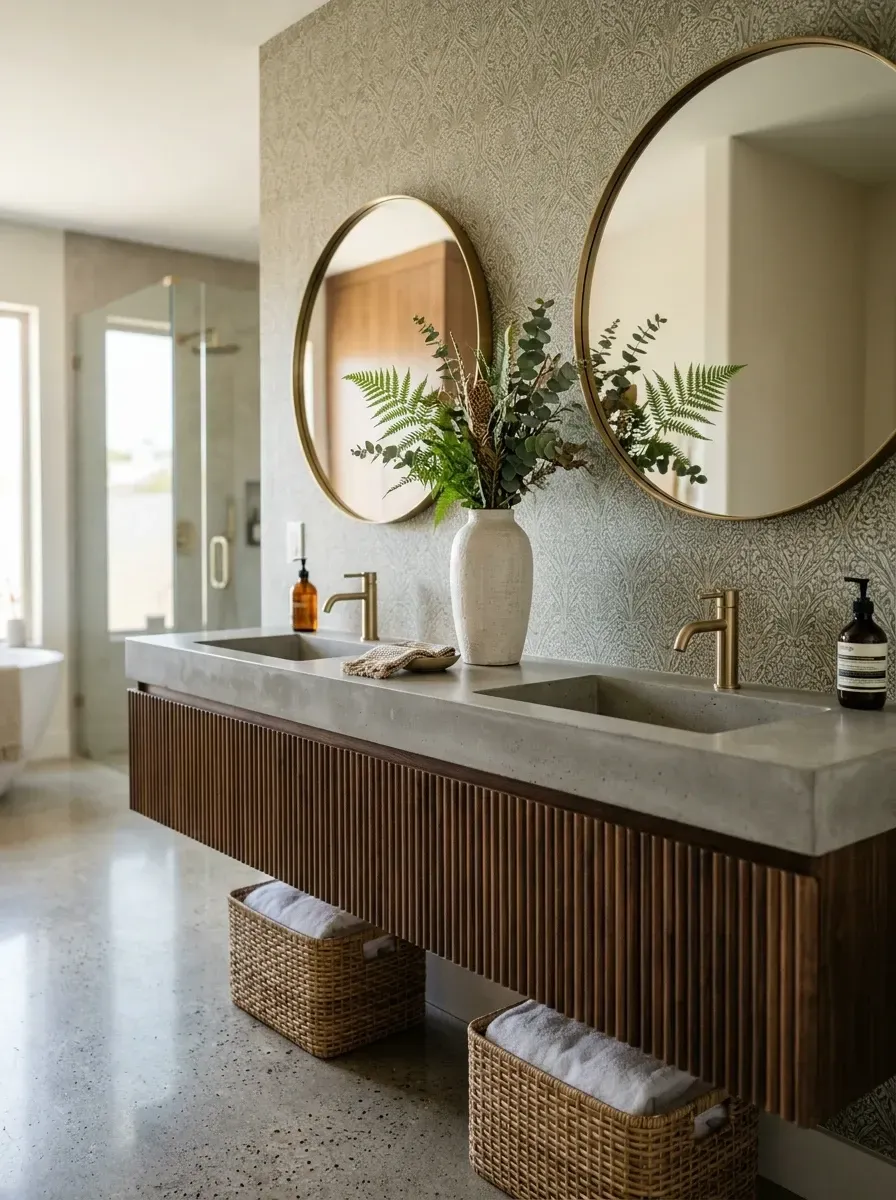
Pattern and texture working as partners. The William Morris-style botanical wallpaper provides a dense organic backdrop; the fluted walnut vanity adds a rhythmic vertical texture that contrasts the wallpaper's curves. A cast concrete countertop with integrated sinks pulls the room back to neutral — without it, the wallpaper plus the wood would tip over into busy. This is the most "transitional" of the nine bathrooms, and the easiest to drop into a 1920s Hudson Valley Colonial without an architectural fight.
Plan-aware verdict: fluted cabinetry is a 30–50% labor premium over flat-panel — every flute is milled, sanded, and finished individually. Worth it on a vanity face that owns the room; not worth it on a perimeter run nobody studies. Wallpaper in a bathroom must be vinyl-coated or specified as bathroom-rated (Wallquest, Ronald Redding, York Wallcoverings) — uncoated paper will fail at the corners within two humid summers.
Features
- Botanical wallpaper (vinyl-coated, bathroom-rated)
- Slatted walnut floating vanity (fluted)
- Integrated cast concrete sink countertop
- Round brass mirrors (matched pair)
- Terrazzo-style concrete or microtopping floor
Cost Analysis (2026 Northeast)
| Decor Item (Qty) | Total Price Range |
|---|---|
| Custom Slatted Walnut Vanity | $4,000 – $6,500 |
| Custom Concrete Countertop & Integrated Sinks | $2,500 – $4,500 |
| Designer Wallpaper & Installation | $1,200 – $2,200 |
| Brushed Brass Faucets (×2) | $800 – $1,600 |
| Round Brass Mirrors (×2) | $600 – $1,200 |
| Total Estimated Cost | $9,100 – $16,000 |
Color Palette
Sage & Cream Botanical
#A6AFA0
Morris & Co. Acanthus, Sister Parish Mistral, or House of Hackney's Garden of Eden in a vinyl-coated stock.
Rich Walnut
#6B4832
FSC-certified American walnut veneer or solid walnut on the flute milling — finish with a hardwax oil for the matte read.
Smooth Concrete Grey
#9EA0A1
Cast concrete from Trueform or Concrete Pete — sealed with a food-grade penetrating densifier rated for daily water exposure.
Brushed Brass
#C6A664
Newport Brass East Linear or Brizo Litze in luxe gold — warmth that lifts the cool concrete.
3. The Slate and River Stone Shower
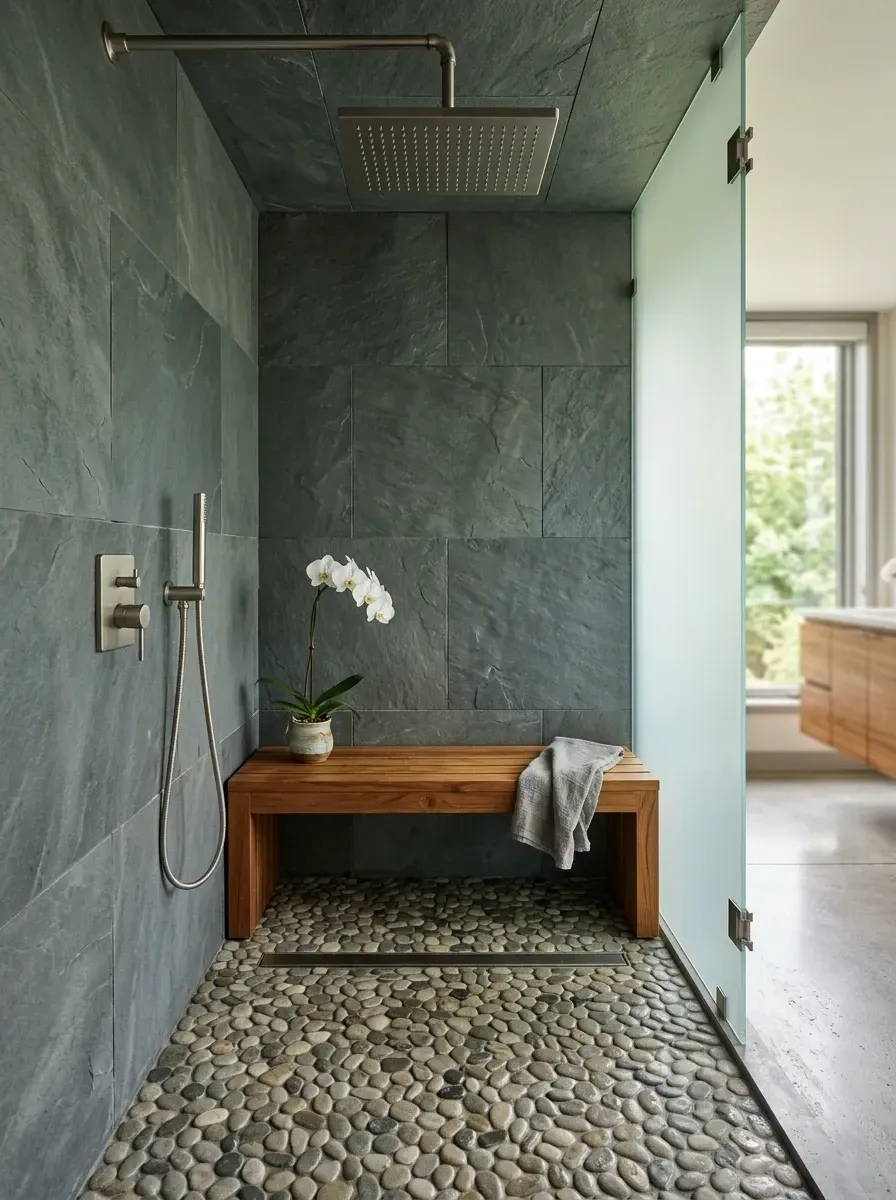
A sensory shower built entirely on raw natural materials. The slate wall tile is naturally cleft, meaning it's split along its grain rather than sawn flat — that's the surface variation that catches light differently than ceramic ever can. The pebble mosaic floor delivers a real foot-massage effect underfoot, which is the genuine biophilic move (engaging touch, not just sight). A teak bench adds the necessary warmth point in an otherwise stone-and-glass envelope. This is the shower I spec for clients who tell me they want a "spa feeling without leaving the house" — it does the work.
Plan-aware verdict: pebble floors need an epoxy grout, not standard cement grout, because the surface area of grout joint relative to stone is much larger than on flat tile. Skip that detail and you're scrubbing soap residue out of every joint twice a year. The slate should be specified as "ungauged on the face, gauged on the back" — face texture for the design, flat back for the installer's sanity.
Features
- Large-format natural cleft slate wall tiles
- Multi-tone river pebble mosaic floor (epoxy grout)
- Floating teak shower bench
- Rain shower head with separate handshower
- Frameless glass shower panel
Cost Analysis (2026 Northeast)
| Decor Item (Qty) | Total Price Range |
|---|---|
| Slate Wall Tile & Installation (~100 sq ft) | $3,000 – $5,000 |
| Pebble Mosaic Floor & Installation | $800 – $1,500 |
| Floating Teak Bench | $400 – $800 |
| Rain Shower System & Handshower | $1,000 – $2,000 |
| Frameless Glass Panel | $1,000 – $1,800 |
| Total Estimated Cost | $6,200 – $11,100 |
Color Palette
Natural Cleft Slate
#4A4F52
Vermont structural slate or Montauk Black slate in 12×24 or 24×24 format — the cleft face carries shadow and water beautifully.
Multi-tone River Pebble
#7D7870
Bali Cloud or Sonoma River Rock pebble mosaic — pre-mounted on mesh sheets for installation.
Natural Teak
#A37850
FSC-certified Burmese or plantation teak — naturally water-resistant due to its silica content.
Brushed Nickel
#8C8C8C
Hansgrohe Locarno or Dornbracht Tara in brushed nickel — disappears against slate where polished chrome would jump.
4. Floor-to-Ceiling Living Wall
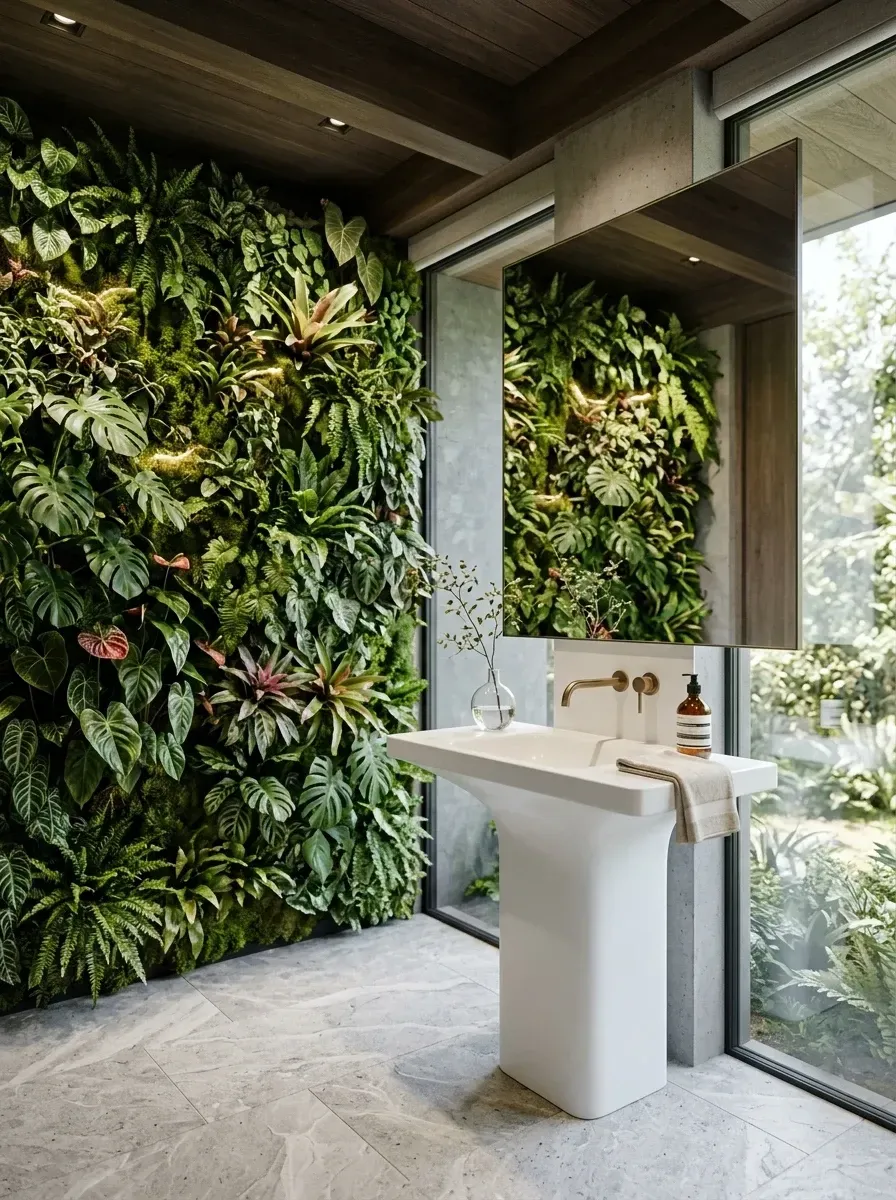
Maximalist biophilia. A full living wall isn't decor — it's a living architectural finish that contributes to humidity balance, air quality, and acoustic dampening. Done well, it's the most powerful biophilic statement available in residential design. Done poorly (no integrated irrigation, no proper grow lighting, plants chosen for catalog shots rather than humid-zone tolerance), it dies in six months and stains the wall behind it. To prevent visual chaos around a wall this busy, the design correctly under-furnishes the rest of the room — sculptural white pedestal sink, simple brass wall-mount faucet, calm marble underfoot. The network's read on the psychology of space covers why heavy biophilia changes how a room actually feels, not just how it looks.
Plan-aware verdict: an installed living wall system runs $100–$200 per sq ft because that price has to cover the structural framework, plumbed drip irrigation, integrated grow lights (if natural light is short), and the plants themselves. Plus 8–12 hours of monthly maintenance — most homeowners contract a plant-care service. Skip any of those and the wall fails. This is the most expensive biophilic move on the list and the most rewarding when it works.
Features
- Full-scale integrated living wall (60–80 sq ft typical)
- Plumbed drip irrigation with reservoir and timer
- Integrated full-spectrum grow lights (if natural light insufficient)
- Sculptural white pedestal sink (Kohler Veil or Duravit Cape Cod)
- Wall-mount brass faucet
- Large-format grey-veined marble flooring
Cost Analysis (2026 Northeast)
| Decor Item (Qty) | Total Price Range |
|---|---|
| Living Wall System (Plants, Irrigation, Lighting) | $8,000 – $15,000 |
| Sculptural Pedestal Sink | $1,000 – $2,500 |
| Wall-Mount Brass Faucet | $400 – $800 |
| Large Mirror with Wood Frame | $600 – $1,200 |
| Marble Flooring & Installation (small area) | $2,000 – $4,000 |
| Total Estimated Cost | $12,000 – $23,500 |
Color Palette
Foliage Green
#2F5926
Mixed planting: Boston fern, Monstera, bromeliads, philodendron, pothos — all humid-zone tolerant.
Pure White Ceramic
#FFFFFF
Vitreous china pedestal sink in pure white — the only crisp surface in a room of organic complexity.
Grey-Veined Marble
#D0D3D6
Calacatta Borghini or Bardiglio Imperiale in 24×48 honed format — quiet enough not to compete with the wall.
Brushed Brass
#C6A664
Watermark Loft or Vola HV1 in brushed brass — warmth that complements green foliage.
5. Scandi-Clean with Potted Biophilia
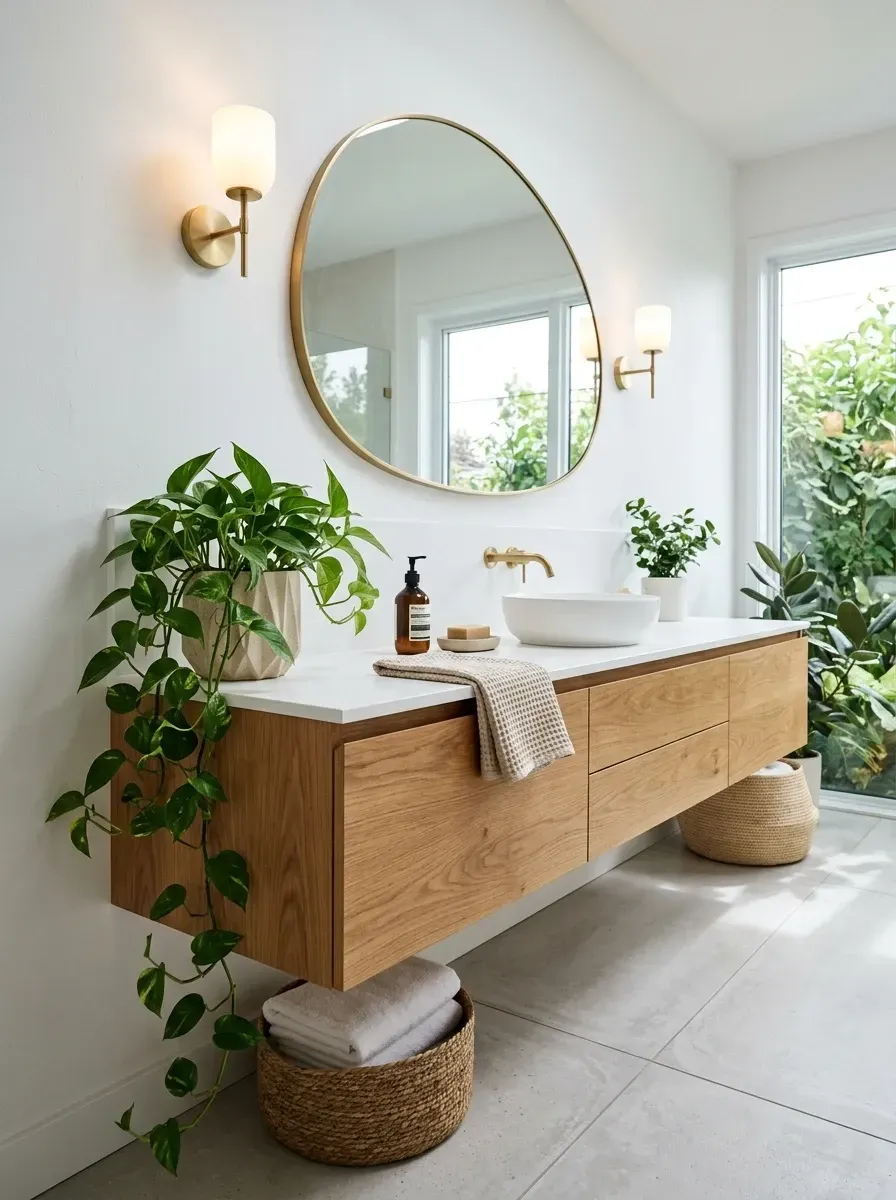
The proof that biophilic isn't a budget. This Scandi-clean base — light oak floating vanity, white quartz counter, ceramic vessel — costs less than $5K to build, and the sanctuary feeling comes entirely from the styling layer: a trailing pothos draped from a high shelf, two floor plants, an asymmetrical brass mirror that breaks the rectilinear grid. The lesson is that biophilic design rewards careful styling at any budget point. Most clients overspend on the renovation and underspend on the plants and mirrors that actually carry the room.
Plan-aware verdict: pothos, snake plant (Sansevieria), and Boston fern all thrive in a humid bathroom with low-to-medium light — match the plant to the actual light in the room, not the catalog photo. Asymmetrical mirrors are an architectural shortcut: where a rectangular mirror reads as a fixture, an asymmetrical or arched mirror reads as a sculpture, and the room reads more designed.
Features
- Light oak floating vanity (60")
- White quartz countertop
- Ceramic vessel sink
- Asymmetrical or arched brass-framed mirror
- Curated potted plant collection (pothos, snake plant, fern)
Cost Analysis (2026 Northeast)
| Decor Item (Qty) | Total Price Range |
|---|---|
| White Oak Floating Vanity (60") | $1,800 – $3,500 |
| White Quartz Countertop | $800 – $1,500 |
| Ceramic Vessel Sink | $300 – $600 |
| Asymmetrical Brass Mirror | $400 – $800 |
| Brass Wall Sconces (×2) | $300 – $600 |
| Total Estimated Cost | $3,600 – $7,000 |
Color Palette
Matte White
#F5F5F5
Benjamin Moore Simply White (OC-117) in matte — bright but warm enough not to read clinical.
Natural White Oak
#CDBFA3
Rift-cut white oak with hardwax oil — the warm baseline for any Scandi-leaning room.
Vibrant Leaf Green
#4A7C2D
Living foliage as the design's color saturation — the only "paint" in the room.
Satin Brass
#D4AF37
Schoolhouse Hudson sconces or Cedar & Moss Yara — humble, well-made brass at honest prices.
6. The Dark Stone Cave Retreat
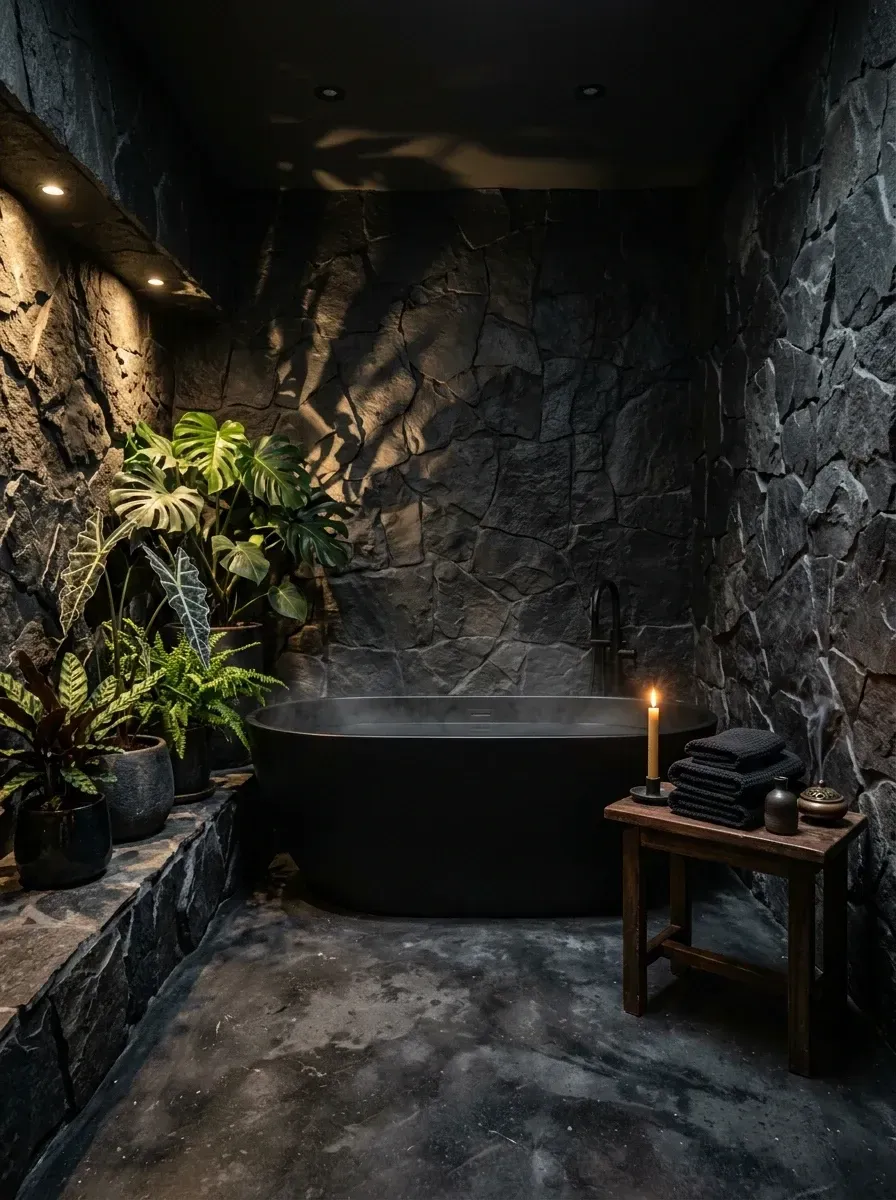
Womb-like, deeply quiet, and a direct rejection of the bright-white bathroom default. Black stacked stone veneer creates intense shadow play under directed spotlights — the kind of light-and-stone interaction you'd see in a Scandinavian sauna. A matte black soaking tub disappears into the shadows; a single candle and a teak stool carry the warmth. This format works in basement primary suites, in attic conversions with limited natural light, and in any small Hudson Valley bath where the owner is comfortable rejecting bright as a goal.
Plan-aware verdict: dark bathrooms live or die on the lighting plan. You need at least three layers — wall-grazing spotlights to highlight the stone, a single warm 2700K candle-temperature pendant or wall sconce for ambient, and a high-CRI task light at the mirror. Skip any layer and the room flattens. Tropical plants with large vibrant leaves (Alocasia, Monstera, Philodendron) carry the contrast that prevents the room from going lifeless.
Features
- Black stacked stone veneer walls (full room)
- Matte black freestanding soaking tub
- Dark burnished concrete or honed slate floor
- Dramatic three-layer spot and ambient lighting
- Tropical foliage (Alocasia, Monstera) for contrast
Cost Analysis (2026 Northeast)
| Decor Item (Qty) | Total Price Range |
|---|---|
| Stacked Stone Veneer & Installation (Full Room) | $5,000 – $10,000 |
| Matte Black Freestanding Tub | $2,000 – $4,000 |
| Floor-Mount Tub Filler (Black) | $800 – $1,500 |
| Concrete Floor Finish | $1,000 – $2,000 |
| Teak Stool | $150 – $300 |
| Total Estimated Cost | $8,950 – $17,800 |
Color Palette
Charcoal Stacked Stone
#2B2B2B
Norstone Charcoal or Eldorado Stone Cascade in black — stacked rather than mortared joints for the texture depth.
Matte Black
#1A1A1A
Native Trails Avalon or Wyndham Soho freestanding in solid surface or cast resin with a matte black finish.
Dark Burnished Concrete
#3D3D3D
Polished concrete with iron-oxide pigment — sealed with a matte topcoat to keep the depth without the gloss.
Dark Walnut
#4A3326
Solid walnut stool with hardwax oil — the only warm tone in the room.
7. Japanese Wabi-Sabi with Ofuro Tub
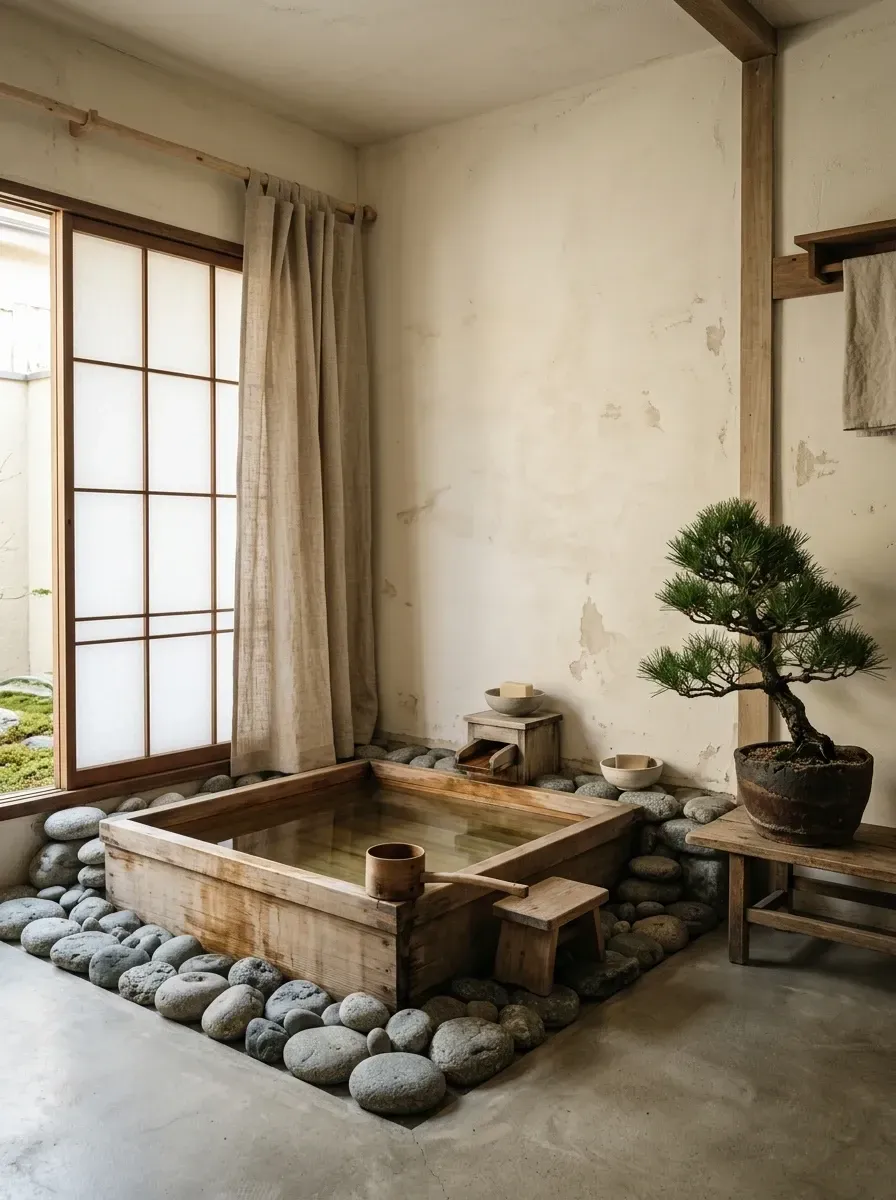
A masterclass in Wabi-Sabi — finding beauty in imperfection and the trace of time. The wooden Ofuro soaking tub (Hinoki or Japanese cedar) sits in a bed of large river stones; the walls are deliberately aged plaster that looks centuries old; a Shoji-style screen filters the daylight. This is the most authentic biophilic format on the list because it doesn't try to look natural — it is natural. For Hudson Valley clients with a Catskills cabin or a converted Beacon barn, this format is a genuine sanctuary that reads as honest rather than themed. The network's design-mindset essay on the unconscious canvas covers why this kind of material honesty changes how a room feels, not just how it looks.
Plan-aware verdict: an authentic wooden Ofuro is a maintenance commitment. The wood needs to be kept slightly damp when not in active use (typically by leaving an inch of water in the tub between baths) or it will dry out and crack. Aged plaster walls aren't a paint job — they're a multi-pass trowel application by a specialist artisan. This format is more authentic than expensive, but it's the most opinionated bathroom on the list.
Features
- Authentic wooden Ofuro soaking tub (Hinoki or Japanese cedar)
- River stone tub surround
- Aged / distressed lime plaster walls
- Shoji-style rice paper window screen
- Natural linen privacy curtain
Cost Analysis (2026 Northeast)
| Decor Item (Qty) | Total Price Range |
|---|---|
| Authentic Wooden Ofuro Tub | $4,000 – $8,000 |
| River Stone Surround Materials | $500 – $1,000 |
| Specialty Aged Plaster Wall Treatment | $2,000 – $4,000 |
| Custom Shoji Window Screen | $1,000 – $2,500 |
| Heavy Linen Curtain Panel | $150 – $300 |
| Total Estimated Cost | $7,650 – $15,800 |
Color Palette
Natural Hinoki / Cedar
#C7B299
Hinoki cypress (Bartok Design or Zen Bathworks) — the wood that defines the format, aromatic and naturally water-resistant.
Aged Cream Plaster
#D9D0C1
Marrakech Design Tadelakt or Mortex applied in multiple troweled passes for the deliberate imperfection.
Large Grey River Stones
#808080
Hand-selected smooth river stones — graded for size and tone, set in a sand-and-resin bed for permanence.
Natural Oatmeal Linen
#CABFB1
Heavyweight Belgian linen, undyed — filters light without blocking it.
8. Industrial Organic with Rough Stone Sink
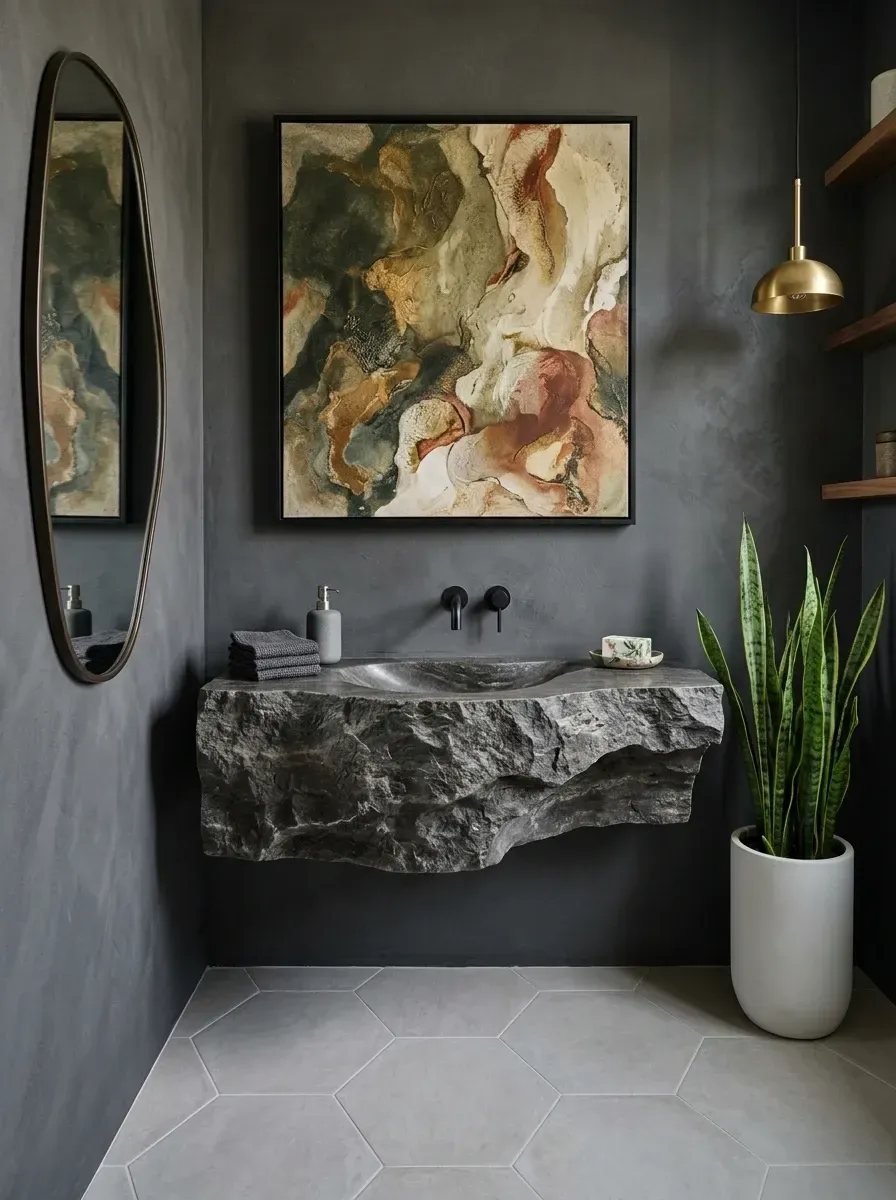
A powder room built around one sculptural object: a floating integrated sink carved from a single block of rough-hewn stone. It looks weightless and reads heavy at the same time. The dark grey suede-effect walls (a specialty paint or Roman Clay finish) provide the backdrop; matte black wall-mount fixtures recede; brass pendant adds the only warm note. Sharp hexagonal floor tile geometry is the structural counterpoint to the raw organic edge of the stone. Powder rooms are the right canvas for this kind of high-drama material — guests pass through, nobody lives in them, and the room can carry a stronger statement than a primary bath should.
Plan-aware verdict: a stone sink of this size weighs 200–400 lbs and needs structural blocking lag-bolted into wall framing — never just drywall and toggle bolts. Get the cabinet shop or stone fabricator to provide the structural mounting detail in writing, and have the framer add the blocking before drywall closes.
Features
- Rough-hewn integrated stone sink (single block, structural mount)
- Dark grey suede or Roman Clay texture walls
- Matte black wall-mount faucet
- Brass pendant light (statement piece)
- Large-scale earthen-tone abstract art
Cost Analysis (2026 Northeast)
| Decor Item (Qty) | Total Price Range |
|---|---|
| Custom Rough Stone Integrated Sink | $4,500 – $8,500 |
| Structural Wall Support for Sink | $500 – $1,500 |
| Specialty Suede / Plaster Wall Finish | $1,500 – $3,000 |
| Matte Black Wall-Mount Faucet Set | $400 – $800 |
| Brass Pendant Light | $200 – $500 |
| Total Estimated Cost | $7,100 – $14,300 |
Color Palette
Dark Charcoal Suede
#363636
Portola Roman Clay in Charcoal or Behr Premium Plus Suede in a dark gray — matte velvety finish that absorbs light.
Rough Grey Granite
#5E5E5E
Hand-chiseled granite or Pietra Cardosa from a custom fabricator — the chisel marks are the point.
Brushed Brass
#C6A664
Apparatus Studio Tassel or Allied Maker Tube — the one warm metal in a cool dark room.
Earthen Rust & Ochre
#9C6B4F
A single piece of large-scale earth-tone abstract art — the second visible warmth source after the brass.
9. Structured Biophilia with Vertical Tile
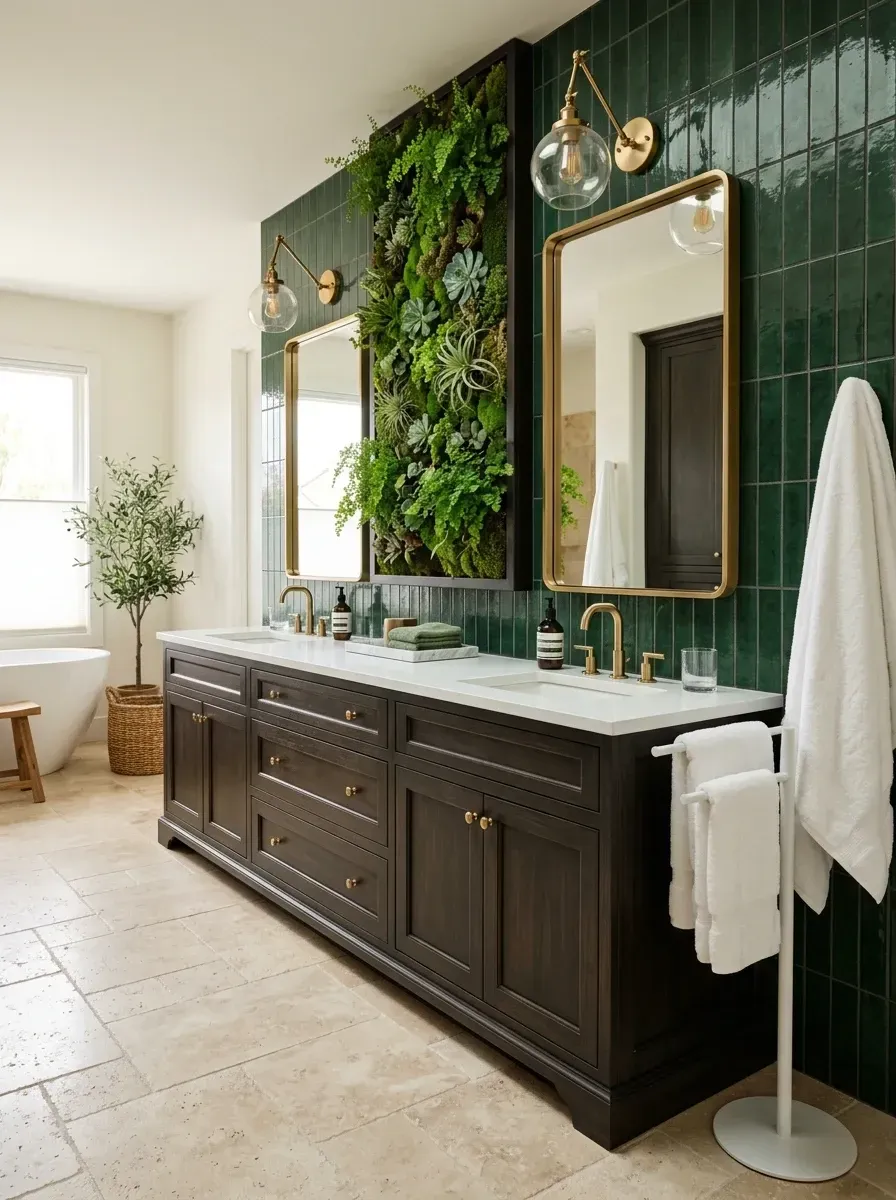
Classic shaker-vanity layout with two strong moves: emerald subway tile stacked vertically rather than horizontally, and a framed preserved-moss panel where most bathrooms would put a generic mirror or art. The vertical tile stack is the cheapest format upgrade in this entire guide — same tile, same labor, dramatically modern read. The preserved moss delivers the biophilic brief without the irrigation, drainage, and lighting commitment of a true living wall. For most Northeast clients, this is the right balance between bold and buildable.
Plan-aware verdict: stacked subway tile telegraphs every layout error. The grout joints have to be perfectly vertical for 8 feet, which means the tile setter needs to chalk a true vertical reference line on the wall before the first row goes up. Most subway-tile installers assume horizontal layout — call this out on the contract specifically. Preserved moss panels require zero water and zero light but should not be installed in a steam shower zone (steam can re-hydrate and degrade them).
Features
- Vertical-stack emerald green glazed subway tile
- Dark espresso double vanity (shaker or flat-front)
- Framed preserved-moss and succulent wall art
- Brass rectangular mirrors and tube sconces
- Beige travertine flooring
Cost Analysis (2026 Northeast)
| Decor Item (Qty) | Total Price Range |
|---|---|
| Emerald Green Tile & Installation (Full Wall) | $3,000 – $6,000 |
| Dark Wood Double Vanity | $3,000 – $5,500 |
| Quartz Vanity Top | $1,500 – $3,000 |
| Framed Preserved Moss Art Piece | $800 – $1,500 |
| Brass Rectangular Mirrors (×2) | $600 – $1,200 |
| Brass Wall Sconces (×3) | $450 – $900 |
| Total Estimated Cost | $9,350 – $18,100 |
Color Palette
Emerald Green Glazed Tile
#0F4D3A
Fireclay Calistoga in Hunter Green or Heath Ceramics in Forest — rich saturated glaze with hand-craft variation.
Dark Espresso
#3B2B23
Stained American walnut or wenge — deep, almost black, that grounds the room without going to absolute black.
Satin Brass
#D4AF37
Rejuvenation, Schoolhouse, or Visual Comfort in satin brass — gold tones pop against deep green like nothing else.
Beige Travertine
#D9CFC1
Walnut Travertine or Classic Travertine in 12×24 honed format — warm enough not to chill the green.
Pro Tips From the Renovation Designer's Chair
- Texture beats color. If a bathroom feels sterile, the answer is rarely paint. Replace one flat surface with a real material — concrete sink, lime plaster wall, slate shower floor, walnut vanity. A single tactile substitution carries more sanctuary feel than three trips to the paint counter.
- Lighting is the make-or-break. Textured walls under 4000K cool light look like dirty drywall. Spec 2700K–3000K warm white throughout, position fixtures to graze the surface from above (not flat-on), and put every layer on its own dimmer. The same textured wall reads completely different at 100% versus 30% dimmer setting.
- The rule of three textures. A successful biophilic bathroom usually carries at least three distinct textures: something rough (stone, concrete, plaster), something warm (wood, linen, leather), and something sleek (glass, polished metal, water surface). Pure rough reads cold; pure warm reads cluttered; pure sleek reads sterile. Three textures is the working balance.
- Plan the wet zone separately. Lime plaster, real stone, and unsealed wood behave differently under direct water exposure than they do as accent walls. Decide which zones are wet (shower, tub deck, splash) and which are dry (vanity wall, opposite wall) at the framing stage, and spec the right protocol for each. Tadelakt and tadelakt-equivalents are waterproof; standard lime wash is not.
- Ventilation is non-negotiable. A textured biophilic bathroom needs at least 110 CFM of dedicated exhaust ventilation, vented outside (never into the attic). Porous surfaces hold moisture longer than tile and ceramic — undersized ventilation becomes a mildew problem within a year.
- Get the structural letter before the centerpiece arrives. Heavy concrete tubs, stone sinks, freestanding stacked-stone walls, and full living-wall systems all add structural load that pre-1980 Northeast houses weren't engineered for. A $400 engineer's letter saves a $20,000 floor reframe later.
Cost-Saving Moves That Don't Read as Cuts
- Faux living, real biophilia. Skip the $10K+ plumbed living wall and use preserved moss panels (Garden On The Wall, Benetti) for 80% of the visual at 20% of the cost. Pair with two or three carefully chosen potted plants and the room reads as biophilic without the monthly maintenance contract.
- Tile only the wet zones. Standard tile is the most expensive square-footage item in any bathroom build. Tile only the shower walls and tub surround, and use Roman Clay or Bauwerk Lime Wash on the remaining walls for a higher-end textured read at $4–$8 per square foot instead of $25–$50 per square foot for tile-and-labor.
- Stone remnants for sinks. Powder rooms and small bathrooms don't need a full stone slab. Hudson Valley and outer-borough NYC fabricators keep remnant yards — Calacatta, Statuario, granite, soapstone — at 50–70% off slab pricing. Bring exact dimensions and pick what's left.
- Vertical-stack standard tile. Stacking standard 3×6 or 4×8 subway tile vertically rather than horizontally costs nothing extra but reads dramatically more designed. Same tile, same labor, completely different room.
The Core Idea. A biophilic bathroom isn't a styling choice you apply at the end of a renovation — it's a building-science argument decided at framing. Lime plaster, real stone, raw wood, and live plants behave differently from drywall and ceramic, and they reward homeowners who plan around their behavior. Get the structural letter, the ventilation calc, the lighting plan, and the wet-zone protocol right at the framing stage, and the textures carry the room. Skip any of them and the textures fight the room instead.
Reader Questions on Biophilic Bathrooms
What makes a bathroom "biophilic" beyond just adding plants?
Biophilic design connects to nature through multiple senses, not just sight. In a bathroom that means tactile materials with surface variation — rough-cleft slate, lime plaster, raw wood, hand-chiseled stone — combined with natural light, organic shapes, and (where possible) actual living plants or preserved moss. The defining test is whether you'd want to touch the wall on the way out. If the surfaces are all glossy ceramic and chrome, the room can have a dozen plants and still not read biophilic. The architecture has to be doing the work.
Is lime wash plaster actually durable enough for a bathroom?
Traditional Tadelakt (a Moroccan polished lime plaster sealed with olive-oil soap) is genuinely waterproof and has been used in Marrakech bathhouses for centuries — it's an excellent shower-wall material when applied by a qualified specialist. Standard interior lime wash, by contrast, is not waterproof and should not be used in direct wet zones. For non-wet bathroom walls, lime wash performs beautifully because it's breathable (lets moisture evaporate rather than trapping it) and naturally mold-resistant due to its high pH. The trick is matching the right product to the right zone.
How much does a real installed living wall cost?
In the Northeast, expect $100–$200 per square foot installed for a true plumbed living wall — that price covers the structural framework, drip irrigation with reservoir and timer, integrated grow lighting, the plants themselves, and labor. A 60-square-foot bathroom installation typically lands in the $8,000–$15,000 range. Plan for an additional $150–$300 monthly maintenance contract with a plant-wall service for the first 12–18 months while the planting establishes. Skipping the maintenance contract is the most common reason these installations fail.
Are rough stone sinks hard to clean?
Yes — meaningfully harder than ceramic. The porous surface absorbs soap residue and oils, and harsh acidic cleaners (most bathroom cleaners) will etch porous stones like marble and limestone. Plan on a Marble Institute–approved pH-neutral cleaner for daily use, a sealing application every 6–12 months, and acceptance of more visible patina than ceramic shows. The reward is a sink that genuinely ages with the homeowner — but it's a lifestyle commitment, not a low-maintenance install.
Can I add a heavy concrete or stone tub to an existing older bathroom?
Sometimes, but never without a structural engineer's review. A typical filled concrete soaking tub weighs 1,200–1,800 lbs concentrated on roughly 12 square feet of floor — about double what a cast-iron clawfoot from the same era weighed. In any pre-1980 Hudson Valley or Northeast house with original 2×8 or 2×10 floor joists, you usually need to either sister the joists, add a beam in the basement to shorten the span, or both. The engineer's letter typically runs $400–$800 and saves significantly more than that in avoided structural-failure repair.
What's the most cost-effective way to get the biophilic look?
In order of cost-versus-impact: vertical-stack standard subway tile (no extra cost over horizontal, dramatic visual upgrade); preserved moss panel as wall art ($800–$1,500 vs. $10,000+ for a living wall); lime wash or Roman Clay paint on dry-zone walls ($4–$8 per square foot for the textured plaster look); a single rough-stone or hand-thrown ceramic sink as the room's centerpiece. Combine three of these moves and a $5,000 bathroom can read more sanctuary than a $40,000 builder-grade renovation that bought all-new everything.
Where to Read Next
If this guide was useful, the natural next reads across the network sit in two directions. For more bath-and-kitchen integration studies and material walk-throughs, the kitchens and baths archive is the closest neighbor. For the planning-first thinking that underpins material-honest design, the essay on the unconscious canvas is a good companion piece. And for the broader psychology of how textured rooms shape daily life, the unseen architect covers the same ground at a higher altitude.
Sources & Further Reading
- Architectural Digest. Biophilic Design Ideas on a Budget. architecturaldigest.com
- Remodelista. Remodeling 101: Tadelakt, the Waterproof Plaster Surface for Bathroom Walls and Showers. remodelista.com
- The Spruce. How to Grow a Living Wall. thespruce.com
- Marrakech Design / Mortex. Tadelakt Application and Sealing Specifications.
- Bauwerk Colour & Portola Paints. Lime Wash and Roman Clay Application Guidelines.
- Natural Stone Institute (Marble Institute of America). Care & Cleaning of Natural Stone Surfaces. naturalstoneinstitute.org
- National Kitchen & Bath Association (NKBA). Bathroom Planning Guidelines and Industry Standards. nkba.org
- U.S. Green Building Council. WaterSense Bathroom Fixture Specifications.
- U.S. Department of Energy / Building America Solution Center. Bathroom Ventilation Sizing and Moisture Management. basc.pnnl.gov
- NAHB / Hanley Wood. 2025 Cost vs. Value Report — Bathroom Remodel ROI by Region. remodeling.hw.net

Nora Whitfield
Renovation Designer & Interiors Editor · Beacon, New YorkNine years of design-build renovation work across the Hudson Valley and the Northeast. Nora runs the Renovations, Room Guides and Renovation Mind desks — before-and-after studies, room-by-room design guides, and the long essays on why what we renovate matters.
More from Nora →
Reader notes