


A quiet luxury living room is misread more often than any other style I get briefed on. Clients arrive with Pinterest boards full of beige and ask for a minimalist room. What they actually want — and what the photos are quietly doing — is a room with very few colors but a great many materials. Plaster against linen. Travertine against boucle. Rift-cut oak against limewashed wall. Below: nine living rooms that handle that material discipline well, with the real Hudson Valley cost ranges to build them and the framing-stage decisions that decide whether the finish reads expensive or just empty.
How I Read a Quiet Luxury Room
When I walk a Hudson Valley client through a living-room renovation, I read four things before color or furniture comes up: the material count (how many honest materials are in the room — three to six is the sweet spot, ten is chaos), the texture spread (rough plaster to slubby linen to nubby boucle to honed stone — at least one from each register), the light path (where daylight enters, where a lamp pools light at night, and whether the room has a third tier of glow at the ceiling plane), and the edge discipline (window trim, baseboard, where joinery meets plaster). Get those four right and a room with almost no color reads as luxurious. Miss any of them and the same beige palette reads as a builder-grade rental.
The nine rooms below cover the realistic spread — from a $3,000 corner restyle to a $30,000 floor-to-ceiling renovation — with brand-level material call-outs and the 2026 Northeast labor rates that get you there. For readers building a network-wide style read, our quiet luxury interior design guide sits over the top of this room-by-room breakdown.
Reading note. I am not ranking these rooms. The order moves from intimate (a corner) through mid-scale (a sectional, a fireplace) to grand-scale (a double-height room). Pick the section closest to your floor plan and ignore the others.1. The Sculptural Lighting Corner
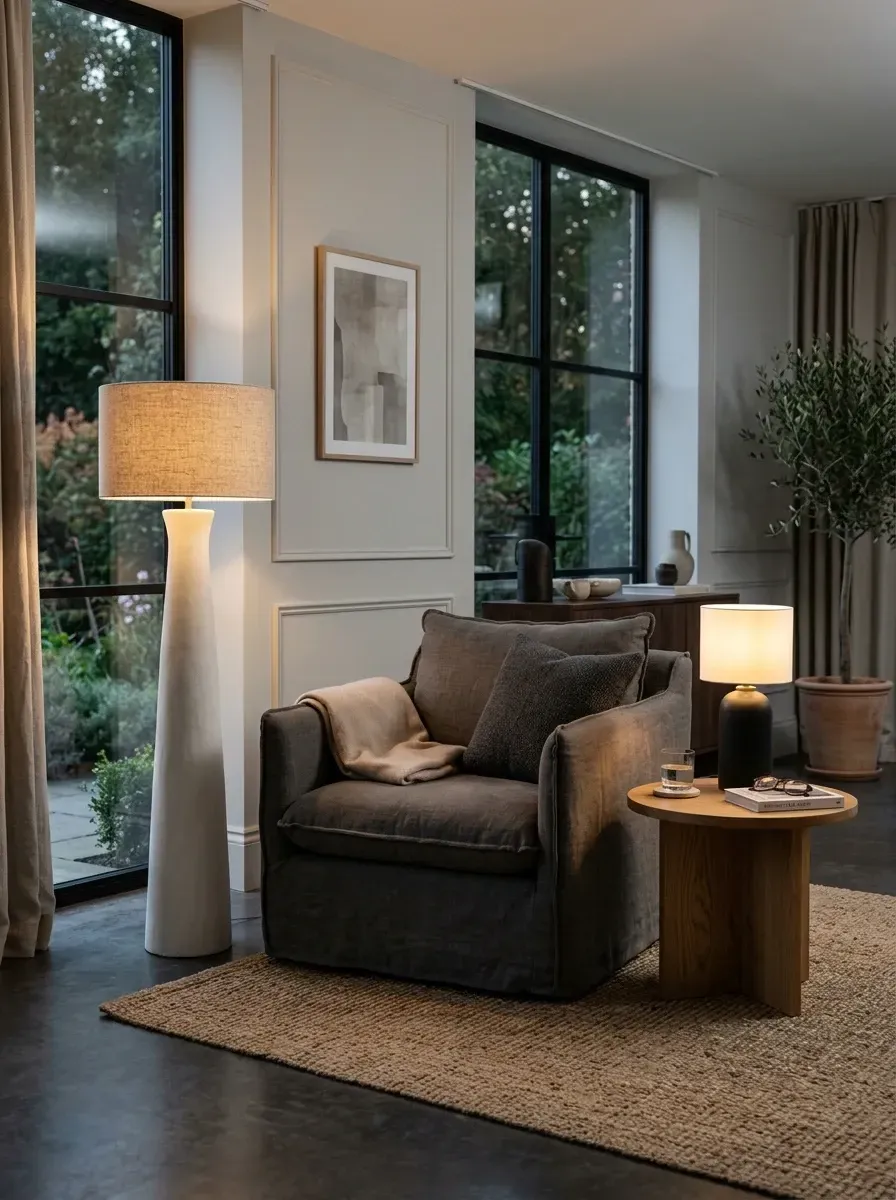
A corner like this is the easiest place for a homeowner to actually try the style without committing to a whole-room renovation. The plaster floor lamp is the architectural move — it sits on the floor like a small sculpture even when it's off. The linen slipcover on the chair is doing the soft-texture work, and the dark fabric grounds the corner so the room isn't all one tone. Two warm-light sources at different heights are what create the pooled, intimate glow people read as luxury.
Plan-aware verdict: the only thing that needs to be right structurally here is the outlet location. If you can get a floor outlet roughly 12 inches off the wall on the chair side, you can run the floor lamp without a cord crossing the rug. On any renovation I'm running, that gets specified at the framing stage — pulling a floor outlet later means cutting and patching a finished floor, which costs more than the lamp.
Features
- Sculptural plaster floor lamp (In Common With, Apparatus, or RW Guild)
- Linen slipcovered armchair in charcoal
- Layered lighting — floor lamp + small table lamp
- Solid oak side table at proper drink height (24–26 in.)
- Partial jute rug to tie the corner into the larger room
Cost Analysis (2026 Northeast)
| Decor Item (Qty) | Total Price Range |
|---|---|
| Tall Plaster Floor Lamp | $800 – $1,500 |
| Linen Slipcovered Armchair | $1,200 – $2,200 |
| Solid Oak Side Table | $400 – $800 |
| Small Ceramic Table Lamp | $150 – $300 |
| Jute Area Rug (partial visible) | $300 – $600 |
| Total Estimated Cost | $2,850 – $5,400 |
Color Palette
Off-White / Pale Grey
#E8E8E3
Benjamin Moore Classic Gray (OC-23) or Sherwin-Williams Eider White (SW 7014) in a flat or matte finish — neutral enough to recede behind the plaster lamp.
Charcoal Linen
#4A4843
Belgian linen slipcover in a warm charcoal — Libeco or Rose Tarlow weights drape better on a slipcover than light-weight linens that wrinkle harshly.
Plaster White
#F2F0EB
Hand-applied plaster finish over a steel armature — not painted. The chalky surface is what catches and softens the bulb's light.
Medium Oak
#A68B6C
Solid white oak finished with Rubio Monocoat hardwax oil for a low-sheen, hand-rubbed look.
2. Open-Plan Boucle Lounge
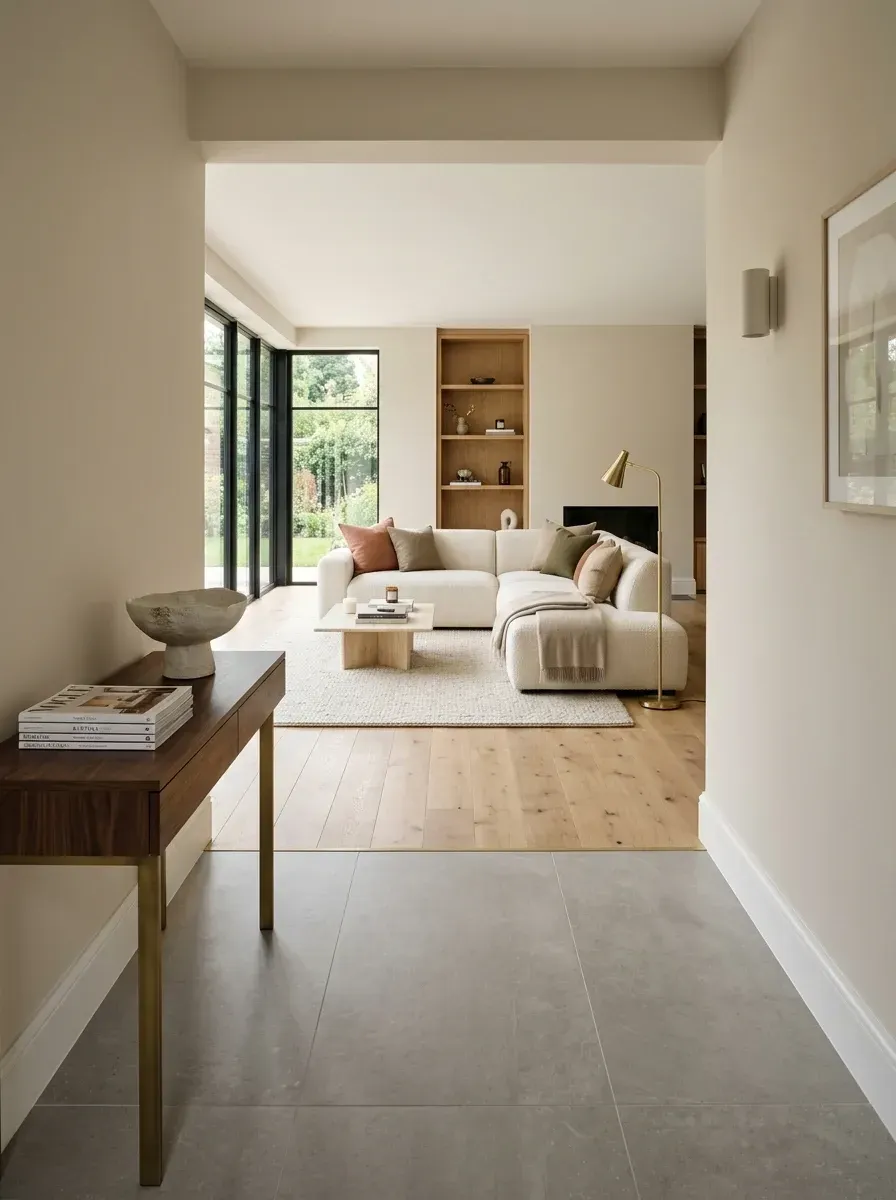
In an open plan, the seating area has to do its own architectural work — it can't borrow walls or doorways to define itself. Here a deep cream boucle sectional anchors one half of the floor plate while the oak built-ins anchor the wall plane. The marble block coffee table is the single hard, polished material in a room otherwise built on textile. That contrast — soft, soft, soft, then one slab of stone — is what carries the whole composition.
Plan-aware verdict: the built-ins are the budget-mover here. A floor-to-ceiling oak shelving unit done by a local Hudson Valley cabinet shop runs $400–$650 per linear foot installed for solid oak with veneered backs. The sectional should be specified with a performance boucle (Maharam Mohair Supreme or a high-rub-count chenille blend) if there are kids or pets in the picture — pure wool boucle pills under heavy use within two years.
Features
- Large boucle sectional sofa, cream
- Custom oak built-in shelving (full wall)
- Marble block coffee table
- Indoor-outdoor connection through full-height glazing
- Brass floor lamp for height balance against the shelving
Cost Analysis (2026 Northeast)
| Decor Item (Qty) | Total Price Range |
|---|---|
| Large Boucle Sectional Sofa | $3,500 – $7,000 |
| Custom Oak Built-in Shelving (~8 ft.) | $3,200 – $5,500 |
| Marble Block Coffee Table | $1,000 – $2,500 |
| Large Textured Wool Area Rug | $800 – $1,800 |
| Brass Floor Lamp | $300 – $600 |
| Console Table (foreground) | $500 – $1,000 |
| Total Estimated Cost | $9,300 – $18,400 |
Color Palette
Warm Beige
#E0D5C5
Benjamin Moore Manchester Tan (HC-81) or Sherwin-Williams Accessible Beige (SW 7036) — both keep their warmth under north light, which Hudson Valley living rooms often have.
Cream Boucle
#F5F3E8
Performance boucle in a warm ivory — specify a 50,000+ double rub count if the sofa is going to live with daily use.
Light Oak
#C9B294
Rift-cut white oak finished to a single sample for both flooring and joinery — sequencing the two means the built-ins don't fight the floor.
Muted Terracotta / Olive
#A87B67
Earthy accent tones broken across two or three pillows — never one matched set, which reads catalog rather than collected.
3. Layered Textures and Organic Forms
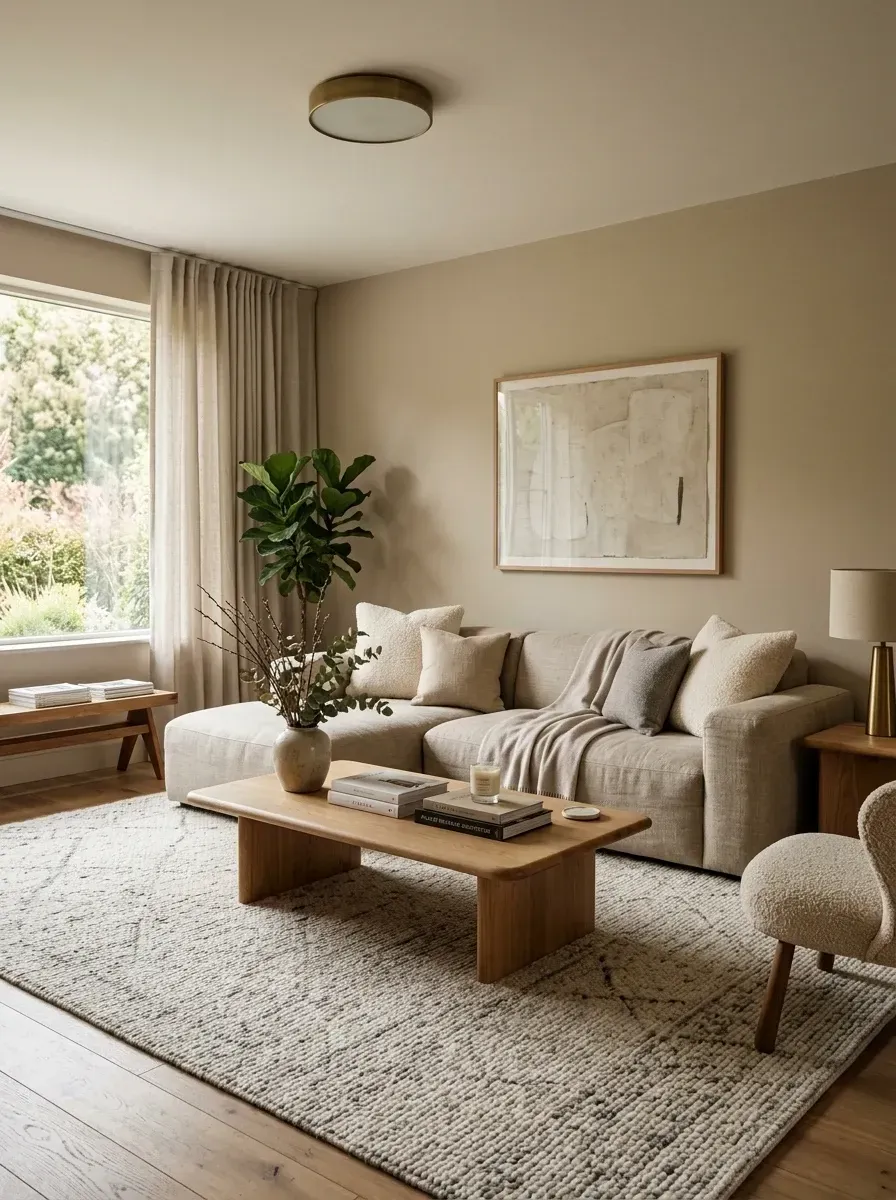
This room is a clinic on what designers mean when we say "tone-on-tone with texture variance." Every soft surface lives in the same beige-to-cream band, but each one has a completely different hand: a flat-weave natural linen on the sectional, a high-pile boucle on the accent chair, a deep cut-pile wool rug under foot, and a hand-finished slab coffee table with a live edge. Five materials, one color. That's the formula.
Plan-aware verdict: this composition will fail without a generous rug. A 9×12 minimum under a sectional this size — anything smaller and the sofa floats, breaking the layered floor plane that holds the whole look together. The chunky slab coffee table works because it's organic-edged and roughly 36 inches across, sized to the negative space between the sectional and the chair, not to a generic catalog dimension. For an adjacent style read, the same texture-first thinking shows up in our quiet luxury bedroom design guide.
Features
- Heavy-pile wool area rug
- Chunky solid wood slab coffee table with live edge
- Linen sectional in natural beige
- Cream boucle accent chair
- Large framed abstract anchoring the sofa wall
Cost Analysis (2026 Northeast)
| Decor Item (Qty) | Total Price Range |
|---|---|
| Linen Sectional Sofa | $2,500 – $5,000 |
| Boucle / Sherpa Accent Chair | $600 – $1,200 |
| Large Textured Wool Rug (9×12) | $1,000 – $2,500 |
| Solid Wood Slab Coffee Table | $800 – $1,800 |
| Large Framed Abstract Art | $400 – $1,000 |
| Flush Mount Ceiling Light | $200 – $500 |
| Total Estimated Cost | $5,500 – $12,000 |
Color Palette
Greige
#D3CEBF
Benjamin Moore Edgecomb Gray (HC-173) is the workhorse here — sits between grey and beige and shifts subtly through the day without going pink.
Natural Linen
#CFC4B0
Heavyweight Belgian linen — slightly slubby, undyed, with the natural color variation that comes from the flax fiber itself.
Warm Ash / Oak
#BFA382
Solid ash or live-edge oak slab with a hardwax-oil finish — never high-gloss poly, which reads as catalog furniture.
Cream Sherpa / Boucle
#EFEDE6
High-pile sherpa or boucle — works hardest as a textural counterpoint to the flat-weave sectional fabric.
4. The Sage Green Built-in Library
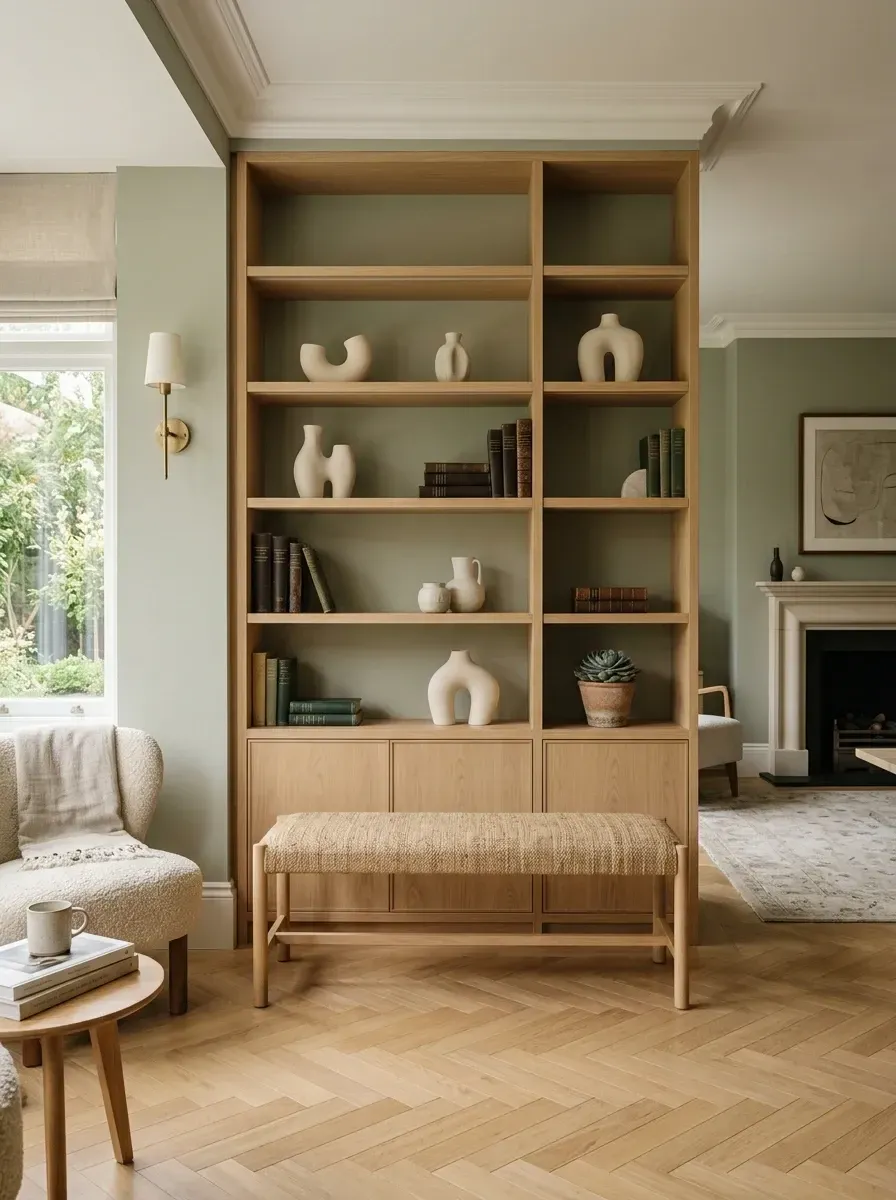
Quiet luxury and color are not mutually exclusive. The trick is choosing colors with a lot of black in them — sage greens, plaster pinks, deep ochres, dirty navys. The sage here is doing the work a wallpaper would do, but on the back of joinery rather than on the wall, so the color shows up only inside the cabinet bays and reads as architectural rather than decorative.
Plan-aware verdict: this only works if the joinery is properly proportioned. The shelves should be roughly 11–13 inches deep — deep enough for art books but shallow enough to make styling easy — and the back panel needs to be flat MDF or veneer board, not beadboard. The herringbone floor is the other half of the bargain: a 4-inch oak herringbone laid on the long axis of the room visually stretches the floor and anchors the bookcase. Painting alone runs $500–$1,200 for walls and trim by a Hudson Valley painter.
Features
- Sage green wall and shelf-back color
- Floor-to-ceiling oak built-ins
- Herringbone wood floor
- Curated, low-density shelf styling
- Woven seagrass bench in lieu of a second chair
Cost Analysis (2026 Northeast)
| Decor Item (Qty) | Total Price Range |
|---|---|
| Custom Oak Built-in Shelving Unit | $5,500 – $9,500 |
| Herringbone Wood Flooring (material + install) | $2,500 – $5,500 |
| Boucle Armchair | $700 – $1,500 |
| Woven Seagrass Bench | $300 – $700 |
| Professional Painting (Walls & Trim) | $500 – $1,200 |
| Ceramic Decor Collection (~10 pieces) | $500 – $1,500 |
| Total Estimated Cost | $10,000 – $19,900 |
Color Palette
Muted Sage
#9CA894
Farrow & Ball Lichen (No. 19) or Sherwin-Williams Evergreen Fog (SW 9130) — both desaturated greens that read as a neutral once they're up.
Natural Oak
#C4A986
Quarter-sawn white oak in a hardwax-oil finish — same material on the floor and the cabinetry creates the unified read.
Cream Boucle
#F0ECE2
Warm cream boucle that pops against the green without fighting it.
Woven Seagrass / Rope
#D9C6A9
Hand-woven seagrass on a hardwood frame — a natural-fiber reference that warms the green-and-oak base palette.
5. Symmetrical Fireplace Setting
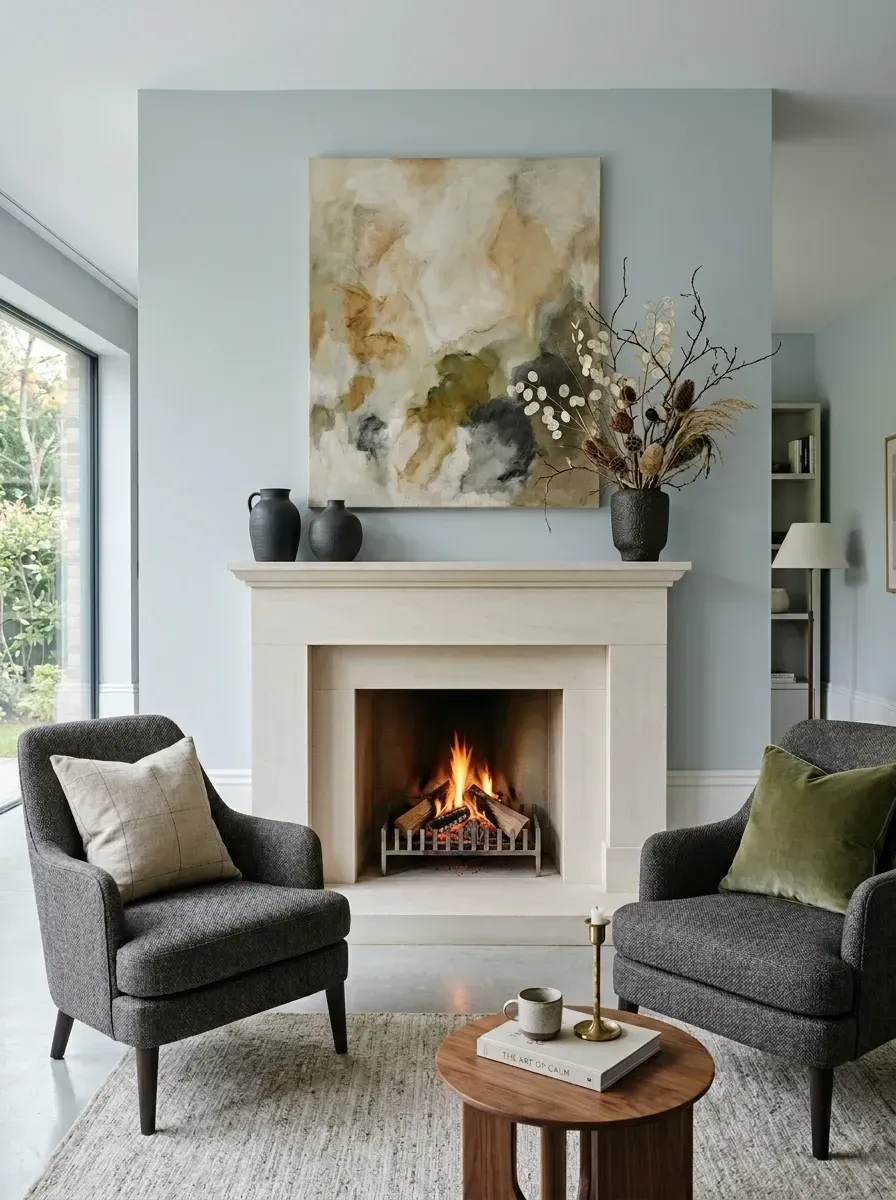
When a room has a single, dominant architectural feature — here, a tall limestone fireplace — the rest of the layout should defer to it. A pair of identical armchairs framing the hearth instantly composes the room. The oversized abstract above the mantel is sized to roughly two-thirds of the fireplace width, which is the proportion that reads as deliberate rather than ad-hoc. Cool blue-grey walls let the warm cream of the limestone come forward.
Plan-aware verdict: a stone fireplace surround is the place where renovation budgets balloon if the planning is sloppy. A solid limestone surround with a one-piece mantel runs $3,000–$6,000 in material plus another $2,000–$3,500 for fabrication and install in the Hudson Valley — but only if the rough opening, hearth depth, and chimney chase were specified at the framing stage. Trying to add a real stone surround to a finished room means cutting drywall and reframing, which doubles the labor.
Features
- Symmetrical pair of upholstered armchairs
- Tall limestone fireplace mantel and surround
- Oversized abstract canvas as focal anchor
- Cool-toned blue-grey walls
- Round oak side table to soften the symmetry
Cost Analysis (2026 Northeast)
| Decor Item (Qty) | Total Price Range |
|---|---|
| Stone Fireplace Mantel & Surround (Material + Install) | $5,000 – $9,500 |
| Upholstered Armchair (×2) | $1,600 – $3,200 |
| Large Statement Abstract Art | $800 – $2,000 |
| Round Oak Side Table | $300 – $700 |
| Wool Blend Area Rug | $400 – $900 |
| Total Estimated Cost | $8,100 – $16,300 |
Color Palette
Light Blue-Grey
#BFC9D2
Farrow & Ball Skylight (No. 205) or Benjamin Moore Quiet Moments (1563) — both stay airy in north light without going icy.
Limestone / Cream Stone
#EAEDC
French limestone or honed Indiana limestone — cream-toned with a subtle, fine-grain texture that reads as architectural.
Charcoal Tweed
#525457
Wool tweed or boucle in dark charcoal — the texture is what keeps a dark fabric from going flat in the room.
Olive Velvet
#7A825B
Cotton velvet in deep olive — used sparingly, on one or two pillows only, to color-bridge the limestone and the charcoal.
6. Grand Scale and Soft Drapery
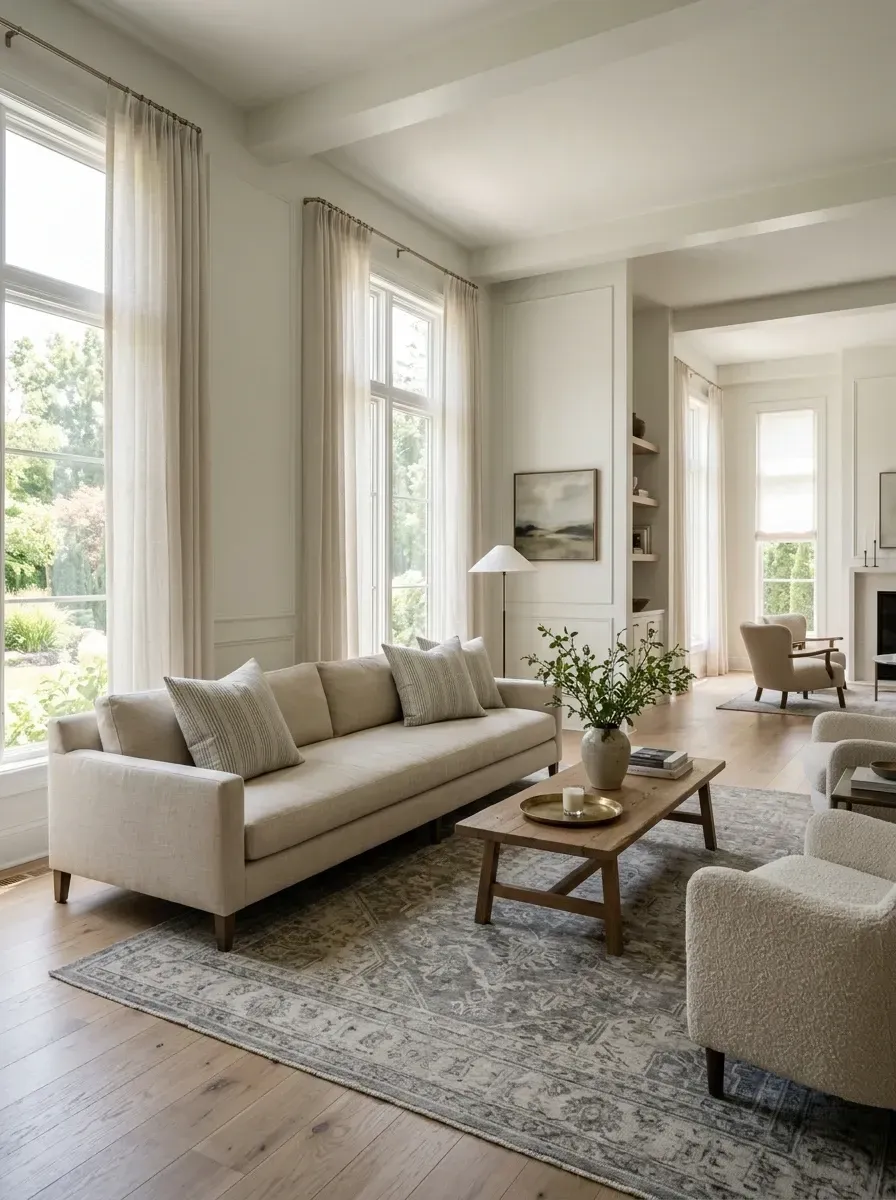
A double-height or 10-foot-ceiling room is a different design problem from a standard 8-foot living room. The walls are large enough that a normal-scale sofa looks lost. Here the response is right: a 9-foot-plus linen sofa, drapery hung as close to the ceiling as the molding allows, and a single oversize patterned rug that reads as one composition rather than several smaller pieces. Light is part of the material palette in a room like this — sheer drapery diffuses harsh window light into a soft glow that bathes the linen surfaces.
Plan-aware verdict: custom drapery is the line item people underestimate. A floor-to-ceiling sheer panel set in a 10-foot room runs $80–$140 per linear foot fabricated, plus hardware. For a wall with three windows you're at $2,000–$4,500 — and that's before motorized rods, which add another $800–$1,500. Hudson Valley clients renovating older houses with tall windows almost always need this line item; budget for it from day one.
Features
- Floor-to-ceiling sheer linen drapery
- Extra-long linen sofa (9 ft.+)
- Large vintage-style patterned rug
- High ceilings with traditional millwork
- Pair of boucle accent chairs to balance the sofa scale
Cost Analysis (2026 Northeast)
| Decor Item (Qty) | Total Price Range |
|---|---|
| Extra-Long Linen Sofa (9 ft.+) | $3,000 – $6,000 |
| Custom Floor-to-Ceiling Sheer Drapery + Hardware | $2,500 – $5,500 |
| Large Vintage-Style Area Rug (10×14+) | $1,500 – $4,000 |
| Wood Coffee Table | $600 – $1,200 |
| Boucle Accent Chair (×2) | $1,200 – $2,400 |
| Total Estimated Cost | $8,800 – $19,100 |
Color Palette
Soft White
#F7F7F2
Benjamin Moore White Dove (OC-17) or Farrow & Ball Wevet (No. 273) — both highlight crown molding and door casings without going stark.
Light Beige Linen
#E3DED3
Pale Belgian linen — performance variants from Romo or Holly Hunt hold up to a sun-bathed window wall without fading.
Medium Brown Oak
#9E8B73
Wide-plank European white oak with a medium stain and a UV-protective hardwax oil — the right call under heavy daylight.
Muted Blue-Grey
#AAB3B8
A washed antique rug — Persian, Oushak, or Kerman with a faded palette, sized large enough that all four sofa legs sit on the rug.
7. Curated Coffee Table Details
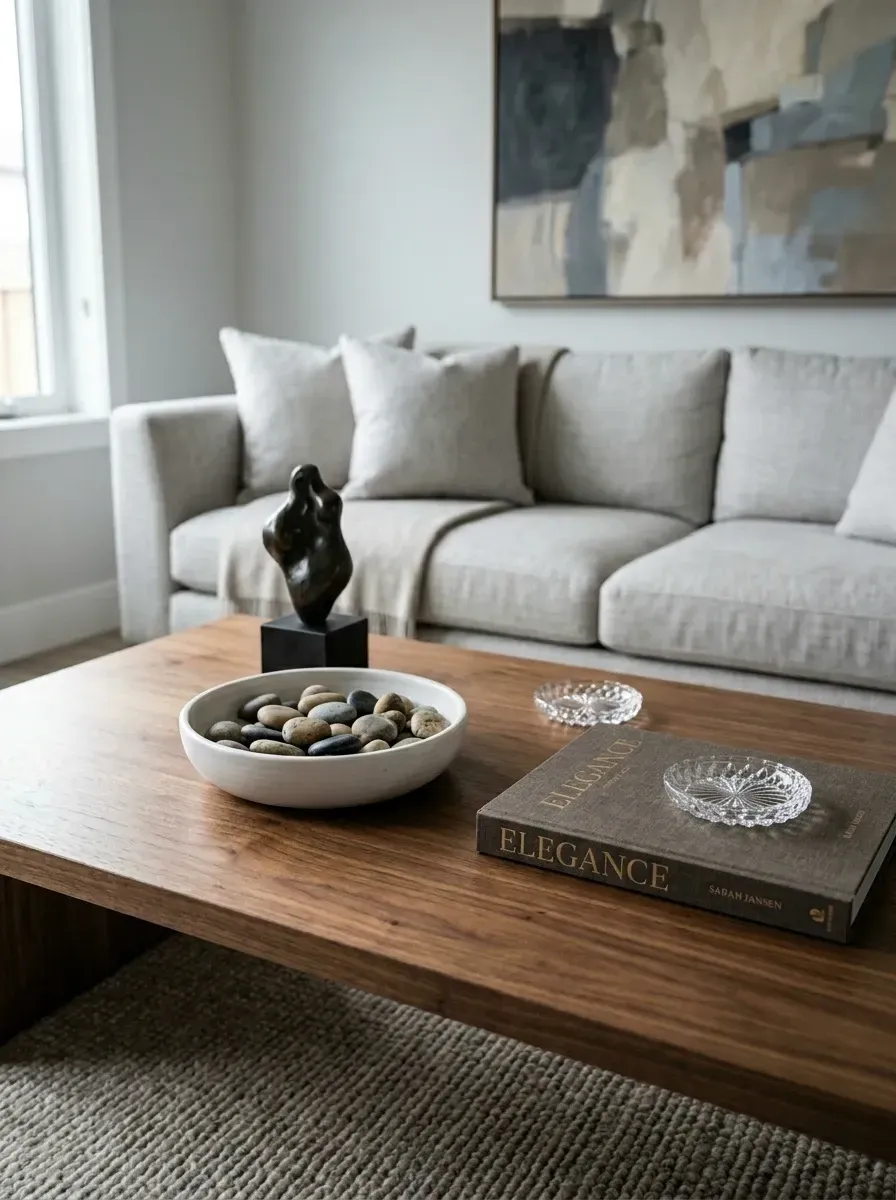
A coffee table vignette is the single piece of styling readers actually photograph and try to copy at home. Quiet luxury at this scale is about three things: real materials (matte ceramic, blown glass, river stone, solid wood), three tiers of height (low book stack, mid bowl, taller sculpture or candle), and breathable negative space. A walnut surface is doing more work here than it gets credit for — its grain provides the visual texture that lets the smaller objects breathe.
Plan-aware verdict: the cost line that surprises clients on a vignette like this is the table itself. A solid American black walnut coffee table from a regional maker (the Hudson Valley has at least four good ones) lands at $1,200–$2,200 versus $400–$700 for a veneered import. The difference is real walnut grain, real weight, and a piece you can refinish a decade or two from now rather than throw out. Worth it; this is one of the things you actually touch every day.
Features
- Solid American black walnut coffee table
- Three-tier styled vignette
- Mix of raw (river stones) and refined (crystal) materials
- Linen-bound coffee table books as a styling pedestal
- Small bronze sculpture for height variation
Cost Analysis (2026 Northeast)
| Decor Item (Qty) | Total Price Range |
|---|---|
| Solid Walnut Coffee Table | $1,200 – $2,200 |
| Large Matte Ceramic Bowl with Stones | $120 – $280 |
| Decorative Crystal / Glass Bowls (×2) | $80 – $200 |
| Coffee Table Book (×1–3) | $60 – $200 |
| Bronze / Cast-Metal Sculpture | $150 – $400 |
| Total Estimated Cost | $1,610 – $3,280 |
Color Palette
Rich Walnut
#7A573C
Solid American black walnut, hand-finished with hardwax oil — the grain pattern is doing most of the visual texture work.
Light Grey
#CDCDC8
A cool, neutral upholstery that lets the warm wood pop without competing.
Matte Cream Ceramic
#EFEBE0
Hand-thrown stoneware with a chalky, unglazed exterior — small-batch makers like Setsu Studio or East Fork.
Natural River Stone
#7F7A70
A handful of waterworn stones in mixed greys, browns, and tans — collected, not bought.
8. Velvet Chair, Grasscloth Wall
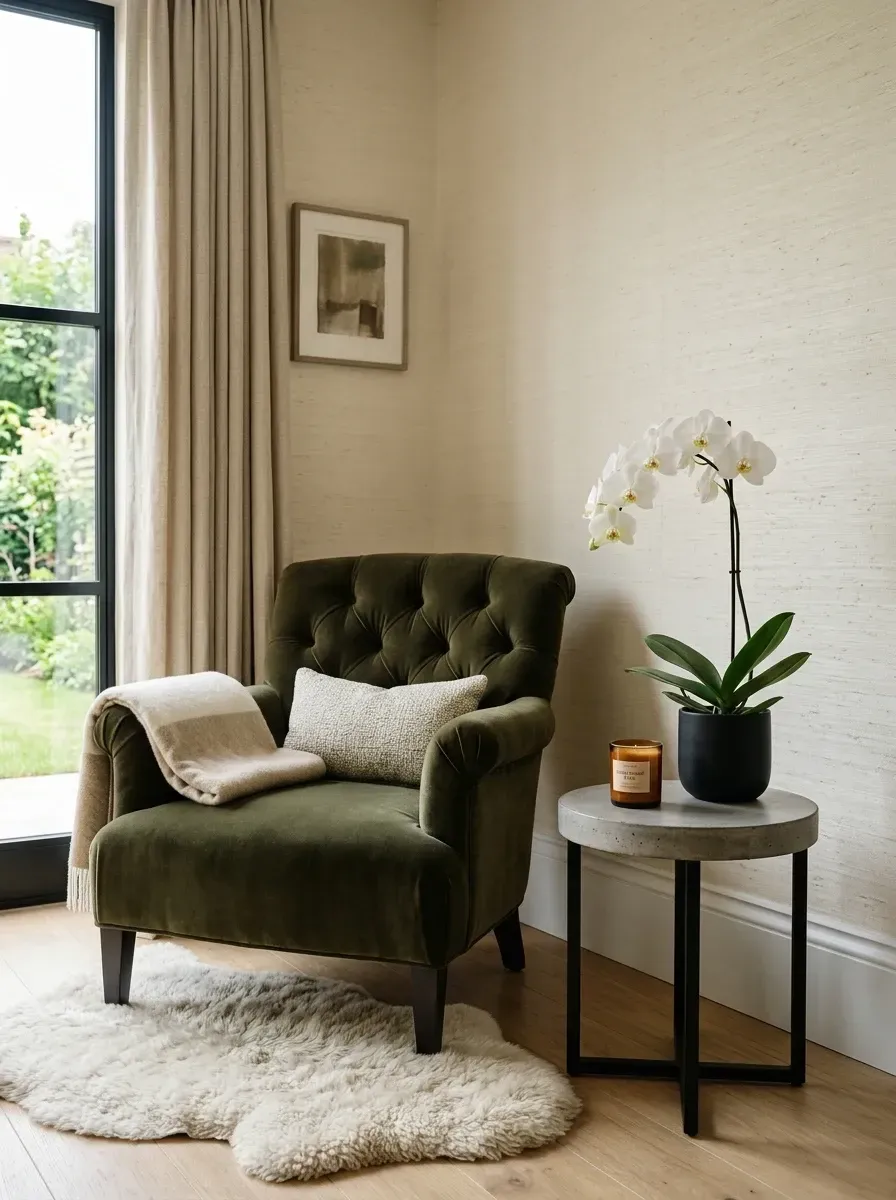
This corner makes the case that quiet luxury is about restraint, not absence of color. A single deep-olive velvet armchair carries this whole vignette. It works because the surrounding palette is deliberately quiet — a natural grasscloth wallpaper does the warmth-and-texture job that would otherwise require a second piece of upholstery. The concrete and metal side table is the modern foil that keeps the space from sliding into traditional territory.
Plan-aware verdict: grasscloth wallpaper is one of the highest-impact, most undersold renovation moves. Material runs $80–$150 per double roll for the good stuff (Phillip Jeffries, Arte, Schumacher), and a skilled paper-hanger in the Hudson Valley charges $80–$120 per hour. A 12×12 feature wall lands at roughly $600–$1,500 fully installed. The catch: grasscloth shows seams and water damage, so it has to be hung by someone who actually knows the material — and not in a bathroom.
Features
- Deep olive green velvet tufted armchair
- Textured grasscloth wallpaper feature wall
- Concrete and metal side table
- Cream sheepskin layered over a larger rug or wood floor
- Floor-to-ceiling linen drapery as soft frame
Cost Analysis (2026 Northeast)
| Decor Item (Qty) | Total Price Range |
|---|---|
| Velvet Tufted Armchair | $800 – $1,800 |
| Grasscloth Wallpaper (Material + Install, 1 wall) | $600 – $1,500 |
| Concrete & Metal Side Table | $200 – $500 |
| Real Sheepskin Rug | $100 – $250 |
| Linen Drapery Panel (×1 visible) | $400 – $800 |
| Total Estimated Cost | $2,100 – $4,850 |
Color Palette
Natural Grasscloth
#D4CDBC
Phillip Jeffries Manila Hemp or Arte Lino in a natural beige — the fiber variation is what creates the depth.
Deep Olive Velvet
#4F5B38
Cotton or mohair velvet in a desaturated olive — Romo Linara or Designtex Mohair Supreme are the go-to specs.
Grey Concrete
#999999
Sealed concrete with a powder-coated steel base — the matte raw finish is what makes it read as material rather than as decor.
Cream Sheepskin
#F8F7F2
Real Icelandic sheepskin — long-pile, undyed, sized to the chair footprint only.
9. Curved Forms and Monochromatic Calm
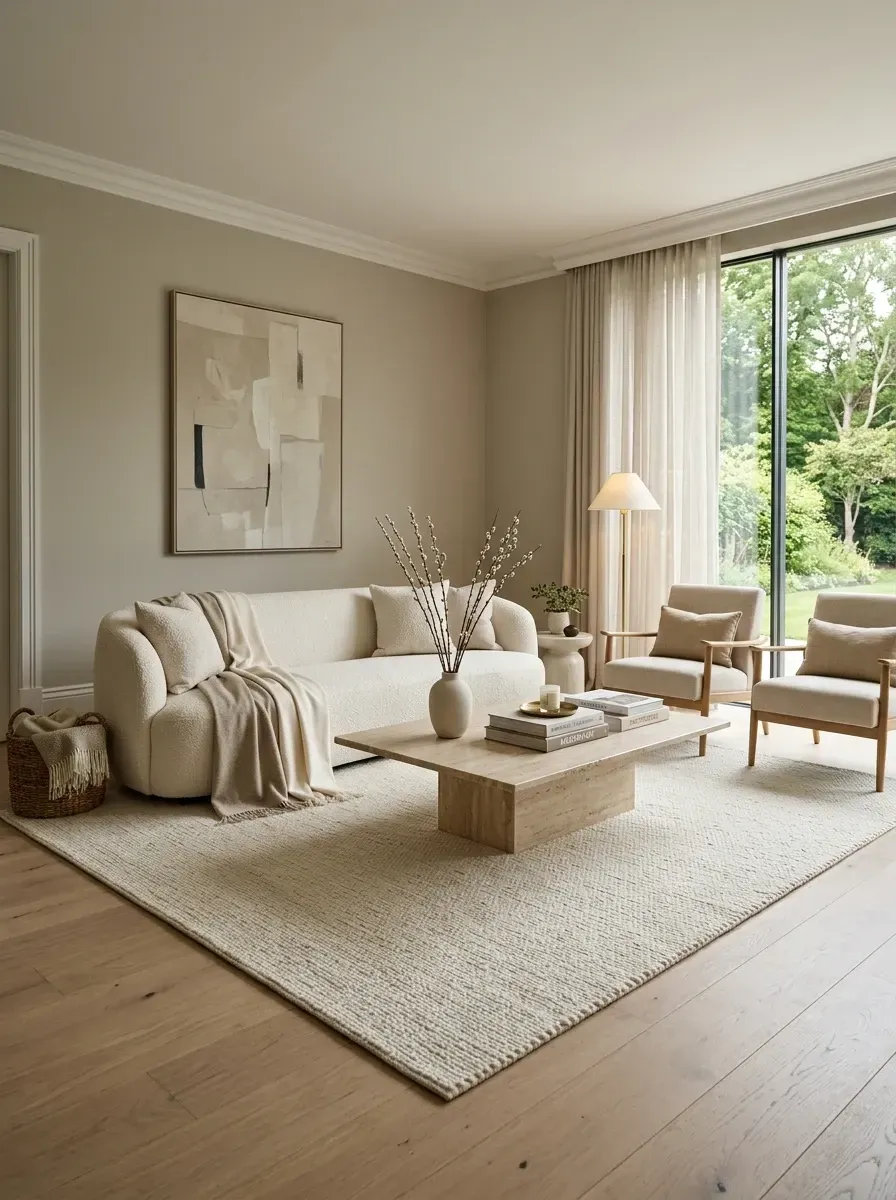
A monochromatic room only works when every form earns its keep. Here the curved boucle sofa is doing two jobs: softening the room visually and giving the eye a place to rest in a palette without color contrast. The travertine coffee table reads as a single sculptural mass — porous, warm, and weighty in a room otherwise built on textile. Pair this with the parallel reads in our quiet luxury dining room ideas if you're carrying the language across an open plan.
Plan-aware verdict: travertine is the unsung hero of quiet-luxury furniture. Where marble reads cold and showy, travertine reads warm and quiet — the natural pitting and beige veining feel ancient rather than precious. A solid travertine block coffee table runs $1,200–$3,000 from a regional maker; the budget kicks in for sealed travertine that won't stain on red wine. The curved sofa adds 15–25% to a comparable rectilinear sectional because of the custom frame work.
Features
- Curved boucle sofa
- Solid travertine block coffee table
- Strict monochromatic cream-to-taupe palette
- Large textured wool / jute rug
- Pair of light-ash wood-frame chairs to anchor the corner
Cost Analysis (2026 Northeast)
| Decor Item (Qty) | Total Price Range |
|---|---|
| Curved Boucle Sofa | $3,000 – $6,500 |
| Travertine Block Coffee Table | $1,200 – $3,000 |
| Wood-Frame Accent Chair (×2) | $1,000 – $2,400 |
| Large Woven Wool / Jute Rug | $1,000 – $2,200 |
| Large Abstract Art | $500 – $1,200 |
| Total Estimated Cost | $6,700 – $15,300 |
Color Palette
Pale Taupe / Greige
#D0C8BC
Sherwin-Williams Natural Linen (SW 9109) or Benjamin Moore Pale Oak (OC-20) in a flat finish — both stay neutral under varied light.
Cream Boucle
#F2EFE4
Heavyweight performance boucle in warm cream — Maharam or Knoll have rub-count specs that hold up to a daily-use sofa.
Natural Travertine
#DBC9A9
Honed, sealed Italian travertine with the natural pitting left visible — sealed against red wine and oil with a penetrating, breathable sealer.
Light Ash Wood
#D5C4A8
Solid white ash with a clear hardwax-oil finish — pale, with a strong grain that reads as material rather than color.
Pro Tips From the Renovation Designer's Chair
- Texture, not pattern. A quiet luxury room can have five tones of beige. It cannot have five different patterns. Solve visual interest with linen-against-boucle, plaster-against-stone, oak-against-travertine — never with prints.
- Spend on the touchpoints. The sofa upholstery, the rug under your feet, the door hardware, the lamp pull. Touchpoints are where your hand reads the quality of a room before your eye does. Cut budget on the items you only look at — large art, decorative bowls — before you cut on the items you touch.
- Edit ruthlessly, decorate intentionally. Quiet luxury is as much about the empty space as the filled space. Every styled object on a coffee table or shelf should pass two tests: does it have purpose, and does it hold up at arm's length? If not, store it.
- Limit the wood-tone count. Two wood tones in a single room — say, a light oak floor and a dark walnut coffee table. Three is possible only if one is small (a side table or picture frame). Four wood tones reads as builder-grade no matter how good the individual pieces are.
- Plan the lighting like a renovation, not like decor. Floor outlets, dimmable circuits on every fixture, three light sources at three heights in every seating area. This gets specified at the framing stage in any new build or full renovation; retrofitting outlets is the most common after-the-fact regret I see.
- Match wood to wood, paint to appliance, stone to stone. If the paneled column is supposed to disappear, the cabinet shop's wood sample and the appliance manufacturer's panel finish must come from a single physical sample, not from two photographs. Same rule for matched paint and stone bookmatching.
Cost-Saving Moves
- Buy your stone vintage. A 1970s travertine coffee table on Hudson Valley Craigslist or Chairish lands at $300–$700. The patina is genuine, the slab is heavier than current production, and you save 60–80% over new.
- Slipcover, don't reupholster. A custom linen slipcover from a regional maker runs $700–$1,400 over an existing chair frame. Full reupholstery is $1,800–$3,500. The slipcover reads as the same Belgian-linen language and washes off red wine.
- Make your own large-scale art. A 4×5-foot canvas from Blick, $80 of joint compound and modeling paste, and a single tube of warm-grey acrylic gives you a textured piece that reads as a $1,500 commission. The trick is restraint — one or two earth tones, big strokes, no representational forms.
- Re-stain the floor instead of replacing it. A solid-oak floor in poor finish but good structural shape can be sanded and re-finished with hardwax oil for $4–$7 per square foot. Replacement starts at $14–$22 per square foot installed for new wide-plank oak.
The Core Idea. Quiet luxury is not a beige paint chip. It's a discipline — three to six honest materials, two wood tones max, one architectural focal point, three layers of warm light, and ruthless restraint with everything else. Get those right and the room reads as expensive whether you spent $5,000 or $50,000 on the build.
Reader Questions on Quiet Luxury Living Rooms
What actually defines the quiet luxury interior style?
It's a discipline of restraint. Quiet luxury rooms prioritize the quality and tactile honesty of a small number of materials — solid hardwoods, real stone, natural fiber textiles, hand-applied finishes — over visible logos, branded furniture, or trend pieces. The color palette is usually narrow and earthy, but the texture spread is wide. The work is happening in what you touch, not what you announce.
How can I make my living room read as quiet luxury on a tight budget?
Start with three moves. First, declutter to roughly 60% of what's currently in the room. Second, upgrade one major touchpoint — a real wool rug, a heavy linen slipcover, or a sculptural lamp. Third, replace the lighting plan with three sources at three heights on dimmable circuits. None of those require a renovation. Together, they shift a room's read more than a $5,000 sofa would in isolation.
Can a quiet luxury living room actually work with kids and pets?
Yes, with the right material specs. Specify performance boucle or linen with a 50,000+ double-rub count, durable wool or jute rugs that hide stains, and solid wood furniture that can be refinished rather than replaced. Avoid silk velvet, unsealed travertine, and unpainted plaster on the lower walls. The aesthetic is much less fragile than the photos suggest — the look comes from materials that age well, which often means they wear well too.
What core materials show up in nearly every quiet luxury living room?
Five recur often enough to call them the canon. Solid hardwoods — usually white oak or American black walnut. Natural stone — travertine, limestone, honed marble, or soapstone. Textile fibers — heavyweight Belgian linen, cotton or mohair velvet, and wool boucle. Wall finishes — limewash, smooth plaster, or grasscloth. Metals in muted patinated tones — unlacquered brass, brushed bronze, oil-rubbed iron. Almost any quiet luxury room is a different combination of those five.
How does quiet luxury differ from pure minimalism?
Minimalism is about the count of objects in a room — fewer is better. Quiet luxury is about the depth of materials in a room — more is better, as long as they're real. A minimalist room can be empty and cold. A quiet luxury room is usually full of texture — heavy rugs, layered textiles, sculptural lighting, real stone — but the visual count stays low because the palette is unified. They look similar in photos and feel completely different in person.
Should I use cool tones or warm tones for the base palette?
Match the base palette to your daylight orientation. North-facing rooms — common in Hudson Valley farmhouses and Brooklyn brownstones — read cooler than the paint chip suggests, so a warm beige (Manchester Tan, Edgecomb Gray) keeps the room from feeling clinical. South-facing rooms tolerate cooler greys (Quiet Moments, Pale Oak) without going dim. East and west rooms shift through the day, so test paint samples on three walls before committing.
Where to Read Next
If you're carrying this language into the rest of the house, start with the broader living and dining archive. For an adjacent room read, the same restraint shows up in our quiet luxury bathroom design ideas, and for a dedicated reading or work space the rules carry over almost exactly into the quiet luxury home office design guide.
Sources & Further Reading
- Architectural Digest — "Quiet Luxury, Explained" for the cross-discipline definition that bridges fashion and interiors.
- Vogue — "The Nuance of Quiet Luxury in Interior Design" on the difference between minimalism and material discipline.
- Remodelista for ongoing material-first coverage of natural-fiber upholstery, plaster, and limewashed walls.
- Natural Stone Institute on travertine, limestone, and marble specification, sealing, and care.
- Old House Journal for plaster and limewash technique guides relevant to historic renovation work.
- This Old House on hardwood-floor refinishing, herringbone installation, and built-in joinery practice.
- NAHB — Cost of Constructing a Home for benchmark labor and material cost data behind the renovation ranges quoted above.
- Dwell for editorial coverage of organic modern interiors and curved-form furniture.
- Farrow & Ball Color Library for the reference palette behind Lichen, Skylight, and Wevet.

Nora Whitfield
Renovation Designer & Interiors Editor · Beacon, New YorkNine years of design-build renovation work across the Hudson Valley and the Northeast. Nora runs the Renovations, Room Guides and Renovation Mind desks — before-and-after studies, room-by-room design guides, and the long essays on why what we renovate matters.
More from Nora →
Reader notes