


Walk into a kitchen that's actually quiet luxury and the first thing you notice is what's missing — the stainless monolith, the digital display, the visible refrigerator hinge. The appliances are still there. They're just hidden inside the cabinetry run, which is doing the architectural work that a row of brand badges used to do. Below: ten kitchens that handle integration well, the real Northeast cost ranges to build them, and the framing-stage planning that separates a kitchen that looks integrated from one that is.
How I Read an Integrated Kitchen
When I evaluate a kitchen for a Hudson Valley renovation client, I read four things before I look at finishes: the cabinetry run continuity (where the wood or paint actually breaks), the appliance integration tier (panel-ready vs. counter-depth vs. exposed), the reveal discipline (the gap between adjacent doors, top to bottom), and the ventilation plan (where the heat from a hidden fridge actually goes). Get those four right and the kitchen reads as architecture. Get any of them wrong and you've built an expensive kitchen that looks just-okay. After seven years running renovation design out of Beacon and Kingston, I've come to think of integration not as a finish-stage decision but as a framing-stage one — the cabinet shop, the appliance spec sheets, and the framer all have to share one drawing set before the studs go up.
The ten kitchens below cover the full range — from $25,000 Scandi-budget integrations to $120,000 navy-and-marble showpieces — with the real material specs and real Northeast labor rates that get you there. Color palettes, brand call-outs, and the plan-aware verdict on each. For a broader category lens, the network's kitchens and baths archive covers cross-format comparisons in more depth than I can fit here.
Reading note. The numbering follows my client-walkthrough order — light to dark, simple to complex — not a ranking. Kitchen #10 is not better than kitchen #1; it's a different brief at a different budget.1. Monochromatic Taupe Minimalism
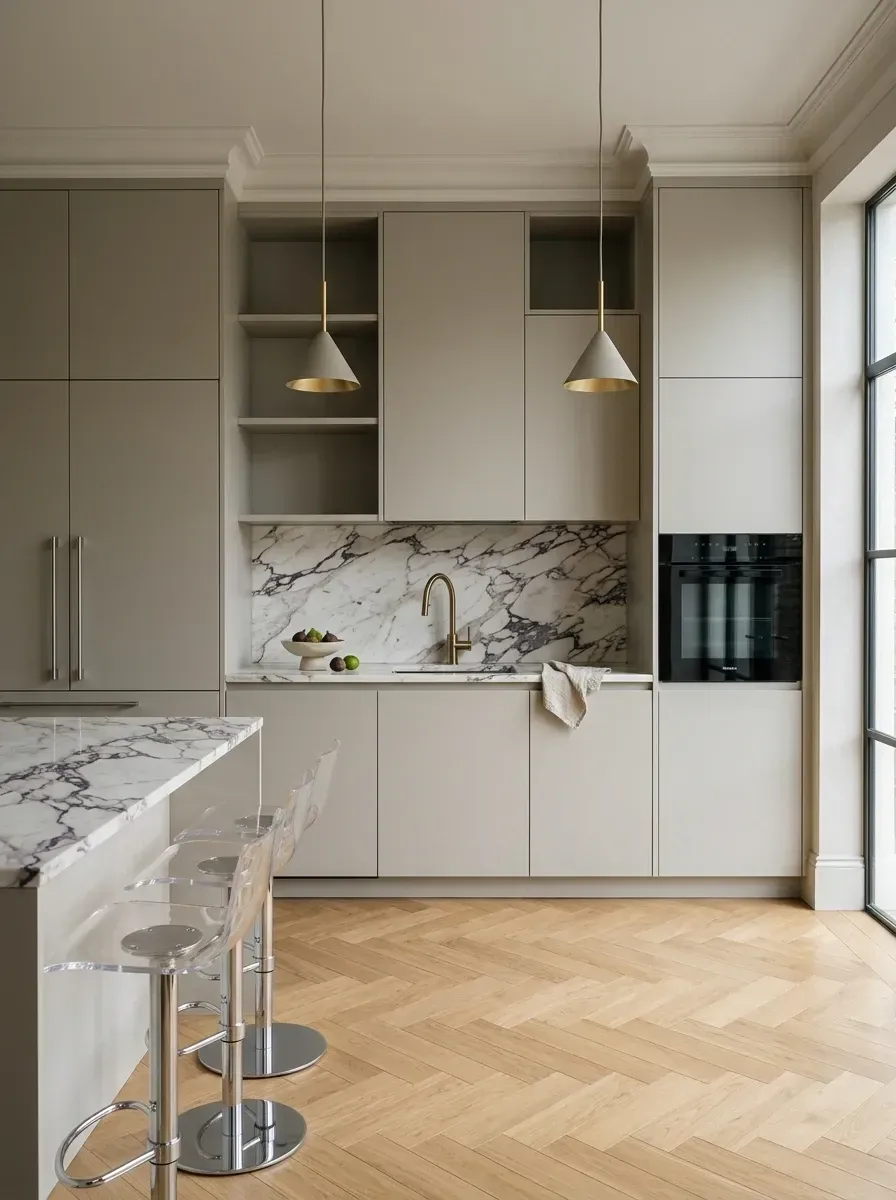
Symmetry built on integration. The two tall cabinets flanking the open shelving are housing a Sub-Zero column refrigerator and freezer pair (their 30/30 setup is the standard for this look). Because the panels are flat-front taupe and run uninterrupted from floor to ceiling, the cooling appliances read as architectural columns rather than equipment. Once the appliances quiet down, the dramatic marble backsplash is allowed to be the room's centerpiece — the only place your eye is supposed to land.
Plan-aware verdict: the trick here is the matched panel grain (or paint sheen) across two appliance fronts that are physically separate units. That match has to be specified on the cabinet shop drawings, not assumed. The herringbone oak floor and brushed brass pendants do warmth duty in a palette that would otherwise read cold. This is a $60K-and-up build at Hudson Valley labor rates.
Features
- Integrated tall fridge / freezer columns (Sub-Zero IC-30 pair or equivalent)
- Flat-panel custom cabinetry, sequenced taupe finish
- Full-height marble backsplash and counters
- Herringbone oak flooring
- Brushed brass cone pendants
Cost Analysis (2026 Northeast)
| Decor Item (Qty) | Total Price Range |
|---|---|
| Custom Flat Panel Cabinetry (Full Wall) | $25,000 – $40,000 |
| Integrated Fridge & Freezer Columns (Panel-Ready) | $14,000 – $22,000 |
| Full-Height Marble Backsplash & Counters (Material + Labor) | $12,000 – $18,000 |
| Brass Cone Pendant Lights (×2) | $800 – $1,600 |
| Lucite Bar Stools (×2) | $600 – $1,200 |
| Herringbone Oak Flooring Installation (~200 sq ft) | $4,000 – $7,000 |
| Total Estimated Cost | $56,400 – $89,800 |
Color Palette
Matte Taupe
#A8A39D
Benjamin Moore Revere Pewter (HC-172) or Sherwin-Williams Worldly Gray (SW 7043) in a 10-degree sheen — quiet, earthy, holds its color across both appliance and cabinet panels.
White & Grey Marble
#EAECEE
Calacatta Gold or Statuario for the dramatic veining — book-match the slabs across the backsplash for the strongest read.
Brushed Brass
#C9A86A
Visual Comfort Goodman pendants or Apparatus Studio Cone — heritage forms, modern execution.
Natural Oak
#D4BC96
Rift-cut white oak in a herringbone pattern, finished with hardwax oil rather than poly for a flatter sheen.
2. Fluted Texture and Contrast
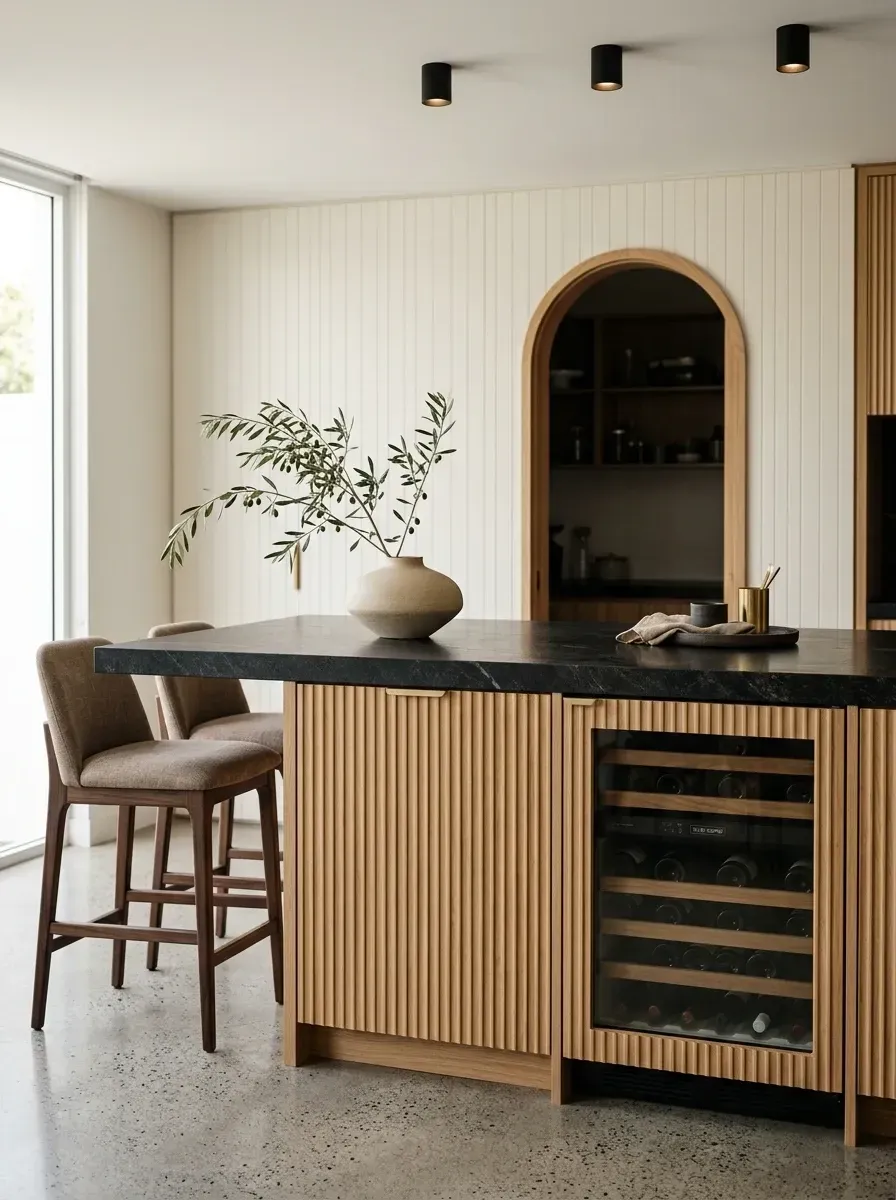
A mixed-integration approach. The vertical-paneled back wall almost certainly conceals the main refrigeration. The island, however, exposes a flush-installed wine column — and it works because the appliance frame is black, matching the honed black soapstone or granite countertop, and because it's set perfectly flush with the surrounding fluted white oak. Quiet luxury doesn't require hiding everything. It requires making every visible thing intentional.
Plan-aware verdict: fluted cabinetry is a labor premium of roughly 30–50% over flat-panel because every flute has to be milled, sanded, and finished individually. Worth it on the island where the eye lands; not always worth it on the perimeter. The arched doorway is a nice nod to traditional bones being reinterpreted in a modern vocabulary — Hudson Valley clients with 1920s houses respond to this format particularly well.
Features
- Fluted white oak island cabinetry
- Honed black soapstone or granite countertops
- Flush-installed undercounter wine column (Sub-Zero or True Residential)
- Vertical shiplap wall paneling
- Arched doorway as architectural detail
Cost Analysis (2026 Northeast)
| Decor Item (Qty) | Total Price Range |
|---|---|
| Custom Fluted Oak Island & Wall Paneling | $18,000 – $28,000 |
| Honed Black Granite / Soapstone Countertops | $5,000 – $8,000 |
| Flush-Install Undercounter Wine Fridge | $1,500 – $3,500 |
| Upholstered Bar Stools (×2) | $1,000 – $2,400 |
| Minimalist Ceiling Spotlights (×3) | $300 – $750 |
| Terrazzo-Style Concrete Flooring | $3,500 – $6,000 |
| Total Estimated Cost | $29,300 – $48,650 |
Color Palette
Creamy Off-White
#F2EFE4
Benjamin Moore White Dove (OC-17) or Farrow & Ball Wimborne White on the vertical shiplap — warm enough not to fight the oak.
Light White Oak
#D8C3A5
Rift-cut white oak with a Rubio Monocoat 2C finish in Pure or Natural — the matte finish reads honest where lacquer would read corporate.
Honed Black
#2A2A2A
Vermont Verde Antique soapstone or Absolute Black granite — both honed, both forgive water spots better than polished alternatives.
Warm Taupe Fabric
#9C8D7D
Bouclé or hand-loomed wool — the textile bridge between the wood and the black counter.
3. Traditional Meets Tech
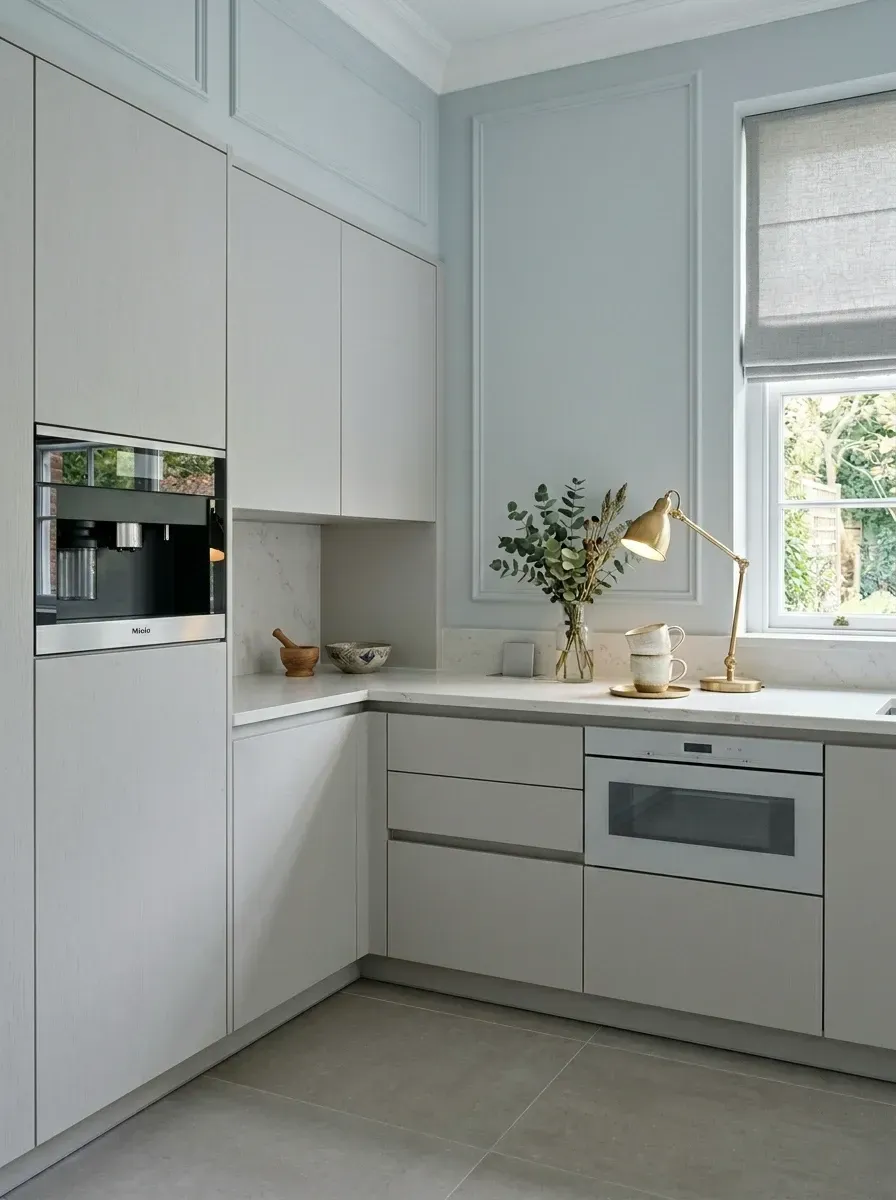
Integration isn't only for modern kitchens. This pale-blue shaker setup keeps a Miele built-in coffee system exposed — treated as a high-end functional fixture, the way an antique brass wall lamp would have been a century ago — while concealing the dishwasher (or auxiliary fridge) behind a panel that exactly matches the surrounding shaker doors. Same paint, same rail-and-stile profile, same edge bevel. The integration succeeds or fails on profile fidelity.
Plan-aware verdict: shaker integration is harder than flat-panel because the rail-and-stile dimensions on the appliance panel must match the cabinet doors to within 1/16 inch. Most cabinet shops in the Hudson Valley can do this; budget shops cannot. Always ask to see a shop drawing of the appliance panel detailed against the adjacent door before signing the order.
Features
- Pale blue shaker cabinetry with classic wall molding
- Integrated undercounter appliance panel (matched profile)
- Built-in Miele CVA coffee system, plumbed
- White quartz countertops
- Brass articulating wall lamp (Hector or similar)
Cost Analysis (2026 Northeast)
| Decor Item (Qty) | Total Price Range |
|---|---|
| Custom Painted Shaker Cabinetry & Molding | $20,000 – $35,000 |
| Miele Built-in Coffee System (Plumbed) | $4,000 – $5,500 |
| Panel-Ready Undercounter Dishwasher / Fridge | $1,200 – $2,500 |
| White Quartz Countertops | $3,000 – $5,000 |
| Brass Articulating Desk Lamp | $200 – $500 |
| Large Format Porcelain Tile Flooring | $2,000 – $4,000 |
| Total Estimated Cost | $30,400 – $52,500 |
Color Palette
Pale Powder Blue
#C8D4D9
Farrow & Ball Light Blue (No. 22) or Benjamin Moore Wickham Gray (HC-171) — quiet, traditional, doesn't fight the brass.
Clean White Quartz
#F4F4F4
Caesarstone Pure White or Silestone Iconic White — engineered surface forgives the daily abuse of an actual cooking kitchen.
Aged Brass
#B59E6F
Rejuvenation Hawthorne pulls or Armac Martin in aged brass — the warmth that lifts pale blue out of nursery territory.
Matte Grey Tile
#989895
Large-format porcelain (24×48 minimum) in a warm grey — fewer grout joints, easier maintenance.
4. The Walnut Wall
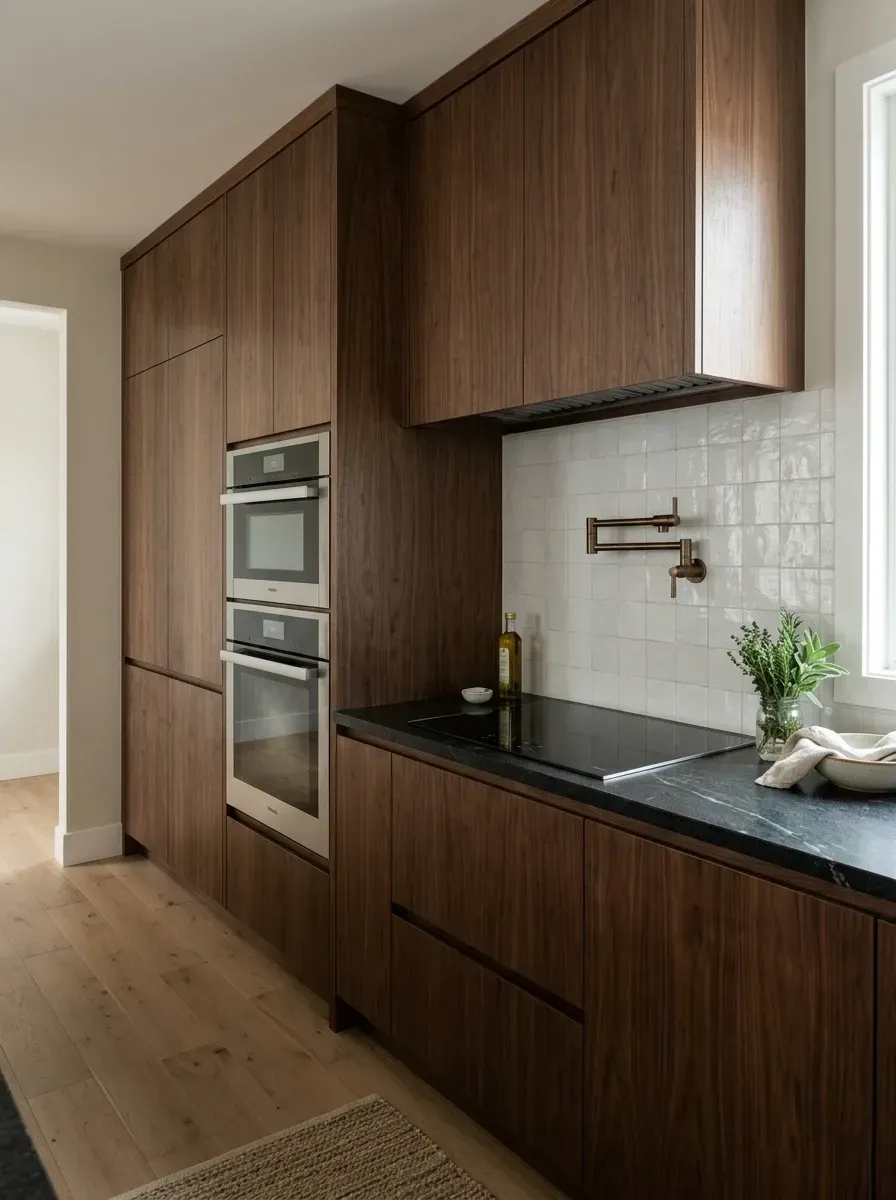
Walnut at full height. The design intentionally exposes the stacked Wolf (or Miele) ovens as a working centerpiece, while the tall panels to their left almost certainly hide a Sub-Zero refrigerator column. That balance is the whole logic of quiet luxury — celebrate the cooking equipment that has functional gravity, suppress the storage equipment that doesn't. The single most important spec on this kitchen is "sequenced matched" walnut veneer panels, so the grain flows across the appliance fronts and adjacent cabinets as if they were milled from one tree. The cabinet shop should call this out on the order.
Plan-aware verdict: this is a $55K-and-up build before counters. It's the most expensive aesthetic on the list because walnut veneer is the most material-cost-sensitive of the cabinet woods. Honed soapstone counters are the right call here — polished black absorbs all the kitchen's light and goes flat against the walnut.
Features
- Full-height sequenced walnut veneer cabinetry
- Exposed double stacked ovens (Wolf M-Series, Miele PureLine)
- Integrated tall fridge column behind matched walnut panel
- Honed soapstone counters
- Off-white zellige-style tile backsplash
- Brass pot filler (Waterstone or Newport Brass)
Cost Analysis (2026 Northeast)
| Decor Item (Qty) | Total Price Range |
|---|---|
| Custom Walnut Veneer Cabinetry (Full Wall) | $35,000 – $55,000 |
| Stacked Double Electric Ovens (High-End) | $5,000 – $9,000 |
| Integrated Fridge Column (Panel-Ready) | $7,000 – $10,000 |
| Honed Soapstone Countertops | $4,000 – $7,000 |
| Zellige-Style Tile Backsplash (Material + Labor) | $2,000 – $3,500 |
| Pot Filler Faucet | $500 – $1,200 |
| Total Estimated Cost | $53,500 – $85,700 |
Color Palette
Natural Walnut
#6B4D36
FSC-certified American black walnut veneer with a UV-stable hardwax oil finish — the warm grain that carries the whole design.
Honed Black Soapstone
#363636
Vermont quarried soapstone in Black Venata, honed — the matte velvety surface that flatters walnut where polished granite would fight it.
Off-White Zellige Tile
#E8E6DF
Clé Tile or Mosaic House zellige in Weathered White — handmade variation that reads honest at close range.
Oil-Rubbed Bronze
#4A3C31
Rocky Mountain Hardware or Sun Valley Bronze — true patinated bronze that ages with the wood.
5. Organic Modern with Exposed Cooling
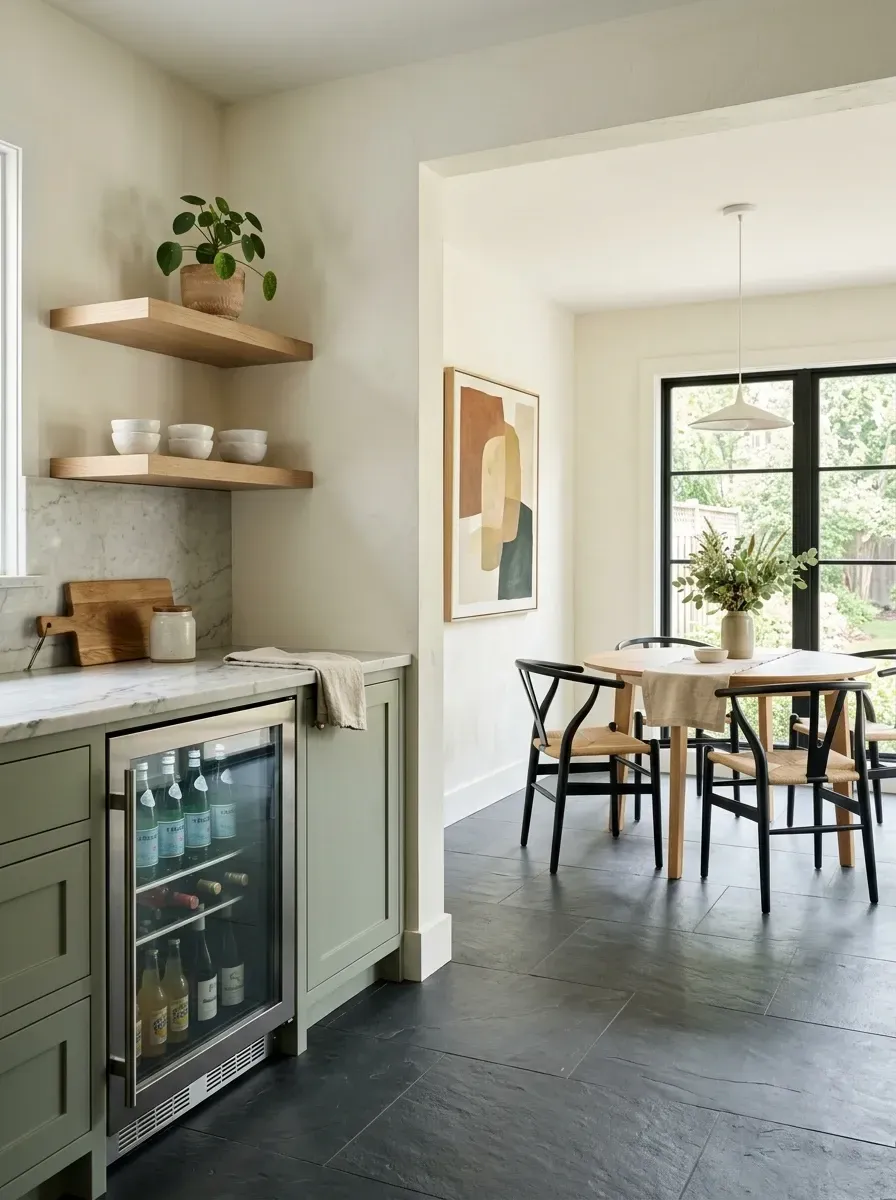
A sage-and-oak palette that reads relaxed and organic — the kind of kitchen I see often in Hudson Valley weekend houses. The interesting move is leaving the glass-front beverage column exposed in the island. In a quiet luxury vocabulary that usually demands integration, an exposed appliance works only if it's a lifestyle appliance (a wine column, a beverage center) rather than a utility one (the main fridge, which is hidden elsewhere). The stainless frame ties to the faucet, the pendant, and the black-framed Marvin windows — all coordinated metals.
Plan-aware verdict: oak floating shelves of any depth need engineered steel brackets buried in the framing — get a structural engineer to size them before drywall. Black slate herringbone floors are gorgeous but cold underfoot; consider in-floor radiant heat in any Northeast renovation, especially for bare-foot weekend houses.
Features
- Sage green shaker lower cabinets
- Thick oak floating shelves (steel-supported)
- Exposed glass-front beverage center (Sub-Zero or True Residential)
- Carrara marble countertops
- Black slate herringbone flooring
- Black-framed Marvin Ultimate windows; Wishbone-style chairs
Cost Analysis (2026 Northeast)
| Decor Item (Qty) | Total Price Range |
|---|---|
| Custom Painted Shaker Cabinets & Oak Shelves | $15,000 – $25,000 |
| Carrara Marble Countertops | $4,000 – $6,500 |
| Glass-Front Undercounter Beverage Center | $1,200 – $2,800 |
| Black Slate Flooring | $3,000 – $5,000 |
| Wishbone-Style Dining Chairs (×4) | $800 – $2,400 |
| Round Oak Dining Table | $1,000 – $2,500 |
| Total Estimated Cost | $25,000 – $44,200 |
Color Palette
Muted Sage Green
#8F9E8B
Farrow & Ball Mizzle (No. 266) or Benjamin Moore Saybrook Sage (HC-114) — desaturated enough to read calm rather than decorative.
Natural White Oak
#CDBEA7
Rift-cut white oak in a 2.25-inch shelf depth, finished with a matte hardwax oil — durable on a working shelf.
Charcoal Slate
#3E4244
Vermont slate in a herringbone layout — natural cleft texture, dense enough for kitchen traffic.
Matte Black
#1A1A1A
Marvin Ebony or Andersen Black factory finish on the windows — never field-painted; the field paint never lasts.
6. The Wabi-Sabi Hideaway
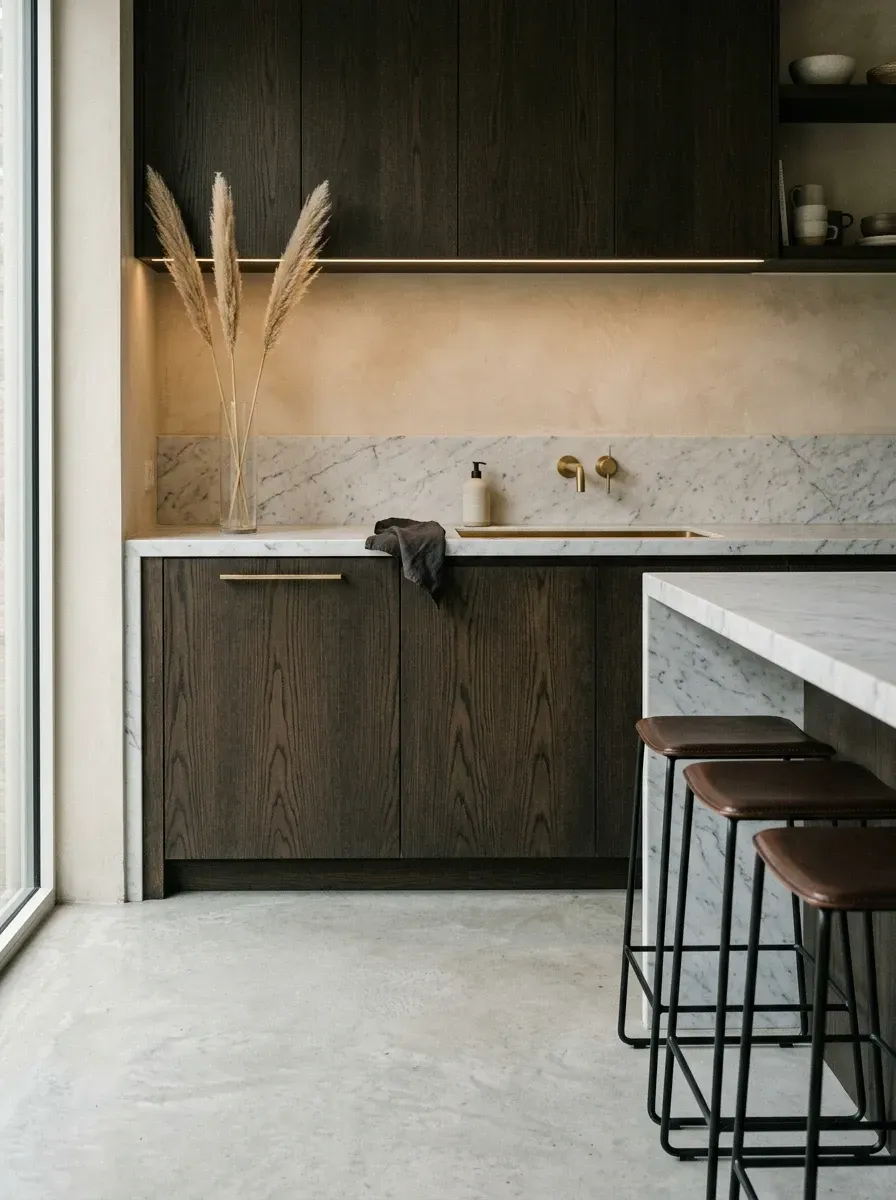
Minimalism pushed to the edge. The dark stained oak cabinetry is the only feature in the room — no upper cabinets, no decorative hardware, no visible appliances. The dishwasher and likely a refrigerator are concealed behind these dark panels with push-to-open mechanisms (Blum Tip-On or Häfele Push-to-Open Silent). The complete absence of adornment removes every visual cue that this is a kitchen, leaving only material and form. Polished concrete underfoot reinforces the architectural honesty.
Plan-aware verdict: handleless minimalism is the highest reveal-discipline format on this list. Every gap between every door has to read as a perfectly uniform 3mm or 4mm reveal — top to bottom, left to right, across appliance fronts and cabinet doors equally. Cabinet shops that aren't fully comfortable with European-style frameless construction (Blum, Hettich, Häfele hardware) shouldn't take this job.
Features
- Dark stained oak handleless cabinetry (frameless / European)
- Integrated dishwasher with push-to-open hinge (Miele or Bosch panel-ready)
- Polished concrete flooring (in-floor radiant recommended)
- Honed white marble countertop with integral splash shelf
- Wall-mounted brass faucet (Vola or Dornbracht)
Cost Analysis (2026 Northeast)
| Decor Item (Qty) | Total Price Range |
|---|---|
| Custom Handleless Dark Oak Cabinetry | $25,000 – $40,000 |
| Panel-Ready Dishwasher with Push-to-Open | $1,500 – $2,500 |
| Polished Concrete Flooring (Pour & Finish) | $5,000 – $8,000 |
| Marble Countertop & Integral Shelf | $6,000 – $10,000 |
| Wall-Mounted Brass Faucet | $600 – $1,200 |
| Leather and Steel Bar Stools (×3) | $1,500 – $3,600 |
| Total Estimated Cost | $39,600 – $65,300 |
Color Palette
Dark Stained Oak
#3B3027
Rubio Monocoat 2C in Smoke or Charcoal on rift-cut oak — a stain that lets grain still show through.
Polished Concrete / Plaster
#B0ADA8
Diamond-polished concrete in a medium grey aggregate — sealed with a penetrating densifier rather than a topical coating.
Honed White Marble
#EAEAEA
Calacatta Mont Blanc or Bianco Carrara in a honed finish — the brightness counterpoint the dark oak needs.
Brushed Brass
#BFA57D
Vola HV1 or Dornbracht Tara in brushed brass — the only metal in the room, which is the whole point.
7. Open-Plan Integration
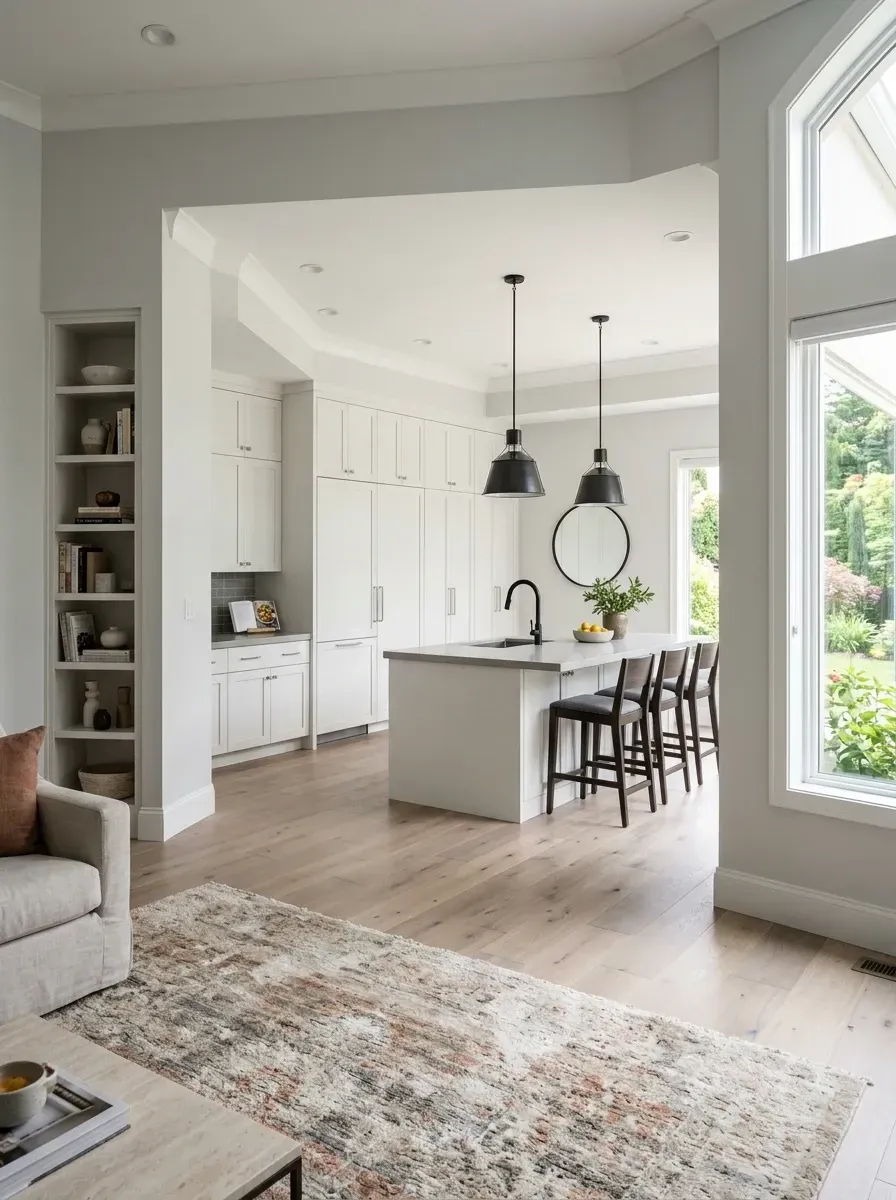
In a true open-plan room, integrated appliances are not optional — they're load-bearing. If the 36-inch fridge column on the back wall were exposed stainless, it would visually dominate the entire living area from across the sofa, and the kitchen would always feel like a kitchen rather than part of the great room. By paneling it in the same white shaker doors as the rest of the run, it recedes into architecture, and the eye is allowed to rest on the island, the pendants, and the view through the windows. The discipline here is scale management — you can't unsee a 6-foot-tall stainless box once you've put it in a 25-foot-long room. The network's interior renovation archive covers the open-plan integration question across other rooms in similar depth.
Plan-aware verdict: this is a $75K-and-up build because the shaker cabinetry volume is genuinely large. Wide-plank oak flooring across an open-plan space needs at least 5-inch board widths or it will read as scaled-wrong against the room's dimensions. Long appliance pulls (18 inches minimum) on the tall fridge column are non-negotiable — anything shorter looks toy-sized.
Features
- Expansive white shaker cabinetry
- Tall integrated 36" fridge column (Sub-Zero IT-36 or Thermador T36IT905NP)
- Large central island with grey quartz top
- Wide-plank light oak flooring (5"+ widths)
- Black industrial pendant lighting (Hudson Valley Bone or RH Brut)
Cost Analysis (2026 Northeast)
| Decor Item (Qty) | Total Price Range |
|---|---|
| Custom White Shaker Cabinetry (Large Volume) | $45,000 – $70,000 |
| Integrated 36" Fridge Column (Panel-Ready) | $8,000 – $11,000 |
| Grey Quartz Island Top & Perimeter Counters | $8,000 – $12,000 |
| Wide Plank Oak Flooring (Large Area) | $10,000 – $18,000 |
| Large Black Pendant Lights (×2) | $1,000 – $2,000 |
| Counter Stools (×4) | $1,200 – $2,800 |
| Total Estimated Cost | $73,200 – $115,800 |
Color Palette
Crisp White
#FAFAFA
Benjamin Moore Simply White (OC-117) on the cabinets — the warmest of the popular whites, holds up against bright Hudson Valley light.
Light Wide-Plank Oak
#C9B69E
European white oak in a 6"–8" board width, finished with a matte hardwax oil — anchors the open volume without going dark.
Solid Grey Quartz
#A8A8A8
Caesarstone Sleek Concrete or Silestone Loft series — durable, large-format, no veining to fight the white.
Matte Black
#222222
Top Knobs Bristol pulls or Schoolhouse Hudson hardware — the single graphic move that defines the architecture.
8. The Power of the Reveal
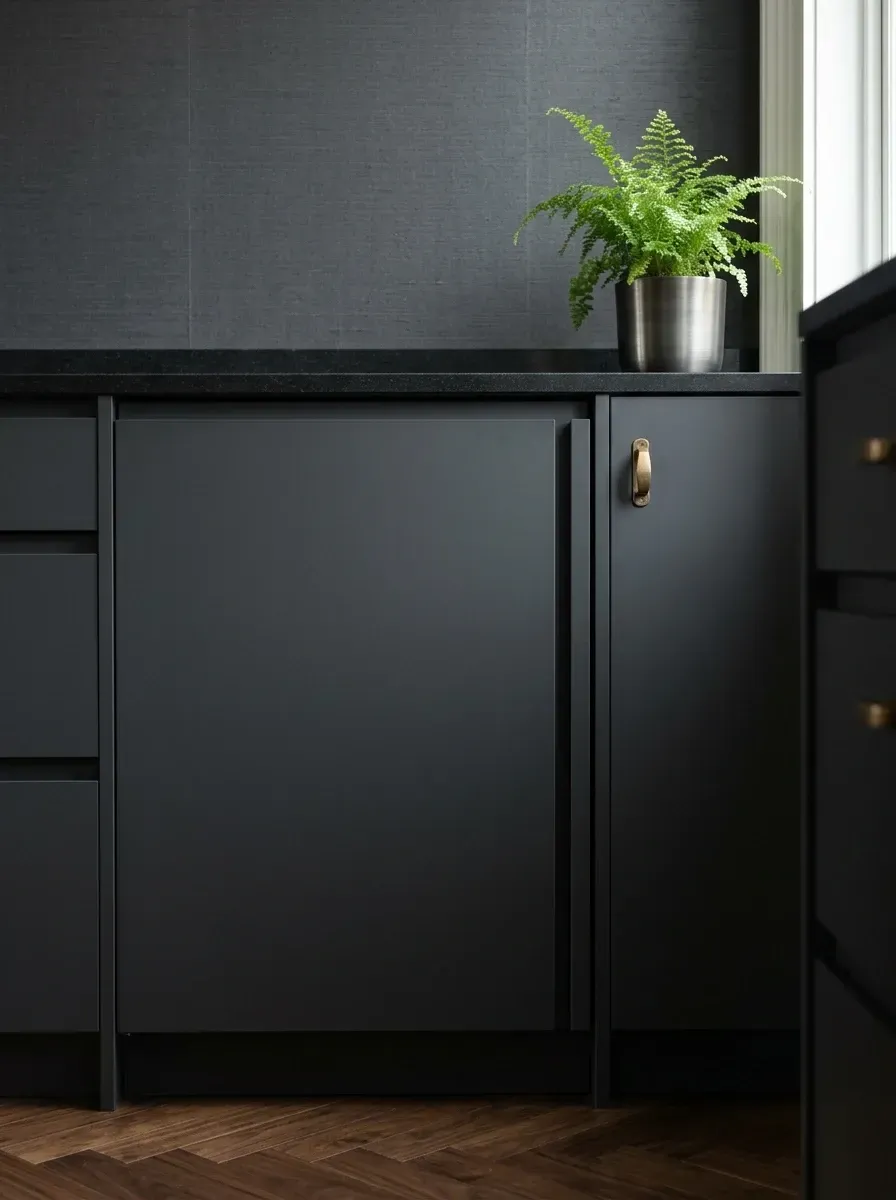
A detail study, not a full kitchen — and one that explains more about quiet luxury than most full-room shots. We're looking at flat-panel cabinetry in a matte dark grey, with a brass finger pull suggesting an integrated dishwasher or undercounter fridge. The success of this entire aesthetic rests on the reveal — the tiny, perfectly uniform gap between the appliance panel and the adjacent drawer fronts. If that gap varies by 1mm across its length, the integration reads as sloppy. If it's perfectly parallel across all 24 inches, the integration reads as architecture. There is no middle.
Plan-aware verdict: matte lacquer cabinets at this caliber run $800–$1,500 per linear foot installed. The brass finger pull is your only visible piece of hardware — pick something with weight (Sun Valley Bronze, Rocky Mountain Hardware, Armac Martin) rather than anything stamped or hollow.
Features
- Matte dark grey flat-panel cabinetry (lacquer or veneer)
- Integrated undercounter appliance panel
- Solid brass finger pull (single, statement)
- Black quartz or granite countertop
- Dark walnut herringbone floor
Cost Analysis (2026 Northeast)
| Decor Item (Qty) | Total Price Range |
|---|---|
| Custom Matte Lacquer Cabinetry (per linear ft est.) | $800 – $1,500 |
| Panel-Ready Undercounter Dishwasher | $1,000 – $2,200 |
| Black Quartz Countertop (per sq ft est.) | $70 – $120 |
| Brass Finger Pull Hardware (×1) | $30 – $80 |
| Total Estimated (Detail Vignette) | $1,900 – $3,900 |
Color Palette
Matte Charcoal Grey
#3C3F42
A 5-degree-sheen matte lacquer or PET foil over MDF — the material has to resist scuffing better than standard paint.
Absolute Black
#1C1C1C
Absolute Black granite (honed) or Caesarstone Jet Black quartz — the deepest blacks available in stone form.
Aged Brass
#B39A74
Solid bronze or unlacquered brass with weight — the only visible hardware in the room earns its specification.
Dark Walnut
#5C4033
American walnut in a herringbone layout, finished with a matte hardwax oil — the warmth that prevents the dark scheme from going funereal.
9. Scandi-Style Affordable Luxury
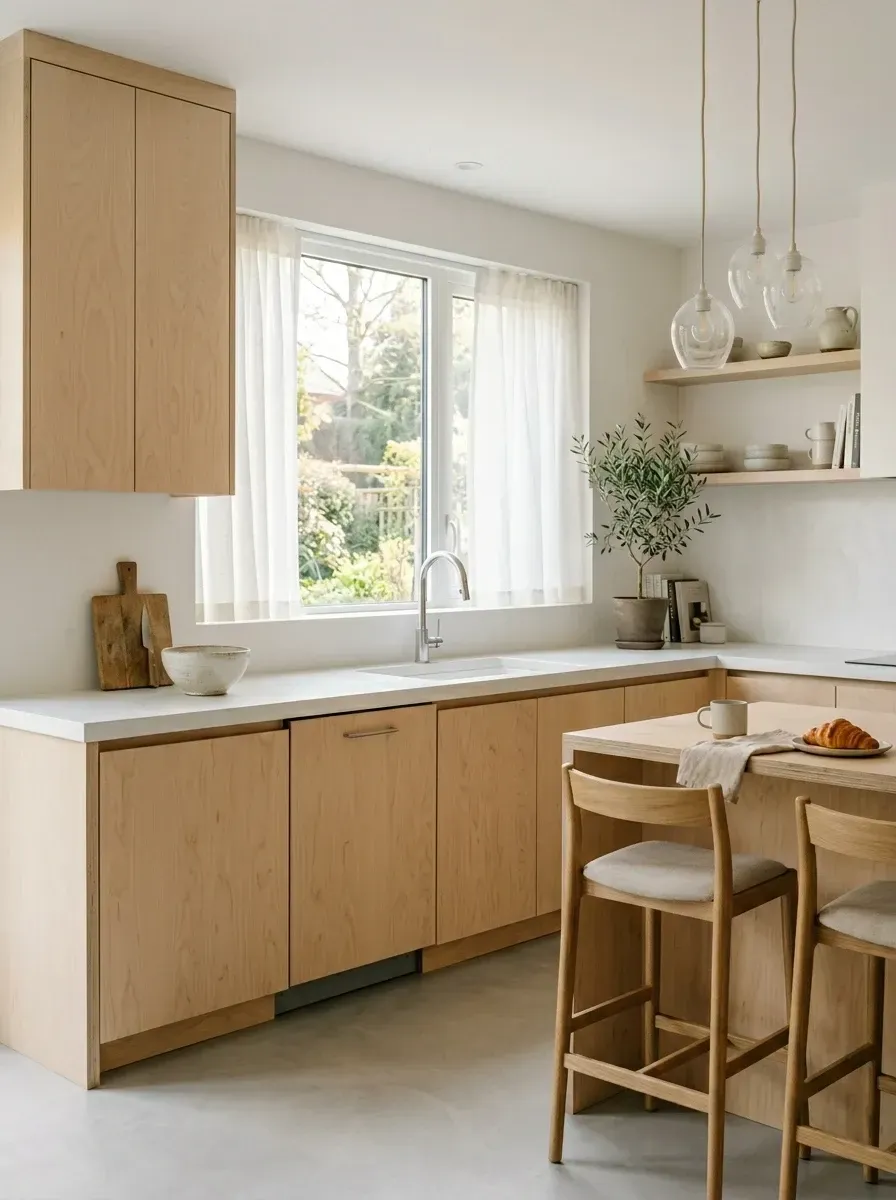
Quiet luxury without the imported-marble premium. This Scandi-leaning kitchen uses lighter, more affordable materials — birch or ash veneer rather than American walnut, Bosch panel-ready rather than Sub-Zero, thin Corian or quartz rather than Calacatta — and still achieves a high-end read because the integration discipline is the same. The dishwasher to the right of the sink is fully concealed behind a flat birch panel that reads as another cabinet door. By hiding the working appliance, the simple beauty of the wood grain becomes the focus, and the kitchen reads quiet at roughly half the budget of the walnut-and-marble alternatives.
Plan-aware verdict: this is the proof that quiet luxury isn't a finish budget. It's a planning discipline applied to whatever budget you actually have. Bosch 800 Series and Fisher & Paykel panel-ready dishwashers run $900–$1,500 and look identical to Miele once a custom panel is on them. The savings on the appliance buys you a better cabinet shop — which is what actually carries the look.
Features
- Light wood (birch or European ash) flat-panel cabinetry
- Integrated dishwasher panel (Bosch 800 / F&P DW24)
- Polished concrete or microtopping floor
- Thin white quartz or Corian countertops (2cm)
- Open timber shelving with iron brackets
Cost Analysis (2026 Northeast)
| Decor Item (Qty) | Total Price Range |
|---|---|
| Semi-Custom Light Wood Veneer Cabinetry | $15,000 – $25,000 |
| Panel-Ready Dishwasher (Mid-Range) | $900 – $1,500 |
| Thin White Quartz Countertops | $3,000 – $5,000 |
| Concrete Floor Overlay | $3,000 – $6,000 |
| Glass Pendant Lights (×3) | $450 – $1,200 |
| Wood Bar Stools (×2) | $600 – $1,400 |
| Total Estimated Cost | $22,950 – $40,100 |
Color Palette
Natural Birch / Ash Veneer
#E3D4BC
European birch or American ash veneer with a UV-cured matte topcoat — the airy backbone of the design.
Light Concrete Grey
#CFCFCF
Microtopping over plywood subfloor — far cheaper than poured concrete and visually identical at a 5-foot viewing distance.
Pure White Quartz / Corian
#FFFFFF
Caesarstone Pure White or Corian Designer White — pick the 2cm thickness, not 3cm, for the lighter Scandi profile.
Brushed Chrome / Steel
#A0A0A0
Subtle metallic finishes that blend rather than contrast — Hansgrohe Talis or Grohe Concetto faucet, simple bar pulls.
10. Deep Color Camouflage
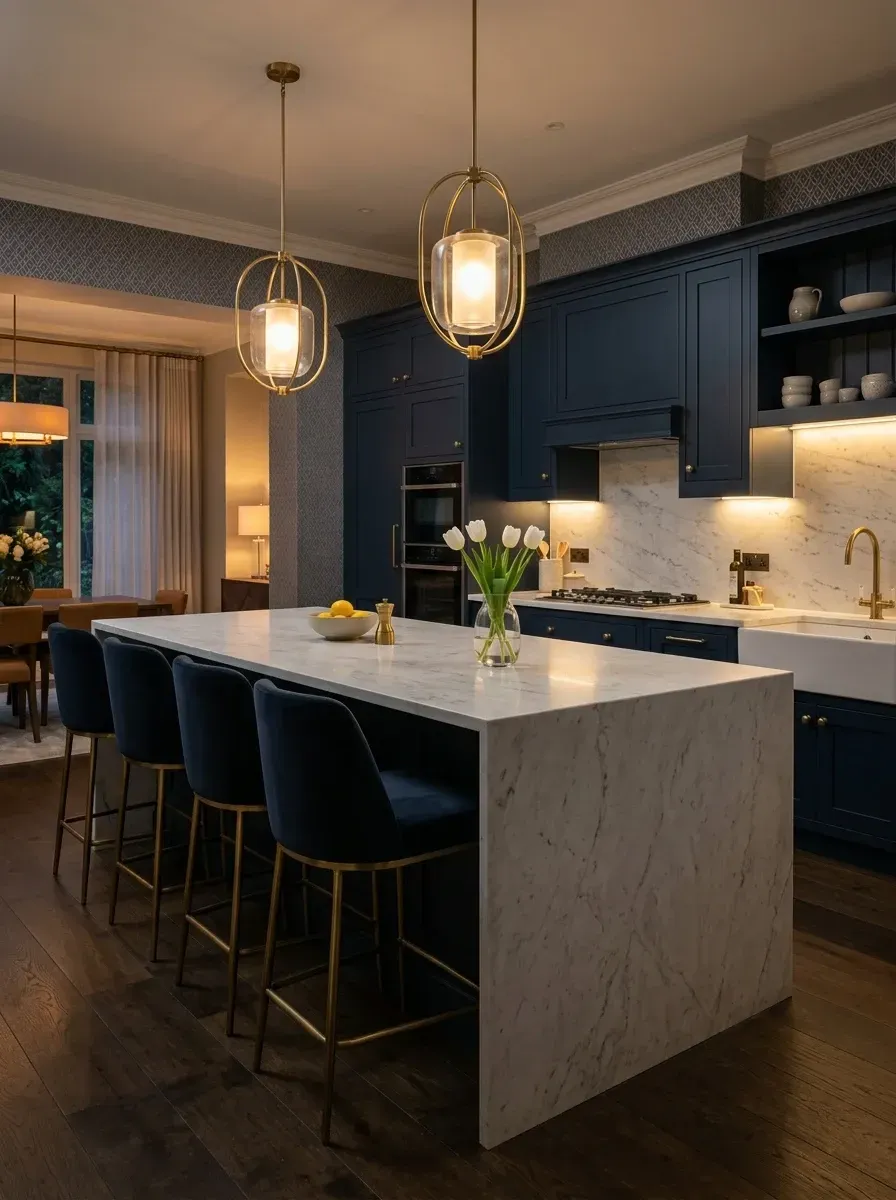
Color as integration tool. The deep navy paint absorbs the gap shadows around the integrated fridge columns flanking the ovens — where a white kitchen would cast hard dark seams that the eye reads as appliance edges, the navy makes those shadows blend into the field. The marble waterfall island carries the brightness load that the cabinets are deliberately rejecting. Polished brass on the hardware and pendants is the third leg of the palette, defining where the eye is supposed to land. This is the most expensive integration on the list because the cabinet volume is the largest and the marble fabrication is non-trivial.
Plan-aware verdict: navy and dark green are the two colors I most often recommend for hiding integration seams in shaker kitchens. They both absorb shadow well, both pair with brass cleanly, and both age more gracefully than charcoal grey (which can feel dated within five years). Hale Navy from Benjamin Moore is the workhorse spec.
Features
- Custom navy blue shaker cabinetry (full-perimeter)
- Integrated tall fridge / freezer columns flanking exposed ovens
- Marble waterfall island with full-height backsplash
- Polished brass hardware and lantern pendants
- Dark oak hardwood flooring
Cost Analysis (2026 Northeast)
| Decor Item (Qty) | Total Price Range |
|---|---|
| Custom Painted Navy Cabinetry (Large Volume) | $40,000 – $65,000 |
| Integrated Fridge & Freezer Columns | $14,000 – $22,000 |
| Marble Waterfall Island & Backsplash Fabrication | $15,000 – $25,000 |
| Brass Lantern Pendant Lights (×2) | $1,200 – $3,000 |
| Brass Cabinet Hardware Collection | $1,000 – $2,500 |
| Velvet Bar Stools (×4) | $1,600 – $3,600 |
| Total Estimated Cost | $72,800 – $121,100 |
Color Palette
Deep Navy Blue
#1B2F4A
Benjamin Moore Hale Navy (HC-154) is the classic spec; Farrow & Ball Hague Blue (No. 30) is the moodier alternative.
White & Grey Marble
#F0EFEF
Calacatta Gold or Cremo Delicato — the high-contrast brightness against deep navy is the design.
Polished Brass
#D4AF37
Visual Comfort or Urban Electric lanterns; Armac Martin or Buster + Punch hardware. Match the brass tone exactly across all pieces.
Dark Oak
#5B4332
Stained American oak in 5"–7" plank widths — warm enough not to chill the navy.
Pro Tips From the Renovation Designer's Chair
- The flush fallacy. Counter-depth doesn't mean integrated. Counter-depth fridges still protrude an inch or two past base cabinets and still have visible metal hinges. If you want true integration you need a "panel-ready" or "fully integrated" model with articulating hinges that swing the heavy custom door away from the cabinet face. Sub-Zero, Miele, Fisher & Paykel, and Thermador all make these. Standard counter-depth from any brand will not deliver the look.
- Budget the panel separately. The price of a panel-ready appliance does not include the panel itself. Your cabinet shop has to fabricate a matching door — same wood or paint, same profile, same edge detail — which adds $500–$1,500 per appliance plus install labor. Budget it as a line item from day one.
- Ventilation is non-negotiable. Integrated appliances have spec-sheet ventilation requirements — typically intake at the toe-kick and exhaust at the top. Cabinet shops that ignore the spec to "make it cleaner" will void the appliance warranty and shorten compressor life. Get the vent grille spec on the shop drawing.
- Reveal discipline is the make-or-break. The gap between adjacent doors and panels has to read as a perfectly uniform reveal — usually 3mm or 4mm — across the entire run. Cabinet shops without European-frameless experience (Blum, Häfele, Hettich hardware) will not deliver this. Get a sample door installed before the rest go in.
- Plan integration at framing, not finish. Wall-mounted faucets, recessed appliance panels, hidden ventilation, push-to-open hardware — all of it requires plumbing and electrical to land in specific locations during framing. Make these decisions on the shop drawings before the framer starts. Retrofit is twice the cost and never as clean.
- Pick your exposed appliances on purpose. The kitchens above that work best aren't the ones that hide everything — they're the ones that hide the storage equipment (fridge, freezer, dishwasher) and expose the cooking equipment (range, ovens, coffee system). Cooking is craft; storage is housekeeping. The aesthetic respects the difference.
Cost-Saving Moves That Don't Read as Cuts
- Mix your integration tiers. Hide the dishwasher (cheapest panel job, biggest visual win) and the wine column. Leave the range exposed as a focal point — a Wolf or BlueStar in stainless reads honest, not utilitarian. You'll capture 80% of the look at roughly half the integration cost.
- Bosch and Fisher & Paykel over Sub-Zero / Miele. Once a custom cabinet panel is on the front, a Bosch 800 Series panel-ready dishwasher and a Fisher & Paykel panel-ready fridge column read identical at a 4-foot viewing distance to their luxury-tier siblings. The Sub-Zero premium buys you a better cooling system and a longer warranty — both worth it long-term, but neither one visible in the kitchen.
- Stone remnants for the island only. If Calacatta or Statuario is out of budget for the full kitchen, use it just on the island — the most visible, most photographed surface — and use a quartz or honed limestone on the perimeter. The eye reads the island as the kitchen's stone.
- Semi-custom shaker over fully custom. A semi-custom line (KraftMaid Vantage, Decora Reserve, Wood-Mode Brookhaven) with a panel-ready appliance order looks indistinguishable from full-custom in 90% of installations and runs 30–40% less. Spend the saved budget on hardware, lighting, and counter material.
The Core Idea. A quiet luxury kitchen is not built with an open wallet — it's built with a planning discipline. The cabinet shop, the appliance spec, the ventilation route, and the reveal tolerance are all decided before drywall closes. Whatever's left of the budget after that is finish. If you start at the finishes and try to plan backwards from there, you don't get a quiet luxury kitchen — you get a kitchen that quietly fights its own integration.
Reader Questions on Integrated Kitchens
Are integrated appliances really more expensive than standard ones?
Yes — meaningfully. Panel-ready models typically run 20–40% more than the equivalent standard appliance from the same brand because of the heavier hinges, articulating door mechanisms, and modified cabinet-fit dimensions. On top of that, your cabinet shop has to fabricate the matching panel, which adds another $500–$1,500 per appliance plus install labor. A fully integrated 36-inch fridge column with a custom walnut panel can easily run $11,000–$14,000 installed, against $4,000–$6,000 for a high-quality standard counter-depth.
Will an integrated panel fridge stick out past the cabinets?
It should not, if planned correctly. True panel-ready integrated columns from Sub-Zero, Miele, Thermador, and Fisher & Paykel are designed to sit completely flush with standard 24-inch deep base cabinets. If they protrude, it's because someone specified a "counter-depth" model (which is shallower than standard but still proud of cabinetry) instead of a true integrated unit, or because the cabinetry cavity wasn't framed to the exact spec on the appliance install sheet. Always order the panel-ready fridge first and detail the cabinet around its dimensions, not the other way around.
Can any dishwasher have a cabinet panel attached to it?
No. You need a dishwasher specifically rated as panel-ready, which has heavy-duty hinges and adjustable spring counterweights designed to support the weight of a wood door (typically 8–15 pounds beyond the appliance's stock front). Attaching a panel to a non-rated dishwasher will overload the hinge mechanism and the door will sag and eventually fail. Bosch, Miele, Fisher & Paykel, KitchenAid, Thermador, and Sub-Zero/Wolf all offer panel-ready models — check the spec sheet for "panel weight" and "panel thickness" tolerances before ordering the door.
Are integrated appliances harder to repair?
Slightly — accessing the mechanics often requires removing the custom panel first, which adds 15–30 minutes to a service call. Reputable brands design their integrated lines for serviceability, so it's rarely a structural problem for a qualified technician. The bigger issue is finding a technician trained on the integrated line specifically; in the Hudson Valley and outer-borough NYC, Sub-Zero and Miele have factory-trained networks, but Bosch and Fisher & Paykel rely on independent appliance-repair shops that vary in quality. Confirm service availability in your zip code before you commit to a brand.
How much does a quiet luxury kitchen actually cost in 2026?
In the Northeast, expect a primary kitchen renovation in this aesthetic to land between $50,000 and $130,000+, depending on cabinet shop tier, appliance integration depth, and counter material. The Scandi-budget end (kitchen #9) lands near $25,000–$40,000. The walnut-and-marble or navy-and-marble end (#4 and #10) lands at $80,000–$130,000. The biggest single budget swing is cabinet shop choice — semi-custom versus fully custom is roughly a 30–40% delta on the largest line item in the project.
Is integration worth the extra cost on resale?
Conditionally. In the high-end Hudson Valley, Brooklyn, and Westchester market segments, a fully integrated kitchen is essentially expected at the $1.5M+ price point — exposed stainless reads as builder-grade and undercuts the listing. In the mid-market ($500K–$1M), integration adds perceived value but doesn't always recoup its full cost. If the renovation is for a long-term hold (10+ years), integration pays back in daily quality of life. If it's a 3-year flip, a high-quality standard kitchen with one premium fixture (a Wolf range, a Sub-Zero column) often hits a better cost-versus-value ratio than full integration.
Where to Read Next
If this guide was useful, the natural next reads across the network depend on where your renovation thinking is sitting. For more bath-and-kitchen integration studies, the kitchens and baths archive covers cross-format comparisons. For the broader plan-first thinking that underpins integration discipline, the design-mindset essay on the unconscious canvas is a good companion. And if you want the psychology of how integrated rooms shape daily living, the unseen architect covers the same ground at a higher altitude.
Sources & Further Reading
- Architectural Digest. Kitchen Trends That Will Be Huge. architecturaldigest.com
- Remodelista. Remodeling 101: Integrated & Panel-Ready Appliances. remodelista.com
- Angi. How Much Do Custom Cabinets Cost? angi.com
- Sub-Zero, Inc. Integrated Refrigeration Specification Manual. subzero-wolf.com
- Miele USA. Built-In Kitchen Appliance Installation Guidelines. mieleusa.com
- National Kitchen & Bath Association (NKBA). Kitchen Planning Guidelines and Industry Standards. nkba.org
- Blum / Häfele / Hettich. European Frameless Cabinet Hardware Specification Sheets.
- NAHB / Hanley Wood. 2025 Cost vs. Value Report — Kitchen Remodel ROI by Region. remodeling.hw.net
- U.S. Green Building Council. WaterSense Kitchen Fixture Specifications.
- Marble Institute of America (Natural Stone Institute). Care & Cleaning of Natural Stone Surfaces. naturalstoneinstitute.org

Nora Whitfield
Renovation Designer & Interiors Editor · Beacon, New YorkNine years of design-build renovation work across the Hudson Valley and the Northeast. Nora runs the Renovations, Room Guides and Renovation Mind desks — before-and-after studies, room-by-room design guides, and the long essays on why what we renovate matters.
More from Nora →
Reader notes