

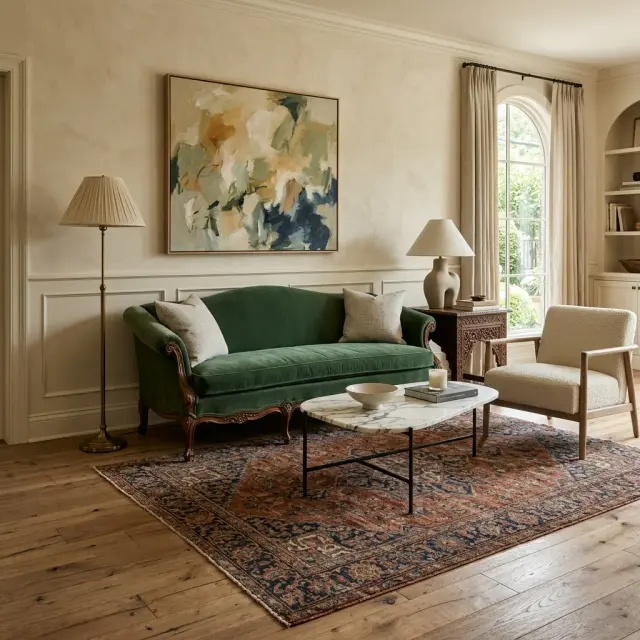
I have spent seven years walking Hudson Valley living rooms with the original construction documents under my arm, and the rooms that move me most are never the ones with the cleanest design language. They are the ones that hold a contradiction openly — a deep-green velvet sofa with carved walnut detail beneath a loose abstract canvas in ochre and indigo, traditional wainscoting wrapping a sculptural boucle chair, an organic marble coffee table on a worn Persian rug. Rooms like that are not eclecticism. They are the visible evidence of a quiet negotiation almost every homeowner runs through and rarely names — the conversation between the spatial identity you inherited and the one you are now choosing.
How I Read Inherited Rooms
When a client invites me into a house they grew up in or recently inherited, I do not start with paint chips. I start with the original floor plan and a long question — what was this room originally drawn to be, and what has it actually been used for in the decades since? The two answers are almost never the same. A parlor drawn for Sunday visitors is now where someone takes laptop calls at 11 p.m. A formal dining room sketched for sit-down meals is now a homework table. The plan tells me what the original architect thought; the wear pattern on the floor tells me what the family decided.
That gap between the drafted intent and the lived reality is where every inheritance question lives. The objects we choose to keep — the carved walnut sofa, the dining table that seats twelve, the brass floor lamp from a grandparent's hallway — are not random. They are decisions about which inherited rituals we still want to perform and which we are quietly retiring. My broader file on this work lives under The Renovation Mind, where I track the essays that try to name what otherwise gets called "personal taste" without examination.
1. The Psychology of Inherited Taste
Long before you chose your first sofa, your brain recorded a template for what home is supposed to feel like. Environmental psychologists have shown that aesthetic preferences are heavily shaped by the domestic environments of early childhood — the spatial layout, the quality of daylight, the dominant color palette, the tolerance for clutter, even the smell of old wood or cedar closet liner. These templates are not stored as conscious opinions; they sit deeper than that, encoded as felt senses of safety, order, restriction, or release.
If you grew up in a house where the living room was reserved for guests, you may feel a low-grade discomfort sprawling on a formal sofa for a Tuesday evening, or you may unconsciously recreate the same untouched formality in your own home and wonder why you never use the room. If the kitchen of your childhood was the social center of the house, you may struggle in a home where the kitchen is a galley closed off from family life. If your parents bought dark, durable furniture out of practicality, you may instinctively reach for the same heavy palette even when your current life would forgive lighter upholstery. None of this is moral failure; it is template recognition.
Inherited taste also carries a moral weight that we rarely admit. Families teach what is wasteful, what is tacky, what is proper. Class and cultural values get embedded into objects — into the kind of rug you find acceptable on a stair, the kind of chandelier you find too much, the kind of dishware you find appropriate for a Wednesday. When you walk into a room and feel an immediate sense of rightness or wrongness, you are not making a fresh aesthetic judgment. You are checking the room against templates you absorbed before you had the words to disagree.
2. The Tension Between Preservation and Autonomy
Adulthood brings the slow task of differentiation — building a self that is distinct from, yet still in relationship with, the family that raised you. The psychological labor of this is real, and our homes become the most visible stage on which it plays out. Many homeowners I work with carry a specific guilt — the discomfort of replacing a family dining table with one that fits the life they actually live, or painting over wood paneling that two generations considered untouchable. The guilt is not trivial. It is the struggle to honor lineage without being held captive by it.
The concept of differentiation of self from Bowen family systems theory maps onto this directly: the capacity to maintain emotional connection to family while holding distinct values and choices. A home is the material evidence of that capacity. When a client places a contemporary boucle chair beside a Victorian credenza they inherited from a grandmother, they are not just mixing styles. They are staging a conversation between loyalty and autonomy, and they are letting both speak. The most psychologically mature rooms I have walked into do not resolve that tension; they hold it. The credenza is allowed to remain credenza, and the boucle is allowed to remain boucle, and the room is the place where both belong.
3. The Hybrid Home as Self-Portrait
Picture again the room I described at the top — the emerald sofa with the carved walnut frame, the loose abstract painting in ochre and indigo above it, the boucle chair, the marble coffee table on the Persian rug. The traditional sofa is a statement about inherited respect for craftsmanship, formality, and permanence. The abstract canvas above it is a statement about the willingness to live with ambiguity and self-authored meaning. The contemporary furniture is a redefinition of comfort through organic, current materials rather than historical precedent. Together, these elements form a more accurate self-portrait than any single-era room could manage, because human beings are temporally layered. We carry nostalgia and aspiration at the same time.
The frequent mistake I watch homeowners make is trying to neutralize inherited pieces — repainting them, recovering them in safe contemporary tones, sanding the patina off — so they recede into a modern backdrop. The other mistake is the inverse: modernizing so aggressively that the room loses its roots and feels like it could be anyone's. Both miss the dialogue. The practical move is to treat contrast as conversation. A nineteenth-century Persian rug and a twenty-first-century marble table can share the same floor if they share material honesty — both made with integrity, both able to carry their own weight visually. The result is not a museum. It is a biography you can walk through.
4. The Emotional Weight of Objects
Every physical object in a home exerts emotional gravity, but inherited objects carry a specific density. The Persian rug under the coffee table may represent three generations of family history, or it may represent an aesthetic preference no one ever asked whether you shared. The challenge is distinguishing between emotional value and emotional obligation. Most organizational frameworks fail at this distinction because they treat objects as passive clutter to be sorted, rather than active psychological anchors to be honored or released.
A more useful question to ask of each inherited object: does this thing connect me to a memory I want to keep accessing? Does it represent a value I still share? Or does it function primarily as a guilt receptacle — kept because someone in the family would notice and judge if it disappeared? The exercise I run with clients is simple. We remove every inherited item from one room, then reintroduce them one by one, and I watch their body language. If their shoulders rise when the sideboard comes back in, that piece is enforcing an identity they may have outgrown. If their breathing eases when a particular lamp returns, that object is supporting who they are now. The goal is not minimalism. The goal is intentionality. Your home should be populated by objects that recognize you, not just objects you recognize from childhood.
5. Spatial Habits and Domestic Rituals
We inherit more than furniture. We inherit choreography — the way morning light gets greeted, where shoes are permitted, whether the kitchen table is for meals or for paperwork, which room is for guests only and which is for life. These are learned spatial rituals that become invisible defaults, and they are harder to notice than aesthetic preferences because they are procedural. You do not think about them; you just do them.
A client in Rhinebeck recently realized she had been preserving her formal living room as a "good room" for thirty years simply because her mother had. The room sat empty six days a week while the family crowded into a too-small den. Once she named the inheritance, she could choose differently — and she did. We rearranged the seating to face inward toward conversation, we put a lit candle and a stack of current books on the coffee table, we hung a reading lamp where it would actually get used. The room itself did not change much. What changed was permission. Reclaiming an inherited room for the rituals you actually have is one of the most powerful ways to rewrite a domestic script without touching the architecture. The plan stayed the same; the relationship to the plan shifted entirely.
6. The Architecture of Belonging
The built elements of the homes we grew up in — ceiling heights, hallway widths, window proportions, the depth of the porch overhang — shape an innate sense of shelter that follows us for life. Jay Appleton's prospect-refuge theory proposes that human beings need spaces that offer both protection and outlook in balance. The childhood home calibrates that balance for us. A childhood spent in small, low-ceiling rooms with heavy drapes may create an adult who craves open plan and curtain-free walls of glass — or, just as often, an adult who needs to recreate the same protected enclosure to feel safe.
The most resolved rooms I have walked into balance the two registers consciously. Traditional wainscoting and mouldings deliver the psychological refuge of structure and heritage; a tall arched window or a low reading nook delivers the outlook side of the equation. You do not need to renovate to achieve this. Furniture placement does most of the work — a turned armchair angled into a corner, a canopy bed framing the body, a sofa oriented toward the window rather than the television. The architecture of belonging is less about square footage than about whether a home lets you feel grounded and expansive in the same breath.
7. Curating the Transition
Integrating inherited identity with chosen identity is a practice, not a single decision. The tactics I use repeatedly with clients are concrete. The first is the one-honored-one-new principle — in any given sightline, pair a contemporary piece with an inherited one so that neither dominates the conversation. The second is neutral architectural backdrop. Warm whites, real plaster or skim-coated walls, honest wood floors give heritage and contemporary objects a common ground to share without competing for the wall behind them.
The third tactic is to reupholster and refinish rather than replace. A traditional sofa with good bones reads completely current in a deep performance velvet and a lighter, airier surrounding context. The frame is honest history; the surface is current life. The fourth is to literalize the dialogue on the walls — hang abstract or contemporary art in traditional gilded frames, or display ancestral portraits in thin, minimal profiles, so that the conversation is explicit rather than accidental. The fifth is to respect scale; a massive Victorian dining table can anchor a contemporary open kitchen if the chairs around it and the pendant above it speak in current material language. Finally, when mixing feels chaotic, zone by era — let one corner read as heritage, another as contemporary experiment, and let the eye understand the room as a curated timeline rather than a collision. None of these tactics dilute either identity. They give the room a readable order.
8. Sustainability and the Inherited Future
The most environmentally responsible piece of furniture is almost always the one that already exists. Inherited and antique pieces represent embodied carbon that is already in the world — the trees were already felled, the joinery was already cut, the upholstery foam was already poured. Restoring rather than replacing avoids a second round of manufacturing, shipping, packaging, and disposal. In an era of tightening sustainability standards, particularly across European interior practice, keeping and restoring heritage furniture is becoming an ethical position as much as an aesthetic one.
The renewed interest in brown furniture, real wood, and traditional rugs among younger homeowners is not pure nostalgia. It is a quiet rejection of disposable fast decor and the carbon footprint that comes with it. When a client decides to restore a grandmother's dresser rather than buy a flat-pack alternative, they are making a statement about the kind of inhabitant they want to be — one who values stewardship over convenience. This does not mean preserving objects in amber. The most interesting adaptive reuse projects I work on combine the inherited and the current openly: modern hardware on antique cabinetry, rewired vintage lamps with LED filament bulbs, a traditional rug grounding an otherwise spare contemporary room. The conversation shifts from what is trending to what is lasting.
9. When to Honor, When to Release
Inheritance is not the same as retention. Not every object handed down deserves a place in your daily life, and keeping something out of guilt turns a gift into a burden. Research on place attachment distinguishes between roots that nourish and roots that strangle. If an inherited china cabinet makes you feel like a tenant in your own dining room, it is not serving you. If a bedroom set from your childhood triggers associations with a household you spent years working to leave, its physical presence can reinforce neural pathways you are trying to outgrow.
Releasing such pieces is not disrespect. It is editorial clarity. The transition can be ceremonial if you need it to be — photograph the object, document its story for the family archive, pass it to a cousin who will actively use it, donate it to a Hudson Valley estate-sale specialist who will place it with someone who chooses it freely. Your home has limited physical and emotional bandwidth. Every object you keep occupies not just square footage but cognitive space. The best rooms I walk into feel chosen — every element present, none crammed in by obligation. Give yourself permission to be the final generation an object travels through, or the bridge that hands it on. Your primary loyalty is to the integrity of the space you currently inhabit, not to every material thread connecting you to the past.
10. The Home as Active Biography
A home is never a finished product. It is a document being written in collaboration with ancestors, culture, personal experience, and the version of yourself you are still becoming. The room I keep returning to in this essay — the emerald sofa, the abstract canvas, the boucle chair, the wainscoting, the marble — embodies that principle. Traditional architecture provides the structure of history; abstract art and contemporary seating provide the vocabulary of individual interpretation. Together they make a narrative, not a collision.
This is how I have come to read my own clients' homes — not as backdrops for performance but as active biographies that get edited, expanded, and annotated over years. The goal is not stylistic uniformity, which often signals a fear of complexity. The goal is psychological coherence — a home that holds both the values you were raised with and the values you are currently testing, and lets them sit in the same room without requiring one to win. The emerald sofa and the boucle chair do not need to agree with each other. They only need to agree to share the floor. In that sharing, they model what a mature identity looks like — one that respects its origins without being trapped by them, and one that embraces change without erasing what came before. Standing in your own living room, you are standing at the intersection of legacy and agency. What stays, what goes, and what is newly welcomed are decisions about which parts of your inherited self you are choosing to carry forward.
Pro Tips From the Renovation Designer's Chair
- Read the plan before you read the Pinterest board. The original construction documents — even county-assessor floor plans — tell you what the room was drawn to do. Half of the inherited-versus-chosen tension dissolves once you separate the architect's intent from the family's habit.
- Run the body-language audit. Remove every inherited object from one room and reintroduce them one at a time. Watch your own shoulders. If they tighten, that object is enforcing an identity you may have outgrown. If they settle, it is supporting who you are now.
- One-honored, one-new in every sightline. Pair a contemporary piece with an inherited piece in any direction the eye travels. Neither piece has to win; together they make the room coherent.
- Reupholster and refinish before you replace. A traditional sofa frame with good joinery, recovered in a current performance velvet, reads more sophisticated than anything you can buy new for the same money.
- Hang the contemporary art in traditional frames. The frame says heritage, the canvas says current. The friction is the whole point.
- Be willing to be the last generation. Not every inherited object needs to outlive you in your house. Releasing a piece with documentation, gratitude, and intention is not betrayal. It is editorial responsibility.
Reader Questions on Inherited Space
How do I tell whether an inherited piece is worth keeping or whether I'm keeping it out of guilt?
The test I use with clients is somatic, not intellectual. Remove the object from the room for two weeks and notice what the room feels like in its absence. If you find yourself missing it, that is a real signal — bring it back. If you find the room actually breathes easier, the piece was probably holding an identity you have outgrown. Guilt about family judgment is a separate decision from whether the object serves you. The two often masquerade as each other; the body usually knows the difference even when the head doesn't.
What's the difference between honoring family heritage and being trapped by it?
Honoring is an active choice — you keep the piece because you have actively decided it represents a value or memory you want to carry forward. Being trapped is a passive default — you keep the piece because nobody asked whether you wanted to, and removing it feels like a violation you don't have permission for. Honoring tends to feel like stewardship. Being trapped tends to feel like a low-grade resentment that surfaces every time you look at the object. Once you can name which one you're doing, you can choose differently if you want to.
How do I mix antique and contemporary furniture without it looking accidental?
Three rules I rely on. First, match scale — a Victorian dining table works with current chairs only if the chairs are proportionally honest, not undersized. Second, match material integrity — a real walnut credenza and a real marble table can share a room; a real credenza and a veneered laminate cannot. Third, give them a shared neutral architectural backdrop, usually warm white walls and a real wood floor, so the contrast reads as a deliberate conversation rather than a clash. If those three are right, the rest tends to find its way.
Why does my current home still feel like my parents' home even though I picked everything?
Because aesthetic preference is not the same as identity, and you may have replicated your parents' templates without realizing it — the same color tolerance, the same approach to formal versus casual rooms, the same procedural rules about what the living room is for. The fix is usually not to throw out what you have. It is to notice the templates first, and then decide consciously which ones you want to keep. The home doesn't change overnight, but the relationship to it does, and the next round of purchases starts being authored rather than inherited.
Can renters do this work, or does it require ownership and renovation?
Renters can do most of it. The architecture of belonging is more about furniture placement, lighting, textile choice, and ritual than about wall removal or wainscoting. A renter can orient seating toward conversation rather than the television, can layer warm-spectrum lamps over the harsh overhead, can reclaim a "good room" by putting current books and a lit candle in it, can release inherited pieces that no longer serve. The ownership question matters for major architectural moves; it does not matter for the psychological editing this essay is actually about.
Where do I start if I want to do this thoughtfully without overhauling everything at once?
Pick one room — usually the living room or primary bedroom — and start by listing every object in it, then marking each as either inherited, chosen, or default-purchased-without-thinking. The exercise itself is often clarifying; you may discover the room is 70 percent inherited and you never noticed. From there, work in slow editorial passes. Honor what is worth keeping, release what is functioning as guilt, and add one new piece that explicitly represents the current version of you. One room a season is plenty. The home is meant to keep being written.
Where to Read Next
If this essay resonated, the closest companion pieces in my Renovation Mind file are the silent storyteller, which decodes the everyday objects a home uses to tell on us, and the silent confessions, which examines what daily rituals reveal about the inner life of the household. Together with this piece, they form a loose trilogy on reading domestic space as biography.
Sources & Further Reading
- Jay Appleton, The Experience of Landscape, John Wiley & Sons, revised edition — the foundational text on prospect-refuge theory in environmental psychology.
- Murray Bowen, Family Therapy in Clinical Practice, Jason Aronson — the origin of the differentiation-of-self concept referenced throughout this essay.
- Christopher Alexander, Sara Ishikawa, Murray Silverstein, A Pattern Language: Towns, Buildings, Construction, Oxford University Press. patternlanguage.com.
- Sarah Susanka, The Not So Big House: A Blueprint for the Way We Really Live, The Taunton Press. notsobighouse.com.
- The Atlantic, Julie Beck, The Psychology of Home: Why Where You Live Means So Much. theatlantic.com.
- Architectural Digest, Designers on Mixing Antique and Contemporary Furniture. architecturaldigest.com.
- Remodelista, The Case for Brown Furniture and the Return of Heritage Pieces. remodelista.com.
- Ellen Bromberg-Bar Yam, Place Attachment and Identity: A Review of Environmental Psychology Research, Journal of Environmental Psychology.
- National Park Service, Preservation Brief 17: Architectural Character — Identifying the Visual Aspects of Historic Buildings as an Aid to Preserving Their Character. nps.gov.
- Furniture Industry Research Association, Embodied Carbon in Domestic Furniture: A Sustainability Assessment. fira.co.uk.

Nora Whitfield
Renovation Designer & Interiors Editor · Beacon, New YorkNine years of design-build renovation work across the Hudson Valley and the Northeast. Nora runs the Renovations, Room Guides and Renovation Mind desks — before-and-after studies, room-by-room design guides, and the long essays on why what we renovate matters.
More from Nora →
Reader notes