

A house is the longest piece of writing most people will ever produce, and the most honest. Walk into any Hudson Valley primary I've worked on — the Beacon farmhouse with the worn linen rug under the new oak coffee table, the Rhinebeck Cape with the velvet chair angled exactly twelve degrees off the window, the Kingston bungalow whose owner cannot explain why she keeps her grandmother's brass lamp on a shelf nobody sees — and you are reading a chapter draft. Every ceramic vase is a sentence. Every cabinet pull is a comma. The way you arranged the living room two Augusts ago, and then never moved it back, is the kind of self-portrait you only realize you've written when somebody else points at it. This essay is about learning to read the autobiography your house is quietly writing in your name.
How I Read a Room's Autobiography
The first time I noticed a house was reading me back to its owner was a Beacon weekend-house renovation in 2021. The client — a senior partner at a midtown firm — had asked for "a cleaner version of what's here." We walked the house twice before I understood what cleaner meant. Every horizontal surface in the place was holding two or three small objects: a folded handkerchief on the entry console, a glass jar of dried lavender on the kitchen sill, three river stones on the bathroom counter. Every one of them had been picked up from somewhere outdoors on a walk. None of them were arranged. They had landed where they landed. The autobiography the house was writing was: "I come here from the city to remember that I have hands and ground."
We didn't clean the house. We built shallow shelves the depth of those small objects, ran them along the walls of the rooms where the walks ended (entry, kitchen, bathroom), and let the objects keep landing. The renovation, in other words, listened to what the house had been quietly saying for years and made room for it. That is the read I am after when I walk a house with a client, and the eight sections below are the patterns the read tends to fall into.
1. The Psychology of Color — Your Emotional Palette
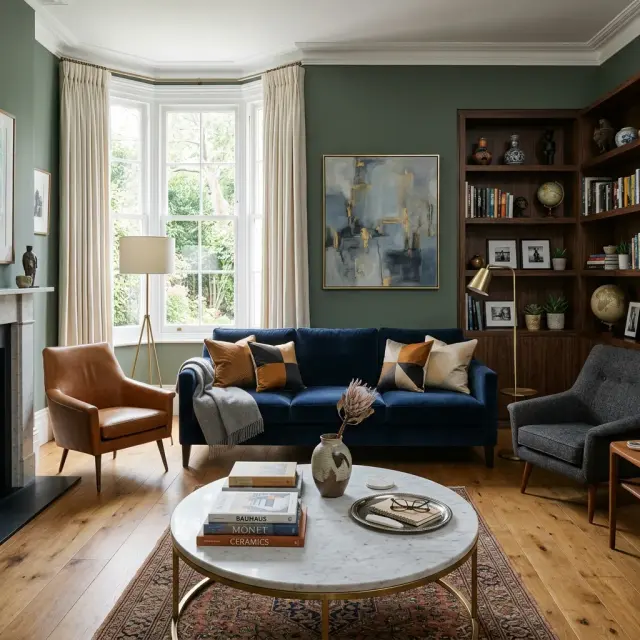
Color is the loudest sentence in any room's autobiography. A homeowner who has settled into forest green walls and a navy velvet sofa is writing inward: cocoon, introspection, library quiet. A homeowner who has chosen warm terracotta and saturated yellow is writing outward: kitchen warmth, conversation, southern light pulled indoors. Both are accurate self-descriptions; neither is more sophisticated than the other. The mistake is to think the question is "which color is better" rather than "which color is mine."
What I watch for in client conversations is the gap between the color a homeowner says they want and the color they actually return to in the moodboard. The Rhinebeck client who told me she wanted "warm and inviting" but kept dragging Farrow & Ball Down Pipe — a deep slate gray — onto her shortlist was, on a third pass, designing the cocoon she actually needed for her decompression hours. We painted three rooms Down Pipe and her dining room a warm muted clay (Benjamin Moore Audubon Russet HC-51) for the company she wanted to host on Sundays. Two colors, two different functions of the household, both true.
The diagnostic, again, is to sit in the room at the hour you most often occupy it and ask what the wall is asking your nervous system to do. The autobiography being written is biology before it is taste.
2. Curated Histories — The Narrative of Objects
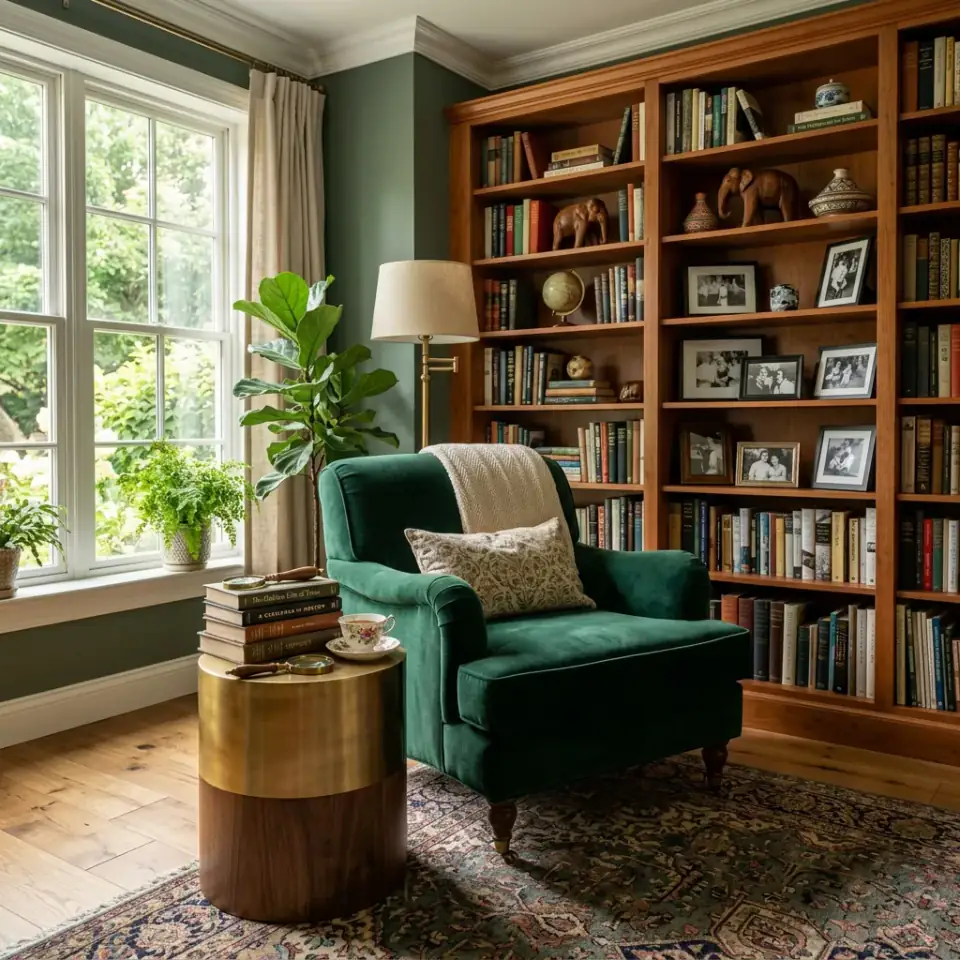
Your shelves are the manuscript pages. Every object on them is a sentence you have decided, by act of placement or act of neglect, to leave in the draft. The most revealing shelves are not the ones you arranged for guests; they are the ones near where you make morning coffee, or beside the chair where you read, or by the bathroom mirror — the shelves you have stopped consciously curating because they are part of your hand-to-eye day. Those are the shelves writing the truest autobiography.
In renovation work, I argue with clients about the objects they want to retire to a storage unit before the painters arrive. The grandmother's chipped ceramic dog. The husband's college-era brass lamp. The half-finished knitting project on the side table. All of them, in the client's logic, are clutter. In the autobiography logic, they are paragraphs the house has spent years writing. The Brooklyn brownstone client who let me keep a worn linen rug from her aunt under her new oak coffee table told me eight months later that it was the only thing in the room that made her cry in a good way. The rug had a paragraph. The new coffee table did not.
The distinction I draw with clients: a curated object earns its place by contributing to the story; a cluttered object accumulates because no story was being told. Audit the shelves. Keep what writes. Retire what merely fills.
3. The Comfort vs. Aesthetic Dichotomy
The most common renovation autobiography I read in the Hudson Valley is the gap between how a house looks and how it lives. A showroom-perfect living room with no visible signs of human use — no stack of magazines, no throw blanket in motion, no glass with a water ring on the side table — is writing one autobiography: "I would like to be seen as composed." A living room with a soft chair shaped to the body of the person who reads in it, a coffee table with a current book face-down on the surface, and a blanket abandoned where it was used last is writing another: "I live here, and I let the house show it."
Neither autobiography is wrong. The Manhattan client who keeps her Hudson Valley weekend house in showroom condition does so because the showroom condition is itself a form of weekend rest — the cognitive load of a perfectly composed room is, for her, the antidote to a chaotic workweek. The Rhinebeck farmhouse client who keeps her living room loose with throw blankets and books on every surface is, equally, resting in a different way. The renovation question is not which mode is right. It is whether the mode you are in is the mode you actually want to be in.
My field test: if a friend dropped by unannounced at the wrong hour, would you welcome the visit or hide from it? An honest answer to that question is more useful than any aesthetic survey.
4. Spatial Arrangement as Social Commentary
Where the seating faces in a room is the household's stated preference for what the room is for. Two armchairs angled toward a sofa with a coffee table at the center: this household optimizes for conversation. Three pieces of seating all facing a wall-mounted screen: this household optimizes for parallel-play in front of media. A reading chair pulled to the window with a small table within arm's reach and no second chair nearby: this household optimizes for solitary thinking, and is honest enough to admit it.
The autobiography here is about what the household has actually been doing in the room — not what it imagined doing when it bought the furniture. The Kingston primary I renovated in 2024 had been listed as "a great room for entertaining" by the realtor; in the actual life of the household, the room had been used by one parent and one teenager who never spoke in it because they were each on their own device on opposite ends of the sofa. We rebuilt the room as a divided space — one corner for the parent (an oversized armchair next to a window and a small table for tea), one corner for the teenager (a beanbag, a low table, a screen). Both occupants reported, six months in, that they ended up talking more, not less, because each had a defensible base from which to come out.
Open-plan vs. segmented is the macro version of the same question. The autobiography is honest about how the household actually distributes its attention across the day. Read it before you take down a wall.
5. The Tactile Experience — Texture and Emotional Regulation
Texture is the autobiography most clients underestimate. The reach toward a velvet chair after a long day, the wool throw kept on the sofa even in July, the linen tea towel preferred over the cotton one in the second drawer — all of these are tactile preferences the body has registered before the mind named them. A household drawn consistently to soft, plush, layered surfaces is writing an autobiography of physical nurture. A household drawn to sleek, hard, polished surfaces is writing one of cognitive clarity and emotional restraint.
In design-build practice, I push clients toward layering natural textures — rough white oak, woven jute, linen, leather, honed stone — for a reason that goes beyond style. These materials carry the biophilic response the synthetic ones cannot fake. A jute rug under a coffee table changes the room's chemistry on the soles of the feet that walk across it. A linen sheer at a window filters light into a different room than a polyester blackout does, even when both shade the same window at the same hour. The autobiography being written by a textured room is one of grounded, embodied living.
If your house is reading cool, polished, and emotionally restrained to you, and you wish it read warmer — the cheapest tactile intervention I know is to add one linen throw and one jute or wool rug per regularly occupied room. Within a month the household will be sitting differently in the rooms.
6. Lighting — Setting the Stage for Daily Scenes
The autobiography written by a house's lighting plan is among the clearest reads I do. A house lit only by overhead 4000K LEDs on a single switch is saying: "I have not yet decided what I want to be at different times of day." A house with layered lighting — table lamps, floor lamps, sconces, recessed cans, all dimmable, all 2700K at 90+ CRI for evening hours — is saying: "I know that I am a different person at 7 in the morning than I am at 9 at night, and I have built the room to honor both."
The Beacon client whose lighting plan I most enjoyed writing was an empty-nester who used the same room as a morning yoga space and an evening reading space. We built three lighting scenes: 4000K bright morning (for the cold-month yoga sessions before dawn), 3000K mid-day (for daylight work at the desk in the corner), and 2200K evening (for the reading chair by the lamp). Three scenes, three switches, three biological tasks. The room did three jobs without changing a single piece of furniture.
If your house writes one lighting scene for every hour of the day, the autobiography is flat. Add dimmers and table lamps. The household reads richer almost immediately.
7. The Evolution of Style — Reflecting Personal Growth
Houses that hold up well over a decade tend to read as layered, not as renovated. The first-apartment hand-me-down chair that survived three moves and is now reupholstered in a better fabric beside a new oak coffee table is the kind of paragraph that gives a room temporal depth. A house entirely furnished from one Pottery Barn or West Elm catalog reads as published — competent, well-styled, ahistorical. A house furnished across decades reads as written — uneven in spots, deeper in others, accumulating meaning.
The renovation move I most respect is the strategic mix: one inherited piece per generation, one current piece per recent decade, and the rest filled in with material that holds up (white oak, honed stone, linen, leather). Five years post-renovation, the rooms with that mix are the ones I want to photograph again. The rooms entirely furnished new in the renovation are the ones the household has already started replacing.
If you are tempted by a wholesale style swap — modern farmhouse to quiet luxury to organic modern in five-year cycles — the autobiography you are writing is one of search rather than settling. There is nothing wrong with the search; some lives are searches. But the houses that read as homes are usually the houses where the search has, at least for now, come to rest.
8. Minimalism vs. Maximalism — A Mindset Manifested
Minimalism and maximalism are not aesthetic choices; they are cognitive ones. A minimalist room is the autobiography of a mind that thinks better when the field of view is uncluttered. A maximalist room is the autobiography of a mind that thinks better when the field of view is loaded with referenced objects. Both are legitimate cognitive styles. The mistake is to adopt the wrong one out of trend-following.
The Hudson Valley clients who land in minimalism honestly are the ones who report, at six months post-renovation, that they feel less anxious when they walk in the door — the room had been processing a tax on their attention that they hadn't named. The clients who land in maximalism honestly are the ones who report that the room finally feels like them — the previous minimalist phase had been a performance, not a fit. Both reports are common. Both are correct.
The diagnostic is to ask, at the end of a long day, which kind of room actually rests you. The honest answer is rarely the one your social-media feed is pushing. Build for the honest answer.
Field Notes From the Renovation Designer's Chair
- Read the small-object shelves first. The shelves you stopped consciously curating are the ones writing the truest autobiography. Begin there before you decide what the renovation should preserve.
- Keep one piece of inherited furniture per generation. Temporal depth is the quality renovations cannot manufacture from new purchases. The grandmother's brass lamp earns its place.
- Audit the gap between the room's look and its use. If a room you photograph well is a room you avoid living in, the autobiography is not yet honest. Adjust toward use.
- Reorient seating toward people, not toward screens. The single highest-return social move in any living room renovation is to put the screen on a secondary wall and the seating in sociopetal conversation.
- Layer textures across every regularly occupied room. Linen + jute + wool + honed stone + oiled wood. Five textures in one room reads richer than three of any single one of them.
- Three lighting scenes per room, three switches. Morning bright, mid-day functional, evening warm. The autobiography written by three switches is denser than the one written by one.
- Resist wholesale style swaps. A house rewritten end-to-end every five years reads as restless. Edit, layer, accumulate — but rewrite only when the autobiography has genuinely changed.
Reader Questions on Home Decor Autobiography
What if my house's autobiography embarrasses me when I read it honestly?
It probably shouldn't. The version of yourself the house records is usually the version that has been doing the actual living — not the version you present at work or on social media. A house that reveals a quieter, less ambitious, more domestic person than you think you are is not a failure; it is a more honest portrait than the resume version. The renovation move worth making is to bring the public-facing version of yourself closer to the household-private one, not the other way around. Most of my Hudson Valley clients who renovate toward their public persona end up undoing the work within three to five years. The ones who renovate toward the private read sit in their houses longer and more comfortably.
How do I distinguish between an object that's "writing" my autobiography and one that's just clutter?
Apply two tests. First: would you actively choose to keep this object today if it were not already in your house? If yes, it's writing; if no, it's surviving. Second: does the object create a small moment of recognition or memory when you see it, or does it pass through your field of view unnoticed? Writing objects create the moment; clutter objects don't. The two-test pass-rate in most Hudson Valley primaries I walk is roughly 30 to 40 percent — meaning two-thirds of visible objects are passively accumulating rather than actively contributing. Retiring the bottom 50 percent of any room's object inventory rarely produces loss; it produces the relief of a clearer narrative.
Does this autobiographical framing apply to a rental I don't own?
Yes — sometimes more clearly, because rental constraints force the household to express itself through the few changes it can make. Renters in my Brooklyn brownstone client network often have more honest autobiographies in their rooms than owners do, because they have only soft moves available: rugs, lighting, textiles, art, plant choices, furniture arrangement. The hard moves — wall color, flooring, cabinetry — are out of reach, which means the soft moves carry the whole narrative weight. A thoughtful rental can read richer than a poorly-renovated owned home. Don't equate ownership with authenticity.
Can a couple share one autobiography in a home, or are there always two?
In practice, every cohabiting household carries at least two autobiographies in the same set of walls, and the renovation question is how the rooms negotiate between them. The healthiest homes I read are ones where each occupant has at least one defensible base — a chair, a corner, a shelf, a room — that is unambiguously theirs, plus shared rooms that read as a true average of both. Forcing one autobiography to dominate produces resentment in the other; forcing a fifty-fifty blend in every room produces a house that reads as neither person's. Defensible bases plus shared common ground is the formula that holds up across decades of cohabitation.
How often should the home decor autobiography be updated?
Continuously, in small edits. The healthiest pattern I see is a household that swaps in or retires a handful of objects every season, paints one room every two to three years, and reconsiders furniture arrangement at major life transitions (new child, departing teenager, retirement, bereavement). The unhealthy pattern is the wholesale rewrite every five years — same household, completely different aesthetic — which usually indicates that the rewrites are searching for a self the household has not yet found. Edit small; rewrite rarely. The autobiography accumulates meaning across decades of small edits in a way it never does across five-year-cycle gut renovations.
What's the most common dishonest autobiography my house might be writing without my knowing?
The most common one I read is the "Pinterest-aspirational" autobiography — a house that has been styled to look like a magazine spread the owner saved during a stressful month, without regard to how the household actually lives. The signs are: showroom-condition living rooms with little visible signs of use; identical decorative objects (set-of-three vases, paired books, color-coordinated coffee table books) that read as styled rather than collected; absence of any inherited or temporally-deep object; lighting that photographs well but feels harsh in person. The fix is rarely to gut the styling. It is to add the missing biography — one inherited object per generation, one current object per recent year, one piece of evidence of the actual hand-to-eye life the household lives.
Where to Read Next
Three companion reads from The Renovation Mind on Renovate and Plan walk the same territory from different angles: my silent autobiographer essay covers the unconscious side of the same question; my silent storyteller essay treats decor as language; and my inheritance of space essay traces what your home archives about who raised you. The full Renovation Mind category collects the rest of the reflective work on the site.
Sources & Further Reading
- Edward O. Wilson, Biophilia (Harvard University Press, 1984) — foundational argument for an innate human affiliation with living systems, referenced in the texture section.
- Robert Sommer, Personal Space: The Behavioral Basis of Design (Prentice-Hall, 1969 and subsequent editions) — origin of the sociopetal/sociofugal layout distinction.
- Terrapin Bright Green, "14 Patterns of Biophilic Design" — working framework for biophilic specification across material and sensory patterns.
- Sally Augustin, Place Advantage: Applied Psychology for Interior Architecture (Wiley, 2009) — comprehensive reference on environmental psychology applied to residential and commercial interiors.
- U.S. Department of Energy, Building America Program, Residential Lighting Research — for circadian-rhythm-aligned lighting guidance referenced in the lighting section.
- Lighting Research Center at Rensselaer Polytechnic, Circadian Light Research Library — for color-temperature and biological-effects-of-light citations.
- Center for Health Design, Trauma-Informed Design Reference — for the residential application of trauma-informed design principles.
- Architectural Digest, Residential Design Archive — visual reference for the curation and texture patterns discussed.
- Remodelista, Slow-Living Home Design Sourcebook — companion reference for the layered-over-time aesthetic argued in the evolution-of-style section.
- Old House Journal, Historic House Object Archive — for the inherited-object framework referenced in the curated histories section.

Nora Whitfield
Renovation Designer & Interiors Editor · Beacon, New YorkNine years of design-build renovation work across the Hudson Valley and the Northeast. Nora runs the Renovations, Room Guides and Renovation Mind desks — before-and-after studies, room-by-room design guides, and the long essays on why what we renovate matters.
More from Nora →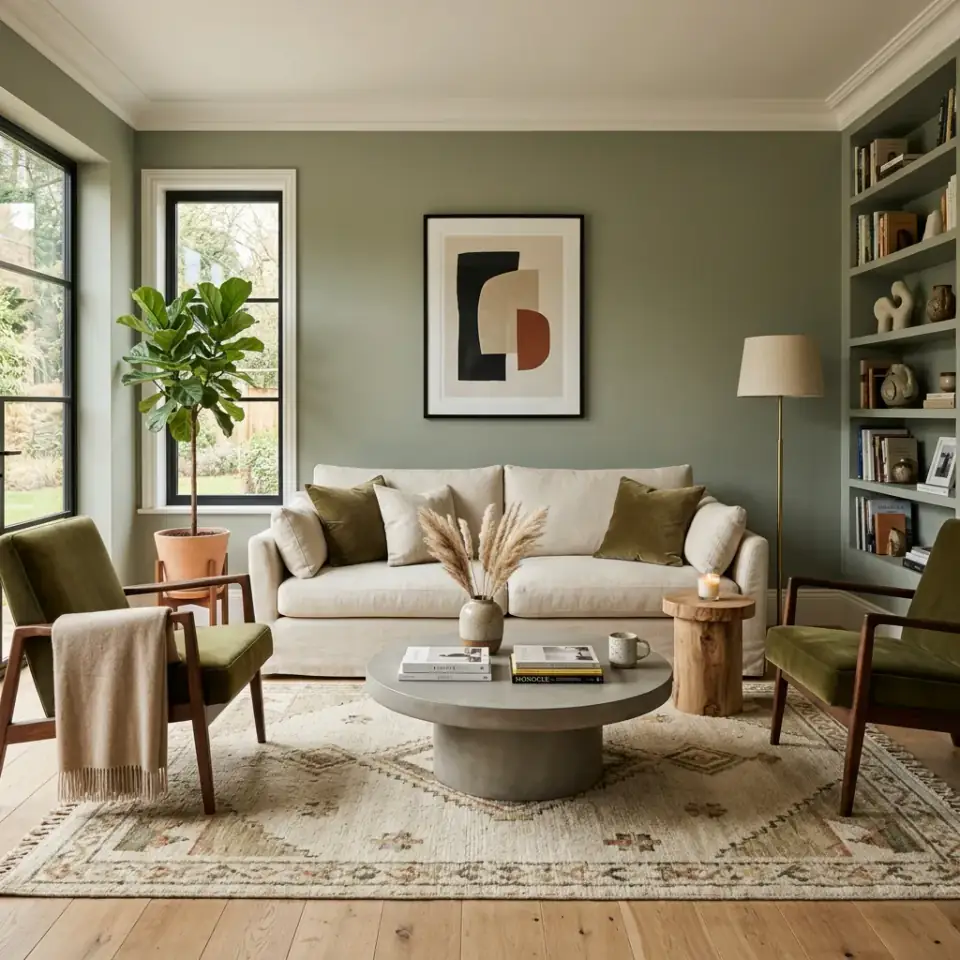
Reader notes