

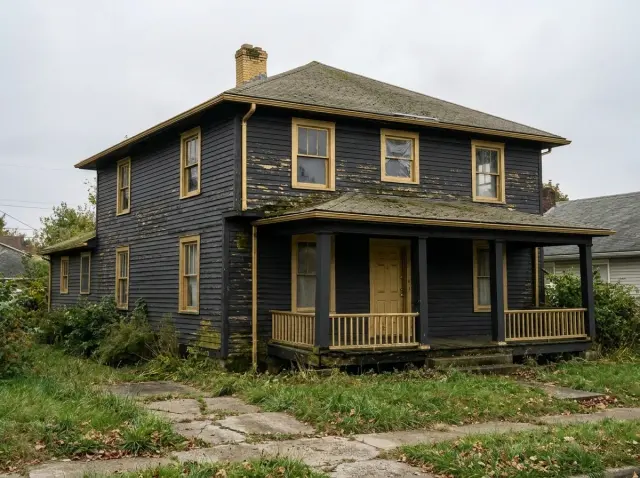
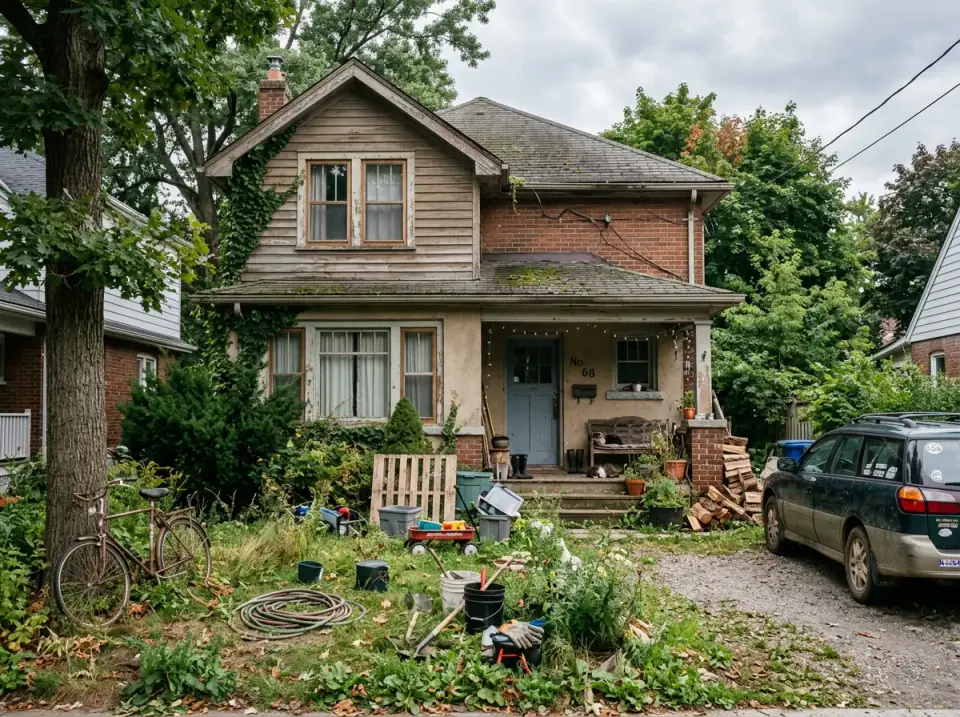
I took a single neglected American Foursquare and ran it through nine exterior treatments — Craftsman, moody rustic-modern, stucco contemporary, cedar desert-modern, Scandi, industrial barn, modern farmhouse, all-black, and coastal shingle. Here's the thing a plan-literate eye notices first: the box never moves. The hipped roof, the two-and-a-half-story massing, the porch footprint — all fixed. Every one of these reveals is a cladding, color, porch, and landscape decision laid over the same envelope. That's not a limitation, it's the actual reality of an exterior renovation. You rarely move a roofline. You re-skin what's there with intent. Here's how each style reads, and what I'd check before committing.
How I Read an Exterior Makeover
When a Foursquare like this lands on my desk, I read the envelope before I read the style. The massing is the given — a boxy, hip-roofed, four-room-over-four-room form you find all over the Hudson Valley and the Northeast streetcar suburbs. None of these nine reveals changes that box, and that's exactly why they're realistic. Re-cladding, repainting, re-roofing, and re-landscaping are the moves a real homeowner can actually fund. Moving a roofline or pushing out a wall is a different project — structural, permitted, and five times the budget. So the honest read of this gallery is: one fixed plan, nine finish-and-material studies.
That reframe matters because it tells you what's a paint job and what's a building project. A color change is a weekend with a sprayer. New siding is an envelope project that should fold in air-sealing and house-wrap while the old cladding is off — the smartest time to improve the wall assembly. A stone-veneer base or a standing-seam roof is its own trade and its own line item. I apply the same sequence I use on every one-house-many-styles study I publish: confirm the envelope, then siding, then roof and windows, then the porch, then the landscape. Read in that order and the nine styles below stop looking like magic and start looking like decisions.
1. The Classic Craftsman Revival
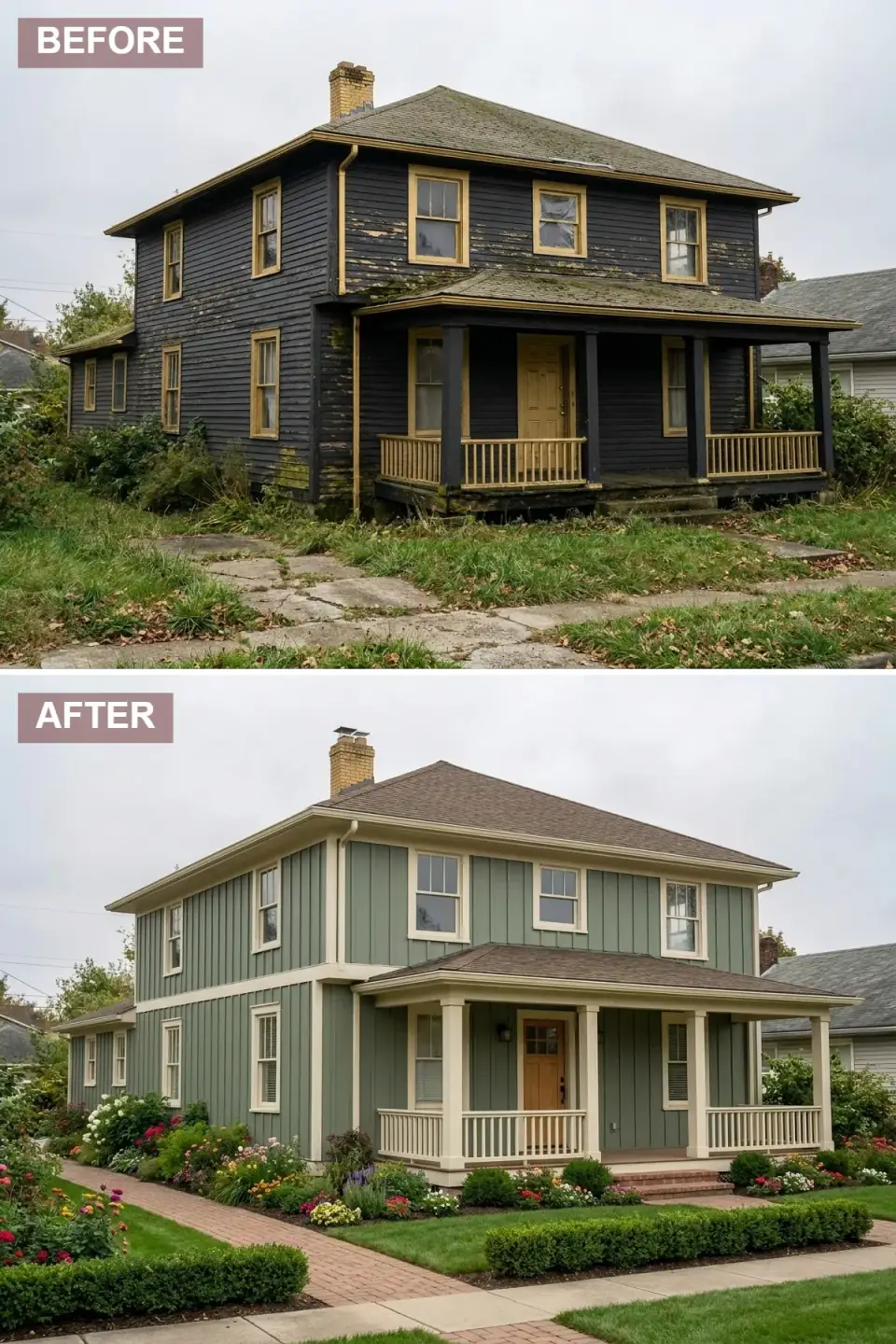
The neglected near-black exterior becomes a warm sage-green facade that mixes board-and-batten and clapboard, with crisp cream trim framing the restored windows and porch. Substantial tapered columns and a traditional railing rebuild the porch's authority, a wood front door adds warmth, and a winding brick path through layered planting completes the welcome. Of the nine, this is the one most faithful to what a Foursquare actually wants to be.
That's the plan-aware point: the Foursquare and the Craftsman era overlap, so this revival works with the architecture instead of against it. Mixing two siding profiles is a genuine design move, but specify it as one system — James Hardie does both board-and-batten (Hardie Panel with battens) and clapboard (HardiePlank) in matched ColorPlus finishes, so they age as a unit rather than fighting each other. Those columns are the detail people cheap out on; a Foursquare porch carries roof load, so the column has to be structural, not a hollow wrap slipped over a skinny post. Get the column proportion right and the whole facade reads correct.
Color Palette
Sage Green
#7F8C72
Read it as Benjamin Moore Saybrook Sage HC-114 or SW Evergreen Fog — a period-correct, grounding green
Creamy Off-White
#F2E8D5
BM White Dove or Navajo White — a warm trim that softens the green without going stark
Medium Oak
#B07B48
A stained wood or fiberglass door (Therma-Tru Mahogany) plus a porch-grade floor finish for warmth
Classic Red Brick
#9C5646
Clay pavers on a compacted base — set them below frost-prone soil with edge restraint to resist heaving
2. The Moody Rustic-Modern Update
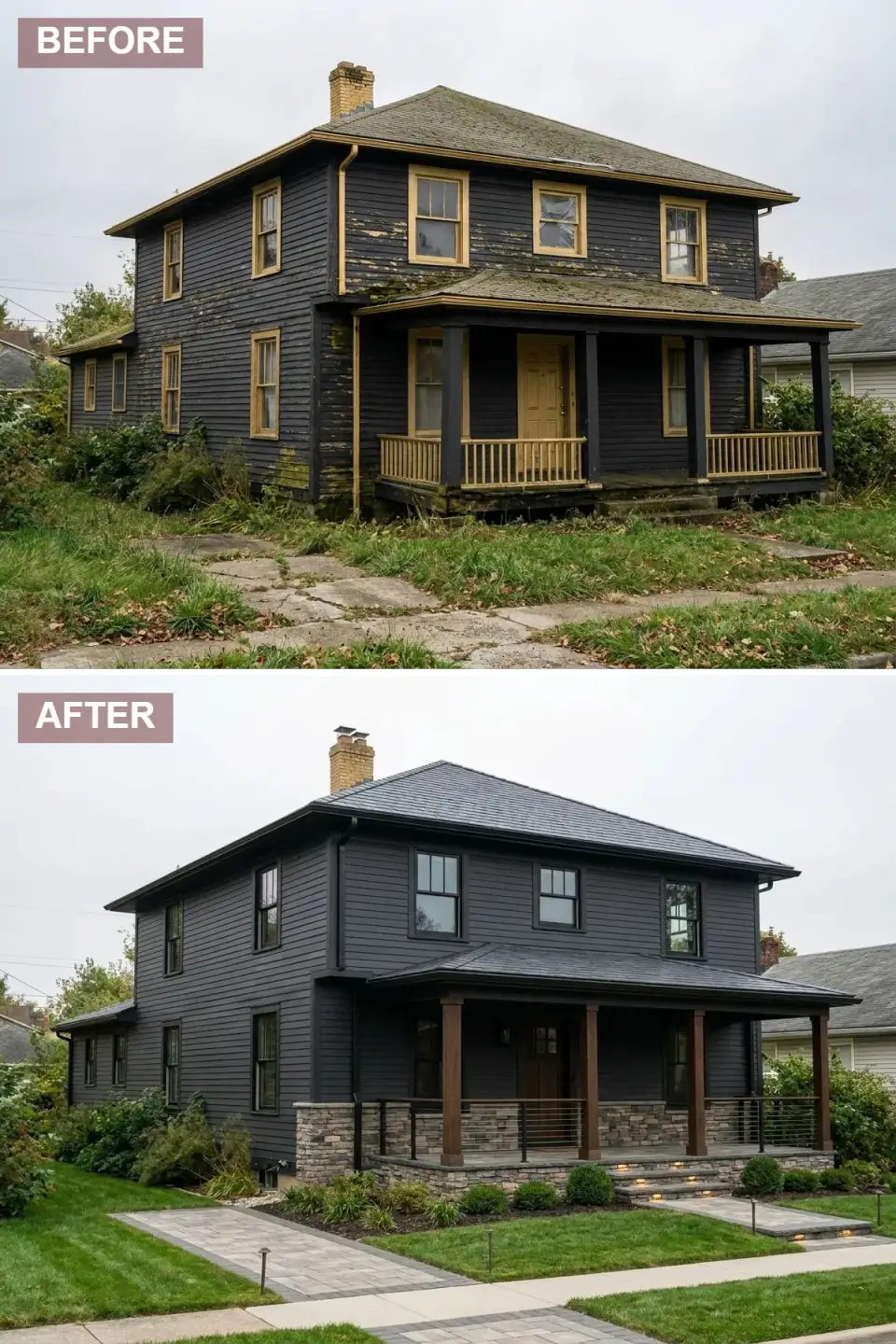
This one goes dark and tactile: charcoal-grey siding, a stacked-stone veneer on the foundation and porch skirting, dark wood columns, a sleek cable railing, and integrated lighting in new paver steps. The stone adds visual weight at the base — exactly where a tall Foursquare benefits from it — and the cable railing modernizes the porch without fighting the dark palette. It's a sophisticated read that still feels grounded.
The stone veneer is the detail with a building science footnote. Adhered manufactured stone (Boral, Eldorado) needs a proper drainage plane and a weep screed at its base, or moisture gets trapped behind it — a real failure mode in our freeze-thaw climate, not a theoretical one. Installed right, it's beautiful and durable; installed against bare sheathing, it's a callback in three winters. The cable railing carries the same caution I give on every porch: end posts take the tension load and must be structurally anchored. And those lit paver steps want their low-voltage wire run before the pavers are set — chasing it afterward means lifting finished hardscape.
Color Palette
Charcoal Grey
#363636
BM Kendall Charcoal HC-166 or Iron Mountain 2134-30 — spec it in Hardie ColorPlus to hold against fade
Earth Tone Stacked Stone
#7A7065
Boral or Eldorado adhered veneer over a drainage plane with a weep screed — never directly on sheathing
Dark Walnut
#4A3425
Stained cedar or a structural post in a dark walnut tone — rich against the charcoal field
Matte Black
#1A1A1A
Black cable railing and black-clad windows (Marvin Essential, Andersen 100) for a sharp finish
3. The Sleek Contemporary Stucco
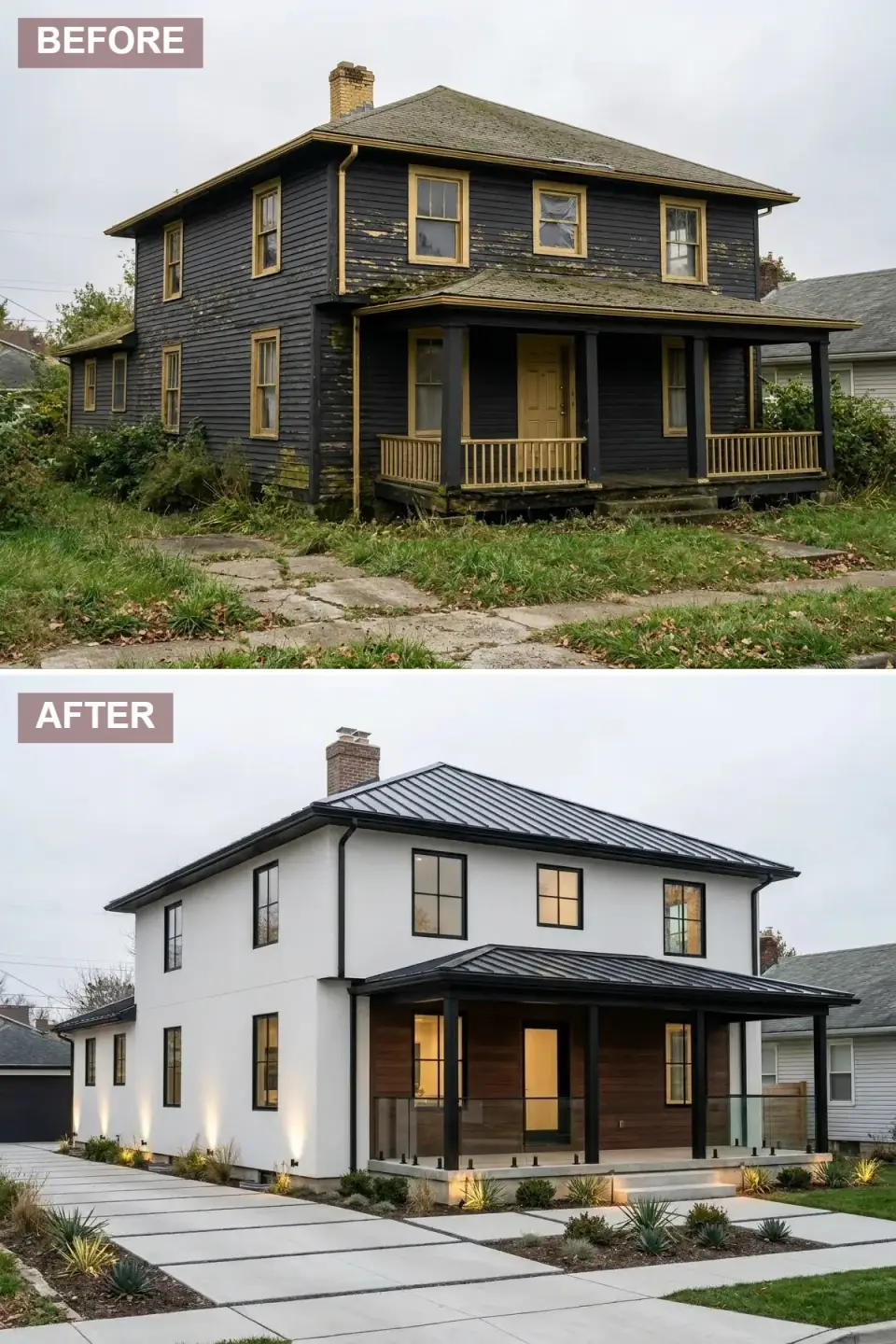
The biggest departure from the original: smooth white stucco walls against a black metal roof and black window frames, a dark wood accent wall behind the porch, and a glass railing. A concrete-paver walkway with gravel joints and architectural planting finishes the minimalist look. It's crisp, graphic, and the furthest the Foursquare travels from its roots — which is exactly why I'd pump the brakes a little here.
Stucco is a Southwest and California native, and in the wet Northeast it has to be detailed carefully or it becomes a moisture trap. If you go this route, specify a rainscreen application — traditional three-coat over a drainage mat and two layers of building paper, not EIFS slapped on sheathing, which has a long litigation history in damp climates. The glass railing is an engineered system with a specified glass thickness and tested anchoring; you don't freelance it. The black metal roof, by contrast, is a genuine upgrade in any climate — a standing-seam roof sheds snow and lasts fifty years, which is real value on a Hudson Valley winter exposure.
Color Palette
Clean White Stucco
#F5F5F5
Integral-color three-coat stucco over a rainscreen — BM Chantilly Lace tone if finish-painted
Dark Wood Plank
#4E3B31
Thermally modified ash or stained cedar cladding — the warm focal point against all that white
Black
#111111
Standing-seam metal roof plus black-clad windows — high-contrast, graphic, and genuinely durable
Poured Concrete Grey
#ADA9A3
Large concrete pavers with gravel joints — control-joint the slabs against our freeze-thaw cracking
4. The Warm Desert Modern
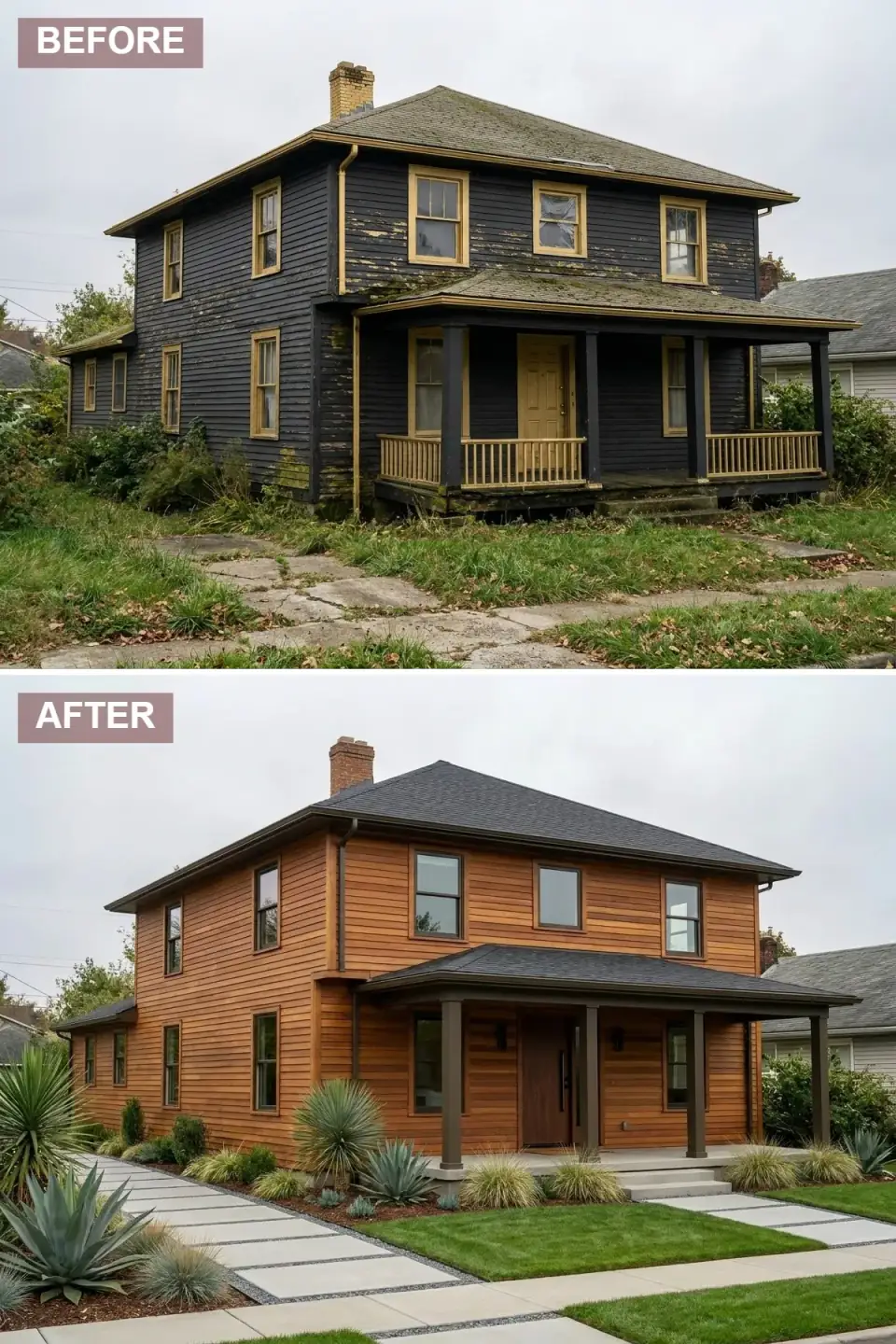
Here the whole box gets wrapped in warm horizontal wood siding, with dark brown trim and columns drawing the architectural lines and black windows adding a modern edge. The landscape goes desert — sculptural yuccas and agaves alongside a concrete-and-gravel walk. The wood wrap is genuinely striking and modern, and on the Foursquare's tall flat planes it reads beautifully. The landscaping, though, is where my Hudson Valley reality check kicks in.
Full wood cladding is a commitment: real cedar needs a UV-stable finish or it silvers unevenly, so I'd push clients toward thermally modified wood (Arbor Wood, Kebony) or a pre-finished system that holds tone through our seasons. The desert planting, on the other hand, mostly won't survive here. Agave is not hardy below zone 8 — it turns to mush in a Northeast winter. If you love the sculptural look, the hardy stand-ins are Yucca filamentosa 'Color Guard' (good to zone 4), blue oat grass, and Russian sage, which give you the same architectural silhouette without an annual replanting bill. Borrow the desert-modern composition; ground it in plants that overwinter.
Color Palette
Natural Cedar
#B87F54
Thermally modified wood (Arbor Wood, Kebony) over real cedar — holds tone and resists our humidity swings
Dark Brown
#3E2F26
A deep espresso-brown trim that frames the warm field and reads as the structural line
Black
#000000
Black-clad windows (Marvin, Pella) — the modern counterpoint that keeps the wood from reading cabin
Light Concrete
#CFCFCF
A clean light-concrete walk that lets the wood and architectural planting carry the scene
5. The Organic Scandi-Craftsman
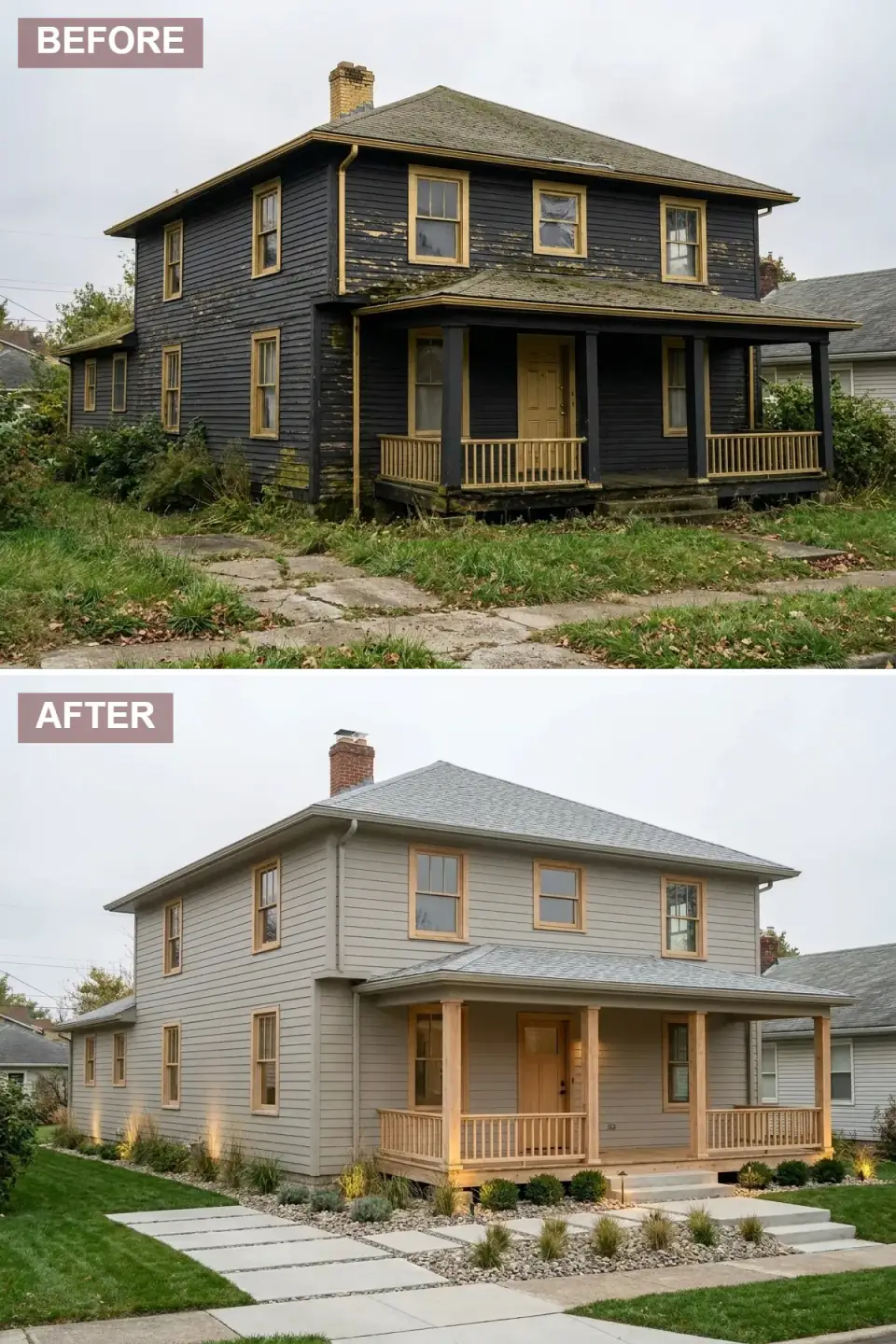
Light and calm: greige clapboard paired with natural, unfinished wood on the columns, railing, door, and porch floor. The landscape is naturalistic and low-upkeep — river stones, ornamental grasses, and concrete pavers in a serene composition. This is the most restrained of the nine, and the greige-plus-raw-wood pairing is genuinely hard to get wrong. It flatters the Foursquare's clean lines instead of dressing them up.
The honest note on "unfinished" wood: nothing outdoors is truly finish-free in our climate. Left bare, pine grays fast and inconsistently and won't last; what you want is a clear penetrating UV sealer (Rubio Monocoat Exterior, or a clear Cutek) that preserves the raw look while protecting the fiber. Reapply every couple of seasons. The greige itself is a forgiving, light-stable color — Sherwin-Williams Agreeable Gray or Benjamin Moore Revere Pewter both hold up. And the river-stone beds aren't just a look; swapping mulch for stone over landscape fabric is a real low-maintenance move that suppresses weeds and never needs topping up.
Color Palette
Soft Greige
#BDBAB0
Sherwin-Williams Agreeable Gray SW 7029 or BM Revere Pewter HC-172 — the dependable greige
Light Natural Pine
#E0C195
Cedar or pine under a clear penetrating UV sealer (Rubio Exterior) — keeps the raw look, protects the fiber
River Rock Grey
#8F8F8F
River stone over landscape fabric — weed-suppressing and zero topping-up, unlike mulch
Smooth Concrete
#D6D6D6
Simple smooth-concrete pavers — quiet hardscape that lets the grasses and stone breathe
6. The Industrial Modern Barn
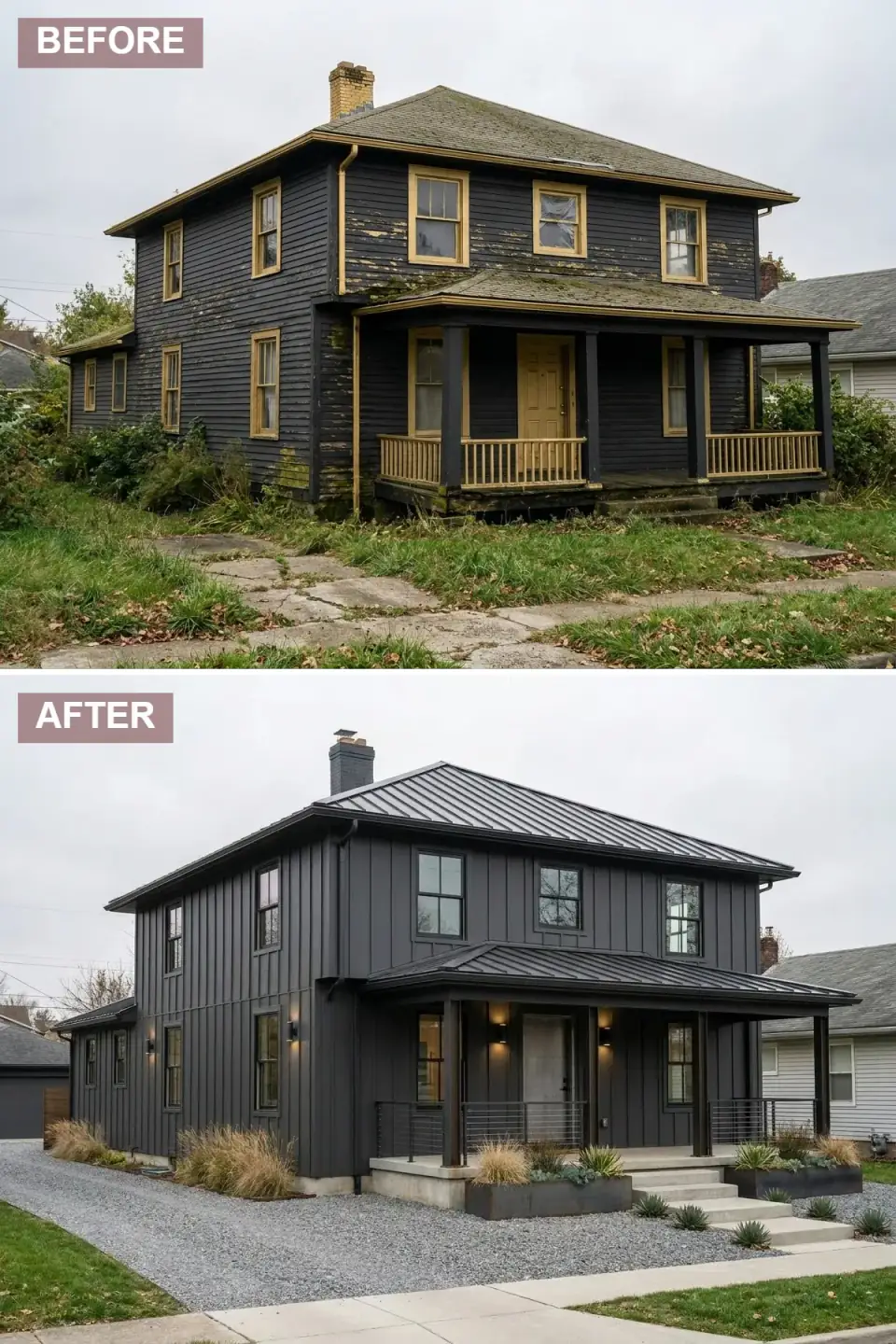
Bold and rugged: dark charcoal board-and-batten, a black metal roof, dark metal porch columns and railings, a concrete floor, a metal front door, and corten steel planter boxes over a gravel drive. It leans hard into the barn-and-industrial vocabulary that's everywhere right now. On a Foursquare the vertical board-and-batten actually flatters the tall proportions — the verticals make the box read intentional rather than blocky.
Two material notes from the field. Board-and-batten in fiber cement (James Hardie) or engineered wood (LP SmartSide) both work, but the batten spacing is a design decision people rush — too-wide battens read cheap, so I hold them to a consistent 12 to 16 inches on center and let the rhythm carry the look. Corten is the showpiece, and it's the one that stains: it bleeds rust for its first year or two, so keep those planters off any concrete, stone, or light hardscape you don't want permanently freckled, or set them on hidden feet over the gravel. The metal roof and metal door are both genuine durability upgrades, not just style — they'll outlast the rest of the house.
Color Palette
Dark Charcoal
#2F3136
Hardie or LP SmartSide board-and-batten in a near-black charcoal — battens at a consistent 12–16" on center
Matte Black Metal
#141414
Standing-seam roof, black metal columns and railing — the industrial frame around the whole composition
Raw Concrete
#999999
A sealed concrete porch floor — utilitarian, durable, and the right base for the industrial read
Rusted Corten Steel
#8B5A2B
Corten — the warm industrial pop, but keep it off light hardscape for the first two years while it sheds rust
7. The Modern Farmhouse Dream
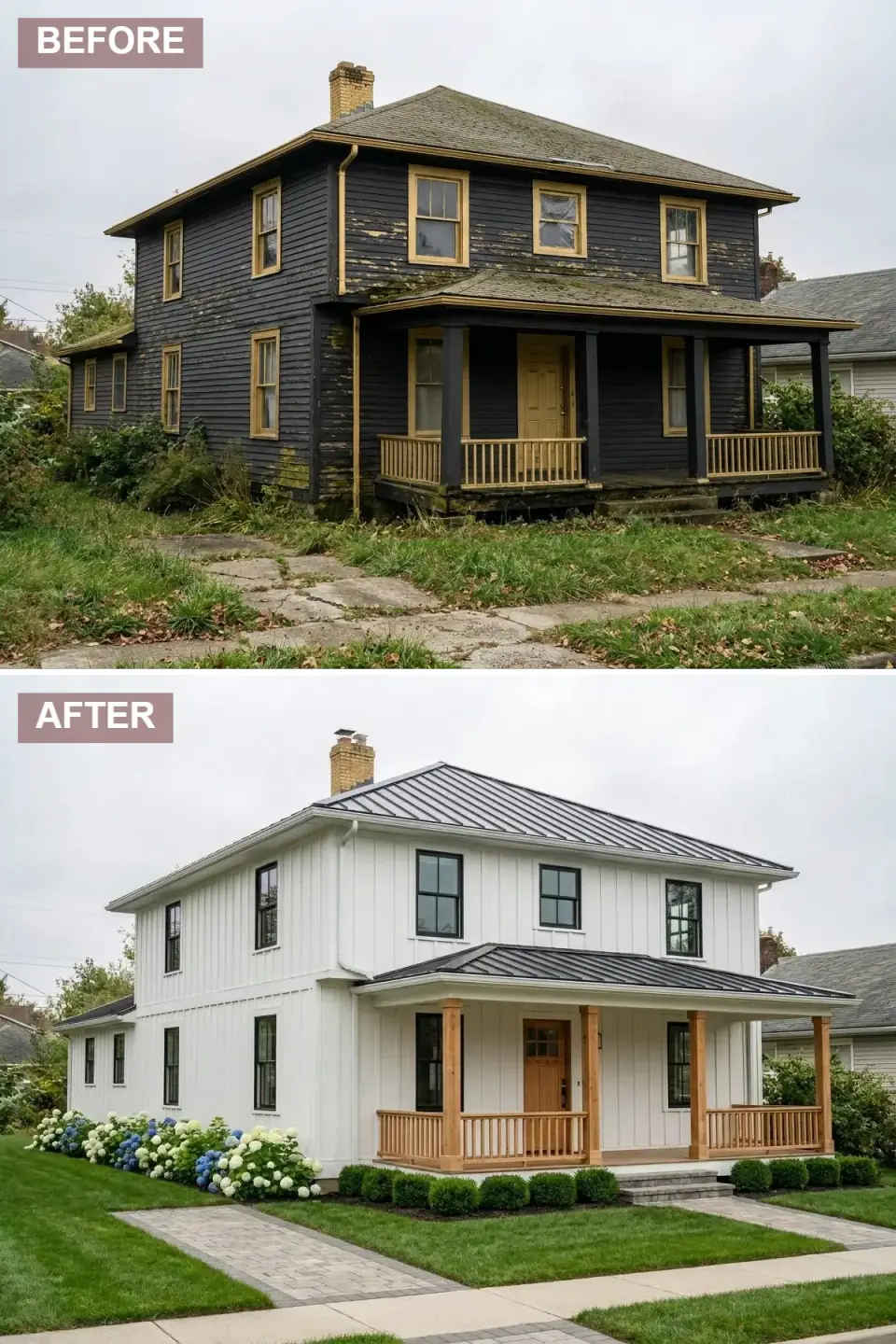
The crowd-pleaser: crisp white board-and-batten, a contrasting black metal roof and black window frames, warm natural-wood columns, railing, and door to soften the contrast, and classic hydrangea-and-boxwood beds along a new paver walk. This is the look that's run the Northeast for years, and the reason it endures is balance — the wood is what keeps the white-and-black from going cold. Strip the wood out and it reads austere; leave it in and it reads inviting.
As a finish package this is one of the most replicable here, because almost every piece is a stocked, off-the-shelf choice. White board-and-batten in Hardie or LP, black-clad windows from Andersen or Marvin, a standing-seam or architectural-shingle roof in black. The single highest-value upgrade in the bunch is the black windows — but if your existing windows are sound, painting or cladding the exterior frames black gets you most of the effect at a fraction of full replacement. Spend the window budget only where the units are actually failing. Hydrangeas and boxwood, meanwhile, are reliably hardy across the Hudson Valley, so this is one landscape that translates straight from the render.
Color Palette
Pure White
#FFFFFF
BM Simply White OC-117 or Chantilly Lace — the farmhouse white, warm enough to avoid clinical
Matte Black
#0F0F0F
Black standing-seam roof and black-clad windows — the essential high-contrast accent
Warm Cedar Tone
#C7935F
Cedar columns and a stained door — the warmth that keeps the black-and-white from going austere
Grey Pavers
#858585
Concrete pavers on a compacted base with edge restraint — durable and frost-stable
8. The Minimalist All-Black Farmhouse
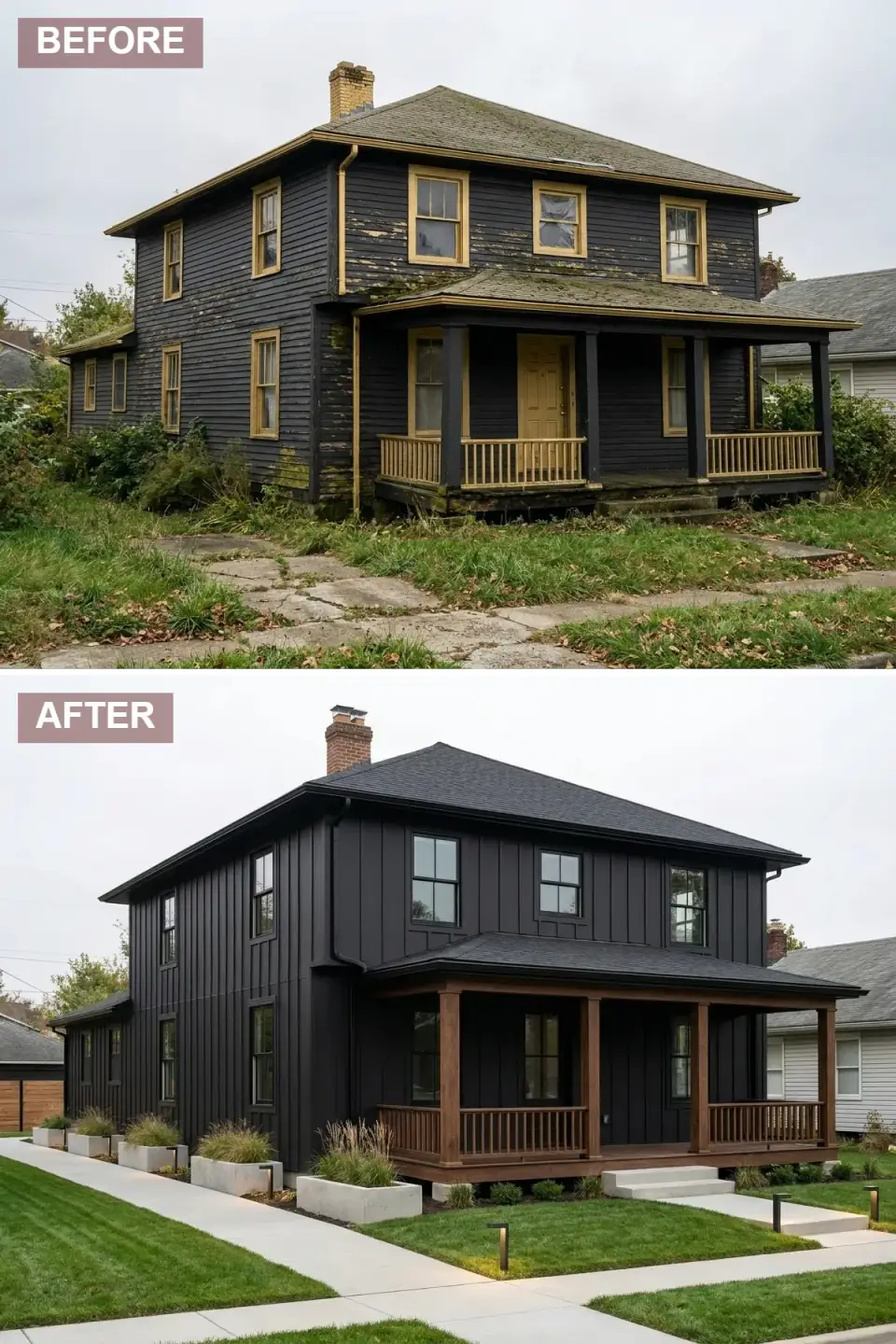
A monolithic statement: the entire house — board-and-batten siding, roof, and windows — finished in matte black, with dark wood columns and railing for a subtle textural break and a minimal, architectural landscape of concrete planters and a geometric lit walkway. On a Foursquare, the all-black treatment turns the simple box into a sculptural object. It's the boldest of the nine and, done right, the most photographed.
Done right is the operative phrase, because all-black is a maintenance and material decision before it's a style one. Dark surfaces absorb heat — a south or west black wall runs significantly hotter than a light one, which means vinyl siding can warp and cheap paint can fade chalky within a few years. This look demands a quality substrate and coating: fiber cement in a factory finish (Hardie's darkest ColorPlus tones) or engineered wood with a premium exterior paint like Sherwin-Williams Duration in a deep base. The wood columns aren't optional decoration here — they're the one texture break that keeps the facade from flattening into a silhouette. Lose them and the house reads like a cutout.
Color Palette
Matte Black
#1C1C1C
BM Black Beauty 2128-10 in SW Duration, or Hardie's darkest ColorPlus — spec for heat and UV stability
Dark Roast Walnut
#3B2618
A dark stained wood that reads as texture against the black — the one break that keeps the facade from flattening
Light Grey Concrete
#D1D1D1
A light concrete walk for sharp contrast — the bright foil the all-black facade needs to read
Smooth Concrete
#A0A0A0
Minimal concrete planters matched to the walk — architectural greenery, nothing fussy
9. The Coastal Shingle-Style Cottage
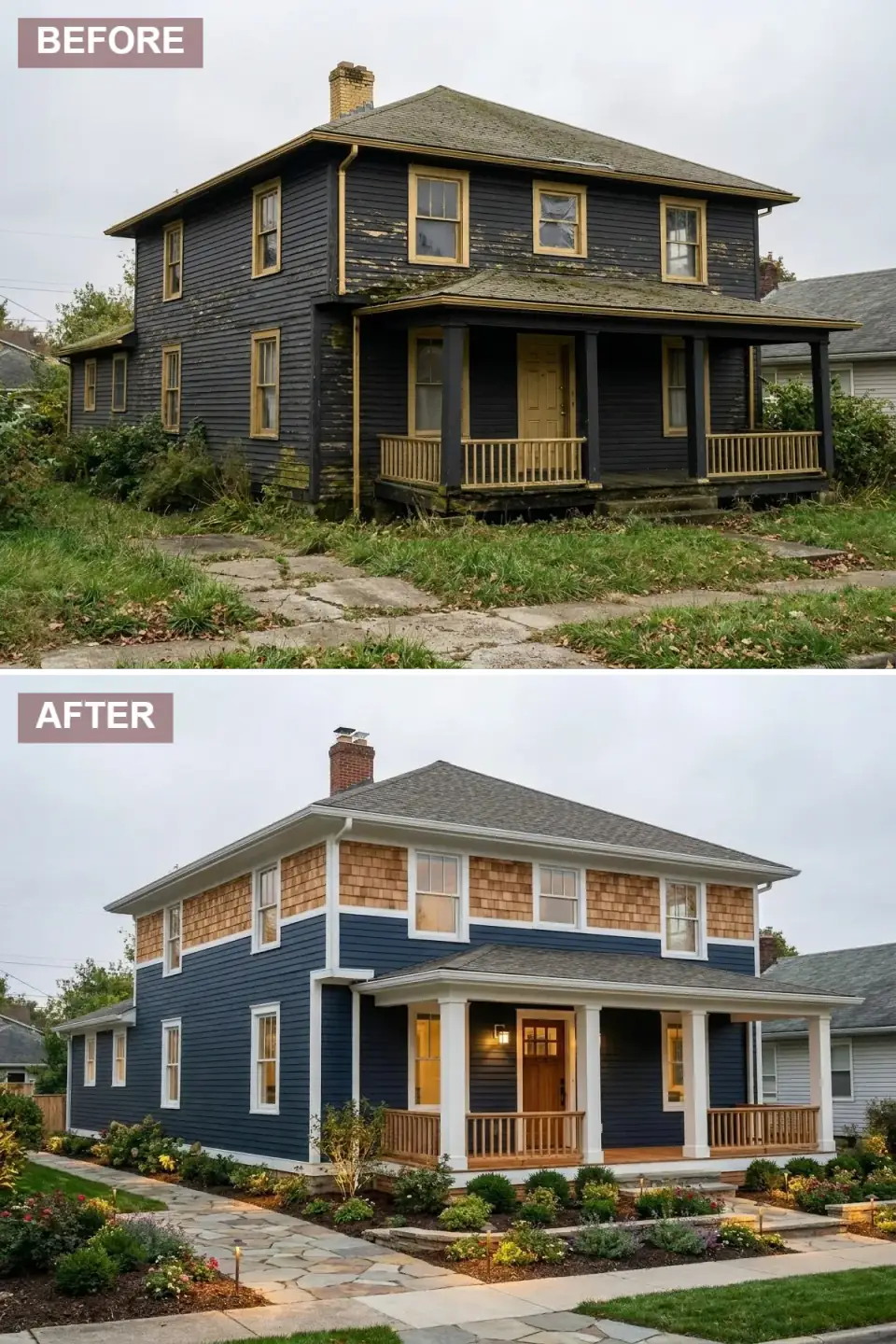
The closer is warm and timeless: deep navy clapboard on the first floor, natural cedar shakes on the second, crisp white trim, columns and railings popping against the darker tones, and a flagstone path winding through cottage-style flower beds. The two-tone, two-material split is a classic shingle-style move, and it does something smart to the Foursquare — the navy base visually grounds the box while the lighter shakes lift the upper story.
This is the read I'd point a Hudson Valley or southern-New-England client toward most often, because it sits naturally on our older housing stock — it would look right in Rhinebeck, Hudson, or a Connecticut shoreline town without trying. The detail to honor is the material transition: the clapboard-to-shake break wants to land on a real architectural line (a water table or belt course), not float arbitrarily mid-wall, and it needs proper flashing at the transition to shed water. Cedar shakes are gorgeous and they're a maintenance commitment — figure on resealing every few years, or spec a pre-finished shake (Maibec) to stretch the interval. The navy holds beautifully in a quality coating like Benjamin Moore Hale Navy.
Color Palette
Deep Navy Blue
#2A3B54
Benjamin Moore Hale Navy HC-154 — the dependable Northeast navy that grounds the box
Natural Cedar Shake
#BA8C61
Pre-finished cedar shake (Maibec) to stretch the reseal interval — warm coastal texture up top
Crisp White
#FAFAFA
BM White Dove or Chantilly Lace trim — sharpens every architectural edge against the navy and shake
Flagstone Pavers
#8F8376
Natural flagstone on a proper base — the rustic cottage-garden path that ties the whole scene together
Pro Tips From the Renovation Designer's Chair
- Re-side once, improve the wall. When the old cladding comes off, that's the moment to add a weather-resistive barrier, air-seal, and a rainscreen gap. Re-siding without upgrading the assembly underneath is a missed opportunity you only get once a generation.
- Ground a tall box at the base. A Foursquare reads top-heavy when the foundation is bare. Stone veneer, a darker first-floor color, or a wrapping porch visually anchors the form — that's why the moody and coastal reveals feel so settled.
- Black windows are the cheat code. More than any single color, swapping window frames to black sharpens a facade. If the units are sound, clad or paint the exteriors black instead of replacing — same effect, far less money.
- Lighting is architecture after dark. Integrated step lights, sconces, and uplights on a specimen tree improve safety and double the hours your curb appeal is visible. Plan the wiring before the hardscape and siding close up.
- Mix materials with a logic. Clapboard, shake, stone, and board-and-batten read intentional only when each lands on a real architectural line — a story break, a gable, a porch bay. Random mixing reads busy and cheapens the whole facade.
- Match plants to the zone, not the photo. A render full of agave is a Northeast replanting bill. Use hardy architectural stand-ins so the landscape that sells the look in May still looks like it in March.
Cost-Saving Moves
- Paint before you re-clad. If your existing siding is sound, a quality full exterior repaint runs roughly $8,000–$15,000 on a Foursquare in the Hudson Valley — a fraction of the $30,000-plus for new fiber-cement cladding. Several of these reveals are achievable as a color change alone.
- Clad windows black instead of replacing. Full window replacement runs $800–$1,500 per unit installed here. Painting or applying exterior frame cladding to sound windows captures the black-window look for a small share of that.
- Veneer only the base. Stone veneer runs $25–$45 per square foot installed. Applying it just to the foundation and porch skirting — where it does the most visual work anchoring the box — costs far less than wrapping the whole first floor.
- Stone beds over annual planting. River stone over landscape fabric is a one-time cost that suppresses weeds and never needs mulch top-ups, trading a recurring seasonal bill for a single install.
Reader Questions on Exterior Home Transformations
Can you really turn a Foursquare into a farmhouse or a barn?
Not structurally — and you don't need to. A render can paint the box to read farmhouse or barn, but the hipped-roof Foursquare massing stays underneath. What actually changes is the skin: siding profile, color, roof material, porch details, and landscape. That's good news, because re-cladding and repainting a fixed envelope is a fundable, buildable project, while moving a roofline is structural work at many times the cost. Think of these nine as material-and-color studies on one form, not nine different houses. The honest version of any of them keeps the massing and transforms the finish.
What's the best siding for a Northeast climate?
For most Hudson Valley clients I steer toward fiber cement (James Hardie) or engineered wood (LP SmartSide). Both handle our freeze-thaw cycles and humidity far better than vinyl, hold a factory color finish, and resist the warping and fading that punish cheaper materials on sun-facing walls. Real cedar and cedar shake are beautiful and historically correct on older stock, but they're a maintenance commitment — figure on resealing every few years. Whatever you choose, the bigger win is what goes behind it: a weather-resistive barrier and a rainscreen gap added during re-siding will outlast and outperform any cosmetic choice.
Is dark or black siding a problem for heat and fading?
It can be, which is why the material matters more than the color. Dark surfaces absorb significant heat on south and west exposures, and that punishes cheap substrates — standard vinyl can warp, and low-grade paint chalks and fades within a few years. Done correctly, an all-black or charcoal exterior uses fiber cement in a factory finish or engineered wood coated with a premium deep-base paint like Sherwin-Williams Duration, both formulated for heat and UV stability. Spend on the substrate and coating and a dark facade holds for decades; cut that corner and you'll be repainting far too soon.
How much does an exterior makeover cost in 2026?
In the Hudson Valley and NYC outer boroughs, a full exterior repaint on a Foursquare runs roughly $8,000–$15,000, while new fiber-cement siding typically lands at $12–$18 per square foot installed and engineered wood a bit less. Stone veneer runs $25–$45 per square foot, a standing-seam metal roof $12–$18, and black-clad window replacement $800–$1,500 per unit. The biggest cost lever is how much you re-clad versus repaint — several of these looks are reachable as a color and landscape change, while others are full envelope projects. Decide that split first and the budget follows.
Does stucco hold up in the wet Northeast?
Only when it's detailed for the climate. Stucco and EIFS are Southwest and California natives; in our wet, freeze-thaw conditions they have to be applied as a rainscreen — traditional three-coat over a drainage mat and two layers of building paper — not face-sealed to sheathing. EIFS in particular has a long history of trapped-moisture failures in damp climates when installed without a drainage plane. If you love the smooth contemporary look, it's achievable here, but insist on a contractor who can walk you through the drainage detail behind the wall. If they can't, that's your answer to keep looking.
Where to Read Next
If the one-home-many-styles format pulls you in, the Chameleon House study runs a neglected home through ten more treatments, and the cottage exterior makeover guide drills into the shingle and clapboard reads in detail. For the full library of facade projects — every style and material covered here and more — browse exterior renovations.
Sources & Further Reading
- National Park Service, Preservation Briefs (historic siding, masonry, and wood-window guidance).
- James Hardie, fiber-cement siding and ColorPlus technical data.
- LP Building Solutions, LP SmartSide engineered-wood siding specifications.
- This Old House, exterior renovation and siding guides.
- Fine Homebuilding, articles on rainscreen siding, stone veneer, and water management.
- U.S. Department of Energy, weatherization and air-sealing guidance.
- Marvin, window product and black-clad finish specifications.
- USDA, Plant Hardiness Zone Map (Hudson Valley zone 5b–6b planting reference).
- Remodeling magazine, Cost vs. Value Report — siding and curb-appeal returns.

Nora Whitfield
Renovation Designer & Interiors Editor · Beacon, New YorkNine years of design-build renovation work across the Hudson Valley and the Northeast. Nora runs the Renovations, Room Guides and Renovation Mind desks — before-and-after studies, room-by-room design guides, and the long essays on why what we renovate matters.
More from Nora →
Reader notes