


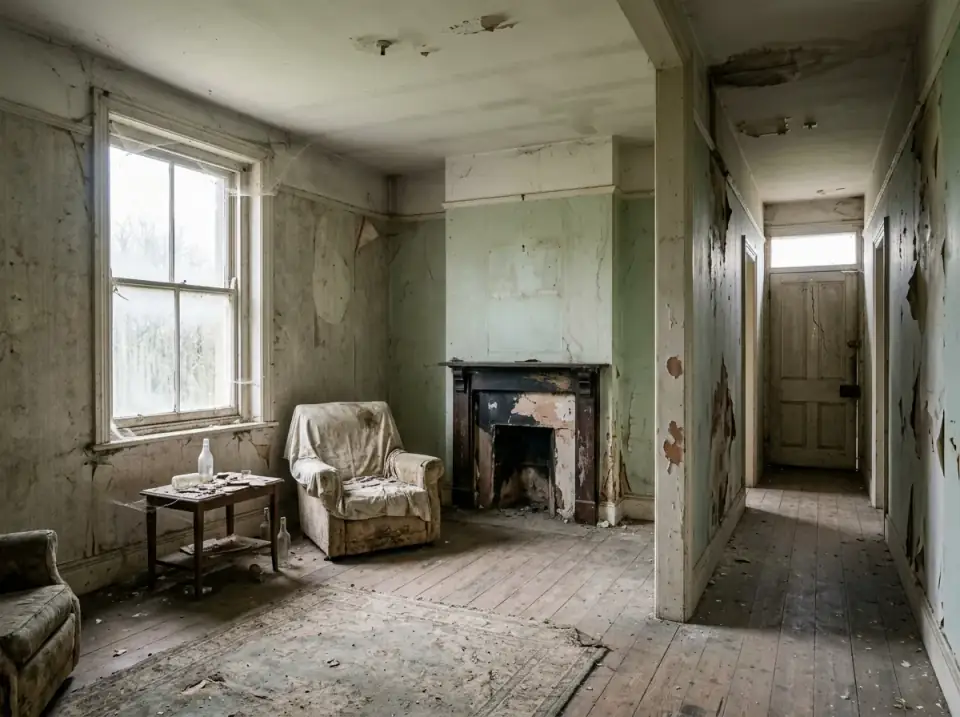
I spend my working life telling people which walls they can move and which they cannot. So when a room gets dressed for a party, I read it the same way I read a renovation — what is permanent here, and what is just a layer I can pull off on Sunday morning? This is one tired living room, the same four walls in every photo, restyled two completely different ways. Neither restyle touches a stud, a pipe, or the floor framing. Everything you see is reversible, finish-stage, rentable-and-returnable styling — which is exactly why a celebration is the safest design experiment you will ever run in your own home.
How I Build Celebration Spaces From One Room
A celebration restyle is the opposite of a renovation, and that is its whole appeal. In a renovation I am committing your money to things that are expensive to undo — a moved wall, a relocated kitchen, a new window opening. Dressing a room for a party is all reversible moves: paint or peel-and-stick on the walls, a rug over the floor you already have, lighting that plugs in, furniture you rent or rearrange. Nothing here changes the bones, so nothing here carries the risk that makes people freeze up before a real remodel.
That is also why I treat a party as a rehearsal. The same room below becomes a soft, feminine birthday suite and then a candlelit rustic dinner hall — and watching how one space takes two opposite moods tells you more about its real potential than any mood board. If you like the idea of styling a room around an occasion, the rest of my celebrations work runs on the same principle: read the room first, then layer.
1. The Pink-and-Gold Birthday Suite
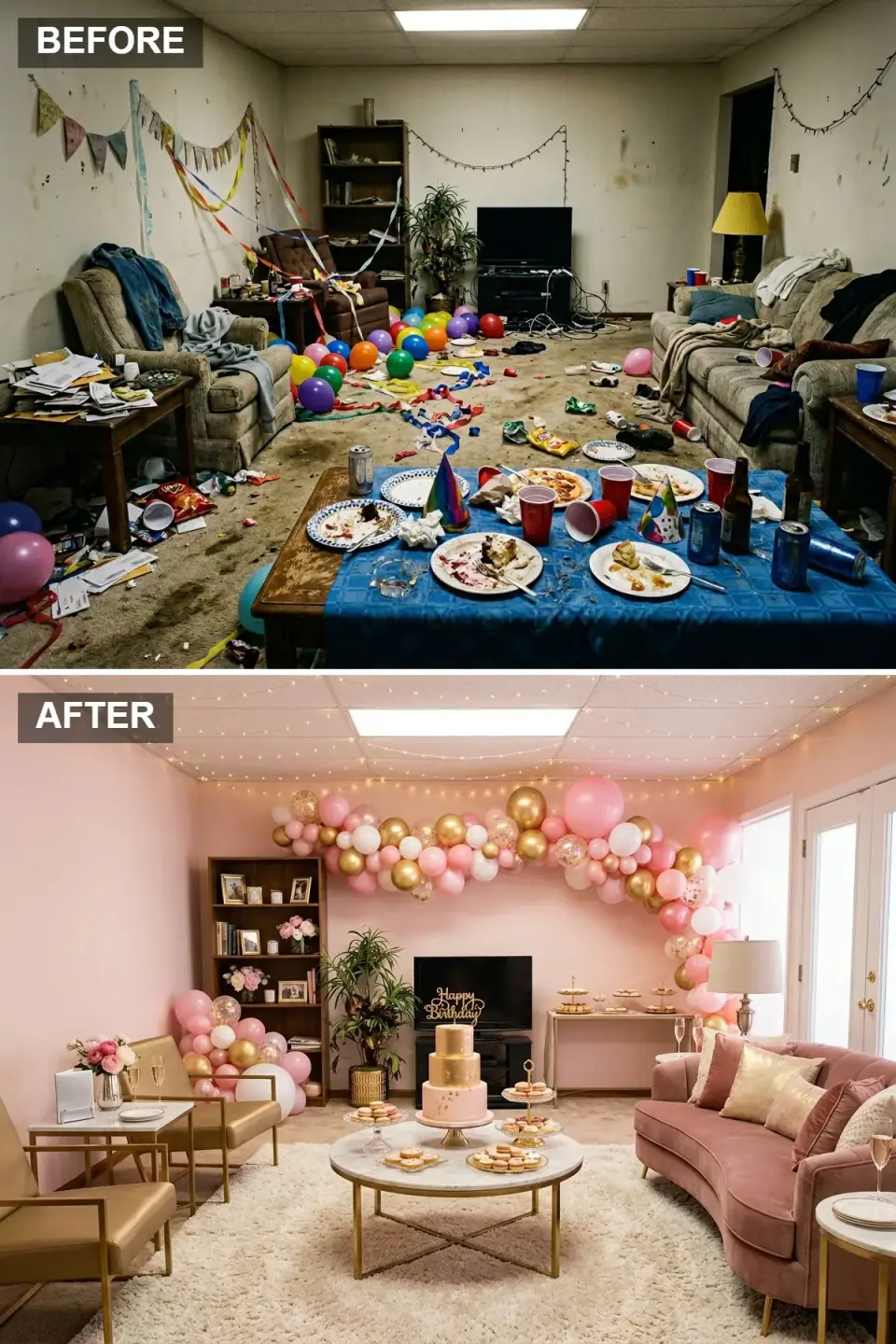
The drab room turns soft and bright here. A blush pink wall and a high-pile ivory rug do the heavy lifting, giving the whole space a gentle, airy floor-to-ceiling reset before a single decoration goes up. The worn seating is swapped for a curving rose-pink velvet sofa and slim gold-framed chairs, and the focal point is built — not bought — from an organic balloon garland, a dessert table, and a tiered cake. None of it is permanent: the wall color is the only semi-committed move, and even that is a weekend and a gallon of paint to undo.
What makes this read as designed rather than decorated is restraint in the palette. Pink rooms go wrong when every pink is a different temperature; here the blush wall, the deeper rose sofa, and the gold all sit in the same warm family, so the eye reads one mood instead of a fight. If a joyful, color-forward room is your instinct, you will recognize the same logic in my dopamine-dream bedroom guide — pick a family, then layer tones inside it.
Color Palette
Blush Pink
#F4C2C2
A soft, low-saturation pink in the spirit of Benjamin Moore First Light 2102-70 — warm enough to flatter skin and candlelight, pale enough not to overwhelm the room.
Ivory Shag
#F5F5F0
A plush, high-pile ivory that brightens the floor and quiets footsteps — the cheapest way to make a hard-used room feel soft underfoot for a night.
Polished Gold
#D4AF37
Warm polished gold on the chair frames and side tables — the metal that reads celebratory rather than industrial, and the thread that ties the cake table to the seating.
Rose Pink Velvet
#C48793
A deeper rose that anchors the lighter blush wall so the scheme has weight — the focal seat that keeps an all-pastel room from floating away.
- Build the focal point, don't buy it. An organic balloon garland in three tones of your scheme costs a fraction of a single statement piece and reads as styled, not store-bought.
- Keep every pink in one temperature. Warm blush, warm rose, warm gold — mixing a cool pink into a warm scheme is what makes a room look accidental.
- Let the dessert table double as the display. A tiered cake on a round gold table is decor and dessert at once, which earns its floor space twice over.
2. The Warm Rustic Dinner Party
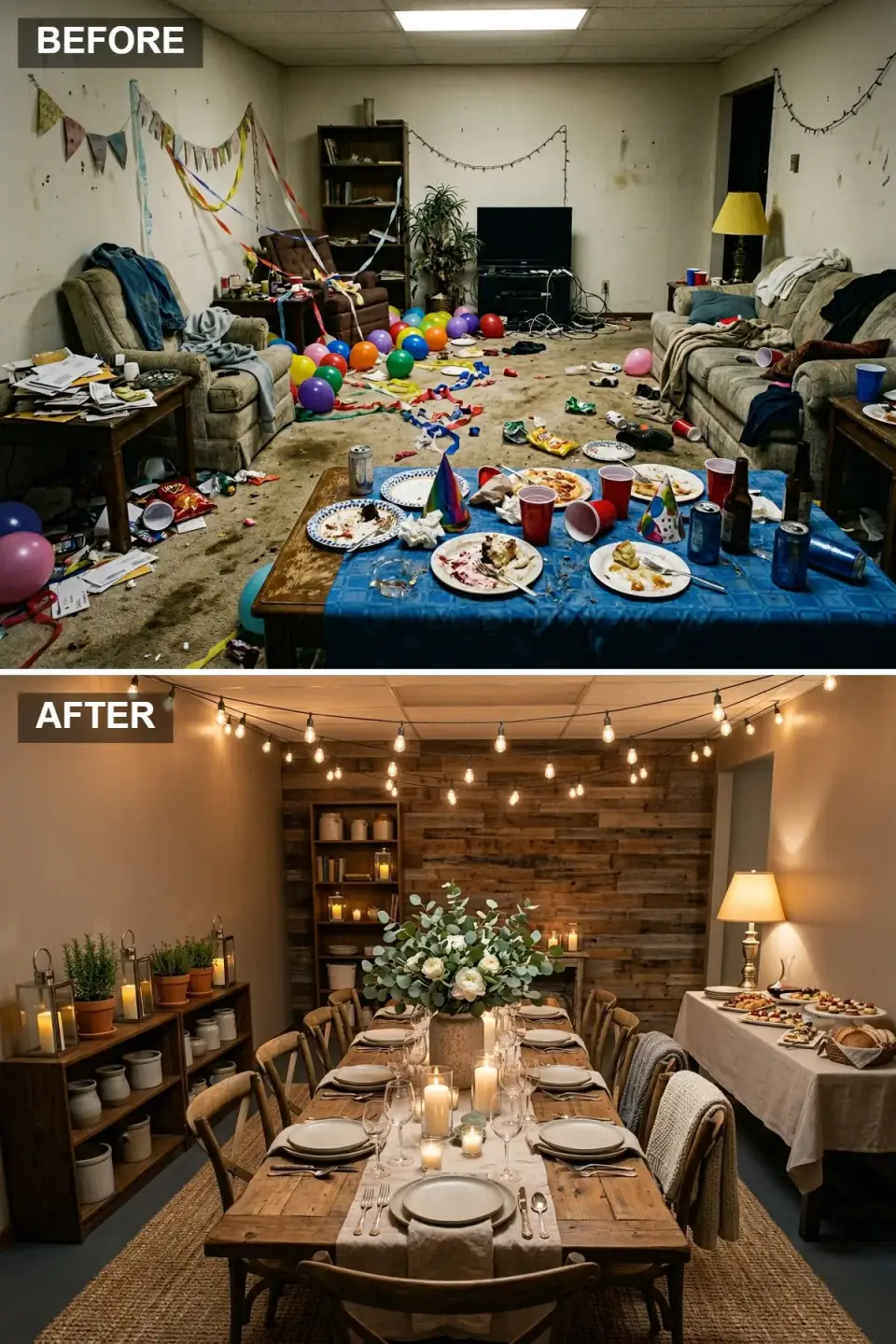
This restyle does something more interesting than redecorate — it changes the room's function. The living room becomes a dining hall, built around a long farmhouse table and cross-back chairs, with a reclaimed-wood plank accent wall as the backdrop and a large jute rug grounding the whole arrangement. The lighting is the move that sells it: overhead bistro strings plus a run of pillar candles in the table's center, no overhead glare anywhere. That layered, low, warm light is the single most convincing thing you can do to make an ordinary room feel like an occasion.
From a designer's seat, the plank accent wall is the only part I would think twice about. A nailed-up reclaimed-wood wall is semi-permanent and leaves fastener holes; for a one-night dinner I would reach for peel-and-stick plank panels or a freestanding wood screen instead, so the room returns to neutral on Monday. Everything else — the table, the jute rug, the linen runner, the lanterns — is rented or rearranged and leaves no trace. If you want this look as a standing dining room rather than a one-off, my quiet-luxury dining room ideas show how to make the same warmth permanent, and my notes on dried and foraged floral centerpieces cover the tablescape.
Color Palette
Reclaimed Wood Tone
#8B5A2B
A warm, mid-brown reclaimed-oak tone finished with a penetrating oil like Rubio Monocoat rather than a glossy varnish — the matte finish is what reads authentic instead of laminate.
Natural Jute
#C19A6B
A neutral, textured jute base that takes traffic and crumbs without complaint and complements the wood without competing with it.
Oatmeal Linen
#D9CFC1
A soft, undyed linen runner and napkins — the matte textile that catches candlelight gently and keeps the table from feeling formal or stiff.
Darkened Metal
#4A4A4A
Near-black metal lanterns and fixtures in the spirit of Sherwin-Williams Iron Ore SW 7069 — the dark accent that grounds all the warm wood and linen.
- Make light the centerpiece. Bistro strings overhead plus a low run of pillar candles is the whole atmosphere — kill the overhead can lights entirely.
- Use one large rug to redraw the room. A jute rug under the table tells the eye "this is the dining zone" even in a space that is normally a living room.
- Go semi-permanent only where it is reversible. Peel-and-stick plank panels give the reclaimed-wood backdrop without the fastener holes a real plank wall leaves behind.
Pro Tips From the Designer's Chair
- Lighting does the most work. The single biggest shift in either restyle is swapping harsh overheads for layered, low, warm light — floor lamps, table lamps, string lights, and candles in glass. Dim and warm reads as "occasion" to the human eye every time.
- A rug redraws a room for free. A large area rug hides a tired floor and instantly defines a seating or dining zone, grounding the furniture and adding texture in one move you can roll up afterward.
- Walls set the whole tone. Color is the most dramatic reversible change you can make. Paint if you own; reach for peel-and-stick wallpaper or a draped backdrop if you rent. Either way, the wall sets the mood before any decor arrives.
- Curate the furniture, don't just fill the room. Choose pieces that fit the scale and the theme. Renting or rearranging a few distinct pieces — a velvet sofa, a long farmhouse table — does more than crowding the floor with whatever you own.
- Build one focal point, not five. A balloon garland or a candlelit table center earns the eye. Spreading decor evenly around a room reads as cluttered; concentrating it reads as designed.
Reversible, Renter-Safe Moves
- Peel-and-stick over paint. Removable wallpaper and fabric backdrops give you the wall reset without losing a deposit — test a hidden corner for adhesive compatibility first.
- Rent the statement furniture. A velvet sofa or a farmhouse table for one night costs far less than buying, and party-rental houses deliver and collect.
- Lighting is the cheapest transformation. String lights, plug-in floor lamps, and glass-housed candles cost little, store flat, and reset any room's mood in minutes.
- One good rug, used twice. A neutral jute or an ivory shag works across multiple themes, so the same rug carries you from a birthday to a dinner party.
Reader Questions on Celebration Restyles
Can one room really be restyled for completely different celebrations?
Yes — and it is easier than people expect, because party styling lives entirely in the reversible layer. The same living room here becomes a pink birthday suite and a rustic dinner hall using only walls, lighting, a rug, and swapped furniture. None of those touch the structure, the plumbing, or the floor framing, so there is no risk of a change you cannot undo. The trick is to pick one mood per event, commit the whole palette to it, and resist mixing themes. Reset to neutral afterward and the room is ready for the next occasion.
What are the most budget-friendly ways to transform a room for a party?
Lighting first — string lights, plug-in lamps, and candles in glass cost very little and change a room's mood faster than anything else. A single large rug is next; it hides a tired floor and defines a zone for the price of one item. For walls, peel-and-stick wallpaper or a draped fabric backdrop gives a dramatic reset without paint. Build your focal point from a balloon garland rather than buying a statement piece. And rent the big furniture for the night instead of buying — party-rental houses deliver, and you store nothing afterward.
How do I light a room for a celebration without harsh overheads?
Turn the overhead cans off entirely and replace them with layered, low, warm light. Run bistro string lights overhead for a soft canopy, add floor and table lamps at the room's edges, and place candles in clear glass hurricanes down the center of any table. Warm bulbs in the 2400–2700K range read as candlelight; anything cooler reads as an office. Put what you can on a dimmer or a smart plug so you can drop the level as the evening goes on. Low and warm is the whole secret to a room feeling like an occasion.
How do I turn an open living room into a dining space for one night?
Start with the rug — a large jute or natural-fiber rug under a long table tells the eye that this corner is now the dining zone, even in a room that is normally for lounging. Move the everyday seating out, bring in a farmhouse table and chairs, and build the table center with candles and a low floral runner so sightlines across the table stay open. Keep the lighting low and warm overhead. Because every piece is rented or rearranged, the living room returns to itself the next morning with nothing to repair.
Which of these restyles works best in a rental?
Both do, as long as you swap the two semi-permanent moves for reversible versions. In the birthday suite, replace painted walls with peel-and-stick wallpaper or a fabric backdrop. In the dinner party, replace the nailed reclaimed-wood accent wall with peel-and-stick plank panels or a freestanding wood screen so you leave no fastener holes. Everything else in both schemes — the rugs, lighting, furniture, and decor — is already reversible. Test any adhesive product on a hidden corner first, since glossy paint can release the backing differently than flat.
Where to Read Next
If you are planning a party rather than a permanent room, my sustainable garden-party decor ideas carry the same reversible-styling logic outdoors. For the dinner-party tablescape specifically, the dried and foraged floral guide covers low, long centerpieces, and the rest of the occasion work lives in my celebrations archive.
Sources & Further Reading
- Benjamin Moore — Color reference for soft pinks and warm neutrals (First Light 2102-70).
- Sherwin-Williams — Iron Ore SW 7069 specification for darkened-metal accents.
- U.S. Department of Energy — Color-temperature and dimmable LED guidance for ambient lighting.
- Rubio Monocoat — Penetrating hardwax-oil finish data for reclaimed-wood surfaces.
- National Fire Protection Association — Candle-safety guidance for enclosed-flame table settings.
- Architectural Digest — Editorial guidance on staging dinner-party table settings and lighting.
- Remodelista — Renter-friendly peel-and-stick wallpaper application notes.

Nora Whitfield
Renovation Designer & Interiors Editor · Beacon, New YorkNine years of design-build renovation work across the Hudson Valley and the Northeast. Nora runs the Renovations, Room Guides and Renovation Mind desks — before-and-after studies, room-by-room design guides, and the long essays on why what we renovate matters.
More from Nora →
Reader notes