


One dated brick house, nine different exterior directions — and I'm judging each not just on the after photo but on what the renovation actually does to the masonry underneath. Painting brick is close to permanent; limewash breathes; stucco and stone change the envelope entirely. Color palettes, real material specs, Northeast climate notes, and the plan reading behind every facade.
Almost every house in this study starts the same way: solid red or orange brick, good bones, dated look. And almost every transformation makes the same fundamental decision — what to do with that brick. It's the most consequential and least understood choice in an exterior renovation, because the options aren't interchangeable. Painting brick is effectively permanent and can trap moisture in masonry that was built to breathe. Limewash soaks in and stays breathable. Stucco-over-brick changes the whole water-management story and demands a rainscreen. Stone veneer adds dead load and needs a drainage plane. Same red-brick "before," five completely different building-science outcomes.
That's the frame for this study. The same house gets reimagined nine ways — graphite-modern, cream-elegant, desert-minimalist, farmhouse, adobe, rustic stone, all-white, Nordic, nautical-navy. For each, I'll tell you what the render gets right, what it's actually doing to the brick and the envelope, which moves hold up in a Hudson Valley freeze-thaw winter and which are borrowed from a climate that doesn't apply here, and where the money really goes. The colors are the easy part. The decision about that brick is the one you can't undo.
Who this study is for
Homeowners with a dated brick (or brick-veneer) house weighing an exterior renovation, who want an honest read on what painting, limewashing, stuccoing, or stone-veneering actually commits them to — plus the cost, durability, and climate realities behind each look. Also useful for designers building a comparative palette deck. The plan-aware notes throughout are aimed at readers who want a facade that performs for decades, not just one that photographs well on day one.
Before the nine variants, the anchor that runs through all of them: how you treat the brick. Standard latex paint forms a film on the surface; on old brick that was designed to absorb and release moisture, that film can trap water inside the masonry, and in a freeze-thaw climate that trapped water expands and spalls the brick face off. It's also nearly impossible to fully remove later. Limewash, by contrast, is a mineral coating that bonds into the brick and stays vapor-open — it breathes, it ages gracefully, and it's the move I recommend most often on real masonry. If you want a painted look, use a breathable mineral paint (Romabio Masonry Flat, a silicate system) rather than standard acrylic. Stucco and stone veneer are bigger envelope changes covered in their sections. For the broader category, my exterior renovations archive collects every before-and-after on the site.
1. Graphite Modernity
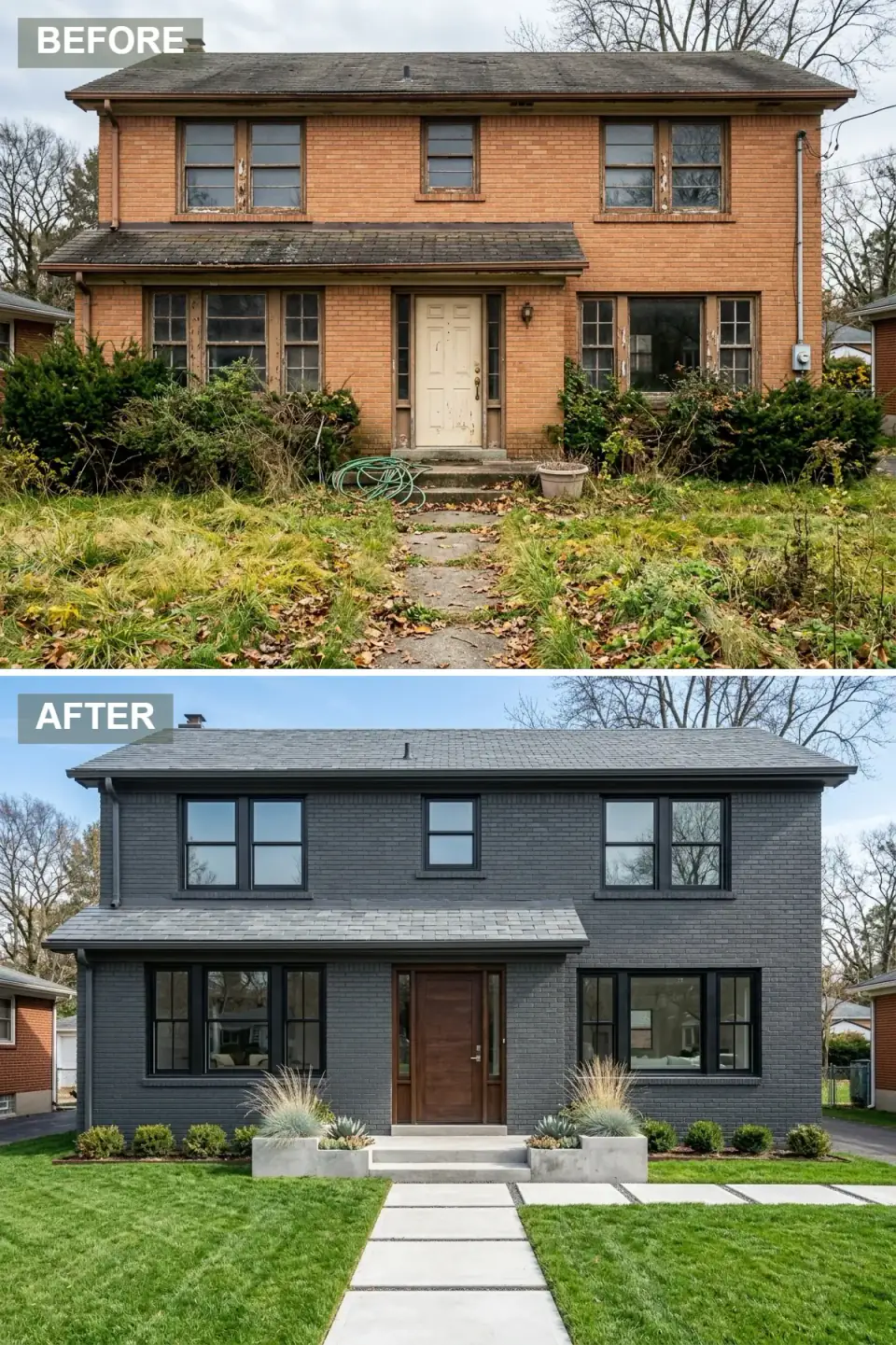
The most popular dated-brick fix of the moment, and a strong one when executed correctly. A charcoal wash unifies the brick with a slate-grey roof, black-framed windows erase visual clutter, and a walnut door supplies the warm note that keeps the cool masonry from going cold. My one non-negotiable: do not do this in standard latex. On real brick in our climate, use a breathable mineral masonry paint (Romabio Masonry Flat or a silicate-based system) so the wall can still release moisture — a film-forming latex here is a freeze-thaw spalling problem waiting two or three winters to appear. The walnut door should be a solid or engineered hardwood with a marine-grade exterior finish, refreshed every couple of years, or a fiberglass wood-look (Therma-Tru) if you won't maintain real wood. The agave in the planters won't overwinter in Zone 5 — substitute hardy yucca.
Color Palette
A moody contemporary envelope — apply only in a breathable mineral paint on real masonry.
Cool-grey architectural shingles that sharpen the roofline against the dark wall.
Crisp matte-black frames — Marvin or Andersen black factory finish reads cleaner than site-painted.
The warm organic counterpoint to the cool masonry — finish it for UV or it greys fast.
How to read this renovation
- Charcoal brick only works long-term in a breathable mineral paint; standard latex traps moisture and spalls brick in freeze-thaw.
- Black factory-finished windows hold up better than site-painted frames, which chip at the sightlines first.
- Oversized concrete planters anchor a symmetrical entry, but on a freezing site use frost-proof fiberglass or concrete rated for it.
- Swap agave for hardy yucca (Yucca filamentosa); the desert look survives Zone 5 only with cold-hardy substitutes.
2. Classic Cream Elegance
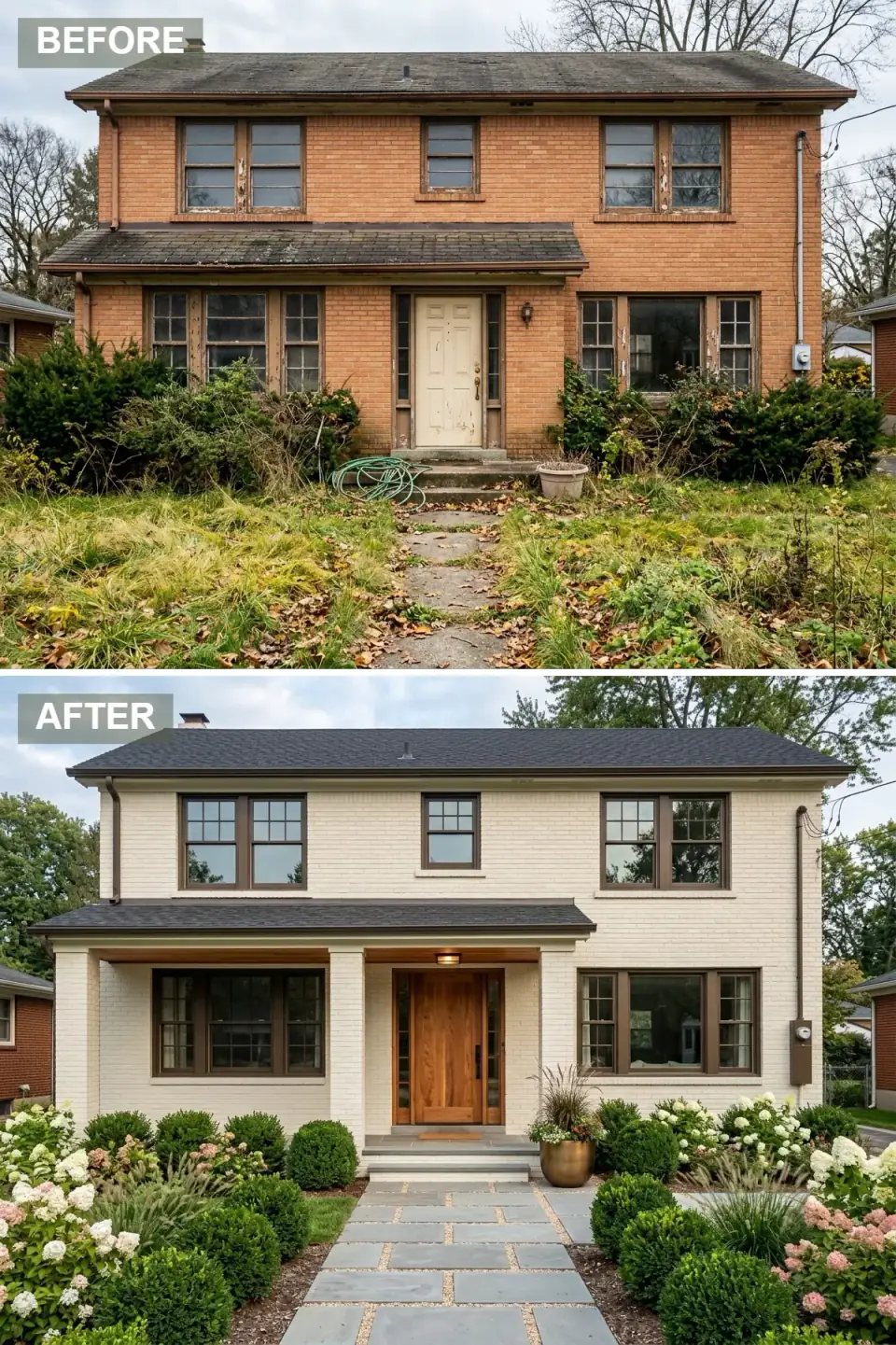
This is the one I'd point a client to first, because it does the brick the right way. A warm ivory limewash brightens the house while staying breathable — it bonds into the masonry, ages with a soft patina instead of peeling, and won't trap moisture the way film paint does. The chocolate-framed traditional windows respect the original proportions, and the cedar-lined porch soffit is the detail that adds real material richness for relatively little money. Bluestone is a regionally perfect walkway choice — it's a Northeast native stone, durable through freeze-thaw, and it ages beautifully. The boxwood-hydrangea-rose planting is the classic Northeast historic-house trinity. Of all nine, this is the most timeless and the lowest-risk.
Color Palette
A breathable mineral finish — Romabio Classico Limewash bonds into the brick and ages gracefully.
Deep grey shingles grounding the bright facade with classic contrast.
Dark brown frames with muntins honoring the home's traditional architecture.
Northeast-native bluestone — durable through freeze-thaw and beautiful as it weathers.
How to read this renovation
- Limewash over paint: it bonds into the brick, breathes, and patinas — the lowest-risk way to lighten masonry in our climate.
- A cedar or tongue-and-groove porch soffit adds warmth and shadow line for modest cost — a high-value detail.
- Bluestone is a Northeast-native, freeze-thaw-durable walkway stone; set it on a proper compacted base.
- Layer foundation plantings by bloom time (hydrangea, rose, boxwood structure) for curb appeal across all seasons.
3. Desert-Modern Minimalism
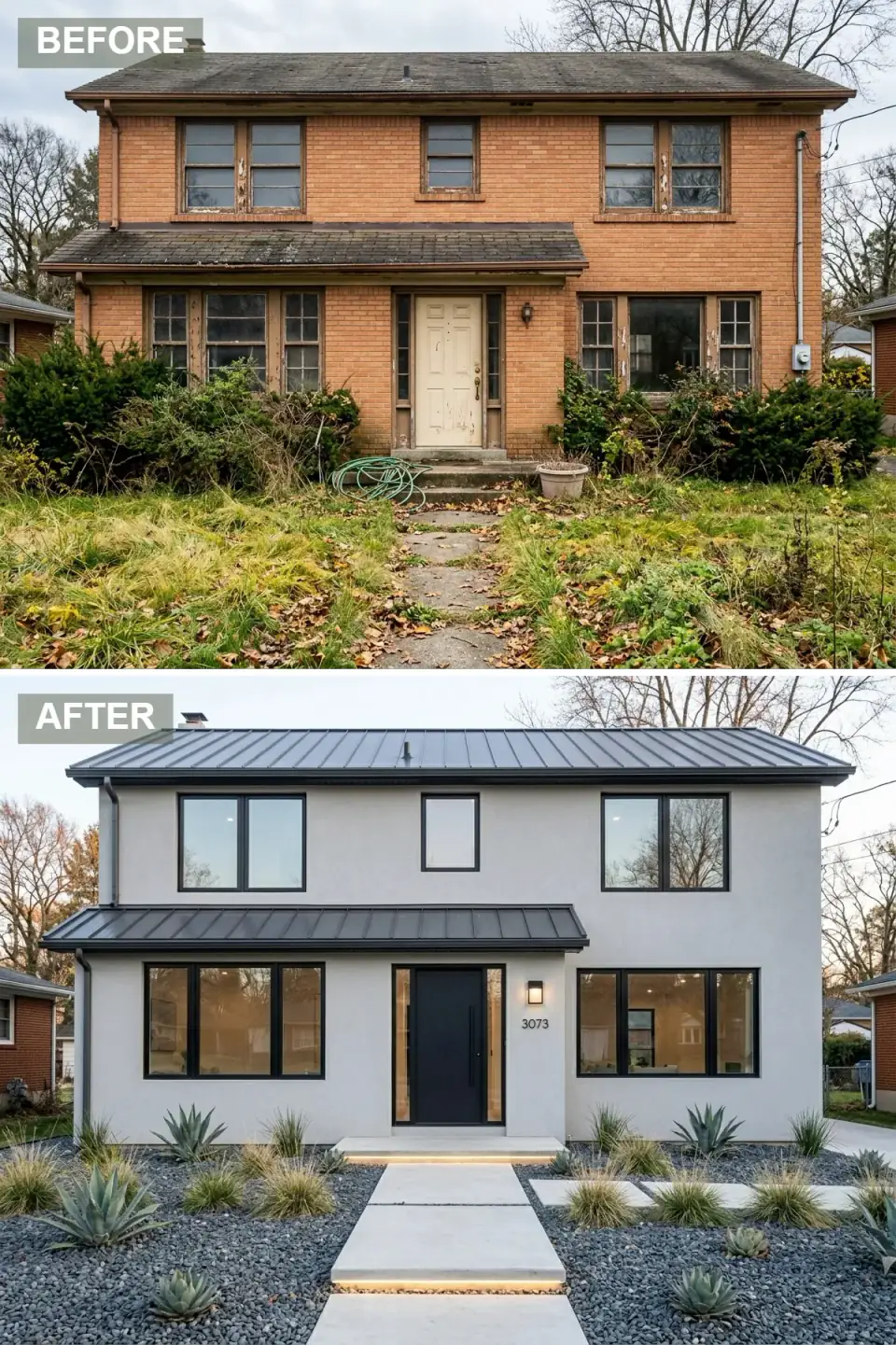
A striking render and the one most at odds with a Northeast site. Wrapping the brick in smooth stucco is a real envelope change: stucco over a masonry or framed wall in our climate needs a properly detailed rainscreen and weep system, or trapped moisture rots and cracks it — this is the substitution conversation, and I'd build the smooth white in a James Hardie Architectural Panel rather than three-coat stucco unless you're committed to the detailing. The standing-seam metal roof is genuinely good here — it sheds Hudson Valley snow beautifully. But the desert landscape is a costume: agave, succulents, and a river-rock xeriscape are designed for an arid Southwest climate and will not survive a Zone 5 winter. If you love the minimalist look, keep the architecture and rebuild the landscape with hardy yucca, ornamental grasses, and gravel rated for freeze-thaw.
Color Palette
A cool gallery-like backdrop — use a smooth fiber-cement panel for the Northeast, not true stucco.
Dark standing-seam metal — industrial precision and excellent snow shedding.
Deep black on the pivot door and window frames for graphic contrast against the white.
Blue-grey gravel for texture — keep the gravel, swap the desert plants for hardy substitutes.
How to read this renovation
- Stucco over brick in the Northeast needs a rainscreen and weep detailing — or build the smooth look in fiber-cement panel instead.
- A standing-seam metal roof sheds snow well; add snow guards above doors and walkways.
- A pivot door is a beautiful focal point but needs a robust hinge system and a weather-tight threshold to handle wind-driven rain.
- The xeriscape is climate-fragile here — keep the gravel, replace agave and succulents with Zone 5 hardy yucca and grasses.
4. Modern Farmhouse Cottage
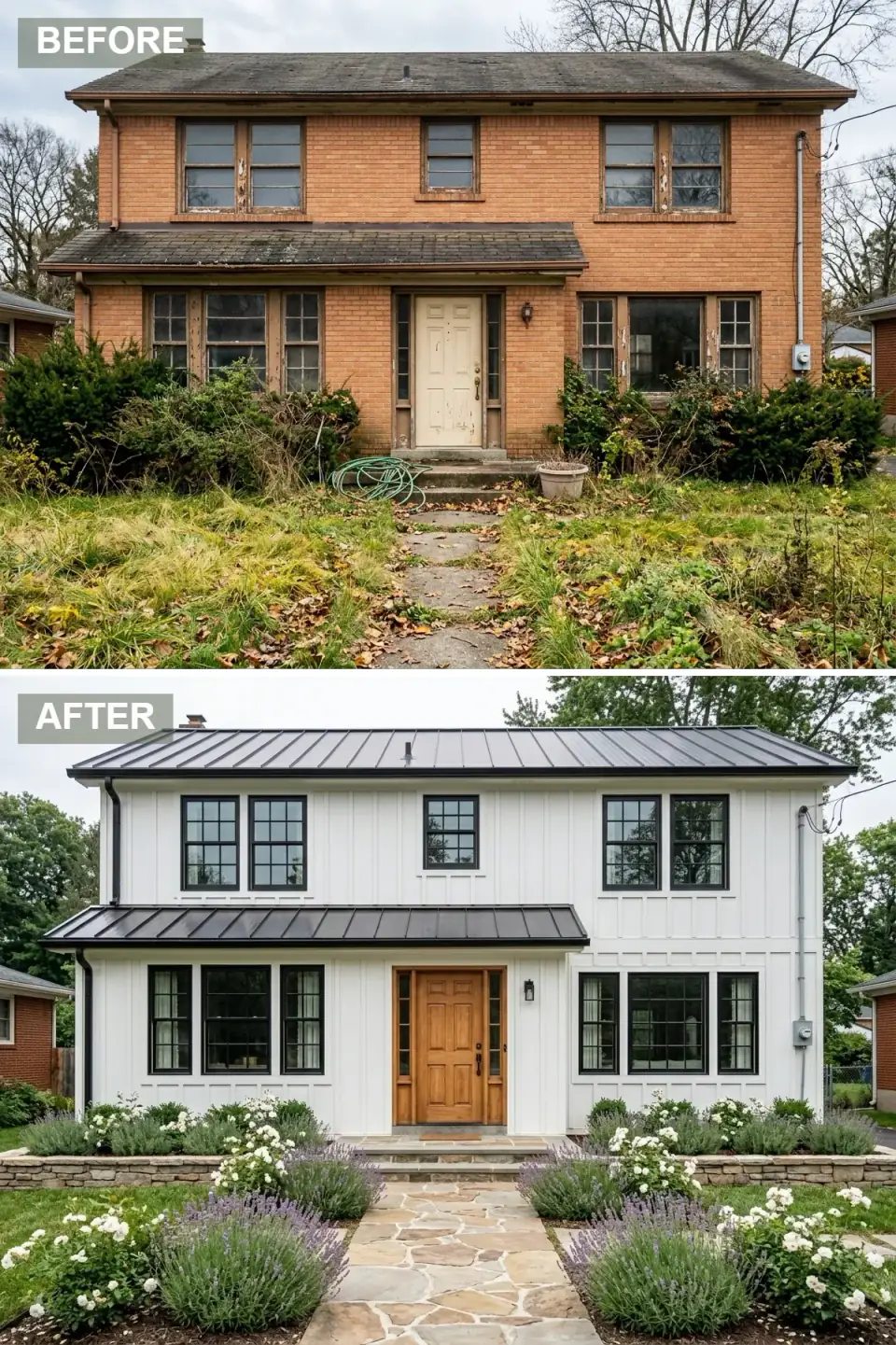
The widest-appeal direction of the nine, and a clean way to handle dated brick without touching it. Cladding over brick with board-and-batten changes the architectural language entirely while leaving the masonry as a substrate — just confirm the new siding gets a ventilated rainscreen gap and proper flashing where it meets the existing brick. Spec the board-and-batten in James Hardie ColorPlus or LP SmartSide for paint retention (primed pine is a five-year repaint cycle here), run battens 12 to 16 inches on center, and the black standing-seam roof both reads agrarian and sheds snow. The fieldstone wall and lavender-rose-boxwood beds are regionally appropriate; lavender just needs sharp drainage and full sun, which a raised stone-bordered bed provides nicely.
Color Palette
Crisp board-and-batten — in fiber-cement or engineered wood for durable color retention.
Dark charcoal standing-seam metal referencing agricultural buildings, in a Kynar finish.
A warm golden wood tone at the center of the symmetrical composition.
Warm tan-grey natural stone for the low garden wall and walkway.
How to read this renovation
- Cladding over brick needs a ventilated rainscreen gap and careful flashing at the transition — don't fur strips tight to the masonry.
- Board-and-batten in fiber-cement or engineered wood holds paint far longer than primed pine; run battens 12 to 16 inches on center.
- White cladding with a black roof and black windows is the high-contrast formula that defines the modern-farmhouse read.
- Lavender needs sharp drainage and full sun — a raised, stone-bordered bed is the right home for it in the Northeast.
5. Southwest Adobe Revival
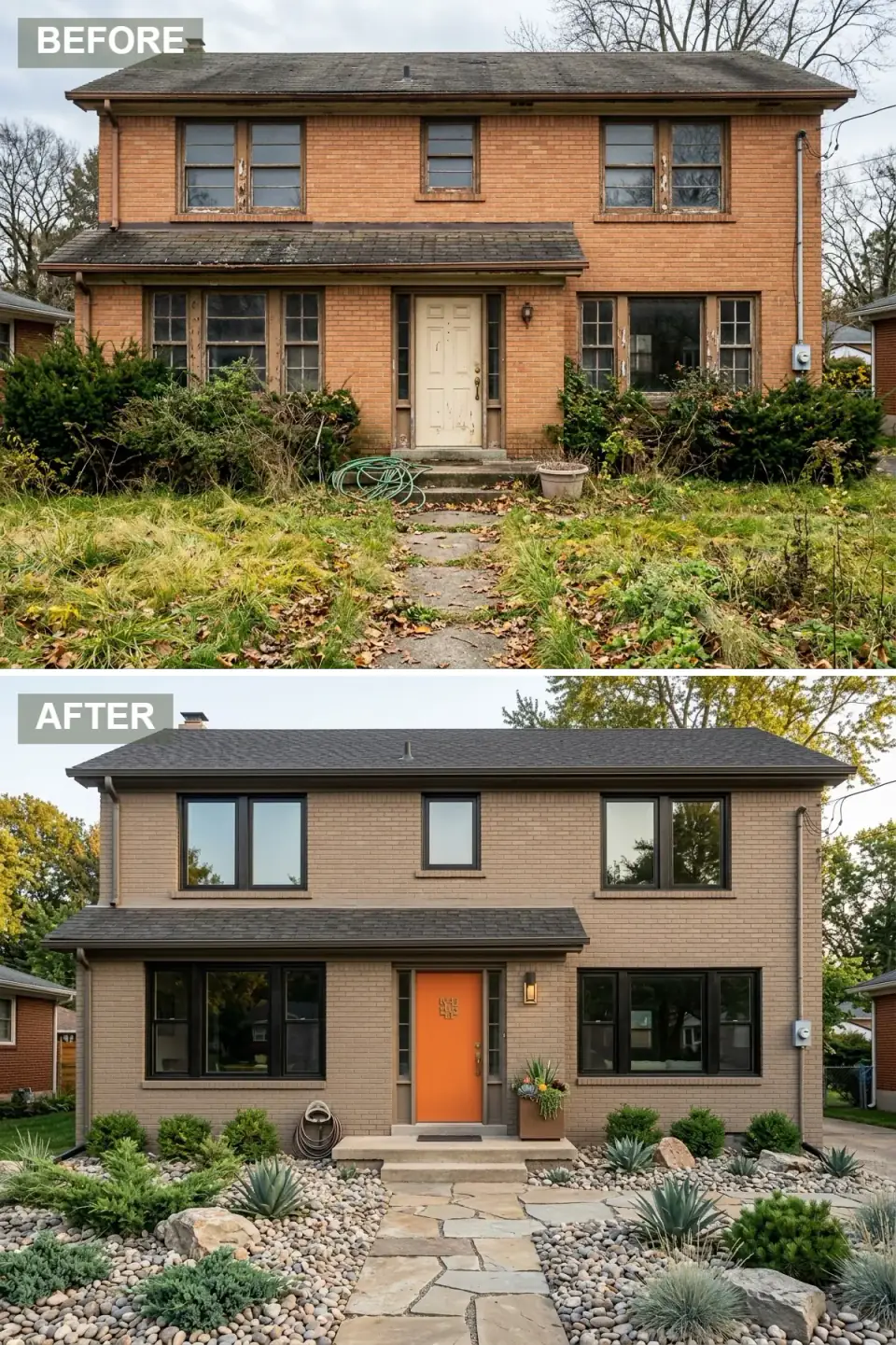
The smartest building-science move of all nine is hiding in this one: staining the brick instead of painting it. A masonry stain (like a breathable mineral stain) soaks into the brick and changes its color while preserving the natural mineral variation and, crucially, the brick's ability to breathe — no film, no spalling risk. So even though this is styled as a Southwest adobe, the technique is exactly what I'd recommend on a Northeast house that wants to warm up its brick tone. The tangerine door is the single high-saturation accent that makes the whole neutral facade sing — a great, low-cost lesson in restraint. The catch is the same as #3: the succulent rock garden is a Southwest climate borrowed onto the wrong site. Keep the boulders and flagstone, swap the succulents for hardy sedum and ornamental grasses.
Color Palette
A breathable masonry stain that warms the brick while keeping its texture and vapor-openness.
Deep brown-grey roof and trim anchoring the warm earth tones.
The single bold accent — one high-saturation color does more than a dozen muted ones.
Mixed grey-and-tan pebbles — keep the stone, swap the succulents for hardy alternatives.
How to read this renovation
- Staining brick beats painting it — a mineral stain recolors while preserving texture and the brick's ability to breathe.
- One high-saturation accent door enlivens an entire neutral facade; resist adding a second bold color.
- Rock gardens cut water and maintenance, but choose Zone 5 hardy sedum and grasses over Southwest succulents.
- Combine flagstone and gravel for textural contrast, and set flagstone on a frost-stable base so it doesn't heave.
6. Rustic Stone Sanctuary
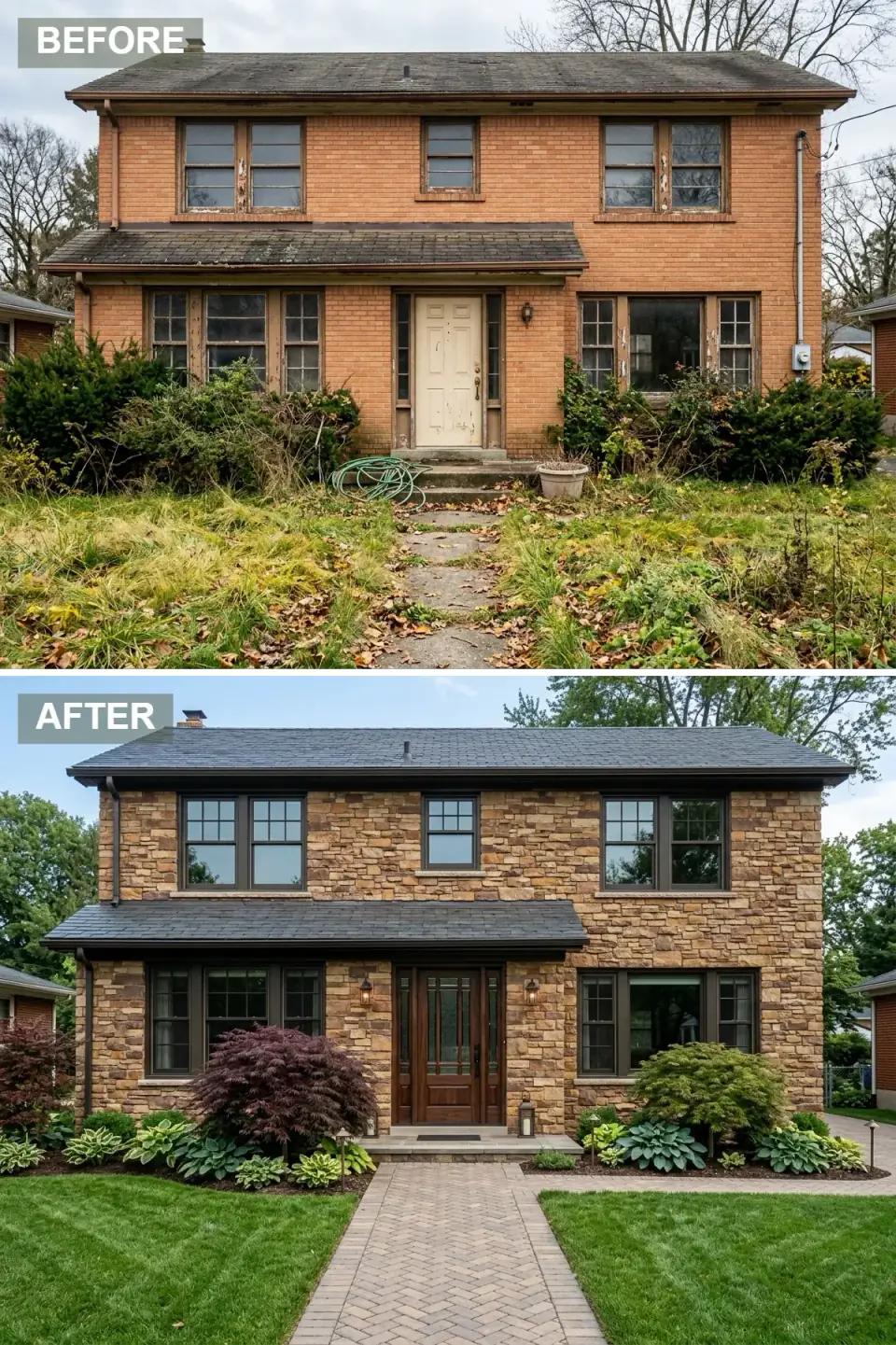
The most expensive transformation here and the one with the biggest structural footnote. Veneering the entire house in natural stone gives it genuine lodge-like gravitas, but full-coverage stone veneer adds real dead load and, more importantly, must be installed over a proper drainage plane — a weather-resistive barrier, a drainage mat, and a weep screed at the base. Stone slapped against the brick with no air gap is the single most common envelope failure I'm called to fix; the water gets behind it and has nowhere to go. Done right, with real stone or a deep cultured veneer (Eldorado Stone, Boral), this is a fifty-year facade. The herringbone brick walkway is beautiful craftsmanship, and the burgundy Japanese maple is hardy through Zone 5 in the right cultivar ('Bloodgood', 'Crimson Queen'). This is a build for an owner with the budget to do the stone properly.
Color Palette
Variegated natural stone in copper and tan — installed over a true drainage plane, never tight to the wall.
Deep brown frames and door surround reinforcing the rustic palette.
Dark blue-grey shingles complementing the warm stone tones.
A warm metallic finish on the carriage-style entry lanterns.
How to read this renovation
- Stone veneer must go over a weather-resistive barrier, drainage mat, and weep screed — code requirement, not preference, in freeze-thaw.
- Full-coverage stone adds dead load; have an engineer confirm the footings and lintels can carry it.
- Real stone or a deep cultured veneer reads with shadow and depth a thin 1.5-inch veneer can't fake.
- A burgundy Japanese maple is hardy through Zone 5 in 'Bloodgood' or 'Crimson Queen' — a reliable year-round focal point.
7. Pure White Minimalist
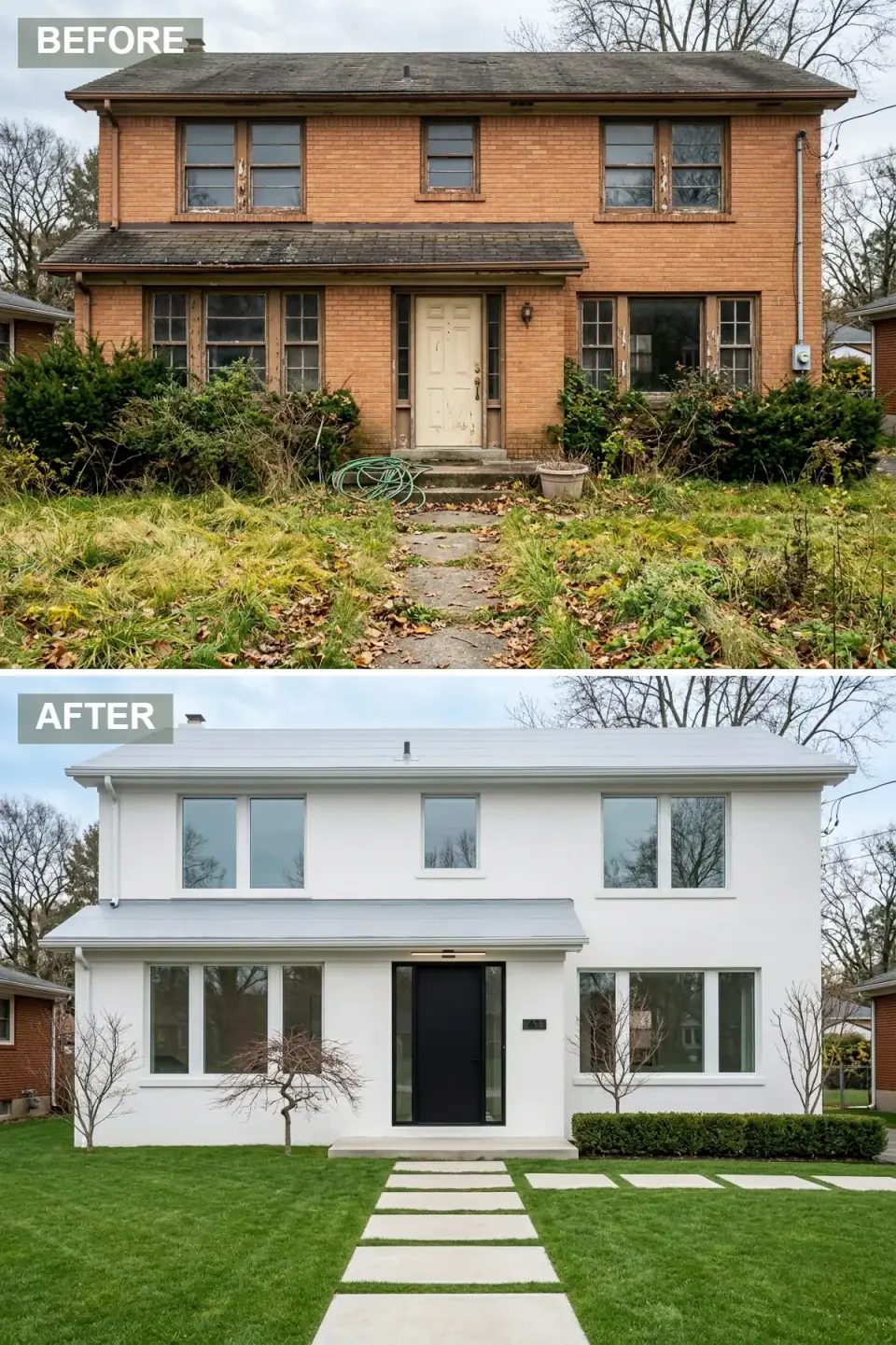
The most disciplined and least forgiving of the nine. Unifying every surface — render, roof, and trim — in white turns the house into a sculptural volume, with the ebony door as the single deliberate void. It's a stunning effect and it depends entirely on perfect execution: any flashing reveal, any inconsistent shadow line, any uneven render patch reads instantly on an all-white volume. The render-over-brick is the same envelope conversation as #3 — build it in a smooth fiber-cement panel with detailed flashing rather than three-coat stucco for Northeast durability. White is also a maintenance reality near grade and under trees: it shows dirt, algae, and salt spray, so budget a periodic soft-wash. The restraint in the landscape is correct — minimalism wants sculptural form and negative space, not a full garden.
Color Palette
Crisp white render and trim forming one continuous sculptural envelope.
A pale roof tone matched to the walls for an unbroken volume.
A deep black door providing the sole, deliberate point of contrast.
Light grey cast-concrete pavers set in lawn for a floating geometric walkway.
How to read this renovation
- An all-white volume hides nothing — every flashing line and render patch shows, so execution has to be flawless.
- Render over brick is the rainscreen conversation again; a smooth fiber-cement panel is the durable Northeast substitute.
- White facades show dirt, algae, and road salt — budget a periodic soft-wash, especially near grade and under trees.
- Keep landscaping minimal and sculptural; on a blank white volume, less planting reads as more intentional.
8. Natural Nordic Cottage
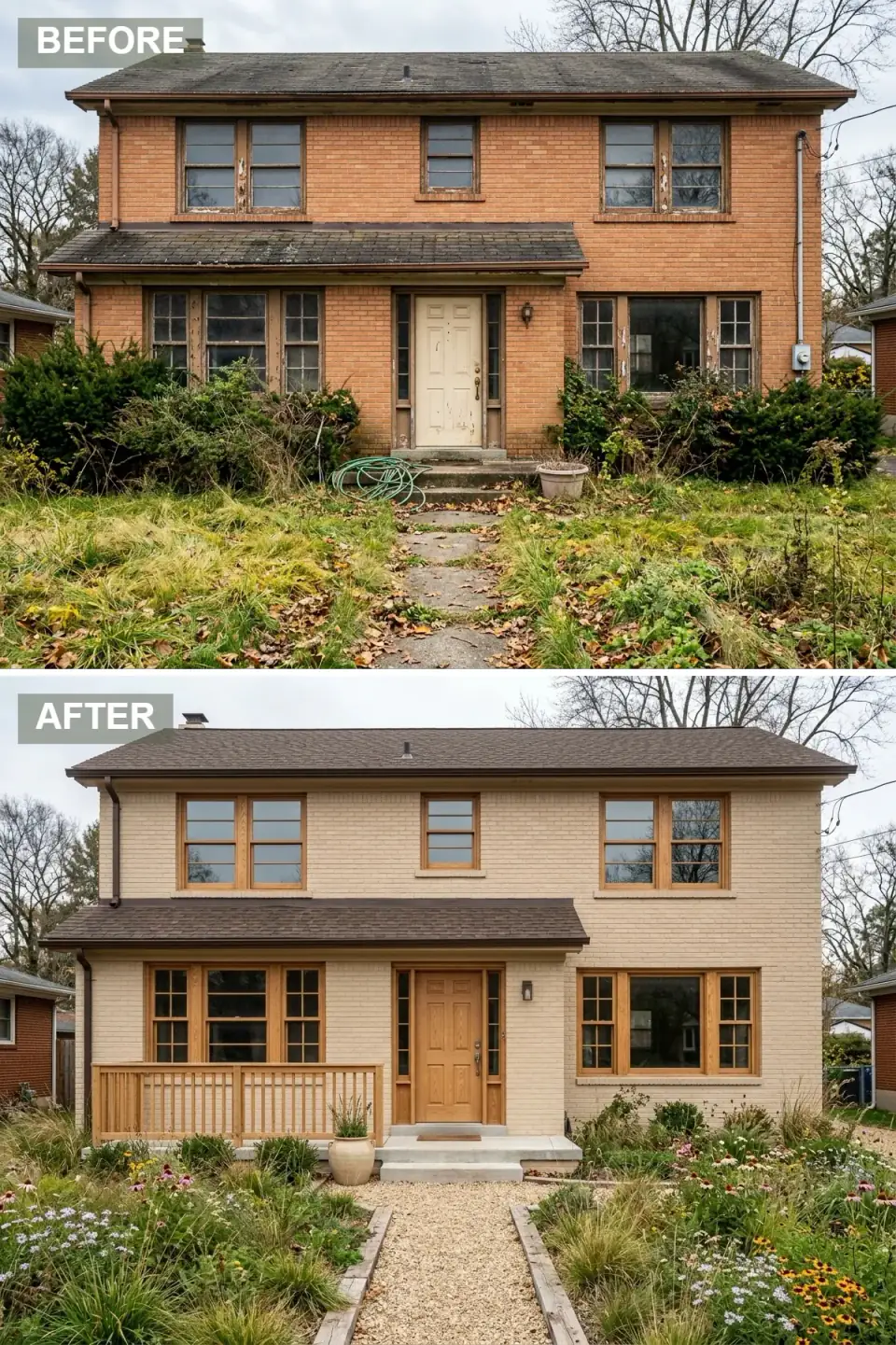
A close cousin of the cream-elegance scheme but warmer and more relaxed, and another correct use of limewash — here in an oatmeal tone that lets the masonry texture read through rather than burying it. That partial-coverage, texture-forward limewash is exactly what makes it feel handcrafted instead of painted. The honey oak window frames and timber porch rail bring the Scandinavian warmth, and the standout move is the landscape: replacing formal hedges with a native pollinator meadow of grasses, coneflowers, and daisies is both beautiful and genuinely ecological, and it thrives in the Northeast with almost no irrigation once established. The gravel ribbon edged in weathered wood suits the relaxed aesthetic. This is the lowest-maintenance, most ecologically sound landscape of the nine.
Color Palette
A breathable oatmeal limewash applied to let the brick texture whisper through.
Light golden wood on windows, door, and rail — sealed for UV to hold the tone.
Dark brown shingles adding depth above the soft beige walls.
Grey-brown natural wood edging the gravel ribbon for a garden-rustic feel.
How to read this renovation
- A lighter, partial-coverage limewash lets brick texture show — the move that reads handcrafted rather than painted.
- Honey-oak wood trim evokes Nordic warmth but needs a UV-stable finish, or it greys within a couple of seasons.
- A native pollinator meadow is beautiful, ecological, and nearly irrigation-free once established in the Northeast.
- Edge gravel paths with reclaimed or weathered wood for a relaxed, garden-inspired approach.
9. Nautical Bold Tradition
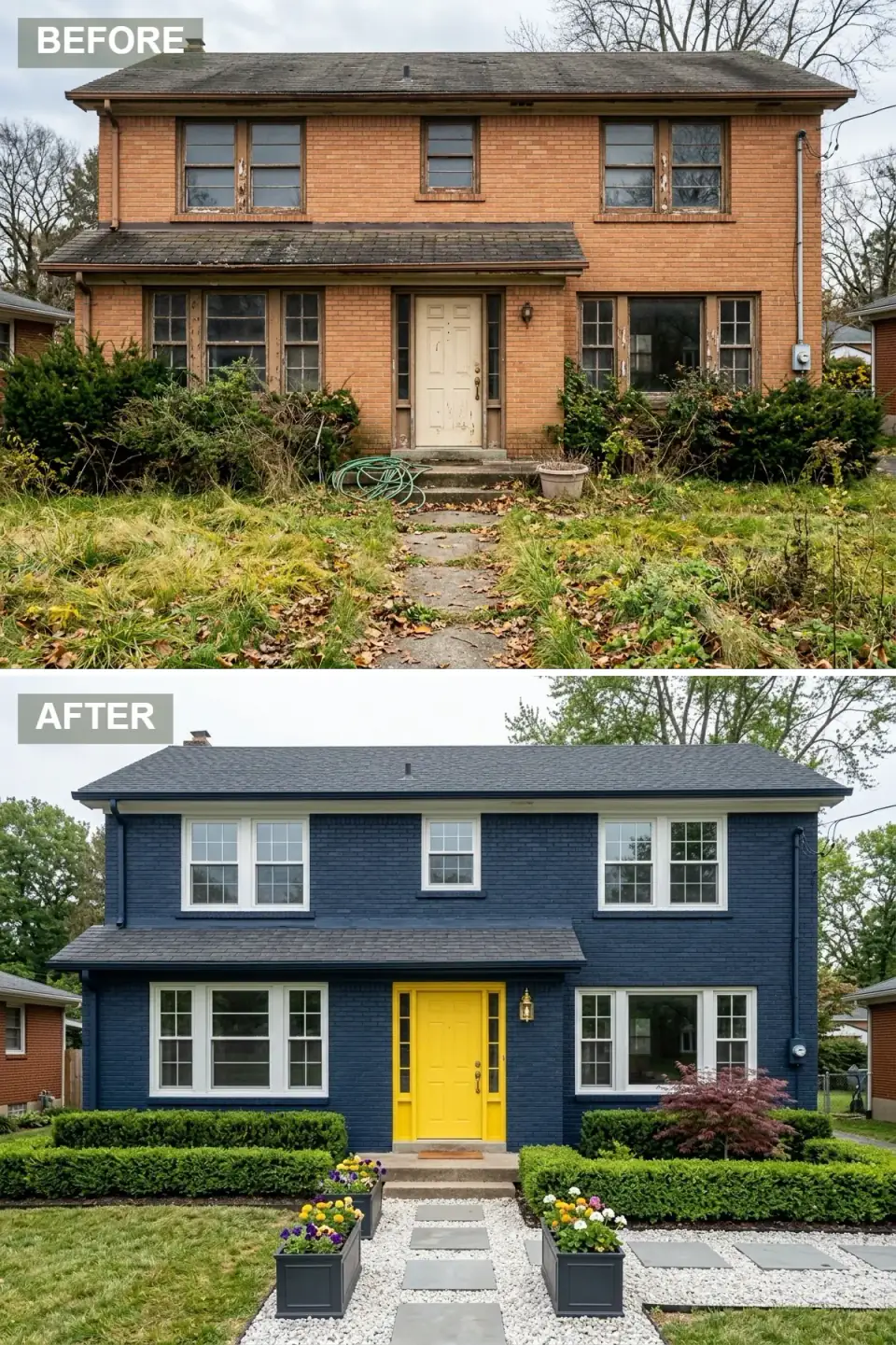
A confident, joyful end to the set — deep navy brick, crisp white trim, and a canary-yellow door that's the exclamation point. Navy-and-white is one of the most resilient color pairings in the Northeast, reading equally at home on a coastal Connecticut house and a Hudson Valley village street. Same brick caution as the dark schemes: if you're painting real masonry navy, use a breathable mineral paint, not standard latex, or you'll trap moisture under that dark film. The yellow door is a lesson in calculated boldness — one saturated accent against a disciplined navy-and-white field reads as designed, not chaotic. The formal boxwood-and-gravel garden keeps it tailored, and the burgundy Japanese maple (hardy in Zone 5) and brass sconce layer in the sophistication that balances the playfulness.
Color Palette
Deep navy painted brick — Benjamin Moore Hale Navy in a breathable mineral formula on masonry.
Bright white muntin windows and trim for classic high contrast against the navy.
A vibrant yellow door as the one joyful, calculated exclamation point.
Deep grey rectangular planters flanking the entry steps.
How to read this renovation
- Navy on real brick still needs a breathable mineral paint — dark film-forming latex traps the most moisture of all.
- One saturated accent door against a disciplined navy-and-white field reads designed; two competing brights read chaotic.
- Formal boxwood hedges with white gravel give a tailored, coastal-garden structure that holds through winter.
- White-framed, divided-light windows keep a bold color scheme reading classic rather than trendy.
Pro Tips: How I Read These Renovations
- Decide the brick treatment first, because most of these are irreversible. Limewash and mineral stain bond into the masonry and stay breathable — they age gracefully and don't trap moisture. Standard latex paint forms a film that can spall brick in freeze-thaw and is nearly impossible to remove. Stucco and stone veneer change the envelope and demand a rainscreen or drainage plane. Before you fall in love with a color, decide what you're doing to the wall and whether you can ever undo it. I dig into that read-before-you-renovate thinking in The Renovation Mind.
- Repair and prep the masonry before any finish. Repoint failing mortar, clean the brick, and let it fully dry before limewash, stain, paint, or veneer. The most common reason these finishes fail early is skipped prep — a beautiful charcoal wash over crumbling mortar joints is money spent on a problem you've now hidden instead of fixed.
- Match the landscape to Zone 5b, not the rendering. Three of these nine lean on desert planting — agave, succulents, a Southwest xeriscape — that looks great in a render and dies in the first Hudson Valley February. Keep the gravel and the architectural intent; swap the plants for hardy yucca, sedum, ornamental grasses, and a pollinator meadow. The hardscape travels; the plants don't.
- The roof is half the facade. The roof occupies a huge visual field, so its color and material drive the whole contrast ratio. Coordinate it with the wall treatment before you commit, and remember a standing-seam metal roof both reads contemporary and earns its keep shedding Northeast snow.
- Spend the detail budget on the entry. The door, the sconces, the porch soffit, and the entry hardware are where the eye lands and where craftsmanship reads. A considered entry lifts an entire facade; a builder-grade door undercuts even the best paint job. It's the highest-return detail dollar on the whole project.
Brick Exterior Renovation FAQ
Should I paint, limewash, or stain my brick?
For most older brick homes in the Northeast, limewash or mineral stain is the better choice over standard paint. Both bond into the masonry and stay vapor-open, so the brick can still release moisture — important in a freeze-thaw climate where trapped water spalls the brick face. Limewash gives a soft, textured, lighter finish that patinas with age; mineral stain recolors while preserving the brick's natural variation. Standard latex paint forms a film that can trap moisture and is nearly impossible to remove later. If you want a fully painted look, use a breathable mineral masonry paint rather than acrylic latex.
Is painting brick permanent?
Effectively, yes. Once standard paint is on brick, removing it completely is difficult, expensive, and risks damaging the masonry surface — chemical strippers and abrasive blasting can both harm the brick face. That's why the decision deserves real thought before you start. Limewash is more forgiving because it weathers and can be re-coated or allowed to wear, and mineral stain soaks in rather than coating the surface. If there's any chance you'll want the natural brick back someday, limewash or stain rather than paint.
How much does a brick exterior makeover cost in the Northeast?
It depends heavily on the treatment. Limewashing or staining brick on a typical house runs roughly $5,000–$15,000 including prep and repointing. A full breathable-paint job lands similarly. Cladding over brick with fiber-cement board-and-batten runs $25,000–$60,000. Full stone veneer is the most expensive at $40,000–$120,000 or more, given the material, the drainage detailing, and the labor. Add new windows, a quality door, roofing, and landscaping and a complete facade transformation in 2026 Hudson Valley pricing commonly falls between $40,000 and $150,000. Get at least three local bids.
Can I put stucco or stone veneer over my existing brick?
Yes, but both are envelope changes that require proper water management, not just a surface applied to the brick. Stucco needs a rainscreen and weep system so moisture can drain and dry; in the Northeast I often substitute a smooth fiber-cement panel for true three-coat stucco to avoid the maintenance and failure risk. Stone veneer must be installed over a weather-resistive barrier, a drainage mat, and a weep screed at the base, and it adds dead load that should be checked against the foundation and lintels. Done with the right detailing, both last decades; done tight to the wall with no drainage plane, both fail.
Will a desert or Southwest landscape survive in the Northeast?
The plants won't, but the look can be adapted. Agave, most succulents, and many Southwest specimens aren't hardy below roughly USDA Zone 8 and will die in a Hudson Valley winter. The good news is the hardscape — gravel, boulders, flagstone, river rock — travels fine, and you can recreate the sculptural, low-water aesthetic with cold-hardy substitutes: Yucca filamentosa, hardy sedums, ornamental grasses like little bluestem and feather reed grass, and alliums. You keep the modern, water-wise feel without replanting every spring.
What's the highest-impact, lowest-cost exterior upgrade?
Paint or restain the front door a confident accent color and upgrade the entry hardware and lighting. The eye lands on the entry, so a saturated door (against a restrained facade), a quality lever or handleset, and well-chosen sconces deliver an outsized first impression for a few hundred to a couple thousand dollars. Beyond that, refreshing the foundation planting and replacing a cracked concrete walkway with bluestone or large pavers are the next-best returns. The biggest mistakes are the reverse — spending heavily on the wall while leaving a tired builder-grade door and dated light fixtures untouched.
Where to Read Next
If this one-house-many-faces format is your thing, my eleven-way curb-appeal study and my one-house-ten-destinies masterclass both run the same comparative, plan-aware lens across different bone structures. For a cottage-specific take on the before-and-after, the cottage exterior makeover guide walks through the same material decisions on a smaller footprint.
Sources & References
- U.S. National Park Service. Preservation Brief 1: Cleaning and Water-Repellent Treatments for Historic Masonry. nps.gov.
- U.S. National Park Service. Preservation Brief 2: Repointing Mortar Joints in Historic Masonry Buildings. nps.gov.
- Romabio. Classico Limewash & Masonry Flat Paint — Breathable Mineral Coating Documentation. romabio.com.
- Brick Industry Association. Technical Notes on Painting and Coating Brick Masonry. gobrick.com.
- James Hardie. Architectural Panel & ColorPlus Documentation — fiber-cement cold-climate performance. jameshardie.com.
- Eldorado Stone. Stone Veneer Installation & Drainage Plane Guidelines. eldoradostone.com.
- USDA. Plant Hardiness Zone Map — cold-hardiness reference for Northeast planting. planthardiness.ars.usda.gov.
- This Old House. Exterior Makeover & Curb Appeal Cost Guide — regional Northeast benchmarks.
- Remodeling Magazine 2024 Cost vs. Value Report — Northeast exterior project return-on-investment data.
- Architectural Digest. Exterior Color & Material Trend Reporting — facade, door, and hardware references.
Closing Read
Nine facades from one dated brick house, and the lesson underneath all of them is the same: the color is the easy decision, and the treatment of the brick is the one that actually matters. Limewash and stain respect the masonry and keep your options open; paint and cladding and veneer each commit you to something harder to reverse and demand the building science be done right. Pick the look you love from these nine — graphite, cream, farmhouse, navy, whatever fits your street and your taste — but make the brick decision with your eyes open, prep the masonry properly, and plant for the climate you actually live in. Read the plan first. Then renovate, with intent.

Nora Whitfield
Renovation Designer & Interiors Editor · Beacon, New YorkNine years of design-build renovation work across the Hudson Valley and the Northeast. Nora runs the Renovations, Room Guides and Renovation Mind desks — before-and-after studies, room-by-room design guides, and the long essays on why what we renovate matters.
More from Nora →
Reader notes