

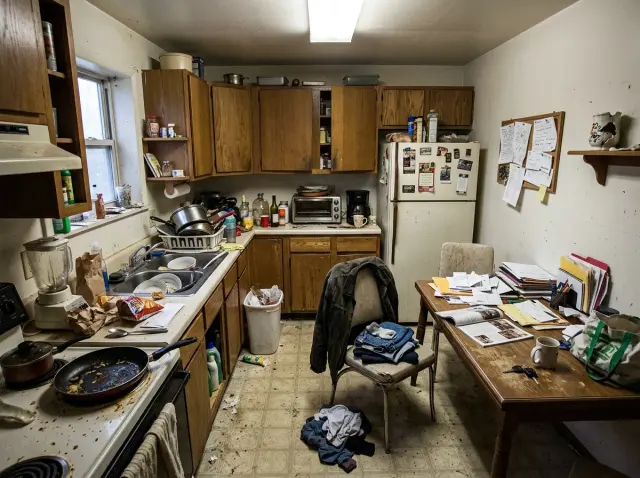
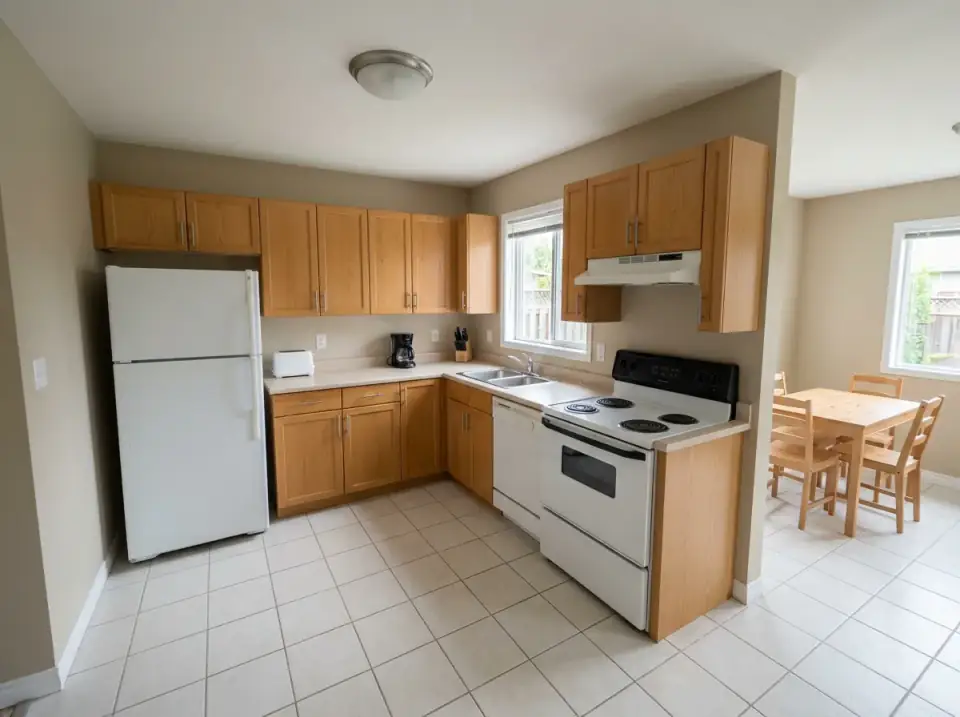
A 1990s Hudson Valley galley kitchen — laminate cabinets, vinyl flooring, eight feet of cluttered counter — sits in front of you. The bones are decent: real wall framing, a workable plumbing chase, a sound floor joist span, and one south-facing window that should be carrying more daylight than it does. Below: eight makeovers of that same footprint, the framing-stage moves each style depends on, the brand-level cabinetry and stone specs that separate a kitchen that ages with intent from one that ages into a Pinterest screenshot in five years, and the 2026 Beacon-to-Kingston budget ranges I'd quote at a first consultation.
How I Read a Kitchen Renovation
When a Beacon, Rhinebeck, or Brooklyn-brownstone client emails me about a tired kitchen, I read four things before I open a single cabinet catalog. First, the plumbing and gas chase: most 1990s Northeast kitchens have the sink, dishwasher, and gas range tied to a single chase wall — move the range and you're moving the gas line, which means a permit, a Mason Dixon-licensed plumber in the Hudson Valley, and a $4,000–$8,000 surprise. Second, the electrical service: a 100-amp panel can handle most modern induction kitchens but not a full 36-inch induction range plus a steam oven plus a 48-inch panel-ready refrigerator — that combination needs a 200-amp upgrade. Third, the window-to-counter alignment: most builder kitchens put the sink under the window for plumbing reasons, but if you can keep the sink on the chase wall and free the window, you get a daylight read that transforms every photograph. Fourth, the traffic pattern: a galley becomes a peninsula, a peninsula becomes an island, and the island only works if you have 42 inches of clearance on every side.
Pass those four and you have a styling problem; fail any of them and you have a structural problem to solve first. The eight makeovers below run from a $35,000 cosmetic refresh (paint, hardware, counter swap) up to a $180,000+ full gut with custom cabinetry and stone. For a deeper read on the quietest end of the spectrum, the quiet luxury kitchen with integrated appliances guide covers the panel-ready refrigerator and integrated steam-oven approach in detail, and the moody organic modern kitchen guide walks the darker end of the palette spectrum on a similar footprint.
1. Warm & Inviting Modern Farmhouse
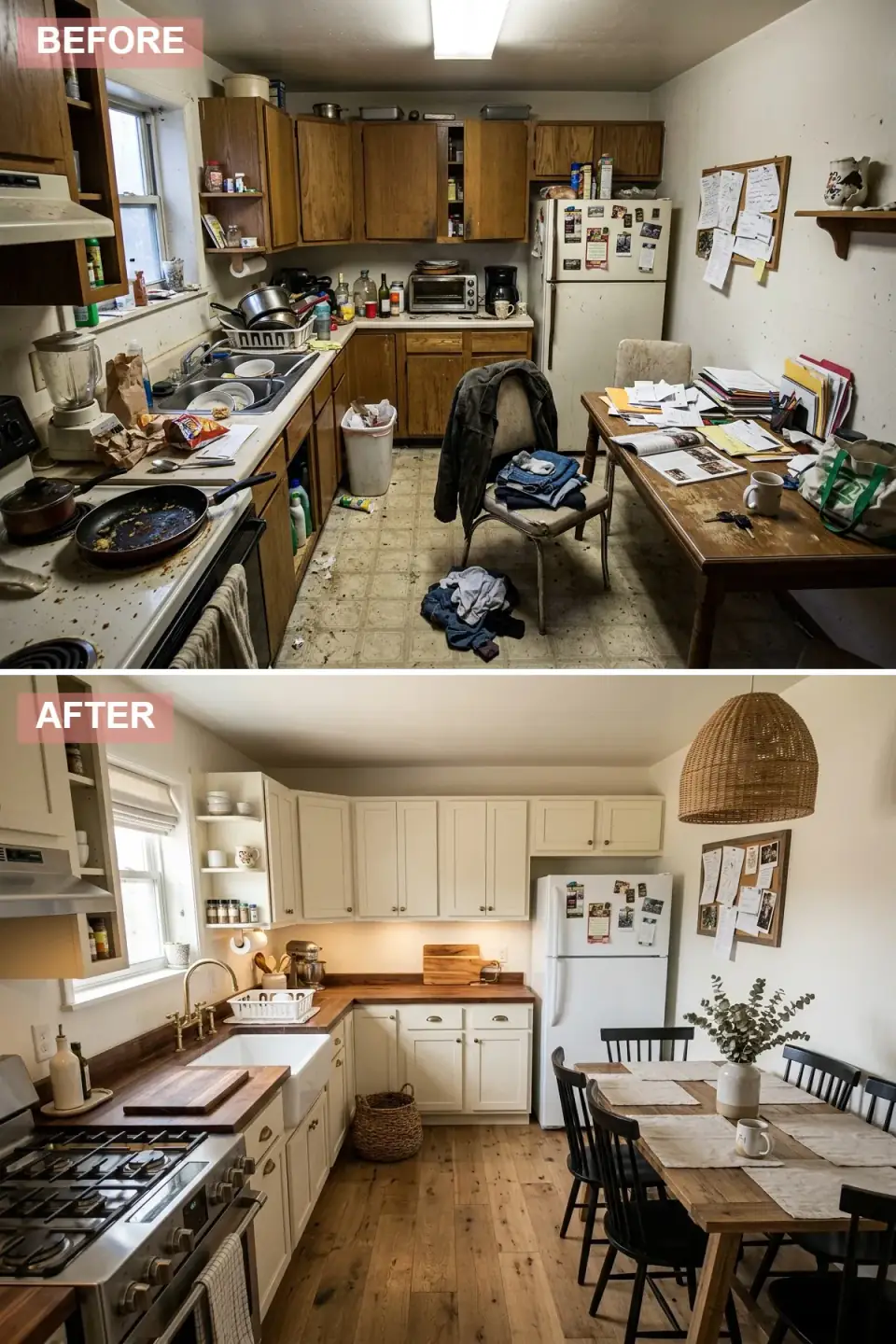
Cream shaker cabinets, butcher-block counters, a fireclay apron-front farmhouse sink, brushed-brass hardware, wide-plank oak flooring. The transformation reads warm and intentional rather than themed — the difference between a modern farmhouse that ages 20 years and a Pinterest-trend farmhouse that ages out in three. The black Windsor chairs and the wrought-iron chandelier are the contrast notes that prevent the cream-on-cream from going saccharine.
Plan-aware verdict: spec semi-custom shaker fronts from KraftMaid Vantage, Bellmont, or Conestoga (factory-finished in Benjamin Moore White Dove OC-17 or Sherwin-Williams Alabaster SW 7008) rather than field-painted boxes — factory finishes are spray-applied in a temperature-controlled booth and last twice as long as a job-site spray. Butcher-block counters in walnut or hard maple need oiling every 3–6 months with food-safe mineral oil; if maintenance isn't your thing, spec Caesarstone Frosty Carrina or Cambria Carrick instead and keep the walnut as a single 30-inch baking-station section. The farmhouse sink (Shaws Original or Kohler Whitehaven) needs a reinforced cabinet base — most stock sink cabinets won't take 80 pounds of fireclay without a custom support kit. Budget $45K–$80K for this makeover in 2026 Hudson Valley pricing on a 12-by-14 kitchen footprint.
Color Palette
Benjamin Moore White Dove (OC-17) or Sherwin-Williams Alabaster (SW 7008) — warm-leaning whites that flatter brass and wood.
Boos Block American black walnut, 1.5-inch thick, finished with food-safe mineral oil and re-oiled quarterly.
Wide-plank (5–7″) white oak with a Rubio Monocoat or Bona Traffic HD oil-finish — Hudson Valley vernacular.
Wegner-style Windsor or Eames-influenced black chairs from DWR or O&G Studio — the contrast that lifts cream from saccharine to designed.
2. Sleek & Sophisticated Minimalist
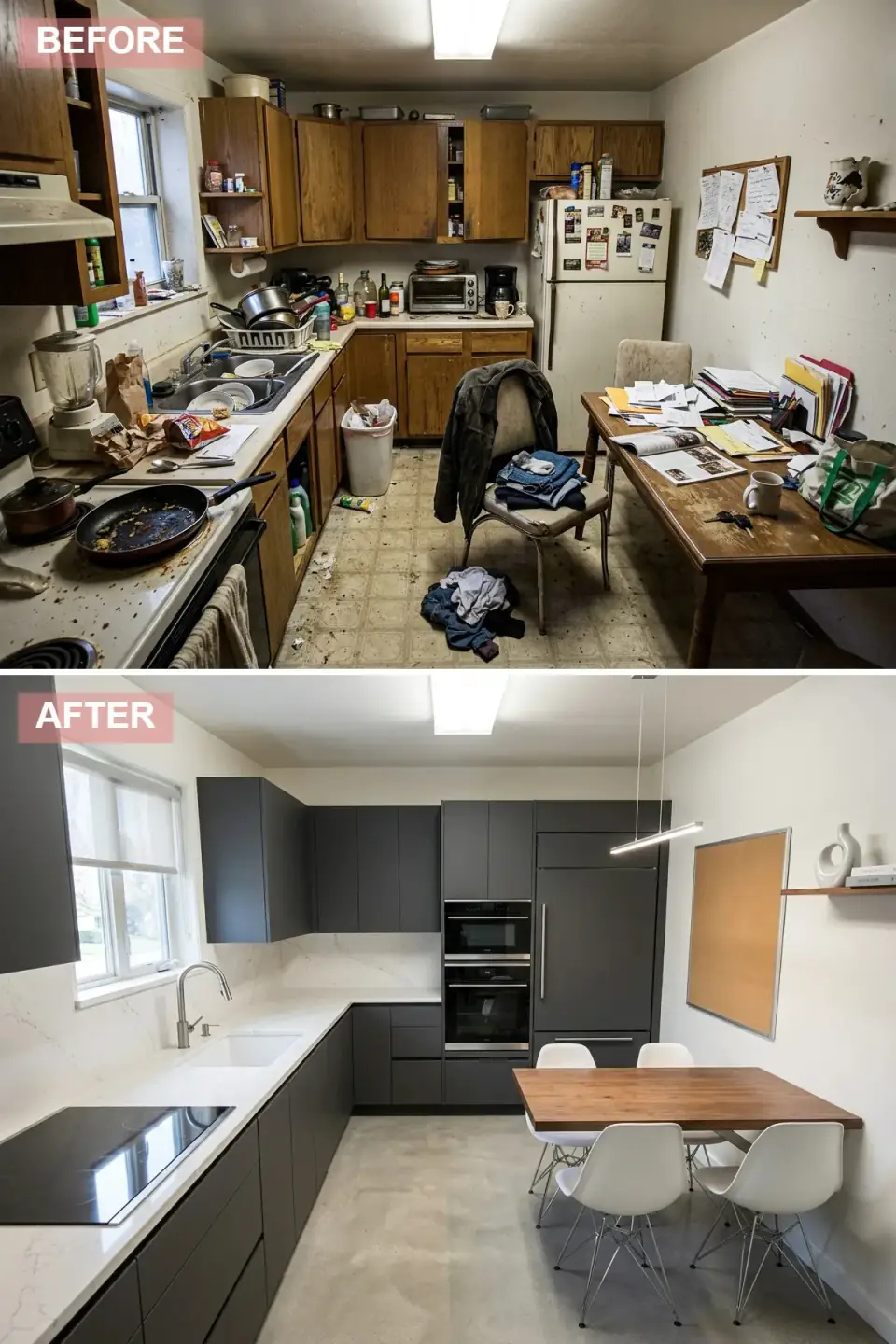
Charcoal flat-panel cabinets, full-height white quartz backsplash, panel-ready integrated appliances, polished concrete floor, linear LED pendant. This is the renovation a couple commits to when they want the kitchen to recede into the architecture — every visible line is intentional, every appliance disappears behind a panel, every fixture sits flush. It's the kitchen I'd specify for a contemporary Beacon riverfront condo or a contemporary Catskills modern barn.
Plan-aware verdict: full-overlay flat-panel cabinets read minimalist only if the gaps are perfect — 3/32 of an inch around every door, with no shadow line variation. That precision is the difference between a $35,000 semi-custom box (which won't hold the tolerance) and a $75,000 fully-custom European cabinet line (Henrybuilt, Plain English, Reform with Semihandmade fronts on IKEA boxes for the cost-conscious version). Panel-ready Sub-Zero column refrigerators run $11,000–$15,000 installed in the Hudson Valley; the Miele or Bosch panel-ready dishwasher adds another $1,500–$2,500. Full-height quartz backsplash needs a 12-foot maximum slab length — bigger kitchens require a seam, which an experienced fabricator (Stone Source, Cosmos Granite Hudson) can hide along a grout line or a corner.
Color Palette
Sherwin-Williams Iron Ore (SW 7069) or Benjamin Moore Wrought Iron (2124-10) on factory-spray-finished MDF, or Reform Match in Iron Ore.
Caesarstone Frosty Carrina, Cambria Brittanicca, or Silestone Eternal Statuario — quartz reads cleaner than marble under task lighting.
Cementitious polish with a 1500-grit finish, sealed with Prosoco Saltguard — durable, light-reflective, easy to maintain.
Carl Hansen CH338 or Wegner-style pedestal in American black walnut — the one warm note in an otherwise cool palette.
3. Calm & Organic Scandi-Japandi
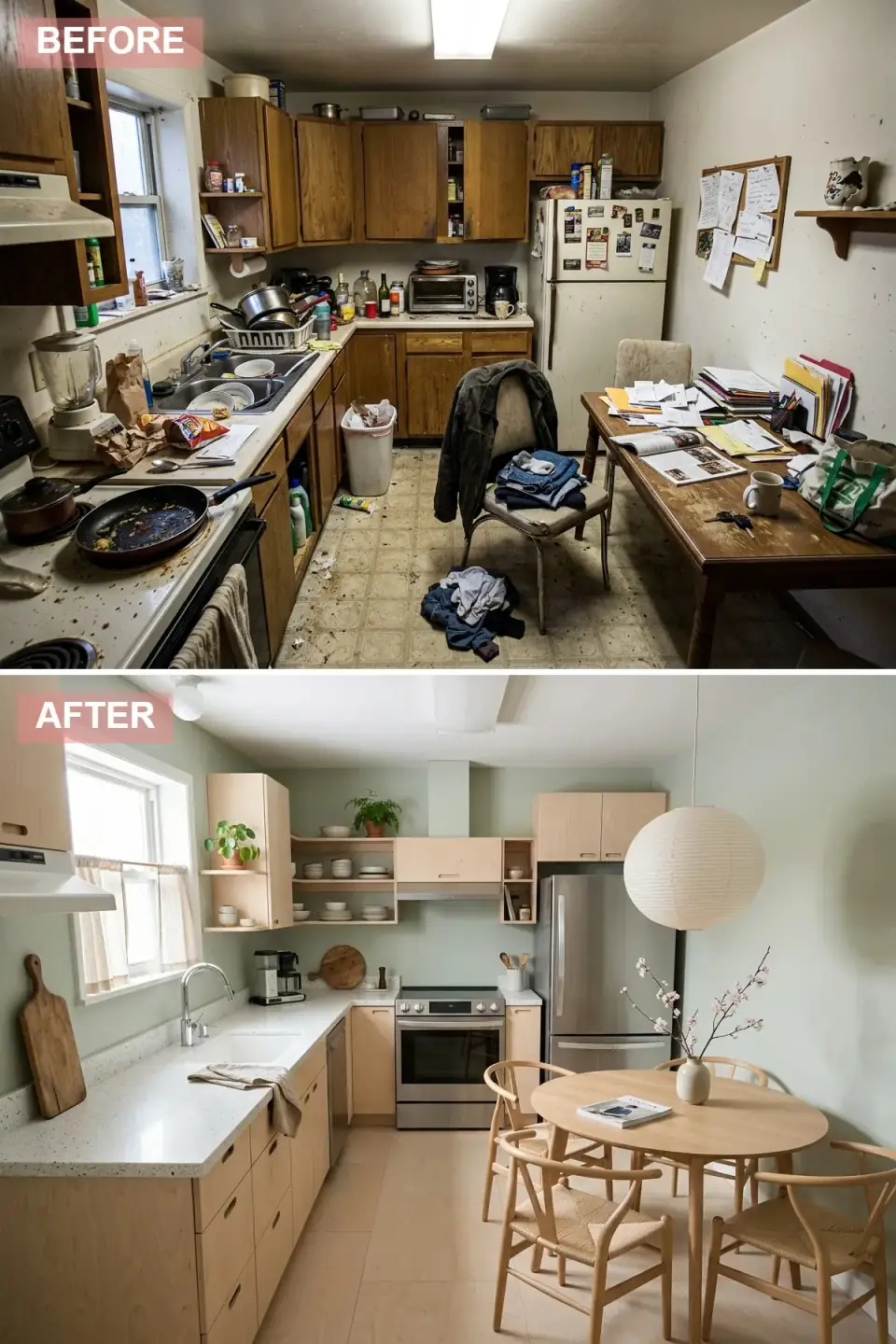
Light ash cabinets, terrazzo counters, sage plaster walls, paper-lantern pendant, wishbone chairs. The Scandi-Japandi register is the calmest of the eight — every material asks you to slow down. The light-on-light palette reads almost monastic, which is the point. This works in a Hudson Valley weekend house where the brief is “quiet” and works less well in a high-energy family kitchen where everything will be coated in flour and tomato sauce within 90 days.
Plan-aware verdict: light ash cabinets (Reform Basis, Semihandmade FRAME in Natural Oak, or fully custom from Henrybuilt in white-oiled ash) show every scratch. Spec a Rubio Monocoat or Osmo Polyx-Oil finish so individual scratches sand-and-spot-repair easily; never spec a polyurethane top-coat — it can't be spot-repaired without re-doing the entire panel. Terrazzo counters with cement binder are stunning but porous — a hot pan over a sealer breach leaves a permanent mark within an hour. Spec a resin-bound terrazzo (Diespeker, Concrete Collaborative) for kitchen use instead. The paper-lantern Akari Noguchi pendant is gorgeous but rice-paper and tropical-storm humidity don't mix — keep it 6+ feet from any cooktop vent.
Color Palette
Farrow & Ball Mizzle (No. 266) or Benjamin Moore Saybrook Sage (HC-114) on a Roman clay plaster finish from Portola Paints.
European ash or quartersawn white oak finished with Rubio Monocoat Pure — preserves grain without yellowing under LED light.
Diespeker resin terrazzo or Concrete Collaborative slab — kitchen-rated, no porosity issues.
Akari Noguchi 70EN or Isamu Noguchi 75A — the real article from Vitra or Noguchi Museum, not a knock-off.
4. Raw & Rugged Industrial Rustic
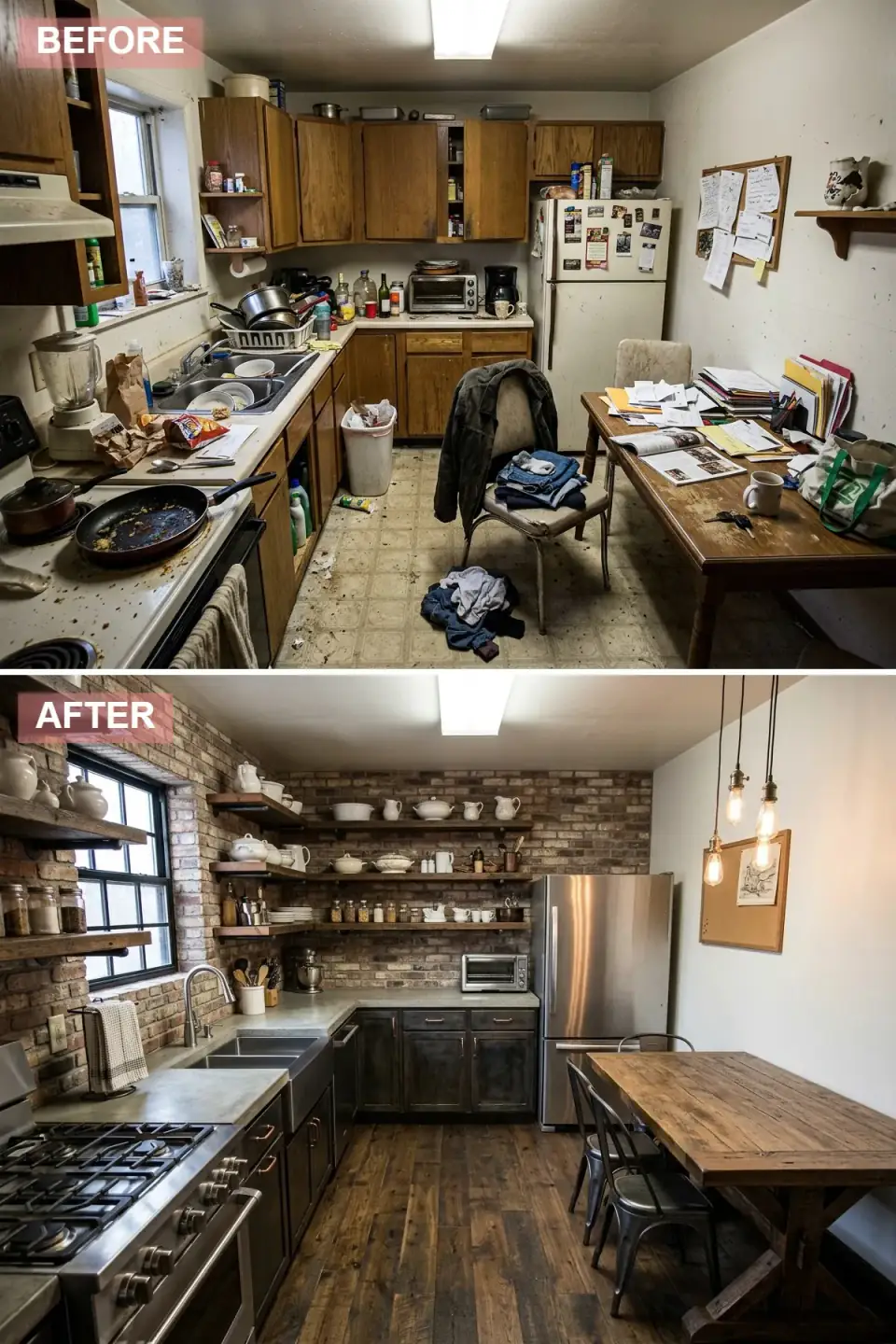
Exposed brick, distressed black metal cabinets, concrete counters, open shelves on pipe brackets, reclaimed wood floor, Edison pendants. The industrial-rustic register works in a converted Hudson Valley mill, a Beacon brick-and-beam loft, or any Brooklyn rowhouse where the original wall is actually brick. It does not work in a vinyl-sided 1990s suburban kitchen — the “exposed brick” becomes a $4,000 brick-veneer build-out that fools no one.
Plan-aware verdict: if the building has real brick, expose it honestly — sand-blast or chemical-strip the paint, seal with a breathable masonry sealer (Prosoco SaltGuard WB), and accept the imperfection. If it doesn't have brick, drop the brick wall and double down on the rest of the palette; faux exposed brick reads cheap in every photograph, period. Hand-troweled concrete countertops (Concreteworks, Trueform Concrete) are beautiful but heavy — 3-inch thick concrete weighs 40+ pounds per square foot, which usually requires a reinforced cabinet base or a steel sub-frame. Reclaimed oak shelves from a regional Hudson Valley salvage yard (Olde Good Things, Architectural Salvage Warehouse Albany) run $40–$80 per linear foot and look light-years better than new oak stained dark.
Color Palette
Honest exposed original brick — never faux brick veneer in a kitchen this style commits to.
Custom blackened-steel cabinet fronts from a regional fabricator, hand-rubbed wax finish.
Hand-troweled concrete from Concreteworks or Trueform — sealed with a food-safe wax/resin (CHENG ProFormula).
Genuine reclaimed barn or factory-floor pine from a regional Hudson Valley salvage yard — never new pine stained to imitate.
5. Vibrant & Retro Mid-Century Modern
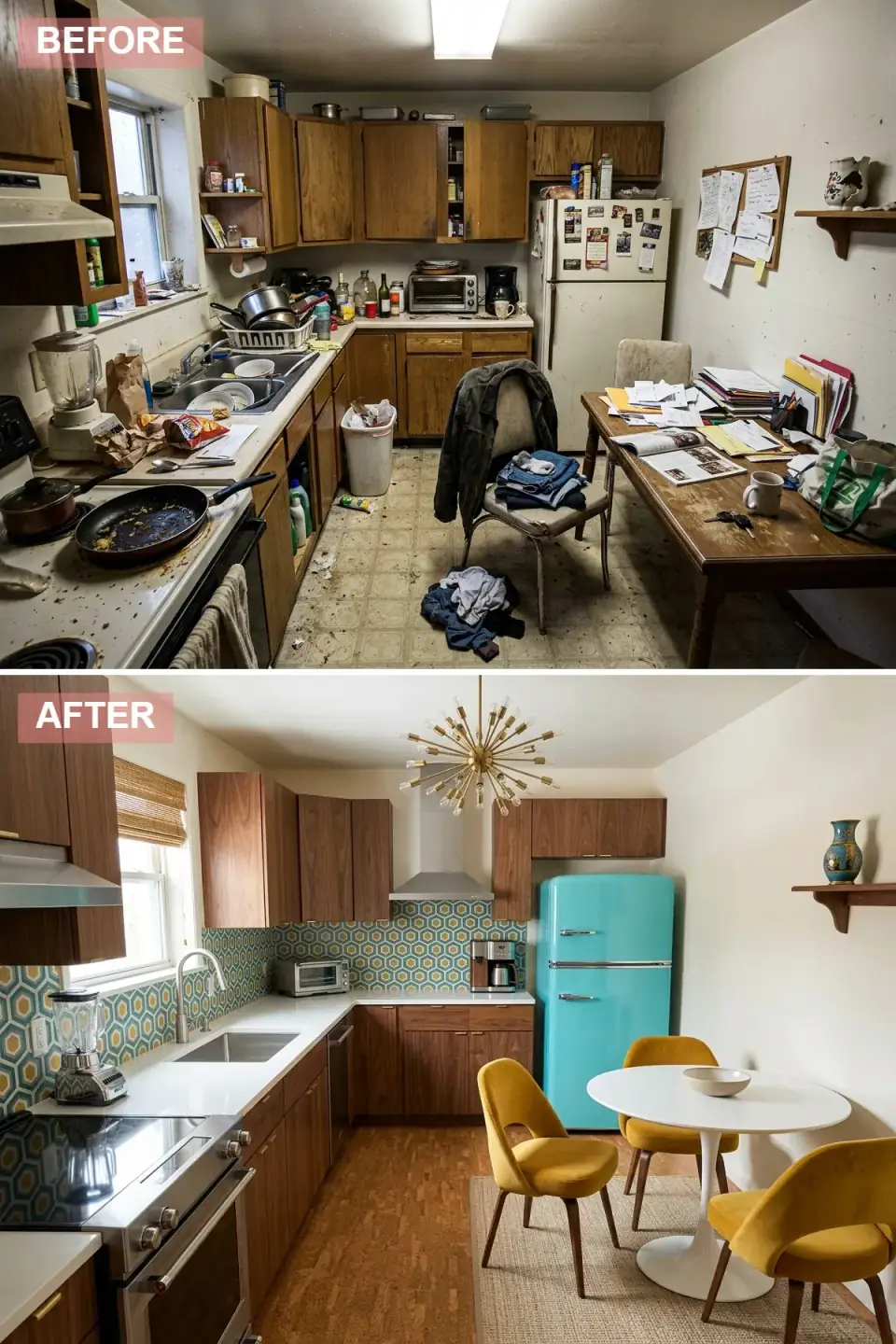
Walnut cabinets, white counters, geometric tile backsplash, Smeg fridge in turquoise, cork floor, Sputnik chandelier, Saarinen tulip table, mustard velvet chairs. The MCM register is the most photographic and the most polarizing — it commits unapologetically to the era. Done with restraint (the right walnut, the right tile, no kitsch), it's a kitchen that holds up for decades. Done with excess (every appliance retro, every surface patterned), it becomes a costume.
Plan-aware verdict: real American black walnut cabinet fronts from Semihandmade (DOORS line) or a custom Hudson Valley cabinet shop run $25,000–$45,000 for a typical kitchen — the wood is what carries the era, not the props. Geometric tile in teal and gold from Heath Ceramics, Clé Tile, or Fireclay Tile costs $25–$40 per square foot installed and is the move that distinguishes this kitchen. The Smeg FAB28 refrigerator is the focal-point splurge ($2,500–$3,500) and the one item the kitchen genuinely needs in color. Cork flooring (Forna, US Floors Natural Cork) is period-correct, soft underfoot, and warm — but it requires a moisture-rated sub-floor and a clear-coat re-application every 7–10 years.
Color Palette
Semihandmade DOORS in Walnut or custom American black walnut fronts, finished with a clear hardwax oil.
Smeg FAB28 refrigerator in pastel green or Pantone 14-4811 turquoise — the one piece of the kitchen that earns the color budget.
Italian cotton-velvet upholstered Saarinen-style chairs from Knoll or a faithful Modernica reproduction — never poly-acrylic velvet, which pills.
Custom geometric tile from Heath Ceramics, Clé Tile, or Fireclay Tile — the move that distinguishes this kitchen.
6. Timeless & Elegant Classic Transitional
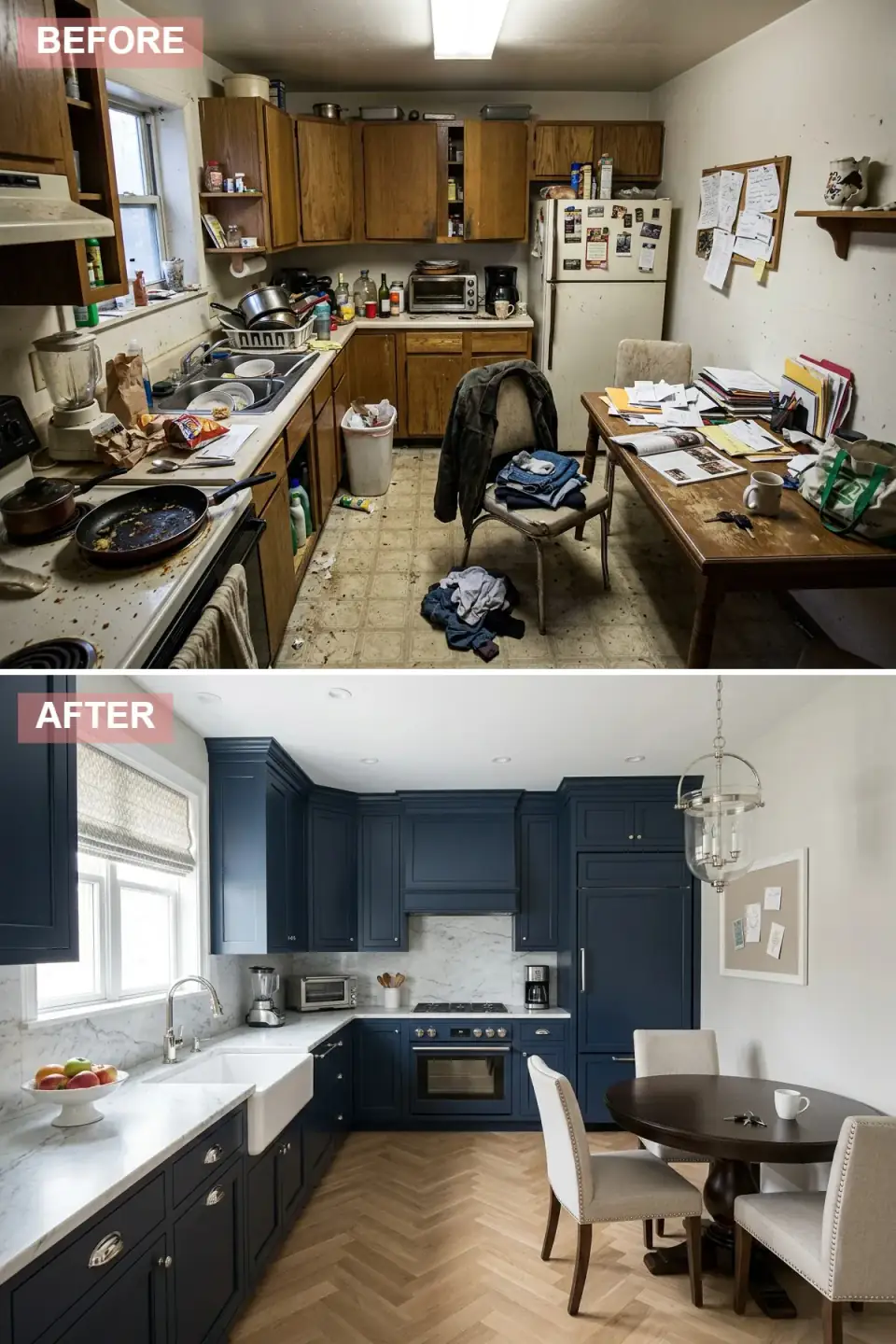
Navy shaker cabinets, brass hardware, white marble counters and slab backsplash, panel-ready refrigerator, herringbone oak floor, glass lantern pendant, dark wood dining table. This is the renovation I'd quote for a Cold Spring or Rhinebeck primary residence where the client wants to be there in 20 years and have the kitchen still read “current.” The navy-and-marble pairing has been the Northeast kitchen default for a decade and shows no signs of dating.
Plan-aware verdict: Benjamin Moore Hale Navy (HC-154) on factory-finished shaker fronts is the safe-and-correct choice; Sherwin-Williams Naval (SW 6244) or Farrow & Ball Hague Blue (No. 30) are more saturated alternatives if the kitchen has strong north light. Honed Carrara marble (never polished — polished etches visibly in three months of kitchen use) runs $80–$120 per square foot installed in the Hudson Valley; Mont Blanc quartzite is the harder-wearing alternative at $90–$140. Herringbone oak flooring laid in 5-inch boards costs $18–$28 per square foot installed (material + labor) — count on adding 12–15% to the material order over a standard run for the cuts and waste.
Color Palette
Benjamin Moore Hale Navy (HC-154) or Sherwin-Williams Naval (SW 6244) on factory-finished shaker fronts.
Italian Carrara honed (not polished) — softer veining, more forgiving of inevitable kitchen wear.
5-inch wide European oak herringbone, oil-finished — adds 12–15% to material count for cut waste.
Belgian linen upholstery (Romo, Holland & Sherry) on cane-back side chairs — the soft note that warms the navy and marble.
7. Old World Tuscan & Mediterranean
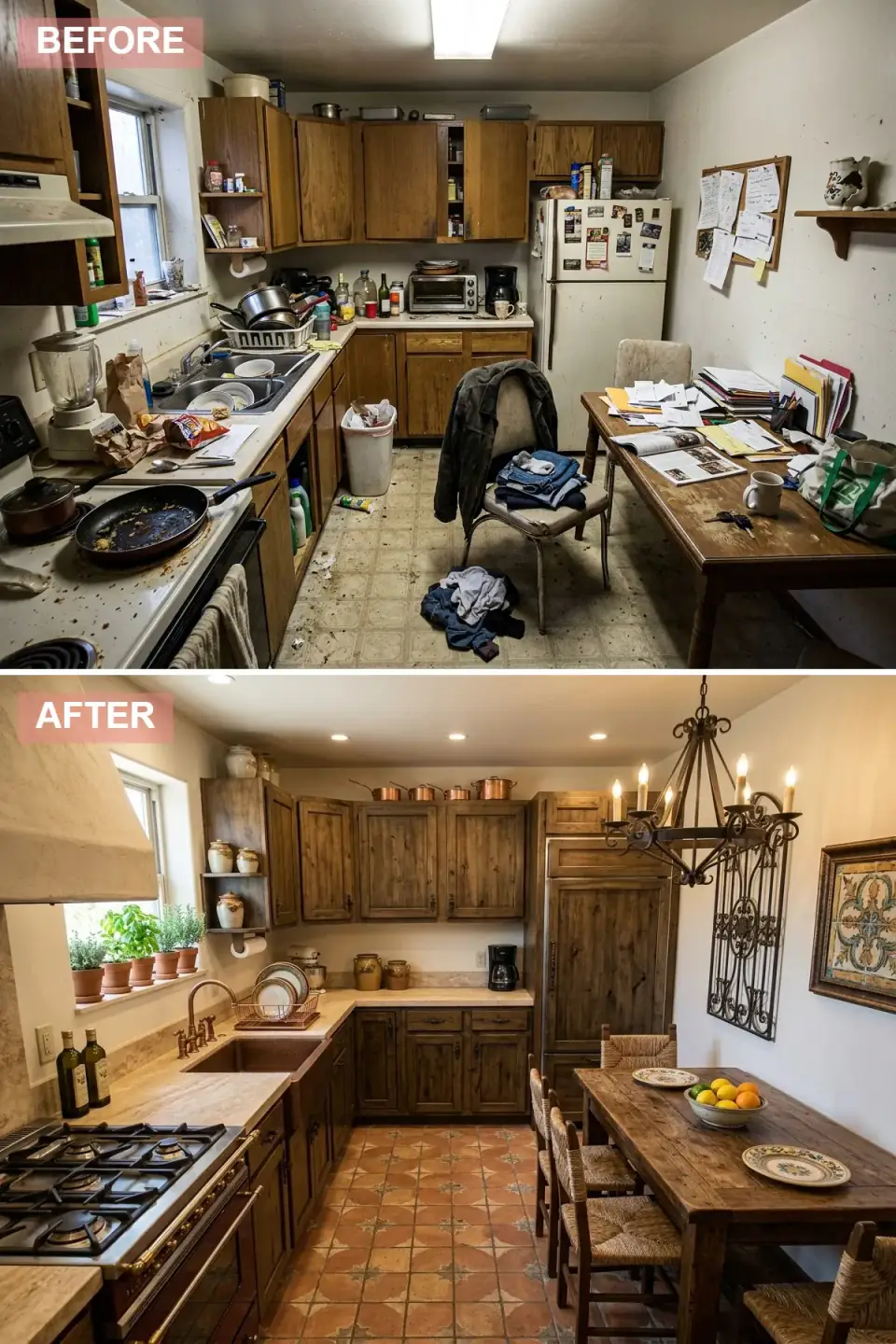
Distressed walnut cabinets, hand-plastered range hood, glazed tile counters, hammered copper sink, terracotta floor, wrought-iron chandelier, rush-seat chairs. The Tuscan-Mediterranean register reads richest of the eight — every surface has texture and weight. It works on a Hudson Valley stone-walled farmhouse, a Catskills converted estate, or a Mediterranean Revival home in Brooklyn's older neighborhoods. It doesn't work in a flat-ceilinged 1990s tract kitchen — the architecture has to carry it.
Plan-aware verdict: distressed walnut cabinet fronts from a Hudson Valley custom shop (Beacon Cabinetry, KraftMaid Vantage Heritage line) run $30,000–$55,000 for a typical kitchen and need a heavy lacquer or wax finish that hides spot wear. The custom plaster range hood is the focal-point splurge — a real hand-troweled Venetian plaster hood from a regional plasterer (Plaster Magic, Hudson Valley Decorative Plaster) costs $3,500–$7,500, three times what a stock metal hood costs but transforms the room. Terracotta flooring requires sealing every 18–24 months with a penetrating sealer (Aldon Premium, Surfaces RX); unsealed it absorbs olive oil, balsamic, and tomato pulp permanently. The hammered copper sink (Native Trails, Sinkology) needs a wax patina seal every 4–6 months or it tarnishes.
Color Palette
Distressed and hand-rubbed American black walnut, sealed with a tinted wax finish to preserve the patina.
Italian Impruneta terracotta or Mexican Saltillo tile, sealed with a penetrating sealer every 18–24 months.
Hand-troweled Venetian plaster from a regional Hudson Valley plasterer — the focal-point splurge worth making.
Heavy hand-forged wrought iron from a regional blacksmith (Cumberland Forge, NY Forge) — the weight is what reads authentic.
8. Luxurious & Glamorous Modern
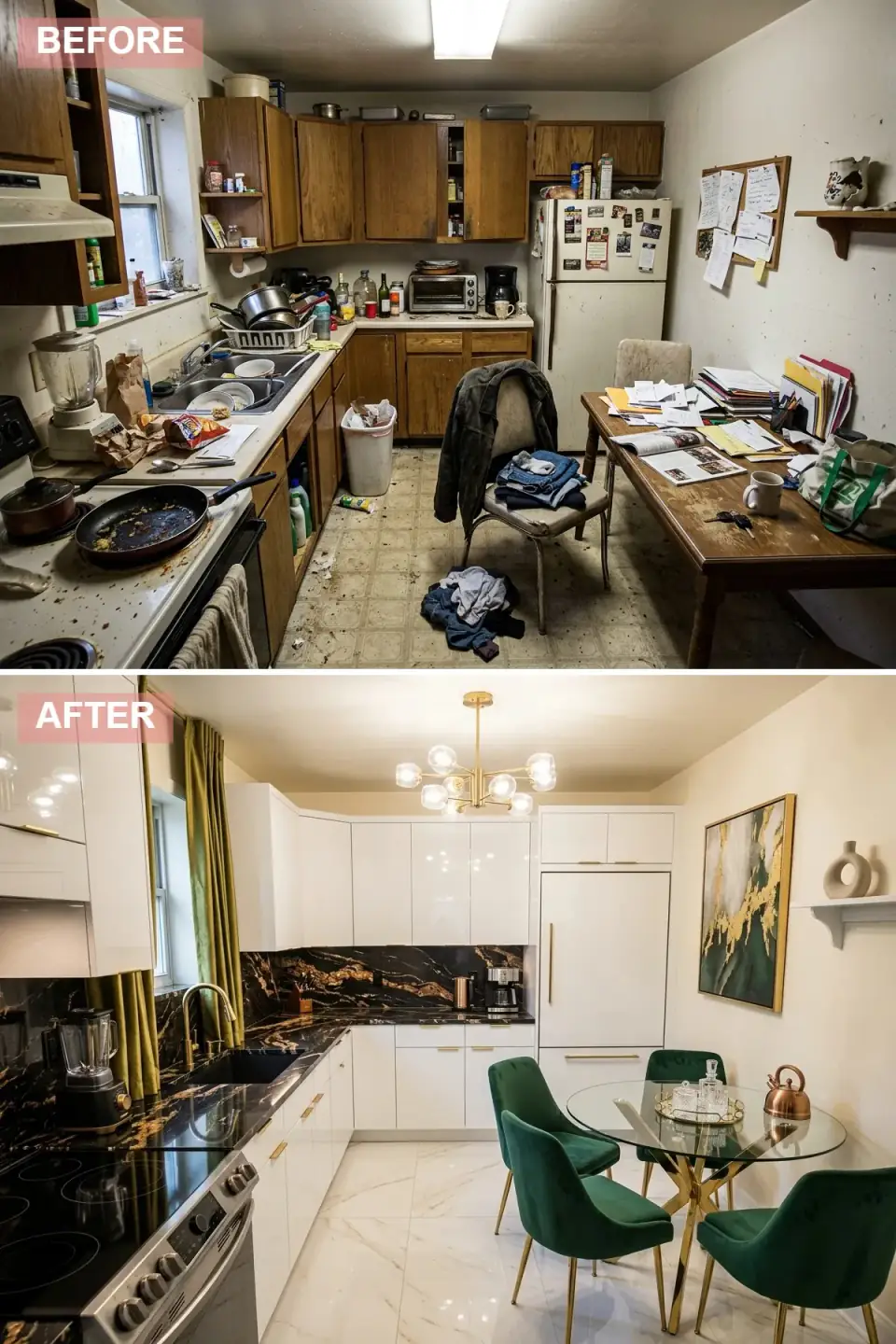
High-gloss white slab cabinets, Nero Marquina marble counters with gold veining, brushed gold hardware, brass chandelier, emerald velvet chairs. The glamorous register reads Art Deco modern — high contrast, jewel tones, lots of metallics. This is the kitchen for a Beacon riverfront condo, a Brooklyn brownstone with original plaster ceilings, or a contemporary Catskills retreat where the brief is “photograph well at every hour.” It's also the kitchen that ages most decisively on trend — when 2020s glam reads dated, it reads dated fast.
Plan-aware verdict: high-gloss white lacquer is unforgiving — every fingerprint, every smudge, every greasy splatter shows. Spec a UV-cured polyester lacquer (Henrybuilt, Bulthaup, Boffi) not a standard acrylic — the cured polyester is dramatically more durable and the surface holds against kitchen abuse. Nero Marquina marble with gold veining ($120–$200 per square foot installed) is more porous than Carrara and stains harder; seal aggressively at install, re-seal annually, and accept that hot pans will leave permanent marks. The emerald velvet chairs need an ottoman fabric protector spray (Crypton, Scotchgard) before first use, and even then expect the cushions to wear visibly in 4–5 years of daily kitchen use.
Color Palette
UV-cured polyester lacquer from Henrybuilt, Bulthaup, or Boffi — dramatically more durable than standard acrylic high-gloss.
Spanish Nero Marquina marble with natural gold-yellow veining — sealed aggressively, re-sealed annually.
Italian silk-cotton velvet from Romo, Holly Hunt, or Pierre Frey — fabric protector applied before first use.
Brushed brass from Waterworks Henry, Rejuvenation Yates, or Brizo Litze — never polished brass in a kitchen, which fingerprints constantly.
Pro Tips From the Renovation Designer's Chair
- Plumbing chase before cabinets. The most expensive kitchen renovation mistakes I see are clients who commit to a cabinet layout that requires moving the sink three feet from the existing chase. A 3-foot plumbing relocation is a $3,500–$6,000 line item once you account for the licensed plumber, the permit, and the drywall patching above. Often the better answer is to design the cabinet layout around the existing chase.
- 200-amp service before integrated appliances. A 100-amp panel cannot run a 36-inch induction cooktop, a double wall oven, a steam oven, a panel-ready Sub-Zero, a Miele dishwasher, and a coffee station simultaneously. If the makeover involves panel-ready integration (transformations 2 and 6 here), budget the 200-amp upgrade at $4,500–$8,000 with permit, and schedule the Central Hudson coordination 4–8 weeks ahead of cabinet install.
- Factory finish, not job-site spray. Painted cabinet fronts spray-finished at the factory in a temperature-controlled booth (KraftMaid Vantage, Bellmont, Reform, Semihandmade) hold up roughly twice as long as job-site sprayed cabinets. The price premium is 10–15%; the longevity gain is 5–8 years.
- Match stone to use, not to photograph. Honed Carrara marble photographs beautifully and etches the day you use lemon juice. Polished marble looks worse with every kitchen use. Quartzite (Mont Blanc, Taj Mahal) and quartz (Caesarstone, Cambria) photograph nearly identically to marble and survive a working kitchen for decades. Save real marble for the butler's pantry or the dry bar.
- Light in three layers, always. Ambient (a central pendant or a flush mount that lights the whole room), task (under-cabinet LED strips at 2700K warm-white — never 4000K), and accent (over the island, over the sink window, inside glass-front cabinets). Specify all three at the framing stage; chasing wire through finished walls is twice the cost.
- Spend on cabinets and stone; cut elsewhere. The kitchen's daily-use surfaces are cabinets and counters. Splurge on factory-finished cabinet fronts and quality stone (or quartz). Save on hardware (West Elm, Schoolhouse, Rejuvenation have great $15–$40 pulls), backsplash field tile (Heath, Clé, Fireclay only for the focal-point wall), and lighting (Visual Comfort and Schoolhouse mid-range fixtures hit the same look as Restoration Hardware at 40% less).
Cost-Saving Moves That Don't Show
- IKEA boxes with Semihandmade fronts. An IKEA Sektion cabinet box with a Semihandmade DOORS slab front costs 40% of a full custom European cabinet line and is visually indistinguishable in finish-quality. Use for transformations 2, 5, or 8 above.
- Panel-ready dishwasher, not panel-ready refrigerator. A panel-ready Miele dishwasher is $1,500 over standard; a panel-ready Sub-Zero refrigerator is $5,000–$7,000 over a quality standalone. The dishwasher integration earns its money visually; the refrigerator integration often doesn't if the rest of the kitchen isn't fully integrated.
- Quartz over marble for primary counter; marble accent slab only. Run quartz on the working counters and use one 30-inch marble slab on the baking station or island accent. You get the marble look in the photograph and the quartz performance for the working kitchen.
- Reclaimed shelves over open shelving from a big-box. Reclaimed oak or chestnut shelves from a regional Hudson Valley salvage yard cost $40–$80 per linear foot and look like museum pieces. Big-box pine open shelves cost $20 per linear foot and look exactly like big-box pine.
Reader Questions on Kitchen Renovations
How much does a full kitchen renovation cost in the Hudson Valley in 2026?
A meaningful Hudson Valley kitchen renovation on a 12-by-14-foot footprint — new cabinets, counters, backsplash, flooring, lighting, faucet, sink, and basic appliance swap — typically falls between $45,000 and $180,000 in 2026 pricing. The swing variables are cabinetry (semi-custom KraftMaid at $25K vs fully-custom Henrybuilt at $80K), countertops (quartz at $80–$110/sqft vs natural marble or quartzite at $100–$200/sqft), and appliances (a mid-range Bosch package at $8K vs a Sub-Zero / Wolf / Miele package at $35K+). Add 10–25% for plumbing relocation, electrical service upgrade, or structural wall removal — each can be a $4K–$10K line item.
Which of these eight makeovers holds the best resale value in the Northeast market?
According to the NAHB Cost vs. Value Report for the Northeast region (2025 figures), the strongest resale pulls come from the Classic Transitional palette (transformation #6) — navy or charcoal shaker cabinets with white quartz or marble, herringbone oak flooring, brass or matte black hardware. This palette has been the Northeast resale default for nearly a decade and shows no sign of dating. Sleek Minimalist (#2) and Modern Farmhouse (#1) also pull well in Beacon, Rhinebeck, and Brooklyn brownstone markets. The more stylized palettes (#5 Mid-Century, #7 Tuscan, #8 Glamorous) pull a narrower buyer pool and only return their cost in the right neighborhood.
Is honed or polished marble better for kitchen countertops?
Honed, always — for a working kitchen. Polished marble looks pristine the day it's installed and looks visibly worse with every kitchen use; lemon juice, balsamic vinegar, tomato sauce, and fruit juice etch the polished surface within seconds and the marks are permanent. Honed marble's matte surface hides etches dramatically better and develops a soft patina that reads as “loved” rather than “damaged.” If you want the polished-marble photograph but the honed-marble forgiveness, spec Mont Blanc quartzite — visually nearly identical to polished marble but with quartzite's harder mineral structure.
Do I need a 200-amp electrical service for a modern kitchen?
Only if you're running multiple high-draw appliances: a 36-inch or larger induction cooktop, a 48-inch dual-fuel range, double wall ovens, a steam oven, and a panel-ready Sub-Zero column refrigerator all draw heavily. A 100-amp panel can handle a typical Bosch or Miele range plus a single oven plus a standard refrigerator, but anything beyond that pushes the panel. In the Hudson Valley, a 200-amp service upgrade with new meter base, new panel, and Central Hudson coordination runs $4,500–$8,000 and takes 4–8 weeks to permit. Plan the panel upgrade at the design stage if your spec includes any panel-ready integrated appliances.
Should I use IKEA cabinets with custom fronts, or go fully custom?
IKEA Sektion boxes with Semihandmade DOORS or Reform custom fronts (and a quality drawer-runner upgrade like Blum Tandem) deliver about 85% of the visual quality of a full European custom cabinet line at roughly 40% of the cost. The trade-off is in two places: IKEA boxes are particleboard with melamine, not plywood, so they handle moisture worse than custom; and the maximum box height and depth options are more limited. For most Hudson Valley kitchens this is the right cost-saving move. For genuinely fully-integrated panel-ready installations (transformation #2 above) the tighter tolerance of Henrybuilt, Plain English, or Bulthaup is worth the premium.
How long does a kitchen renovation actually take?
From signed design contract to final punch-list: 4–7 months for a typical Hudson Valley kitchen makeover at this scale. The breakdown: 4–6 weeks of design and selection, 8–14 weeks of cabinet lead time (semi-custom is closer to 8, fully-custom European can be 14–20), 1–2 weeks of demo, 4–8 weeks of installation (cabinets, counters, appliances, paint, floor, finish work), and 2–4 weeks of punch-list. Plan for the kitchen to be unusable for 8–12 weeks during the active install phase and set up a temporary kitchen with a microwave, an induction burner, a mini-fridge, and a clean utility sink before demo begins.
Where to Read Next
If this study was useful, the quiet luxury kitchen with integrated appliances guide walks the panel-ready end of the spectrum in detail, and the moody organic modern kitchen guide covers the darker palette range. For storage-driven kitchen thinking, the un-kitchen guide on hidden pantries and appliance garages and the visible pantry storage guide are the natural follow-ups. The kitchens & baths category is the place to browse every kitchen study on the site.
Sources & Further Reading
- National Kitchen & Bath Association (NKBA). Kitchen & Bath Industry Show 2026 Trend Report & Kitchen Design Standards. nkba.org
- NAHB & Remodeling Magazine. 2025 Cost vs. Value Report — East North Central & New England Regions — kitchen renovation cost-recovery benchmarks. remodeling.hw.net/cost-vs-value
- Natural Stone Institute / Marble Institute of America. Marble, Quartzite & Quartz Selection and Care Standards. naturalstoneinstitute.org
- Sub-Zero, Wolf & Cove. Integrated Appliance Specifications & Cabinet Panel Sizing Documentation. subzero-wolf.com
- Miele & Bosch. Panel-Ready Dishwasher & Built-In Appliance Documentation. miele.com
- KraftMaid Vantage, Semihandmade & Reform. Cabinet Door Style, Finish, and Construction Documentation.
- Caesarstone, Cambria & Silestone. Engineered Quartz Specifications, Veining Patterns, and Warranty Documentation.
- Heath Ceramics, Clé Tile & Fireclay Tile. Handmade Backsplash Tile Catalogs & Installation Specifications.
- Henrybuilt, Plain English & Bulthaup. Fully-Custom Kitchen Cabinetry & Tolerance Standards.
- U.S. Department of Energy / ENERGY STAR. Kitchen Appliance Efficiency Standards & Induction Cooktop Specifications. energystar.gov
- Visual Comfort, Schoolhouse Electric & Rejuvenation. Pendant, Sputnik, and Lantern Kitchen Lighting Specifications.

Nora Whitfield
Renovation Designer & Interiors Editor · Beacon, New YorkNine years of design-build renovation work across the Hudson Valley and the Northeast. Nora runs the Renovations, Room Guides and Renovation Mind desks — before-and-after studies, room-by-room design guides, and the long essays on why what we renovate matters.
More from Nora →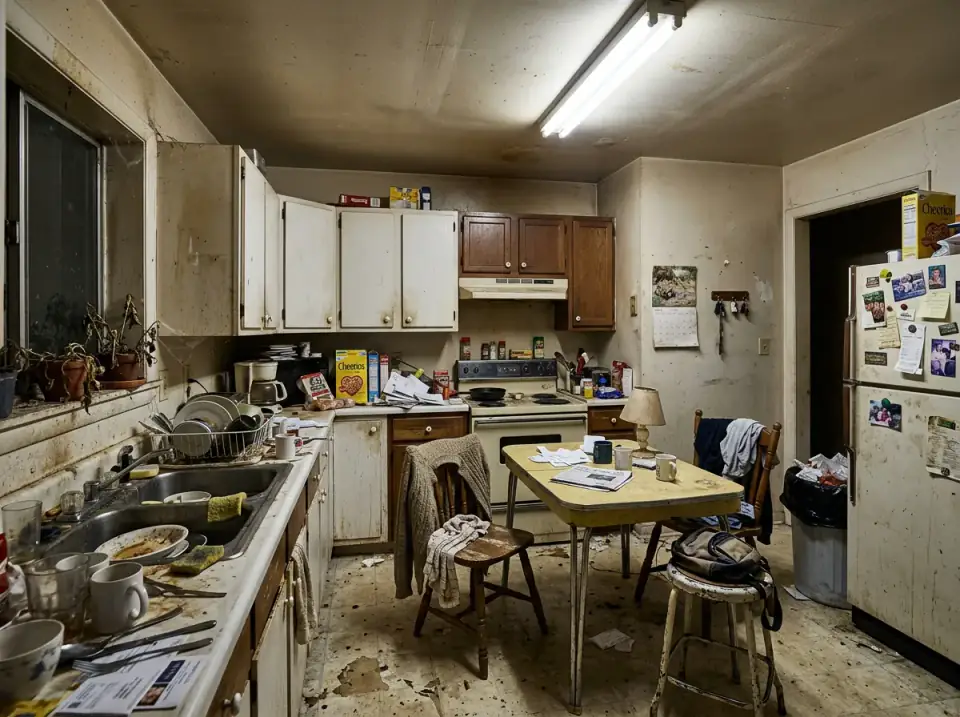
Reader notes