


A bedroom that doesn't rest you is usually a material problem, not a layout problem. The walls are painted, the bed is fine, the fixtures work — but nothing in the room engages the body the way an outdoor space does, so the brain never fully stands down. Biophilic design fixes that, and it's not about parking a pot on the nightstand. It's about weaving organic texture, earthy color, real daylight, and living greenery into the surfaces a sleeping body actually touches and sees. Below are six bedrooms that do it well, with the real material specs, 2026 Northeast cost ranges, and the framing-stage calls behind each one.
How I Read a Biophilic Bedroom
Before I recommend a single material in a Hudson Valley bedroom, I read four things. The light plan: how the windows handle east-versus-west sun, and what the dimming looks like at night. The material breath: whether the surfaces around the bed exchange humidity with the room or trap it — wood, wool, linen, and lime plaster all breathe; vinyl, polyester, and MDF don't. The tactile load: how many surfaces the body actually touches, from headboard to bedding to rug. And the sensory anchors: the single living plant, the single piece of organic geometry, the single natural-fiber textile that signals "outside" to a sleeping brain. Get those four right and the room rests you. Skip any of them and it photographs well but disappoints in person.
Seven years of running renovation design across Beacon, Rhinebeck, Kingston, and a few Brooklyn brownstones has convinced me biophilic isn't a finish style — it's a sleep-hygiene argument made in materials. The six rooms below run the full range, from a sub-$6,000 boho styling refresh to a $40,000-plus architectural renovation with sliding glass walls. Each one I've broken down to real specs and Northeast labor rates. If you want the companion read that walks the same logic across a different set of rooms, my biophilic bedroom design guide covers eight more formats, and the broader bedrooms and kids' rooms archive collects the rest.
1. Organic Minimalism & the Wood-Clad Sanctuary
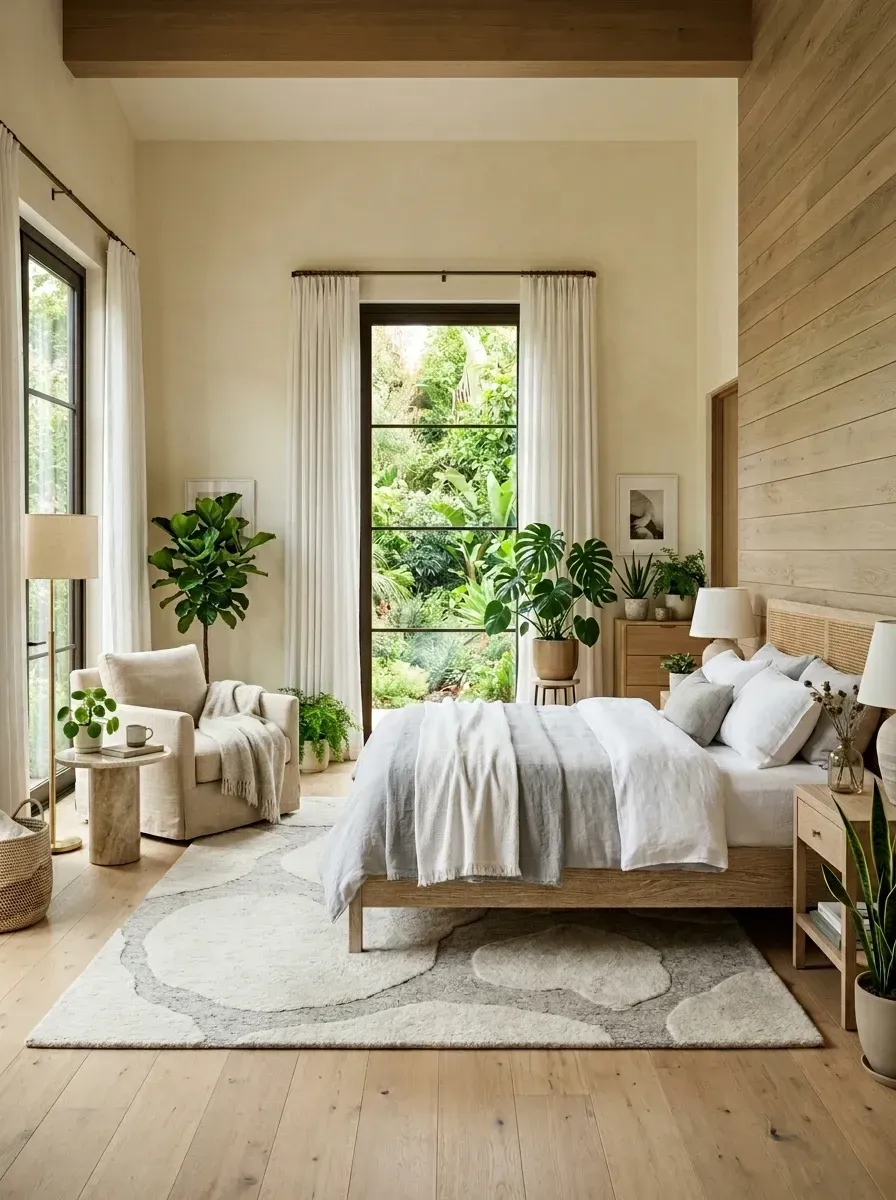
This room marries minimalist restraint to organic warmth, and the discipline is what makes it work. The expansive shiplap wood wall behind the bed delivers texture and a forest-floor color cue without a single decorative object competing for attention. The floor-to-ceiling window framing a garden is the real biophilic anchor — it blurs the indoor-outdoor line better than any houseplant can. The palette stays deliberately quiet, letting the natural tones of wood, stone, and linen carry the calm. Large-scale plants — a fiddle leaf fig, a monstera — add living scale, and an organic-shaped rug softens the floorplane.
Plan-aware verdict: the floor-to-ceiling window is the framing-stage decision that makes or breaks this room. Enlarging a rough opening after drywall closes means re-headering the wall and patching siding — a $4,000–$7,000 surprise that should have been a $0 line on the framing plan. Decide the glass before the framers leave. On the shiplap, spec 4"–6" boards; wider planks read as flooring on a wall, and the proportion fights the bed. In our climate, finish the wood with a hardwax oil (Rubio Monocoat) rather than poly — it keeps the wood breathing, which is half the biophilic point.
Features
- Full-height shiplap wood accent wall (4"–6" boards)
- Floor-to-ceiling garden window
- Natural linen textiles and bedding
- Stone side table
- Large-scale indoor plants (fiddle leaf fig, monstera)
Cost Analysis (2026 Northeast)
| Decor Item (Qty) | Total Price Range |
|---|---|
| Wood Plank Wall Installation (approx. 150 sq ft) | $1,500 – $4,500 |
| Hardwood Flooring Installation (approx. 200 sq ft) | $1,600 – $3,000 |
| Custom Floor-to-Ceiling Window & Door | $5,000 – $10,000 |
| Linen Curtains & Hardware (x4 panels) | $800 – $2,000 |
| Upholstered Bed Frame | $1,000 – $3,000 |
| Linen Bedding Set | $300 – $800 |
| Linen Armchair | $800 – $1,500 |
| Stone Side Table | $300 – $800 |
| Large Patterned Area Rug | $500 – $1,500 |
| Lighting (Floor Lamp, 2x Table Lamps) | $350 – $900 |
| Nightstands (x2) & Dresser | $1,200 – $3,000 |
| Large Potted Plants & Decor | $400 – $900 |
| Total Estimated Cost | $13,750 – $31,900 |
Color Palette
Benjamin Moore Swiss Coffee (OC-45) or Farrow & Ball Wimborne White — a warm neutral that reflects light gently and lets the wood carry the room.
White oak shiplap in a natural hardwax oil finish — organic warmth and real surface texture.
A soft layering neutral for the rug and textiles — Belgian linen and hand-loomed wool.
Living foliage from the fiddle leaf and monstera — the one true color in an otherwise neutral room.
2. Boho-Chic Earth Tones & Woven Textures
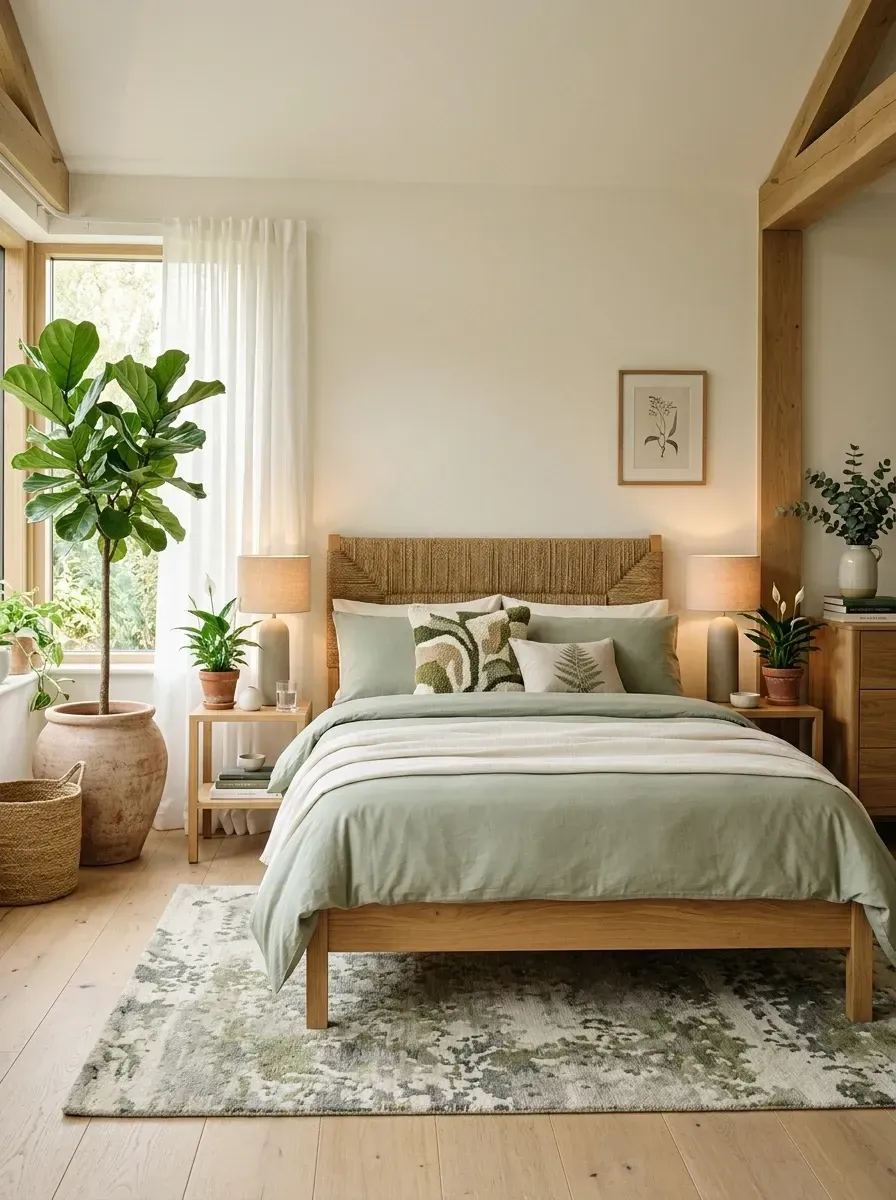
A warm, grounded take on biophilic design that leans entirely on natural fiber and earthy color. The woven jute headboard is the centerpiece, and exposed wood ceiling beams add rustic structure overhead. The palette — sage green, creamy white, warm wood — reads like a forest floor, and a large terracotta pot with a fiddle leaf fig reinforces the connection to earth. This is the most accessible format on the list and the cheapest to execute, because most of it is textiles and furniture rather than construction. It's the room I'd recommend to a Hudson Valley renter who can't touch the structure but wants the sanctuary read by the weekend.
Plan-aware verdict: real structural beams are an architectural move; faux beams are a finish move. Lightweight polyurethane beams (Volterra, Country Woodcraft) install in a day at $40–$70 per linear foot and read indistinguishable from real timber at eight feet. Use them here — there's no reason to open a ceiling for a look. On the jute headboard and rug, jute sheds and flattens; spec a higher-density weave for the headboard, which gets leaned on nightly, and save the looser weave for the rug.
Features
- Woven jute headboard (high-density weave)
- Exposed wood ceiling beams (real or faux)
- Sage green bedding
- Large terracotta planter
- Natural jute rug
Cost Analysis (2026 Northeast)
| Decor Item (Qty) | Total Price Range |
|---|---|
| Exposed Wood Beam Installation | $1,000 – $3,000 |
| Hardwood Flooring | $1,600 – $3,000 |
| Woven Headboard Bed Frame | $800 – $2,000 |
| Sage & Patterned Bedding Set | $200 – $500 |
| Nightstands (x2) | $300 – $700 |
| Concrete-Style Table Lamps (x2) | $150 – $400 |
| Large Terracotta Pot & Plant | $200 – $500 |
| Jute Area Rug | $200 – $500 |
| Linen Curtains | $200 – $500 |
| Dresser & Small Decor | $850 – $2,150 |
| Total Estimated Cost | $5,500 – $13,250 |
Color Palette
Benjamin Moore White Dove (OC-17) — a warm neutral that keeps the space bright behind the earthy accents.
A calming, desaturated green — pulls from Farrow & Ball Mizzle territory and reads restful, not decorative.
The natural-fiber backbone of the room — significant texture and organic warmth from the headboard and rug.
Real-fired terracotta from Bergs Potter or Eye of the Day — resin pots fail this baked-earth color test instantly.
3. Scandinavian Simplicity with a Green Focus
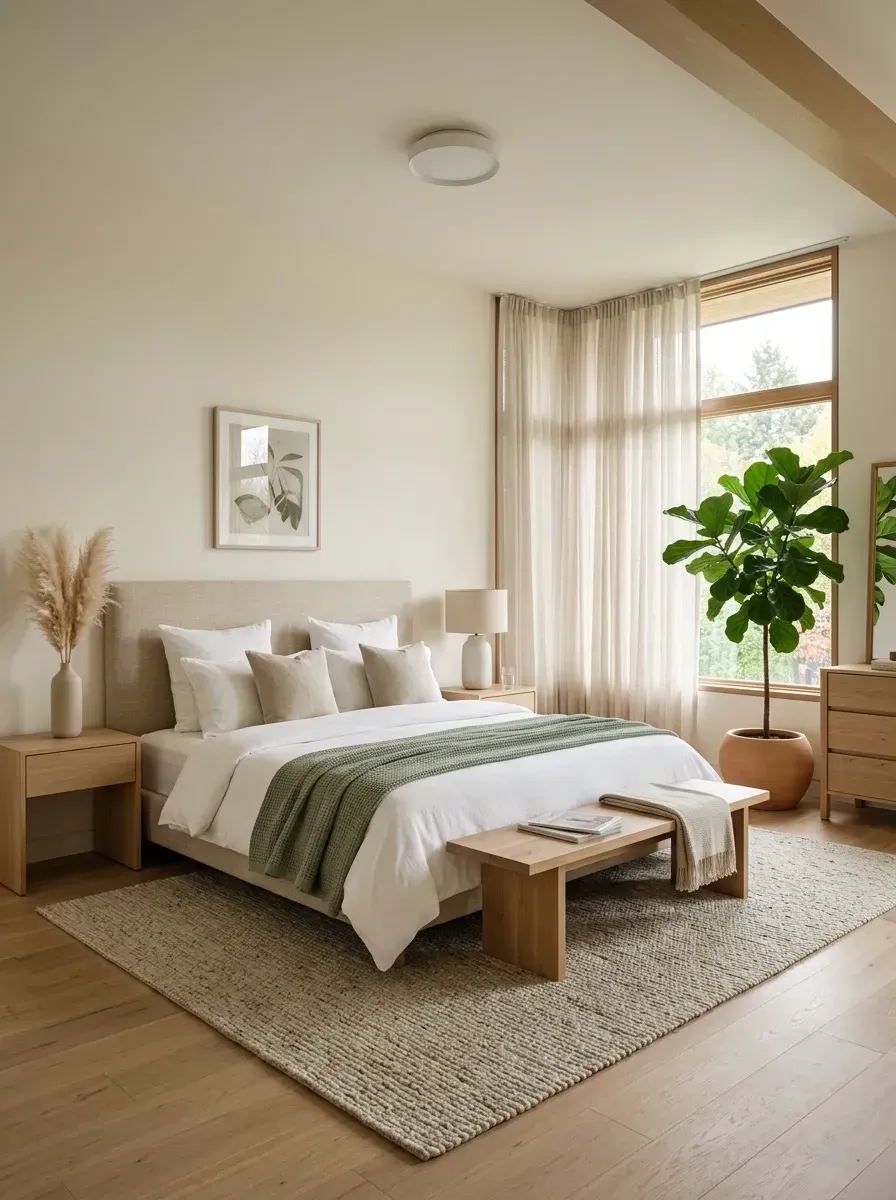
This is Scandinavian restraint applied to biophilic intent — simplicity, function, and one undisputed hero. The large corner window turns the view of the trees into living art, and the rest of the room stays out of its way. A neutral upholstered bed, a simple wood bench, a textured rug, a single fiddle leaf fig, and a vase of pampas grass do the entire job. It proves you don't need a jungle to feel connected to nature; you need one strong daylight source and a couple of well-chosen anchors. The result is bright, airy, and genuinely peaceful.
Plan-aware verdict: the corner window is the spec that earns this room, and corner glazing is a structural conversation — you're removing a load-bearing corner, which means a moment frame or a structural post hidden in the adjacent wall. That's an engineer's stamp, not a window-shopping decision, so price it into the framing budget honestly. The cheap version of this look, if the structure won't allow corner glass: leave an existing window unadorned and hang an oversized round mirror opposite it. A 36"–48" mirror across from the daylight is the single best perceived-light upgrade available for $200–$400.
Features
- Large corner window with garden view
- Minimalist solid-wood bench
- Neutral upholstered bed
- Fiddle leaf fig statement plant
- Pampas grass decor
Cost Analysis (2026 Northeast)
| Decor Item (Qty) | Total Price Range |
|---|---|
| Hardwood Flooring Installation | $1,600 – $3,000 |
| Large Custom Corner Window | $3,000 – $7,000 |
| Sheer Wall-to-Wall Curtains | $200 – $600 |
| Upholstered Bed Frame | $800 – $2,000 |
| Neutral Bedding with Green Throw | $250 – $600 |
| Solid Wood Bench | $300 – $700 |
| Nightstands (x2) & Dresser | $1,200 – $3,000 |
| Large Fiddle Leaf Fig & Pot | $200 – $500 |
| Textured Wool Blend Rug | $300 – $800 |
| Pampas Grass, Vase & Wall Art | $100 – $300 |
| Total Estimated Cost | $7,950 – $18,500 |
Color Palette
Benjamin Moore Manchester Tan (HC-81) — a light, airy neutral that creates calm and bounces daylight.
Pale ash or birch in a matte finish — the light-wood register Scandinavian design relies on.
A single olive throw is the whole color story — a subtle nod to nature that breaks the neutrals.
A grey-beige blend in a wool-blend rug — adds depth without introducing a competing color.
4. Mid-Century Modern Meets Botanical Boldness
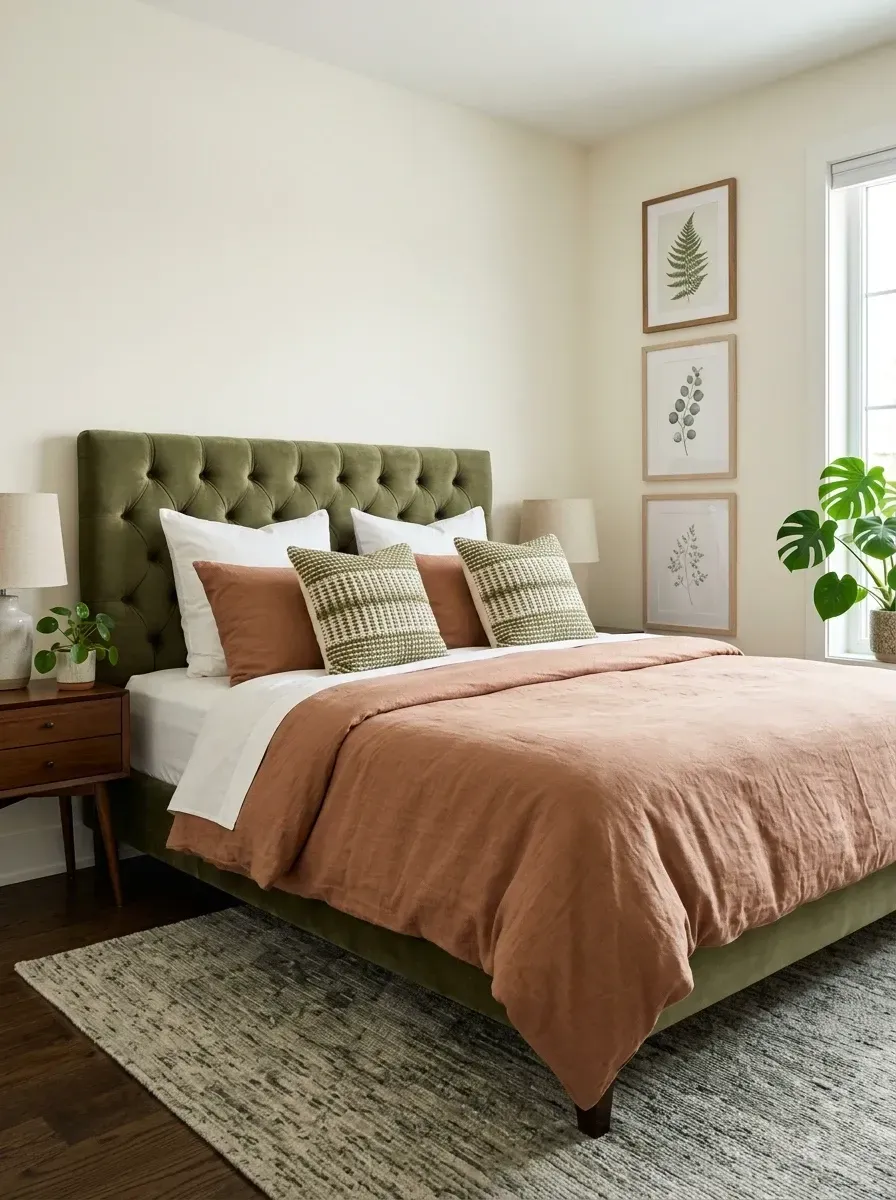
Mid-century lines paired with bold biophilic color. The green velvet tufted headboard anchors the room with a rich, nature-derived hue, contrasted by a terracotta linen duvet for an earthy, sophisticated pairing. A gallery wall of framed botanical prints provides the direct visual connection to nature, while a walnut nightstand and a geometric lamp carry the retro vocabulary. Plants on the nightstand and windowsill finish it. This is the lowest-cost room on the list and the easiest to execute in a single weekend, because none of it is construction — it's furniture, textiles, and art.
Plan-aware verdict: velvet headboards are a humidity and light question over the long run. Performance velvet (a solution-dyed synthetic woven to look like cotton velvet) holds color against the UV that pours into a south-facing bedroom; natural cotton velvet fades and crushes. Spec performance velvet from Kravet or Romo on a south or west wall. For the botanical gallery, use real wood frames and archival mats — the plastic-frame poster look reads cheap against real plants and undercuts the whole biophilic argument the room is making.
Features
- Green velvet tufted headboard (performance velvet)
- Terracotta linen duvet
- Botanical gallery wall in real wood frames
- Mid-century modern walnut nightstand
- Geometric patterned pillows
Cost Analysis (2026 Northeast)
| Decor Item (Qty) | Total Price Range |
|---|---|
| Hardwood Flooring | $1,600 – $3,000 |
| Green Velvet Tufted Bed Frame | $600 – $1,500 |
| Terracotta Linen Bedding Set | $200 – $500 |
| Decorative Pillows (x2) | $50 – $150 |
| Mid-Century Modern Nightstand | $150 – $400 |
| Table Lamp | $50 – $150 |
| Framed Botanical Wall Art (x3) | $150 – $400 |
| Various Potted Plants | $100 – $300 |
| Area Rug | $200 – $500 |
| Total Estimated Cost | $3,100 – $6,900 |
Color Palette
A rich, luxurious green that grounds the bed — echoes Benjamin Moore Hunter Green in a performance velvet.
A warm reddish-brown that plays beautifully against the olive — the classic earth-and-foliage pairing.
American black walnut with a hardwax oil — the classic mid-century dark wood, and it ages honestly.
Benjamin Moore Cloud White (OC-130) — a clean backdrop that lets the bold colors carry.
5. Coastal-Cool Biophilia with Beadboard & Beams
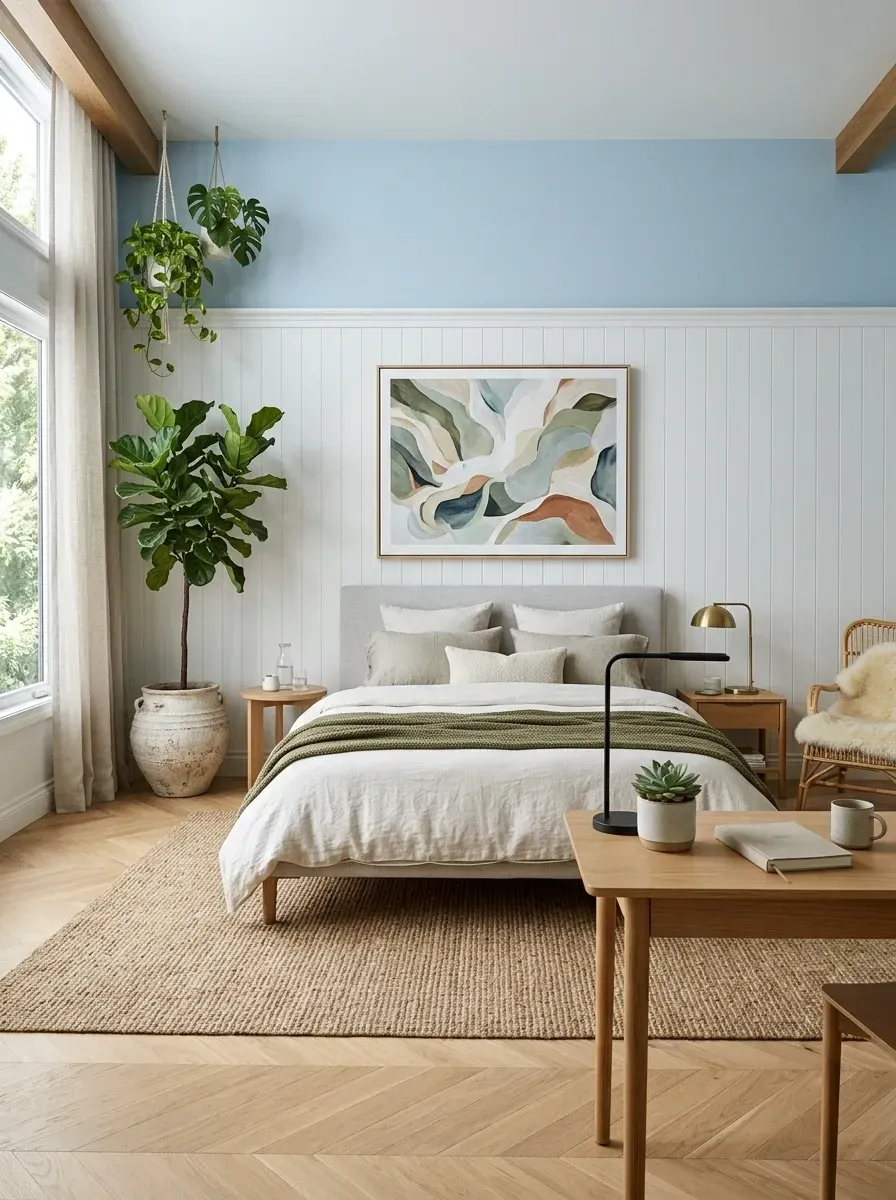
A fresh coastal escape with the architectural detail doing the heavy lifting. The herringbone wood floor and a two-tone wall — white beadboard wainscoting below, a serene sky-blue upper section above — give the room its bones, and exposed ceiling beams draw the eye up and add warmth. Greenery layers throughout: a large fiddle leaf fig at floor level, hanging planters using the vertical space. Natural materials — a jute rug, a rattan chair, linen bedding — keep the feel breezy and organic. It's bright, cheerful, and deeply relaxing, and it translates cleanly to a Cold Spring or Beacon river-town bedroom.
Plan-aware verdict: herringbone is a labor cost, not a material cost. The flooring itself is standard oak; the pattern roughly doubles the installation labor versus straight-lay because of the cutting and the layout time, which is why the line below runs $3,000–$5,000 for 200 square feet. Budget for it honestly or run straight-lay and put the saved money into the beams. On the beadboard, prime the back as well as the face before installation — bedrooms attached to a bath swing in humidity, and unprimed MDF beadboard swells at the joints within a season.
Features
- Two-tone wall with white beadboard wainscoting
- Herringbone wood flooring
- Exposed ceiling beams
- Hanging plants
- Rattan accent chair
Cost Analysis (2026 Northeast)
| Decor Item (Qty) | Total Price Range |
|---|---|
| Herringbone Wood Flooring Installation (approx. 200 sq ft) | $3,000 – $5,000 |
| Beadboard Wainscoting Installation & Paint | $1,000 – $2,500 |
| Exposed Wood Beam Installation | $1,000 – $3,000 |
| Upholstered Bed & Linen Bedding | $1,000 – $2,500 |
| Nightstands (x2), Desk & Chair | $700 – $1,700 |
| Rattan Armchair with Sheepskin | $250 – $600 |
| Jute Area Rug | $200 – $500 |
| Plants (Large & Hanging) & Pots | $250 – $650 |
| Wall Art & Lighting | $250 – $700 |
| Total Estimated Cost | $7,650 – $17,150 |
Color Palette
Farrow & Ball Borrowed Light (No. 235) or Benjamin Moore Beach Glass (1564) — a calm, sleep-friendly blue.
Benjamin Moore Chantilly Lace in a satin finish — wipeable and bright for the wainscot.
White oak in the herringbone floor and beams — a warm, organic foundation for the cool wall.
Raw jute and rattan fibers — the tactile counterweight to the painted surfaces.
6. Industrial Luxury with an Indoor-Outdoor Flow
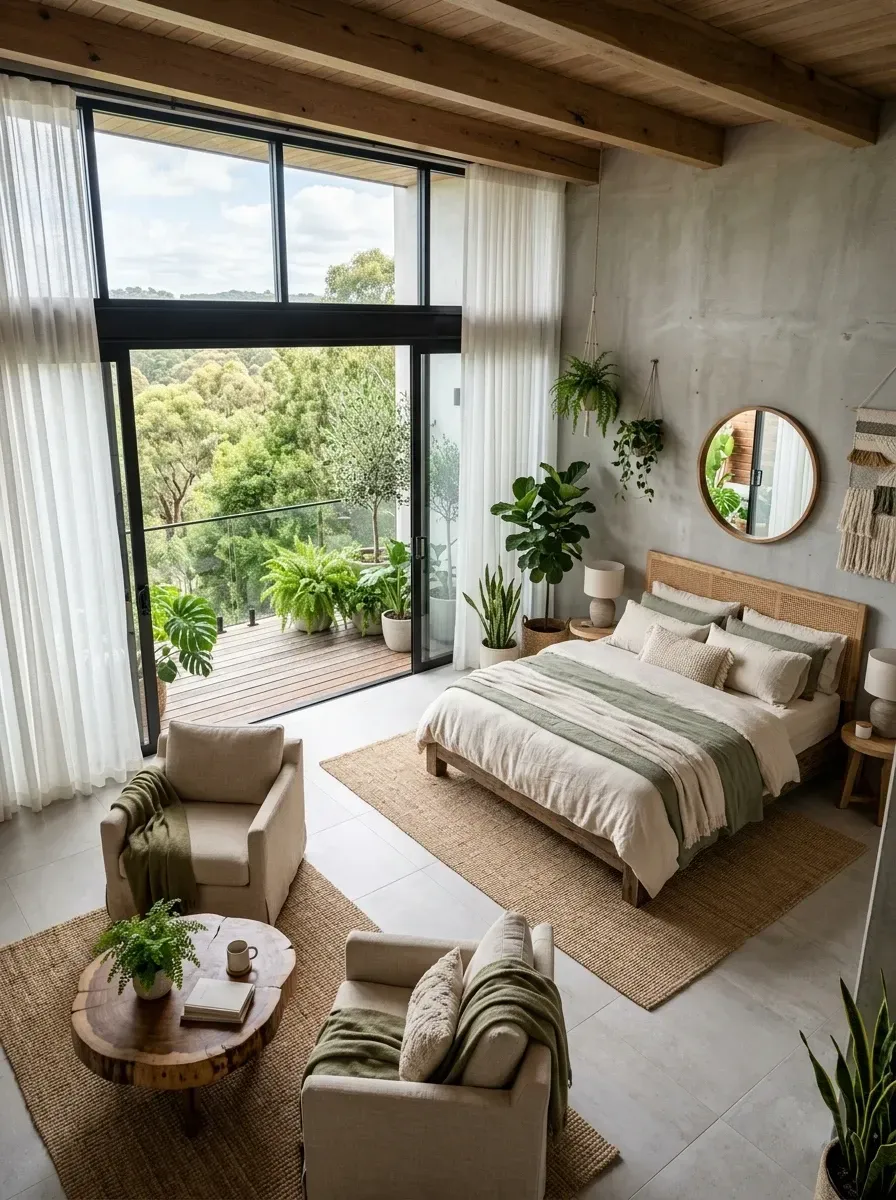
This is the most ambitious room on the list — industrial materials balanced against biophilic luxury. Raw concrete walls and large-format floor tile give a cool, modern base, warmed by a wood plank ceiling and exposed beams overhead. The drama is the wall of sliding glass opening onto a planted balcony, which dissolves the boundary between the bed and the tree canopy outside. Inside, a rattan bed, layered rugs, and an armchair seating area invite a slower morning. Floor plants and hanging ferns complete the urban-jungle read. It's the format I'd reserve for a Brooklyn loft conversion or a high-design Hudson Valley new-build with the budget to back it.
Plan-aware verdict: the sliding glass wall is the entire project, and it's a structural one. A multi-panel slider that wide carries the floor load above it on a header that has to be sized by an engineer, and in our climate the glass has to be a thermally broken, triple-glazed unit (a single-pane wall of glass on a Hudson Valley bedroom is a heating bill and a condensation problem). That's why the door line runs $5,000–$12,000 — and a high-performance unit can run past it. Raw concrete walls also need a breathable mineral sealer, not a film-forming one, or they sweat behind the finish.
Features
- Concrete walls and floors (breathable mineral sealer)
- Wood plank ceiling and exposed beams
- Massive sliding glass doors (thermally broken, triple-glazed)
- Balcony with lush greenery
- Rattan bed frame
- Layered rugs
Cost Analysis (2026 Northeast)
| Decor Item (Qty) | Total Price Range |
|---|---|
| Concrete Wall Finish & Tile Flooring | $3,500 – $8,500 |
| Wood Ceiling & Beam Installation | $3,000 – $8,000 |
| Large Sliding Glass Door System | $5,000 – $12,000 |
| Balcony Decking & Railing | $2,000 – $5,000 |
| Rattan Bed Frame & Bedding | $1,300 – $3,200 |
| Seating Area (2 Armchairs, Coffee & Side Table) | $1,100 – $2,800 |
| Layered Area Rugs (x2) | $500 – $1,200 |
| Abundant Plants & Decor (Mirror, Lighting) | $800 – $2,300 |
| Total Estimated Cost | $17,200 – $43,000 |
Color Palette
A cool, raw industrial tone — board-formed or polished concrete as the modern canvas.
Stained fir or oak ceiling planks — the essential warmth that keeps the concrete from reading cold.
The rattan bed and jute rug tie the hard surfaces back to the natural world.
Linen and wool upholstery in cream — softens the concrete and gives the body something warm to land on.
Pro Tips From the Renovation Designer's Chair
- Lighting temperature is the make-or-break. Spec 2700K warm white throughout the bedroom — every fixture, every bulb. Cool 4000K bulbs disrupt circadian rhythm and make biophilic textures look flat and clinical. Put each layer (overhead, sconces, lamps) on its own dimmer so the room steps from grooming-bright to sleep-dim across the evening.
- Real materials beat their substitutes for sleep performance. Solid wood breathes; MDF off-gasses. Wool regulates temperature; polyester fights it. Linen and cotton wick humidity; synthetic blends trap it. When budget forces a tradeoff, put the real materials on the surfaces you actually touch — bedding, headboard, rug — and accept substitutes on the surfaces you only see.
- Layer texture, not just color. Don't stop at plants. Pull linen, wool, jute, rattan, wood, and stone into the bedding, rug, furniture, and decor. Three textures reads designed; five reads rich. The tactile range is what separates a room that looks like a sanctuary from one that feels like one.
- Match the plant to the actual light. The single biggest plant failure I see is fiddle leaf figs in north-facing Northeast bedrooms. Pick for your room's real light reading, not its catalog vibe — pothos, snake plant, ZZ plant, peace lily, and cast iron plant survive low light and winter humidity drift; fiddle leaf and bird of paradise need bright indirect minimum.
- Decide structural moves at framing. Plank walls, corner windows, sliding glass walls, cove lighting, faux beams, and floating nightstands are all framing-stage calls. Decide them before drywall closes. Retrofitting any of them later costs two to three times as much and never reads as clean.
- Spend on the bed before the room. The highest-ROI bedroom upgrade is the mattress and bedding, not the wallpaper or the rug. A quality organic wool-and-latex mattress (Avocado, Naturepedic, Saatva Latex Hybrid) on a mid-grade frame out-rests a cheap foam mattress in an expensive designer room. Spend where the body actually contacts the room.
Cost-Saving Moves That Don't Read as Cuts
- Propagate, don't buy. Buy one good pothos or snake plant and learn to propagate cuttings. A single mother plant can fill three or four pots over a year — free, and the greenery is genuinely yours. It's how you get the urban-jungle look without the urban-jungle invoice.
- Faux beams over real beams. Lightweight polyurethane beams (Volterra, Country Woodcraft) install in a day at $40–$70 per linear foot. Real reclaimed timber runs $200–$500 per linear foot installed. From eight feet away the read is identical — put the savings into the floor or the glass.
- Press your own botanical art. Instead of buying prints for the gallery wall, press leaves and flowers from the garden and frame them in real wood frames. Personal, budget-friendly, and more honestly biophilic than a printed poster.
- Thrift the texture. Vintage solid-wood furniture, hand-made baskets, and ceramic lamps from Hudson Valley estate sales and antique markets carry more material honesty than anything new under $500. The patina and weight read more biophilic than mass-market new.
- Mirror before glazing. If a corner window or a glass wall is out of reach, hang an oversized round mirror opposite the largest existing window. At $200–$400 it's the cheapest perceived-daylight upgrade available, and it reflects the outdoor green back into the room — doubling the nature exposure for an hour of work.
Reader Questions on Biophilic Bedrooms
What actually makes a bedroom biophilic beyond adding plants?
Biophilic design connects to nature through several sensory channels — sight, touch, sound, scent — not just visual greenery. In a bedroom that means real natural materials (solid wood, wool, linen, lime plaster), generous daylight or warm circadian-mimicking light, organic shapes, and where possible living plants. The defining test is whether the surfaces around the bed engage the body the way an outdoor space does. A room with twenty plants and synthetic everything else still isn't biophilic; a room with one fiddle leaf fig, real wool bedding, oak floors, and a lime-washed wall reads biophilic immediately.
Which of these six rooms is the most budget-friendly?
The Mid-Century Modern room (number four) at $3,100–$6,900 is the lowest-cost, because it's almost entirely furniture, textiles, and art with no construction. The Boho-Chic room (number two) at $5,500–$13,250 is close behind and the easiest for a renter, since faux beams and a woven headboard don't touch the building's structure. At the other end, the Industrial Luxury room at $17,200–$43,000 is a true renovation — the sliding glass wall alone is a structural and glazing project. If you want most of the biophilic benefit for the least money, start with real linen bedding, one large plant, and warm dimmable lighting.
Do I need a lot of natural light for a biophilic bedroom to work?
No, but you need a thoughtful artificial-light plan. Low-light bedrooms can still read deeply biophilic with warm 2700K LED lighting on dimmers across multiple layers — overhead, bedside, accent — and low-light-tolerant plants like snake plant, ZZ plant, pothos, peace lily, and cast iron plant. Cove lighting and warm-glow bulbs deliver the late-evening campfire register the body associates with rest. The one rule is to skip cool 4000K bulbs entirely; they fight the biophilic intent and disrupt sleep onset.
What are the best plants for a Northeast bedroom?
Pick for actual room conditions, not catalog photos. Reliable Northeast bedroom plants: snake plant (Sansevieria) for low light and dry tolerance; pothos for low light and humidity tolerance; ZZ plant for the darkest corners; peace lily for medium light with seasonal humidity swings; Boston fern for higher-humidity rooms attached to baths; and bird of paradise or rubber plant as the large statement piece in a south- or east-facing room. Avoid fiddle leaf figs in any north-facing room — they sulk dramatically and die quietly through a Hudson Valley winter.
What's the highest-impact biophilic move I can make this weekend?
Replace your bedding with real linen or organic cotton percale. The tactile difference of natural fiber against the body for eight hours a night outperforms any single visual change in the room. Coyuchi, Boll & Branch, Parachute, Cultiver, and MagicLinen all deliver — the entry price for real linen is roughly $200 for a queen set and worth every dollar. Pair it with one five-foot plant and a warm 2700K bedside lamp on a dimmer, and you've made the three highest-leverage moves available without a contractor.
Will a biophilic bedroom actually improve my sleep?
The research from Terrapin Bright Green's 14 Patterns of Biophilic Design and from sleep-environment studies points to yes — natural materials, organic geometries, and circadian-aligned lighting measurably reduce stress hormones, lower resting heart rate, and shorten sleep onset latency. The effect size varies by person and by how completely the design is executed. Don't expect one new houseplant to fix insomnia, but expect a fully biophilic bedroom — light plus material plus tactile plus sensory — to deliver a real night-over-night improvement most people notice within two to three weeks.
Where to Read Next
If this guide was useful, three companion reads on Renovate and Plan stay in the bedroom: my sensory bedroom revolution piece goes deeper on circadian lighting and weighted textures; my quiet luxury bedroom design guide covers the restrained, material-first end of the spectrum; and for a louder, color-forward counterpoint, dopamine dreams argues the opposite case. The broader bedrooms and kids' rooms archive collects the rest.
Sources & Further Reading
- Terrapin Bright Green. 14 Patterns of Biophilic Design. terrapinbrightgreen.com
- Architectural Digest. The Ultimate Guide to Biophilic Design. architecturaldigest.com
- National Sleep Foundation. Sleep Environment and Sleep Quality Recommendations. thensf.org
- American Society of Interior Designers (ASID). Biophilic Design and Wellbeing in Residential Spaces.
- U.S. Department of Energy. Lighting Color Temperature and Circadian Rhythm Guidelines. energy.gov
- Energy Star. Residential Window and Glazing Performance Specifications. energystar.gov
- Forest Stewardship Council (FSC). Certified Wood Source Standards for Interior Applications. us.fsc.org
- Coyuchi, Boll & Branch, Cultiver. Organic Linen and Cotton Bedding Specifications.
- This Old House. Beadboard, Wood Cladding, and Herringbone Flooring Installation References. thisoldhouse.com
- NAHB / Hanley Wood. 2026 Cost vs. Value Report — Bedroom and Primary Suite Renovation ROI. remodeling.hw.net

Nora Whitfield
Renovation Designer & Interiors Editor · Beacon, New YorkNine years of design-build renovation work across the Hudson Valley and the Northeast. Nora runs the Renovations, Room Guides and Renovation Mind desks — before-and-after studies, room-by-room design guides, and the long essays on why what we renovate matters.
More from Nora →
Reader notes