

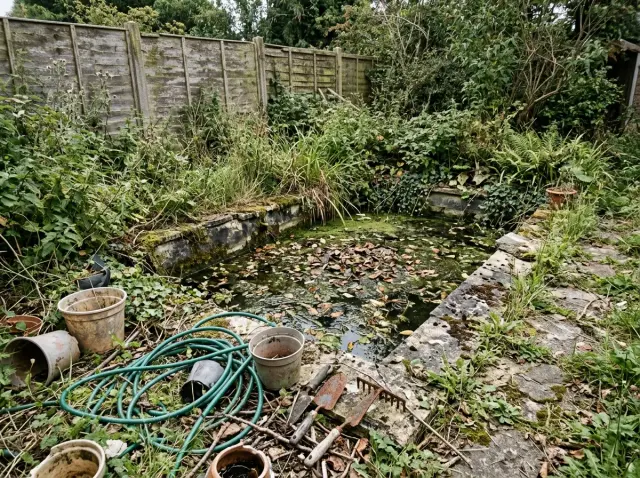
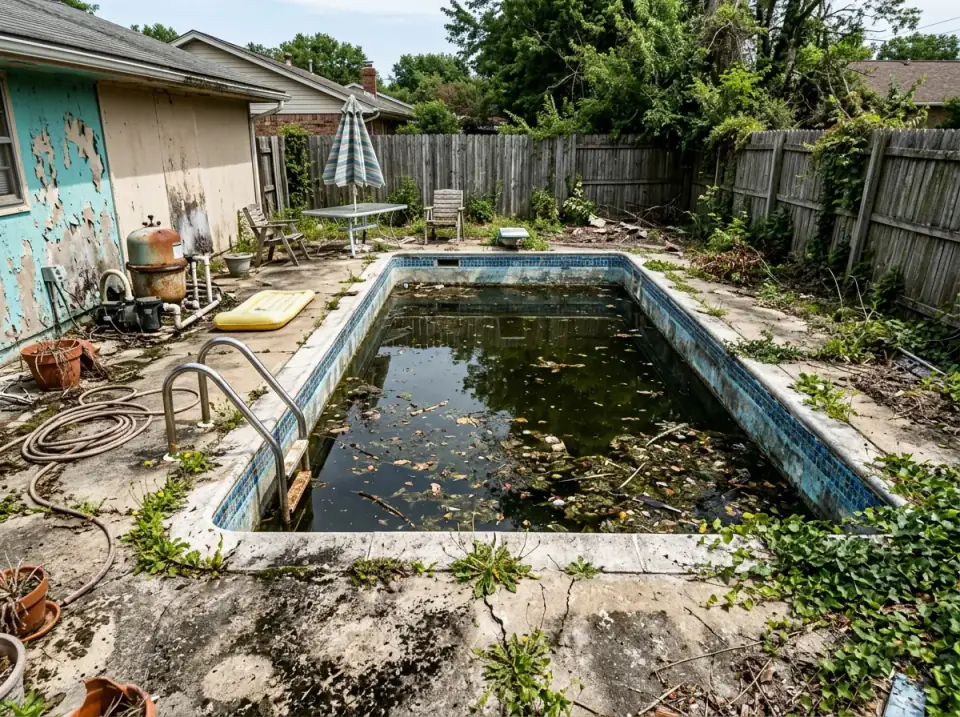
I'm Theo Caldwell — a Renovation Designer and Plan Strategist working out of Beacon, with regular projects across Rhinebeck, Kingston, Hudson, and Cold Spring. A backyard pond is one of the most rewarding water features you can build and one of the easiest to get wrong. The single greatest reason ponds turn into the green-water, algae-choked eyesores most clients inherit is that the original installer treated the pond as a hole in the ground filled with water, rather than as a closed-loop ecosystem with filtration, circulation, and seasonal-thaw mechanics designed in from day one. Below, the same neglected pond on the same Hudson Valley site reinvented nine different ways. Same basin location. Same property lines. Nine genuinely different gardens. Costs, brand specs for liners and pumps and lighting, and Northeast freeze-thaw caveats included for every brief.
How I Read a Pond Renovation
Every pond renovation I take on starts with three engineering decisions that have nothing to do with style. Liner — EPDM 45-mil rubber (Firestone PondGard or Aquascape EPDM) is the only material I specify for Northeast climates because PVC liners crack at the first hard freeze cycle. Filtration — sized to roughly 1.5 times the pond's water volume turnover per hour, with a combination biofilter-and-mechanical system (Aquascape BioFalls combined with a Signature Series Skimmer, or OASE FiltoMatic CWS for an integrated approach). Aeration — a submerged diffuser running through the winter to keep a hole open in the ice for gas exchange (Airmax PondSeries 1, or Atlantic Tidalwave TT-Series). Get these three right and the rest of the brief is just decoration. Get them wrong and the most beautiful coping in the world sits on top of a green-water failure.
The Hudson Valley adds a fourth engineering constraint most national pond articles ignore: freeze-thaw on the coping. Any stone or concrete edge that sits at the water line goes through 60-plus freeze-thaw cycles per Northeast winter, and any unrated material spalls, cracks, or shifts within three seasons. Specify the coping in real granite, dense fieldstone, or rated-for-freeze-thaw concrete (Belgard Mega-Arbel, Techo-Bloc Travertina Raw — both rated to ASTM C1645 freeze-thaw standards). Cast-in-place concrete needs to be a 5,000-psi mix with air-entrainment additive, not the 3,500-psi mix the standard ready-mix plant delivers. My broader approach across our outdoor-renovations archive is to lock the engineering scope first, then choose the stylistic brief — never the other way around. The nine briefs below all sit on the same pond engineering; only the aesthetic skin changes.
1. Sleek Minimalist Sanctuary
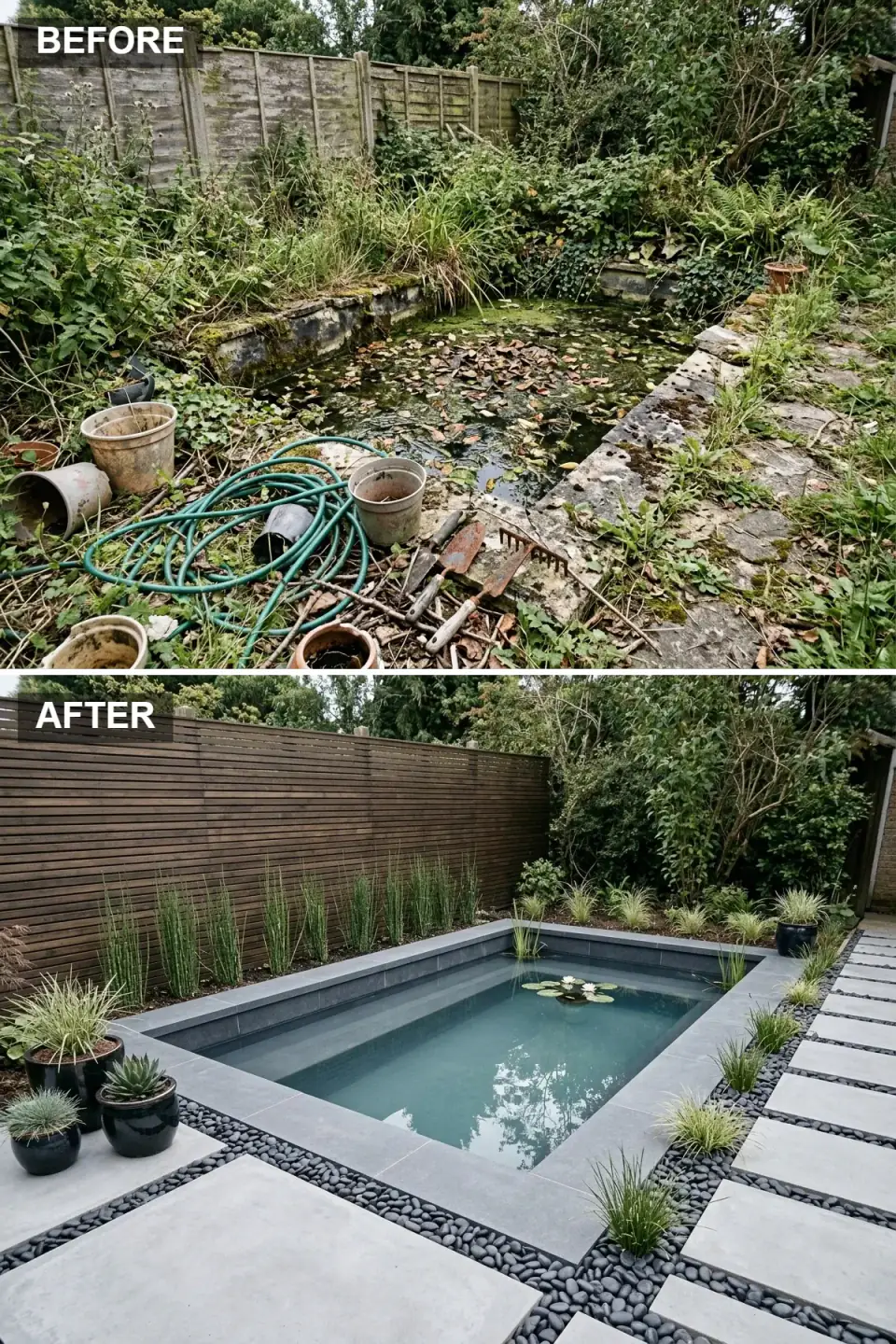
The sleek minimalist brief reads as deliberate because almost nothing is improvised. The original concrete pond shell stays, structurally — relining a sound shell with a 45-mil EPDM liner (Firestone PondGard) costs roughly 40% of demolishing and rebuilding, and the result is identical structurally. The coping is the brief's defining material decision: specify a 4-inch-thick honed granite slab in a dark charcoal-to-black tone (Cold Spring Granite Carnelian Granite, or Materra Imperial Black) running continuously around the perimeter at a consistent 6-inch overhang above the water line. Cast concrete coping is the cheaper alternative — Bomanite or Tabularis cast-in-place with a 5,000-psi air-entrained mix — but specify the formwork joints carefully because every visible joint in cast concrete reads as a defect on a minimalist brief.
The horizontal slatted wood fence (1x4 or 1x6 western red cedar slats with 1/2-inch gaps, prefinished in Cabot Australian Timber Oil in Mahogany Flame or Penofin Verde Brazilian Rosewood) carries roughly 40% of the brief's visual weight. Specify the slats with consistent gap dimensions — irregular spacing destroys the minimalist read. The large-format pavers are 24-by-24-inch or larger concrete or porcelain (Techo-Bloc Industria in Greyed Nickel, or Daltile Emerson Wood in Slate) with a tight 1/8-inch joint filled with black polymeric sand. Horsetail reed (Equisetum hyemale) is the right architectural plant for the brief, but it's aggressive — plant exclusively in matched matte-black planters (Lechuza Cubico in Slate Black, or Crescent Garden Madison Tall in Charcoal) with no soil contact to the surrounding bed, or it spreads through the garden within two seasons.
Color Palette
Slate Grey
#6D767E
Cold Spring Granite Carnelian or Techo-Bloc Industria in Greyed Nickel, 24x24 inch large-format.
Dark Walnut
#4A3B30
Cabot Australian Timber Oil Mahogany Flame on 1x6 western red cedar horizontal slats.
Charcoal Black
#212121
Mexican Beach Pebble in dark slate, 1-to-2-inch tumbled aggregate, set in paver inlay strips.
Glossy Black
#000000
Lechuza Cubico in Slate Black or Crescent Garden Madison Tall in Charcoal, matched pairs only.
2. Naturalistic Rock Oasis
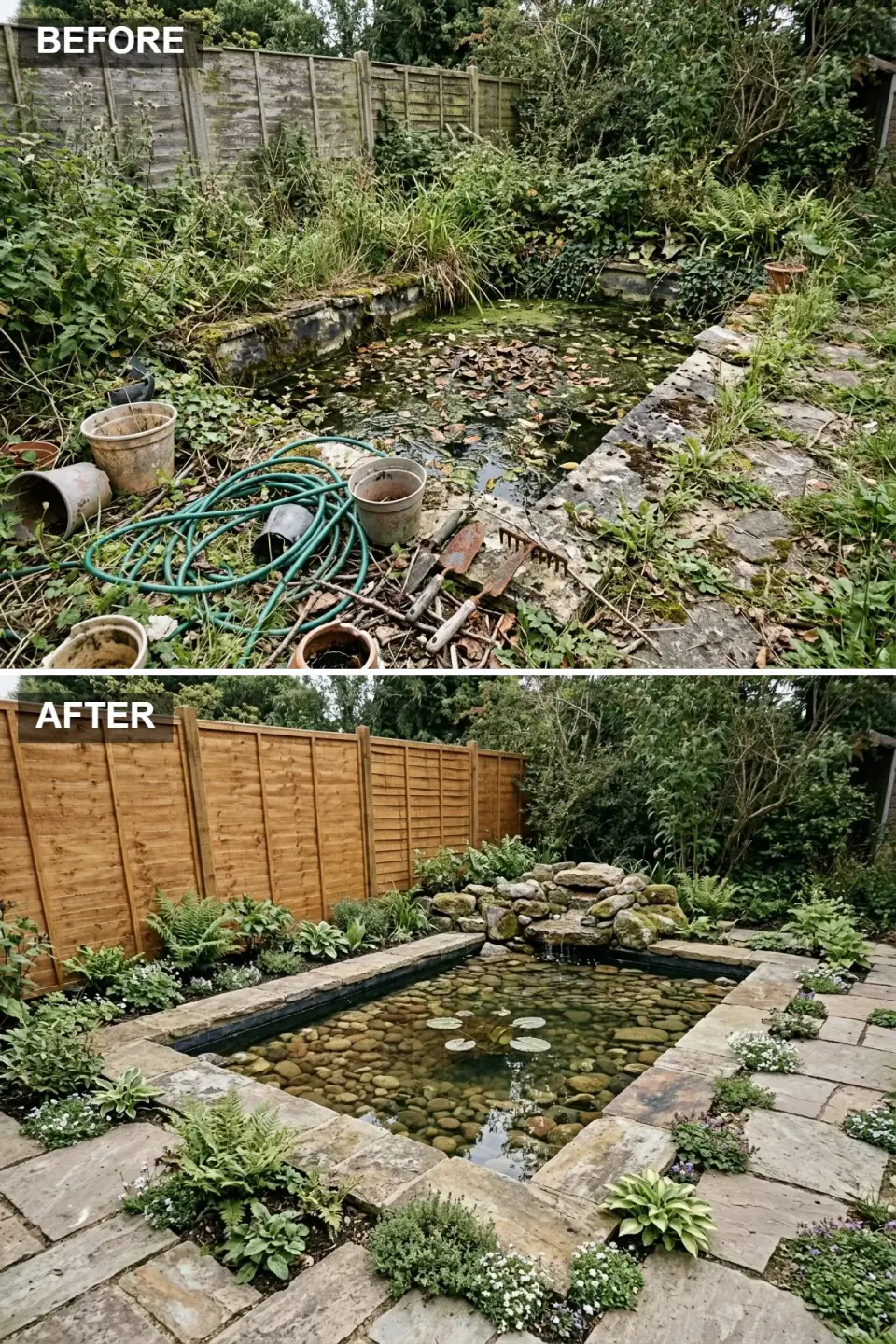
The naturalistic rock oasis is the brief most clients ask for first and the one that's hardest to execute well — because nothing reads more amateur than a manicured "natural" pond. The secret is asymmetry and stone weight. Specify the boulder palette with three size grades: anchor boulders (24-to-36-inch diameter, 200-to-400 lbs each, set on compacted base with a crane or skid-steer), secondary boulders (12-to-18-inch, 50-to-100 lbs), and accent stones (6-to-10-inch, 15-to-30 lbs). Local quarry stone (Hudson Valley fieldstone from Sheldon Stoneworks, or Mohegan Granite from Eastern Stone) reads better than imported river rock — the eye instinctively recognizes regional stone vocabularies, and a Catskills fieldstone in a Hudson Valley pond reads as honest where a Tennessee Crab Orchard would read as catalog.
The cascading waterfall is the brief's signature element. Specify a three-tier drop with the top tier sourced from a small reservoir set roughly 18 inches above the main pond water line, pumped via an Aquascape AquaForce 5200 or OASE AquaMax Eco Classic 3500 (sized at 1.5x the pond's volume per hour). The biofilter (Aquascape BioFalls 6000, or OASE FiltoMatic CWS) sits hidden in the upper reservoir, doing dual duty as the filtration core and the waterfall headwater. The Pennsylvania bluestone flagstone paving with creeping thyme (Thymus serpyllum 'Elfin') in the joints is the brief's tactile element — the thyme releases fragrance when stepped on and seals the joints against weed pressure. Ferns (Athyrium niponicum 'Pictum', Dryopteris erythrosora, Polystichum acrostichoides) and hostas (Hosta 'Sum and Substance', 'Patriot', 'Halcyon') carry the shade-tolerant planting; specify the cultivars by name, not "ferns and hostas" generally.
Color Palette
Sandstone Beige
#C8B490
Full-color Pennsylvania bluestone in random flagstone pattern, dry-set on compacted base.
Weathered Grey-Brown
#7A7060
Hudson Valley fieldstone from Sheldon Stoneworks or Mohegan Granite from Eastern Stone in graduated sizes.
River Stone Multi
#8F8065
Mixed-color river-jack tumbled aggregate, 1-to-3-inch range, lining the pond floor.
Medium Oak
#A08060
Western red cedar 1x6 vertical board, stained with Cabot Solid Color in Cedar Natural and allowed to silver.
3. Contemporary Chic with Integrated Lighting
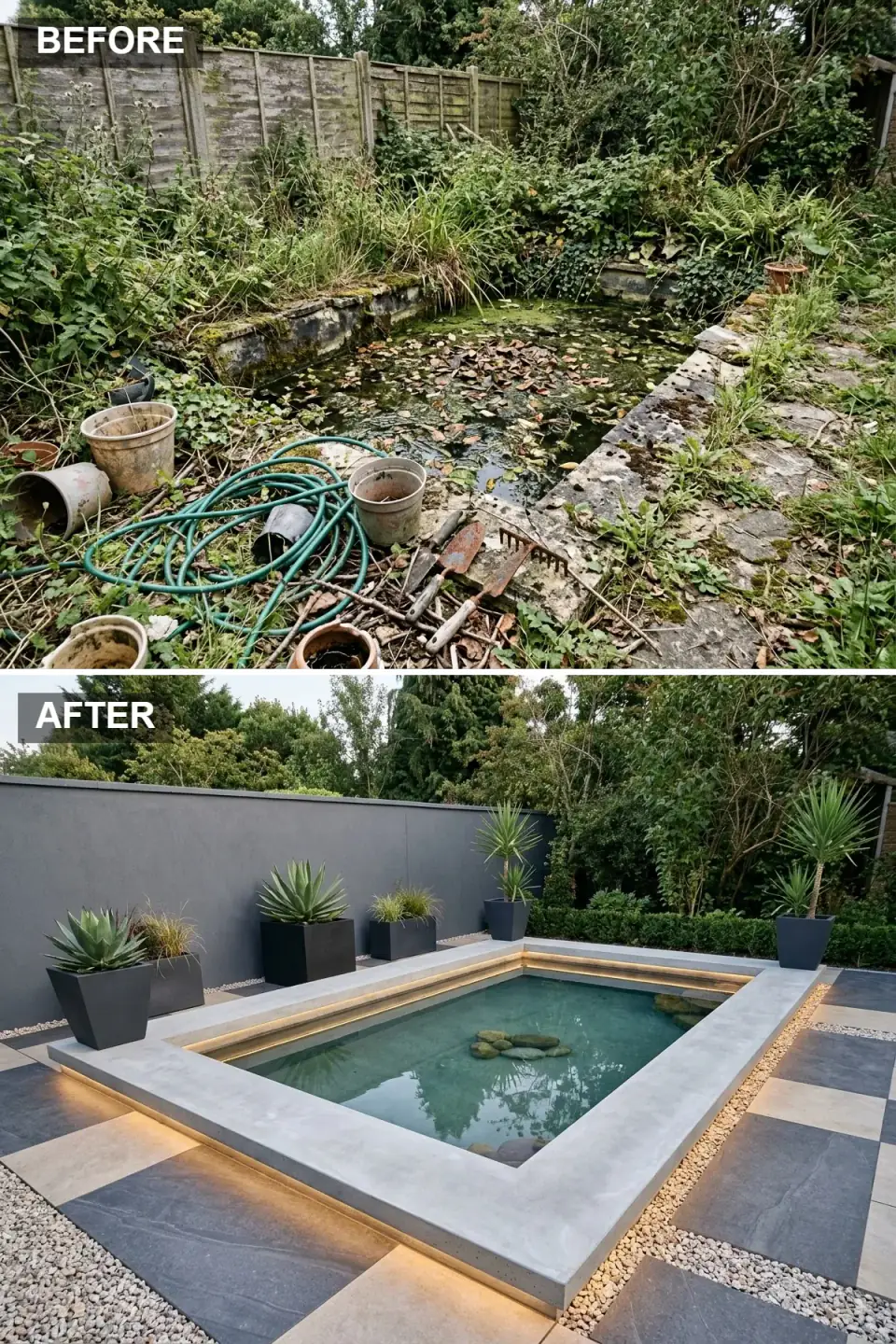
The contemporary chic brief reads as the natural evolution of the minimalist sanctuary with the lighting plan dialed up to architectural levels. The thick cast concrete surround — specify a 6-to-8-inch thickness in a 5,000-psi air-entrained mix with a sealed bull-nose edge — is the brief's defining structural decision. Cost roughly $180 to $280 per linear foot in 2026 Hudson Valley pricing, which is 2 to 3 times the cost of natural stone coping but delivers a continuous monolithic read that natural stone cannot. Specify a CTI Imagecrete or Bomanite cast-in-place system with a sample-approved color match before pouring; concrete is unforgiving once cured.
The integrated LED strip is the brief's hero element. Specify a waterproof IP68-rated linear LED system (WAC Landscape InvisiLED Pro IP66 in 2700K, or Lumen Brite RGB-W in continuous 16-foot reels) recessed in a continuous channel under the bull-nose, wired to a 12V low-voltage transformer (FX Luminaire ZD 600W) on a smart timer (Lutron Caséta Outdoor or FX Luminaire ZD-LINK). Specify the color temperature at 2700K — not the 3000K or 4000K options some installers default to. The 2700K read is warm enough to feel inviting after sunset; cooler temperatures read clinical and surveillance-camera-like. The wall surface behind the pond should be a smooth integral-color stucco (Sto Powerwall in Carbon, or LaHabra Smooth in Charcoal) — three-coat over wire-lath and CMU back-up. The plants are sculptural drought-tolerant specimens: agave (Agave parryi for cold-hardiness, A. americana for warm-zone applications), Yucca rostrata, ornamental grasses (Schizachyrium scoparium, Stipa tenuissima).
Color Palette
Light Concrete
#D0D0D0
CTI Imagecrete or Bomanite cast-in-place, 5,000-psi air-entrained mix, sealed bull-nose edge.
Graphite Grey
#3A3A3A
Daltile Emerson Wood in Slate or Florim Magnum Oversize Pietra D'Iseo Grey porcelain pavers.
Pale Beige
#E0D5C0
Belgard Mega-Arbel in Sandstone or Techo-Bloc Travertina Raw in Stone Beige, freeze-thaw rated.
Charcoal
#454545
Sto Powerwall integral-color stucco in Carbon or LaHabra Smooth in Charcoal, three-coat application.
4. Lush Tropical Escape
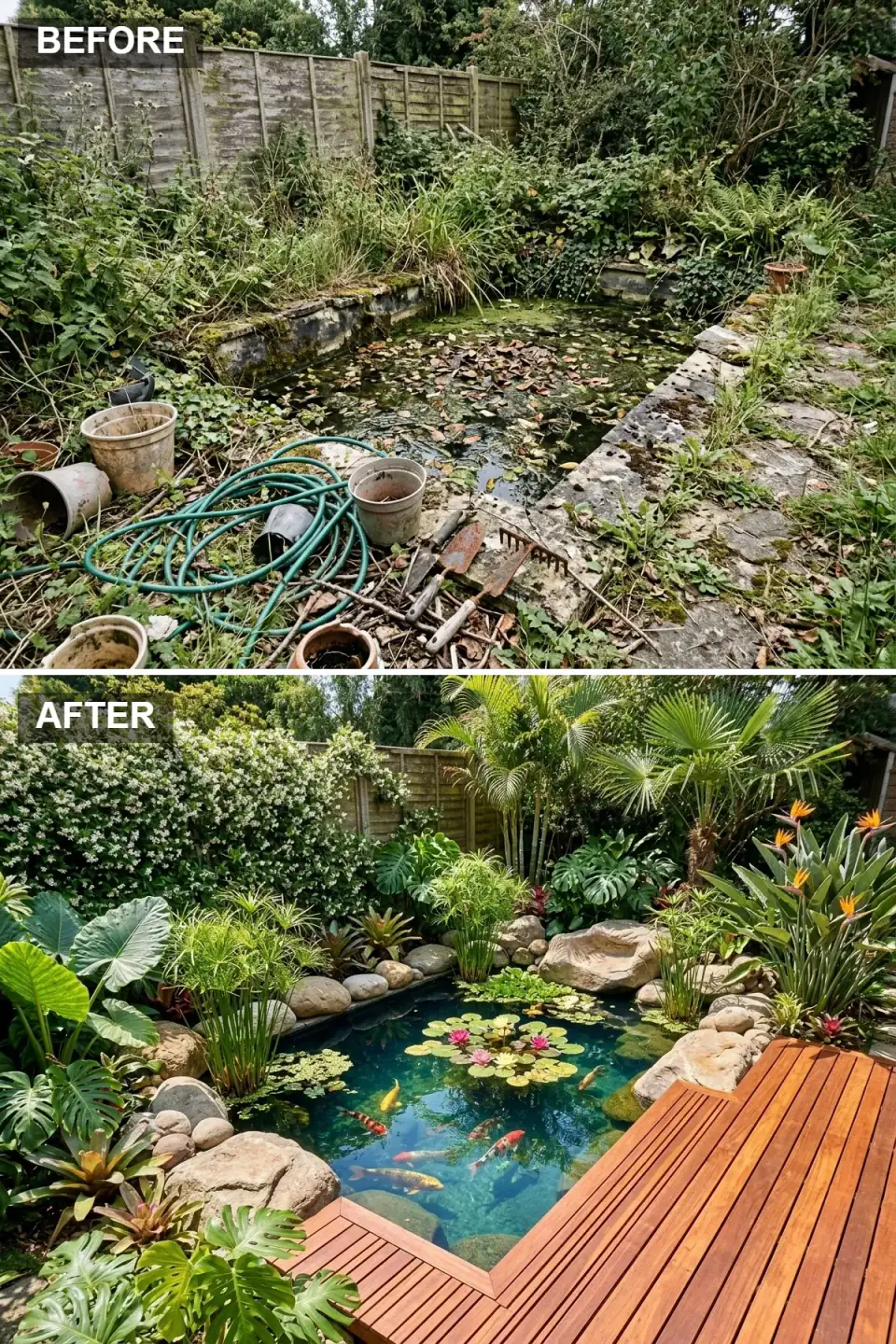
The lush tropical brief is the most engineering-heavy on this list because it adds koi to the program — and koi are not goldfish-on-easy-mode. They require 12-to-18 inches of overwinter water depth below the ice line (which means a minimum 36-inch overall pond depth in the Hudson Valley), heavy mechanical and biological filtration sized for the fish load (Aquascape Signature Series 1000 Skimmer paired with a BioFalls 6000, plus an OASE BioPress 6000 for polishing), and a UV clarifier (Aquascape UltraKlear 4500) to prevent green-water blooms in the warm-water season. Stock at no more than 1 inch of koi per 10 gallons of water; a 1,500-gallon pond reasonably supports 12-to-15 inches of total koi length, no more.
The raised wooden deck is the brief's most flexible element. Specify the deck in Ipe (Brazilian Walnut) or Cumaru hardwood — both Class A fire-rated, naturally rot-resistant for 25-plus years without sealing, and dimensionally stable enough to handle the freeze-thaw cycles. Cheap pressure-treated pine decks adjacent to ponds rot within 8 years from the underside moisture exposure. Budget $24 to $38 per square foot installed for an Ipe deck versus $12 to $18 for pressure-treated pine; the math favors Ipe over a 20-year hold. Tropical plant overwintering is the brief's hidden cost — palms, bird of paradise (Strelitzia nicolai), monstera (Monstera deliciosa), and elephant ears (Colocasia, Alocasia) cannot overwinter outdoors in Zone 5 or 6. Specify them in wheeled fiberglass-clad planters (Crescent Garden Madison Bowl) for indoor transition each October. Water lilies (Nymphaea 'Attraction', 'Chromatella', 'Wanvisa') are hardy and survive Northeast winters in the pond.
Color Palette
Rich Mahogany
#8B4513
Ipe (Brazilian Walnut) or Cumaru hardwood decking, 5/4 x 6, hidden-fastener installation.
Tan Granite
#B0A080
Mohegan Granite or Hudson Valley fieldstone in tan-brown range, 18-to-30-inch diameter anchor stones.
Grey Slate
#707070
Pennsylvania bluestone thermal-finish or Vermont slate, 2-inch-thick natural-cleft coping.
Aged Wood
#6B5B4B
Western red cedar 1x6 vertical board, Cabot Solid Color in Driftwood Grey, hidden behind dense planting.
5. Classic Formal Elegance
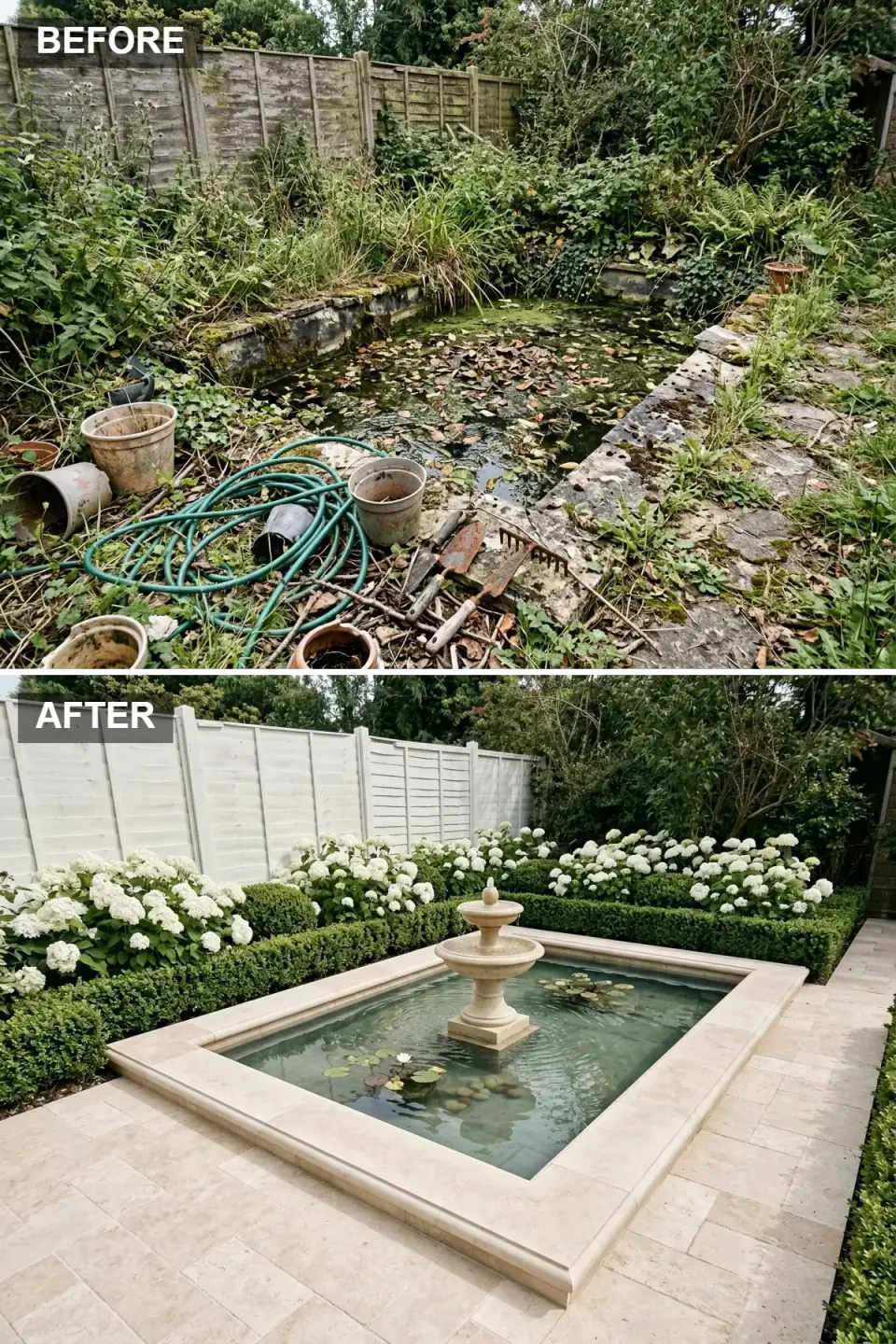
The classic formal brief is the right read for traditional Hudson Valley properties — Rhinebeck colonial estates, Hyde Park manor properties, Hudson historical-district homes — where the front facade carries Federal, Georgian, or Colonial Revival vocabulary and the pond needs to extend that language into the rear garden. The tiered fountain is the brief's defining element. Specify a real cast-limestone or cast-stone fountain (Campania International, Haddonstone, or Longshadow Planters), not a resin-replica from a big-box retailer. A genuine cast-limestone two-tier fountain in 2026 pricing runs $4,800 to $11,500 for the unit, $2,200 to $4,800 for installation (foundation, pump, plumbing, electrical), and weighs 800 to 2,400 pounds set, which requires a poured concrete footing extending below frost depth (42 inches in Hudson Valley).
The travertine coping should be a true Italian travertine in honed finish, not the tumbled or chiseled-edge variants — formal briefs demand the cleanest edge available. Specify Stone Source or Daltile Tuscany Travertine in 12-by-24-inch or larger modules with sealed joints. The pale limestone paving (Indiana Buff Limestone, French Lavaux Limestone, or a domestic equivalent from Champlain Stone) carries the brief's continuity. The boxwood (Buxus 'Green Velvet' or 'Green Mountain' for cold-hardiness and deer resistance — never B. sempervirens varietals on deer-pressure Hudson Valley lots) needs to be clipped twice yearly to the same dimensions to maintain the formal read. The white hydrangea should be Hydrangea paniculata 'Limelight', 'Quick Fire', or 'Bobo' — all reliably cold-hardy, all delivering white blooms that don't depend on soil pH like H. macrophylla varieties do.
Color Palette
Cream Travertine
#E6DBC0
Italian travertine honed finish from Stone Source or Daltile Tuscany Travertine; Campania cast-limestone fountain.
Pale Limestone
#F0EAD6
Indiana Buff Limestone or French Lavaux Limestone, 18-by-18-inch or 24-by-24-inch modules.
Crisp White
#FFFFFF
Benjamin Moore OC-117 Simply White on AZEK PaintPro PVC fence pickets, 25-year color warranty.
Deep Forest Green
#005000
Buxus 'Green Velvet' or 'Green Mountain' clipped 18-inch hedges, twice-yearly trimming schedule.
6. Tranquil Japanese Zen Garden
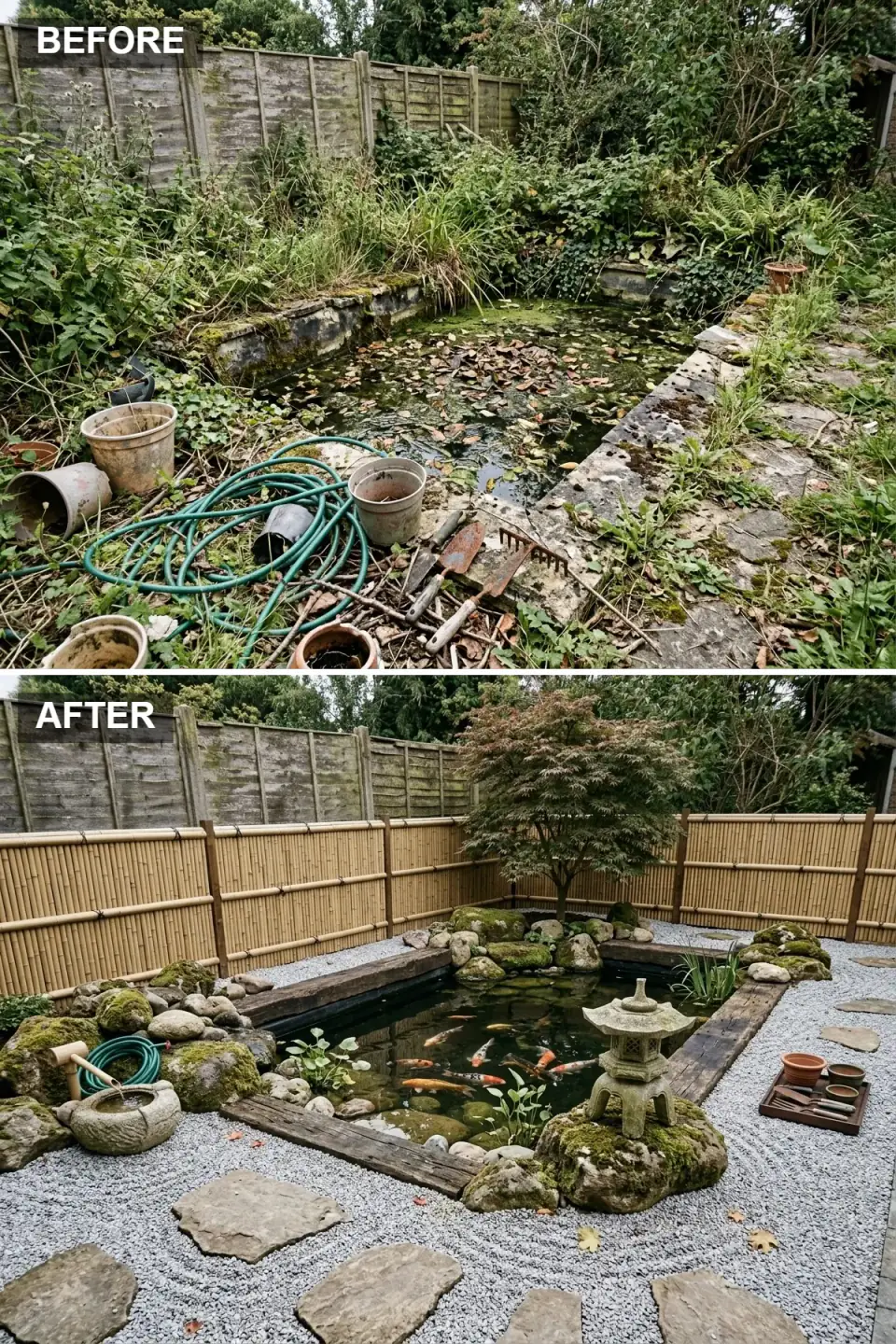
The Japanese zen garden brief is the most disciplined on this list — the brief that lives on what's left out rather than what's added in. The pond framing in aged timber sleepers should be real reclaimed Japanese cedar or domestic cypress weathered to a silvery gray, not pressure-treated pine stained brown. Source reclaimed sleepers from a regional supplier (Pioneer Millworks in upstate New York, Olde Wood Limited in Ohio) and accept the cost premium. The shishi-odoshi (deer scarer) — the bamboo water feature that periodically tips and strikes a stone with a soft hollow clack — is the brief's audio signature; specify a real bamboo unit (Niigata Bamboo, or a custom one from a regional Japanese-garden specialist), not a resin reproduction.
The raked gravel ground cover should be a 3/8-inch white or pale-gold pea gravel (Carolina Stalite Granite-Sourced Pea Gravel, or pale-tone river-jack from a regional aggregate supplier) over a geotextile fabric (Mirafi 140N) and a 4-inch compacted base. The raked patterns require maintenance — they smooth out after rain, after squirrels, after dropping leaves — so plan on a weekly raking schedule in season and a willingness to accept the impermanence as part of the brief's philosophy. The Japanese maple should be Acer palmatum 'Bloodgood' (upright form, 15-to-20-foot mature height) or A. palmatum dissectum 'Tamukeyama' (weeping form, 6-to-10-foot) — both reliably cold-hardy for Hudson Valley applications. Black bamboo (Phyllostachys nigra) is the only cold-hardy black bamboo varietal; specify it with a 24-inch-deep HDPE root barrier (BambooBarrier 60-mil) or it conquers the entire property within three years.
Color Palette
Natural Bamboo
#D0B080
Authentic Japanese tea-garden bamboo fencing from Niigata Bamboo or Forever Bamboo Premium grade.
Aged Timber Sleepers
#5F4F3F
Reclaimed Japanese cedar or domestic cypress timber sleepers from Pioneer Millworks or Olde Wood Limited.
Light Grey Granite
#B0B0B0
3/8-inch white-to-pale-gold pea gravel over Mirafi 140N geotextile fabric and 4-inch compacted base.
Aged Stone Grey
#808080
Hand-carved Japanese granite Yukimi or Kasuga lantern, 24-to-36-inch height, mossed naturally over time.
7. Rustic Charm with Built-in Bench
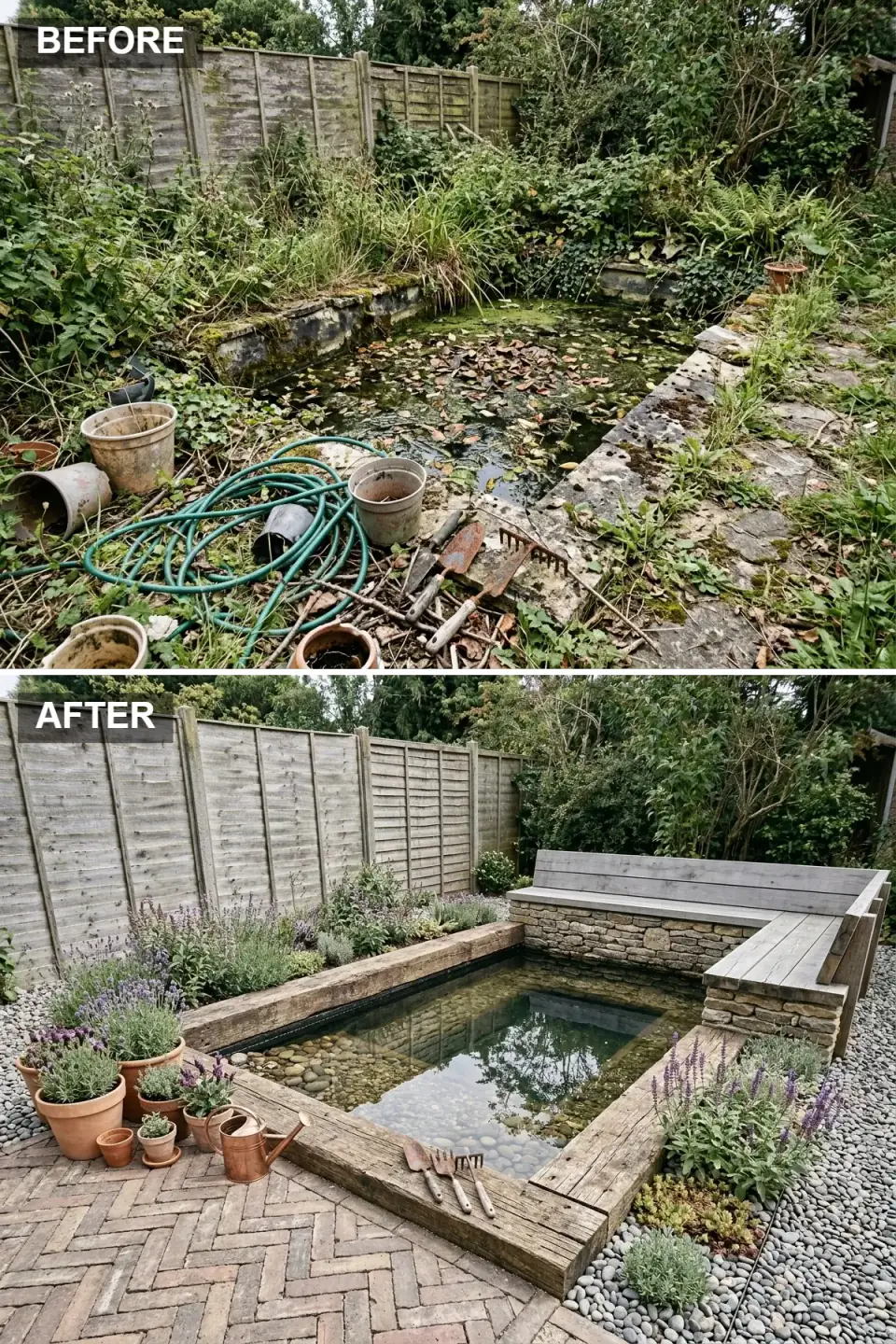
The rustic charm brief is the most cost-honest on this list — the one that delivers the most visible character per dollar spent. The built-in gabion-and-timber bench is the brief's signature move and a structural detail I've borrowed for half a dozen Hudson Valley back-garden projects. Specify the gabion baskets as galvanized welded-wire (Maccaferri Gabion, or LIBA Gabion) filled with locally-sourced fieldstone in 4-to-8-inch range, sized as a 18-inch-tall by 18-inch-deep base. The bench top should be a 3-inch-thick rough-sawn oak slab (white oak or red oak from a regional sawmill) finished with Penofin Verde Pure tinted oil. Total bench install runs $1,800 to $2,800 for an 8-foot run, which is roughly 30% of the cost of a comparable wood-frame bench built from new lumber.
The herringbone brick paving is the brief's tactile floor. Specify a true paving brick (Belden Pathway Pavers in Old Brownstone, Pine Hall Pathway Pavers in Brick Red, or reclaimed Glen-Gery from a regional reclamation supplier) laid in 90-degree herringbone with a 6-inch compacted gravel base and sand-set joints. Wet-mortared brick fails in Hudson Valley freeze-thaw within 4 to 6 seasons. The cottage-style planting should be working herbs (Salvia officinalis, Thymus vulgaris, Rosmarinus officinalis 'Arp' for cold-hardy rosemary, Origanum vulgare) and lavender (Lavandula angustifolia 'Phenomenal' — the only varietal reliably hardy through Zone 5 winters). The terracotta pots need to be frost-rated (Whichford Pottery, Pennoyer Newman, or Mital — all frost-rated to -10°F); the big-box terracotta freeze-cracks in one winter.
Color Palette
Weathered Oak
#8B7D6B
Rough-sawn white or red oak from a regional sawmill, finished with Penofin Verde Pure tinted oil.
Terracotta Red
#A05040
Belden Pathway Pavers in Old Brownstone or Pine Hall in Brick Red, sand-set herringbone pattern.
Mixed Fieldstone
#908070
Maccaferri or LIBA galvanized welded-wire gabion baskets filled with Hudson Valley fieldstone, 4-to-8-inch range.
Classic Clay
#C07050
Whichford Pottery, Pennoyer Newman, or Mital — frost-rated to -10°F for Hudson Valley winters.
8. Magical Evening Retreat
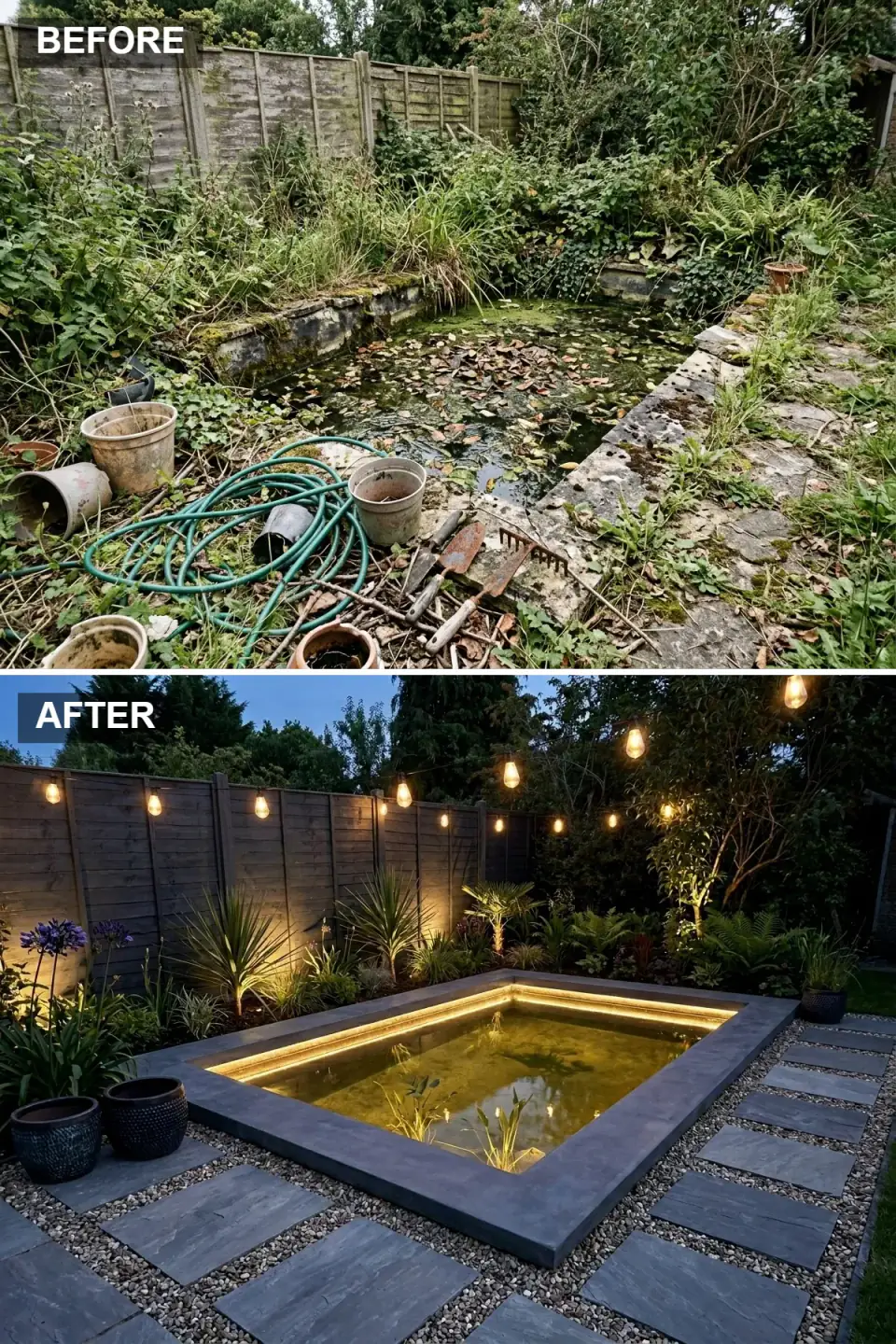
The magical evening retreat brief is really a lighting-plan brief overlaid on any of the previous physical-installation briefs. It's the right approach for any client who actually uses their back garden after sunset — which, in the Hudson Valley summer, is when the garden delivers most of its livability hours from June through September. The strategy is layered low-voltage lighting at four distinct heights: in-water pond lighting (Aquascape Garden & Pond LED Spotlights, IP68-rated, three to five units depending on pond size), perimeter LED strips under the coping (WAC Landscape InvisiLED Pro IP66 in 2700K, the same spec from Brief 3), accent uplights on specimen plants (FX Luminaire BD-series or Vista Pro 5215 bullet lights), and ambient overhead string lighting (Brightech Ambience Pro Weatherproof G40, or Bulbrite Solana Smart String).
The transformer sizing is the most common mistake on this brief. A typical 800-to-1,200-square-foot back garden with the layered lighting plan above draws 280 to 450 watts total — which means specifying a 600W or 900W FX Luminaire ZD transformer (not the 300W unit that the contractor's typical residential install assumes). Wire on three separate zones — pond lighting, accent uplighting, ambient overhead — to a Lutron Caséta Outdoor or FX Luminaire ZD-LINK smart controller. The zones let you turn the pond glow up for ambient evenings and the path lighting up for guests-arriving moments without flooding the whole garden every time. Specify all bulbs at 2700K; mixing color temperatures (4000K path lights with 2700K accents, for instance) reads as catalog from the first step into the garden.
Color Palette
Warm White Light
#FBEFB0
Aquascape Garden & Pond LED Spotlights at 2700K, IP68-rated, three-to-five-unit array.
Dark Slate
#3A3F45
Daltile Emerson Wood in Slate or Pennsylvania bluestone in thermal-finish dark gauged tone.
Deep Shadow
#1A1A1A
Cabot Solid Color Stain in Black on cedar 1x6 vertical board fence panels.
Black Textured
#101010
Lechuza Cubico in Slate Black or Crescent Garden Madison in Charcoal, matched-pair groupings.
9. Industrial Chic with Corten Steel
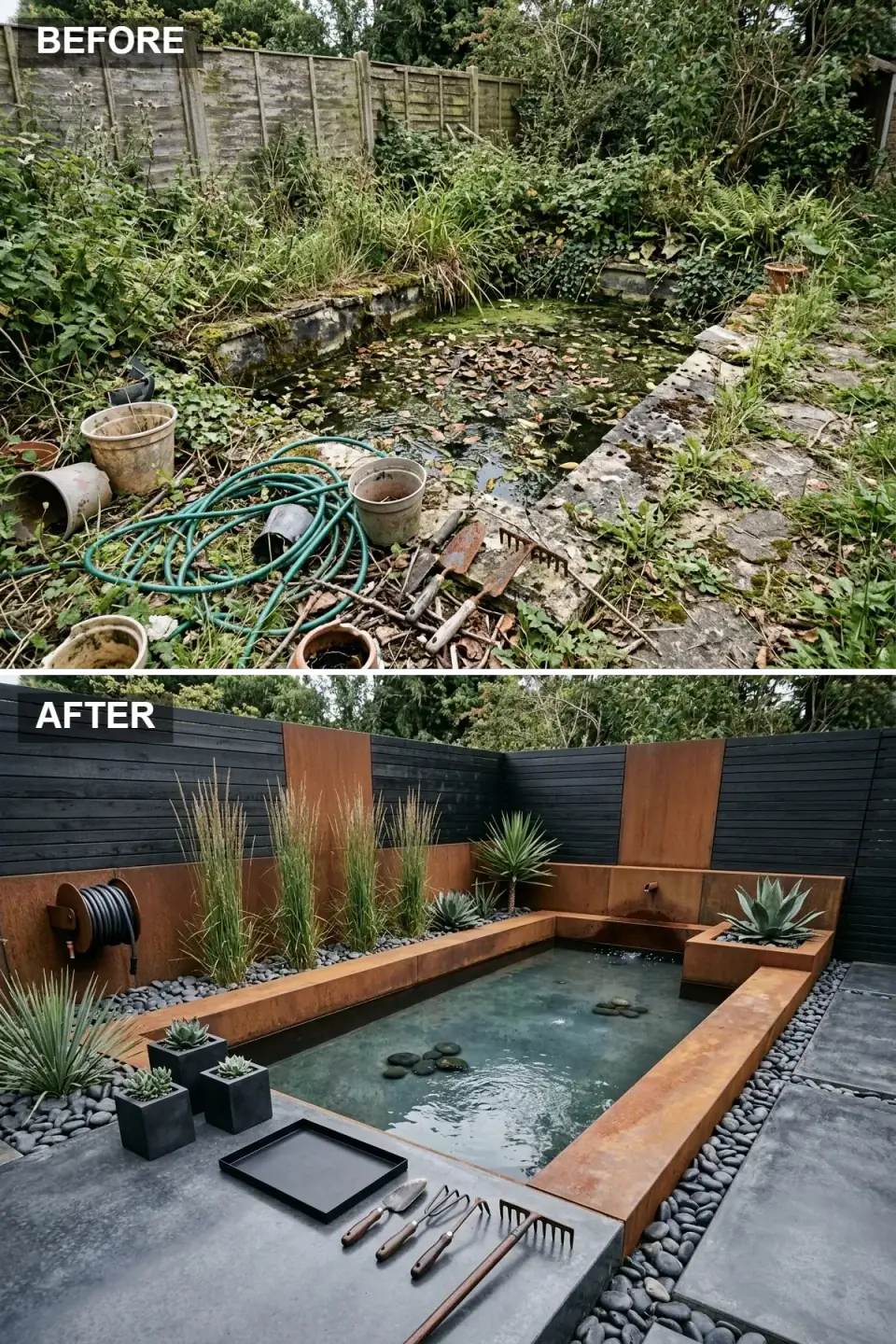
The industrial Corten brief is the boldest on this list — the move that turns a garden pond into an architectural object. Real architectural-grade Corten steel (specify AlumaSteel, MeridianCast, or a custom fabrication from a regional steel shop with weathering-steel experience) weathers from raw mill-finish to a stable orange-brown patina over 6 to 18 months and lasts 80-plus years exposed. The cheap painted-rust faux versions sold at garden centers chip within two seasons and reveal grey-painted steel underneath, killing the brief instantly. Budget $48 to $85 per square foot installed for real Corten fabrication including the design, cutting, welding, weathering acceleration treatment if specified, and structural installation.
The multi-level planter and water-feature wall is the brief's signature element. Specify a CAD-drawn fabrication package — not field-improvised — with the Corten units arriving on site as pre-fabricated modules with welded internal bracing, integral basin liners (the planter sections need waterproof EPDM-lined interiors), and pre-drilled mounting holes for the structural bolts. Cheaping out on the fabrication detail produces wavy, dented, or out-of-plumb panels that read amateur from across the yard. The matte-black concrete paver patio (Belgard Holland Stone in Charcoal, or Techo-Bloc Industria in Onyx Black, both freeze-thaw rated) and smooth black river-stone bedding (Mexican Beach Pebble in dark slate, 2-to-3-inch tumbled aggregate) complete the monochrome read against the Corten orange. The plants are sculptural: cold-hardy agave (Agave parryi or A. ovatifolia 'Frosty Blue'), Yucca rostrata, and ornamental grasses (Schizachyrium scoparium 'The Blues').
Color Palette
Rust Orange
#A05030
AlumaSteel, MeridianCast, or custom architectural-grade weathering steel — real Corten only, never painted faux.
Matte Black
#202020
Belgard Holland Stone in Charcoal or Techo-Bloc Industria in Onyx Black, freeze-thaw rated.
Smooth Black
#101010
Mexican Beach Pebble in dark slate, 2-to-3-inch tumbled aggregate around pond perimeter.
Black Stain
#000000
Cabot Solid Color Stain in Black or Cutek Extreme in Sooty on cedar 1x6 fence panels.
Pro Tips From the Renovation Designer's Chair
- Drain and inspect the basin before any aesthetic decision. Pump the existing pond dry, scrape the bottom, and inspect the original liner or concrete shell for cracks, root intrusion, or sub-grade settling. Roughly 60% of the "pond renovations" I'm called to inherited a sound shell that just needed a new liner and proper filtration; the other 40% need a full rebuild. The inspection determines which category your project lives in.
- Specify the liner as 45-mil EPDM, not PVC. Firestone PondGard or Aquascape EPDM is the only material I'll specify for Northeast climates. PVC liners crack at the first hard freeze cycle and are the single most common cause of pond failures in the Hudson Valley.
- Size the filtration at 1.5x volume turnover per hour. A 1,500-gallon pond needs at least a 2,250-gallon-per-hour filtration system (Aquascape AquaForce 4000 or equivalent). Under-sized filtration produces green water and unhappy fish; over-sized filtration costs slightly more in electricity but never causes a problem.
- Plan electrical conduit at the demolition stage, not after the coping is set. Running a fresh GFCI-protected 20-amp circuit to the pond zone in 3/4-inch PVC conduit costs $400 to $900 at demo; tearing up cured concrete to add it later costs $2,800 to $5,400. Plan all four lighting zones plus pump electrical at one go.
- Stone-edge selection determines maintenance load. Tightly mortared coping needs zero weeding but cracks in freeze-thaw; sand-set flagstone with creeping thyme joints needs annual weeding but flexes with frost heave. Pick the maintenance trade-off you'll actually sustain.
- Match the brief to the front facade. A Japanese zen pond behind a Colonial front facade confuses the property's narrative at resale. The pond brief should extend or complement the architectural language of the main house, not contradict it.
Cost-Saving Moves on a Pond Renovation
- Reline the existing concrete shell instead of demolishing it. A 45-mil EPDM liner over a sound concrete shell costs roughly 40% of a full demo-and-rebuild and delivers identical structural performance. Demolish only if the shell is cracked through, root-penetrated, or sub-grade-settled.
- Local fieldstone instead of imported boulders. Hudson Valley fieldstone from a regional supplier (Sheldon Stoneworks, Catskill Valley Stone) runs $0.18 to $0.32 per pound; imported river rock or imported granite runs $0.45 to $0.95 per pound. The local stone reads more honest and saves 50–60% on the boulder line.
- Sand-set, never mortared, in freeze-thaw climates. Sand-set flagstone costs 30–40% less than mortared assemblies and outlasts them in Northeast climates by 15-plus years. Polymeric sand (Alliance Gator Maxx G2 or Techniseal NextGel) gives you stable joints without the rigid-failure risk of mortar.
- Layer the lighting investment. Install the transformer, the smart controller, and the direct-burial wiring on day one; phase the fixtures in over two years if budget is tight. Adding fixtures to an existing low-voltage system is plug-and-play; running new wire after the patio is set is a teardown.
Reader Questions on Pond Transformations
What does a complete pond renovation actually cost in 2026 Hudson Valley pricing?
Budgets range from roughly $14,000 (rustic charm with built-in gabion bench, sand-set herringbone brick, basic LED lighting) to $98,000 (industrial Corten with full custom steel fabrication, integrated lighting, and architectural planting) for a typical 1,000-to-1,500-gallon pond plus surrounding hardscape and planting. Engineering recovery alone — new 45-mil EPDM liner, properly-sized filtration system, winter aeration, electrical conduit, and licensed-electrician hook-up — consumes $6,000 to $14,000 before any aesthetic line item begins. Cast-limestone fountains, real Corten fabrication, and cast-in-place concrete coping push budgets toward the high end. Get firm bids on the engineering scope before locking the aesthetic brief.
Which of the nine briefs is the most maintenance-intensive?
The lush tropical escape with koi is the highest-maintenance brief, easily — koi require year-round care including winter aeration, weekly water-quality testing during the warm season, high-quality feed at varying rates by temperature, and overwintering of tropical container plants indoors from late October through April. The classic formal elegance brief is the second-highest because boxwood needs twice-yearly clipping and the cast-limestone fountain must be drained, covered, and disconnected each October. The naturalistic rock oasis is moderate. The rustic charm and industrial Corten briefs are the lowest-maintenance after the initial install settles.
Can a pond actually overwinter koi in the Hudson Valley?
Yes, with proper specifications. Koi need 12-to-18 inches of unfrozen water below the ice line to survive a Northeast winter, which means a minimum 36-inch total pond depth. A submerged aerator (Airmax PondSeries 1 with a diffuser plate set on the pond floor) runs continuously from November through March to keep a 24-to-36-inch hole open in the ice for gas exchange. Stop feeding the koi when water temperatures drop below 50°F; resume in spring when temperatures are consistently above 50°F. With those three protocols, koi overwinter reliably in the Hudson Valley.
How do I keep pond water from turning green?
Green water is almost always a filtration sizing problem combined with excess nutrient load. The fix has three parts. First, size mechanical and biological filtration at 1.5x the pond volume per hour (a 1,500-gallon pond needs at least 2,250 GPH filtration). Second, add a UV clarifier (Aquascape UltraKlear 4500, OASE Vitronic Premium) in the return line to kill suspended algae. Third, control the nutrient load — overfeeding fish is the most common cause of nutrient overload, followed by leaf litter accumulation in the basin. Skim leaves weekly, feed koi only what they consume in 5 minutes, and the green water problem resolves within 2 to 4 weeks.
Which brief holds resale value best in the Northeast?
The naturalistic rock oasis and the classic formal elegance briefs deliver the most defensible resale appraisals for Hudson Valley properties — both read as professionally-designed water features that local appraisers can comp against high-end residential sales. The sleek minimalist and contemporary chic briefs hold value strongly on contemporary properties but limit the buyer pool. The Japanese zen, industrial Corten, and lush tropical briefs are highly buyer-specific and read as personalization rather than improvement at resale — they're owner-enjoyment projects, not appraisal-driven ones. Pick the brief for how you'll live in the garden, not how it'll list.
How long does a complete pond renovation take from start to finish?
Six to fourteen weeks for the construction phase of a typical Northeast project, plus two to four weeks of design and permitting beforehand. Drainage and demolition consume the first 2 weeks; engineering install (liner, filtration, electrical, plumbing) consumes weeks 3 through 6; hardscape coping and surrounding paving consumes weeks 6 through 10; planting and lighting finalization consumes the last 2 to 4 weeks. Briefs with full custom Corten fabrication or cast-limestone fountains add 4 to 8 weeks for the off-site fabrication and delivery lead time. Plan for a single construction season (April through October) and don't schedule a pond install for the same season as a major front-house renovation — the trades collide.
Where to Read Next
If pond renovation is one piece of a broader back-garden rebuild, the 12 backyard pool transformations walks the same engineering-first logic on a pool installation instead of a pond, and the backyard forest-bathing nook shows how to commit fully to one meditative brief on a small footprint. For smaller-scale outdoor work, the garden-corner transformations applies the brief-driven approach at a tighter scale. And for the broader outdoor-renovations category index, every outdoor-living article I publish lives there.
Sources & Further Reading
- Aquascape Inc., Pond construction specifications, filtration sizing, and EPDM liner installation guidance.
- Firestone Specialty Products, PondGard 45-mil EPDM technical data sheet and warranty terms.
- OASE Living Water, Filtration and UV clarifier specifications for residential pond installations.
- American Society of Landscape Architects, Residential water-feature design standards and best practices.
- National Association of Home Builders, 2026 Cost vs. Value Report for the Northeast region — outdoor renovation benchmarks.
- Cornell Cooperative Extension, Hudson Valley horticultural guidance and cold-hardiness zone references.
- Belgard Hardscapes, Paver system technical specifications including freeze-thaw ratings.
- Pioneer Millworks, Reclaimed timber sleepers and architectural wood specifications.
- Campania International, Cast-stone fountain specifications and frost-resistance ratings.
- U.S. Department of Energy, Outdoor low-voltage lighting efficiency and transformer sizing references.

Nora Whitfield
Renovation Designer & Interiors Editor · Beacon, New YorkNine years of design-build renovation work across the Hudson Valley and the Northeast. Nora runs the Renovations, Room Guides and Renovation Mind desks — before-and-after studies, room-by-room design guides, and the long essays on why what we renovate matters.
More from Nora →
Reader notes