


The first time I walked this property, the peeling paint and the weed-claimed yard pulled every eye to the damage. I looked past it. Under the neglect sat a clean gable-front box — symmetrical, well-proportioned, sitting square on its lot. Good bones, in the way a drafter would mean it: the load paths were honest and the footprint needed nothing. So instead of pitching an addition that would force new framing and a new foundation, I asked a cheaper, smarter question — what happens if we only change the skin? Siding, roofing, porch, and the few details that read from the curb. Here are nine answers, each a complete style, none of them touching a structural wall.
How I Read a Re-Skin
A material swap looks cosmetic, but it is a framing-literate decision before it is a finish one. The skin has to attach to what is already there — sheathing condition, the rainscreen gap, the flashing at every window head, the way water leaves the wall. When I evaluate a restyle, I am really reading the plan that the original house was built from: where the studs land, whether the porch roof can carry weight, how the cladding terminates at the foundation. Get those right and the look takes care of itself. Get them wrong and the prettiest siding in the catalog rots out from behind in five winters.
Everything below is a re-skin of the same gable box — no walls moved, no footprint changed. That constraint is the point. Across the Hudson Valley, from Beacon to Kingston, I see owners reach for an addition when a considered material change would have bought them the new house for a third of the spend. If you want the wider catalog of what's possible on a tired facade, our roundup of exterior makeover material transformations walks through the same logic on a different house. This article is the deep version: nine finished directions, with the cost and the structural catch on each.
1. Industrial Rustic — Corrugated Metal and Reclaimed Wood
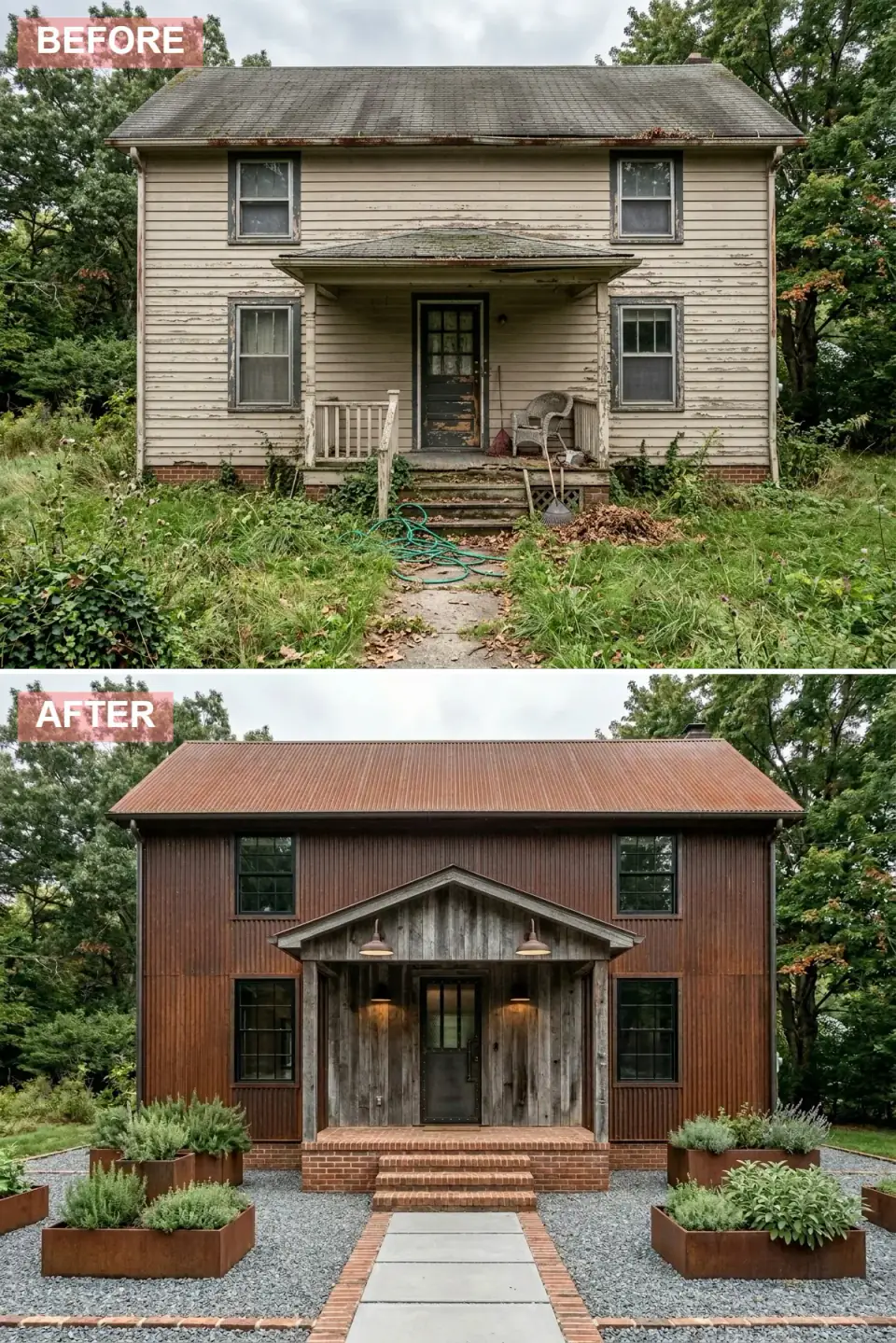
We pulled the old clapboard and ran rusted corrugated metal vertically up the walls, with a matching weathered-steel roof tying the whole box together. The vertical run matters — it reads taller and lets water shed fast off the ribs. To keep the metal from feeling cold, I rebuilt the porch in reclaimed, weathered timber right at the entry, where your hand and eye actually land. Dark-framed windows and a heavy iron door finish the theme. The yard went to crushed dark gravel, brick paths, and corten planters of drought-tolerant herbs — low water, low upkeep, no lawn to fight.
Here is what the plan tells you that the catalog photo won't. Corten and rusted ribbed panels keep oxidizing, and the runoff stains anything porous below — concrete, stone, the brick path you just laid. On a Hudson Valley build I detail a drip edge and a gravel splash zone so the bleed never reaches a finished surface. This is a high-end re-skin: specialty metal runs well above standard fiber-cement, and a true reclaimed-timber porch is real money in both material and skilled labor — figure $9–$14 per square foot installed for the metal alone up here. Not a DIY weekend. Done right with proper flashing and a vented rainscreen behind the panels, it is one of the most durable skins on this list.
Color Palette
Weathered Corten Rust
#8B4513
An oxidized orange-brown with real depth — think Bridger Steel's corten ribbed panel, where the patina is the finish, not a coat over it.
Reclaimed Weathered Timber
#6F6153
A muted grayish-brown salvage tone sealed with Rubio Monocoat Smoke to hold the age without going slick.
Iron Black
#2C2C2C
A near-black that defines every opening — Benjamin Moore Black Beauty 2128-10 on trim, or factory black on Marvin Elevate units.
Brick Red
#A55D4B
An earthy clay-brick red that grounds the metal and gives the eye one warm, traditional anchor at the base.
2. Classic Coastal — Cedar Shakes and a Metal Roof
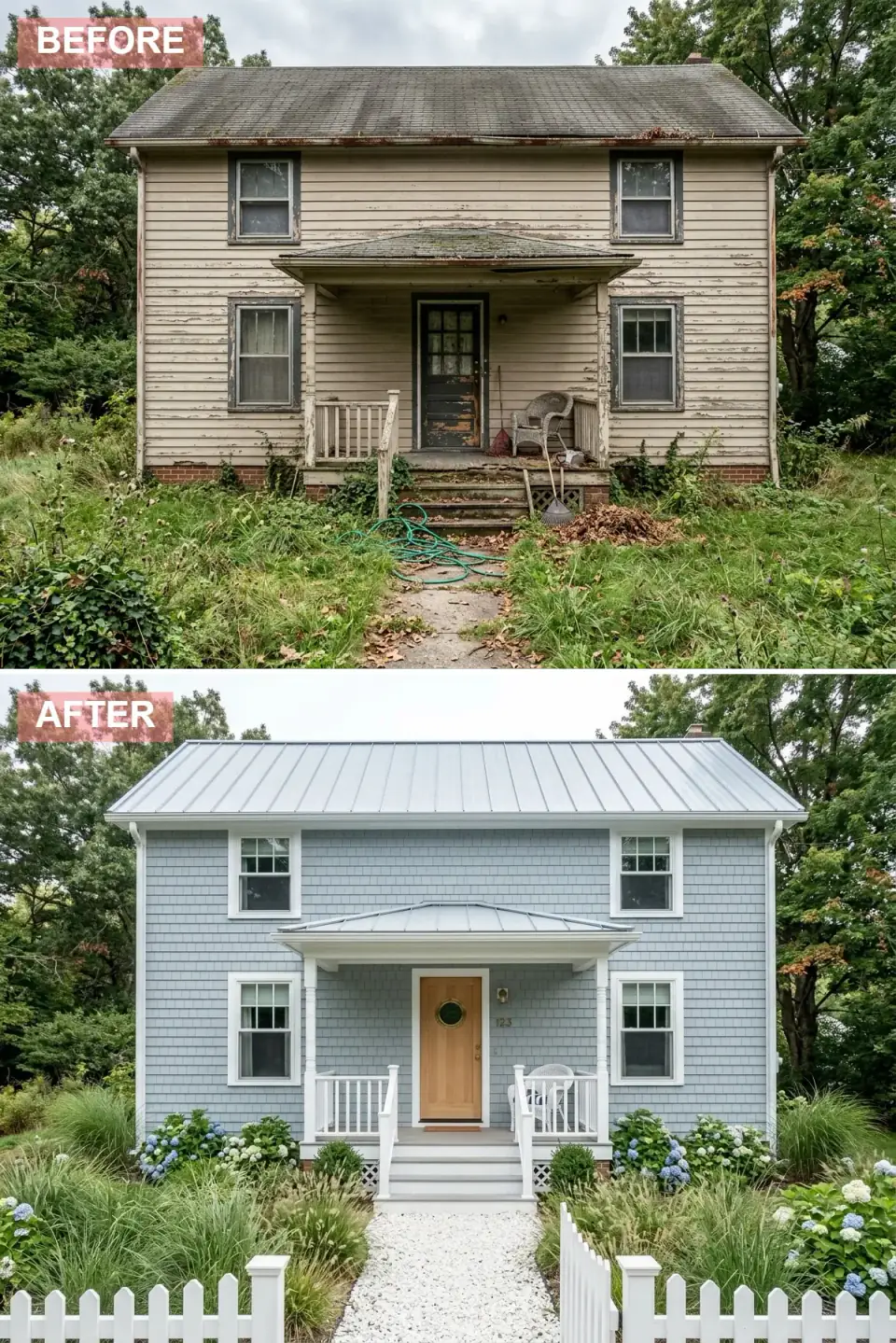
This one reads the box as a timeless cottage. We stripped the siding and installed real cedar shakes painted a soft light blue, then topped it with a light-gray standing-seam roof that lifts the whole top-line. The porch came back with crisp white rails and posts, and the door swapped to natural wood with a porthole window for one warm focal point. Hydrangeas, ornamental grasses, a crushed-shell path, and a white picket fence carry the seaside read all the way to the curb.
The texture is doing the work here — shakes throw a shadow line that flat lap siding never will, and that depth is what keeps the blue from going flat and builder-grade. From the plan side, real cedar earns its keep only if it breathes: a vented rainscreen behind the shakes and a back-prime on every piece, or the New England damp cycle will cup them. This is a high-cost route — cedar is material-intensive and slow to hang, and standing-seam is a premium roof. Budget around $7–$11 per square foot for shake installation up here. The mistake I see most is imitation vinyl shakes, which photograph plastic and repeat the same mold every eighteen inches. The slight irregularity of real wood is the entire point.
Color Palette
Coastal Blue
#A6BACE
A soft sky-and-sea blue — close to Benjamin Moore Yarmouth Blue HC-150, a coastal staple that holds up next to white trim.
Crisp White
#FFFFFF
A clean bright white — Sherwin-Williams Pure White SW 7005 on PVC trim, which won't yellow at the coast.
Light Gray Standing Seam
#C0C0C0
A reflective neutral gray that complements the blue and keeps the box from looking top-heavy.
Natural Oak
#CFA876
A warm golden wood tone that gives the entry an organic focal point against the cool blue field.
3. Shou Sugi Ban Siding with Copper Accents
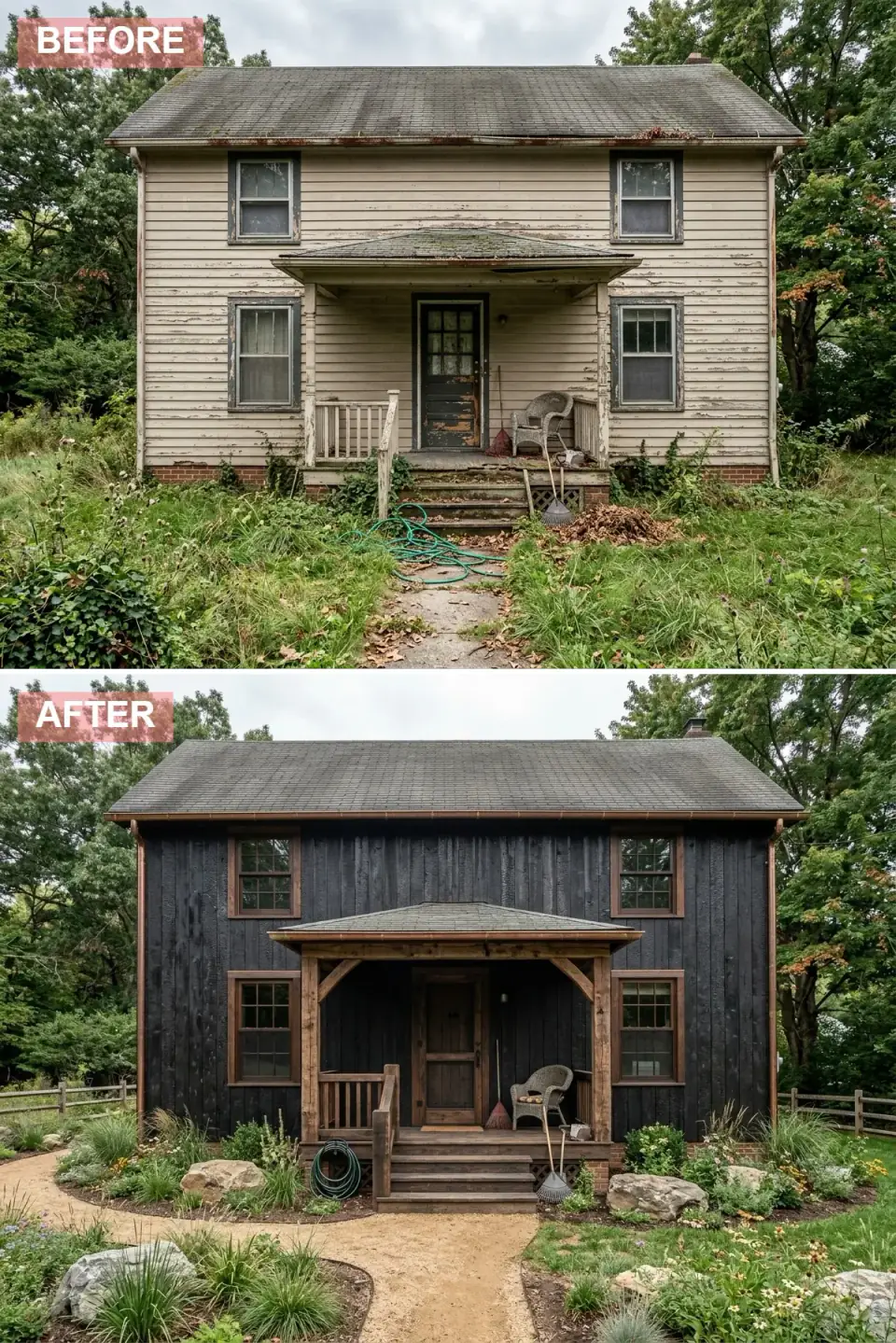
For the most dramatic direction, we used shou sugi ban — the Japanese technique of charring the wood face. The box got re-clad in deeply charred vertical timber, a textured black surface that is naturally weather- and insect-resistant once sealed. Against that dark field we hung copper gutters and downspouts as the one note of warmth, set to patina toward verdigris over the years. The porch came back in heavy dark-stained timber with a matching door. Boulders, native grasses, and a decomposed-granite path keep the ground plane as elemental as the walls.
It works because it is nearly monochrome and lets texture carry everything — the charred face has an alligator-skin crackle that catches low Hudson Valley light beautifully in the late afternoon. The copper is the jewelry. From the plan's view, the non-negotiable is the sealant: char left raw rubs off black onto hands, clothes, and the porch deck, so it gets a penetrating oil top-coat and a maintenance schedule. This is a very high-end re-skin — true shou sugi ban is a specialty product and copper gutters run several times aluminum. Definitely a pro job. The mistake to avoid is treating it as a one-and-done finish; the oil wants refreshing, and a skipped cycle is how the char starts shedding.
Color Palette
Charred Charcoal Black
#1A1A1A
A deep textured black straight off the burn — closest factory equivalent is Nakamoto Forestry's gendai char.
Dark Walnut
#3E2723
A dark brown stain — think Rubio Monocoat Chocolate — that complements the char while reading as wood, not paint.
New Copper
#B87333
A bright metallic orange-brown that will weather to a soft verdigris — leave it unsealed to age, or lacquer it to hold the shine.
Tan Decomposed Granite
#C2B280
A natural earthy beige that gives the landscape a neutral base under the black walls.
4. Crisp Modern Farmhouse — High-Contrast Paint
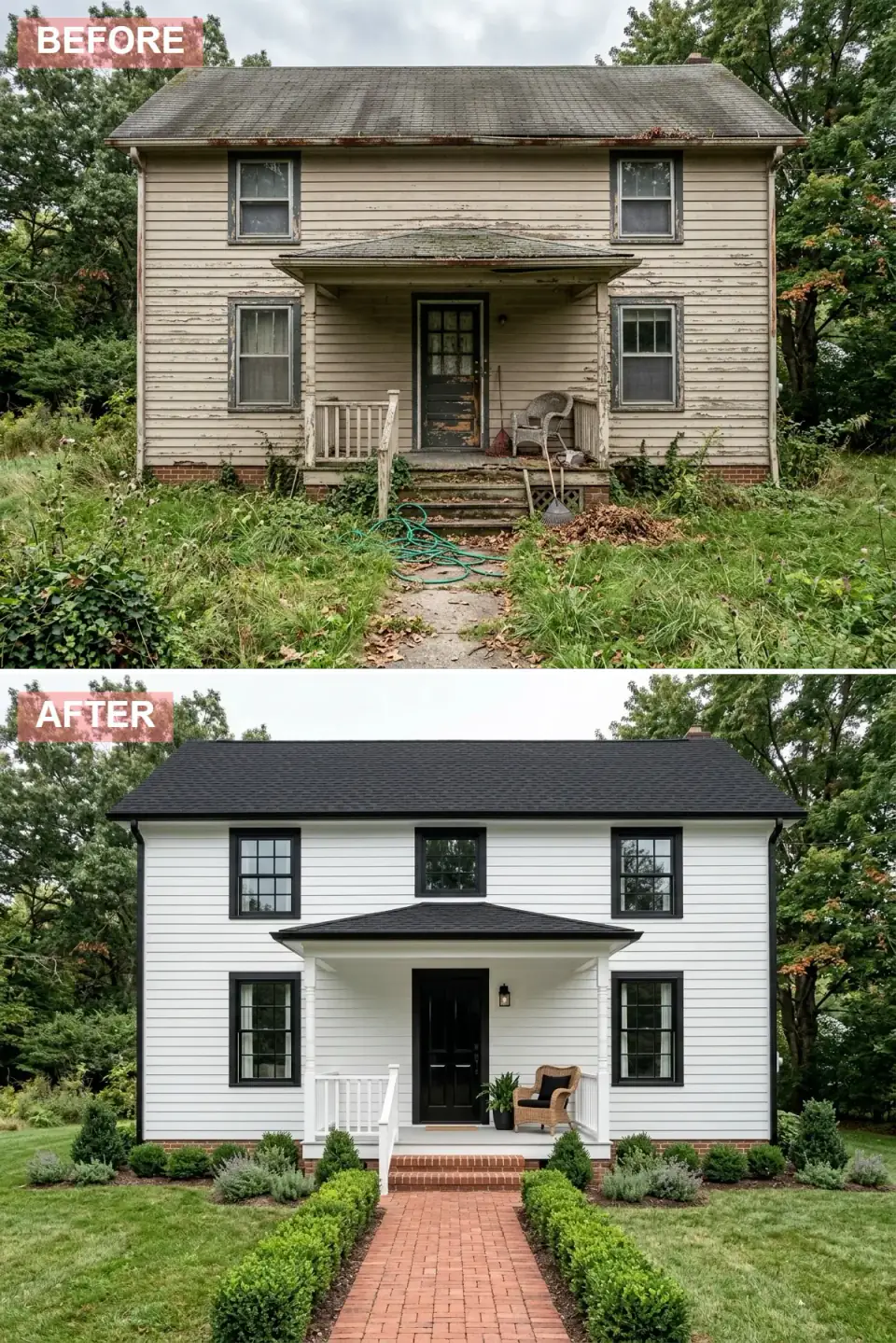
This is the most popular exterior in the country right now, and it is popular because it is cheap leverage. We kept the existing horizontal siding, painted the body crisp white, and ran every piece of trim, every sash, the new shingle roof, and the door in stark black. The porch rail got simplified and painted white. The result is graphic and modern on top of a classic form — the black outline makes the windows pop and traces the gable like a drawing. Boxwood hedges and a brick path add the one note of traditional warmth the palette needs.
The reason to flag this one on a re-skin list: it is the only route here that is genuinely moderate-cost, because you are painting sound siding rather than replacing it. If your existing cladding is solid, a quality spray-and-backroll is a fraction of new material — call it $5,000–$9,000 for a house this size up here, with new black windows and roof as the real line items. It is also partly DIY-able if you are comfortable on a ladder. The mistake is overdoing the black — once the light fixtures, the planters, the house numbers, and the furniture all go black too, the house reads busy instead of crisp. Let the architecture carry it and stop adding.
Color Palette
Pure White
#FFFFFF
A bright clean white canvas — Benjamin Moore Chantilly Lace OC-65 is the modern-farmhouse default for a reason.
Matte Black
#121212
A deep non-reflective black for the graphic outline — Sherwin-Williams Tricorn Black SW 6258 in a low sheen.
Classic Brick
#8C4836
A reddish-brown clay brick that warms the ground plane against the high-contrast walls.
Boxwood Green
#4F7942
A deep structured green from manicured boxwood that gives the clean palette an organic frame.
5. Contemporary Stucco with Warm Wood Cladding
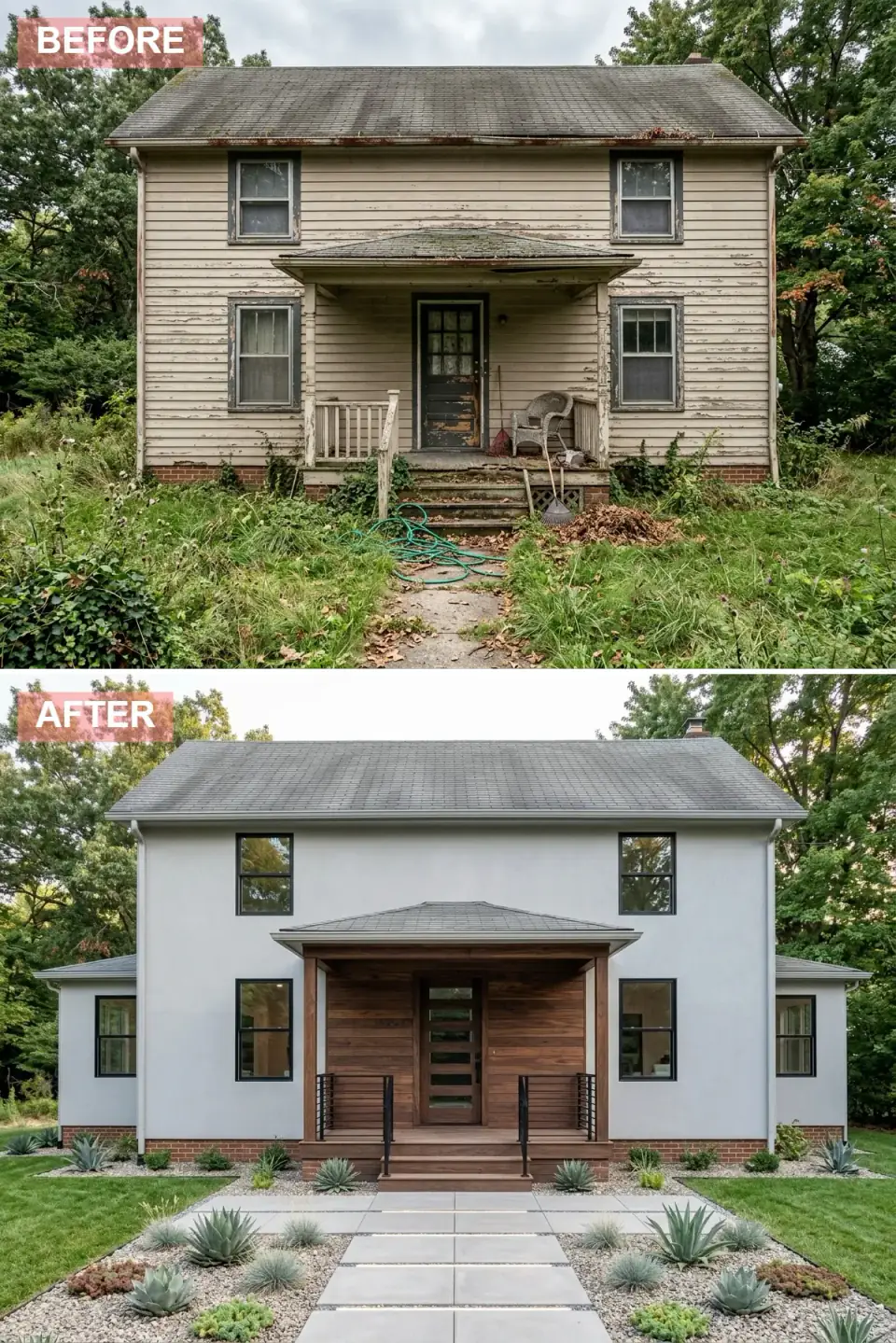
To pull the box contemporary, we floated smooth light-gray stucco over the existing wall and clad the entire porch alcove in horizontal walnut planks to warm and define the entry. The windows changed to large black-framed casements with no muntins for a clean modern read, and the rail became a minimalist black cable system. The design lives on the temperature contrast — flat cool stucco as a minimalist field, the figured walnut grain warm against it, the black metal as the sharp edge. Modern pavers, agave, and gravel beds finish the contemporary ground plane.
This is a high-cost route and the one where the plan matters most, because stucco hides its own failures. If the flashing at window heads and the kickout at the roof-wall intersection isn't detailed correctly, water gets behind the stucco and rots the sheathing invisibly — you don't find out until it's structural. In our freeze-thaw climate I lean toward a drainage-plane stucco assembly over a true three-coat, specifically so any water that gets in can get back out. Not a DIY project, and not a contractor to hire on price alone — ask for exterior stucco references you can drive past. Pick a rot-resistant cladding species too: cedar, redwood, or thermally modified ash for that walnut tone.
Color Palette
Light Gray Stucco
#B0B0B0
A smooth cool neutral — integral-color finish in the range of Benjamin Moore Stonington Gray HC-170 so chips don't show a different base.
Oiled Walnut
#694B37
A rich warm brown with visible grain — thermally modified ash finished in Rubio Monocoat Cotton White over walnut tone, drawing the eye to the entry.
Black Metal
#000000
A true black on casements and cable rail — Marvin Modern in factory black gives the crisp sightlines this look needs.
Concrete Gray
#9E9E9E
A light gray from large-format pavers that echoes the stucco and keeps the ground plane uncluttered.
6. Craftsman — Natural Cedar and Stone
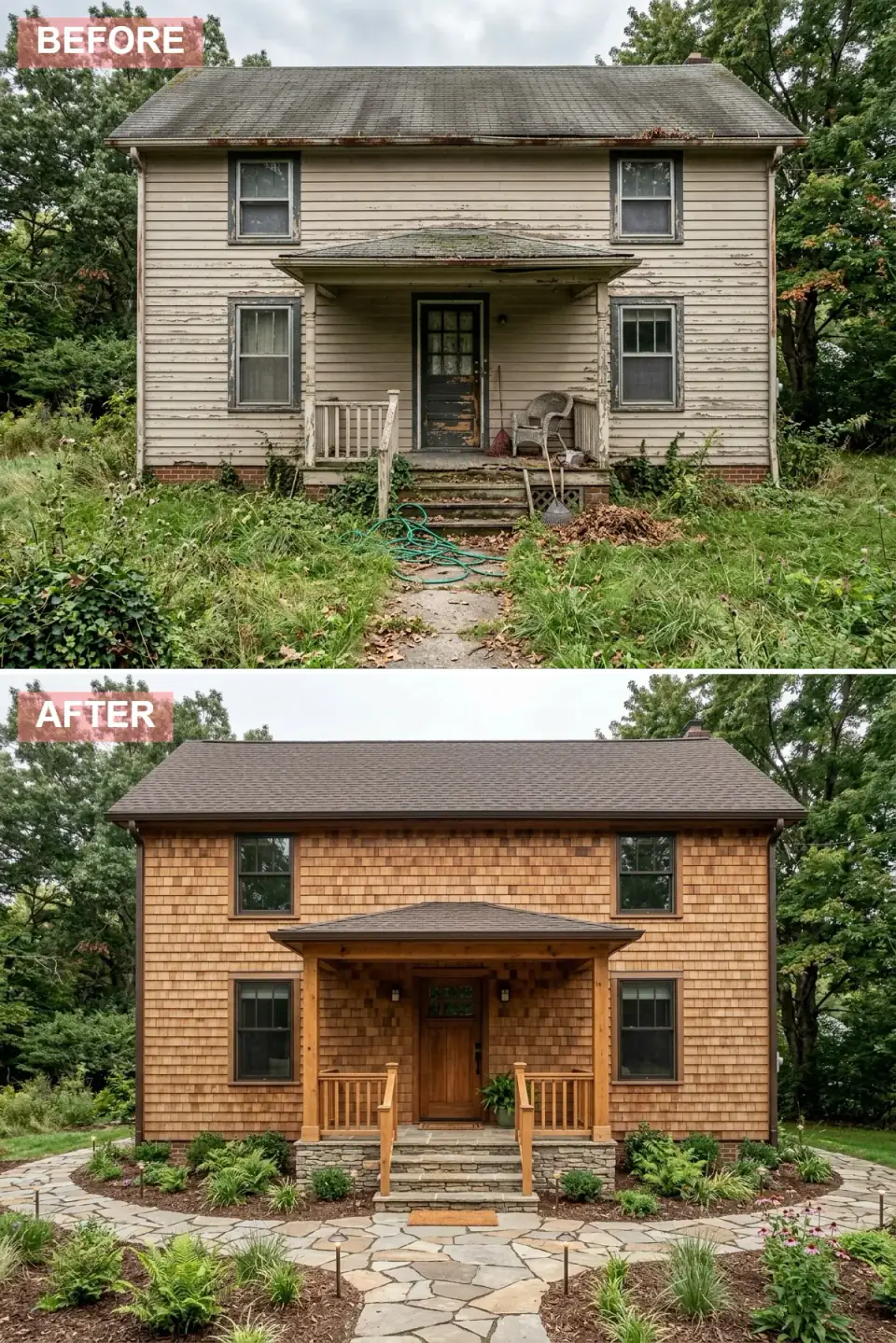
This direction gives the simple box the handcrafted weight of the Craftsman tradition. We re-clad in natural cedar shakes with a clear stain to show the grain, rebuilt the porch with substantial timber posts and beams, and wrapped the foundation in stacked-stone veneer. A Craftsman door with a dentil shelf and decorative glass finishes the entry. It works because wood and stone together read grounded and permanent — the texture range, from rough fieldstone to smooth timber, is doing the heavy lifting, and the beefy porch columns finally give the box the visual mass it always lacked. A flagstone path through ferns and hostas carries the woodland feel.
From the plan side, the porch is the real project here — Craftsman columns and beams have to be structurally honest and properly proportioned, not foam sleeves over a skinny post. Up here I size them to actually read like they carry the roof, because a too-thin column on a Craftsman reads instantly wrong. This is a high-cost route: cedar, heavy timber, and stone masonry are all premium with skilled labor behind each. Not a typical DIY. The mistake to avoid is hiding the cedar under an opaque stain or paint — the entire reason to spend on real cedar is the grain and the natural color variation. A clear or semi-transparent UV stain preserves it; paint throws the money away.
Color Palette
Natural Cedar
#C88A65
A warm orange-brown with grain variation — protect it with a semi-transparent UV stain like Sikkens Cetol to slow the gray-out.
Fieldstone Gray
#808080
A mix of cool grays and warm earth tones from stacked natural stone — Hudson Valley fieldstone reads local and unrepetitive.
Stained Fir
#7A5135
A slightly darker, richer wood tone that lets the structural posts and beams read as the frame they are.
Fern Green
#4E6E3E
A lush shade-garden green that softens the stone and wood and reinforces the woodland setting.
7. Sleek Modern — Dark Monochrome Palette
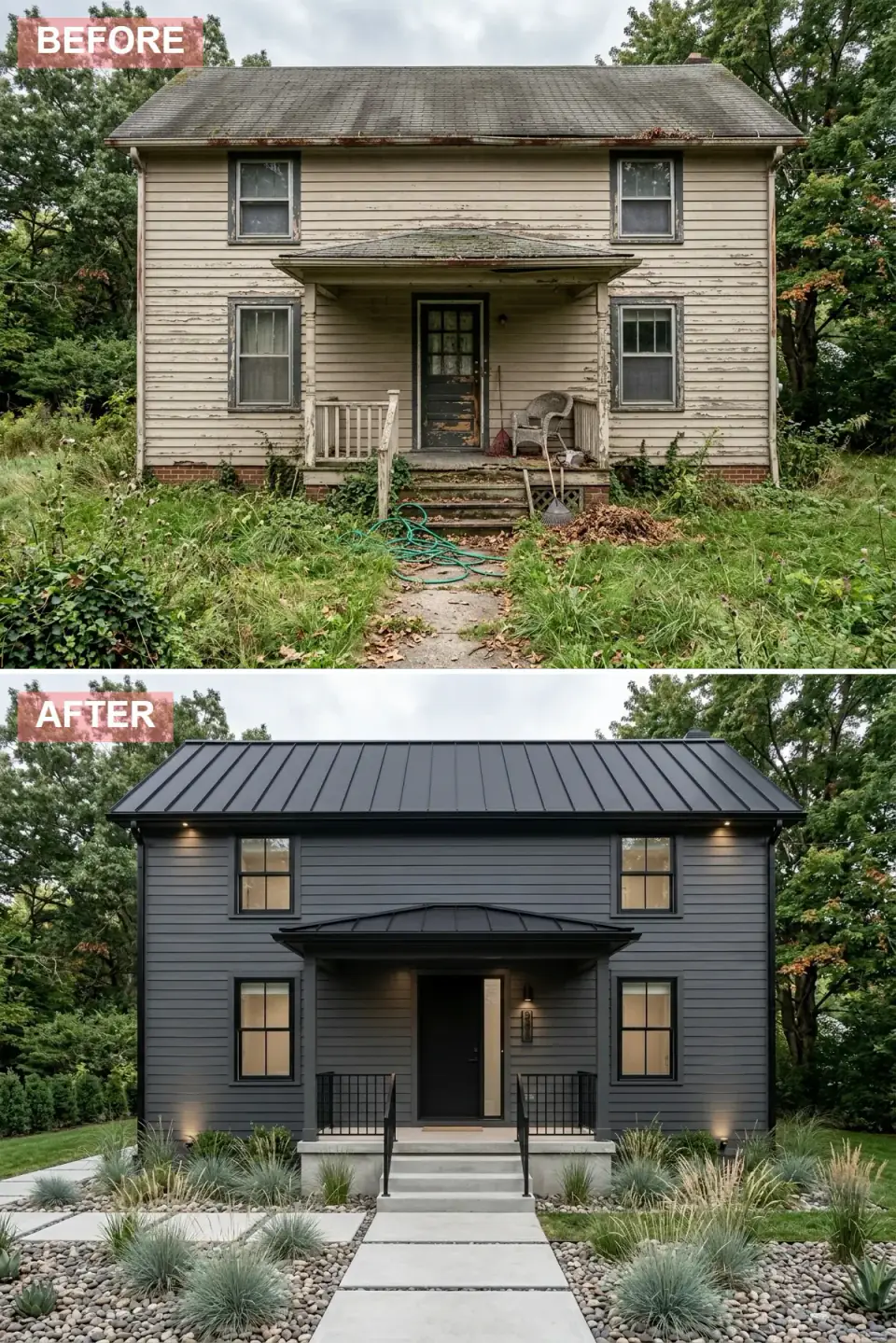
For a sculptural modern read, we went dark and monochrome. The box got re-sided in smooth horizontal planks in deep charcoal, capped with a black standing-seam roof, with every window frame, the new door, and the minimalist rail in matte black. The fussy old porch came off in favor of a simple concrete stoop and steps. It works by unifying the whole form — the dark color recedes, the house feels grounded and sophisticated, and the standing-seam adds a subtle vertical texture and a premium read. Concrete pavers, river stone, and clumps of blue fescue keep the landscape minimal and intentional.
This lands as a moderate-to-high cost, with the metal roof and new siding as the headline items and the concrete work close behind. The plan-literate caution here is heat: dark cladding and a dark roof absorb solar gain, which matters less in the Hudson Valley than in Phoenix but still pushes summer cooling load. Before you commit to near-black, confirm your attic insulation and ventilation can carry it — a dark house over a poorly vented attic cooks the upper floor. Specify a fiber-cement or engineered plank rated for dark-color fade, because cheap dark siding chalks and goes blotchy within a few seasons of full sun.
Color Palette
Charcoal Gray
#363636
A deep dark gray for the sleek field — James Hardie Iron Gray in their fade-resistant ColorPlus finish holds the tone in full sun.
Matte Black
#1A1A1A
A stark black unifying roof, windows, and door — matte over gloss so the large surfaces don't glare.
Smooth Concrete
#BDBDBD
A light gray that gives the dark body a clean contrasting base and keeps the look from going heavy.
Blue Fescue
#6F8C99
A cool dusty blue-green from ornamental grass that adds movement and a softer texture against the hard lines.
8. Eco Farmhouse with a Green-Roof Porch
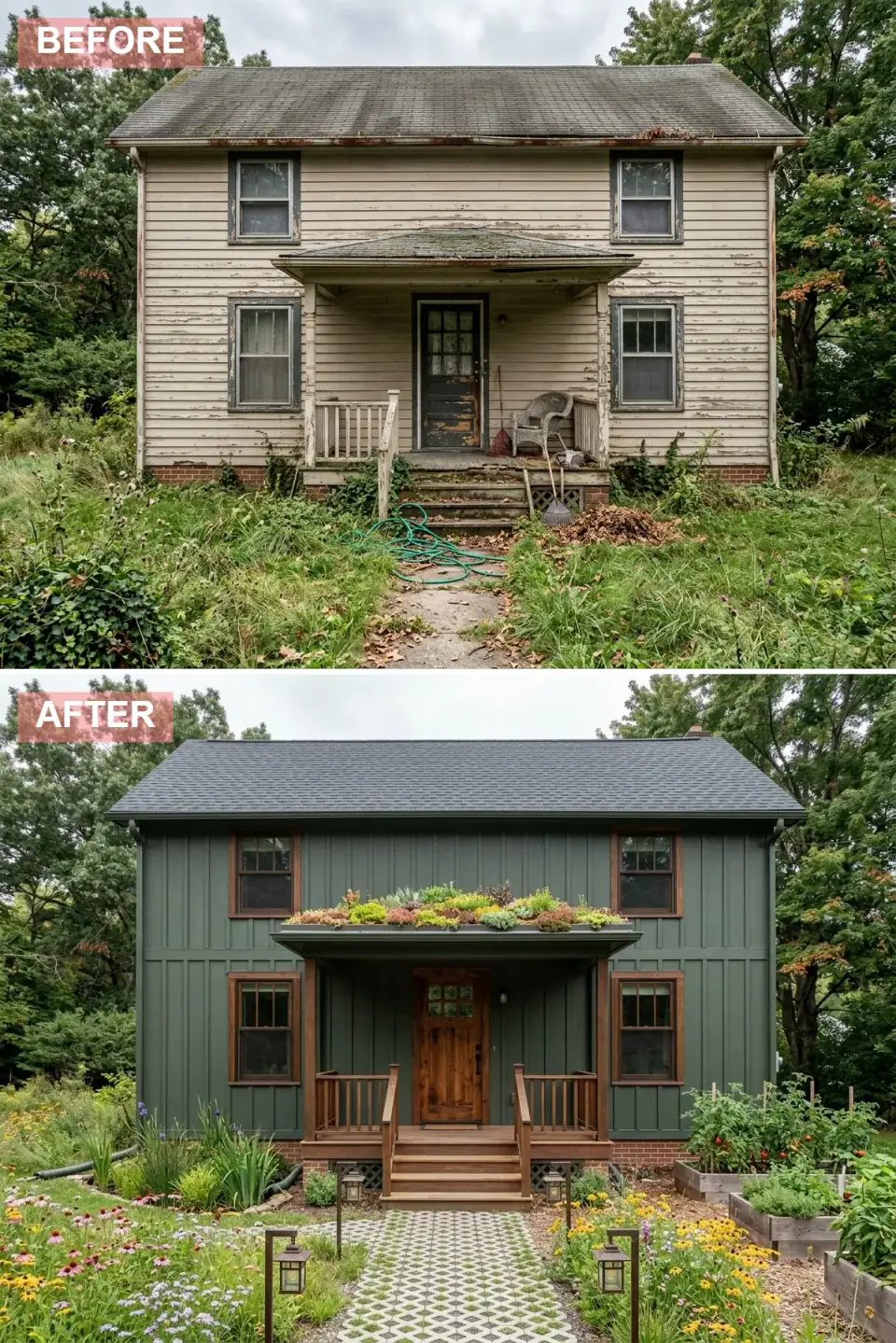
This direction blends rustic farmhouse with a genuine sustainability move. We ran dark green board-and-batten siding — the vertical battens stretch the box taller — and built a living green roof over the porch, planted with sedums and drought-tolerant succulents. The porch itself came back in natural clear-sealed wood with a matching Craftsman door. The dark green helps the house settle into its surroundings while the wood warms the entry. The green roof isn't only a conversation piece: it slows rainwater runoff and adds insulation over the porch. Raised vegetable beds and a permeable paver path turn the yard into productive homestead space.
This is the most structurally serious route on the list, and it is exactly where reading the plan stops being optional. A green roof is heavy — saturated soil can multiply the dead load several times over — so the porch roof framing has to be engineered for it, with proper waterproofing and a drainage layer beneath. Get a structural engineer on it before anyone orders sedum trays; this is not a finish decision. It is high-cost and complex, and a job for crews who have built living roofs before. The mistake people make is underestimating the upkeep — even low-maintenance sedum needs weeding, drought watering, and a drainage check each season, or a clogged mat turns into a leak over your front door.
Color Palette
Forest Green
#2E4B36
A deep natural green that lets the house recede into the landscape — Benjamin Moore Hunter Green 2041-10 in the same family.
Natural Cedar
#A36F40
A warm golden-brown wood that contrasts cleanly with the green siding and warms the entry.
Sedum Mix
#7E9F5E
A living palette of greens, reds, and yellows from the succulent mat that shifts with the seasons.
Aged Wood
#7B6D5D
A weathered grayish-brown from untreated lumber on the raised beds — leave it to silver naturally.
9. Modern Farmhouse — Board-and-Batten and Natural Wood
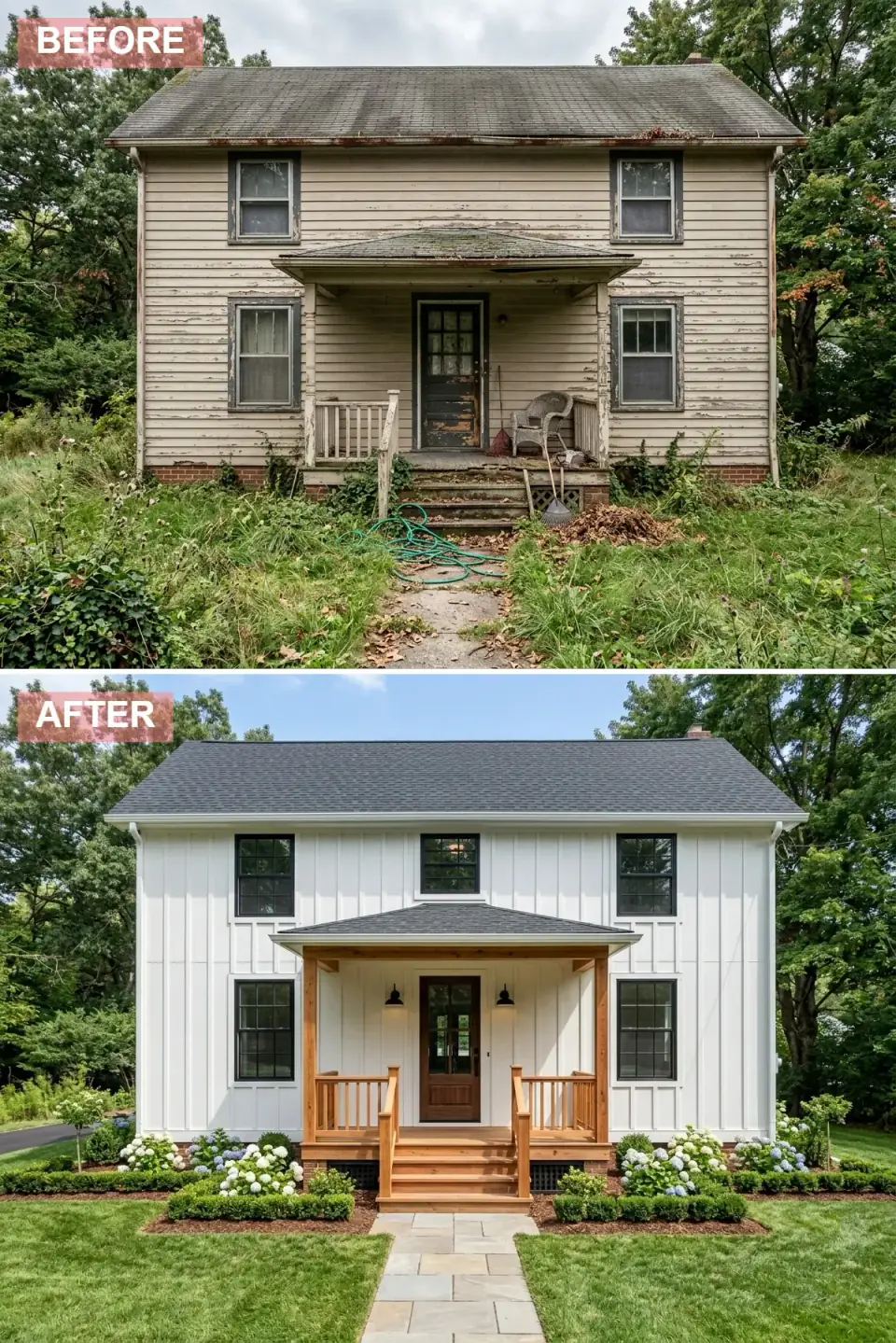
This is a warmer, more textured take on the modern farmhouse than the painted version earlier. Instead of horizontal siding we ran white board-and-batten — the vertical lines draw the eye up and make the box feel taller. We kept the black window frames and roof for contrast, then loaded in warmth by rebuilding the porch posts, rails, and steps in natural clear-sealed cedar, with a wood-and-glass door to match. The success is in the balance: the crisp white-and-black against the organic cedar, with the board-and-batten throwing a shadow line that plain siding can't. Hydrangeas, boxwoods, and a flagstone path complete a classic, mass-appeal exterior.
This sits at moderate-to-high cost — new siding, new roof, and custom cedar porch carpentry all stack up — and a skilled DIYer could plausibly hang the siding while leaving the roofing and fine carpentry to pros. The plan-literate detail that separates good board-and-batten from amateur board-and-batten is layout. The boards and battens have to be set out on paper first so the spacing is consistent and the battens land centered under windows and at the gable peak — get it wrong and you end up with awkward slivers of board at corners that the eye catches every time. Proportion the batten width to the wall, and the whole facade reads composed.
Color Palette
Clean White
#F5F5F5
A bright white that highlights the vertical board-and-batten rhythm — Benjamin Moore Simply White OC-117.
Clear Cedar
#CFA876
A warm honey-toned cedar under a UV-resistant clear coat that adds the natural, inviting note.
Black Accent
#212121
A sharp black that frames the house's features — black-clad Andersen or Marvin units carry it cleanly.
Blue-Gray Flagstone
#707D8C
A natural stone in cool gray-blue tones for a classic walkway that reads with the white-and-black palette.
Pro Tips From the Renovation Designer's Chair
- Read the sheathing before you choose the skin. Every direction here assumes sound substrate and a working rainscreen. Open a corner, check the sheathing and the existing flashing, and budget for repairs before you fall in love with a finish.
- The front door is the cheapest high-impact move. A new door — or even a fresh stain and good hardware — returns more curb appeal per dollar than almost anything else. It's the focal point; treat it like one.
- Get the scale right. House numbers, light fixtures, and porch columns all have to be proportional to the house. Skimpy fixtures on a big facade read cheap; oversized ones on a small box read cartoonish.
- Don't ignore lighting. Swap tiny dated fixtures for statement pieces that match the new style, and add path and uplighting to carry the design after dark. A re-skin that disappears at night is only half finished.
- Match the material to the climate, not the mood board. In the Northeast freeze-thaw cycle, breathability and drainage beat raw looks — a vented assembly outlasts a sealed one every time.
- Landscaping is part of the renovation, not an afterthought. The best facade looks unfinished over bare dirt. Plan a foundation planting with evergreen structure and a defined path the same day you plan the siding.
Cost-Saving Moves
- Paint sound siding instead of replacing it. The high-contrast farmhouse (route 4) proves a quality paint job on solid cladding gets you a new house for a fraction of re-siding — the cheapest credible direction on this list.
- Spend the material budget where the eye lands. Premium cladding on the front facade and a simpler engineered product on the side and rear walls is a legitimate move that nobody reads from the street.
- Phase the porch. Re-skin the walls now and rebuild the porch in a clear-sealed wood next season — splitting the carpentry from the siding spreads the two biggest labor lines across two budgets.
- Choose low-water landscaping. Gravel beds, drought-tolerant grasses, and permeable paths cut both install cost and years of upkeep versus a thirsty lawn that fights the Northeast summer.
Reader Questions on Exterior Material Transformations
What is the most cost-effective way to update a home's exterior?
Painting sound existing siding and trim is the most budget-friendly route, followed by updating the front door, house numbers, and exterior lighting. For a gable box like this one in the Hudson Valley, a quality spray-and-backroll runs a fraction of new cladding — call it $5,000–$9,000 versus tens of thousands to re-side. Replacing siding or roofing is where the real money goes. Before you replace, confirm the existing material is actually failing and not just dated; if it's solid, paint and detail it instead.
Can I mix different siding materials on one house?
Yes, and done with intent it's one of the strongest moves available. Pairing horizontal lap with board-and-batten, or wrapping a stone base under wood walls, adds architectural interest and breaks up large blank planes. The rule that keeps it from looking busy: let the material change follow the architecture, not fight it — switch materials at a gable, a porch, or a foundation line, where the building already gives you a logical seam. Random material breaks mid-wall read as a mistake; breaks at structural transitions read as design.
How do I choose the right exterior style for my home?
Start with the structure you actually have — the roofline, the proportions, the neighborhood context — and choose a direction that works with that geometry rather than fighting it. A simple gable form takes a farmhouse, a coastal cottage, or a dark modern read easily; it resists styles that need dormers or complex massing it doesn't have. I tell Hudson Valley clients to look at what the original drafter gave them and amplify it. The cheapest regret on this list is forcing a look the basic form will never carry.
What is shou sugi ban siding?
Shou sugi ban (also called yakisugi) is a traditional Japanese method of charring wood siding to preserve it. The burn creates a blackened, textured surface that resists weather, rot, and insects, and it has become a popular modern design element on contemporary exteriors. The critical maintenance point: once installed, the char needs a penetrating oil top-coat, or the surface rubs off black onto anything that touches it. Treated and re-oiled on schedule, it's one of the most durable and striking skins you can put on a house.
Is a metal roof better than asphalt shingles?
For longevity, yes — a quality standing-seam metal roof commonly lasts 50 years or more, against roughly 20–30 for asphalt, and it sheds snow and reflects heat better, which matters through a Northeast winter. The trade-off is upfront cost: metal can run two to three times asphalt per square. If you plan to hold the house long-term, the lifecycle math often favors metal; if you're restyling to sell within a few years, premium asphalt architectural shingles deliver most of the look for far less.
Does re-skinning an exterior require a permit?
It depends on the scope and your town. Like-for-like siding replacement is often a minor permit or none in much of the Hudson Valley, but anything structural — rebuilding a porch, adding a green roof, changing window openings — needs a permit and frequently an engineer's stamp. The green-roof porch in this article absolutely requires structural review for the added load. Always call your local building department before you start; an unpermitted structural change becomes a problem at resale, when the inspection and the records don't match.
Where to Read Next
If these nine directions sparked something, see the full range of exterior renovation work across the site, then dig into the chameleon-house piece on one neglected home in ten styles for a parallel take on the same re-skin logic. For owners working specifically with a small house, our walk through cottage exterior makeover before-and-after styles shows how the same material moves scale down to a tighter footprint.
Sources & Further Reading
- Bob Vila, Siding Options Compared.
- This Old House, How to Repair a Rotted Porch Floor.
- Architectural Digest, Exterior Paint Color Trends.
- James Hardie, HardiePlank Lap Siding & ColorPlus Technology Specs.
- U.S. Department of Energy, Cool Roofs and Reflective Roofing.
- National Park Service, Preservation Brief 14: New Exterior Additions to Historic Buildings.
- Old House Journal, Wood Siding Repair and Maintenance.
- Nakamoto Forestry, What Is Shou Sugi Ban / Yakisugi.
- Remodeling Magazine, Cost vs. Value Report (Siding & Curb-Appeal Returns).

Nora Whitfield
Renovation Designer & Interiors Editor · Beacon, New YorkNine years of design-build renovation work across the Hudson Valley and the Northeast. Nora runs the Renovations, Room Guides and Renovation Mind desks — before-and-after studies, room-by-room design guides, and the long essays on why what we renovate matters.
More from Nora →
Reader notes