

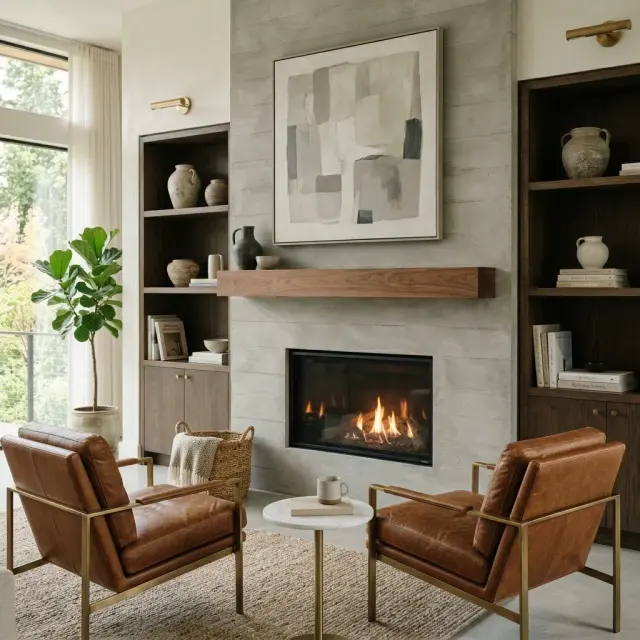
Quiet luxury isn't a paint color or a sofa shape — it's a discipline about what you choose to leave out. The principle is restraint: fewer, better, longer-lasting, less performative. Below: ten distinct living-room vignettes that each read as quiet luxury by a different route — minimalist grandeur, organic modern with jewel tones, modern coastal, industrial warmth, classic elegance with modern twist, Parisian herringbone, tonal limewash, serene reading nook, slatted-wood minimalism, and rich-texture cozy corner. For each, the read on what makes the room actually work — and the brand-specific specifications that hold the look up at year ten, not just at the listing photograph.
How I Read Quiet Luxury
When a Hudson Valley client asks me to read a living room as quiet luxury, I'm not looking for a particular palette or a particular sofa. I'm looking for four structural discipline signals. Material honesty — solid wood instead of veneer, real stone instead of printed-pattern porcelain, full-grain leather instead of bonded, hand-loomed wool instead of polypropylene. Quiet luxury reads quiet because the materials don't have to perform — they simply are what they are. Restraint in count — fewer pieces, more space between them, each one earning its place. The styled-magazine living room with a cluster of three throws and seven coffee-table books reads loud; the quiet luxury version has one throw, one stack of books, and a lot of negative space. Tactile invitation — the room should reward touch. Limewash walls, boucle, linen, hand-rubbed wood, brushed brass — surfaces that read different under the hand than they do under the eye. Architectural intent — built-ins, paneling, cove lighting, herringbone floors. Quiet luxury rooms commit to the architecture they sit inside; they don't fight it with applied decoration.
Below: ten vignettes that arrive at quiet luxury by ten different routes. Each section reads what makes the room work, names the specific brands and material specs that hold the look at year ten, and notes the Hudson Valley and Northeast specifics that change how the same vignette would land in Beacon vs Brooklyn vs Cape Cod. For the parent treatment of the philosophy, the full quiet luxury interior design guide covers the principle across all rooms; for a deeper read on the living-room-specific decisions, my living room design guide is the natural companion. Browse the broader living and dining archive for everything in this register.
1. Minimalist Grandeur with Statement Art
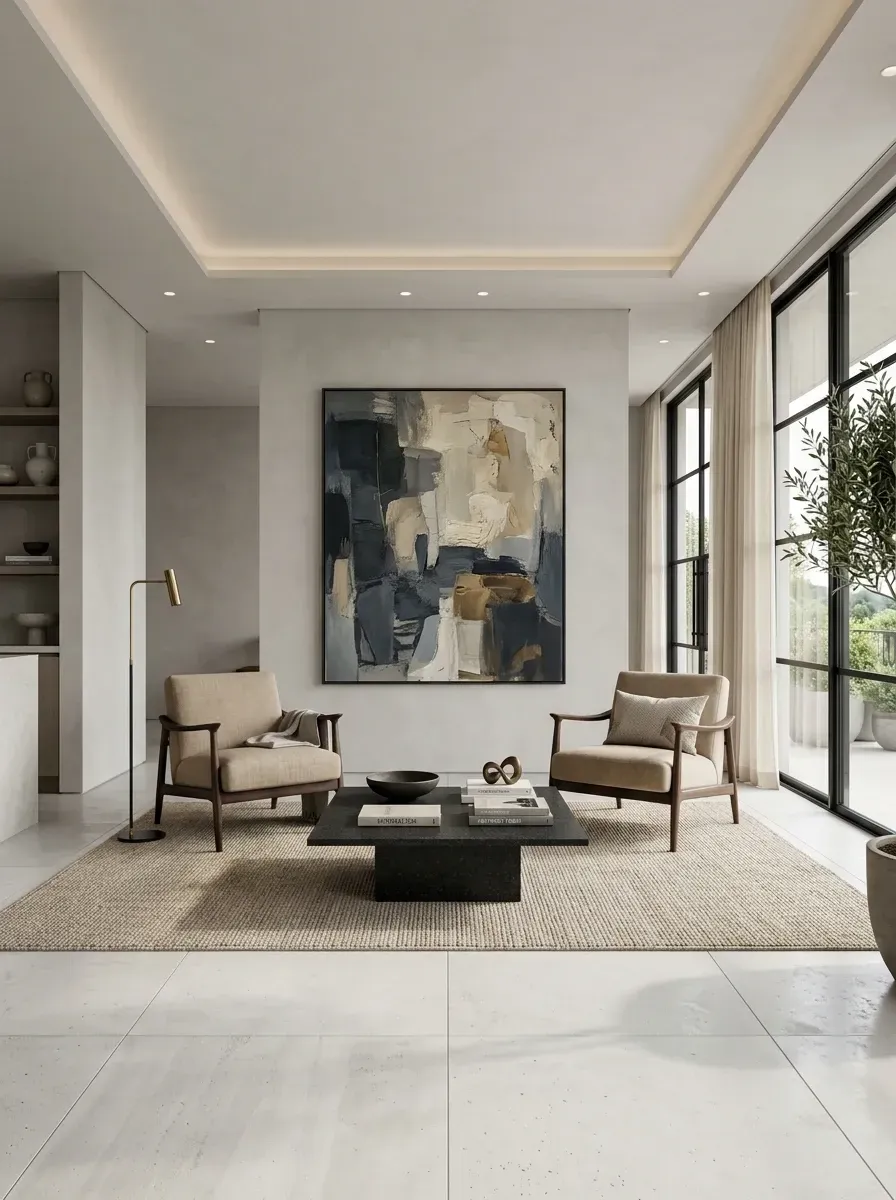
A room that does almost nothing — and that's the point. The cove ceiling delivers indirect Lutron-controlled LED at 2700K, washing the walls without a single visible fixture. The large-format floor tile (60×120 cm or 80×80 cm porcelain in a honed concrete-look — Florim Magnum Oversize, Atlas Concorde, or Casalgrande Padana) extends wall-to-wall with minimal grout lines. The art is sized to the room, not to a budget — at this scale (60–96 inches across the longest dimension), the canvas anchors the seating area and lets the rest of the furniture stay quiet. Two mid-century-leaning armchairs and a single block coffee table do the work; nothing else competes.
Plan-aware verdict: this is an architectural read first and a decor read second. The cove ceiling and the large-format tile are framing-stage decisions, not finish-stage decisions — you have to plan them at the construction documents. Retrofitting cove lighting into an existing flat ceiling costs 3–4× the framing-stage installation and rarely lines up cleanly with the room's proportions. Spec the cove at 8–14 inches deep, with a continuous Lutron Caséta or Soraa 24V LED strip at 95 CRI minimum, dimmable to 1%. Anything less than 95 CRI flattens the art and the textiles below.
Features at a Glance
- Large-scale abstract art as the room's structural anchor
- Cove ceiling with continuous integrated LED at 95 CRI
- Large-format porcelain tile floor with minimal grout lines
- Custom built-in shelving unit (millwork, not retail)
- Mid-century-leaning upholstered armchairs in oatmeal beige
Cost Analysis
| Decor Item (Qty) | Total Price Range |
|---|---|
| Large Framed Abstract Art | $1,500 – $4,000 |
| Upholstered Armchair (x2) | $1,800 – $4,500 |
| Black Block Coffee Table | $800 – $2,000 |
| Large Jute Area Rug | $500 – $1,200 |
| Brass Floor Lamp | $300 – $700 |
| Custom Built-in Shelving | $2,500 – $6,000 |
| Cove Lighting Installation | $1,500 – $3,500 |
| Large Format Tiled Flooring (Installed) | $4,000 – $8,000 |
| Curated Decor (Vases, Books, Sculpture) | $400 – $1,000 |
| Total Estimated Cost | $13,300 – $30,900 |
Color Palette
Soft Cloud White
#F2F2F0
Benjamin Moore White Dove (OC-17) or Sherwin-Williams Alabaster (SW 7008) — warm whites that reflect the cove light without going clinical.
Oatmeal Beige
#D3CEC4
Belgian linen or heavyweight Holland & Sherry upholstery — the substrate carries this color; chintzy poly blends read flat.
Matte Black
#2C2C2C
Solid wood block, ebonized white oak or stained walnut — never a hollow-core or veneered substitute at this scale.
Pale Concrete Grey
#E0E0E0
Honed-finish large-format porcelain — Florim Magnum or Casalgrande Padana; grout matched to the tile for the monolithic read.
2. Organic Modern with Rich Jewel Tones
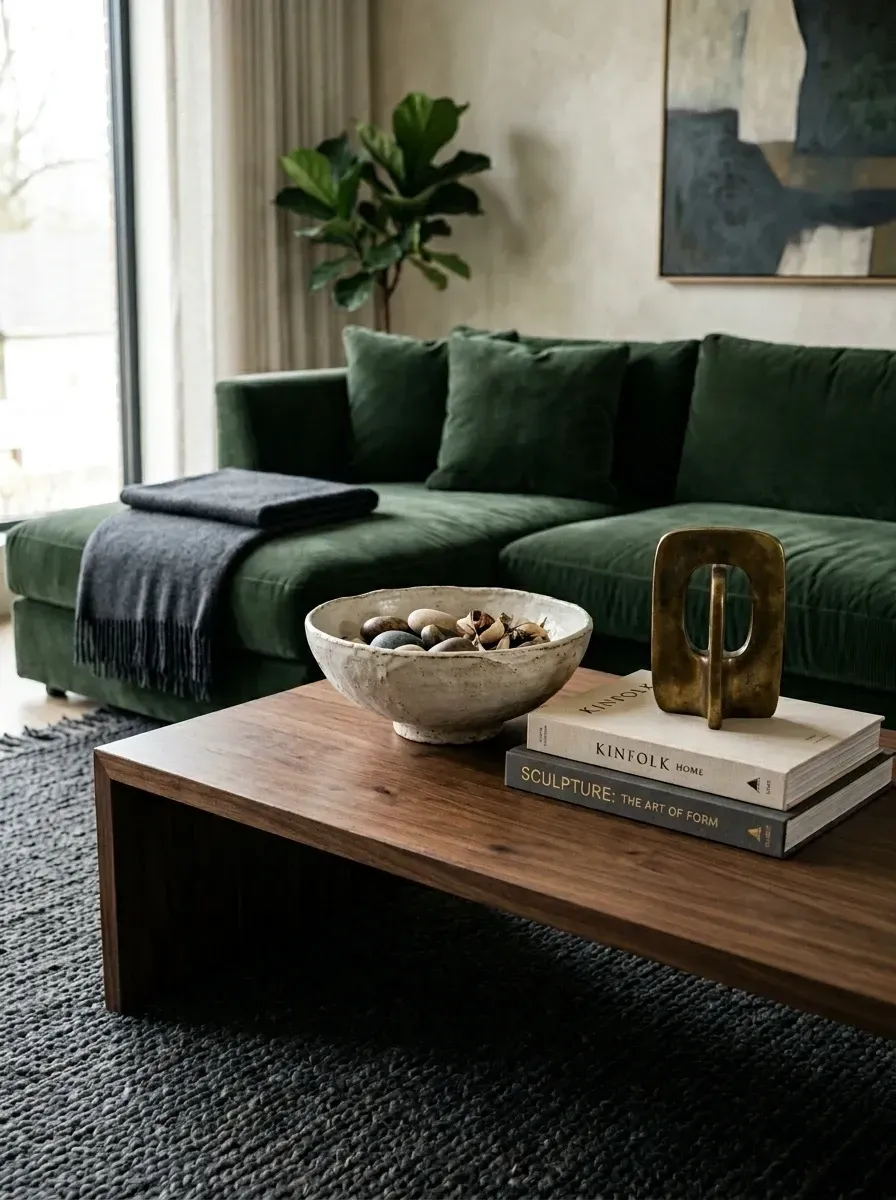
A two-material rewrite of the quiet luxury rule: one rich jewel tone, one warm hardwood, everything else neutral and textural. The green velvet sectional (Holly Hunt Hera Velvet, Romo Velluto, or Robert Allen Petite Velvet on a custom-frame sectional from BenchMade Modern, Interior Define, or a regional Hudson Valley upholsterer like Beacon's Lola & Daughter) carries the color. The waterfall coffee table is solid walnut, not veneer — the waterfall detail at the corner requires a continuous grain match that only solid stock delivers. The rug is hand-loomed wool with visible texture rather than machine-tufted.
Plan-aware verdict: this is the read I most often recommend to clients in Beacon, Rhinebeck, and the inner Hudson Valley who want quiet luxury that doesn't read cold. The forest green sectional plus walnut plus brass plus chunky wool is a Northeast palette — it sits inside the regional vocabulary of woodland-and-stone houses without performing it. Spec the velvet honestly: heavyweight mohair or cotton-blend velvet from Holland & Sherry, Romo, or Schumacher carries the deep saturation; polyester velvet at the same hex code reads plastic at three feet. The wool rug should be hand-loomed; Stark, Tibetano, or Patterson Flynn at the high end; Loloi Hagen or Annie Selke Dash & Albert at the budget tier.
Features at a Glance
- Deep green velvet sectional sofa in mohair or cotton-blend (not polyester)
- Solid walnut waterfall coffee table with grain-matched corner
- Hand-loomed chunky knit wool rug with visible texture
- Sculptural aged brass and ceramic decor
- Heavyweight throw blankets in cashmere or lambswool
Cost Analysis
| Decor Item (Qty) | Total Price Range |
|---|---|
| Green Velvet Sectional Sofa | $3,000 – $6,500 |
| Walnut Waterfall Coffee Table | $1,000 – $2,500 |
| Chunky Knit Wool Rug | $700 – $1,800 |
| Large Ceramic Bowl with Stones | $200 – $450 |
| Brass Abstract Sculpture | $150 – $350 |
| Coffee Table Books (x2) | $80 – $150 |
| Premium Throw Blankets (x2) | $200 – $500 |
| Total Estimated Cost | $5,330 – $12,250 |
Color Palette
Forest Green
#2E4A3D
Benjamin Moore Forest Floor (2042-20) or Farrow & Ball Studio Green (No.93) as the velvet color reference.
Rich Walnut
#5C4033
FSC-certified American black walnut with Rubio Monocoat Pure finish — never veneer at waterfall details.
Charcoal Grey
#363636
Hand-loomed New Zealand wool or alpaca-wool blend — Stark Loop Pile or Tibetano weave.
Aged Brass
#B5A642
Solid cast or hand-spun brass with a natural patina — never lacquered (lacquer flattens the warmth in two years).
3. Airy Open-Plan Living
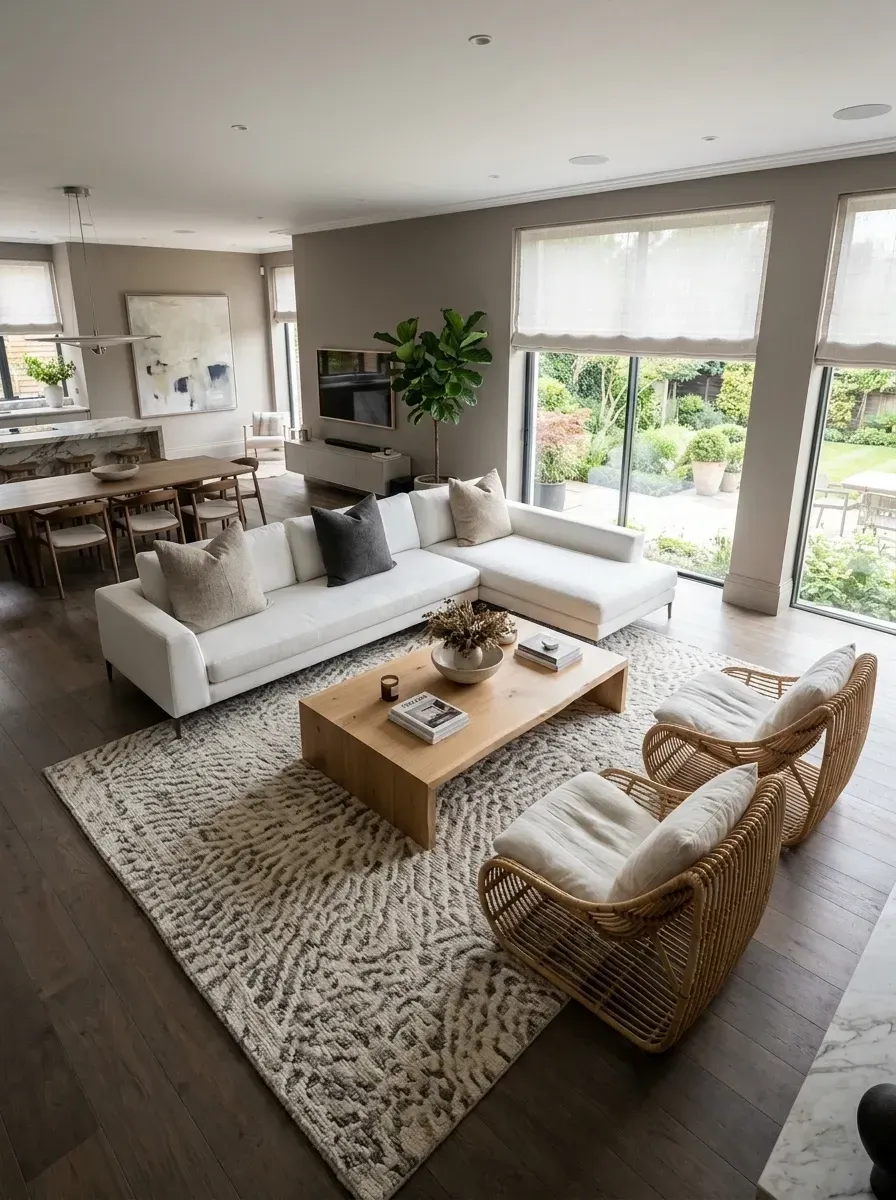
A modern-coastal read of quiet luxury that depends on the bones, not the styling. The floor-to-ceiling windows and sliding doors deliver the light; the white linen sectional, light oak block coffee table, and natural rattan armchairs ride the brightness. The patterned rug is the single move that earns its place — it defines the seating zone within an otherwise open plan, and it's the only piece in the room carrying any pattern. White linen on a sectional is the discipline: it announces that the household actually cares for the upholstery (linen requires regular vacuuming, occasional dry cleaning of slipcovers, and active life-management with kids and dogs). Slipcovered linen sectionals from Belgian Lab, Restoration Hardware Cloud, or a regional upholsterer is the realistic spec.
Plan-aware verdict: this read works in Cold Spring weekend houses, Hudson NY converted-mill loft conversions, and Cape Cod / Outer Banks coastal properties; it underperforms in a north-facing tight-window apartment because the entire palette depends on the light. Confirm the room's north-south orientation and window-to-wall ratio before committing. The rattan chairs are the affordable luxury anchor — Serena & Lily Riviera, McGee & Co Lyle, or a vintage rattan find from Foreland Catskill or 1stDibs all read credible at curb. The flooring is the real budget line: wide-plank engineered oak (Carlisle Wide Plank, Stuga, or Mafi) at $14–$22 per sq ft installed runs the line item to $6,000–$12,000 for the room scale shown.
Features at a Glance
- Floor-to-ceiling windows and sliding glass doors
- White linen sectional with washable slipcover
- Light oak solid-wood block coffee table
- Natural rattan accent armchairs from Serena & Lily or vintage
- Large patterned wool rug defining the seating zone
Cost Analysis
| Decor Item (Qty) | Total Price Range |
|---|---|
| White Linen Sectional Sofa | $3,500 – $7,500 |
| Light Oak Block Coffee Table | $800 – $2,000 |
| Rattan Armchair with Cushion (x2) | $1,200 – $2,800 |
| Large Patterned Area Rug | $1,000 – $2,500 |
| Dark Wood Flooring (Installed) | $6,000 – $12,000 |
| Floor-to-Ceiling Window Treatments | $1,500 – $4,000 |
| Decor and Lighting | $500 – $1,200 |
| Total Estimated Cost | $14,500 – $32,000 |
Color Palette
Crisp White
#FFFFFF
Benjamin Moore Chantilly Lace (OC-65) or Pure White (OC-64) on walls; heavyweight Belgian linen for the sectional slipcover.
Light Oak
#C4A484
White oak block with Rubio Monocoat Natural or Pure — the unstained wood tone holds up across the seasons.
Natural Rattan
#D6C0A4
Hand-woven rattan with cotton-canvas cushion — Serena & Lily, McGee & Co, or vintage 1stDibs sourcing.
Dark Brown Wood
#4A3321
Wide-plank engineered oak (5–8 inch widths) in a smoked or fumed finish — Carlisle Wide Plank, Stuga, or Mafi.
4. Industrial Warmth with Concrete and Leather
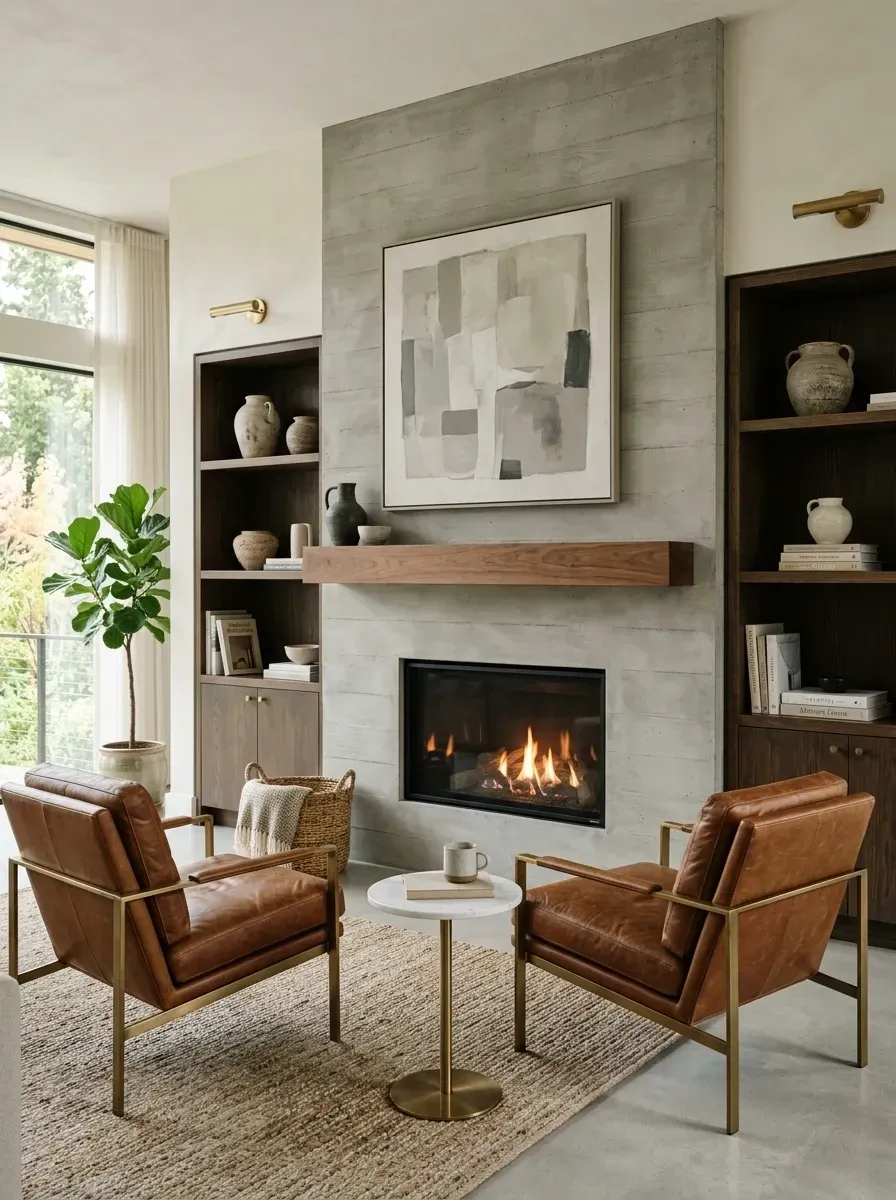
A read that earns its industrial vocabulary through honest material. The fireplace is board-formed concrete — poured against rough-sawn lumber forms that leave the wood-grain texture in the cured face. This is a framing-stage decision; you can't fake the board-formed read with applied panels or stamped pattern. The floating walnut mantel reads as a single timber, with visible mortise and stain-grade finish. The built-ins are millwork in stained American walnut, symmetrical, holding curated objects rather than family-photo clutter. The leather armchairs are full-grain cognac (Italian saddle leather from Edelman, Garrett Leather, or Holly Hunt) on brushed brass frames.
Plan-aware verdict: this is the strongest read on the list for a Hudson Valley converted-industrial building (Beacon dye-works lofts, Newburgh waterfront warehouses, Hudson factory conversions) and reads well in any house where the fireplace masonry can carry a 36–48 inch wide board-formed concrete surround. Costs run high — board-formed concrete typically lands $90–$150 per square foot installed when done properly, with quality forming, fiber reinforcement, and proper curing. Spec a linear gas fireplace insert (Heat & Glo Mezzo, Valor LX1, Stûv) rather than a wood-burning unit if the goal is the architectural read at the lowest operating cost; spec a Rumford-proportioned masonry firebox if the goal is the actual fire experience.
Features at a Glance
- Floor-to-ceiling board-formed concrete fireplace breast
- Floating solid-walnut mantel with visible joinery
- Symmetrical custom dark-walnut built-in cabinetry
- Full-grain leather armchairs with brushed brass frames
- Linear gas or Rumford masonry firebox
Cost Analysis
| Decor Item (Qty) | Total Price Range |
|---|---|
| Concrete Fireplace Surround (Installed) | $3,500 – $7,000 |
| Linear Gas Fireplace Insert | $2,500 – $5,500 |
| Floating Walnut Mantel | $500 – $1,200 |
| Leather & Brass Armchair (x2) | $2,000 – $4,800 |
| Custom Built-in Shelving Units (x2) | $5,000 – $10,000 |
| Brass Wall Sconce (x2) | $400 – $900 |
| Marble Top Side Table | $250 – $600 |
| Jute Area Rug | $300 – $800 |
| Curated Shelf Decor & Art | $800 – $2,000 |
| Total Estimated Cost | $15,250 – $32,800 |
Color Palette
Raw Concrete Grey
#999999
Board-formed cast-in-place concrete with rough-sawn form texture — sealed with a penetrating siloxane against efflorescence.
Cognac Leather
#9A4F26
Full-grain Italian saddle leather — Edelman, Holly Hunt, or Garrett. Bonded leather is the most common cost-cutting mistake here.
Dark Walnut
#423224
American black walnut, stain-grade, with a hand-rubbed oil finish — never veneer at this scale.
Brushed Brass
#C2A674
Unlacquered brushed brass that patinas over time — Visual Comfort, Apparatus, or Allied Maker sconces.
5. Classic Elegance with a Modern Twist
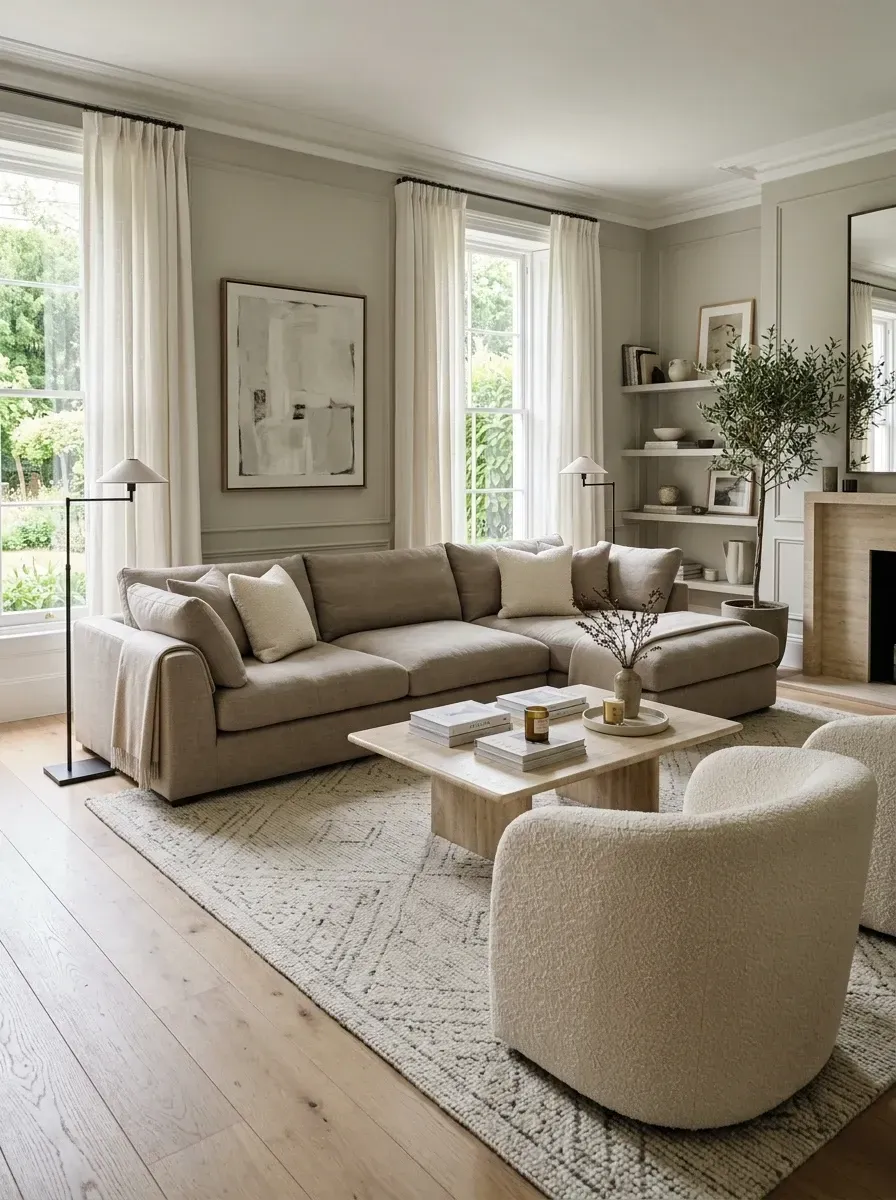
A transitional read that bridges Colonial Revival architecture with modern comfort vocabulary. The applied wall paneling — typically a Shaker-style flat-panel frame with proportions sized to the room's ceiling height — is the architectural anchor. The fireplace surround is honed limestone or travertine in a clean, period-correct silhouette without heavy carving. The sectional is a deep greige fabric (Belgian linen, Holland & Sherry herringbone, or Romo Aiola), the boucle swivel chairs are the contemporary note, and the travertine coffee table is the regional period material — travertine is correct for Northeast Colonial Revival vocabulary in a way Carrara isn't.
Plan-aware verdict: this is the highest-resale quiet luxury read on the list for a traditional Hudson Valley or southern New England home — Rhinebeck, Hartford, New Haven, Providence neighborhoods where Colonial Revival housing already sits on the block. The wall paneling is the labor-intensive piece: real applied molding in poplar or MDF (HardieTrim ProBoards or Wickes Moulding) installed by a finish carpenter typically lands $50–$95 per linear foot when done properly, not the $25 per linear foot the budget renovations advertise. Travertine is sensitive to acidic spills (wine, citrus) — spec it sealed annually and instruct the household accordingly, or substitute a similar-tone honed quartzite for daily-life resilience.
Features at a Glance
- Applied wall paneling with period-correct proportions
- Honed limestone or travertine fireplace surround
- Heavyweight greige fabric sectional sofa
- Boucle swivel armchairs as contemporary accent
- Solid travertine or honed quartzite coffee table
Cost Analysis
| Decor Item (Qty) | Total Price Range |
|---|---|
| Wall Paneling & Molding (Installed) | $3,000 – $6,000 |
| Beige Fabric Sectional Sofa | $3,000 – $6,000 |
| Boucle Swivel Armchair (x2) | $1,600 – $3,500 |
| Travertine Coffee Table | $1,500 – $3,500 |
| Stone Fireplace Surround (Installed) | $2,000 – $4,500 |
| Large Patterned Wool Rug | $1,200 – $2,800 |
| Floor Lamp & Decor | $600 – $1,500 |
| Custom Window Treatments | $800 – $2,000 |
| Total Estimated Cost | $13,700 – $29,800 |
Color Palette
Warm Greige
#CFC9C0
Benjamin Moore Pale Oak (OC-20) or Farrow & Ball Skimming Stone (No.241) for walls; matching greige Belgian linen for sectional.
Creamy Boucle White
#F0EFEA
Heavyweight boucle from Pierre Frey, Sandra Jordan, or Schumacher — natural wool/cotton blends only.
Natural Travertine
#D8CCA9
Honed Italian travertine — vein-cut for the classic horizontal pattern; sealed annually against acidic spills.
Light Oak
#E0C9A8
Wide-plank white oak with Rubio Monocoat Pure 5% finish — keeps the floor bright under the heavy upholstery.
6. Parisian Chic with Herringbone Floors
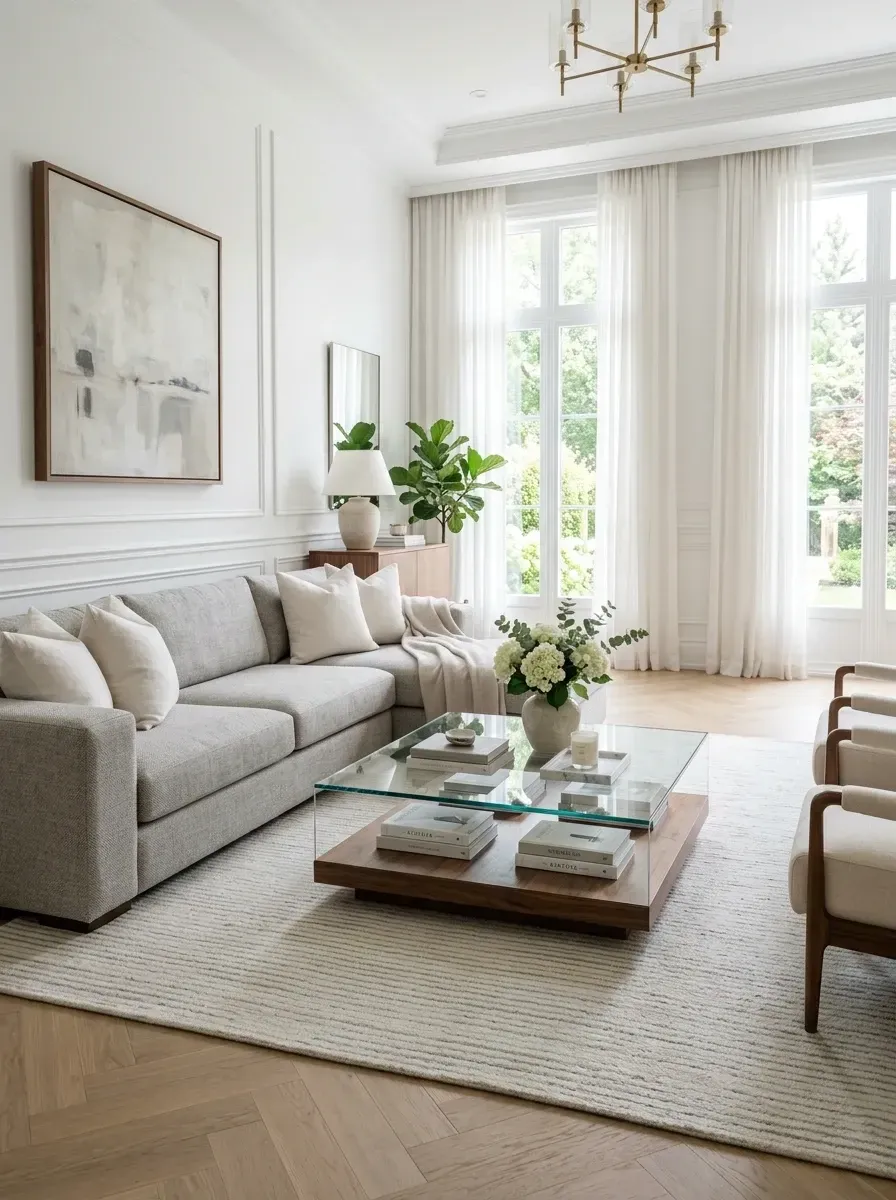
A read where the floor is the architecture and everything else is a backdrop. Herringbone-pattern wide-plank wood floor (5–7 inch widths, set in a 90-degree herringbone) is the budget anchor; everything in the room respects the floor as the strongest visual element. Furniture is light and translucent on purpose: pale grey sectional, glass-top coffee table with wood base, sheer floor-to-ceiling curtains. The wall molding is the period-correct grace note — delicate vertical wainscoting up to a chair-rail height, with smooth plaster above. The brass chandelier is the single sculptural object that gets to break the rule of restraint.
Plan-aware verdict: this is the strongest read for a converted Brooklyn brownstone, a Manhattan pre-war apartment, or a Hudson Valley village townhouse with original tall windows. The herringbone floor commits the budget — installation on solid hardwood herringbone runs $25–$45 per square foot installed; engineered herringbone (Mafi, Stuga, or Carlisle Wide Plank pre-assembled tiles) runs $18–$30 per square foot. Plan the floor at construction documents, not after the walls are painted — the floor decision constrains the rest of the room's vocabulary. Match the wood species and stain to the existing architectural context: warm honey oak for pre-1940 vocabulary; pale European white oak for contemporary translations.
Features at a Glance
- Herringbone-pattern wide-plank wood flooring as primary architecture
- Floor-to-ceiling windows with sheer linen curtains
- Delicate wall molding and chair-rail wainscoting
- Glass-top coffee table with wood base (visual lightness)
- Modern brass chandelier as sculptural anchor
Cost Analysis
| Decor Item (Qty) | Total Price Range |
|---|---|
| Herringbone Wood Flooring (Installed) | $7,000 – $14,000 |
| Wall Molding & Wainscoting (Installed) | $2,500 – $5,500 |
| Light Grey Sectional Sofa | $2,500 – $5,500 |
| Upholstered Armchair (x2) | $1,400 – $3,200 |
| Glass & Wood Coffee Table | $1,000 – $2,200 |
| Brass Chandelier | $600 – $1,800 |
| Floor-to-Ceiling Sheer Curtains | $1,000 – $2,500 |
| Large Area Rug | $800 – $2,000 |
| Large Art & Decor | $1,000 – $2,500 |
| Total Estimated Cost | $17,800 – $39,200 |
Color Palette
Soft White
#FAFAFA
Benjamin Moore Simply White (OC-117) or Farrow & Ball School House White (No.291) on plaster walls.
Pale Mist Grey
#DCDCDC
Light grey Belgian linen or cotton-blend canvas — soft enough to recede behind the floor.
Warm Honey Oak
#CBA87A
Solid or engineered white oak in a warm penetrating-oil finish — Carlisle Wide Plank, Mafi, or Stuga.
Clear Glass
#EDF2F4
Low-iron tempered glass top — the clarity matters; standard float glass has a green cast that flattens the room.
7. Tonal Tranquility with Limewash Walls
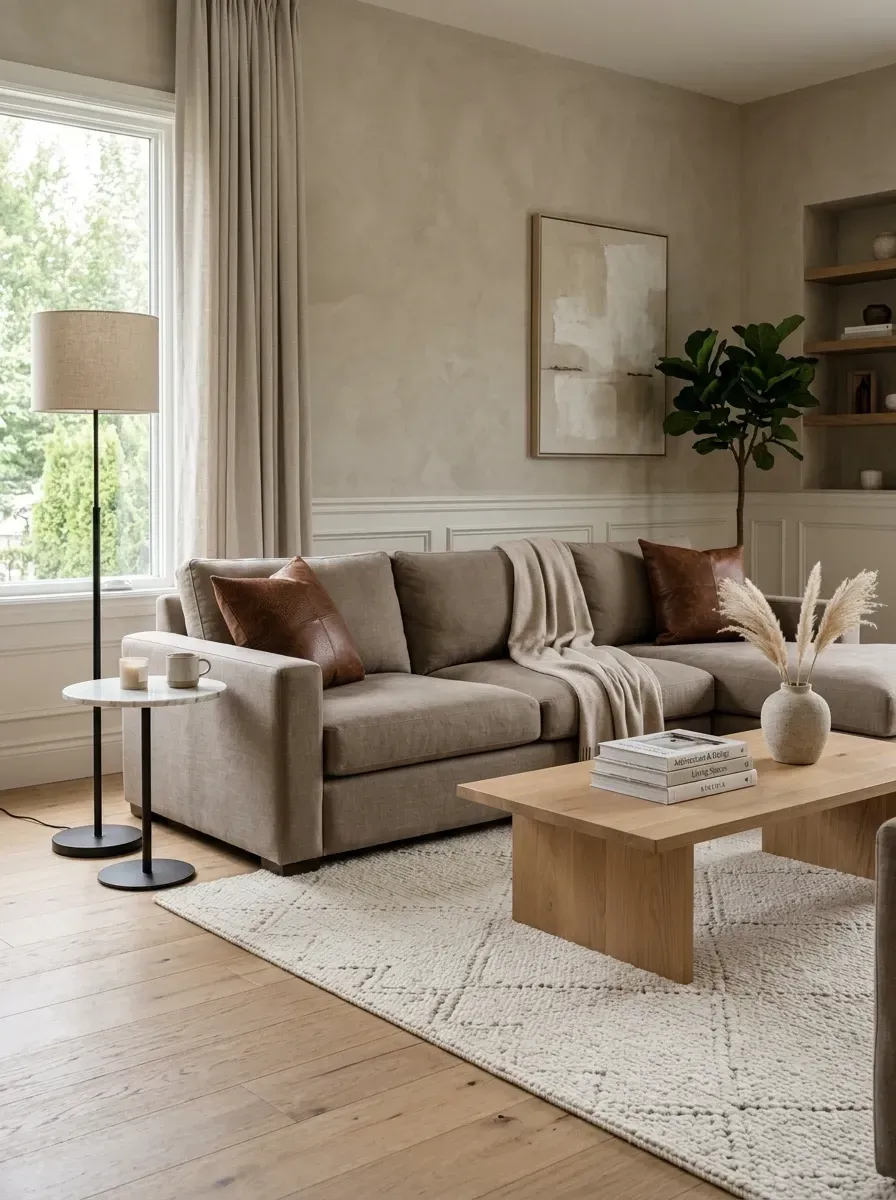
A read built entirely on tonal discipline: every surface in the room sits within 30 hex points of every other surface, varied only by texture. The walls are the architecture — limewash (Romabio Classico, Bauwerk Limewash, or Pure & Original Lime Paint) is the move that makes this vignette work. The limewash creates subtle vertical streaking and depth that flat paint cannot replicate; under raking light it reads almost like old plaster, which is the effect. The sofa is taupe linen, the leather pillows are cognac, the coffee table is light oak, and the rug layers jute under a wool textured weave. The built-in niche holds three objects, not thirty.
Plan-aware verdict: this is one of the most regionally appropriate reads on the list for the Hudson Valley — the limewash + taupe + cognac + oak palette belongs in the upstate New York vernacular without performing it. Limewash is also a forgiving wall finish for older homes with imperfect plaster; the streaking and patina hide the wall's existing irregularities rather than highlighting them. Spec the limewash honestly — Romabio Bauwerk Classico in one of the Northeast neutrals (Lapland White, Sahara Sand, or Bianco Notte) is the regional standard. The texture comes from how it's applied; demand a painter with limewash experience, not a generalist who'll roll it on like standard paint.
Features at a Glance
- True mineral-base limewash wall treatment (Romabio or Bauwerk)
- Tonal palette in beiges, taupes, and warm browns
- Taupe fabric sofa with cognac leather accent pillows
- Minimalist natural white oak coffee table
- Built-in shelving niche with minimal styling
Cost Analysis
| Decor Item (Qty) | Total Price Range |
|---|---|
| Limewash Wall Treatment (Applied) | $1,000 – $2,500 |
| Taupe Fabric Sectional Sofa | $2,000 – $4,500 |
| Light Wood Coffee Table | $700 – $1,800 |
| Textured Wool/Jute Rug | $600 – $1,500 |
| Leather Accent Pillow (x2) | $120 – $300 |
| Built-in Shelving Unit | $1,500 – $3,500 |
| Marble Top Side Table | $200 – $450 |
| Floor Lamp & Decor | $400 – $1,000 |
| Total Estimated Cost | $6,520 – $15,550 |
Color Palette
Sandy Beige Limewash
#D1C7B7
Romabio Classico Sahara Sand or Bauwerk Limewash Pearl — applied with a wide brush in two coats for the period-correct texture.
Warm Taupe
#A89F91
Belgian linen or heavyweight cotton canvas — the natural fiber holds this color depth; synthetic flattens it.
Cognac Leather
#9E5E33
Full-grain Italian saddle leather — Edelman or Garrett Leather. Develops a richer patina with use.
Natural White Oak
#DBC3A3
Untreated or natural-oil-finished white oak — Rubio Monocoat Pure or Osmo Polyx-Oil Natural.
8. The Ultimate Serene Reading Nook
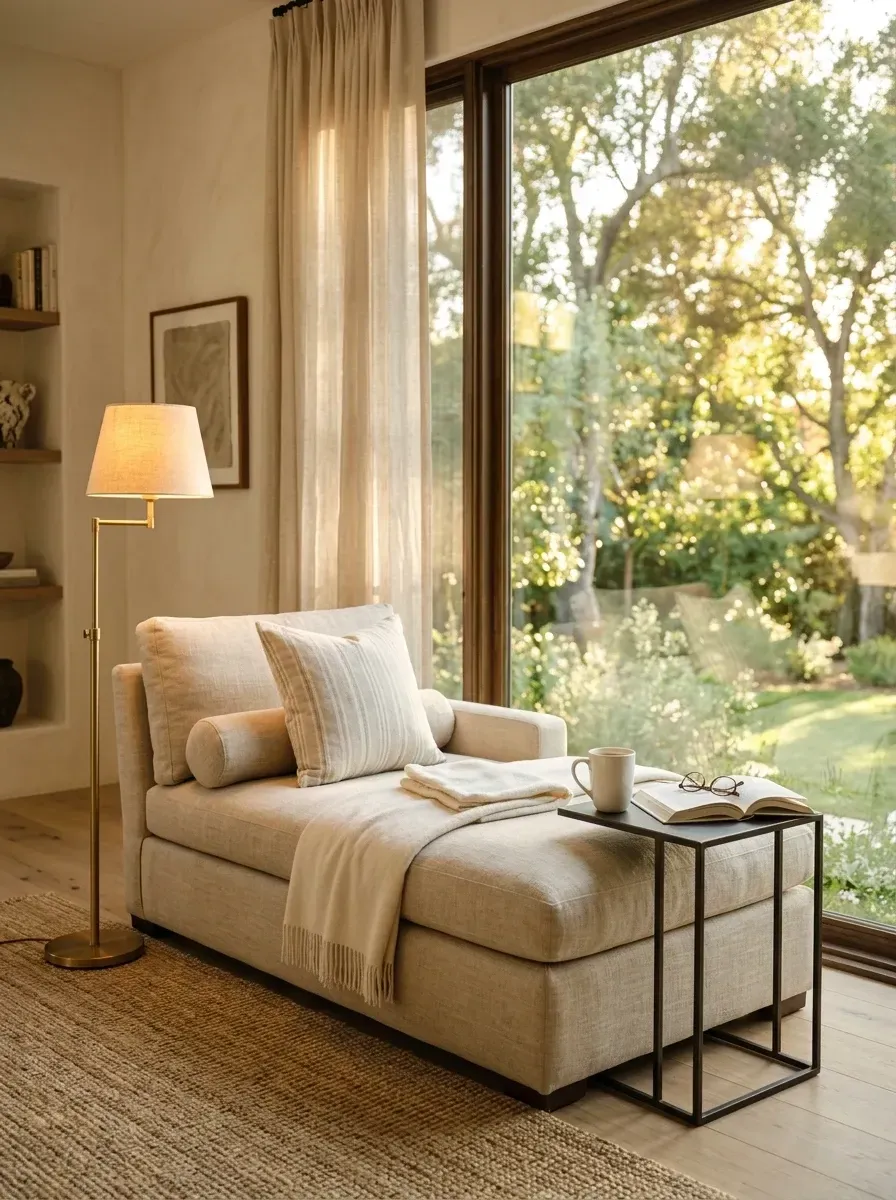
A vignette read of quiet luxury at the smallest possible scale: one chair, one lamp, one window, one rug. The chaise lounge is upholstered in heavyweight linen (a natural-fiber substrate that wrinkles slightly and softens with use), positioned to take the south-facing afternoon light from the picture window. The brass floor lamp is the task light — adjustable arm, 2700K bulb, no overhead glare. The side table is the most minimal thing in the room: a slim black metal plant stand or Vitsoe 606 module functions equally well. The rug is a single jute runner to ground the chaise without competing with the linen.
Plan-aware verdict: this is the read that delivers the highest quiet-luxury-feel-per-dollar of any vignette on the list. The total cost can land under $4,000 if you spec carefully, and the impact on the room is significant — a properly composed reading nook reads as the most considered part of a home. The picture-window orientation matters: a south-facing window gives you afternoon and early-evening light (the warmest hours); an east-facing window gives morning reading light; a north-facing window gives steady diffuse light but no warmth. Choose the chair location to match the time of day the household actually reads.
Features at a Glance
- Heavyweight linen upholstered chaise lounge
- Large picture window with quality garden or landscape view
- Minimalist black metal side table or plant stand
- Adjustable satin brass task floor lamp (2700K)
- Natural linen window curtains and jute runner
Cost Analysis
| Decor Item (Qty) | Total Price Range |
|---|---|
| Upholstered Chaise Lounge | $1,200 – $3,000 |
| Minimalist Metal Side Table | $150 – $350 |
| Brass Floor Lamp | $250 – $600 |
| Linen Window Curtains | $400 – $1,000 |
| Jute Runner Rug | $150 – $400 |
| Built-in Shelving & Decor | $1,000 – $2,500 |
| Total Estimated Cost | $3,150 – $7,850 |
Color Palette
Natural Linen
#E3DED1
Heavyweight unbleached Belgian linen — wrinkles slightly and softens with use; reads warm at every hour.
Satin Brass
#D4AF37
Unlacquered satin brass — Visual Comfort Studio TOB Sconce or Apparatus Cylinder series.
Matte Black
#212121
Powder-coated black steel — the slim profile keeps the visual weight low.
Natural Jute
#C1A57C
Hand-woven jute runner from Loloi, Annie Selke, or Wovn Home — the texture grounds the linen.
9. Sleek Minimalism with Slatted Wood
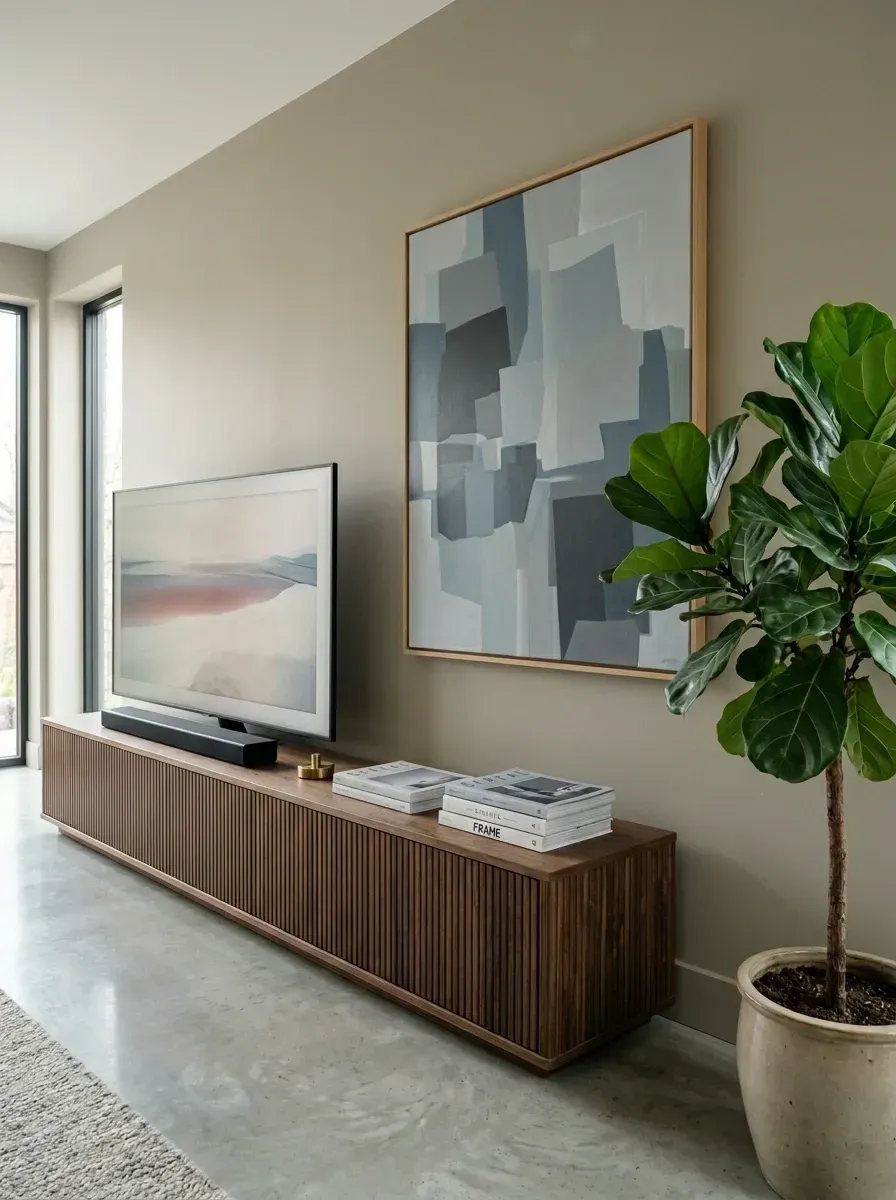
A media wall handled with discipline. The slatted wood console is the architectural hero — vertical slats in walnut or oak, full-extension drawers behind, integrated cable management. Custom millwork from a Hudson Valley shop (Beacon Mill Works, Hudson Valley Hardwoods, or Olde Good Things), or production options from Article, Floyd, or Crate & Barrel for budget. The Frame TV displays art when off, eliminating the dead-black-rectangle problem. The art beside it is a single piece in a wood frame — never a gallery wall in this register. The fiddle leaf fig delivers vertical green; one specimen plant, not a jungle.
Plan-aware verdict: this is the strongest read on the list for a contemporary or transitional home that needs the TV to live in the main living space without dominating it. The Frame TV is the single product I most-often recommend for clients who don't want their living room organized around a screen — at $1,500–$2,000, it pays for itself in living-room calm. Spec the soundbar properly: a Sonos Beam Gen 2 or Sonos Arc plus dual subwoofers reads better than the budget 5.1 alternatives, and the slim profile fits below the Frame without breaking the line. Polished concrete flooring requires proper substrate prep — a ground-and-polished slab over an old subfloor reveals every imperfection; spec a self-leveling overlay if the existing slab isn't pristine.
Features at a Glance
- Long, low slatted-wood media console (custom or premium production)
- Samsung Frame TV with art mode when off
- Single large framed abstract painting in wood frame
- Specimen fiddle leaf fig or ficus for vertical green
- Polished concrete floor with proper substrate prep
Cost Analysis
| Decor Item (Qty) | Total Price Range |
|---|---|
| Slatted Wood Media Console | $1,500 – $3,500 |
| Samsung Frame TV (55"–65") | $1,500 – $2,000 |
| Premium Soundbar (Sonos Beam or Arc) | $400 – $1,000 |
| Large Framed Abstract Art | $600 – $1,800 |
| Large Potted Fiddle Leaf Fig | $250 – $600 |
| Polished Concrete Flooring (Installed) | $4,000 – $8,000 |
| Coffee Table Books | $60 – $120 |
| Total Estimated Cost | $8,310 – $17,020 |
Color Palette
Medium Walnut
#6F4E37
American black walnut or fumed white oak with Rubio Monocoat finish — the slats need real wood to read.
Neutral Greige
#CDC5B9
Benjamin Moore Edgecomb Gray (HC-173) or Pale Oak (OC-20) — calm neutral background.
Polished Concrete
#B0B0B0
Ground-and-polished slab with lithium silicate densifier — semi-gloss finish for daily-life durability.
Muted Slate Blue
#778899
The single saturated accent in the room — pulled from the artwork; never matched elsewhere in the palette.
10. Cozy Corner with Rich Textures
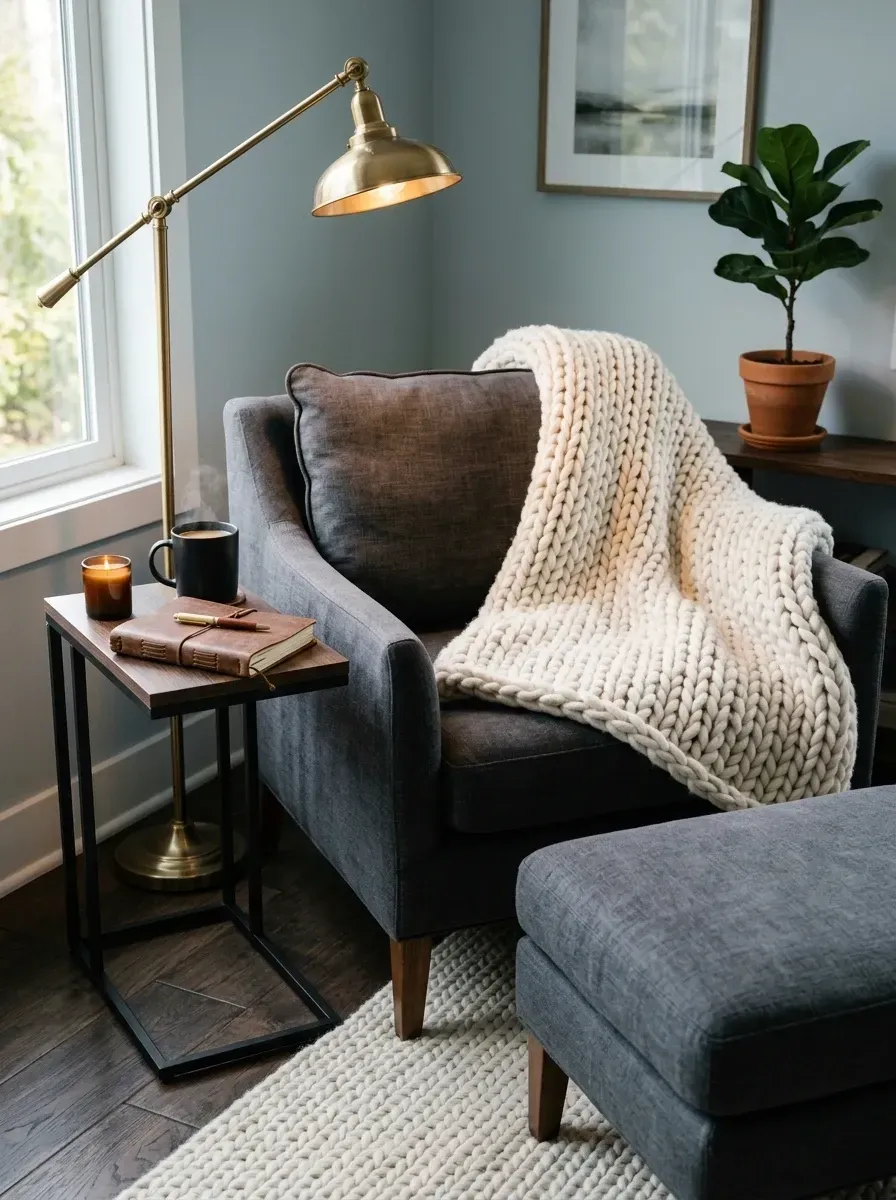
The smallest-scale read on the list, and one of the most satisfying. A single armchair and ottoman in heavy-weight charcoal upholstery, an oversized chunky-knit wool throw, a brass pharmacy lamp at the right shoulder, a small side table. The texture discipline is the read — the chunky knit (24+ mm yarn weight, hand-loomed in heavyweight wool) is the single dramatic textural element; everything else (the chair fabric, the rug, the side table wood) provides quiet supporting texture. The brass pharmacy lamp lifts the entire vignette — Visual Comfort Studio Whitman, Original BTC Hector Pleat, or Schoolhouse Electric Sigmund.
Plan-aware verdict: this is the read that delivers the strongest quiet-luxury return on the smallest budget and the smallest physical footprint. Total spend under $5,000 is achievable, and the corner becomes the most-used spot in the house. Spec the chunky throw honestly: real heavyweight wool from Faribault Mill, Pendleton, or Tibetano in 24–30 mm yarn ranges from $200–$400; acrylic substitutes at the same hex color read plasticky at three feet and the texture flattens under repeated washing. The armchair-and-ottoman pairing is more important than either piece alone — the matching ottoman is what changes "comfortable chair" into "settled retreat."
Features at a Glance
- Heavyweight charcoal upholstered armchair with matching ottoman
- Oversized chunky-knit wool throw (24+ mm yarn weight)
- Adjustable brass pharmacy floor lamp at reading height
- Small dark walnut industrial side table
- Textured hand-woven wool rug
Cost Analysis
| Decor Item (Qty) | Total Price Range |
|---|---|
| Upholstered Armchair and Ottoman Set | $1,000 – $2,500 |
| Chunky Knit Wool Throw Blanket | $180 – $400 |
| Brass Pharmacy Floor Lamp | $200 – $500 |
| Small Industrial Side Table | $100 – $250 |
| Textured Woven Rug | $250 – $600 |
| Decor (Plant, Candle, Books) | $150 – $350 |
| Total Estimated Cost | $1,880 – $4,600 |
Color Palette
Charcoal Grey
#3F4144
Heavyweight wool-blend or boucle upholstery — Holland & Sherry Heritage Wool, Romo Linara, or Knoll Volo.
Creamy Wool White
#F5F5DC
Real heavyweight wool, 24+ mm yarn weight — Faribault Mill, Pendleton, or Tibetano. Acrylic substitutes flatten.
Aged Brass
#B59E5F
Unlacquered aged brass — Visual Comfort Whitman, Original BTC Hector Pleat, or Schoolhouse Sigmund.
Dark Walnut
#4A3525
Solid walnut or fumed oak — small scale lets you use real wood without the cost of a full case piece.
Pro Tips From the Renovation Designer's Chair
- Buy quality at the substrate level. Solid wood instead of veneer at any waterfall edge or visible joinery. Full-grain leather instead of bonded. Hand-loomed wool instead of polypropylene. Belgian linen instead of polyester blends. The substrate is what holds the quiet luxury read; the surface color and styling are secondary.
- Lighting is a planning decision, not a finish decision. Layer floor lamps, table lamps, sconces, and recessed dimmable downs — all at 2700K, all on Lutron or Caséta dimmable controls. Avoid 5000K "daylight" bulbs in any quiet-luxury living room; they read clinical. Plan the lighting at the construction documents; retrofitting recessed downs after drywall costs 3–4× the framing-stage installation.
- Restraint matters more than budget. The Cozy Corner (Read 10) reads as quiet luxury at $4,000 because of restraint; the Industrial Warmth (Read 4) reads as quiet luxury at $30,000 because of restraint at a different scale. Adding more pieces to a high-end room undoes the read faster than substituting cheaper materials would.
- Architecture earns the room. Built-ins, paneling, cove lighting, herringbone floors, board-formed concrete fireplaces — these are framing-stage decisions that commit the room to a quiet-luxury reading. Adding architectural detail after the room is finished is technically possible but costs 3–5× the planning-stage installation.
- Tactile matters more than visual. Choose surfaces that reward touch. Limewash walls, linen upholstery, oiled walnut, brushed brass, hand-loomed wool. The room should pass the closed-eye test — running a hand across each surface should deliver distinctly different textures, not the same vinyl-and-poly slickness.
- One sculptural piece per room. Quiet luxury rooms have a single object that breaks the rule of restraint — a brass chandelier, a sculptural ceramic, a large piece of art, a fiddle leaf fig. Two such objects in one room compete; three undermine the discipline. Pick one and commit.
Cost-Saving Moves on a Quiet Luxury Living Room
- Source vintage at estate sales and 1stDibs. Solid walnut coffee tables, brass floor lamps, vintage Persian rugs, and mid-century armchairs are widely available secondhand at prices 40–70% below new retail. Hudson Valley has strong estate-sale infrastructure (Foreland Catskill, Hudson Mercantile, the Beacon and Rhinebeck antique circuits) — a Saturday morning of sourcing can fill a room for half the budget.
- Mid-tier upholstery, top-tier fabric. Spec a custom sofa from BenchMade Modern, Article, or Interior Define and have it upholstered in heavyweight Belgian linen, Holland & Sherry, or Pierre Frey fabric. The frame at $1,800–$2,800 plus COM (customer's own material) fabric runs 30–40% below the equivalent piece at Restoration Hardware or RH Modern. The fabric is what reads at three feet, not the frame brand.
- Limewash over premium wallpaper. A limewash treatment at $5–$9 per square foot installed (DIY $2–$4 per square foot) delivers depth and texture comparable to $20–$45 per square foot designer wallpaper. Limewash also ages gracefully where wallpaper develops seam and corner failures within 5–8 years.
- Engineered wide-plank floor over solid. Engineered wide-plank European white oak (Carlisle Wide Plank, Stuga, Mafi) at $14–$22 per square foot installed reads identical to solid white oak at $25–$40 per square foot, with better dimensional stability across Hudson Valley seasons.
- Samsung Frame TV over wall-mounted gallery wall. The Frame TV at $1,500–$2,000 displays rotating art when off, eliminating the dead-screen problem and saving the cost of large-format framed prints. The math works: a single Frame TV plus a digital art subscription (Samsung Art Store, Vieunite) at $4–$15 per month is meaningfully cheaper than gallery prints, custom framing, and ongoing rotation.
- One sculptural lamp instead of three table lamps. A single Visual Comfort Studio TOB, Original BTC Hector, or Allied Maker Pendant at $400–$900 delivers more visual presence than three production-grade lamps at $150 each. Quiet luxury rewards the single significant lamp over the matched-set vignette.
Reader Questions on Quiet Luxury Living Rooms
How much should I budget for a full quiet luxury living room renovation?
In the Hudson Valley and Northeast suburban market, a full quiet-luxury living-room renovation — including upholstery, case pieces, lighting, rug, art, and a meaningful architectural move (built-ins, paneling, fireplace surround, or floor) — typically runs $18,000–$48,000 turnkey for a 240–360 sq ft room. The architectural move drives the upper end: a board-formed concrete fireplace, custom millwork built-ins, or a herringbone floor adds $8,000–$18,000 to the line item but anchors the entire read. Without an architectural move, the room can land at $12,000–$25,000 but reads less committed.
Which read works best for a small living room?
The Cozy Corner (Read 10), the Serene Reading Nook (Read 8), and the Tonal Tranquility (Read 7) reads scale down most credibly. Quiet luxury benefits from negative space, and tight rooms force discipline that loose rooms can avoid — a 12×14 living room with one armchair, one ottoman, one lamp, one side table, and a chunky throw reads stronger than the same room overstuffed with sectional, sectional ottoman, two armchairs, three side tables, and four pillows. Cut pieces first; the room will read larger and quieter for the subtraction.
What's the single most-overlooked element in quiet luxury living rooms?
Lighting at 2700K with proper layered placement. Most renovations focus on furniture, art, and architectural surfaces; lighting is treated as a finish-stage decision and the result is harsh overhead downs that flatten every other choice. Quiet luxury rooms have multiple layered light sources — floor lamps, table lamps, sconces, dimmable recessed cans — all at 2700K and all on Lutron Caséta or RadioRA dimmable controls. Cool white (5000K) bulbs in any quiet-luxury living room undo the read. Spec the bulbs and the dimmer controls explicitly.
Can I get a quiet luxury look on a tight budget?
Yes — quiet luxury is more about restraint than spending. The Cozy Corner (Read 10) lands at $1,880 minimum. The Serene Reading Nook (Read 8) lands at $3,150. Both deliver legitimate quiet luxury reads through substrate honesty and restraint rather than dollar value. The path on a tight budget: source vintage solid wood, custom-upholster a mid-tier frame in premium fabric, spec one sculptural lamp, and resist the urge to add more pieces. Aim for under five purchases total for the room. Fewer-better always reads quieter than more-cheaper.
Which quiet luxury read works best in a Hudson Valley weekend home?
Read 2 (Organic Modern with Rich Jewel Tones), Read 4 (Industrial Warmth with Concrete and Leather), and Read 7 (Tonal Tranquility with Limewash) are the strongest reads for Beacon, Rhinebeck, Hudson, and Cold Spring weekend properties. All three sit inside the regional vernacular without performing it — forest green velvet plus walnut plus brass reads native to woodland-and-stone country; board-formed concrete plus walnut built-ins plus leather reads native to converted-industrial sites; limewash plus taupe plus cognac plus oak reads native to the upstate New York neutrals. Cape Cod coastal properties lean toward Read 3 (Airy Open-Plan); Brooklyn brownstones lean toward Read 6 (Parisian Herringbone) or Read 4.
How long does a typical quiet luxury living room renovation take?
A full quiet-luxury living-room renovation in the Northeast typically runs 8–16 weeks from contract signing to substantial completion. The longest-lead items are custom upholstery (8–14 weeks lead time for COM-fabric sofas from BenchMade, Interior Define, or regional upholsterers), custom millwork (6–10 weeks for built-ins from a Hudson Valley shop), and specialty wall treatments (limewash and paneling typically run 1–2 weeks each on-site). Plan the procurement timeline at the construction documents stage; ordering pieces in sequence rather than parallel adds 4–8 weeks to the schedule.
Where to Read Next
If this study was useful, the natural companion reads sit alongside it on the site. For a deeper read on the underlying principles of quiet luxury across all rooms, the full quiet luxury interior design guide covers the philosophy and applies it across kitchen, bath, bedroom, and office. For a longer single-room treatment on the living room specifically, my living room design guide walks the decisions in narrative form. For a before-after look at how one builder-grade living room got rewritten as bespoke sanctuary, the beyond beige living room transformation covers the renovation logic in detail.
Sources & Further Reading
- Architectural Digest. The Principles of Quiet Luxury Interior Design — Material, Restraint, and the New Standard for Sophisticated Living. architecturaldigest.com
- Remodelista. Limewash and Mineral Wall Treatment Guide — Romabio, Bauwerk, and Pure & Original Application Standards. remodelista.com
- Romabio Paints. Classico Limewash Technical Data Sheet and Application Guidelines. romabio.com
- Dwell. Board-Formed Concrete in Residential Architecture — Specification, Forming, and Curing Best Practices. dwell.com
- Marble Institute of America / Natural Stone Institute. Travertine and Limestone Specification & Care Guidelines for Residential Applications. naturalstoneinstitute.org
- Carlisle Wide Plank Floors. Engineered Herringbone and Wide-Plank Hardwood Installation Specifications. wideplankflooring.com
- Visual Comfort & Co. Studio Collection Pharmacy, Floor, and Table Lamp Specifications for Residential Applications. visualcomfort.com
- Edelman Leather / Garrett Leather. Full-Grain Leather Specification, Aniline Finishes, and Residential Upholstery Standards. edelmanleather.com
- Holland & Sherry / Romo / Pierre Frey. Heavyweight Linen, Belgian Linen, and Performance Upholstery Fabric Specifications.
- The American Institute of Architects (AIA). Residential Lighting Best Practices & Color Temperature Guidelines for Living Spaces.
- This Old House. Built-In Cabinetry and Applied Wall Paneling Construction Guide. thisoldhouse.com

Nora Whitfield
Renovation Designer & Interiors Editor · Beacon, New YorkNine years of design-build renovation work across the Hudson Valley and the Northeast. Nora runs the Renovations, Room Guides and Renovation Mind desks — before-and-after studies, room-by-room design guides, and the long essays on why what we renovate matters.
More from Nora →
Reader notes