


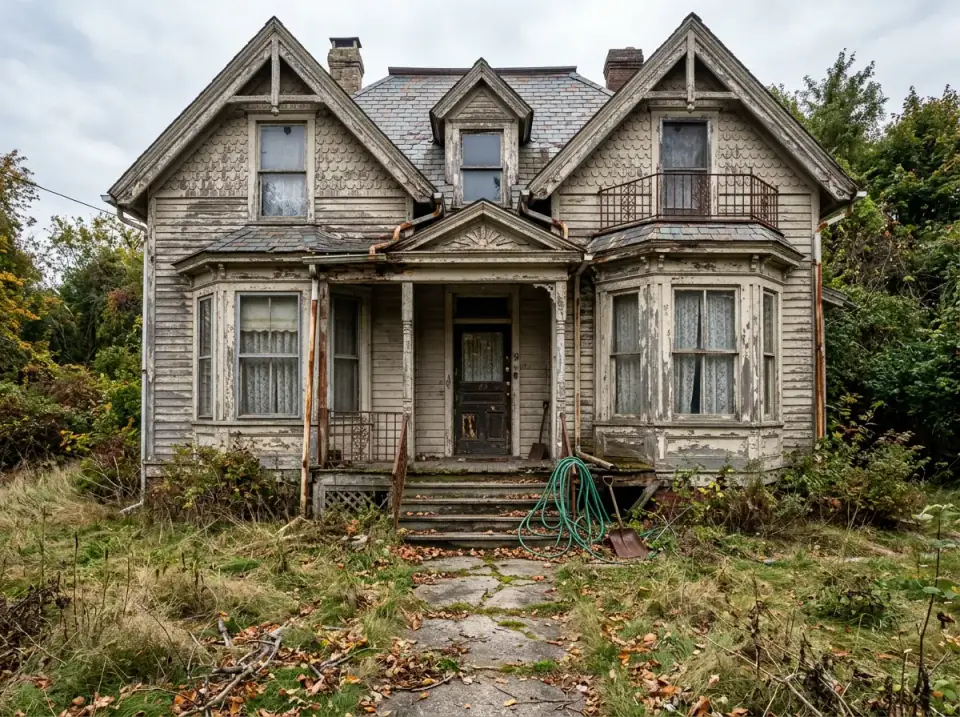
A farmhouse exterior is the one renovation where the cheapest decision and the most expensive one look almost identical in a photo — and that's exactly the trap. I took a single neglected farmhouse, the kind that fills the back roads around Rhinebeck and Kingston, and ran its façade through ten directions: sage and cedar, navy and white, charcoal stucco, corrugated metal, stacked stone. The massing never changes. What changes is the envelope — the siding, the porch structure, the stone — and that's where the money, the maintenance, and the next forty Northeast winters live. Here's how I read each one.
How I Read a Façade
The first thing I want to know about any exterior makeover isn't the color — it's whether you're painting the envelope or replacing it. Those are two completely different projects that produce the same Instagram photo. Repainting existing siding is a finish-stage job: prep, primer, two coats, done in a week. Re-cladding in fiber-cement, stone veneer, or metal means tearing back to the sheathing, re-flashing every window and door, getting the weather-resistive barrier right, and engaging structure where stone is involved. One costs thousands; the other costs tens of thousands. The drafter handed you the massing and the roofline — your job on a façade is to decide how much of the skin you're actually rebuilding.
The second thing I read is climate. Half the directions below are gorgeous in a photo and a maintenance trap in the Hudson Valley, because our freeze-thaw cycle and wet shoulder seasons punish natural wood, real stucco, and dark colors differently than a dry Western climate does. So as I walk these ten, I'll flag what's a paint job versus a re-clad, and what each material actually costs you to keep looking good through a Northeast winter. If you want the deeper material-by-material breakdown behind these calls, I wrote a full guide on how exterior materials transform a home.
1. Organic Sage & Natural Wood
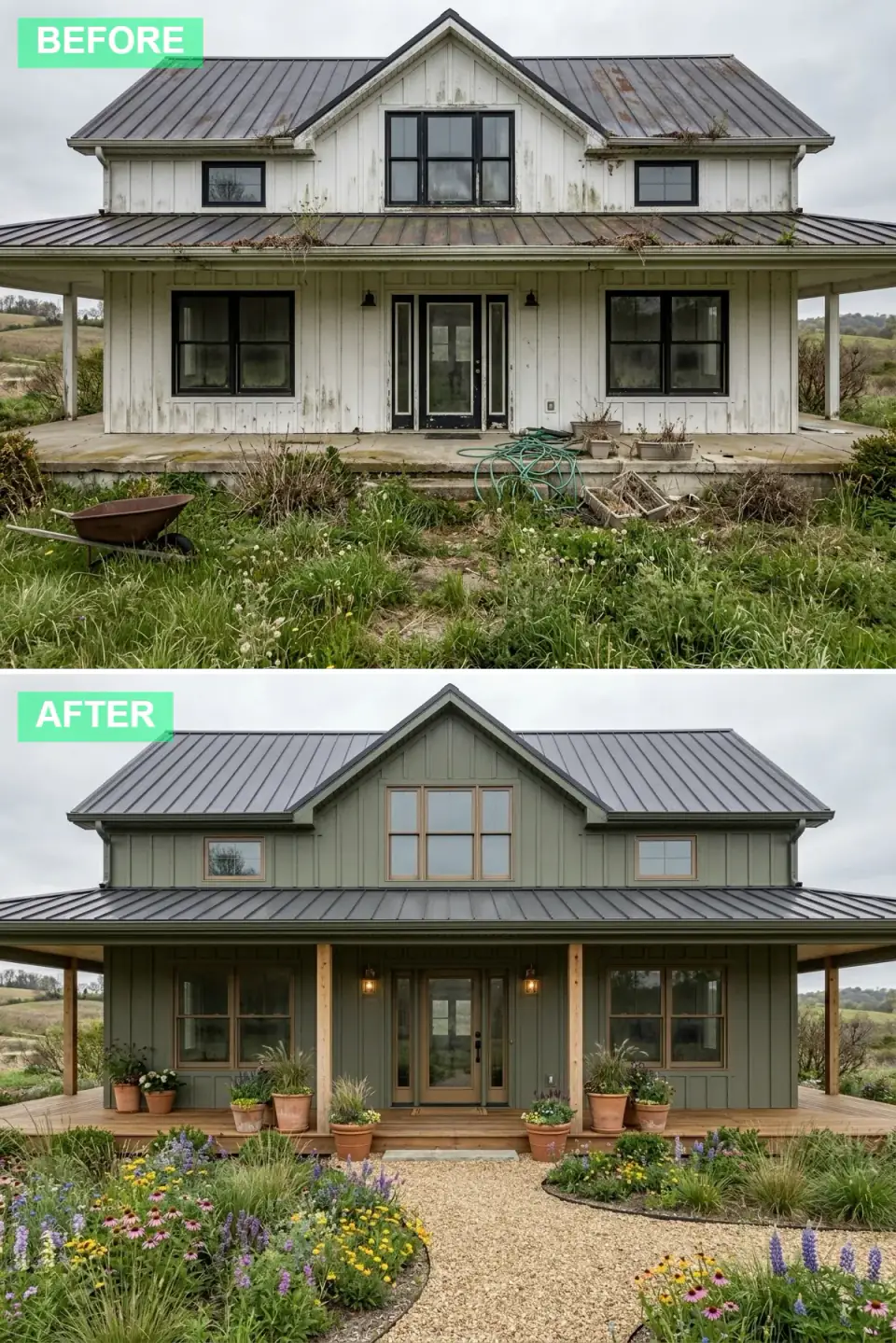
Stained white siding gives way to a calming sage green that settles the house into the landscape. The failing concrete porch is rebuilt with warm wood decking and substantial timber posts, and a gravel path through cottage plantings in terracotta pots erases the overgrown-weed memory entirely. Soft, earthy, welcoming.
Plan-wise, this is the most achievable read in the set — if the existing siding is sound, the green is a paint job, not a re-clad. The real spend is the porch: rebuilding a rotted concrete stoop into a timber-post wood deck is structural carpentry with footings below frost line (48 inches up here), not a finish you brush on. Spec the porch posts and decking in a rot-resistant species or a capped composite, because raw cedar at grade in a wet Hudson Valley spring is a five-year material, not a thirty-year one. The sage hides pollen and rain-spatter better than white ever did — a quiet practical win.
Color Palette
Sage Green
#6F7D65
A muted earthy green — close to Sherwin-Williams Pewter Green SW 6208.
Natural Cedar
#B68E65
Warm wood for rustic texture — seal it or choose capped composite.
Dark Bronze
#3C3B36
A dark metallic that gives the soft palette its definition.
Medium Oak
#9E7B52
A classic wood door tone that reads as a warm welcome.
2. Bold Navy & Crisp White
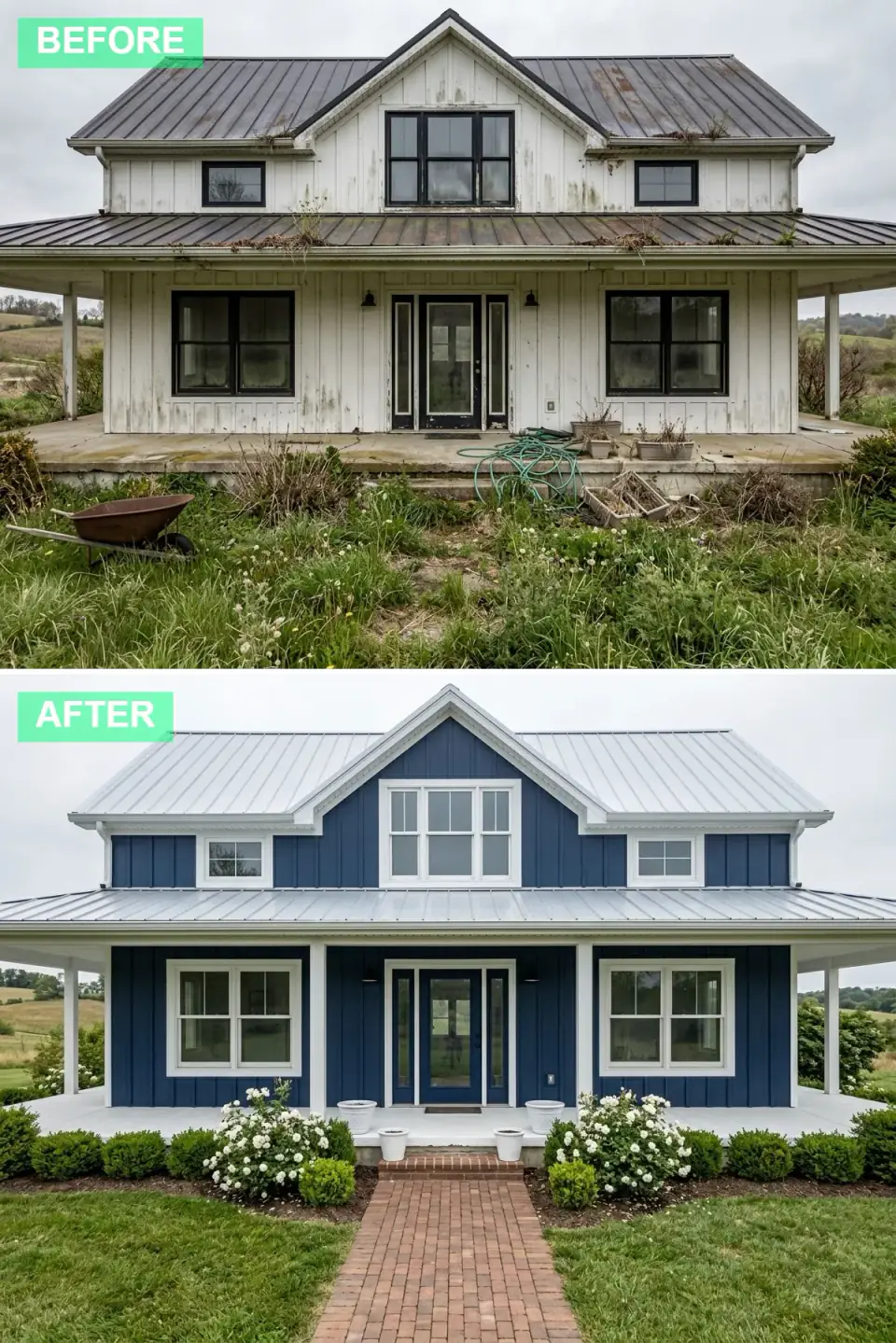
A deep navy ground turns crisp white trim into the star — columns, fascia, and window frames read sharp against the dark field. A grey-painted porch floor and a new brick path add timeless structure, and formal white hydrangeas and boxwoods in white planters push it toward classic coastal farmhouse. Sophisticated and safe in the best sense.
From the plan's view, this is another paint-led read, and navy is a smart, durable choice — but the detail that matters is the brick path, not the color. A proper brick walkway needs a compacted base and edge restraint or our frost heave will have it rippling within two winters; lay it on sand without a plan and you'll be re-leveling it every spring. The white trim is the maintenance line item: white shows our wet-season mildew and pollen fastest, so spec it in a fiber-cement trim with a factory finish (Hardie or Boral) rather than painted wood, and you'll wash it twice a year instead of repainting it every five.
Color Palette
Deep Navy
#2C3E50
A bold classic ground — close to Benjamin Moore Hale Navy HC-154.
Crisp White
#FFFFFF
Sharp white accents — factory-finished fiber cement beats painted wood here.
Traditional Brick
#8C5E4D
Classic red-brown brick — needs a compacted base and edge restraint up north.
Light Concrete Grey
#B0B7BB
A neutral base that lets the bold siding carry the show.
3. Warm Taupe & Stone
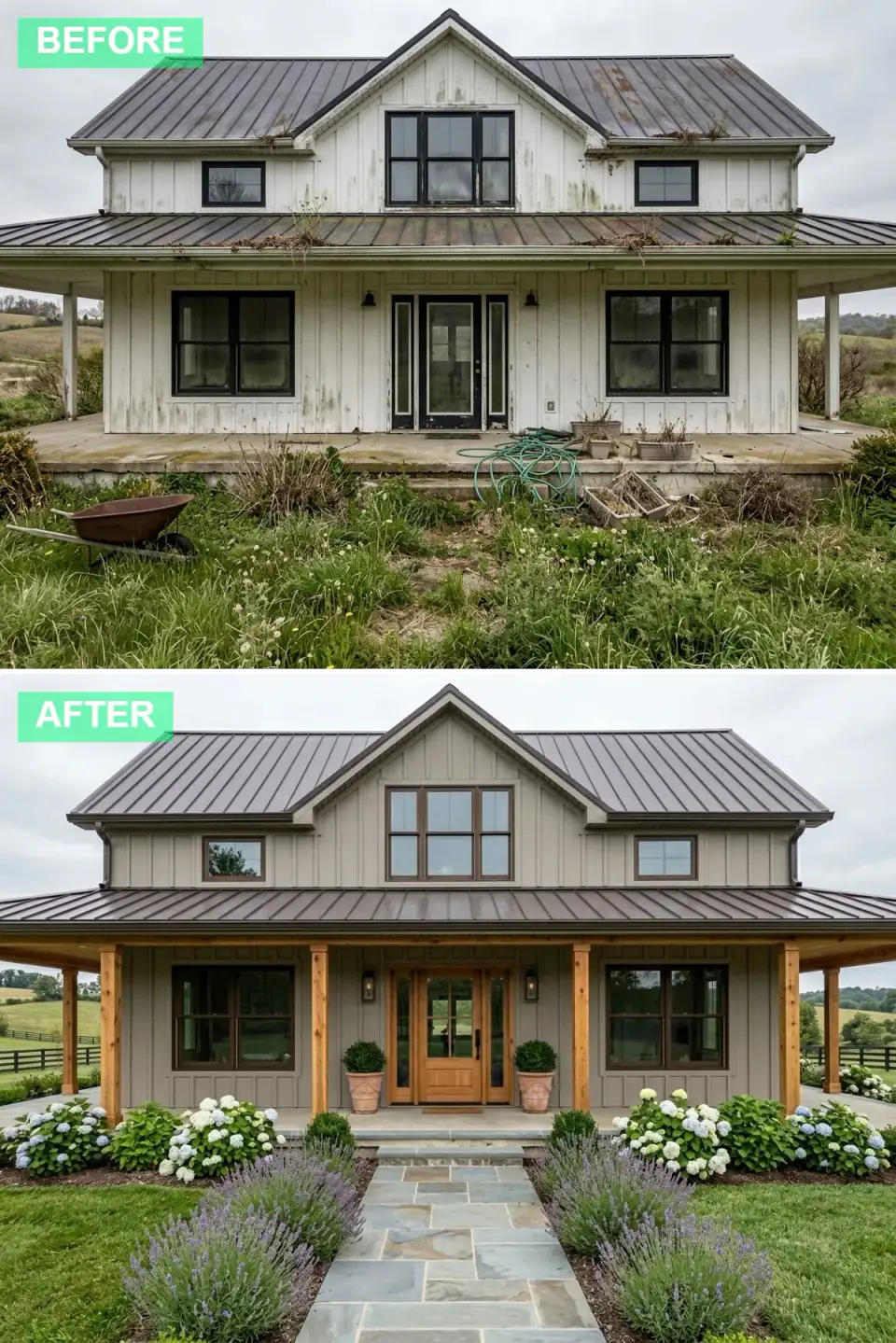
A warm taupe softens the whole house into something cozy and inviting. The porch posts are rebuilt in natural wood to match the new door, a flagstone path winds through hydrangeas and lavender, and big terracotta planters bring a note of Mediterranean warmth. The least polarizing read here — taupe offends no one and dates slowly.
This is a paint-and-hardscape project, and the flagstone is where the craft lives. Dry-laid fieldstone or bluestone over a proper base is one of the few hardscapes that actually improves with our freeze-thaw — it moves and settles rather than cracking like poured concrete — which makes it a smart Northeast choice. Greige is also the most forgiving siding color for an old farmhouse with imperfect surfaces, because it doesn't telegraph every patch and seam the way pure white or deep navy do. Match the door stain to the posts, as shown, and the whole front reads intentional rather than assembled.
Color Palette
Warm Taupe
#9C9083
A versatile greige — close to Sherwin-Williams Mega Greige SW 7031.
Honey Wood
#C19A6B
Golden wood on the door and posts — match the two stains exactly.
Flagstone Grey
#808080
Natural stone in varied tones — dry-laid bluestone handles freeze-thaw well.
Terracotta Orange
#CC7A58
Earthy clay pots for a warm pop — bring frost-prone terracotta in for winter.
4. Modern Minimalist Charcoal
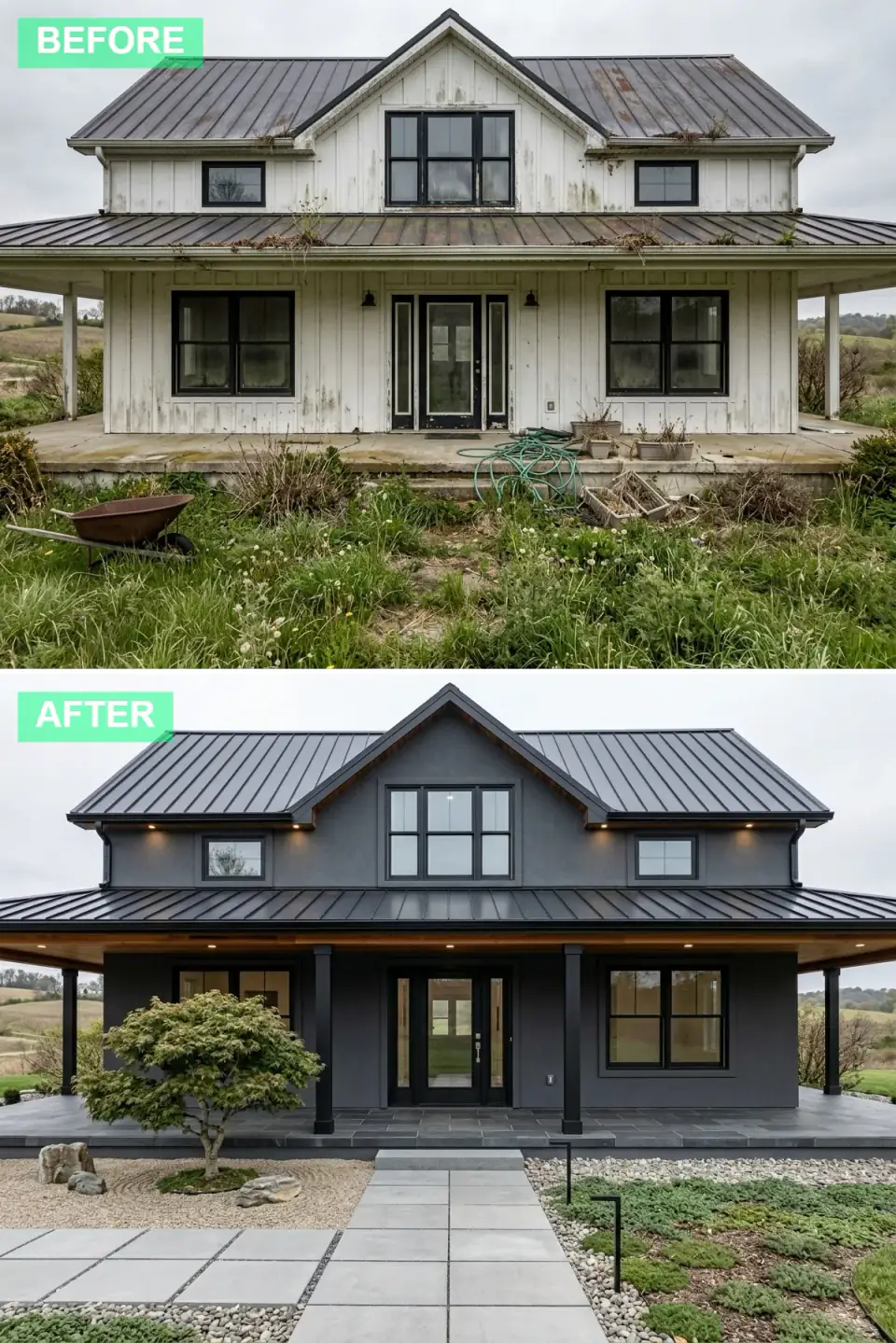
A sleek, contemporary turn: dark charcoal stucco for a smooth monolithic skin, black columns and window frames for a monochrome read, warmed by natural-wood porch soffits. The landscaping goes Zen — gravel garden, stepping stones, a sculptural tree, modern path lighting. The most architectural departure from "farmhouse" in the set.
Here's where I have to be the bad-news architect: traditional three-coat stucco is a difficult, risky envelope in our freeze-thaw climate. Water that gets behind it freezes, expands, and spalls the finish — which is why true stucco is a Southwest material, not a Hudson Valley one. If you love this look, the right Northeast spec is a fiber-cement panel or a properly detailed EIFS system with a drainage plane behind it, not lime-and-sand stucco. The wood soffit is the move that saves the whole thing from reading cold and tomb-like, so don't value-engineer it out. This is a re-clad, not a paint job — budget accordingly.
Color Palette
Charcoal Stucco
#363636
A smooth dark skin — spec fiber-cement panel, not true stucco, up north.
Matte Black
#1A1A1A
Black details that lock in the monochrome theme.
Natural Wood
#A67B5B
Warm wood overhead — the detail that keeps the dark read from going cold.
Light Concrete
#D3D3D3
Smooth pavers for a clean, bright contrast underfoot.
5. Industrial Rustic Metal & Wood
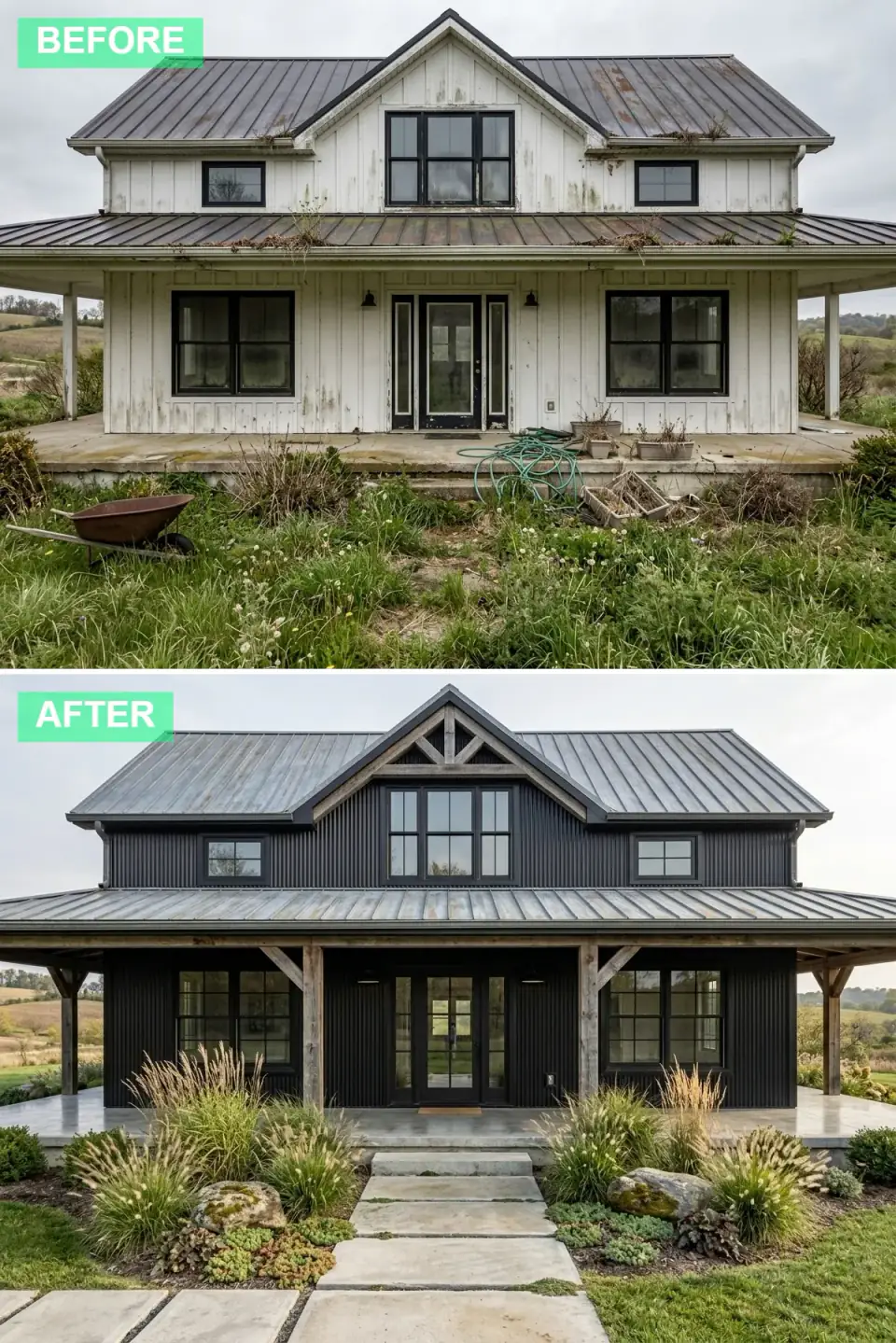
An industrial-rustic read in black corrugated metal, with the gable picked out in chunky timber that matches the new porch posts and beams. A concrete stepping-stone path cuts through prairie-style planting — ornamental grasses and big boulders. Tough, modern, and surprisingly at home on a working-farm road.
Metal siding is genuinely one of the best Northeast envelopes going — a standing-seam or corrugated steel skin sheds our snow and rain, won't rot, and lasts decades, which is why you see it on every serious modern barn up here. The plan caution is the detailing, not the durability: metal needs a rainscreen gap and meticulous flashing at every penetration, because any water that gets behind it has nowhere to dry. The timber gable accents are the warmth that keeps it from reading like a pole barn, and they're structural-grade, so they get the same frost-depth and rot-resistance attention as any exposed wood. This is a full re-clad, but it's a re-clad that earns its keep over forty winters.
Color Palette
Black Corrugated Metal
#222222
Durable industrial steel — needs a rainscreen gap and tight flashing.
Weathered Timber
#8B6F57
Rough-hewn beams and posts for warmth against the cold metal.
Poured Concrete
#B4B4B4
A clean modern material for the path and porch floor.
Natural Granite Boulder
#7A7A7A
Large local rock to anchor the prairie planting.
6. Craftsman Stone & Wood Blend
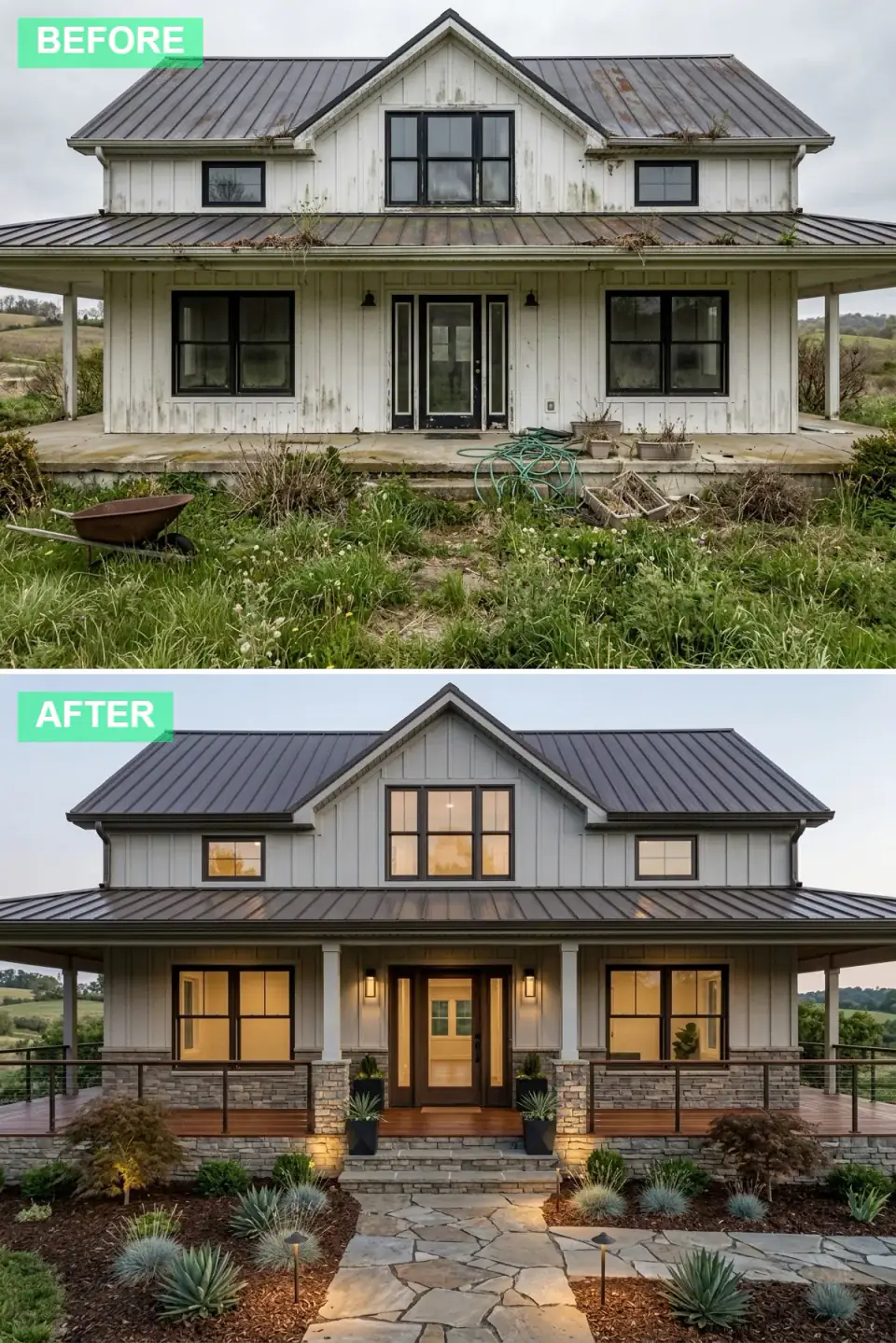
A material-rich Craftsman read. The lower walls and new pier bases wear stacked stone veneer that grounds the whole house, light grey board-and-batten runs above, and a rich wood porch floor with substantial white columns and modern cable railings ties old and new together. A flagstone path threads manicured beds.
This is the most expensive direction here, and the plan reason is the stone. Even thin-cut adhered veneer adds real weight and demands flawless flashing where it meets the siding above — a stone-to-siding transition that's detailed wrong is the single most common source of water intrusion I see on these mixed-material fronts. Full-bed stone on the piers needs a proper footing and ledge. The payoff is that nothing reads more permanent or higher-value than a stone base, and it's the detail that makes an appraiser nod. The cable railing is the contemporary wink that keeps it from going full traditional — a nice tension. Re-clad budget, with a stone premium on top.
Color Palette
Light Grey
#C0C0C0
A soft neutral grey that complements the stone — Benjamin Moore Stonington Gray HC-170.
Stacked Stone
#8F8F8F
Grey-and-brown veneer for texture — flash the stone-to-siding line meticulously.
Redwood Decking
#9C5A42
A warm reddish-brown floor that pulls you onto the porch.
Black Cable Railing
#333333
A modern railing that keeps the porch view open.
7. Natural Wood Scandi-Farmhouse
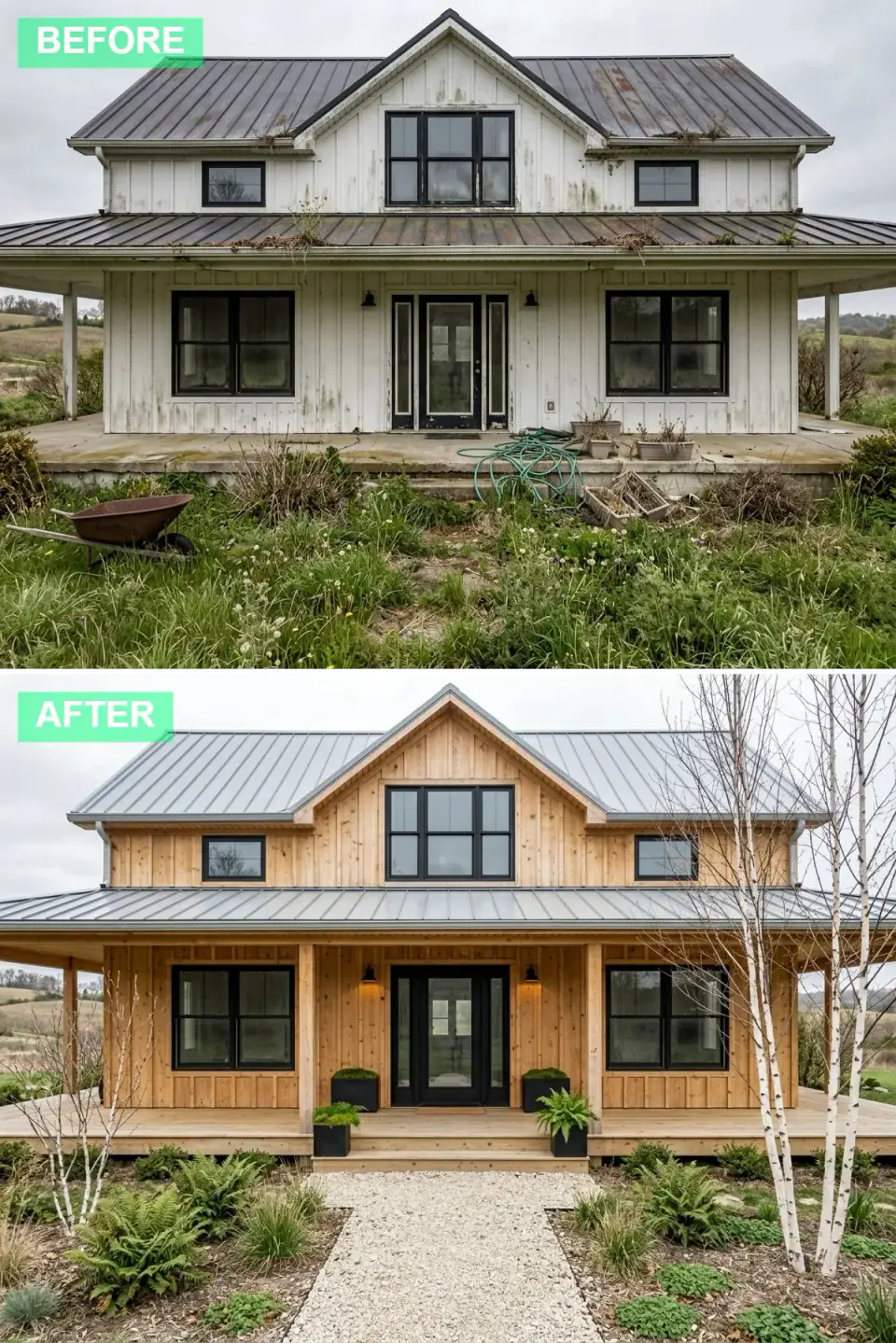
Clad entirely in natural knotty wood, this read goes warm and organic with a Scandinavian undertone. Black window frames and a black door cut a sharp modern contrast, the porch floor continues the wood, and a simple gravel path runs through woodland planting — ferns, birch, black planters. Calm, contemporary, deeply tied to its setting.
I love how this looks and I'm obligated to tell you the truth about full wood cladding in the Northeast: it's a commitment. Natural cedar or pine left clear-coated will silver and weather unevenly — gorgeous if that's the intent, a maintenance chore if you're fighting to keep it golden. The honest two options are to embrace the silvering and let it go grey gracefully, or to specify a pre-weathered or factory-finished wood-look product (a thermally-modified ash, or a fiber-cement woodgrain like Hardie's cedar-texture line) that gives you the warmth without the annual upkeep. The black trim is non-negotiable here — it's the entire reason the wood reads modern instead of cabin.
Color Palette
Natural Cedar Plank
#C7A882
Clear-coated wood showing grain and knots — accept the silvering or go thermally-modified.
Matte Black
#212121
Black doors, windows, and planters — the reason the wood reads modern.
Light Gravel
#E0E0E0
A simple crunchy path that suits the natural read.
Medium Grey Metal
#757575
A neutral metal roof that lets the wood lead.
8. Modern Black & Warm Wood
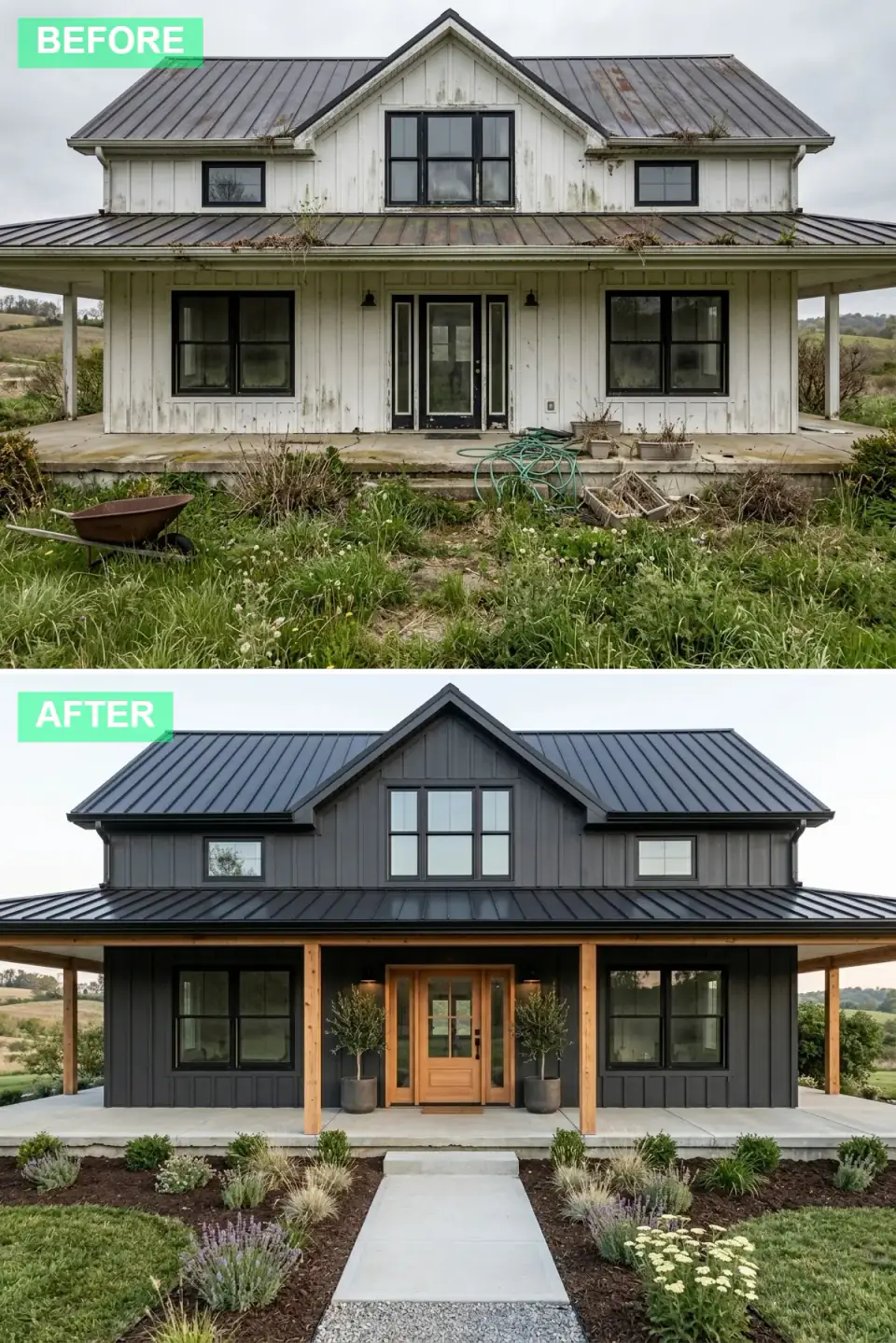
A trendy, sophisticated read: charcoal-black board-and-batten as a moody backdrop that makes the natural wood door and matching posts glow. The composition is symmetrical and clean — concrete path, concrete porch, identical olive trees in dark planters flanking the entry. Restrained and high-end.
This is the most achievable of the dark reads because board-and-batten in black can be a paint job over sound existing siding, or a straightforward re-clad in pre-finished fiber-cement — far simpler than the stucco or stone directions. The plan note is heat and fade: dark colors on a sun-hit south or west elevation run hot and fade faster, so spec a fade-resistant pre-finished product (Hardie's dark ColorPlus line holds up where field-painted black chalks out) rather than mixing your own deep black at the store. The single wood door is doing enormous work — it's the warmth that rescues the whole front from severity. And those olive trees are not winter-hardy here; plan to overwinter them or swap for a hardy evergreen.
Color Palette
Soft Black
#2B2B2B
A deep charcoal-black — Benjamin Moore Soot 2129-20, in a fade-resistant finish.
Natural Oak
#BC9E7A
Warm light oak on the door and posts — the focal point of the façade.
Smooth Concrete
#CCCCCC
Clean light-grey concrete for a minimalist finish.
Dark Grey Concrete
#555555
Substantial planters that echo the home's modern tone.
9. Classic White & Black
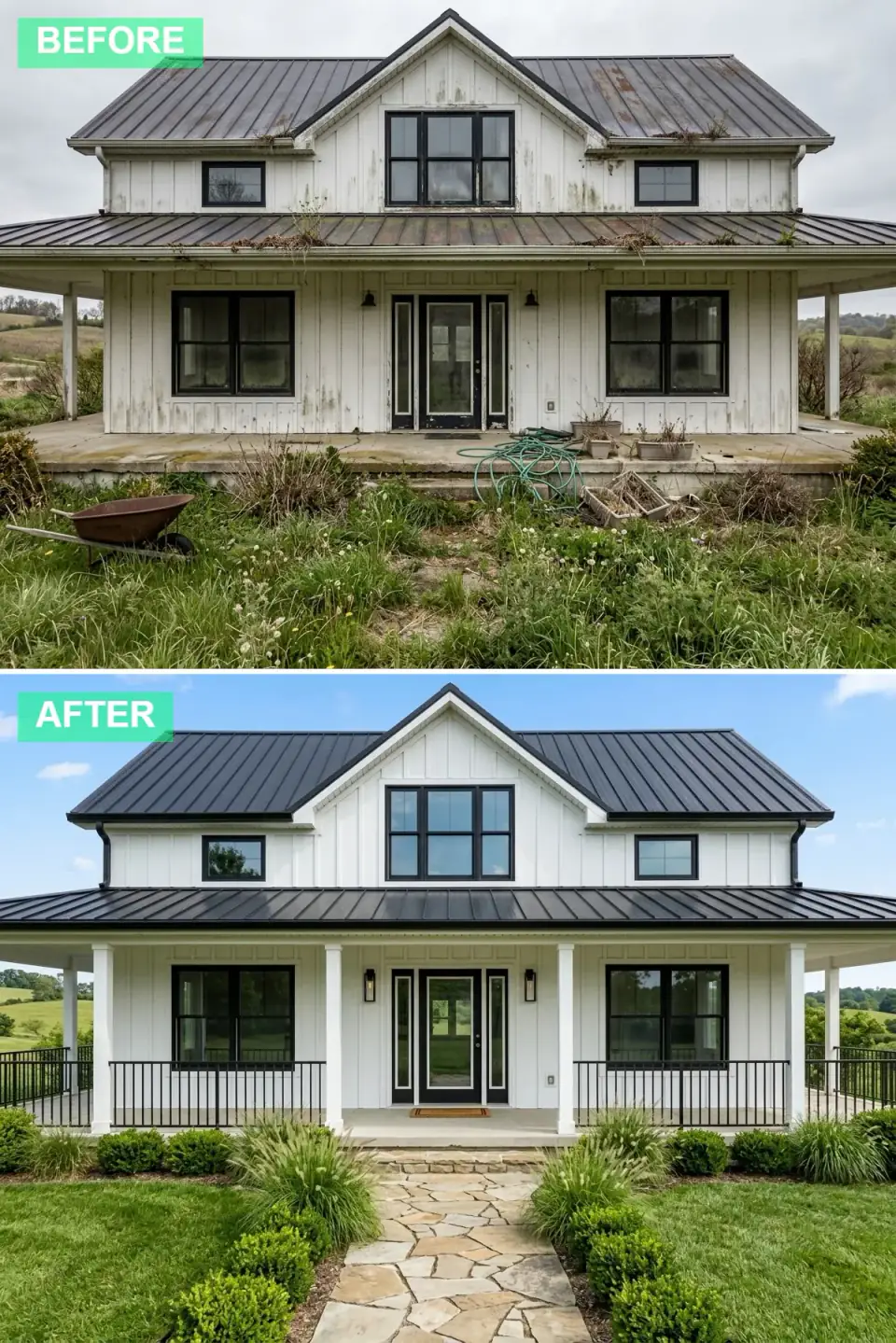
The quintessential modern farmhouse, done right: crisp white board-and-batten, high contrast from black window frames, a black door, and black metal porch railings, with white square columns holding the roof. A flagstone path runs through boxwoods and ornamental grasses. The safest resale read on the page — and a deserved classic.
This is the one most buyers picture when they say "modern farmhouse," and from a plan standpoint it's a paint-or-pre-finished re-clad with no exotic materials, which keeps it accessible. The honest caution is maintenance: white is the highest-upkeep exterior color in our climate, full stop. Our wet shoulder seasons grow mildew and the pollen coats everything, so white needs a fiber-cement factory finish (it washes clean) and a yearly rinse, or it greys out fast. The black metal railings are a genuine upgrade over wood — they won't rot at the post bases, which is exactly where old farmhouse porch railings always fail first. Timeless, but budget the annual wash into your honest cost of ownership.
Color Palette
Pure White
#FAFAFA
A clean bright white — Benjamin Moore Chantilly Lace OC-65 in factory finish.
Black
#000000
Sharp black on windows, door, and railings for definition.
Varied Flagstone
#99948A
Natural stone for texture and a classic, durable path.
Concrete Grey
#BDBDBD
A simple durable porch floor that stays out of the way.
10. Rustic Stone & Grey Contemporary
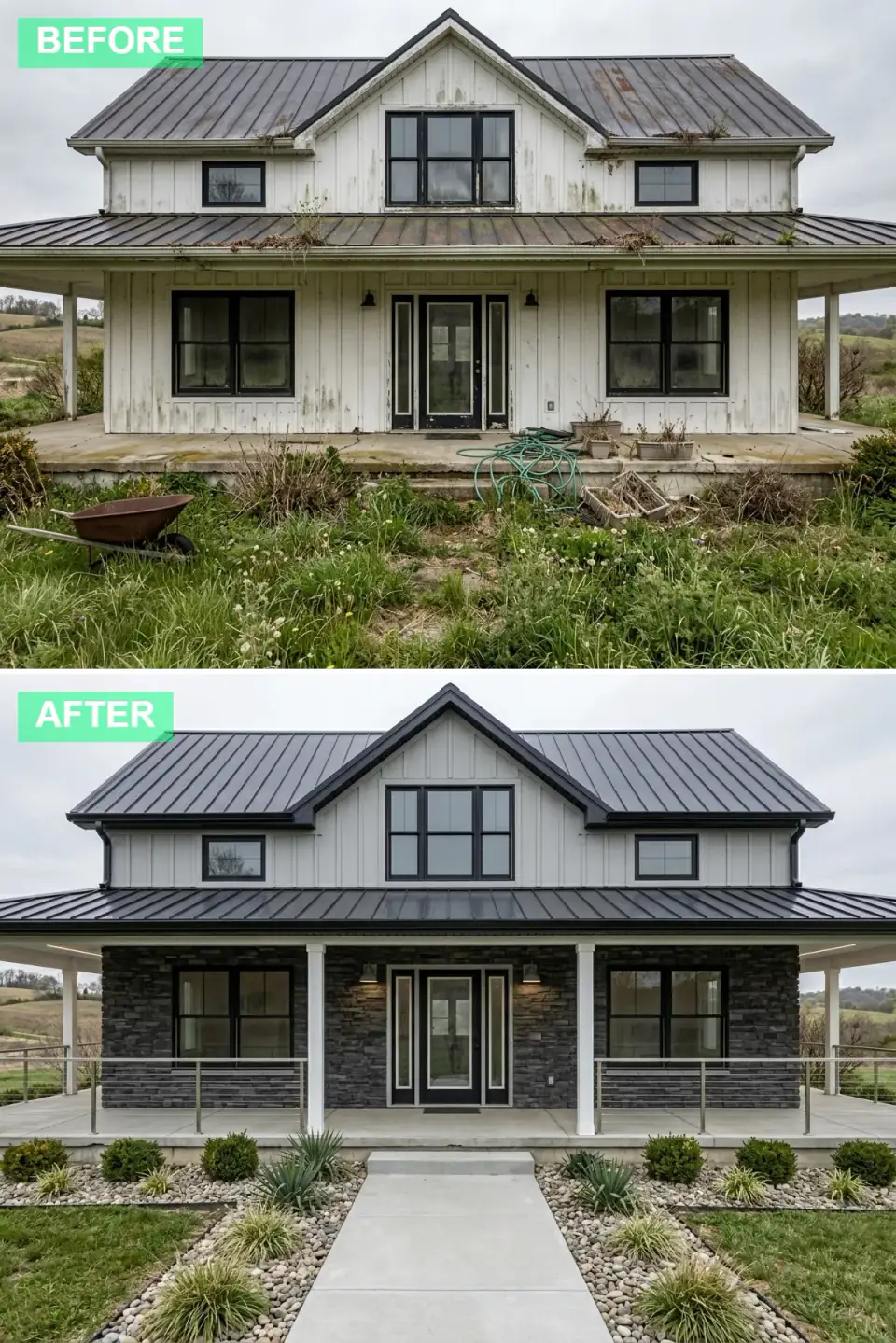
Rustic texture meets contemporary line. Dark stacked stone veneer wraps the lower walls and the full-height porch columns, light grey siding runs above, and a metal cable railing edges the concrete porch. The yard goes clean and low-maintenance — river stone, ornamental grasses, tidy shrubs. A confident, grounded close to the set.
The signature move — stone running full-height up the porch columns — is the most dramatic detail in all ten, and the most demanding. Veneering a full-height column means the column has to carry both the roof load and the dead weight of the stone, so this is a structural conversation, not a finish: the post and footing get sized for the added load before a single stone goes on. Done right, nothing says permanence like a full stone column. The dark-stone-against-light-grey contrast is also the most timeless of the modern reads here, and the river-stone yard is a genuinely smart Northeast choice — no mulch to refresh, no mowing, and it drains instead of heaving. A re-clad with a real structural stone premium.
Color Palette
Light Grey
#D0D0D0
A clean neutral grey that sets off the dark stone — Sherwin-Williams Repose Gray SW 7015.
Dark Stacked Stone
#4A4A4A
Charcoal stone for a solid rustic base — size columns for the added load.
Stainless Steel Cable
#A0A0A0
A sleek, unobtrusive modern railing.
River Stone
#88847B
Smooth ground-cover stone for a tidy, drains-not-heaves yard.
Pro Tips From the Renovation Designer's Chair
- Know whether you're painting or re-cladding. It's the single biggest cost fork on any façade and the photos hide it completely. If your existing siding is sound, lead with color and porch. If it's failing, you're in re-clad territory — price it honestly before you fall for a look.
- Spec for the climate, not the photo. Stucco, raw wood, and field-mixed dark paint all underperform in Northeast freeze-thaw. Fiber cement, metal, and factory finishes give you the same looks with a fraction of the upkeep.
- Flash the material transitions. Every place two materials meet — stone to siding, siding to trim, wall to porch roof — is a potential leak. Metal flashing and kickouts at these lines prevent the water intrusion that ruins a beautiful façade from behind.
- The porch is the soul of a farmhouse. Rebuilding the floor, posts, and railing changes curb appeal more than any wall color. Put footings below frost depth and use rot-resistant materials at grade.
- Layer your exterior lighting. Modern farmhouse sconces at the door, path lights along the walk, and uplighting on a feature tree turn a flat façade three-dimensional after dark — a cheap, high-impact final move.
- Match the landscaping to the maintenance you'll actually do. River stone and ornamental grasses stay tidy with near-zero effort; formal boxwood and annual beds want regular attention. Be honest about which homeowner you are.
Cost-Saving Moves
- Lead with paint where the siding's sound. A full exterior repaint in the 2026 Hudson Valley runs roughly $8,000–$18,000 depending on house size and prep — a fraction of a $40,000–$90,000-plus re-clad. If your envelope is healthy, color plus a porch refresh buys most of the transformation.
- Use fiber-cement woodgrain instead of real wood. Products like Hardie's cedar-texture line give you the Scandi or Craftsman wood look without the annual sealing, and they survive freeze-thaw that splits and greys natural cedar.
- Put stone only where it reads. Stone is the priciest material here. Concentrate it on the porch base, piers, or columns where the eye lands — wrapping a whole façade in veneer rarely earns its cost over a focused application.
- Carry 10–15% contingency on any re-clad. Tearing back an old farmhouse's siding almost always reveals rot, failed flashing, or knob-and-tube. Budget for the surprise up front so it's a line item, not a crisis.
Reader Questions on Farmhouse Exterior Makeovers
What does a farmhouse exterior makeover cost in the Northeast in 2026?
It depends entirely on whether you're painting or re-cladding. A full exterior repaint with proper prep runs roughly $8,000–$18,000 in the 2026 Hudson Valley for a typical farmhouse. A full re-clad in fiber cement lands around $40,000–$90,000, and adding real stone veneer, a rebuilt timber porch, or metal siding pushes it higher. Landscaping and hardscape are separate — a flagstone path and planting can add $10,000–$30,000. The honest move is to price the envelope decision first, because a paint-led makeover and a re-clad makeover that look identical in photos can differ by a factor of five.
Which siding material holds up best in a cold, wet climate?
Fiber cement (James Hardie, Boral) and metal are the two best performers for the Northeast. Both shrug off freeze-thaw, resist rot and insects, and hold a factory finish for decades. Fiber cement gives you board-and-batten, lap, and woodgrain looks with minimal upkeep; metal sheds snow and rain beautifully on modern and barn-style homes. Natural wood is gorgeous but high-maintenance and will silver unless you commit to regular sealing. Traditional three-coat stucco is the one I'd avoid up here — trapped moisture spalls it in freeze-thaw. Whatever you choose, the flashing and weather barrier behind it matter more than the material itself.
Are dark exterior colors a bad idea in the Northeast?
Not bad, but they ask for the right product. Dark colors absorb heat and fade faster on sun-hit south and west elevations, and field-mixed deep blacks and charcoals chalk and streak within a few seasons. The fix is a fade-resistant factory finish — Hardie's dark ColorPlus range, for example — engineered to hold pigment under UV. Dark siding also reads stunning against snow and warm wood accents, which is why the black-and-wood reads here work so well in a Northeast setting. So dark is absolutely viable; just buy a pre-finished fade-resistant product rather than mixing a deep color at the paint counter.
Where does water actually get into these mixed-material façades?
Almost always at the transitions, not in the middle of a wall. The stone-to-siding line, the spot where a porch roof meets the wall, and around windows and doors are the leak points — anywhere two materials or planes meet and the flashing was rushed. The single most common failure I see on farmhouse re-clads is a stone base meeting siding above with no metal cap flashing or kickout, so water sheets behind the veneer and rots the sheathing invisibly for years. Beautiful materials don't save you; correct flashing and a continuous weather-resistive barrier behind everything do.
Which of these ten reads adds the most resale value?
For broad resale, the classic white-and-black modern farmhouse (read nine) is the safest — it's exactly what the largest pool of buyers pictures, and it photographs well in a listing. The stone-and-grey contemporary (read ten) and the navy-and-white classic (read two) also resell strongly because they read as high-value and timeless. The bolder directions — corrugated metal, charcoal stucco, full natural wood — can absolutely add value, but to a narrower buyer pool, so they're better when you're renovating to live than renovating to flip. Match the read to your timeline: distinctive for a forever home, conventional for a near-term sale.
Can I phase a farmhouse exterior renovation to spread the cost?
Yes, and it's often the smart play. Paint and a porch rebuild deliver the biggest visible change for the least money, so lead with those. Stone veneer, a material upgrade, or a metal re-clad can follow in a later phase once you've lived with the house and budgeted. The one thing not to phase carelessly is anything behind the siding — if you're opening the envelope at all, get the flashing, weather barrier, and any rot repair done right the first time, because going back behind finished siding later costs far more than doing it once. Phase the cosmetics; never phase the waterproofing.
Where to Read Next
If this one-house-many-reads exercise is your thing, I run the same play on a different home in one house, ten destinies, and on a smaller scale in my cottage exterior makeover before-and-after styles. For more curb-appeal direction, see eleven transformations that redefine curb appeal, and browse the full exterior renovations archive for more before-and-afters read through the same plan-aware lens.
Sources & Further Reading
- James Hardie — fiber-cement siding specs and cold-climate performance.
- LP SmartSide — engineered-wood siding for northern climates.
- This Old House — siding, flashing, and exterior repair guides.
- Old House Journal — historic farmhouse exterior restoration.
- U.S. DOE Building America — weather-resistive barriers and rainscreen detailing.
- Brick Industry Association — brick paving base and freeze-thaw guidance.
- Architectural Digest — exterior color and curb-appeal direction.
- NAHB — 2026 remodeling cost and Cost vs. Value context.
- Benjamin Moore — exterior paint color references cited above.

Nora Whitfield
Renovation Designer & Interiors Editor · Beacon, New YorkNine years of design-build renovation work across the Hudson Valley and the Northeast. Nora runs the Renovations, Room Guides and Renovation Mind desks — before-and-after studies, room-by-room design guides, and the long essays on why what we renovate matters.
More from Nora →
Reader notes