

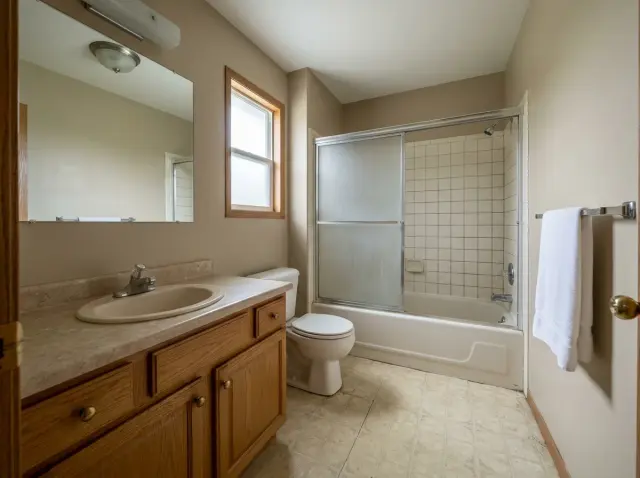
I'm Theo Caldwell, and bathrooms are where renovation lives or dies. Get the wet wall, the plumbing chase, and the ventilation right, and you can finish the room eight different ways without touching the framing. Get them wrong and you spend the next five years repairing what the original drafter never specified. The eight afters below run a single dated builder-grade bathroom — same footprint, same plumbing wall, same window opening — through eight different finish briefs. They're a useful study in how much character you can pull out of a tight envelope when the bones are correct.
How I Read a Bathroom Remodel
Three things are locked in a typical bathroom remodel: the wet wall (where the supply lines and drains run), the window opening, and the door. Almost everything else is finish. That's why a single bathroom can take eight different design directions without expanding the footprint — vanity carcass, countertop, sink type, mirror, lighting, shower enclosure, wall tile, floor tile, fixtures. Each one of those is a discrete decision you can sequence independently, which means a bathroom is the room most homeowners can actually phase through a renovation budget.
My standing rule across every bathroom I've walked in the Hudson Valley — and across every direction in our kitchens-and-baths archive — is to handle the envelope first and the styling last. Waterproofing membrane behind the tile, proper exhaust fan sized to the cubic-foot volume, GFCI placement, sub-floor flatness for large-format tile. Get those right at rough-in and any of the eight directions below works on the finished room. Get them wrong and the prettiest finish in the world fails within two years.
1. Moody Botanical Luxe — Deep Green and Brass
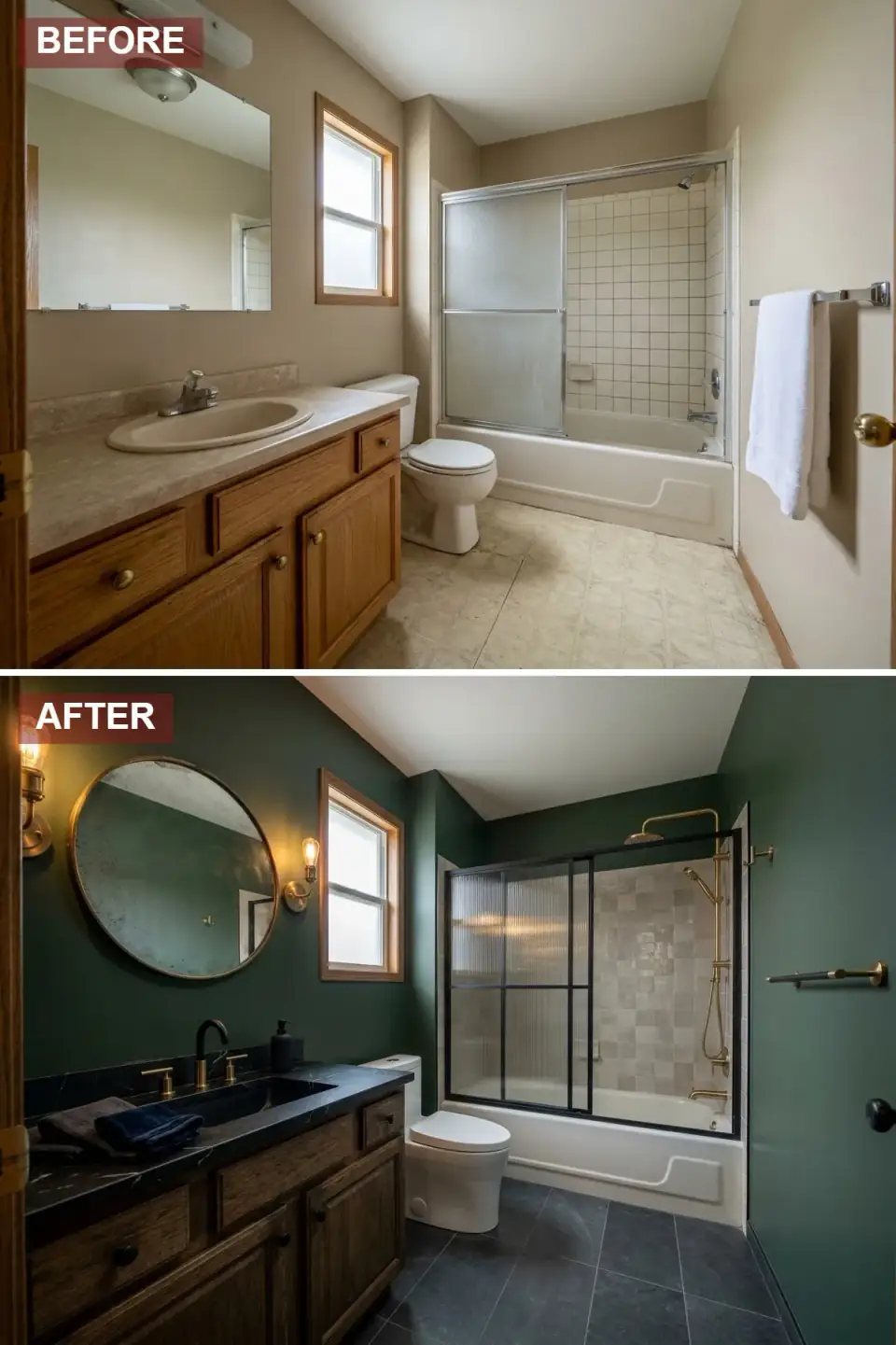
This transformation leans into dramatic contrast by enveloping the room in deep forest green walls that absorb the dated beige energy. The original oak vanity is refinished in a dark walnut stain and topped with a honed black stone countertop and undermount sink, replacing the pale builder-grade laminate. A round antiqued mirror flanked by brass Edison sconces supersedes the oversized rectangular mirror and basic vanity bar. The shower zone is upgraded with a black-framed ribbed glass sliding door and mixed marble shower tiles. Large-format charcoal slate floor tiles ground the room.
My verdict: this is the right move for the bathroom you don't get morning sun in. North-facing or interior bathrooms can absorb a deep saturated wall color like Benjamin Moore Hunter Green HC-145 or Farrow & Ball Studio Green No. 93 without reading as a cave; sun-flooded bathrooms read the same color as moody intent rather than mistake. Honed black soapstone or honed Nero Marquina marble is the right countertop call — polished surfaces in a dark scheme show water spots aggressively. Unlacquered brass (Waterworks Henry or Rocky Mountain Hardware) will patina honestly over the years, which is what you want in a moody room.
Color Palette
Forest Green
#1B3A2F
Deep saturated green walls — Benjamin Moore Hunter Green HC-145 or Farrow & Ball Studio Green No. 93 in matte enamel.
Charcoal Slate
#2C3539
Honed Nero Marquina marble or honed Vermont Black soapstone — never polished in a dark moody scheme.
Antiqued Brass
#C9A961
Unlacquered brass fixtures, mirror frame, and sconces — Waterworks Henry, Rocky Mountain Hardware, or Rejuvenation Greenwich.
Dark Walnut
#3E2723
Gel stain on existing oak millwork — General Finishes Java Gel Stain or Minwax PolyShades Mission Oak Satin.
2. Sun-Kissed Modern Organic — Warm Greige and Oak
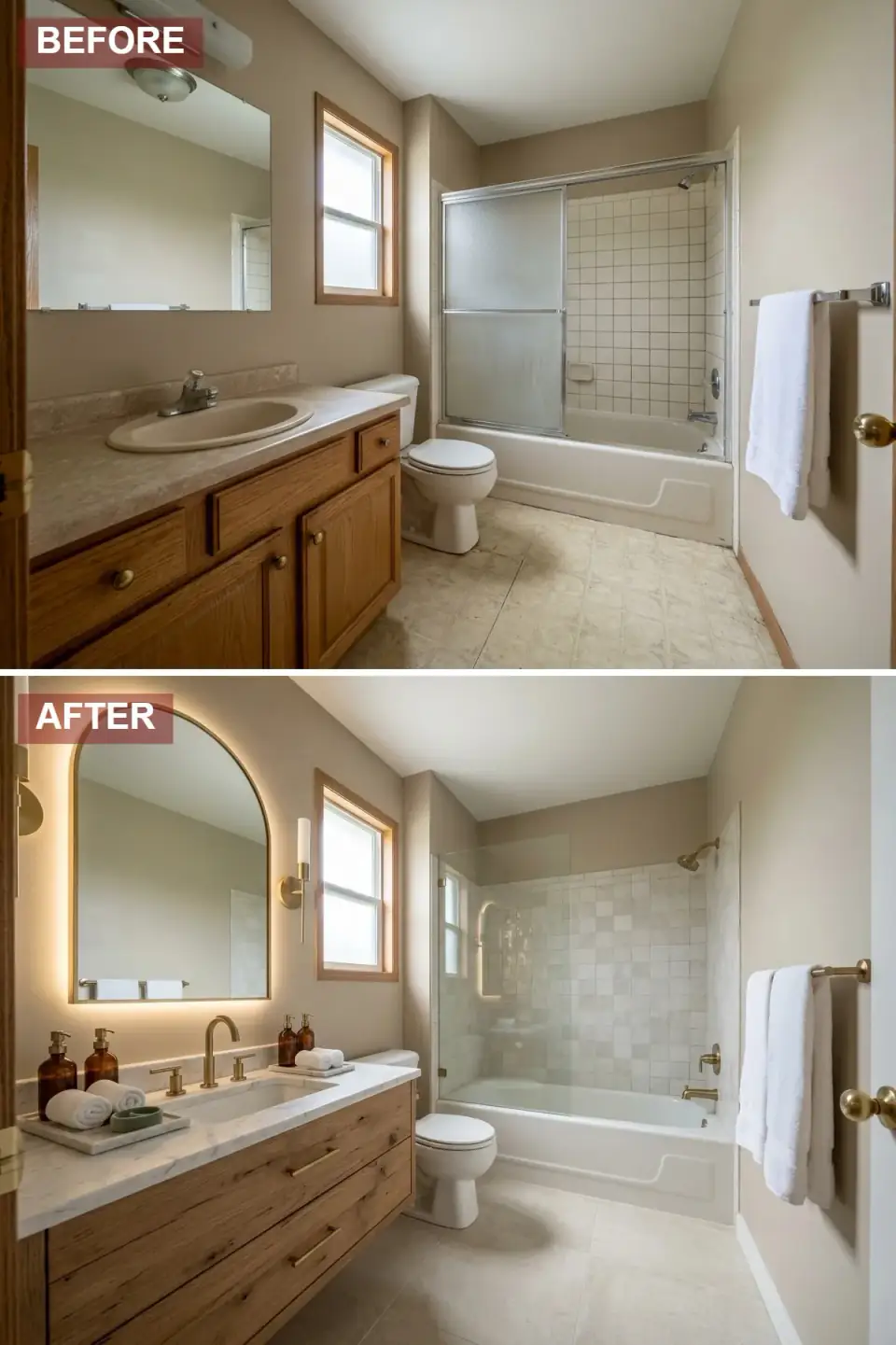
This iteration replaces the beige walls with a sophisticated greige plaster tone. The dated oak vanity is swapped for a light white-oak floating credenza with horizontal grain and clean drawer fronts, topped with thick Calacatta-look quartz and a rectangular undermount sink. An arched backlit LED mirror becomes the focal point, eliminating the need for the old strip light. The shower opens up with a single frameless glass panel revealing handmade zellige-inspired wall tiles; the floor uses large-format ivory limestone-look porcelain. Amber apothecary bottles and rolled Turkish towels provide curated spa styling.
My verdict: this is one of the highest-resale-impact directions on the list and the easiest to specify correctly. The greige walls (Benjamin Moore Edgecomb Gray HC-173 or Sherwin-Williams Accessible Beige SW 7036) handle any natural-light condition and don't date quickly. The floating white-oak vanity is where the spec sheet matters — a real Henrybuilt, Semihandmade Sandstone Slab on Ikea Sektion, or custom millwork from a local Hudson Valley shop will read correctly; big-box "oak look" laminate vanities give themselves away within a year. The backlit mirror needs a code-compliant GFCI plug behind it and a properly rated wet-area driver, which a competent electrician handles at rough-in for under $300. This direction pairs naturally with my deeper walkthrough of quiet luxury bathroom design.
Color Palette
Warm Greige
#C4B9B0
Smooth-trowel plaster or matte enamel — Benjamin Moore Edgecomb Gray HC-173 or Sherwin-Williams Accessible Beige SW 7036.
Natural Oak
#D4C4A8
Rift-sawn white oak with horizontal grain and Rubio Monocoat Natural finish — Henrybuilt or Semihandmade.
Calacatta Gold
#F5F5F0
Calacatta-look quartz — Caesarstone 5111 Statuario Nuvo or Cambria Brittanicca for the maintenance-easy substitute.
Brushed Brass
#BFA76F
Brushed brass fixtures and pulls — Vola HV3, Brizo Litze in Luxe Gold, or Schoolhouse Brushed Brass cabinet pulls.
3. Desert Wabi-Sabi Oasis — Limewash and Terrazzo
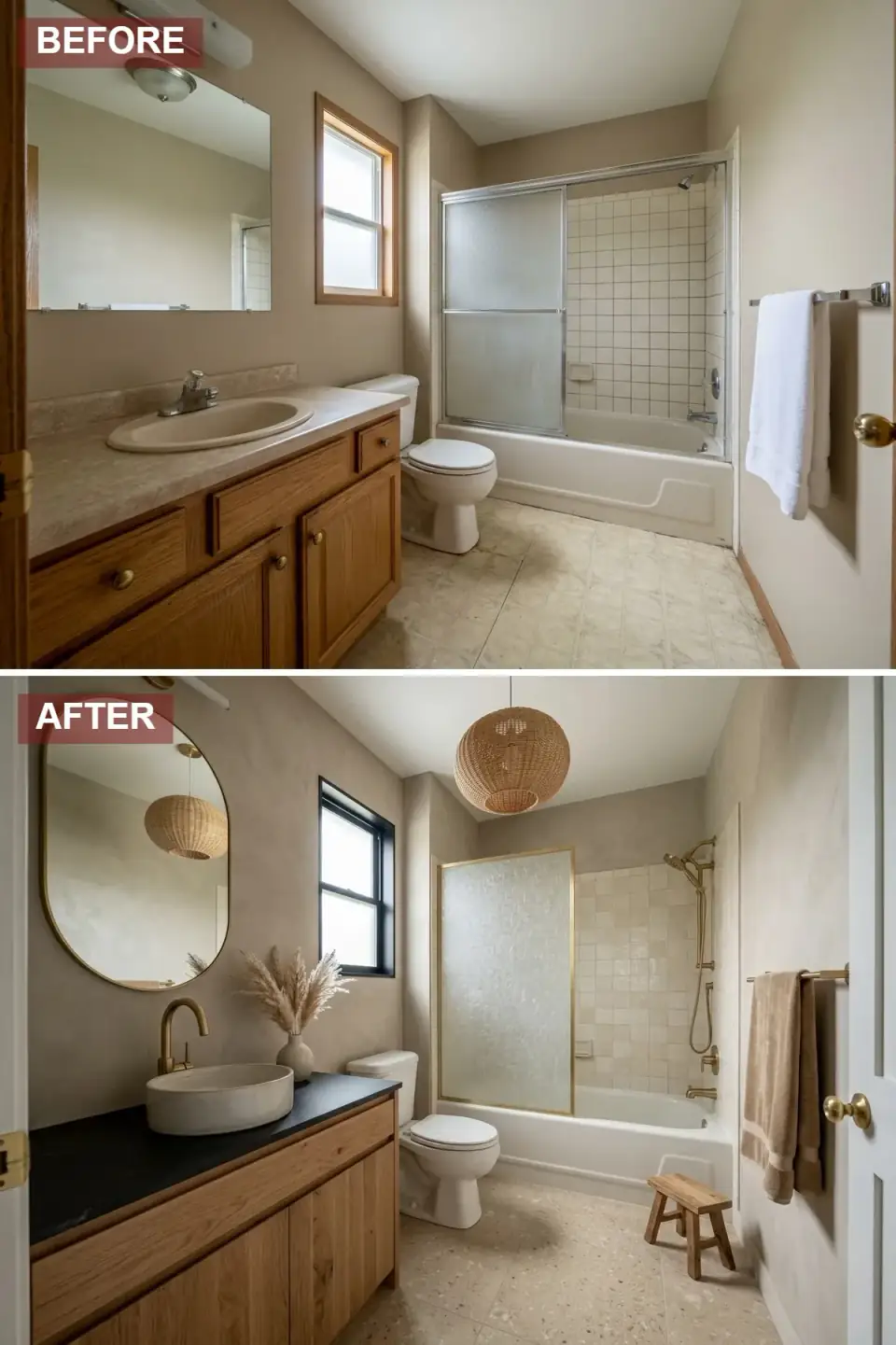
Here the bathroom is reinterpreted through an earthy Mediterranean lens. Walls are finished in matte limewash plaster in warm taupe, completely masking the former flat beige paint. The vanity is rebuilt in raw oak with a black soapstone top, supporting a round concrete vessel sink and a gooseneck brass faucet. An oversized arched mirror echoes the soft architecture, while a woven rattan globe pendant introduces organic overhead texture absent in the original flush mount. The shower receives a single frosted textured-glass panel in a brass frame, set against handmade ivory wall tiles. Underfoot, cream terrazzo tiles replace the dated squares.
My verdict: this is a beautiful direction for an interior bathroom but the substrate matters more than most homeowners realize. True mineral limewash (Romabio Classico Limewash, Bauwerk Lime Wash) breathes naturally and handles bathroom humidity if the exhaust fan is properly sized — minimum 80 CFM for a typical 5-by-9 builder bath, vented to outside, not into an attic. The concrete vessel sink looks beautiful but needs a sealer (Surecrete XS-PC9 or similar) reapplied every 18–24 months or the limescale wins. Terrazzo flooring (real terrazzo, not the printed-pattern porcelain) runs $35–55 per square foot installed; the porcelain alternative (Concept Studio Terrazzo from Crossville) runs $9–14 and is honestly indistinguishable underfoot.
Color Palette
Warm Taupe
#B8A89A
Mineral limewash — Romabio Classico Limewash in Riposo Beige or Bauwerk Sandstone.
Matte Black
#2F2F2F
Honed Vermont Black soapstone — naturally non-porous, ages with subtle character.
Terrazzo Cream
#E6E1D7
Real terrazzo or Crossville Concept Studio Terrazzo porcelain — both options listed above.
Aged Brass
#AA8C5C
Unlacquered brass on fixtures and shower frame — Waterworks Henry or Rocky Mountain Hardware, no clear coat.
4. Nordic Minimalist Bright — White and Bleached Oak
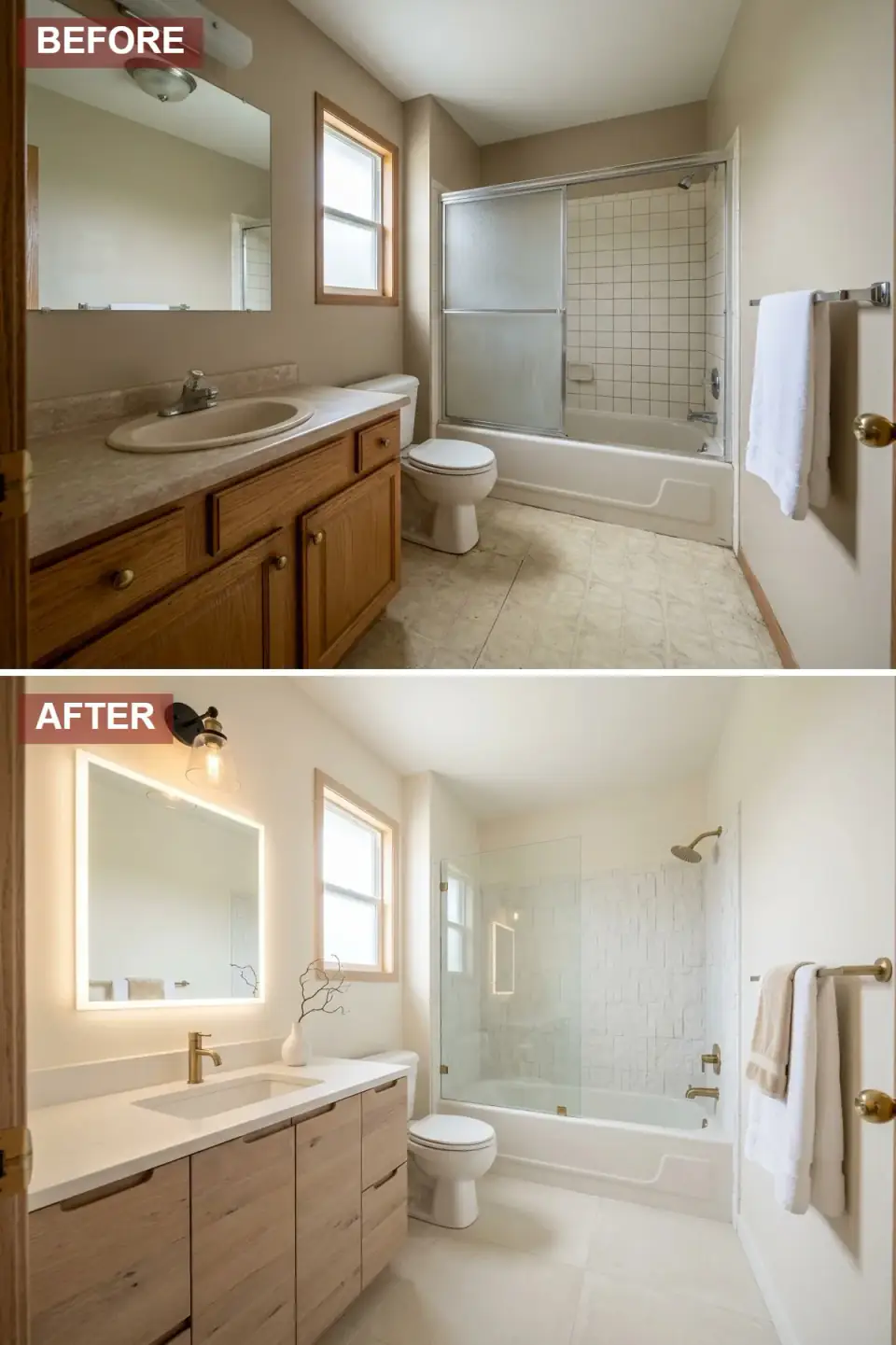
This concept pursues maximum luminosity by cloaking every surface in warm white and pale bleached oak. The original heavy vanity is exchanged for a flat-panel white-washed oak unit with integrated finger pulls, topped with crisp white quartz. A large rectangular mirror with perimeter LED backlighting replaces the old unframed version, paired with a single industrial-meets-refined sconce in black and brass. The shower opens behind a frameless clear glass panel, showcasing three-dimensional white geometric wall tiles that catch light and cast tiny shadows. Pale gray-tinged porcelain planks on the floor continue the cloud-like palette.
My verdict: this is the direction that demands the most natural light to read correctly. A north-facing bathroom or a windowless interior bath will read as flat and clinical in this palette, regardless of how good the fixtures are. If you have south- or east-facing window light, this direction maximizes it. The dimensional white tile (Heath Ceramics, Fireclay Tile, or Daltile's textured collections) is the move that prevents an all-white room from reading sterile — the variable shadow from each tile is what carries the character. Spec the grout color carefully: bright white grout looks crisp on day one and gray-yellow within two years; pick a slightly off-white (Mapei Avalanche or Pearl Gray) and the room ages honestly.
Color Palette
Pure White
#F7F5F0
Warm white wall enamel — Benjamin Moore White Dove OC-17 or Sherwin-Williams Alabaster SW 7008 in matte.
Bleached Oak
#E0D5C5
White-washed white oak — Rubio Monocoat Smoke 5% over rift-sawn oak, or Henrybuilt Smoked Oak.
Cloud Gray
#E8E8E8
Dimensional white shower tile — Heath Ceramics Dimensional, Fireclay Tile Mountain, or Daltile Folio.
Soft Brass
#C4B49A
Brushed champagne brass — Brizo Litze in Luxe Gold or Dornbracht Tara in champagne brass.
5. Deco Glam Revival — Emerald Marble and Brass
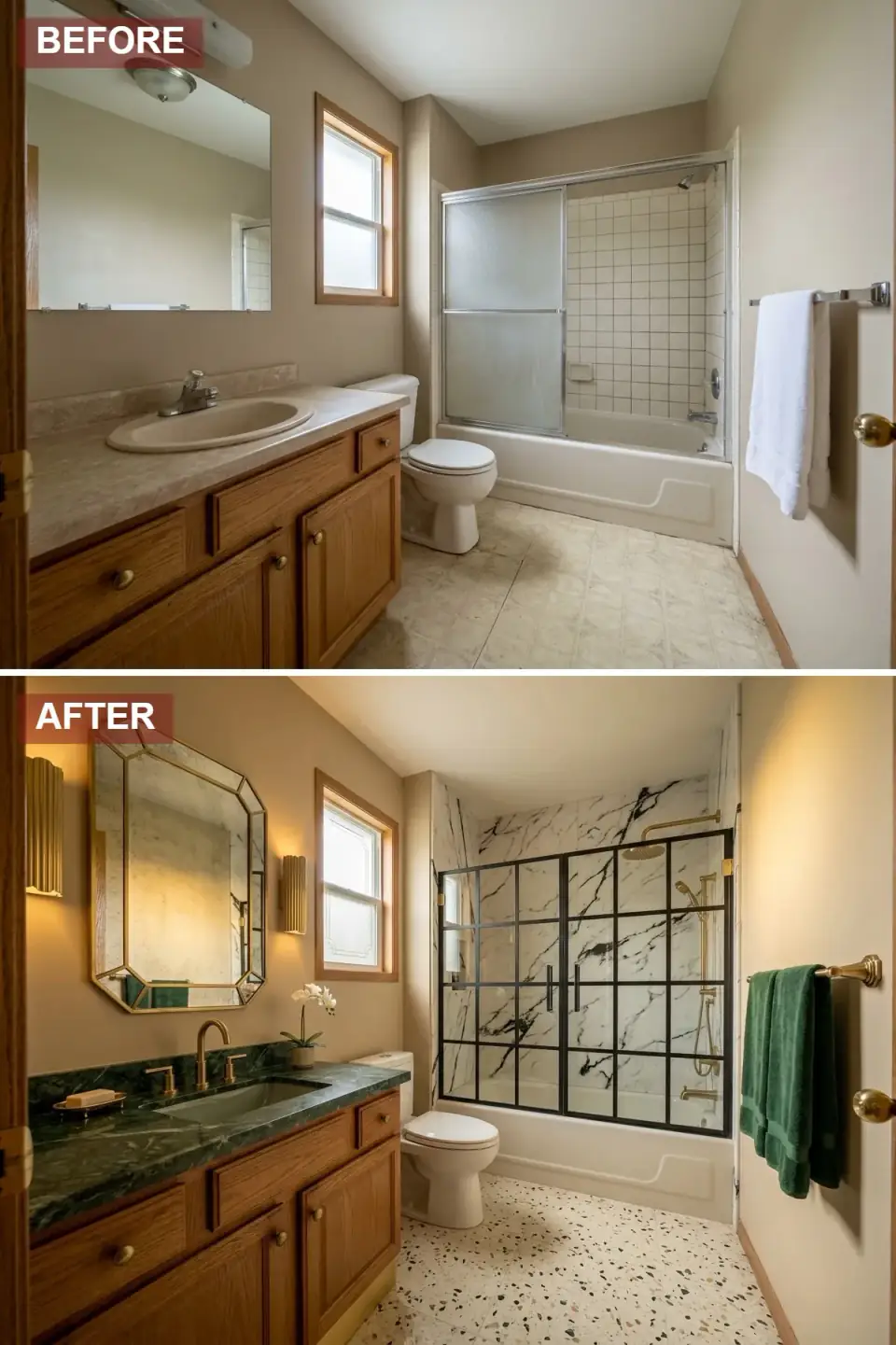
This transformation channels old Hollywood glamour by preserving the existing oak vanity carcass but upgrading it with a striking emerald-green marble countertop and brass knobs. Walls are warmed to a rich camel tan, banishing the previous flat beige. An octagonal antiqued mirror with beveled facets becomes the jewelry of the room, flanked by vertical reeded brass sconces. The shower is wrapped in high-contrast Calacatta Viola porcelain slabs and enclosed by a bold black factory-frame sliding door. Underfoot, graphic terrazzo with black and white chips ties the palette together.
My verdict: this is the cheapest of the eight transformations to execute correctly because it preserves the existing vanity carcass — and it's the one I most often recommend to Hudson Valley homeowners who are renovating a bathroom in a pre-war or interwar house where the bones already lean Deco. A real emerald-green marble slab (Verde Esmeralda, Verde Guatemala) runs $80–140 per square foot installed; a porcelain-printed slab alternative (Florim StoneTalk Verde or Maximum Verde Alpi) runs $30–50 and holds up better in a wet area. The black grid factory-frame shower door (Coastal Industries Paragon Industrial or VIGO Industrial-Style) is the single move that signals "Deco" hardest — pair it with the right tile and the rest of the room follows.
Color Palette
Emerald Marble
#2E4A3E
Verde Esmeralda or Verde Guatemala marble — or Florim StoneTalk Verde porcelain for wet-area durability.
Camel Tan
#C19A6B
Warm camel tan walls — Benjamin Moore Lenox Tan HC-44 or Farrow & Ball India Yellow No. 66.
Calacatta Viola
#F0EDE5
Bold-veined Calacatta Viola porcelain slab — Antolini Calacatta Viola or Florim Maximum Calacatta Viola.
Graphic Terrazzo
#EAE5D8
White-base terrazzo with black aggregate — real Vetrazzo or Crossville Concept Studio Terrazzo porcelain.
6. Coastal Cane Cottage — Caned Oak and Sea-Salt Tile
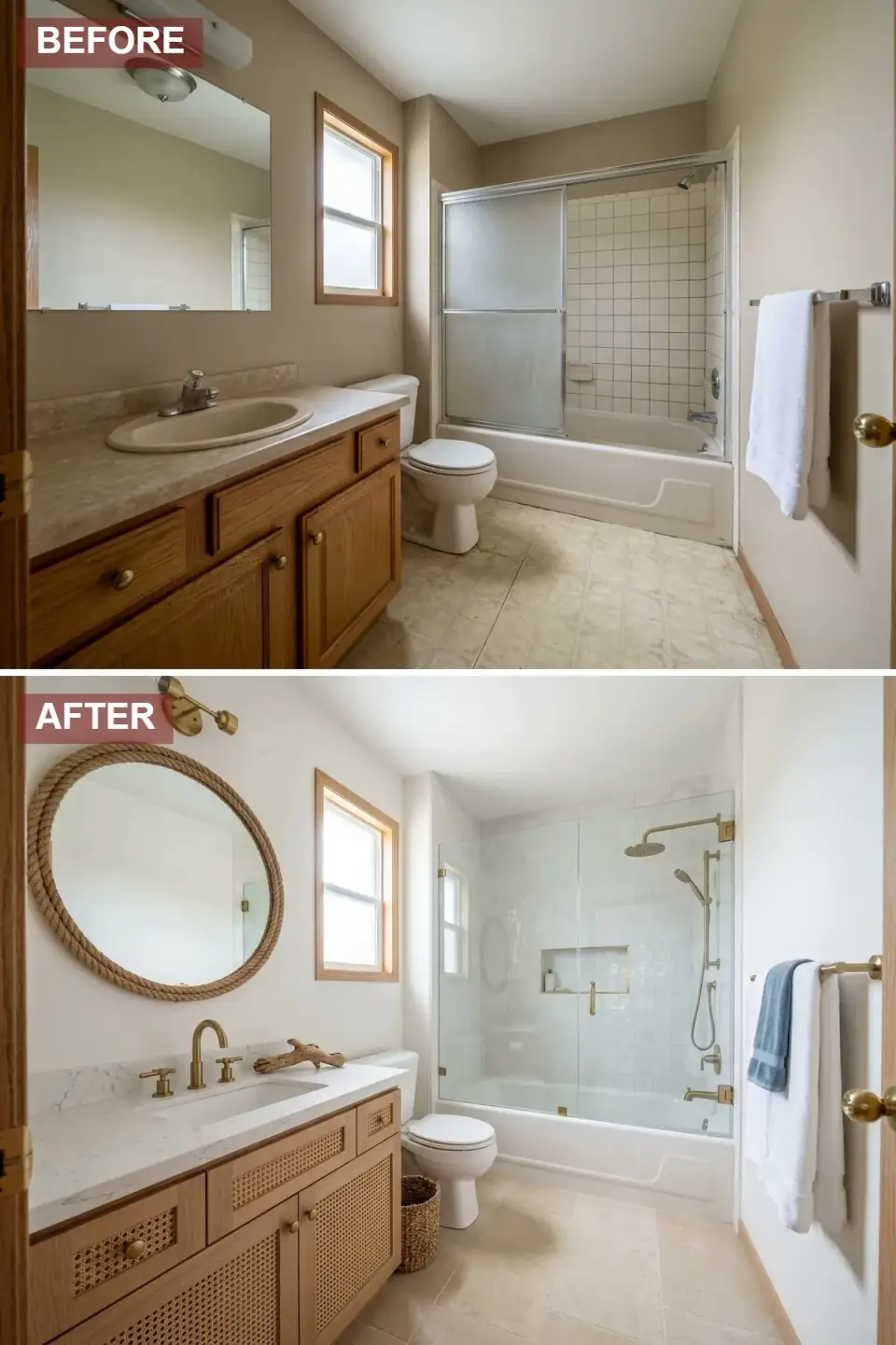
This airy reinterpretation evokes seaside tranquility through light tones and natural fiber. The dated vanity is replaced by a white-oak cabinet featuring caned rattan door fronts and brass knobs, topped with white marble. A round statement mirror wrapped in nautical rope hangs above, while a brass swing-arm sconce provides targeted task lighting. The shower is enclosed with a frameless glass door accented by brass hinges, revealing pale aqua-tinged glossy subway tiles and a brass-trimmed niche. Large-format limestone-look tiles warm the floor.
My verdict: this direction transfers well from its Cape Cod and Newport context to the Hudson Valley river towns — Beacon, Cold Spring, Hudson — where the architectural vocabulary overlaps. Cane on cabinet doors needs realistic expectation-setting: it ages, it can mildew in poorly ventilated bathrooms, and it doesn't love sponge cleanup. Spec the cane as removable inserts (Semihandmade and Reform both offer this) so you can replace a panel without rebuilding the door. The brass-trimmed shower niche is the highest-leverage detail in the room — Schluter-Kerdi-Board prefab niches with a brass Schluter Quadec edge profile run $200–350 installed and read as custom.
Color Palette
Driftwood Oak
#D9C9B6
Light oak stain on the vanity — Rubio Monocoat Pure or Osmo Polyx-Oil Raw on rift-sawn oak.
Natural Cane
#C8B89A
Open-weave rattan cane panel inserts — Semihandmade or Reform with replaceable spec.
Sea Salt
#E0E8E5
Pale aqua-green glossy subway tile — Heath Ceramics Coastal or Fireclay Tile Sea Salt.
Warm Brass
#C4A35A
Warm brass hardware — Newport Brass Astor or Kohler Purist in Vibrant Brushed Moderne Brass.
7. Industrial Rustic Loft — Concrete Trough and Reclaimed Wood
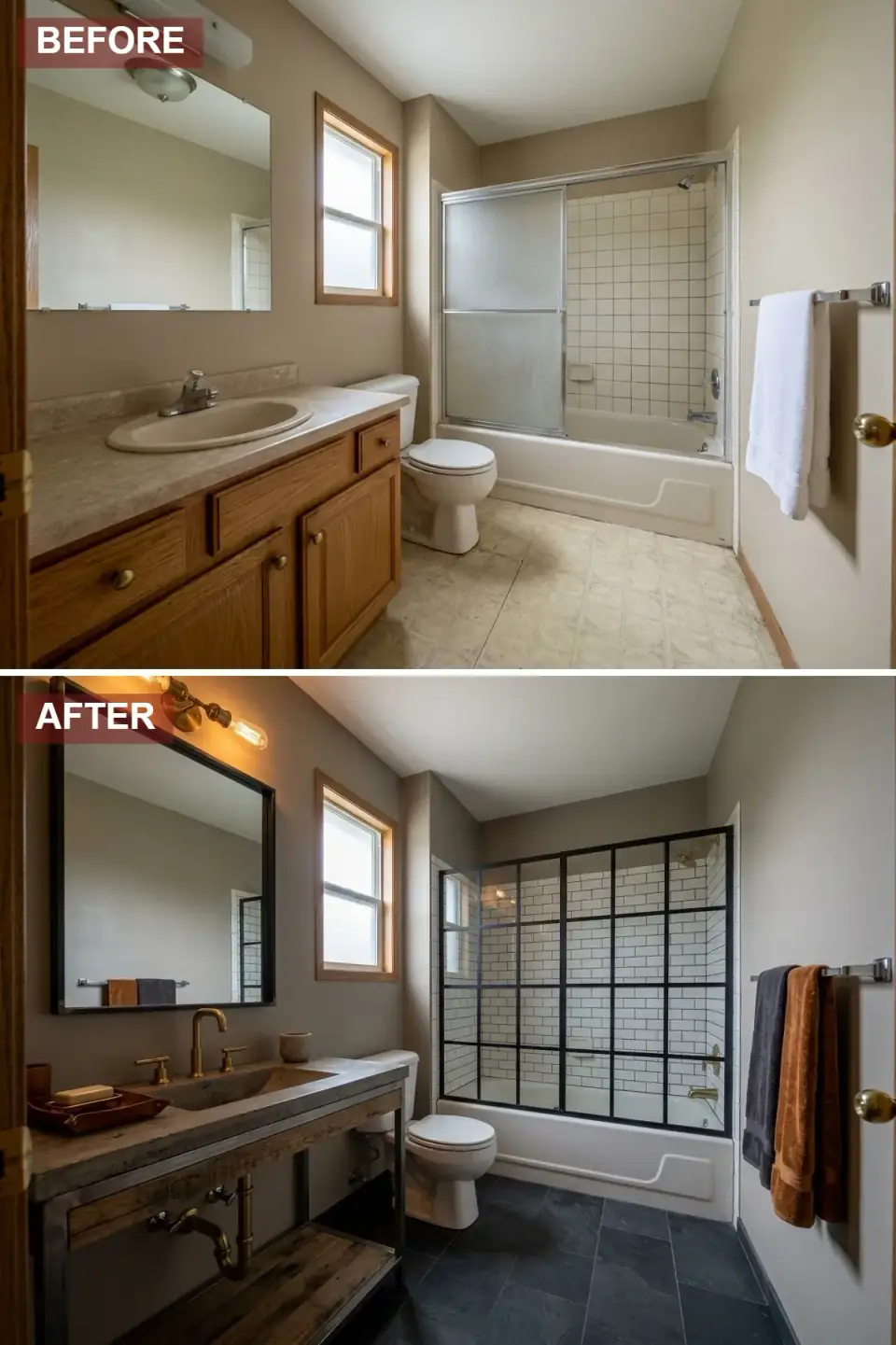
This conversion strips the bathroom down to its utilitarian essence with an industrial edge. Walls are painted a moody mid-tone gray, replacing the bland beige. The built-in vanity is removed entirely in favor of a reclaimed wood open-shelf console with a poured concrete integrated trough sink and exposed brass plumbing underneath, creating a freestanding furniture look. A matte black-framed rectangular mirror hangs above, lit by a vintage brass bare-bulb sconce. The shower features a black grid sliding door and classic white subway tile with dark grout. Large-format charcoal slate tiles on the floor absorb light, while terracotta accessories and rust-toned towels inject warmth.
My verdict: this is the direction with the most structural implications. A poured-in-place concrete trough sink is heavy — 200–400 pounds depending on size — and the supporting console needs to be engineered for the load. Reclaimed wood open shelving over open plumbing means the supply lines and trap are visible, so the plumber needs to install them with the same care as finished trim work (Brizo Litze polished brass supplies, Brasstech P-trap, no exposed PEX). The exposed plumbing also means every shut-off is on display — spec quarter-turn brass valves, not the standard chrome multi-turn ones the plumber will default to. Budget $1,200–2,400 for the exposed-plumbing premium.
Color Palette
Weathered Gray
#8E8C84
Mid-tone warm gray walls — Benjamin Moore Coventry Gray HC-169 or Sherwin-Williams Mindful Gray SW 7016.
Cast Concrete
#9E9E9E
Poured-in-place concrete trough — Concreteworks, Get Real Surfaces, or local Hudson Valley concrete fabricator.
Charcoal Slate
#3A3A3A
Honed natural slate or charcoal porcelain — Daltile Forge in Anthracite or Crossville Buenos Aires.
Burnished Brass
#A67B3D
Aged brass on exposed pipes and fixtures — Watermark Designs Lillian or Sun Valley Bronze in burnished brass.
8. Mediterranean Sun Retreat — Terracotta and Arched Brass
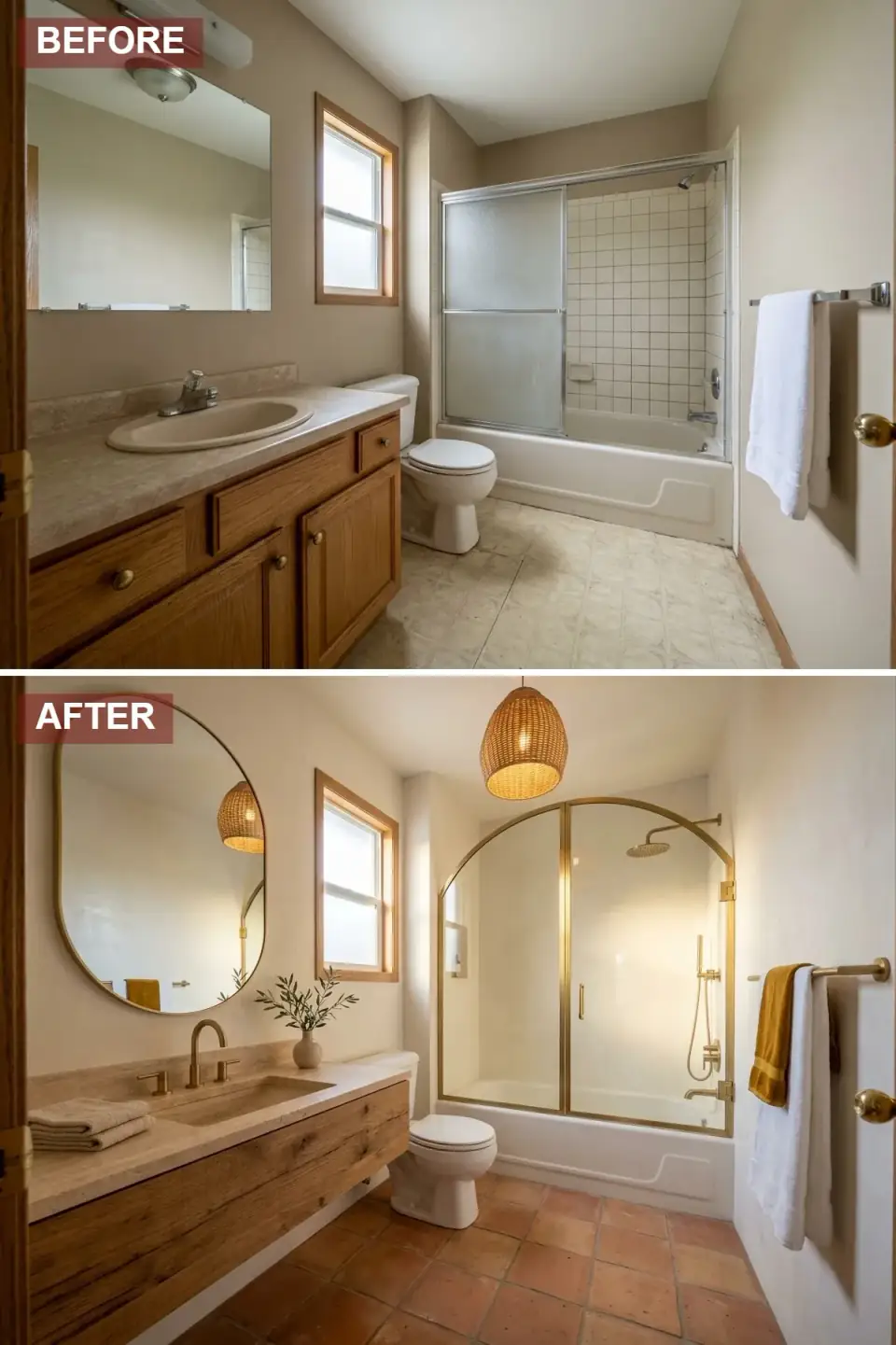
This design transports the bathroom to the coast of Spain or Italy with sun-baked materials and arches. Walls are kept a warm alabaster white, but the floor is dramatically changed to hand-formed terracotta tiles that radiate heat and heritage. The vanity becomes a floating raw oak plank with an integrated stone ramp sink, paired with a brass gooseneck faucet. An oversized organic round mirror with a thin brass rim reflects a woven rattan pendant light that replaces the original overhead fixture. The shower is the architectural star: an arched brass-framed sliding door that mirrors the window arch.
My verdict: real terracotta floor tiles (Saltillo, French Tomette, or Italian cotto) are gorgeous and require a real maintenance commitment — sealing every 18–24 months with a penetrating sealer (Miracle 511, Aqua Mix Sealer's Choice Gold), and accepting that the surface will patina with use. They're cool underfoot in summer and cold in winter unless paired with electric radiant heat (Schluter Ditra-Heat or Warmly Yours) installed at rough-in. The arched brass shower door is the structural challenge — a true arched door is custom fabrication ($3,500–6,500) but a square brass-frame door (Coastal Industries Legend or Vigo Industrial) with a stained-glass-style arched transom retrofit reads almost identical for under $2,000. The architectural impulse here is exactly what I covered in my biophilic bathroom guide on material-driven sanctuaries.
Color Palette
Aged Terracotta
#C66B3A
Hand-formed terracotta tile — Saltillo, French Tomette, or Italian cotto with penetrating sealer.
Alabaster White
#F2EFE9
Creamy white wall enamel — Benjamin Moore Swiss Coffee OC-45 or Farrow & Ball Pointing No. 2003.
Raw Oak
#C19A6B
Unfinished or oiled raw oak plank — Rubio Monocoat Pure or Osmo Polyx-Oil Raw, no stain.
Burnished Gold
#C5A059
Burnished brass on shower frame and mirror — Watermark Lillian or Brizo Litze in Luxe Gold.
Pro Tips From the Renovation Designer's Chair
- Handle the envelope before the finish. Waterproofing membrane (Schluter-Kerdi or Hydroban), correctly sized exhaust fan, GFCI placement, and sub-floor flatness for large-format tile. Get these right at rough-in and any of the eight directions works.
- Pick one accent metal and repeat it three times minimum. Faucet, mirror frame, sconce, towel bar, shower door, niche edge. A single hardware story is what separates a finished bathroom from a Pinterest collage.
- Honed beats polished in a wet area. Polished stone shows every water spot. Honed reads richer, hides spotting, and feels appropriate to bathroom function.
- Light the face, not the ceiling. Sconces at 60–66 inches above finished floor flanking the mirror eliminate shadows on the face. Overhead-only lighting makes everyone look ten years older every morning.
- Match grout to tile color, not contrast. Bright white grout on white tile turns gray-yellow within two years. Off-white tile gets off-white grout (Mapei Avalanche or Pearl Gray); dark tile gets dark grout (Mapei Charcoal).
- Size the exhaust fan for the volume, not the square footage. Builder defaults are 50 CFM; a real exhaust in a 5×9×8 bathroom wants 80–100 CFM, vented outside, on a timer or humidity sensor. Bad ventilation kills the most beautiful finish within five years.
Reader Questions on Bathroom Transformations
What does a full bathroom remodel cost in 2026?
For a typical 5-by-9 Hudson Valley builder bathroom, a full remodel that keeps the existing footprint runs $28,000–$58,000 turnkey. The variables are tile (porcelain at $9/sq ft versus real natural stone at $40–80/sq ft installed), vanity (Ikea Sektion at $1,200 versus Henrybuilt at $9,000), fixtures (Moen at $400 versus Waterworks at $2,800 for the same trim), and shower enclosure (frameless glass at $1,800 versus custom brass-frame at $4,500). Moving the wet wall or relocating plumbing adds $4,000–10,000 and pushes the project past the simple-finish category into structural renovation.
Which transformation has the best ROI at resale?
In the Hudson Valley and Northeast suburban market, the Sun-Kissed Modern Organic (Section 2) and Nordic Minimalist Bright (Section 4) carry the strongest appraisal return — both are inside the current buyer-preference window and signal contemporary upkeep without polarizing tastes. The Moody Botanical and Deco Glam directions have stronger emotional appeal to a narrower buyer pool and can take longer to sell in suburban markets. The 2025 Remodeling Magazine Cost vs. Value Report shows midrange bathroom remodels in the Middle Atlantic region returning 64–72 percent of cost at resale, with upscale remodels returning 55–62 percent.
Can I keep the existing vanity and just refinish it?
Yes, and it's the single highest-value cost-saving move in a bathroom remodel. A solid-wood vanity carcass (oak, maple, cherry) takes a gel stain or a hardwax oil refinish well — General Finishes Java Gel Stain, Minwax PolyShades, or Rubio Monocoat over a clean substrate. A solid-wood carcass with new hardware, new countertop, and new sink is a $1,200–2,500 refresh that mimics a $6,000–10,000 vanity replacement. The exception is laminate or particleboard vanities — those don't refinish and should be replaced. Take a drawer out and check the construction before committing to a refinish path.
How long does a bathroom remodel actually take?
A focused finish-only remodel (no plumbing relocation, no electrical relocation) runs three to five weeks with a competent crew. A full gut-and-remodel with tile shower replacement runs six to nine weeks. Adding plumbing relocation or moving the wet wall pushes to ten to fourteen weeks. The bottleneck is almost always tile installation — a quality tile setter installs roughly 50–80 square feet per day, so a shower with 120 square feet of wall tile and 35 square feet of floor tile takes three to four days of tile labor alone, plus a 48-hour grout cure before sealing. Plan for one entire day of contractor presence per $1,500–2,500 of project cost.
Do I need permits for a bathroom remodel?
In most Hudson Valley townships, a like-for-like finish remodel (tile, vanity, fixtures, no plumbing relocation, no electrical changes) is permit-exempt as a "decorative" change. Any plumbing relocation, any new electrical circuit, any new GFCI placement, any addition of a fan circuit, or any wet-wall modification triggers a building permit and likely a plumbing and electrical permit as well. New GFCI outlets are code-required within six feet of every sink and shower opening. When in doubt, call the township building department — a $50 phone call before signing the contract saves an $8,000 stop-work order mid-project.
How do I pick a direction if I can't decide?
Three filters. First, natural light: a north-facing or windowless bathroom rules out the bright Nordic and Coastal directions and points toward the moodier options (Section 1, 5, or 7). Second, maintenance bandwidth: cane (Section 6), concrete (Section 7), terracotta (Section 8), and limewash (Section 3) all require ongoing maintenance most homeowners under-budget for. Third, the rest of your house: a bathroom that contradicts the rest of the home's design vocabulary reads as a renovation rather than a home. Pick the direction that's continuous with what's outside the bathroom door, and the room will age better than any standalone style decision.
Where to Read Next
For more bathroom case studies in the same lane, the kitchens-and-baths archive collects every renovation we've reviewed on the site. Two close companions to this piece: my quiet luxury bathroom design walkthrough covers the restrained-finish direction in much more depth, and the rise of earthy tones and travertine is exactly the lens that drives Sections 2 and 3 above.
Sources & Further Reading
- Remodeling Magazine, 2025 Cost vs. Value Report — Middle Atlantic Region, Bathroom Remodels — remodeling.hw.net.
- Schluter Systems, Kerdi Waterproofing & Tile Substrate Installation Manual — schluter.com.
- National Kitchen & Bath Association, NKBA Bathroom Planning Guidelines with Access Standards — nkba.org.
- Romabio Paints, Classico Limewash for Interior Bathroom Application — romabio.com.
- Rubio Monocoat USA, Hardwax Oil for Bathroom Vanity Finishes — rubiomonocoatusa.com.
- Marble Institute of America, Care & Maintenance of Honed Stone Surfaces — naturalstoneinstitute.org.
- Heath Ceramics, Dimensional Tile Specifications — heathceramics.com.
- This Old House, The Real Cost of a Bathroom Remodel in 2026 — thisoldhouse.com.
- U.S. Department of Energy, Bathroom Exhaust Ventilation Best Practices — energy.gov.
- Architectural Digest, Trends in Modern Bathroom Material Selection — architecturaldigest.com.

Nora Whitfield
Renovation Designer & Interiors Editor · Beacon, New YorkNine years of design-build renovation work across the Hudson Valley and the Northeast. Nora runs the Renovations, Room Guides and Renovation Mind desks — before-and-after studies, room-by-room design guides, and the long essays on why what we renovate matters.
More from Nora →
Reader notes