
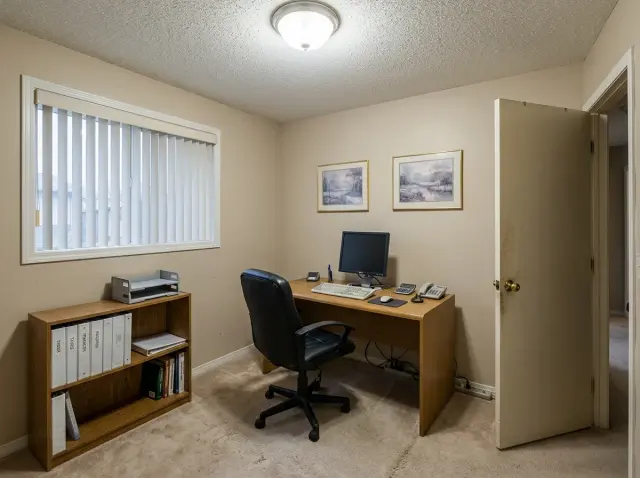
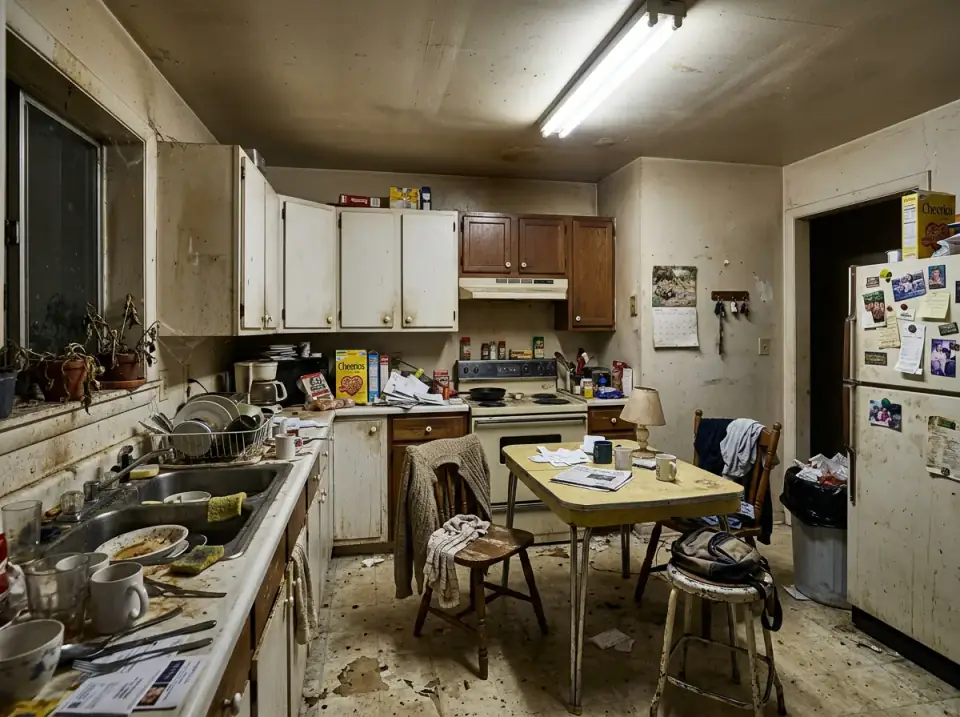
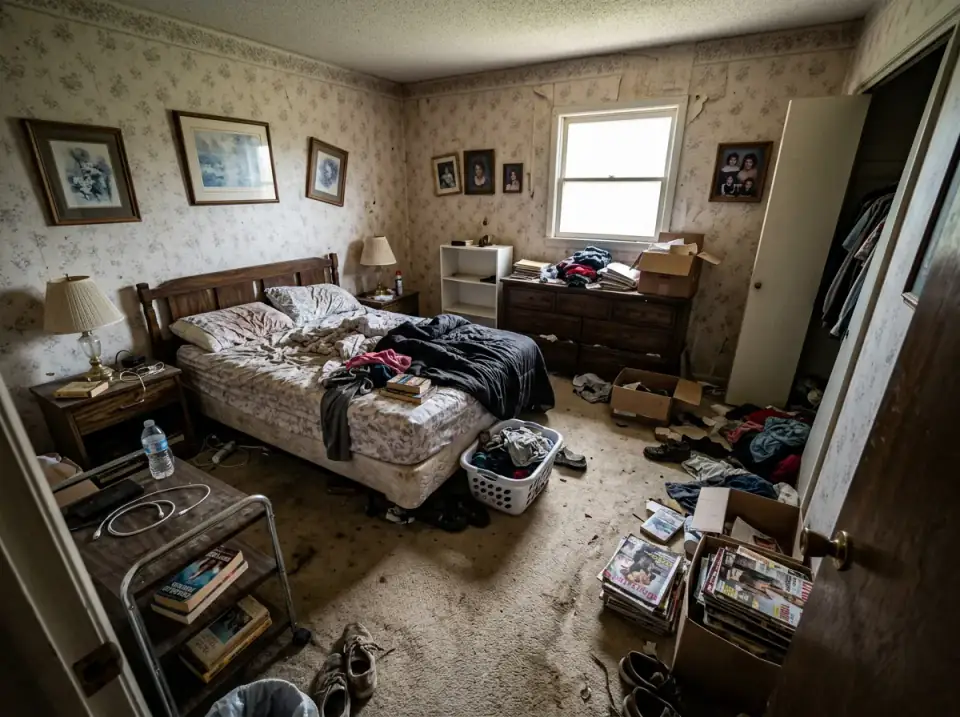
Pre-2020 it was a spare bedroom with a desk shoved against a wall. Post-pandemic it's a legitimate program element — clients ask for it before they ask for the dining room. The six afters below take one tired beige office and rerun it through six different briefs. Same window, same outlet locations, same closet door. What changes is wall color, lighting, floor, desk, chair, and shelving. Six versions of the same shell — six different versions of the work life it supports.
How to Assess a Home Office Reinvention
A home office is the cheapest renovation in the house — and the easiest to get wrong. The expensive moves (knock down a wall, add a window, upgrade the electrical panel) almost never apply; the impactful moves (paint, lighting, flooring, one statement chair) are all in the finish budget. Eight-hour video-call days want different lighting than a writer's desk; a designer's office needs a layout table that a financial planner's never does; a back-to-back Zoom job demands acoustic treatment that a deep-focus reader can skip.
Six reinventions on one room isolates the decisions — same shell, six different work lives, and the only difference is the brief.
All six afters share the same window, ceiling height, closet door, and outlet locations. The transformation lives entirely in paint, lighting, flooring, and furnishings — a single-season, contractor-light project that runs $4,000–$22,000 depending on how far you take the finishes.
Mid-Century Modern renovation
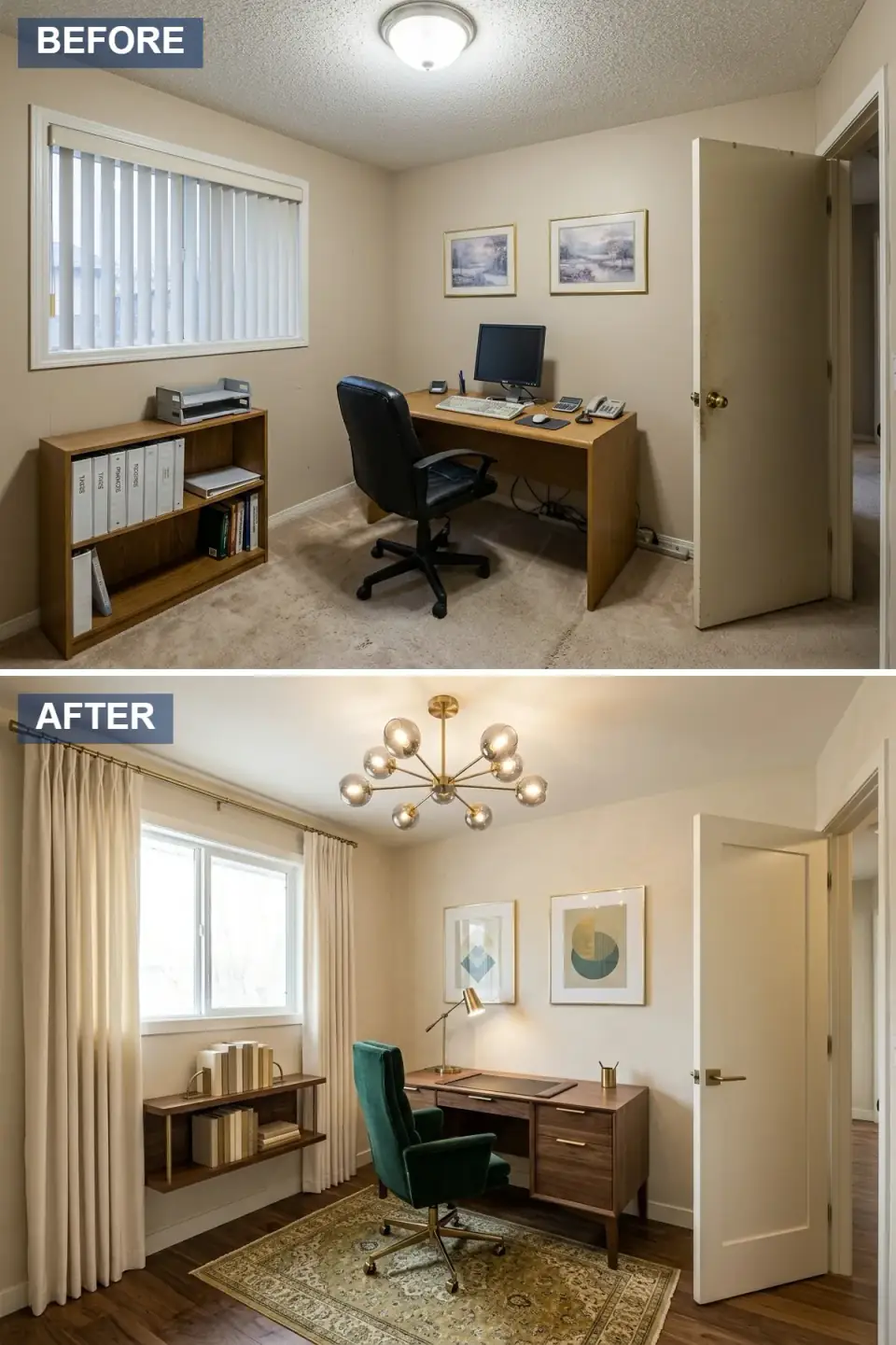
This transformation sheds decades of beige blandness by introducing warm walnut tones, brass accents, and a sculptural sputnik chandelier in place of the old flush mount. Vertical blinds are swapped for flowing ivory drapery that frames the window, while floating wood shelves replace the bulky bookcase with a considered book display. A rich emerald velvet chair replaces the tired black leather seat, anchored by a vintage-inspired rug, and geometric art supplants the dated landscapes. Popcorn ceiling and carpet are gone, replaced by smooth drywall and hardwood floors, with every metal finish singing in brass.
The highest-leverage moves here are the sputnik chandelier and the popcorn-ceiling removal. A West Elm Mobile Chandelier or Sazerac Stitches sputnik fixture in burnished brass ($380–$1,200) makes the room read mid-century before any furniture arrives. Popcorn-ceiling removal is messy ($2.50–$4.50 per square foot in the Northeast project, including testing for asbestos on anything installed before 1980) but it's the single move that strips off the most "1985" from any office. The walnut shelving wants real solid wood, not veneered MDF — Floating Shelves from Etsy custom builders or solid black walnut from the Northeast millwork shop runs $40–80 per linear foot installed and never sags.
Sequencing note. Remove popcorn ceiling and install the new fixture box before painting. Working a fixture install around finished walls adds a half-day of cut-in repaint labor.
Quiet Luxury in Warm Minimalism
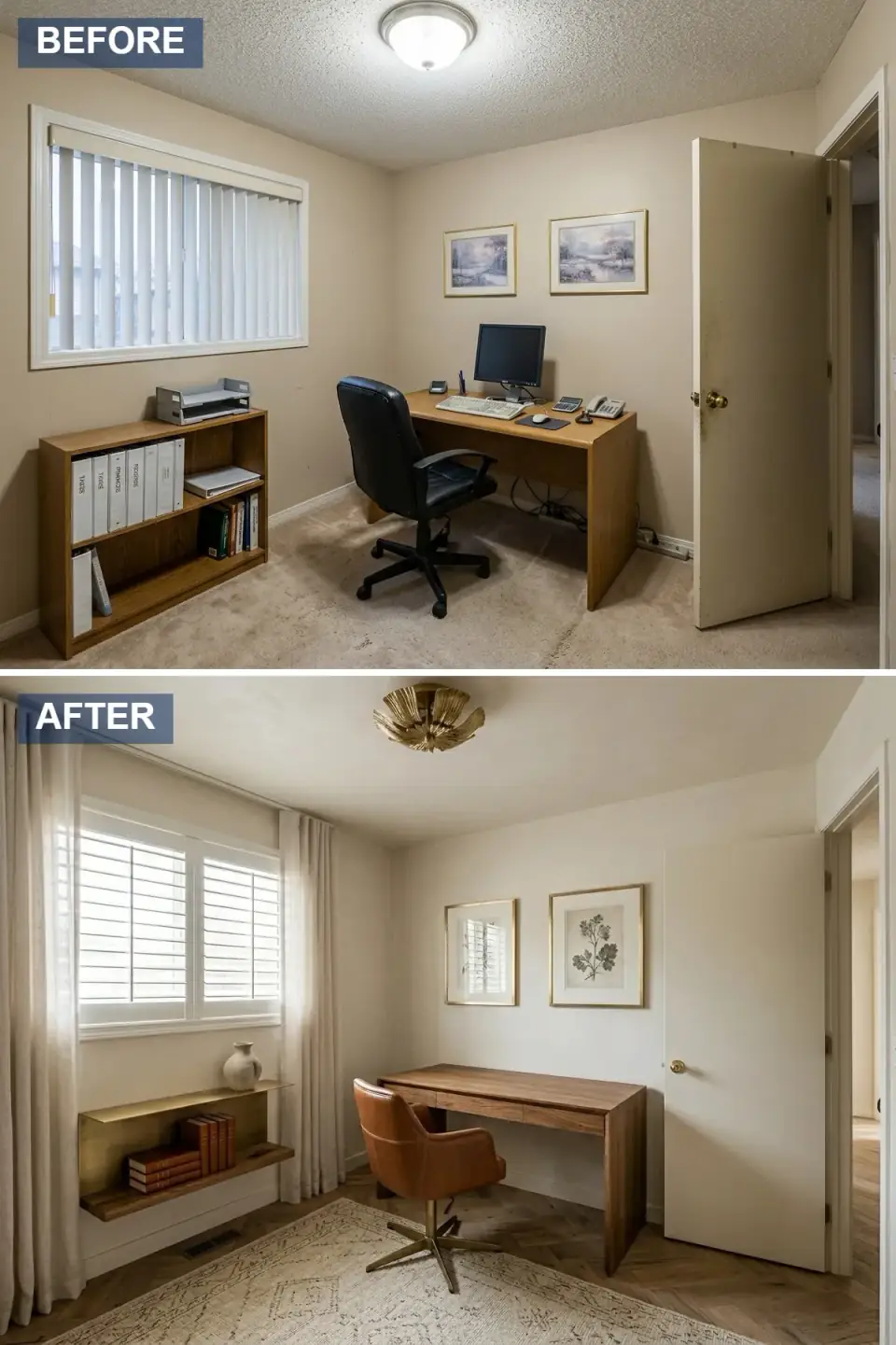
Where the before offered beige walls and basic shelving, this iteration introduces understated elegance through a restrained palette of cognac, walnut, and burnished brass. Plantation shutters paired with sheer curtains replace the dated vertical blinds, while a low-profile brass wall shelf creates an airy alternative to the bulky bookcase. The clunky computer desk gives way to a clean walnut slab, paired with a sculptural leather chair. Herringbone floors replace wall-to-wall carpet, and tonal botanical art swaps the old landscapes for organic softness.
The plantation shutters are the structural move — Hunter Douglas Heritance hardwood shutters run $32–48 per square foot installed, last decades, and signal a fully finished room from the moment a buyer walks in. The cognac leather chair (Article Sven Charme, Burrow Range, or a vintage Eames refurb from the Northeast dealers) is the second-highest-leverage piece.
Scandinavian-Japandi Serenity
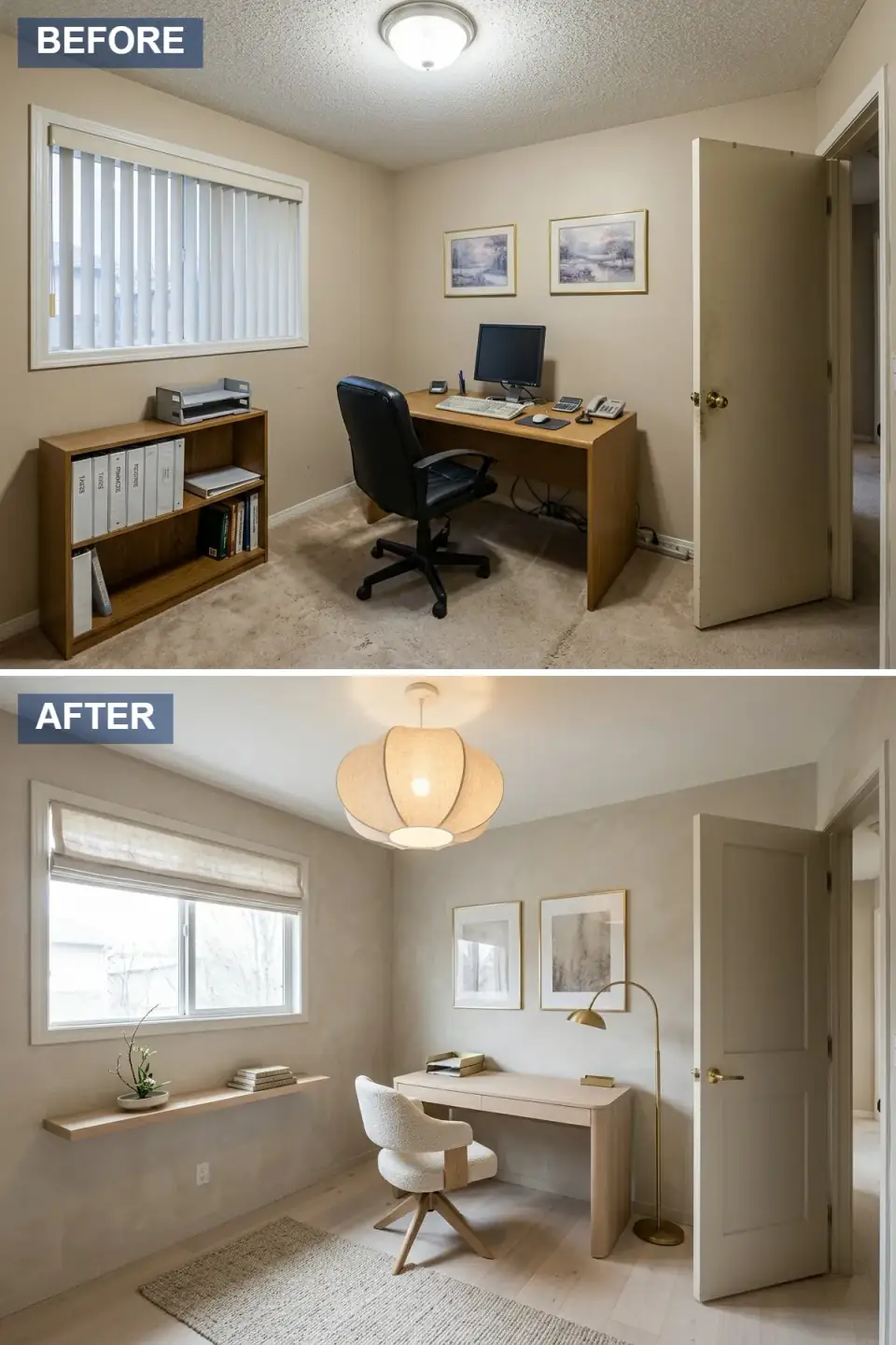
Leaving behind the beige carpet and popcorn ceiling, this retreat embraces Japandi principles of softness and restraint. A sculptural linen pendant replaces the flush dome light, while a pale oak desk and floating shelf introduce Scandinavian clarity against a clay-like wall finish. The black leather chair is swapped for an inviting boucle seat, and the cluttered bookshelf is edited down to a single stem and a few volumes. An arc floor lamp adds brass punctuation without desktop clutter, and a neutral rug keeps the blonde wood flooring feeling warm underfoot.
The lime-plaster or limewash wall finish (Bauwerk Lime Wash, Romabio Classico) gives the room subtle textural variation that reads quiet under long working hours, where flat paint reads sterile. The boucle chair is genuinely comfortable for two-to-three-hour sittings but not for an eight-hour video-call day — pair it with a good task chair (Herman Miller Aeron or Steelcase Leap) in the corner if your work demands ergonomic precision. The arc floor lamp (Schoolhouse Cedar & Moss or Hay PC Portable) saves the desk surface from a task lamp and reads sculptural.
Moody Traditional Library
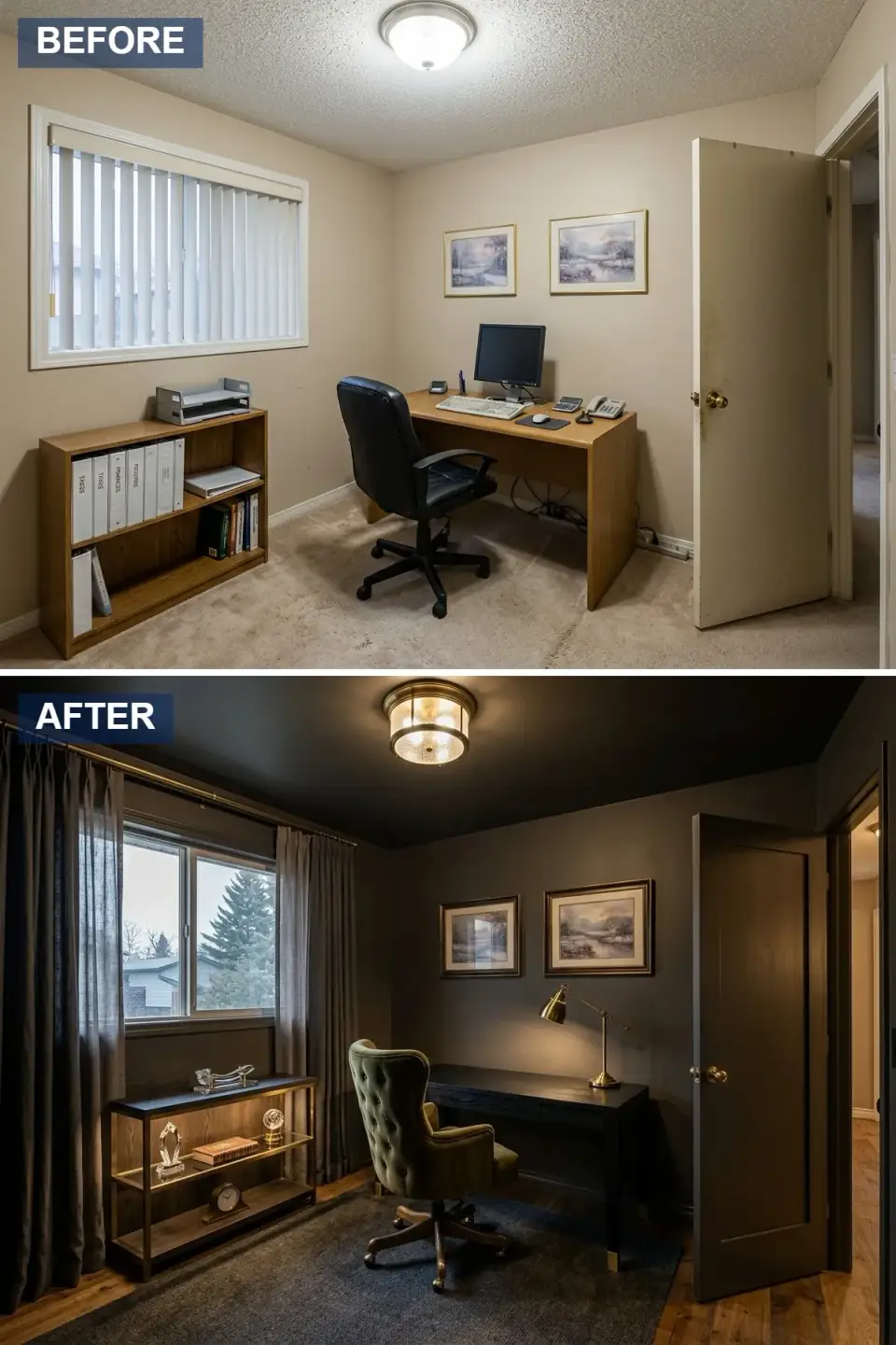
Instead of the bland beige box, this office leans into deep charcoal walls and ceiling, building an intimate cocoon for focused work. The original landscape art concept is retained but reinterpreted with dark frames that merge into the shadowy backdrop, while a glass-and-wood console with interior lighting replaces the low bookcase to display collected curiosities. A black desk disappears into the architecture, allowing an olive tufted velvet chair to emerge as the centerpiece. Layered brass lighting adds warmth where the old single dome failed, and dark drapery replaces vertical blinds for theatrical effect.
This is the right direction for a north-facing or windowless interior office — the kind of room where bright paint reads cold all day. North-facing bathrooms and offices can absorb a deep saturated color like Benjamin Moore Wrought Iron 2124-10 or Farrow & Ball Railings No. 31 without reading as a cave; sun-flooded rooms in the same color read moody-on-purpose rather than mistake. The key trap in a dark room is lighting math: a single overhead fixture is never enough. Plan for at least three light sources at different heights — overhead pendant or flush mount, a desk lamp (the Schoolhouse Adler or the classic Stiffel brass), and an illuminated display cabinet or sconce — to keep the room from reading flat.
Breezy Coastal Calm
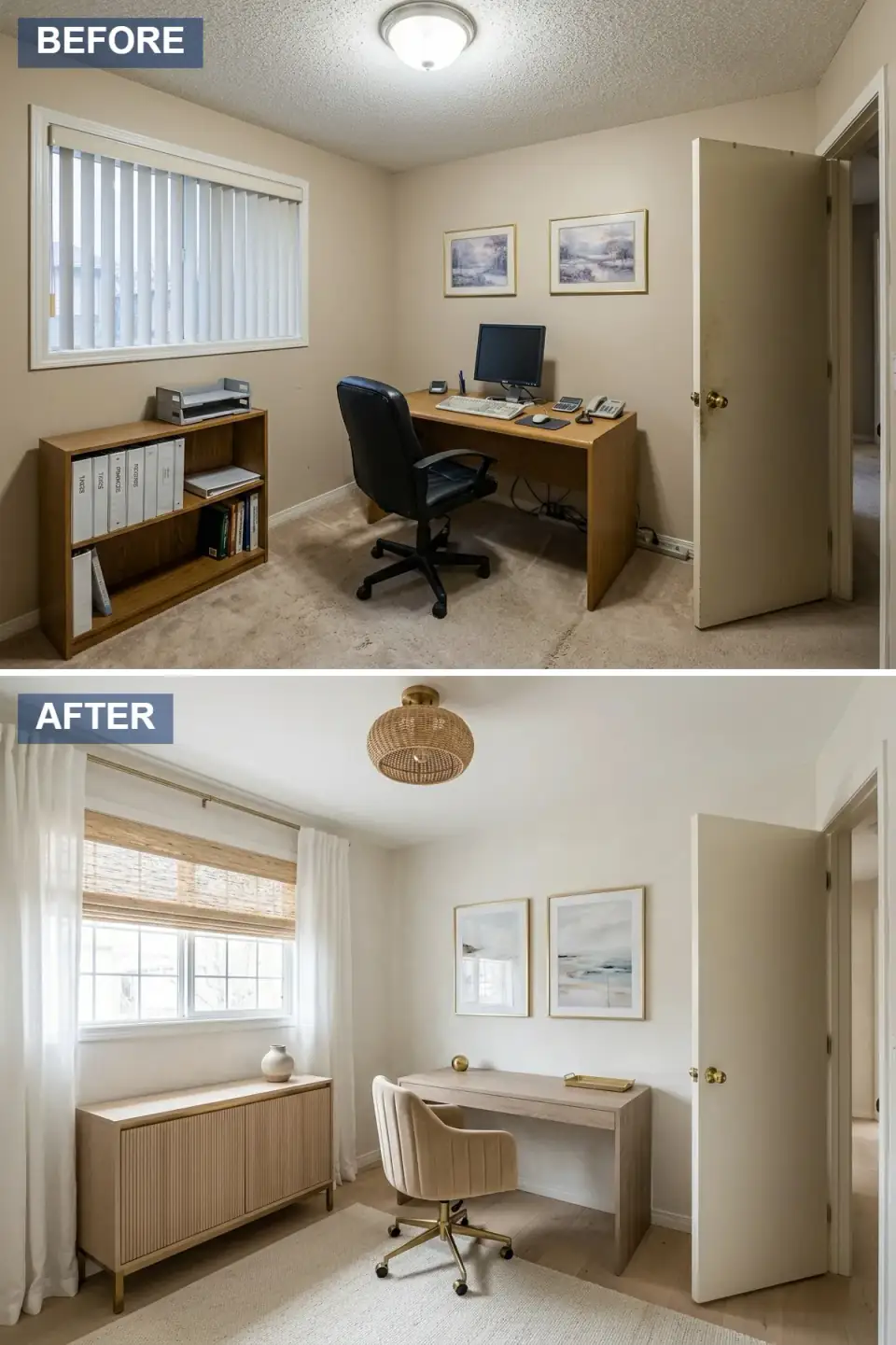
Swapping the tired beige carpet and heavy furniture for sun-bleached tones and natural fibers, this space evokes vacation calm. A woven rattan pendant replaces the utilitarian dome light, while a fluted oak credenza offers concealed storage in place of the open, cluttered bookshelf. The desk and chair stay in a tonal family of oatmeal and sand, softened by a chunky wool rug underfoot. Woven wood shades layered with sheer curtains filter the daylight once blocked by vertical blinds, and abstract seascapes replace the dated prints for a serene, uncluttered mood.
This direction transfers honestly to the Northeast river towns — Northeast communities, Cold Spring, Hudson, Catskill — and to any house with strong natural light. The fluted oak credenza (Crate & Barrel Tate, Rove Concepts Theo, or any of the Etsy custom fluted millwork shops at $2,200–$4,800) is the highest-leverage piece. Closed storage is what makes a coastal office actually function — the look depends on visual quiet, which means paperwork can't live on top of a credenza. The chunky wool rug (Loloi Yeshaia or Jaipur Living Rebecca) wants to be wool, not polyester. Cheap synthetic "wool look" rugs in coastal palettes go flat within a year and contradict the natural-fiber commitment of the rest of the room.
Art Deco Power Suite
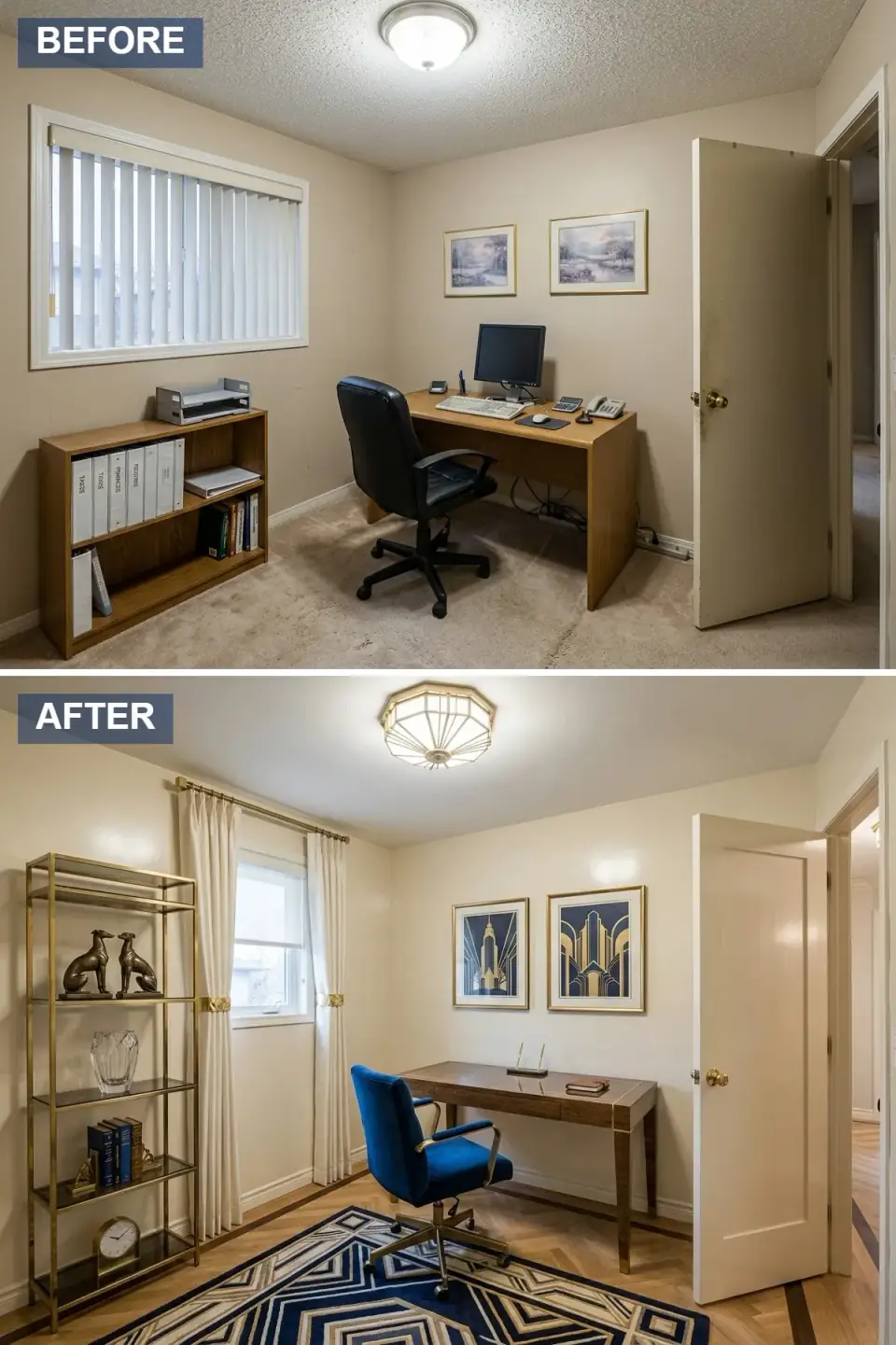
Trading the forgettable beige background for calculated opulence, this office channels Art Deco glamour with bold geometry and metallics. A tall brass-and-glass étagère rises beside the window to display sculptural objects, replacing the low wooden bookcase. An octagonal flush mount casts decorative light patterns overhead, while the desk features inlaid brass details on a polished walnut surface. A saturated cobalt velvet chair commands attention where the black leather once sat, and a sharp geometric rug in navy and cream anchors the herringbone floor. Symmetrical architectural prints finally replace the tired landscapes with era-appropriate drama.
The brass-and-glass étagère is the structural move — a real Mitchell Gold + Bob Williams Townsend or a CB2 Vela in brushed brass runs $1,800–$3,400; the Wayfair lookalikes at $400 have hollow brass-look stems that bend under any actual weight. The herringbone parquet flooring (real solid walnut from the Northeast flooring shops) runs $22–32 per square foot installed, more than three times the cost of standard plank. The cobalt velvet chair (Article Abisko, West Elm Hargrove, or vintage Knoll-era reupholster) is where you can save and where the look most depends on quality.
Quality honesty. Art Deco is the look that telegraphs cheap fastest if any single element is fake. Polished brass plate on plastic, hollow brass look-alike étagères, and printed-pattern "marble" all undo the rest of the room. Save on one piece if you must — don't fake all of them.
Planning checks for Art Deco Power Suite
Map the work before mapping the room. Video-call days need different lighting than deep-focus writing days. Spend an hour describing your actual work routine before you pick paint.
Remove popcorn texture first. The ceiling is the fifth wall. Stripping popcorn (test for asbestos on anything pre-1980) is the highest-leverage move on any office built between 1965 and 1990.
Three light sources, three heights. Overhead fixture, desk task lamp, and either a floor lamp or sconce. A single overhead is the most common mistake and the easiest to fix.
Lock the metal finish before buying anything. Brass, black, or bronze. Repeat it on the light fixture, the hardware, the chair base, and one accessory. Mixed metals in a small room read accidental, not intentional.
Buy the chair once. A real ergonomic chair for video-call days (Herman Miller Aeron, Steelcase Leap, Branch Verve) or a real leather lounge chair for focus days. Cheap office chairs are the single thing that visibly ages a remodel.
Hide the paperwork. Open shelving is for books and objects; paperwork lives in closed storage. A credenza, a cabinet, or a closed file drawer is what makes the whole room read considered rather than cluttered.
The Core Idea. The same tired beige office can become a Mid-Century renovation, a Quiet Luxury study, a Japandi retreat, a Moody library, a Coastal calm, or an Art Deco power suite — without touching the framing, the window, or the electrical panel. Pick the direction that fits the work you actually do, and the room aligns behind it. The footprint never limited the office; the brief did.
Questions about Six Home Office Reinventions
What does a full home office remodel cost in 2026?
For a typical 10-by-12 the Northeast spare-bedroom-converted-to-office, a finish-only remodel — paint, lighting, flooring upgrade, new desk and chair, shutters or drapery, accessories — runs $4,000–$22,000 depending on finish tier. The Mid-Century renovation and Coastal Calm directions land at the lower end ($4K–$10K); Quiet Luxury and Japandi run mid-range ($8K–$15K) because plantation shutters and lime plaster add real labor; Moody Library and Art Deco Power Suite top out near $22K because of brass étagères, herringbone flooring, and custom drapery. Adding electrical work (new outlets, additional circuits, recessed lighting) adds $1,800–$4,500. None of these touch the structural envelope.
Which direction has the best resale return?
In the Northeast and Northeast suburban market, Quiet Luxury (Section 2) and Coastal Calm (Section 5) carry the strongest appraisal return — both fit the current buyer-preference window and signal contemporary upkeep without polarizing tastes. Moody Traditional Library is polarizing but appeals strongly to a specific buyer pool; same with Art Deco. The home office itself rarely shows up as a line item on a comparable-market analysis, but a fully finished office reduces "needs work" objections during inspection and can shift a 30-day-on-market house to a 12-day-on-market house.
How important is the chair, really?
It's the single most important purchase in a home office for anyone working more than four hours a day. A genuinely ergonomic chair (Herman Miller Aeron at $1,800–$2,200, Steelcase Leap at $1,200–$1,500, Branch Verve at $499) supports the posture, reduces back and shoulder strain, and lasts twenty years. A $300 task chair from a big-box retailer wears out in two to three years and is the single most common cause of mid-career neck and back pain in remote workers. If budget is tight, buy a vintage Eames or refurb Aeron from the Northeast dealer rather than a new big-box chair.
Does a homeowner need to upgrade the electrical for a real home office?
Most pre-2000 spare-bedroom offices have only one or two duplex outlets on a single circuit shared with the bedroom hallway. A modern home office runs a desktop computer, two monitors, a printer, a desk lamp, a phone charger, sometimes a ring light or webcam — easily 8–12 plugs. Adding a dedicated 20-amp circuit with four to six new outlets at desk height runs $400–$900 in the Northeast remodel and saves the daily annoyance of power strips piggybacked off power strips. Schedule the electrical work before paint.
Natural light from a window in front of you (not behind you) is the gold standard. When daylight isn't available, the move is a 5500K bi-color LED panel (Elgato Key Light, Aputure MC, or Lume Cube Panel Pro) mounted just above the monitor or on a desktop stand. Avoid the ring light: it puts a circular reflection in your glasses and reads as "influencer" rather than "professional." A second smaller fill light at 45 degrees off-axis eliminates harsh facial shadows. Total investment for video-call quality lighting: $250–$600.
Three filters. First, the work you actually do: deep-focus writers and analysts pair well with Japandi and Moody Library; video-call-heavy roles want bright walls and good natural light (Mid-Century, Quiet Luxury, Coastal); creative roles can carry the Art Deco drama. Second, the natural light you have: north-facing or windowless rooms point toward Moody or Mid-Century with strong warm lighting, not Coastal or Japandi. Third, the rest of your house: an office direction that contradicts the rest of the home reads as a renovation rather than a coherent home. Pick the direction continuous with what's outside the office door.
For more office and outdoor case studies in the same lane, our offices-and-outdoor archive collects every workspace we've reviewed on the site.
Sources & Further Reading
- Remodeling Magazine, 2025 Cost vs. Value Report — Middle Atlantic Region — remodeling.hw.net.
- Herman Miller, Aeron Chair Ergonomic Specifications & Posture Research — hermanmiller.com.
- Hunter Douglas, Heritance Hardwood Plantation Shutter Installation Guide — hunterdouglas.com.
- EPA, Asbestos in Popcorn Ceiling: Identification, Testing & Safe Removal Guidance — epa.gov.
- Romabio Paints, Classico Limewash & Bauwerk Lime Wash Interior Application — romabio.com.
- Rubio Monocoat USA, Pure Oil for Solid Wood Desk & Floor Finishes — rubiomonocoatusa.com.
- U.S. DOE, Lighting Layers for Productivity: Ambient, Task & Accent — energy.gov.
- Architectural Digest, The Best Home Office Design Trends of 2026 — architecturaldigest.com.
- This Old House, Electrical Upgrades for the Modern Home Office — thisoldhouse.com.
- Remodelista, Quiet Luxury: A Field Guide to Restrained Interior Design — remodelista.com.

Renovations & Interiors Desk
Renovation Studies & Room Guides · Northeast United States research focusThe Renovations & Interiors Desk develops sourced room guides and editorial concept studies without presenting concepts as completed client work.
More from this desk →
Reader notes