

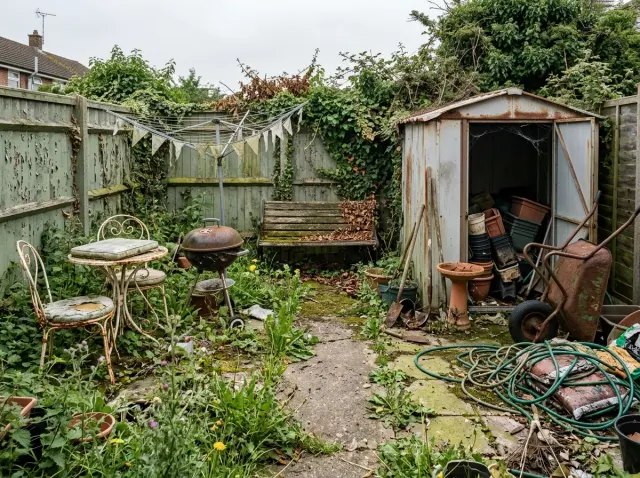
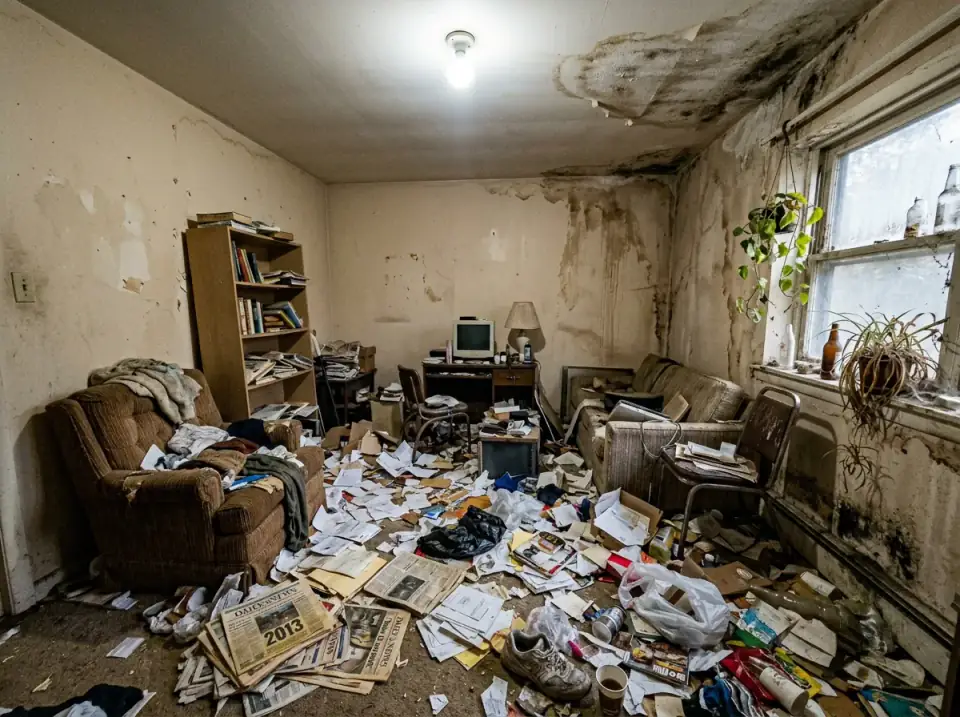
I'm Theo Caldwell — a Renovation Designer and Plan Strategist working out of Beacon, with regular projects across Rhinebeck, Kingston, and Cold Spring. A backyard is the project most clients underestimate. They plan the kitchen renovation for six months and treat the yard as a weekend afterthought, and the result is the same overgrown, half-paved plot they started with. The discipline that separates a real outdoor renovation from a Pinterest scroll is the one a kitchen renovation already taught you: pick one stylistic narrative, commit to three material choices that carry it, zone the space programmatically, and let the lighting plan do the heavy lifting after sunset. Below, the same neglected Hudson Valley back plot — fence, shed, broken concrete, weed-jungle — reinvented nine different ways. Same footprint, same site lines, nine genuinely different gardens. Costs, brand specs, and Northeast-climate caveats included for every one.
How I Read a Backyard Transformation
The first decision on any backyard project I take on is invisible by the end: drainage. Hudson Valley sites sit on glacial till, clay shelves, and ledge rock that move water in directions the original builder rarely accounted for, and any hardscape laid over an unresolved drainage problem fails within three winters. Before I touch a fence stain or a paver palette, I walk the property after a hard rain, map the high spots and the puddling, and decide whether the project needs a French drain, a dry well, regrading, or just a pervious-paver detail. The aesthetic discussion only earns its place after that. Skip the drainage scope and the most beautiful patio on this list cracks heaving by year three.
Once the bones are sound, the nine briefs below isolate exactly one decision: which stylistic narrative does the plot want to carry? My standing approach across our outdoor-renovations archive is to commit to three controlling material choices — fence treatment, ground plane, and a signature object (water feature, fire element, shed) — and let those three choices carry the entire brief. Adding a fourth narrative element dilutes the read; adding a fifth turns the garden into a sample sale. The most disciplined backyards I've ever delivered live on three loud material decisions and a quiet planting plan. The most generic ones live on a quiet ground plane and a dozen competing accent items. Choose loudly in three places; let the rest serve those three.
1. Scandi Minimalist Sanctuary
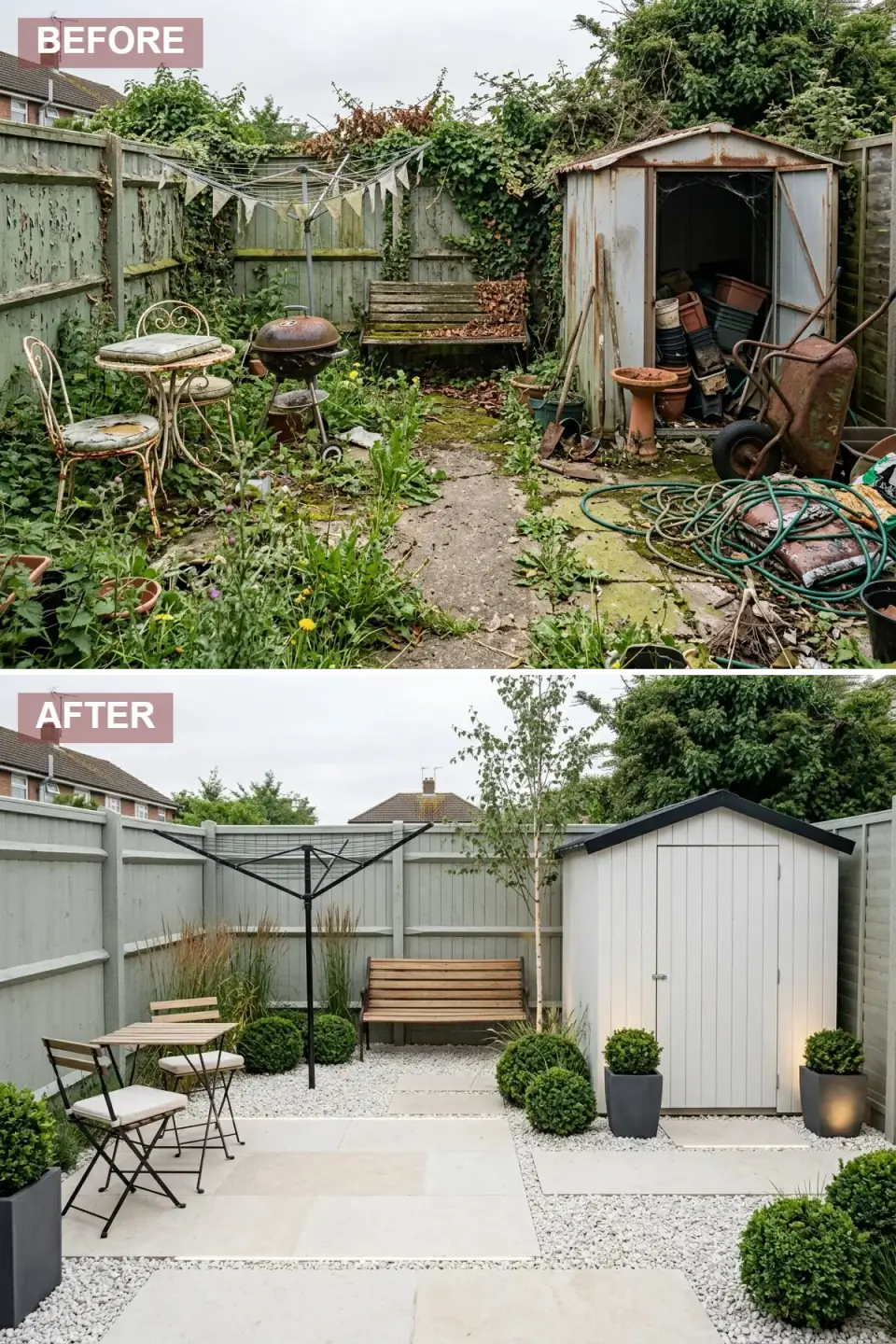
The Scandi minimalist brief is the right read for a small Hudson Valley plot where the owner wants maximum perceived space from minimum visual complexity. The fence treatment carries the brief: replace the rotted boards with a 1x4 vertical or horizontal cedar slat pattern painted in Benjamin Moore HC-167 Amherst Gray or Farrow & Ball No. 28 Dead Salmon's cooler cousin No. 285 Drop Cloth — a pale grey-green that brightens overcast Northeast light without going clinical white. The shed gets a full white-cladding rebuild (LP SmartSide BoardNBatten in Arctic White) with a matte black standing-seam roof (Drexel Metals Snap-Lock in Matte Black). Those two boundary moves do roughly 70% of the visual work on this brief; everything else inside the boundary is restraint.
The ground plane should be large-format pavers — 24-by-24-inch or larger limestone or concrete units (Techo-Bloc Industria in Greyed Nickel, or Belgard Mega-Arbel in Sandstone) — set in a strict orthogonal grid with crisp white #6 or #7 limestone screening between modules. Avoid the random-flagstone pattern that dominates American back patios; it reads busy against a minimalist brief. Furniture is one bistro set, not three groupings; planters are matched in pairs of identical size and color, not collected over decades. The silver birch (Betula utilis var. jacquemontii 'Doorenbos' or 'Jermyns') is the single specimen that earns sculptural status — limit yourself to one. Ground-level LED uplighting (FX Luminaire Path Lighting or Vista Pro Architectural Series) on the shed base extends the daytime crispness into evening hours.
Color Palette
Light Grey-Green
#C5CEC5
Benjamin Moore HC-167 Amherst Gray or Farrow & Ball No. 285 Drop Cloth on the slatted cedar fence.
Pure White
#F2F2F0
LP SmartSide BoardNBatten in Arctic White on the shed cladding; matching crushed limestone screening underfoot.
Deep Grey
#333333
Matte charcoal planters (Lechuza Cubico in Slate, or Crescent Garden Madison in Charcoal), bistro chair frames, and parasol pole.
Warm Ivory
#E8E5DB
Techo-Bloc Industria in Greyed Nickel or Belgard Mega-Arbel large-format pavers, 24-by-24 inch units.
2. Moody Modern Oasis
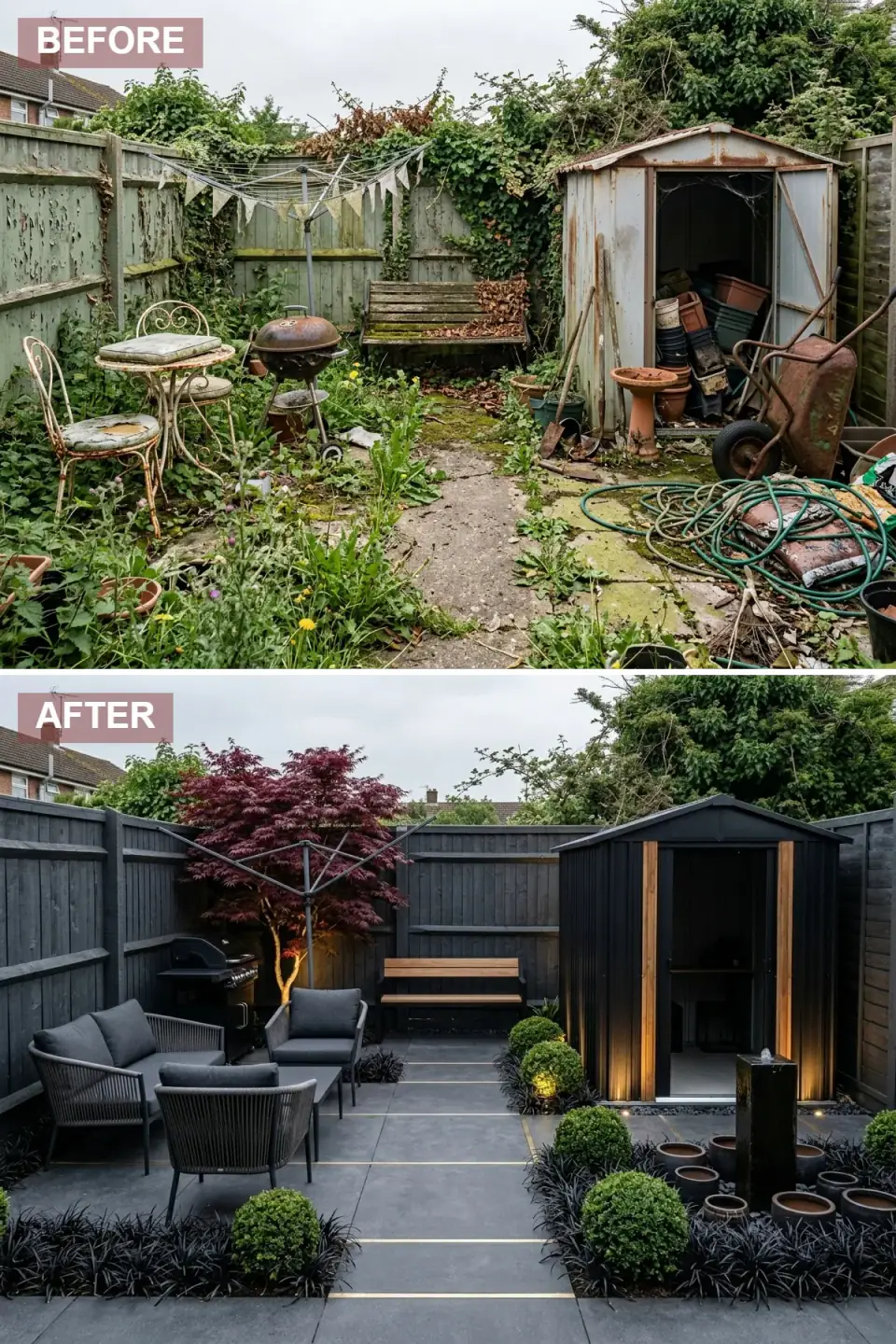
The moody modern oasis is the brief that turns a back garden into a private boutique-hotel terrace, and it earns that comparison by making three decisive moves. First, the boundary disappears: fence and shed are stained the same matte near-black (Benjamin Moore HC-190 Onyx, Cabot Solid Color Stain in Black, or Cutek Extreme in Sooty for the wood-tone permeable option) so the eye stops at the planting line rather than the property line. Second, the ground plane goes dark — 24-by-36-inch porcelain pavers in a slate-grey tone (Daltile Emerson Wood in Slate, Florim Magnum Oversize in Pietra D'Iseo Grey, or Mirage Glocal in Inox) set on a 6-inch compacted base with polymeric sand joints. Third, the lighting plan is the brief's signature element: linear in-grade brass LED strips (Lumen Brite SS-LED in Solid Brass, or WAC Landscape 3000K linear) recessed between paver modules in a runway pattern that reads as architectural intention after sunset.
The water feature is non-negotiable on this brief. A vertical sheet-flow black granite slab with an integral basin (custom from a regional fabricator, or the Aquascape Modern Stainless Steel Spillway model) delivers the sensory layer that distinguishes a moody garden from a dark one. Budget $4,800 to $8,500 installed including the pump, basin liner, and electrical connection. The Japanese maple (Acer palmatum 'Bloodgood' for a 12-to-15-foot specimen, or 'Crimson Queen' for a weeping form) becomes a living sculpture uplit by a single FX Luminaire BD or Vista Pro 5215 fixture; specify the bulb at 2700K, not 3000K, to keep the leaves reading deep red rather than bleached pink. The grill station should be a built-in unit (Lynx 36-inch Sedona or Lion L75000 in stainless), enclosed in a black-clad masonry surround that disappears into the boundary palette.
Color Palette
True Black
#181818
Benjamin Moore HC-190 Onyx or Cabot Solid Color Stain in Black on fence and shed cladding.
Blue-Grey
#4A4A4A
Daltile Emerson Wood Slate or Florim Magnum Pietra D'Iseo Grey porcelain pavers, 24x36 inch.
Muted Gold
#C9A961
Lumen Brite SS-LED solid-brass in-grade strips, 2700K, between paver joints.
Dark Grey
#4F4F4F
Outdoor lounge in Dedon Tibbo or RH Provence Round Weave, dark graphite finish.
3. Romantic English Cottage
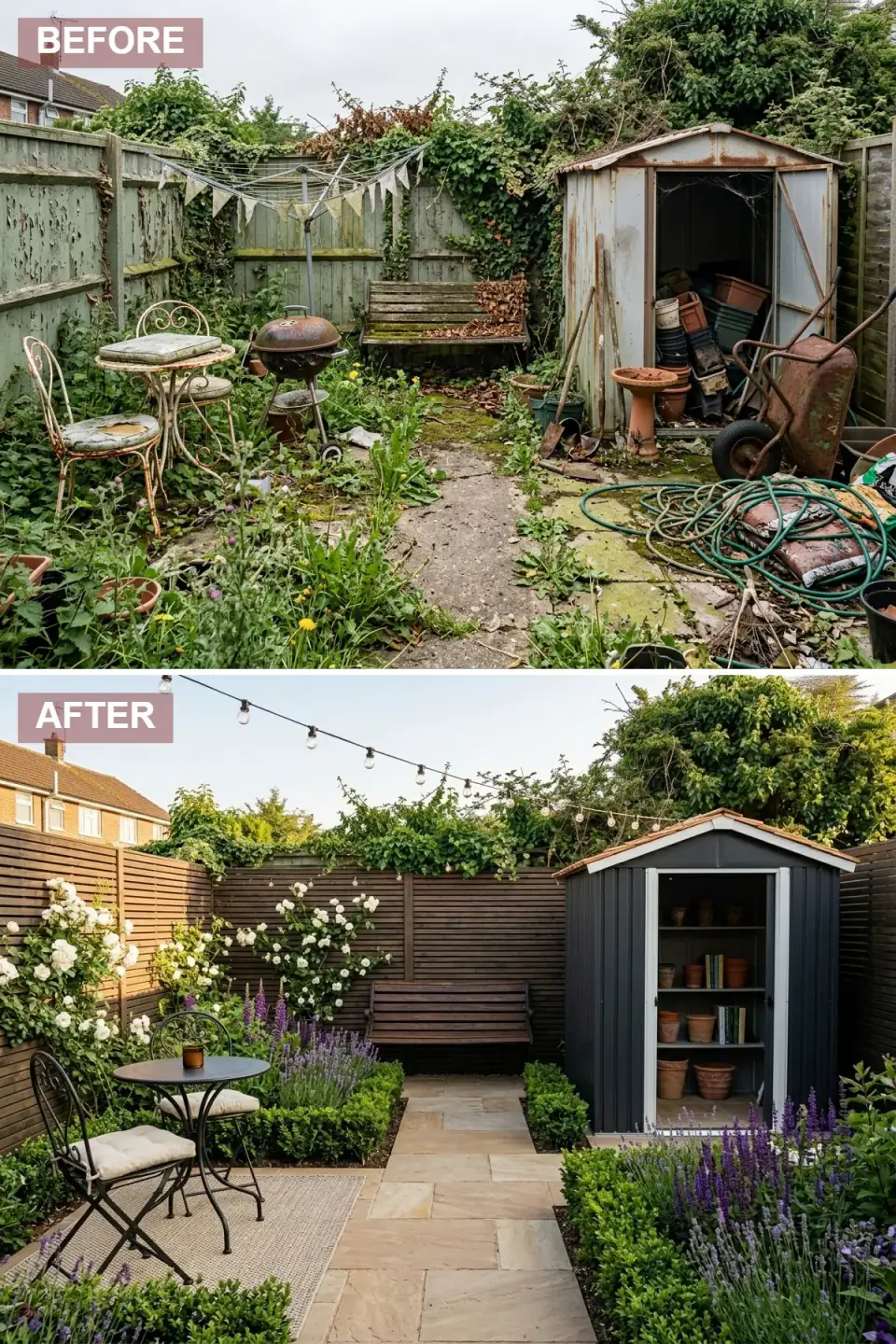
The English cottage brief is the most plant-driven of the nine — the architecture and hardscape are intentionally subordinate to the planting, which is the opposite of how most American back gardens are conceived. The horizontal walnut-stained fence (1x6 western red cedar slats stained with Cabot Australian Timber Oil in Mahogany Flame, or Penofin Verde in Brazilian Rosewood) does the visual work of holding the planting in frame. The white climbing roses should be specified by variety, not "climbing rose": David Austin's 'Claire Austin', 'A Shropshire Lad', or 'Madame Alfred Carrière' are the three I recommend for Hudson Valley climates, with cane-training cables (12-gauge stainless cable, Feeney Cable Rail or DriveWire vineyard wire) running horizontally across the fence at 18-inch vertical intervals.
The York sandstone pathway is the brief's controlled-luxury moment. Real Yorkshire stone is expensive in the U.S. ($28 to $42 per square foot installed including the imported material premium); a credible domestic substitute is full-color Pennsylvania bluestone in random-flagstone pattern with sand-set joints and creeping thyme (Thymus serpyllum 'Elfin') in the joints. The bistro set should be cast iron, not aluminum — the weight and the patina earn the brief in a way that powder-coated steel can't. The festoon overhead lighting is the only post-sunset element required; specify warm 2700K G40 LED bulbs (Hinkley Lighting Festoon or Brightech Ambience Pro) rather than the standard cool-white 4000K strings that read commercial-grade. Lavender (Lavandula angustifolia 'Munstead' or 'Hidcote', not the French L. dentata that won't survive Zone 5 winters) and white hydrangea (Hydrangea paniculata 'Limelight' or 'Quick Fire' for cold-hardy reliability) carry the planting brief through the full Hudson Valley season.
Color Palette
Rich Brown
#5C4033
Cabot Australian Timber Oil in Mahogany Flame or Penofin Verde Brazilian Rosewood on cedar fence slats.
True Black
#1A1A1A
Benjamin Moore HC-190 Onyx or 2132-10 Black on shed exterior; trim picked out in Decorator's White.
Warm Beige
#D4C4A8
Full-color Pennsylvania bluestone in random flagstone pattern with creeping thyme joints.
Off-White
#F5F5DC
Sunbrella Canvas Heather Beige or Perennials Performance Linen Weave on bistro cushions.
4. Sun-Drenched Mediterranean Courtyard
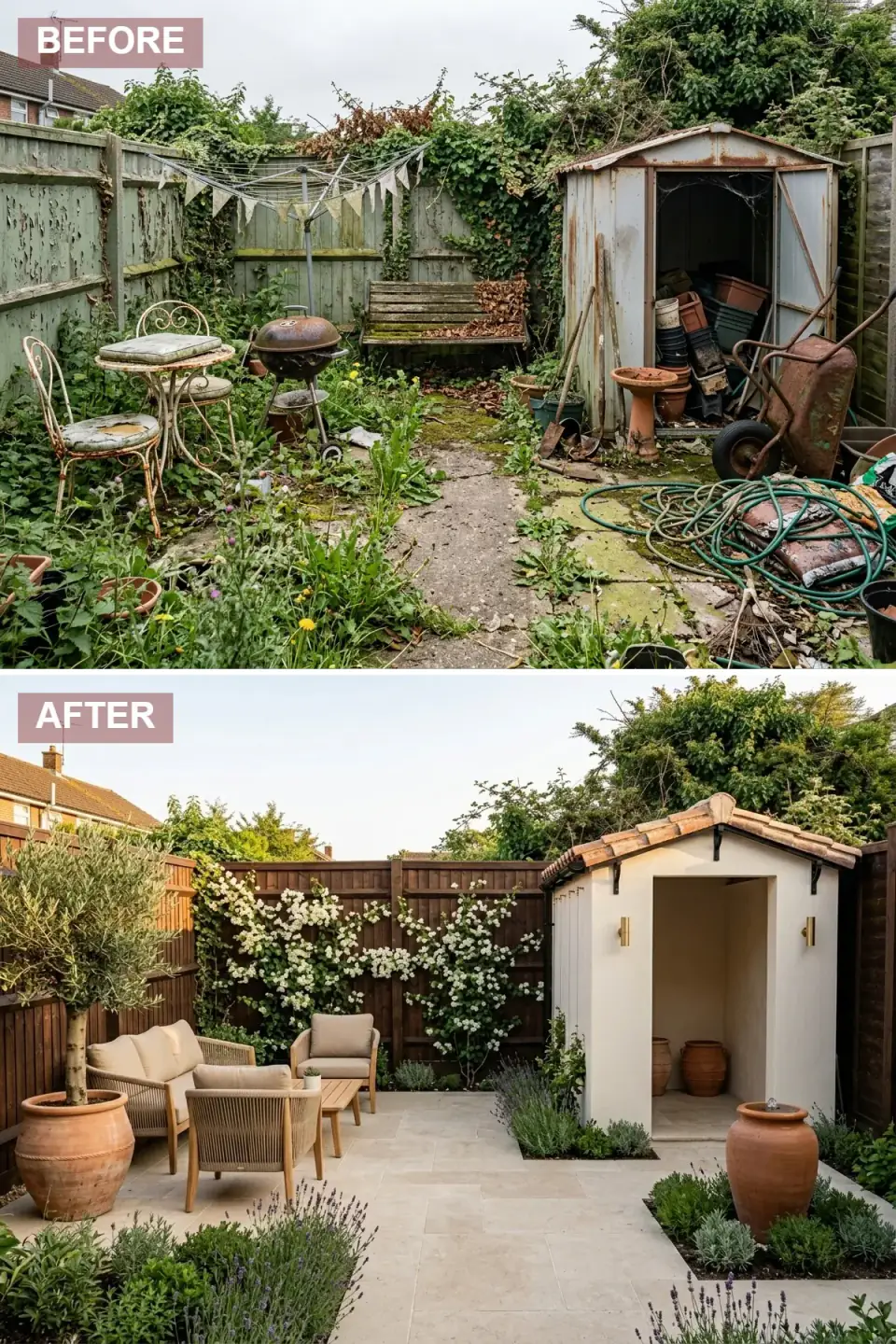
The Mediterranean courtyard brief is the riskiest on this list for a Hudson Valley application — get it wrong and the result reads as Tuscany costume on a Northeast lot. Get it right and the courtyard works year-round, because the disciplined material palette (white stucco, terracotta, limestone, weathered teak) carries authority even in January when the olive trees come inside. The shed rebuild is the most ambitious construction line item on this brief: a true white-rendered casita with a 3-coat stucco system (Sto Powerwall in Antique White, sand-float finish over wire-lath and CMU back-up) and a real terracotta tile roof (Ludowici Imperial or Bel Mar Spanish in Old World Terracotta blend). Budget $32K to $58K for the shed-to-casita conversion alone — it's the single most expensive line item in the entire backyard brief on this list.
The olive tree (Olea europaea 'Arbequina' or 'Mission' — the cold-hardy varietals that handle short-duration freezes) is the brief's signature plant, but it cannot overwinter outdoors in Zone 5 or Zone 6 Hudson Valley climates. Specify the tree in a wheeled fiberglass-clad terracotta planter (Crescent Garden Madison Bowl or Lechuza Quadro in Terracotta finish, with hidden caster wheels) for late-October indoor transition. The lavender bed should be Lavandula angustifolia 'Phenomenal' — the only varietal I'd specify for Hudson Valley cold-hardiness on this brief, since it survives Zone 5 winters where the standard 'Munstead' is borderline. Brass wall sconces (Visual Comfort Bristol Outdoor or Hinkley Lighting Endeavor in Burnished Brass) on the casita exterior carry the warm-glow read after sunset. Limestone pavers should be a true cream-tone (Indiana Buff Limestone, or Travertine Filled and Honed in Walnut) at 24x36 inches for the unified expansive ground plane.
Color Palette
Warm White
#F0EDE5
Sto Powerwall stucco in Antique White, sand-float finish on the casita walls.
Burnt Orange
#C07858
Ludowici Imperial or Bel Mar Spanish terracotta tile roofing in Old World Terracotta blend.
Deep Brown
#3E2723
Cabot Solid Color Stain in Espresso or Behr Premium Plus in Dark Walnut on cedar fence panels.
Warm Grey-Beige
#E3DCCF
Perennials Performance Texture in Oat or Sunbrella Heritage Wheat on teak lounge cushions.
5. Tuscan Terrace Revival
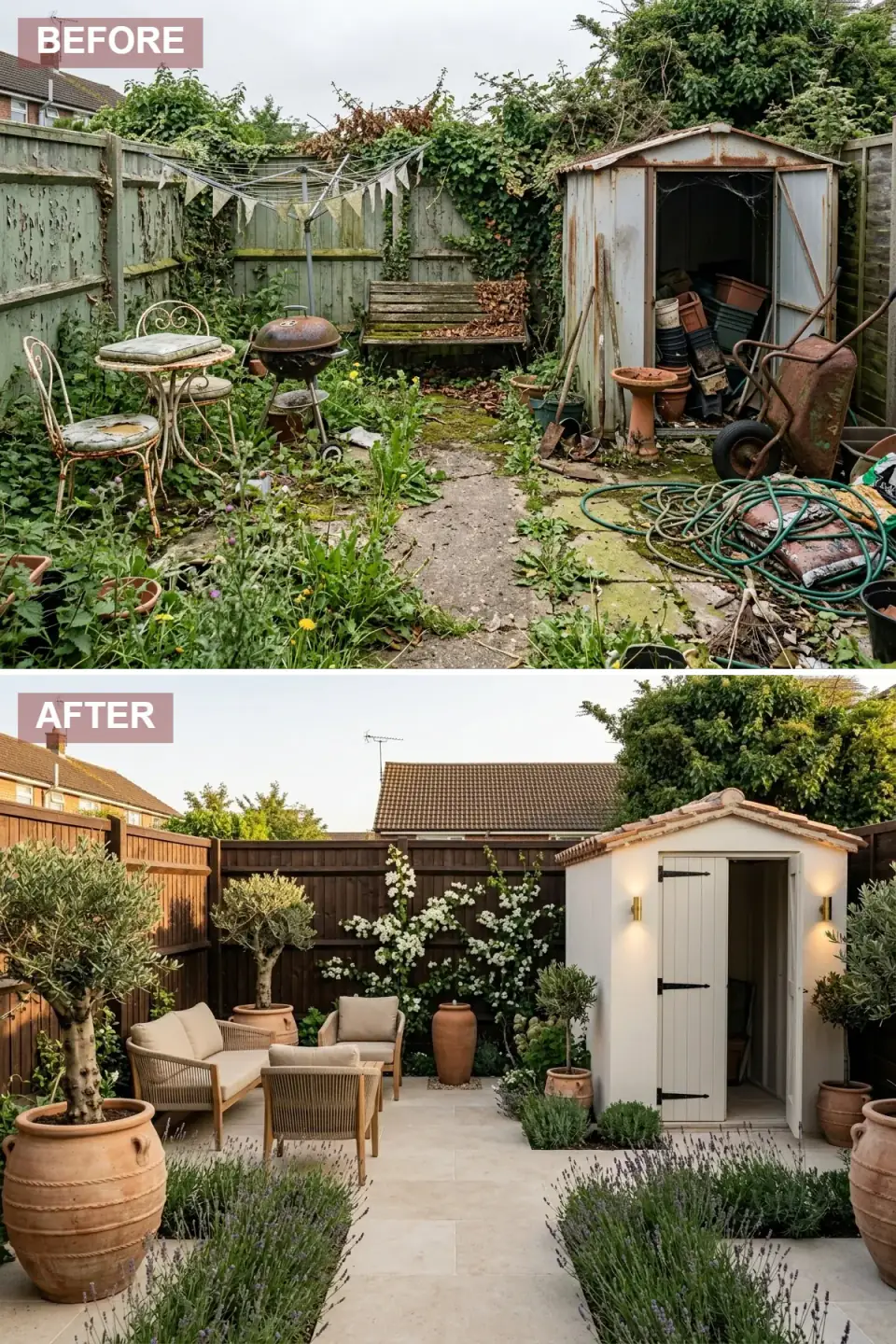
The Tuscan terrace is the Mediterranean brief's older sibling — same material vocabulary, more discipline, more symmetry, less performance-oriented. Where the Mediterranean courtyard is built for entertaining, the Tuscan terrace is built for reading a book at 4 p.m. with a glass of wine. The shed gains black iron strap hinges and hardware (specify Acme Hardware or Snug Cottage Hardware in raw blackened steel, not powder-coated black aluminum that telegraphs cheap) and a partially-open door that reveals the inside-as-still-life — terracotta vessels, hand tools on pegboards, an old wheelbarrow if you have one. The casita-or-shed treatment from Brief 4 carries directly into this brief; the differences are in the layout and the planting density.
The symmetry is the brief's signature discipline. Pair every olive tree with an identical olive tree on the opposite side of the terrace's central axis. Pair every lavender row with a mirroring lavender row. Pair the seating moments. Symmetry done sloppily reads as catalog; symmetry done strictly reads as Italianate restraint — and Tuscan terraces have lived on strict symmetry since the Medici villas. The teak and woven-rope sofa set (Restoration Hardware Provence Round Weave, Tribù Mood, or Dedon Tibbo in Natural) is the splurge; budget $9K to $18K for the seating alone. Limestone pavers as in Brief 4, but specify the largest module the site will accept — 36x36 inch or larger reads as deliberate, smaller reads as collected.
Color Palette
Warm Ivory
#E0D8CC
Indiana Buff Limestone or Travertine Filled and Honed in Walnut, 36x36 inch large-format modules.
Medium Brown
#5C4033
Cabot Australian Timber Oil in Mahogany Flame on cedar fence panels.
Rust Orange
#B86242
Italian-import or Pennoyer Newman Long Tom olive tree pots in fired terracotta with frost-resistant glaze.
Beige
#D6CFC1
Perennials Performance Texture in Sand or Sunbrella Canvas Antique Beige on outdoor sofa cushions.
6. Zen Garden Retreat
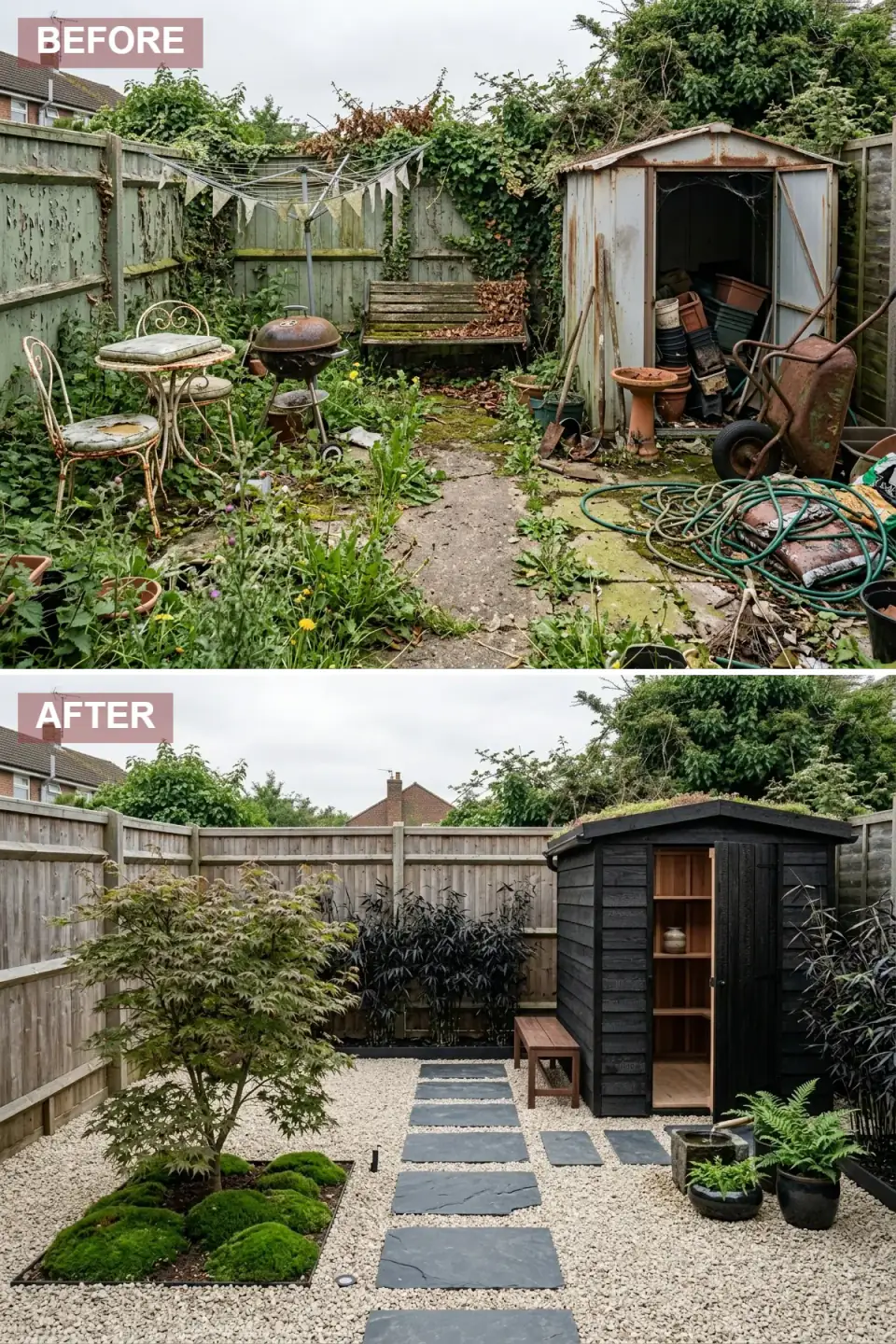
The Zen garden is the most disciplined brief on this list — the one where less is genuinely more, not the rhetorical kind. The fence rebuild specifies untreated Western Red Cedar (1x6 vertical board or 4-inch shou sugi ban planks for a darker boundary) that's allowed to silver naturally over three to five seasons. No stain. No sealer. The patina is the point. The shed is replaced by a charred-black timber cabin using shou sugi ban (yakisugi) — the Japanese technique of torch-charring cedar to a 1/8-inch carbon layer that delivers natural rot resistance, insect resistance, and a deep matte black finish that doesn't fade. Source the shou sugi ban from Nakamoto Forestry (the U.S. importer of the authentic Japanese technique, not the wire-brushed faux versions sold at lumberyards) or commission a local timber-frame shop to char it on-site.
The sedum living roof on the cabin is the brief's specification-heavy element. Specify a 4-inch growing-medium layer with a structural roof deck rated to 30 lbs per square foot saturated load, an EPDM rubber waterproof membrane (Carlisle Sure-Seal 60-mil or Firestone RubberGard EPDM), a drainage mat (American Hydrotech LiteTop or Garland GreenShield), and a plug-planted Sedum mix (Emory Knoll Farms in Maryland is the regional supplier for Northeast green-roof plugs). The Japanese maple should be a small Acer palmatum 'Dissectum' weeping form, planted in a mound of preserved moss (Mountain Moss Enterprises plug-shipped sphagnum) replenished every other spring. Black bamboo (Phyllostachys nigra) is the cold-hardy varietal for Hudson Valley applications, and must be planted in a 24-inch-deep root barrier (BambooBarrier 60-mil HDPE) or it will conquer the entire property within three years.
Color Palette
Near Black
#262626
Nakamoto Forestry shou sugi ban yakisugi or locally-charred Western Red Cedar 1x6 cabin cladding.
Pale Wood
#D4C5A9
Untreated Western Red Cedar fence panels, allowed to silver naturally over 3 to 5 seasons.
Blue-Grey
#4A5459
Irregular Pennsylvania bluestone or Vermont slate stepping stones, hand-selected for shape.
Cream White
#E8E4D9
3/8-inch white or pale-gold pea gravel over geotextile fabric and 4-inch compacted base.
7. Coastal Cottage Charm
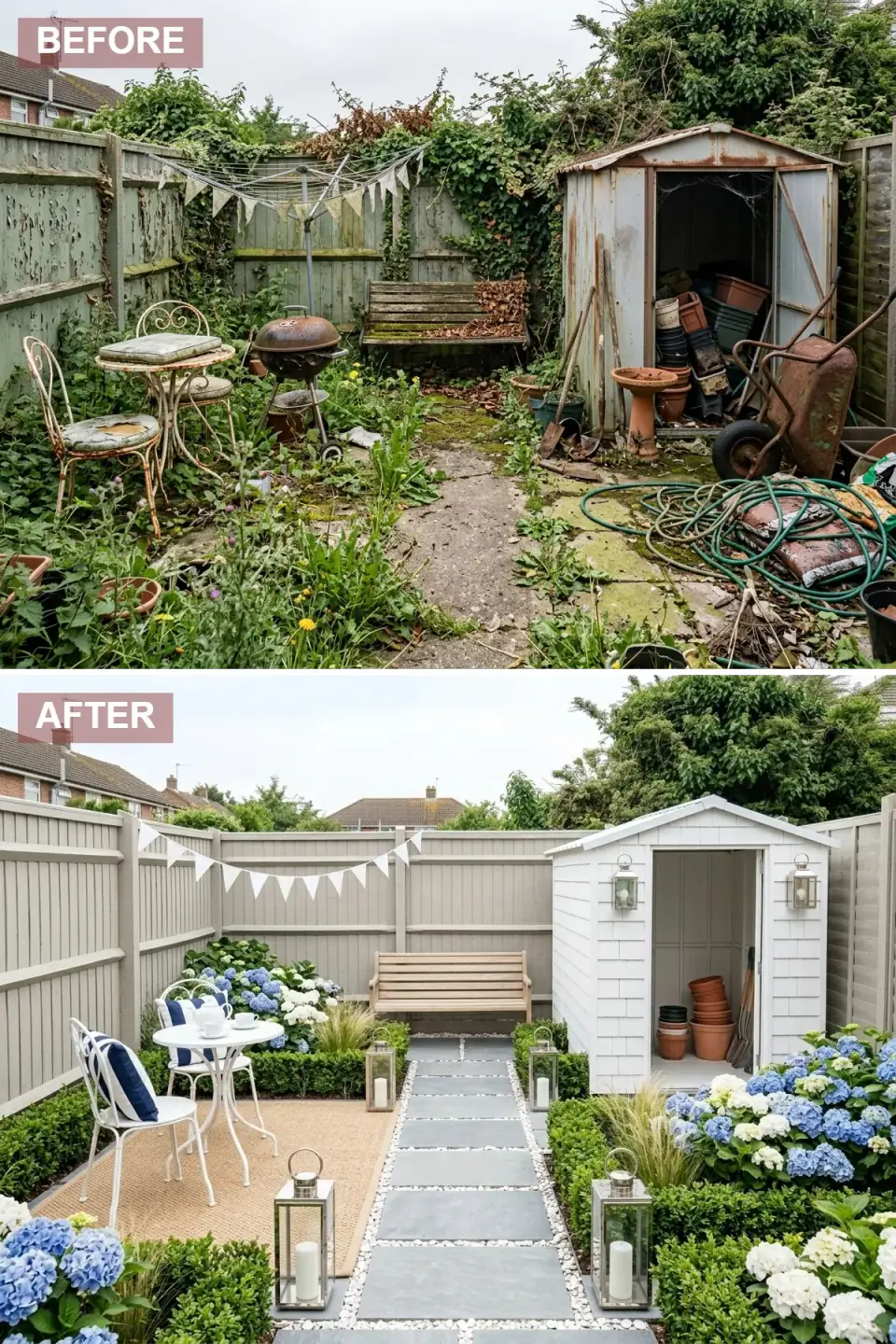
The coastal cottage brief works for back gardens on Long Island, the Connecticut shoreline, Rhode Island's south coast, or the Jersey shore — properties where the salt-air vernacular is authentic. On a landlocked Hudson Valley site, the brief still reads passably because the palette is restrained enough not to demand actual ocean nearby, but the resale read suffers if the brief becomes the property's defining feature. The fence and shed treatment carries the brief: warm greige paint on the boundary fence (Benjamin Moore HC-86 Kingsport Gray or Sherwin-Williams SW 7541 Greek Villa), crisp white clapboard on the shed (LP SmartSide Clapboard in Arctic White or James Hardie ColorPlus Arctic White), grey architectural shingle roof (GAF Timberline HDZ in Pewter Gray), black lantern sconces flanking the shed door (Hinkley Lighting Saturn or Visual Comfort Studio Sail in Black).
The pathway is the brief's most disciplined element. A straight central axial path of 24-by-24-inch slate-grey pavers (Techo-Bloc Industria in Greyed Nickel, or Belgard Holland Stone in Charcoal) bordered by a continuous 4-to-6-inch ribbon of white #6 or #7 marble chip or white river pebble. The straight axis is non-negotiable — this brief doesn't accept the curving paths of the cottage or farmhouse briefs. Hydrangea (Hydrangea macrophylla 'Endless Summer Original' for the blue-to-pink pH-responsive blooms, or 'Nikko Blue' for reliable blue in acidic Hudson Valley soils) carries the planting in massed groupings rather than scattered specimens. Boxwood (Buxus 'Green Velvet') in matched 18-inch clipped spheres along the path edge. Striped textile accents (Sunbrella Yacht Stripe Navy/Natural, or Schumacher Coastal Stripe in Indigo) on cushions and pennant bunting deliver the nautical brief without going theatrical.
Color Palette
Grey-Beige
#B8B5AA
Benjamin Moore HC-86 Kingsport Gray or Sherwin-Williams SW 7541 Greek Villa on cedar boundary fence.
Bright White
#FAFAFA
LP SmartSide Arctic White or James Hardie ColorPlus Arctic White on shed cladding; bistro furniture in white powder-coat.
Blue-Grey
#6A7A85
Techo-Bloc Industria Greyed Nickel or Belgard Holland Stone Charcoal axial-path pavers.
Deep Blue
#1B2E4A
Sunbrella Yacht Stripe Navy/Natural or Schumacher Coastal Stripe Indigo on bistro cushions and bunting.
8. Tropical Twilight Haven
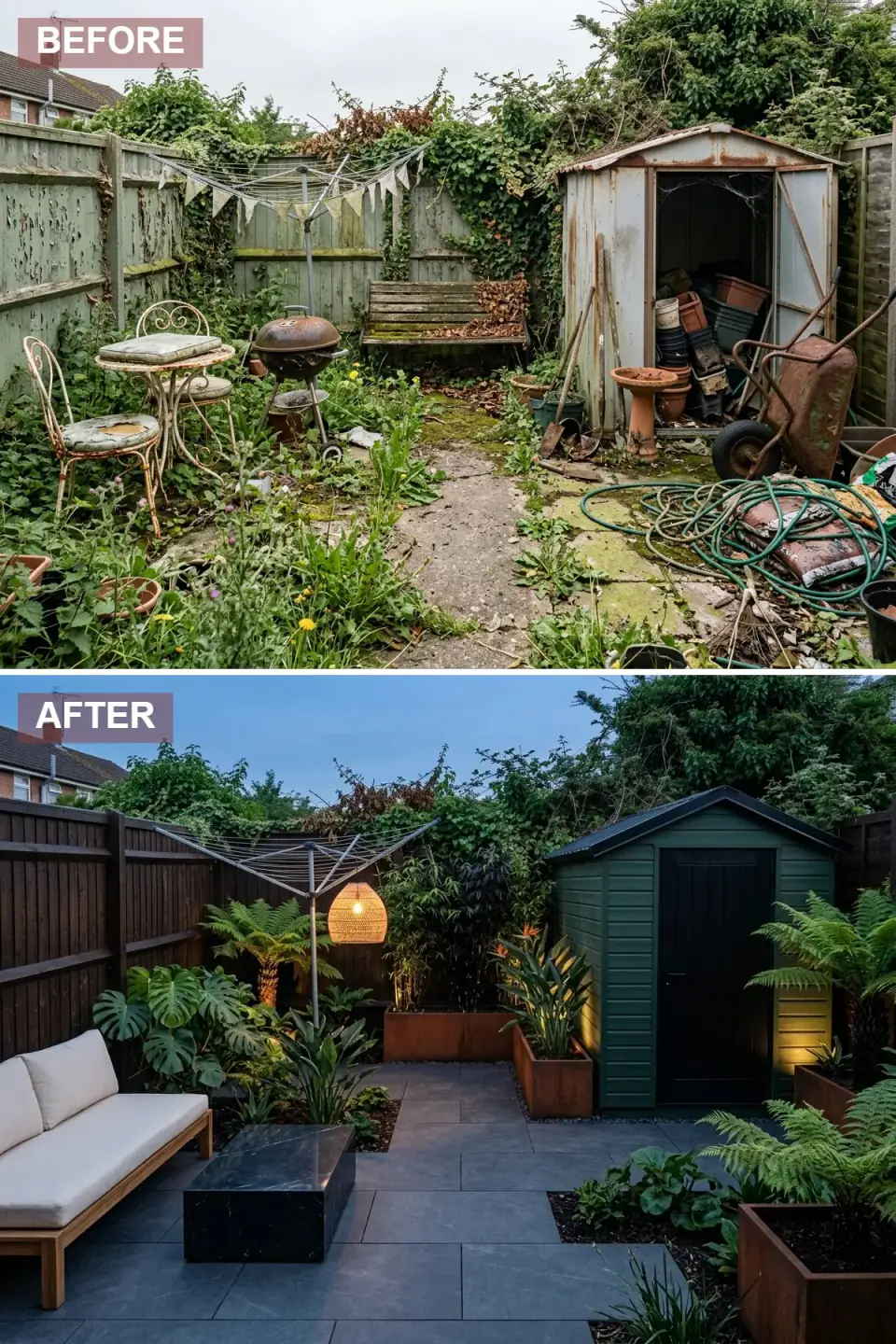
The tropical twilight brief is the most ambitious lighting plan on this list and the most maintenance-honest about the fact that most of its plant palette will not survive a Hudson Valley winter outdoors. The strategy is to specify the perennial bones (cold-hardy ferns like Dryopteris filix-mas male fern and Athyrium niponicum 'Pictum' Japanese painted fern, plus hardy planting Tiarella cordifolia foamflower for ground-level texture) and treat the showpiece tropicals (Monstera deliciosa, Strelitzia nicolai bird of paradise, Cyathea cooperi Australian tree fern) as container plants that overwinter in a heated greenhouse, sunroom, or large basement under grow lights. The honest read is that this brief delivers eight months of resort-style impact and four months of bones-only winter; that's the trade.
The Corten steel planters are the brief's signature material — specify a real architectural-grade Corten (AlumaSteel, MeridianCast, or a custom-fabricated weathering steel from a regional metal shop) rather than the painted-rust faux versions sold at garden centers. Real Corten weathers from raw steel to a stable orange-brown patina over 6 to 18 months and lasts 80-plus years; the painted faux versions chip within two seasons. The teak daybed (RH Provence Daybed, Tribù Pure Sofa, or Sutherland Poolside Daybed) is the brief's investment piece — budget $4,800 to $14,000 for a single piece of weather-rated solid teak — and earns the cost by becoming the visual anchor of the entire garden. The rotary clothesline repurposing is a nice tactical move; specify a heavy-duty marine-grade stainless cable to suspend the woven rattan pendant (PalmShade or Soleil pendant in natural rattan, weather-treated and rated for outdoor use), wired through a low-voltage transformer to a 2700K LED bulb.
Color Palette
Deep Green
#2E3B2E
Benjamin Moore HC-132 Tarrytown Green or Farrow & Ball No. 47 Green Smoke on shed cladding.
True Black
#1C1C1C
Cabot Solid Color Stain in Black on cedar fence; matching matte-black shed door and trim.
Medium Grey
#555555
Daltile Emerson Wood in Slate or Florim Magnum Oversize Pietra D'Iseo Grey porcelain pavers, 24x48 inch.
Burnt Orange
#B7410E
AlumaSteel or MeridianCast architectural-grade Corten weathering-steel planters, custom-sized.
9. Modern Farmhouse Pathway
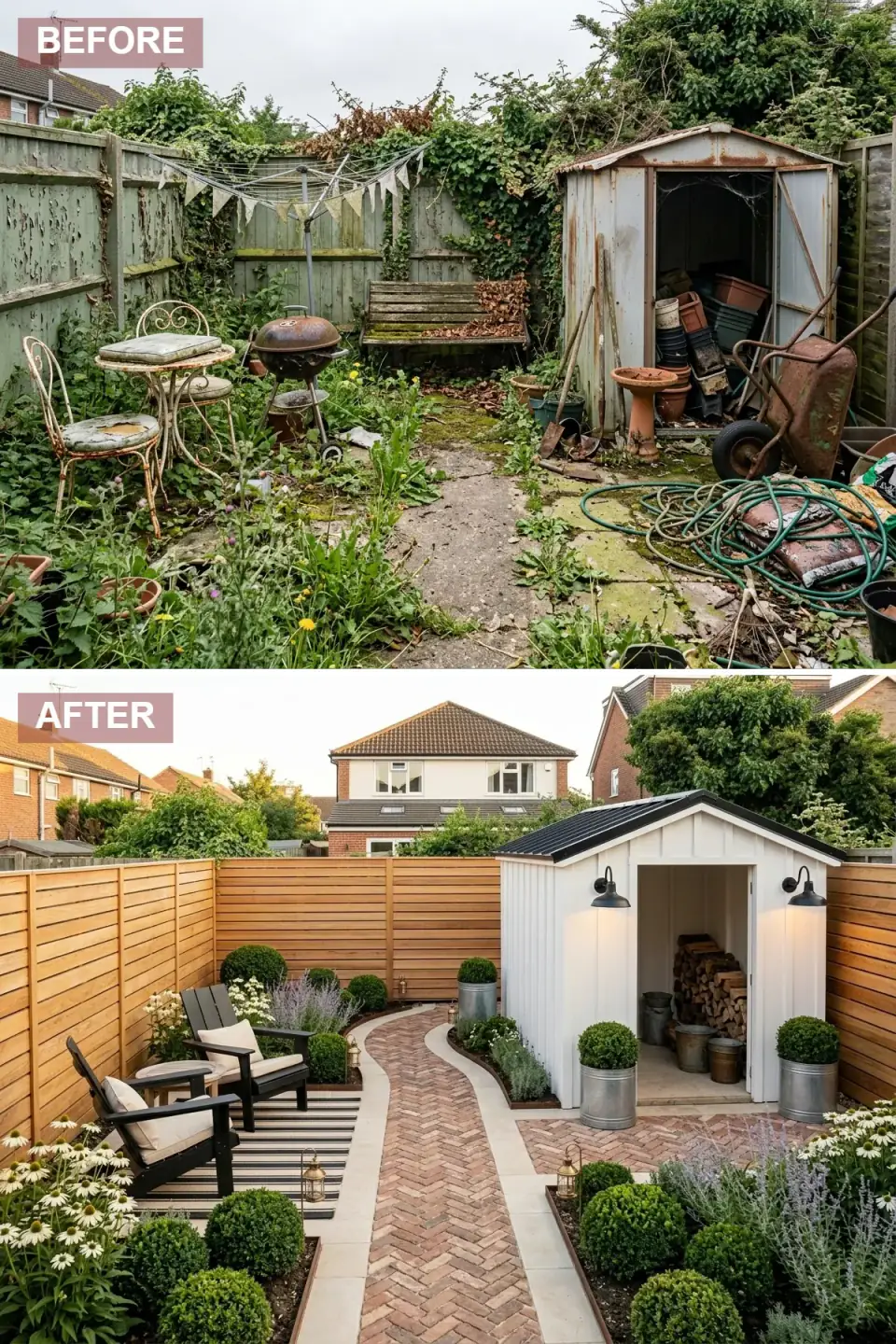
The modern farmhouse pathway brief is the most resale-defensible of the nine for a Hudson Valley or southern New England property. The modern farmhouse vernacular is the dominant exterior style of 2026 American residential design, which means buyers recognize it, appraisers comp it confidently, and the back-garden version of the brief sells the front-facade story to a buyer touring the property. Horizontal cedar slat fencing (1x6 or 1x4 western red cedar, prefinished in Cabot Australian Timber Oil in Honey or unfinished and silvering naturally) is the boundary's signature move. Specify the slats with consistent 1/2-inch gaps for that disciplined modern-farmhouse rhythm — random spacing reads as DIY.
The board-and-batten shed (LP SmartSide BoardNBatten or James Hardie Statement Collection in Arctic White) with a black metal gable roof (Drexel Metals or McElroy Snap-Lock 1.5" in Matte Black) and black barn-style sconces (Hinkley Lighting Foundry Outdoor in Aged Zinc, or Visual Comfort Tobin in Aged Iron) carries the brief decisively. The curving herringbone brick pathway is the brief's tactile element: specify a true paving brick (Belden Pathway Pavers or Pine Hall Old Williamsburg in Red Range), laid in 90-degree herringbone with a soldier-course edge in pale Pennsylvania bluestone. Sand-set on a 6-inch compacted base — never wet-mortared in the Hudson Valley freeze-thaw climate. The two black Adirondack chairs (POLYWOOD Classic Folding Adirondack in Black, or Loll Designs Adirondack in Recycled Black) should be matched, not collected, and arranged on a striped outdoor rug (Dash & Albert Herringbone Indoor/Outdoor in Black or Annie Selke Plain Stripe in Indigo) that pulls the seating into a defined moment.
Color Palette
Honey Wood
#D4A76A
Western Red Cedar 1x6 horizontal slats, Cabot Australian Timber Oil in Honey or natural silvering.
Soft White
#F5F5F0
LP SmartSide or James Hardie Statement Collection in Arctic White on shed board-and-batten.
Red-Orange
#B5654C
Belden Pathway Pavers Red Range or Pine Hall Old Williamsburg in herringbone pattern with bluestone soldier-course edging.
True Black
#1A1A1A
Drexel Metals Snap-Lock Matte Black on shed roof; Hinkley Foundry sconces; POLYWOOD Adirondack chair frames.
Pro Tips From the Renovation Designer's Chair
- Resolve drainage before any aesthetic decision. A puddle in March is a heaved paver in October. Walk the property after a hard rain, map the high spots and the standing-water zones, and budget for a French drain or dry well before pricing the patio. The most beautiful brief on this list fails on undrained substrate.
- Three loud material choices carry the entire brief. Pick the fence treatment, the ground plane, and one signature object (water feature, fire pit, shed, specimen tree). Adding a fourth narrative element dilutes the read. Choose loudly in three places; quiet everywhere else.
- Buy frost-rated planters, not warm-climate ones. The cheap terracotta from big-box retailers freeze-cracks within two Northeast winters. Specify Whichford Pottery, Pennoyer Newman, Mital, or fiberglass-clad faux-terracotta from Crescent Garden — all frost-rated to -10°F or below.
- Lighting is 18–22% of the budget, not 3%. A back garden that looks like a magazine photograph at 7 p.m. in July looks like a yard at 7 p.m. in October. Specify a layered 12V low-voltage system (transformer, direct-burial wiring, smart timer) at the design stage, not after the hardscape is poured.
- Plan the winter read. Six months of the Hudson Valley year are leafless. Every brief above needs an evergreen structural element — boxwood spheres, black bamboo, silver birch bark, or a charred shou sugi ban shed — that holds the composition together from December through March.
- Match the brief to the front facade. A Tuscan back terrace behind a modern farmhouse front confuses the property's read at resale. The back garden should extend or complement the front's architectural language, not contradict it. Pick a brief that the front of the house can comp into.
Cost-Saving Moves on a Backyard Project
- Sand-set, never mortar-set, in the Northeast. Sand-set pavers cost roughly 30–40% less than mortar-set assemblies and outlast them in freeze-thaw climates by 15+ years. Polymeric sand joint stabilizer (Alliance Gator Maxx G2 or Techniseal NextGel) gives you a joint that stays put without the cracking risk.
- LP SmartSide on the shed rebuild, not James Hardie. Engineered-wood siding saves $4–$7 per square foot installed against fiber-cement on shed cladding, with a 50-year transferable warranty in the prefinished ColorPlus tier. Reserve the Hardie premium for the front facade of the main house.
- Domestic Pennsylvania bluestone instead of imported limestone. Bluestone in random-flagstone pattern delivers 80% of the visual read of imported Indiana Buff or French limestone at 35–55% of the installed cost. Reserve the imported limestone budget for the Tuscan or Mediterranean briefs where the warm tone is structurally necessary.
- Specify perennials for the bones; rotate annuals for the splash. A garden built on $6,500 of perennial bones (peonies, boxwood, hydrangea, lavender, ornamental grasses) and $400 of annuals each spring outperforms a $4,000 annual-only planting at one-quarter the long-term cost.
Reader Questions on Backyard Transformations
What does a complete backyard transformation actually cost in 2026 Hudson Valley pricing?
For an 800-to-1,200-square-foot plot with drainage remediation, fence reconstruction, shed rebuild or replacement, hardscape, planting, and a proper lighting plan, budgets range from roughly $18,000 (Scandi minimalist with basic materials) to $145,000 (Tropical Twilight with full Corten planters, specimen plantings, custom Casita, and layered low-voltage lighting). The Mediterranean and Tuscan briefs that include a full casita rebuild push the high end further. Drainage remediation alone — French drain, dry well, regrading — typically consumes $4,000 to $14,000 before the aesthetic budget begins. Get firm bids before locking the brief.
Which of the nine briefs holds resale value best in the Northeast?
Modern farmhouse pathway and coastal cottage charm deliver the most defensible resale appraisals in Hudson Valley and southern New England markets — both vernaculars match the dominant front-facade styles of the region, and appraisers comp them confidently. Scandi minimalist works for contemporary properties but limits the buyer pool. English cottage holds value on traditional properties with mature landscape budgets that buyers can verify. Mediterranean, Tuscan, and tropical briefs underperform at resale in the Northeast unless the front facade and neighborhood support the style — they're brief-driven projects for owner-enjoyment rather than appraisal-driven projects for resale ROI.
Can the Mediterranean or Tuscan briefs really work in a Hudson Valley climate?
Partially. The hardscape and architecture translate — limestone pavers, white-rendered stucco, terracotta tile roofing, and dark-stained cedar fencing all survive Hudson Valley winters when specified correctly with frost-resistant materials. The planting is the constraint. Olive trees, citrus, and most Mediterranean signature plants cannot overwinter outdoors in Zone 5 or 6. Specify the trees in wheeled fiberglass-clad planters for indoor transition each October, substitute cold-hardy lavender (Lavandula angustifolia 'Phenomenal'), and accept that the four-month winter read will be the architecture and hardscape carrying the brief without the plants. With those substitutions, the briefs work; without them, the first hard winter wrecks the planting investment.
How much should I budget for outdoor lighting on a backyard renovation?
Roughly 18–22% of the total project budget, not the 3–5% most clients initially assume. A proper layered 12V low-voltage installation includes a transformer (FX Luminaire ZD 600W or 900W), direct-burial wiring on a dedicated circuit, a smart timer (Lutron Caséta Outdoor or FX Luminaire ZD-LINK), and fixtures at three layers (path lighting, accent uplighting on specimen plants, ambient sconces or string lights). For a 1,000-square-foot back garden, that's $14,000 to $26,000 — the difference between a yard with a few spotlights and a back garden that holds its visual identity from sunset through midnight. Specify lighting at the design stage, not after the hardscape is poured.
What planting choices survive the Hudson Valley winter and still look intentional?
The reliable evergreen bones for Hudson Valley back gardens are boxwood (Buxus 'Green Velvet' or 'Green Mountain' for deer-pressure resistance), black bamboo (Phyllostachys nigra with a 24-inch HDPE root barrier), Eastern white pine in dwarf forms (Pinus strobus 'Nana'), and inkberry holly (Ilex glabra 'Shamrock'). For winter color and texture, specify red-twig dogwood (Cornus sericea 'Arctic Fire'), Japanese maple (Acer palmatum varieties for the contorted bare branches), and Heuchera in 'Caramel' or 'Plum Pudding' for evergreen ground cover. Plant these as the brief's structural skeleton in year one; let the seasonal flowering perennials and annuals layer in around them.
How long does a backyard transformation take from design to completion?
Four to nine months for the construction phase of a typical Northeast project, with another two to three months of design and permitting beforehand. Drainage and excavation consume the first 3 to 4 weeks; hardscape installation (pavers, fence reconstruction, shed rebuild) consumes weeks 5 through 14; planting and lighting install in the final 4 to 6 weeks. The brief that includes a casita rebuild (Mediterranean, Tuscan) adds 6 to 10 weeks for the shed-to-casita conversion and permit cycle. Plan for one full Northeast construction season (April through October) for the brief to complete; gardens designed for May-1 photo shoots that aren't started until April rarely make their photograph deadline.
Where to Read Next
If this one-yard-many-styles framework is your starting point, the garden corner transformations — ignored postage stamp to bespoke botanical sanctuary applies the same brief-driven logic at a smaller scale, and the 12 backyard pool transformations walks how the brief logic shifts when a pool is the anchoring element. For a meditative, single-purpose application, the backyard forest-bathing nook shows how to commit fully to one brief on a small footprint. And for the broader outdoor-renovations category index, every outdoor-living article I publish lives there.
Sources & Further Reading
- American Society of Landscape Architects, Residential design standards and outdoor-living trend reports.
- National Association of Home Builders, 2026 Cost vs. Value Report for the Northeast region — regional construction cost benchmarks for outdoor renovations.
- This Old House, Paver patio design and installation guidance for freeze-thaw climates.
- Pennsylvania State University Extension, Cold-hardiness ratings and regional planting guidance for USDA Zones 5 and 6.
- UMass Extension, Soil pH testing and amendment guidance for Northeast residential landscapes.
- Nakamoto Forestry, Shou sugi ban (yakisugi) charred cedar specifications and installation guidance.
- LP SmartSide, Engineered-wood BoardNBatten siding installation guide for accessory structures.
- Belgard Hardscapes, Paver system technical specifications, base preparation, and installation details.
- David Austin Roses, English climbing rose variety selection and Hudson Valley climate suitability.
- Emory Knoll Farms, Sedum plug suppliers and green-roof planting guidance for Northeast applications.

Nora Whitfield
Renovation Designer & Interiors Editor · Beacon, New YorkNine years of design-build renovation work across the Hudson Valley and the Northeast. Nora runs the Renovations, Room Guides and Renovation Mind desks — before-and-after studies, room-by-room design guides, and the long essays on why what we renovate matters.
More from Nora →
Reader notes